c
Sharif University of Technology, December 2009
DFT Study of the Interaction
of Thymine with Cu
+
and Zn
2+
M. Shakorian Fard Jahromi
1and A. Fattahi
1;Abstract. Interaction of the DNA thymine base with Cu+ and Zn2+ was studied to explore: a) The
metal binding energy (MIA) of thymine with Cu+ and Zn2+ and b) The possible correlation between
charge transfer and MIAs. The gas-phase Cu+ and Zn2+ anities of thymine, as well as the Mulliken
charges, on the complexed metal cations were both determined at the same computational level, including the density functional level and employing the hybrid B3LYP exchange correlation potential in connection with the 6-311++G (d; p) basis set. All the molecular complexes were obtained by interaction between the most stable tautomer of thymine and two transition mono and divalent (Cu+, Zn2+) metal ions. To probe
all possible binding sites, these two cations were placed around the thymine nucleobase and optimized. For both Cu+ and Zn2+, the complexes of thymine with O4 are the most stable structure. For complexes of
thymine with mono cations (Li+, Na+, K+ and Cu+) and dications (Mg2+, Ca2+ and Zn2+), the results
indicate a linear correlation between the transferred charge and metal binding energy. The results also indicate that the amount of charge transfer and bonding strength are the highest for the transion metal ions Cu+ and Zn2+, respectively.
Keywords: Divalent cations; Metal ion anity; Thymine; Metal complexation; Charge transfer.
INTRODUCTION
The reaction between metal ions and organic molecules in the gas phase is an ideal environment from which complexation mechanisms, binding energies, enthalpies and the reactivity of the metal ions can be obtained in the absence of any complicating solvent eects [1]. Indeed, the advantage of a study in the gas phase is that the rationalization of the problem is simpler and needs less guesswork. The vacuum approximation (isolated molecule) used in this work seems to be reasonable, because the active centers of most enzymes are rather hydrophobic and characterized by low dielectric con-stants [2]. An earlier suggestion was made that when nucleosides enter the active site of enzymes, water is displaced [3]. On the other hand, it is clear that more realistic theoretical calculations, in the presence of a solvent, can be also obtained. In this situation, it is possible to directly compare the data coming from the experimental investigations with theoretical calculations. In fact, the metal ions play a signicant
1. Department of Chemistry, Sharif University of Technology, Tehran, P.O. Box 11155-9516, Iran.
*. Corresponding author. E-mail: [email protected]
Received 5 April 2009; received in revised form 19 August 2009; accepted 26 September 2009
role in several biological processes [4]. Synthesis, replication and the cleavage of DNA and RNA, as well as their structural integrity, are aected by the presence of these ionized metals in the cell nucleus [5]. To understand the role of cations in the biophysics of DNA, it is necessary rst to carry out a detailed interaction study of ions with an isolated base and nucleosides [6]. Whether and where a specic metal ion will interact with a nucleic acid is controlled, at least in part, by the relative bond strength between the metal ion and the possible donor group present in the nucleic acid chain [7]. Knowledge about the fundamental modes of metal ion binding to simple DNA and RNA components (nucleobases, nucleosides, etc) would greatly improve our understanding of how metal ions interact with more complex nucleic acid structures [8].
The Density Functional Theory [9] (DFT) has recently been widely recognized as an ecient quan-tum chemistry method for studying molecular prop-erties [10]. DFT with the B3LYP functional [11] has shown its reliability in predicting the geometries, binding energies and frequencies of metal cation- or metal cation-heteroatom complexes with fewer com-puter resources in comparison with other quantum chemistry methods, such as MP2 [12,13]. Furthermore,
the published calculation results demonstrated that the basis set, 6-311++G (d; p), is large enough to generally reduce the Basis Set Superposition Error (BSSE) to 1 kcal/mol [14]. Russo and his co-workers performed B3LYP/6-311+G (2df; 2p) calculations on the interac-tions of alkali cainterac-tions (Li+, Na+and K+) with adenine,
cytosine, guanine, thymine and uracil [15,16]. They calculated the binding anity between M+ and all
possible tautomers of these nucleic bases. Interestingly, their results are in good agreement with most of the ex-perimental results. Weiliang Zhu and their co-workers performed B3LYP/6-311++G (d; p) calculations on the interactions of alkaline and alkaline earth cations with adenine, cytosine, guanine, thymine and uracil.
The aim of the present study is to explore the complexation of thymine with Cu+ and Zn2+, since
these two cations are biologically important and may compete with other cations for complexation with thymine nucleobase. We have studied the coordination modes for Cu+ and Zn2+ and compared them with
those of Li+, Na+, K+, Mg2+ and Ca2+. Furthermore,
employing B3LYP/6-311++G (d; p), the possible linear correlation between metal binding energy and charge transfer was explored for mono cations (Li+, Na+, K+
and Cu+) and dications (Mg2+, Ca2+ and Zn2+).
COMPUTATIONAL METHOD
First, using Spartan 06 software [17], we determined the most stable tautomer in thymine (T1) (Figure 1)
and placed the metal ions (Cu+, Li+, Na+, K+,
Mg2+, Ca2+ and Zn2+) at dierent sites around it.
Then, the conformational search was performed with the MMFF method using Spartan 06 software, and the structures were arranged in the range of 0-10 kcal/mol according to their total energies. Finally, we applied the B3LYP method and the 6-311++G (d; p) basis set to optimize these structures. Optimization and frequency calculations of thymine complexes were performed using B3LYP/6-311++G (d; p) in the gas phase [18]. The values of Mulliken Charges on the atoms in the complexes were calculated with the same basis set. Metal Ion Anity (MIA) was assumed to be the negative of the enthalpy variation (H),
namely the dissociation energy of the B Mn+ bond
for the process B + Mn+ ! B Mn+ where B
represents thymine and Mn+ is the particular metal
ion [19].
RESULTS AND DISCUSSIONS Thymine Complexes
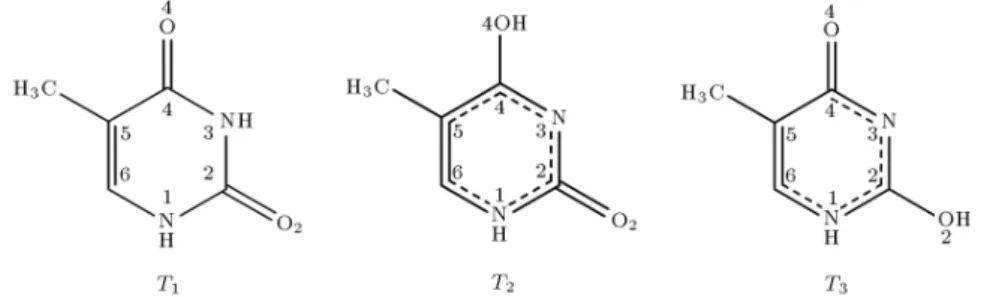
At the rst step of the work, we determined the thymine tautomers using Spartan 06 software. The three most stable thymine tautomers are shown in Figure 1. It has been shown that the evaluation of energetic barriers for the tautomerization of thymine is large, and the free thymine tautomers, T2 and T3, are
separated by 12.6 kcal/mol and 18.3 kcal/mol from T1
taken from [20].
Consequently, T1 is substantially prevalent,
irre-spective of conditions [21]. The most stable complexes of thymine tautomer (T1) with Mn+ (Li+, Na+, K+;
Mg2+, Ca2+; Zn2+, Cu+) were determined by
Spar-tan 06 software. The full geometry optimization of the complexes formed by alkaline and alkaline earth cations, as well as two transition mono and divalent metal ions (Zn2+and Cu+) with T
1, indicate that there
are two types of coordination mode for these cations. In these coordination modes, cations interact with oxygen atom O2 (T1(II) Mn+) and oxygen atom O4
(T1(I) Mn+). The most stable complexes are formed
in the location of the O4 atom (T1(I) Mn+). The
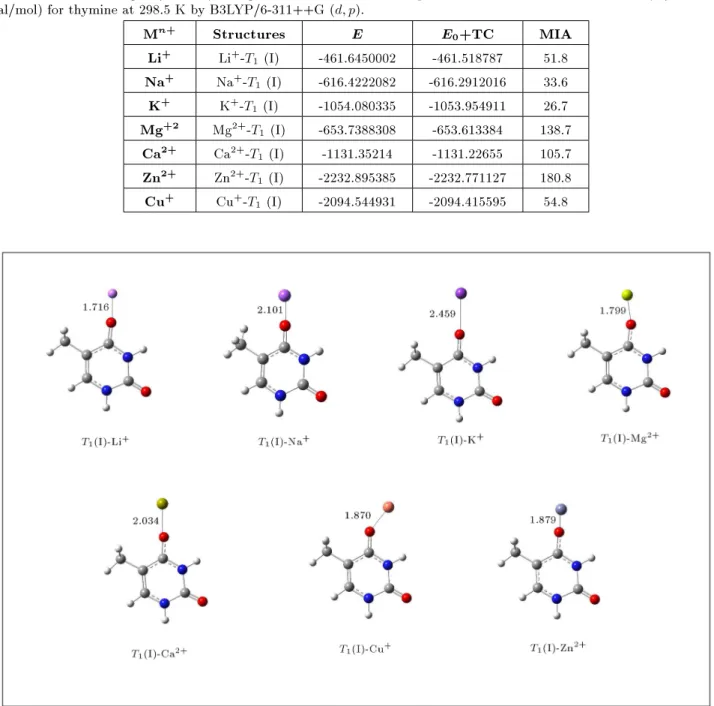
values of absolute energy for the most stable complexes and the amounts of thymine metal ion anity are given in Table 1.
Alkaline Metal Ions and Cu+
Figure 2 shows the most stable complexes for these cations. Our calculated atomic charges by B3LYP 6-311++G (d; p) show that the two oxygen atoms in thymine are almost charged equally (see Table 2), while the hydrogen atom in the methyl group is less positively charged than the hydrogen atoms attached to nitrogen atoms. The values of charge for H1, H3 and H5 (in the methyl group) are 0.343e, 0.368e and 0.179e. Thus, the repulsion between Mn+ and the hydrogen atom
Table 1. Absolute energies (E in au), energies for the most stable complexes at 298.5 K and metal ion anity (MIA in kcal/mol) for thymine at 298.5 K by B3LYP/6-311++G (d; p).
Mn+ Structures E E
0+TC MIA
Li+ Li+-T
1 (I) -461.6450002 -461.518787 51.8
Na+ Na+-T
1 (I) -616.4222082 -616.2912016 33.6
K+ K+-T
1 (I) -1054.080335 -1053.954911 26.7
Mg+2 Mg2+-T
1 (I) -653.7388308 -653.613384 138.7
Ca2+ Ca2+-T
1 (I) -1131.35214 -1131.22655 105.7
Zn2+ Zn2+-T
1 (I) -2232.895385 -2232.771127 180.8
Cu+ Cu+-T
1 (I) -2094.544931 -2094.415595 54.8
Figure 2. The most stable complexes of thymine with Li+, Na+, K+; Mg2+, Ca2+; Zn2+and Cu+cations by
B3LYP/6-311++G (d; p) level. Distances are in angstrom. in the methyl group should be weaker than that of the hydrogen atom attached to nitrogen. This might be the reason for the binding in T1 (I) Mn+ being
stronger than that in T1(II) Mn+. In the most stable
complexes for these cations, the retained charge on the complexed metal cations are 0.731e, 0.950e, 0.977e and 0.659e for Li+, Na+, K+ and Cu+, respectively (see
Table 2). In all these complexes, the measured bond strength is in this order: Cu+ > Li+ > Na+ > K+.
This order is easily understood on the basis of charge transfer values. These values can be measured based upon the retained charge density on the complexed
metal cations (Table 2). The lower the retained charge density is on the complexed metal ion, the more charge transfer is expected. Table 2 shows that the least retained charge density on the complexed metal cations belongs to the Cu+ cation. Therefore, the thymine
MIA value for Cu+ is the highest value in comparison
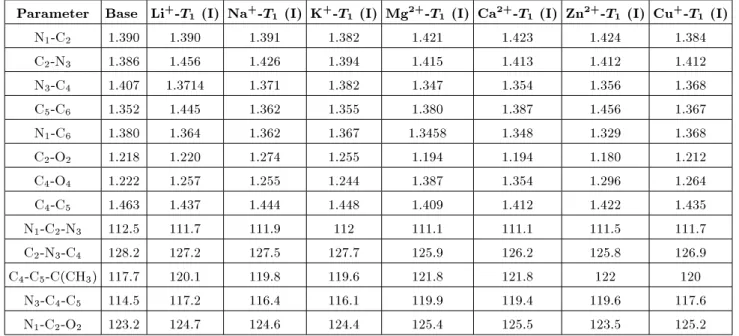
with alkaline cations. There are some variations in bond lengths in the most stable complexes. For exam-ple, due to charge transfer from O4 to M+ (Li+, Na+,
K+ and Cu+), C=O4 bond length increases, whereas
the N3-C4 bond length decreases due to resonance N3 with C=O4 (Table 3).
Table 2. The calculated Mulliken charges (Q=e) for the complexed metal cations and hetroatoms, Dipole moments (Debye) for the most stable thymine complexes by B3LYP/6-311++G (d; p).
M+-T
1 QN1 QN3 QO2 QO4 QMetal
Li+-T
1 (I) -0.356 -0.435 -0.256 -0.364 0.731 10.41
Na+-T
1 (I) -0.363 -0.446 -0.270 -0.496 0.950 14.57
K+-T
1 (I) -0.364 -0.424 -0.277 -0.514 0.977 11.01
Mg2+-T
1 (I) -0.319 -0.444 -0.165 -0.108 1.390 18.87
Ca2+-T
1 (I) -0.332 -0.429 -0.190 -0.565 1.675 17.91
Zn2++-T
1 (I) -0.280 -0.414 -0.125 -0.171 1.045 5.26
Cu+-T
1 (I) -0.371 -0.466 -0.253 -0.132 0.659 3.77
T1 - - -0.345 -0317 -
-Table 3. Selected geometrical parameters for the optimized cation-O4 complexes (bond lengths in A and bond angles in
degree).
Parameter Base Li+-T
1 (I) Na+-T1 (I) K+-T1 (I) Mg2+-T1 (I) Ca2+-T1 (I) Zn2+-T1 (I) Cu+-T1 (I)
N1-C2 1.390 1.390 1.391 1.382 1.421 1.423 1.424 1.384
C2-N3 1.386 1.456 1.426 1.394 1.415 1.413 1.412 1.412
N3-C4 1.407 1.3714 1.371 1.382 1.347 1.354 1.356 1.368
C5-C6 1.352 1.445 1.362 1.355 1.380 1.387 1.456 1.367
N1-C6 1.380 1.364 1.362 1.367 1.3458 1.348 1.329 1.368
C2-O2 1.218 1.220 1.274 1.255 1.194 1.194 1.180 1.212
C4-O4 1.222 1.257 1.255 1.244 1.387 1.354 1.296 1.264
C4-C5 1.463 1.437 1.444 1.448 1.409 1.412 1.422 1.435
N1-C2-N3 112.5 111.7 111.9 112 111.1 111.1 111.5 111.7
C2-N3-C4 128.2 127.2 127.5 127.7 125.9 126.2 125.8 126.9
C4-C5-C(CH3) 117.7 120.1 119.8 119.6 121.8 121.8 122 120
N3-C4-C5 114.5 117.2 116.4 116.1 119.9 119.4 119.6 117.6
N1-C2-O2 123.2 124.7 124.6 124.4 125.4 125.5 123.5 125.2
Alkaline Earth Metal Ions and Zn2+
The most stable coordination modes for alkaline earth cations (Mg2+ and Ca2+) and Zn2+ are shown in
Figure 2. The Zn2+ ion, the same alkaline earth
cation, forms the most complex in location of oxygen atom (O4). The retained charges on the complexed metal cations are 1.390e, 1.675e and 1.045e for Mg2+,
Ca2+, Zn2+, respectively. In all these complexes, the
measured bond strength is in this order: Zn2+> Mg2+
> Ca2+. This order is easily understood on the basis
of charge transfer values. These values can be obtained by means of measuring the retained charge density on the complexed metal cations. The lower the retained charge density is, the more charge transfer is expected. Results show that the least retained charge density on the complexed metal cation belongs to the Zn2+
cation. Therefore, the thymine MIA value for Zn2+
is the highest value in comparison with alkaline earth cations. There are some variations in bond length in these complexes as the same complexes of alkaline and Cu+ cations (Table 3). For example, due to the
charge transfer from O4 to M2+ (Mg2+, Ca2+ and
Zn2+), the bond length in the carbonyl group (C=O4)
increases, whereas the N3-C4 bond length decreases due to resonance N3 with C=O4. On the other hand, N1-C6 and C4-C5 bond lengths decrease, and the C5-C6 bond length increases due to resonance N1 with the double bond (C6-C5). The changes of N1-C6, C4-C5 and C5-C6 bond lengths are also seen in complexes of alkaline and Cu+cations. In a comparison of Zn2+and
Cu+ cations, the amount of thymine metal ion anity
for Zn2+ ion is higher than the thymine metal ion
rather than Cu+. Then, the Zn2+ ion can compete
with the Cu+ ion in complexation with thymine.
Correlation Between Charge Transfer and Binding Strength
Each complex formed by a cation with a nucleobase was divided into two parts: cation and nucleobase. The Mulliken charges located on these two parts have been calculated by B3LYP 6-311++G (d; p) on the most stable complexes. The data suggest that a charge transfer takes place during the complexation reaction and also demonstrate that the higher charge transfer leads to stronger metal binding. On average, the transferred positive charge from the metal cation to the nucleobase (i.e. Q0) is in the order of Q0(Zn2+) >
Q0(Mg2+) > Q0(Ca2+) for dications, and Q0(Cu+) >
Q0(Li+) > Q0(Na+) > Q0(K+) for mono cations.
However, Cu+ and Zn2+ cations have the highest
charge transfer and metal ion anity through the mono and dications. Based on our computed results, the calculated LUMO energy (employing B3LYP 6-311++G (d; p) for the Zn2+ (-0.801a.u) is lower than
that of Cu+(-0.398 a.u). Therefore, the electrons
should be easier to transfer from thymine to Zn2+with
respect to Cu+. More interestingly, our results indicate
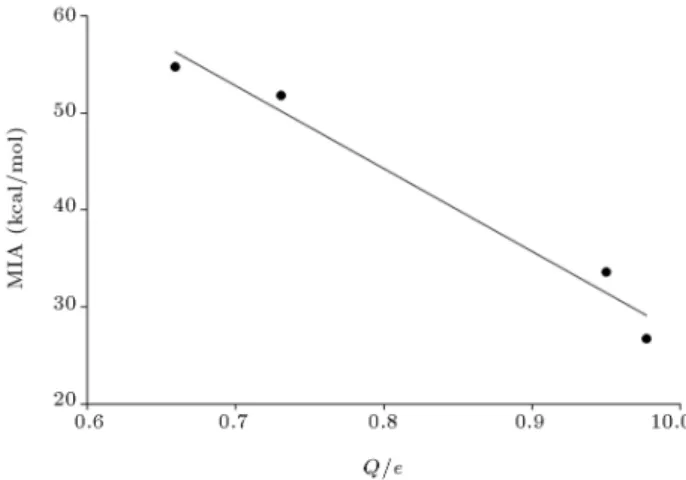
(as seen in Figures 3) that the linear correlation between the MIA values and the retained charge on cations is still observed when we add the data points of Cu+ [i.e. Cu+ anity and Q0(Cu+), and Zn2+
anity and Q0(Zn2+)] to the corresponding lines for
mono cations and dications (see Figures 3a and 3b, respectively). This linear correlation strongly suggests that the higher charge transfer between the metal and the ligand (thymine) leads to the stronger metal binding energy.
Figure 3a. The relation between metal ion anity (MIA in kcal/mol) and the retained charge on the complexed metal cation (Q=e) for T1 (I)-M+complexes. R-squared
value is 0.9724.
Figure 3b. The relation between metal ion anity (MIA in kcal/mol) and the retained charge on the complexed metal cation (Q=e) for T1 (I)-M2+complexes. R-squared
value is 0.9998. CONCLUSION
Based on B3LYP/6-311++G (d; p) calculations, the coordination modes for the interaction of two transi-tion mono and divalent (Cu+, Zn2+) metal ions with
thymine are similar to the coordination modes for alkaline and alkaline earth metal cations. Results demonstrate that the amount of charge transfer be-tween the metal cation and thymine is the dominant factor aecting the metal binding strength between the metal cation and thymine. The amounts of MIA for mono and divalent cations are in the order: Zn2+ >
Mg2+ > Ca2+ and Cu+> Li+ > Na+ > K+. These
results indicate that Zn2+ and Cu+ can eectively
compete with alkaline and alkaline earth cations for complexation with thymine. Furthermore, our results show the linear correlation between MIA values and the retained charge on mono cations (Cu+, Li+, Na+
and K+) and dications (Zn2+, Mg2+ and Ca2+).
ACKNOWLEDGMENT
The support from Sharif University of Technology is gratefully acknowledged.
REFERENCES
1. Marino, T. et al. \Structural and electronic character-ization of the complexes obtained by the interaction between bare and hydrated rst-row transition-metal ions (Mn2+, Fe2+, Co2+, Ni2+, Cu2+, Zn2+) and
glycine", J. Phy. Chem. B., 110, pp. 24666-24673 (2006).
2. Tehrani, Z.A. et al. \DFT study of the interaction of cytidine and 2'-Deoxycytidine with Li+, K+: Eects of
metal cationization on sugar puckering and stability of the N-Glycosidic bond", Carbohydrate Research, 344, pp. 771-778 (2009).
3. Dewar, M.J.S. et al. \Alternative view of enzyme reactions", Proc. Natl. Acad. Sci. USA, 82, pp. 2225-2229 (1985).
4. Bacchus-Montabonel, M.C. et al. \Theoretical treat-ment of charge-transfer processes induced by collision of Cq+ions with uracil", PHYSICAL REVIEW A, 72,
pp. 052706-052709 (2005).
5. Cerda, B. and Wesdemiotis, C. \Zwitterionic vs. charge-solvated structures in the binding ofarginine to alkali metal ions in the gas phase", J. Am. Chem. Soc., 118, pp. 11884-11853 (1996).
6. Burda, J. et al. \Thermodynamic evaluation of com-plexes of zinc and cadmium that mimetize metallic centers in transcription factors", Journal of Molecular Structure: THEOCHEM, 580, pp. 217-223 (2002). 7. Gal, J.F. et al. \Gas-phase lithium-cation basicities
of some benzene derivatives: An experimental and theoretical study", International Journal of Mass Spectrometry, 219, pp. 445-456 (2002).
8. Liu, F. et al. \Coupling characteristics and proton transfer mechanisms of guanine-Na+ monohydrate",
Journal of Molecular Structure: THEOCHEM, 760, pp. 209-217 (2006).
9. Parr, R.G. and Yang, W., Density-Functional Theory of Atoms and Molecules, Oxford University Press, Oxford, UK (1989).
10. Zhu, W. et al. \The multiplicity, strength, and nature of the interaction of nucleobases with alkaline and alkaline earth metal cations: A density functional theory investigation", J. Phys. Chem. A., 108, pp. 4008-4018 (2004).
11. Becke, A.D. \A DFT proton anity study of vinyl and allyl anions of cyclic vinyl ethers and cycloalkenes", J. Chem. Phys., 98, pp. 5648-5652 (1993).
12. Dunbar, R.C. \Cation- complexes between alkali metal cation and para-halogenophenols. Structures, binding energies and thermodynamic properties: DFT study and CCSD (T) complete basis set limit calcula-tions", J. Phys. Chem. A., 104, pp. 8067-8074 (2000).
13. Zhu, W.L. et al. \Density functional theory (DFT) study on the interaction of ammonium (NH4+) and
aromatic nitrogen heterocyclics", J. Chem. Soc., Perkin Trans., 11, pp. 2615-2622 (1999).
14. Zhu, W.L. et al. \Noncovalent interaction or chemical bonding between alkaline earth cations and benzene? A quantum chemistry study using MP2 and density-functional theory methods", J. Phys. Chem. A., 104, pp. 9573-9580 (2000).
15. Russo, N. et al. \Gas-phase theoretical prediction of the metal anity of copper (I) ion for DNA and RNA bases", J. Mass Spectrom, 38, pp. 265-270 (2003). 16. Russo, N. et al. \Gas-phase interaction between DNA
and RNA bases and copper (II) ion: A density functional study", J. Am. Chem. Soc., 123, pp. 10272-10279 (2001).
17. Spartan 06V102, Wavefunction, Inc., Irvine, CA, USA (2004).
18. Leonid, G. et al. \Charges of phosphate groups. A role in stabilization of 2'-deoxyribonucleotides. A DFT investigation", Journal of Biomolecular Structure & Dynamics, 22, pp. 441-454 (2005).
19. Belcastro, M. et al. \The role of glutathione in cad-mium ion detoxication: Coordination modes and binding properties - A density functional study", J. Am. Chem. Soc., 123, pp. 10272-10279 (2001). 20. Szczpaniak, K. et al. \On the interaction of bare and
hydrated aluminum ion with nucleic acid bases (U, T, C, A, G) and monophosphate nucleotides (UMP, dTMP, dCMP, dAMP, dGMP)", J. Phys. Chem. B., 110, pp. 8815-8824 (2006).
21. Rodgers, M.T. \Substituent eects in the binding of alkali metal ions to pyridines, studied by threshold collision-induced dissociation and ab initio theory: The methylpyridines", J. Phys. Chem. A., 105, pp. 2374-2383 (2001).