Supporting staff using WebCT at the University of
Birmingham in the UK
Tracy Kent
Learning and Research Support Division, Information Services, University of Birmingham, UK [email protected]
Abstract: At the University of Birmingham, Information Services, together with the Staff Development Unit and the Learning Development Unit have been working together to set up a number of initiatives to support staff to use WebCT to underpin its learning and teaching strategy within a flexible framework. The framework seeks to invest in developing appropriate skills and training for University staff to ensure that the quality of the content and the communication tools within the WebCT environment are fully exploited to enhance the student learning experience. Developments include the establishment of an e-Learning module, team based projects from the Learning Development Unit and a WebCT training and support pathway.
Keywords: WebCT, Academic and support staff training, e-Learning in higher education; University of
Birmingham
1. Introduction
The JISC Managed Learning Environments Information Pack (1) suggests that
"the implementation of a VLE [Virtual Learning Environment] without significant investment in developing staff will almost certainly not produce good results".
At the University of Birmingham these sentiments formed the basis upon which a Virtual Learning environment was implemented. The University had adopted WebCT as a tool underpinning the learning and teaching strategy and to support developments in e-Learning. Staff within Information Services, Staff Development Unit and the Learning Development Unit have been working together to invest in developing appropriate skills and training for University staff to ensure that the quality of the content and the communication tools within the WebCT environment were fully exploited to enhance the student learning experience. In order to move to this position a number of developments took place to ensure the benefits of e-Learning were fully realised. These developments included the establishment of an e-Learning module, team-based projects from the Learning Development Unit and a WebCT training and support pathway.
2. A University in the 21
stcentury
The University of Birmingham was established by Royal Charter in 1900. It has approximately 24,000 registered students, which comprise undergraduates (c16,500), taught post graduates (c4500) and research postgraduates (c2500). The University undertakes teachingand research in 34 of the 42 subject disciplines as currently defined by the Quality Assurance Agency. The university is a research led institution with a national and international reputation reflected in its membership of organisations such as the Russell Group and Universitas 21. As a well-established campus based University, Birmingham has also developed standards of provision and quality of a learning environment well suited to the changing demands of students, whether these students are undertaking learning on a part time basis or from a variety of locations. As part of the University developing and adapting its provision in the light of the changing environment within Higher Education, consideration has been given to developing teaching and learning within flexible frameworks. The flexibility seeks to maintain and enhance the established strength of this civic University in order to respond to the challenges and opportunities represented by increasing student numbers, national plans for the expansion of Higher Education and the Life Long Learning Agenda. Entry of students into Higher Education via non-traditional routes, with different skills and prior qualifications underpins the benefits afforded by the technologies within the managed learning environment and the possibilities in learning and teaching.
Support for this development and integration of a more learner-centred approach to student learning is provided by Information Services at the University of Birmingham. Information Services is an amalgamation of library, computing and multimedia services to form a coherent whole to support the learning, teaching and research carried out at the University. Information Services is managed
through a number of Divisions including a Learning and Research Support Division which has a remit, amongst other things, to support developments and the changing basis of learning and teaching - such as e-Learning and WebCT. The Learning and Research Support Division also houses the Learning Development Unit which was at the forefront of pushing the e-Learning agenda.
After lengthy discussion across the University, it was agreed that the WebCT package would provide the necessary functionality and ease of use of a VLE for staff and students at the University. After several tests of the main products it was agreed that the University of Birmingham would provide support for, and standardise on WebCT. At the time of writing Version 3.6.3.8 is supported. WebCT was also the largest known product at the time and there were no CHEST deals (Higher Educational Community software) for any VLE. Subsequently, the package was specifically identified within the learning and teaching strategy of the University.
2.1 The Learning Development Unit (LDU)
The Learning Development Unit (LDU)(2), which was set up in September 2000 supports the University's Learning and Teaching Strategy. It aims to enhance the quality of learning and teaching using a number of approaches including:
• Working with the Staff Development Unit [SDU] to provide training in flexible learning methods for academic and support staff.
• Working with the SDU, the Academic office, Information Services and other interested parties to ensure that infrastructures are developed to support flexible ways of learning and teaching • Ensuring collaboration, development and
dissemination of effective practice in learning and teaching innovation.
The Staff Development Unit ensures that staff are able to acquire the skills, knowledge and expertise to carry out their duties. In order to achieve this, the LDU fund and support a number of team based projects to develop best practice in developing, implementing and supporting learning and teaching. A number of these projects involve developments in e-Learning and are discussed below.
3. Learning Development Projects
The HEFCE Teaching Quality Enhancement Fund funds the LDU and the projects it supports. The LDU aims ‘to encourage pedagogic developments by funding projects that integrate flexible ways of learning and teaching into the mainstream curriculum’. The University originally envisaged that members of academic staff would be seconded to projects for up to half their time. However, in practice a team-based approach has been adopted. This involves a number of people who have been seconded for smaller amounts of time, to a total of up to maximum 0.5 of an FTE. Bob Hunter, the Director of the LDU, encourages this team-based approach and most projects involve a mixture of School and Information Services staff, right from the initial bidding stage.Applications for funding are reviewed by the LDU Advisory Board. The criteria for funding include
• Approval by the Head of School and the Director of Learning and Teaching within the School, including a commitment to use some of the funding to provide cover for staff who are seconded to the project
• Evidence that the project will support the University’s and the School’s Learning and Teaching Strategies • Evidence that staff development needs
have been identified
• Strategies for evaluating the project and disseminating the lessons from the project
• An indication of how the innovation will become embedded within the work of the School
• Evidence that the lessons learnt from the project will be transferable to other Schools
The LDU also provides bookable office space for Project Leaders and members of project teams. This enables staff to get away from their own offices to a place where they can concentrate on project work with relatively few interruptions. It is also a place where people working on related projects can get together to share ideas and good practice. The PCs are equipped with a wide range of software, including the standard suite of MS Office software and a range of applications for producing web based learning materials. Such support ensures that staff at the University can be assisted in the management, development, implementation and, perhaps more importantly, appropriate evaluation of their projects.
3.1 Examples of LDU Projects
Since its inception in 2000 the Learning Development Unit has supported and developed in partnership with academic staff a number of projects to encourage pedagogic developments in the use of WebCT. Although these projects differ in terms of the Schools they emanate from, a number of common themes across the projects have emerged. By considering some key examples of projects supported it is hoped to provide a flavour for how WebCT is enhancing the learning experience of students at the University of Birmingham, as well as to produce more pointers for ensuring that the features of the managed learning environment employed (ie WebCT) are being fully exploited. Use was being made of WebCT to overcome some of the current challenges afforded Higher Education (identified in the introduction to this paper). It was also becoming clear as these projects began to be evaluated that staff felt that they did not always have the requisite skills to fully exploit the VLE tool or to develop their students within the online course. It was also felt that the project leaders for these LDU projects would become WebCT champions to raise the profile of the VL and to ensure that is it used effectively and widely. The projects could then become examples of good practice and encourage others to explore the different options.
3.2 Enhancing the Learning Experience of Off Campus Students
• On-line learning support for students on fieldwork placements
This project sought support for students on a Community, Play and Youth course. The main aim was to ensure that students were able to gain valuable experience from the placement element of their course. In particular, that students would not feel isolated when on placement as they would be able to use WebCT to facilitate better communication between students and their tutors and amongst the students themselves. WebCT was also used to administer the placements and deliver information to students about assessment requirements. The Project leader noted that "there has always been a danger that placement was regarded as "real life" and university as "academic life". For the LDU project it was decided to see if the introduction of "virtual life" could help bridge the two worlds. In evaluating the success of the project a key lesson came to the fore. That is, should one introduce new WebCT courses with new
students? First year students were happy to make use of the online support environment, as they knew no different. However, it was found that students who had experienced different forms of support (telephone calls from tutors, appointments with tutors) that there was "unanticipated active resistance" from the existing students. Further, the project leader felt that she was not all together clear how she had expected the students to make use of the communication facility. The suggestion was that the tutor needed more experience of managing the communication tool.
3.3 Developing learning communities
• Public Sector MBA
The use of the communication tools such as discussion boards and email has resulted, according to the feedback from students, in providing more confidence to these students to take part in face to face learning such as tutorials. Students also report a sense of "Class Culture" being developed online. By ensuring that the course content section was utilised fully students were provided with the opportunity for reflection on seminar material. Non-native English speakers, who were able to prepare more confidently for face-to-face seminars and use WebCT as a revision tool, especially welcomed this. The project leader, on reflection, suggested that there was more opportunity for developing collaboration with other tutors for integrating online resources of use to the students as part of their course and for revision purposes.
3.4 Development of Generic Skills Students arriving at the University bring with them a wide variety of Information and Communication Technology skills making it quite difficult to deliver a suitable "one size fits all" ICT training. This is made even more difficult if the traditional delivery methods are used as there are basically too many students and not enough resources. As a result, a blended approach to ensuring that students have access to a variety of learning materials which support the development of their generic skills. The project is based on the Impetus training materials for Microsoft office applications, combined with locally produced materials, all of which are to be delivered using WebCT. Students can then make use of the available resources as they see fit, dependent upon their individual needs. Although this is not intended to replace face to face training for students who are complete beginners it is intended to help bring all students up to an acceptable level of ICT skills in order that they may complete the rest of their degree
programme adequately. The main difficulty for this project has been the lack of experience of the programme tutors in adding appropriate content and writing materials in a style required for this sort of environment.
3.5 Using ICT for Assessment
• Computer-based student centred learning and assessment resources – Highway Management & Engineering • Physiotherapy
These projects looked to the WebCT environment to develop the assessment aspect for their modules. The courses sought to integrate a link between the written assignments or quizzes and the documentation or other media within WebCT. For example, the Physiotherapists use video clips on CDROM about how to examine for a particular scenario and this is then linked back into the WebCT environment for the students to answer specific questions which are then assessed. This is a useful blended approach using a mix of media to enhance the learning and teaching experience of the students. However, the project leaders felt that there was more scope for developing the assessment approach being supported in this environment which was not being fully exploited in this project.
It was becoming apparent, therefore, that more knowledge was required about the principles of E-Learning if staff across the university campus were to be fully supported in exploiting this developing environment. Further, if Information Services were to meet the challenge of supporting the University wide agenda of promoting a managed learning environment effectively then effort was required to set out a flexible framework of staff support. The difficulty facing the Learning Development Unit and Information Services was the range of staff with different needs. Some wanted help on writing materials for this environment whilst others on using new software.
The main area of concern for support staff centred on developing the principles and techniques of e-Learning pedagogy for staff to bring to bear on their projects and a deeper understanding that underpins current practice in online learning and teaching. Despite the fact that this was a fast developing area there appeared to be no course available (externally or internally), which met the needs of the staff at the University of Birmingham. Therefore an approach was made to two external
consultants to work with the Staff Development Unit, the Learning Development Unit and Information Services to develop a module on e-Learning in Higher Education which would go some way to addressing the concerns rising out of the evaluation of some LDU projects. The two external consultants had experience in promoting the use of flexible learning, had developed frameworks for accrediting key transferable skills and had been involved with e-Learning projects. The result was the creation of a module on e-Learning in Higher Education that sought to provide staff at the University with the knowledge and the theoretical content to undertake all aspects of online learning and teaching in Higher Education.
4. The learning outcomes of the
e-Learning in Higher Education
module
The course, created for the University of Birmingham, set out to develop knowledge and skills in e-Learning in Higher Education with the following specific learning outcomes:
• demonstrate knowledge of the
underpinning theoretical content that currently informs online learning and teaching in Higher Education;
• critically evaluate online learning and teaching tools and resources within a managed learning environment;
• demonstrate good practice in supporting online learning and teaching;
• demonstrate good practice in developing online learning materials and programs including the use of online assessment tools;
• apply the processes of critical evaluation and reflection to your work.
It was aimed at anyone who had an interest in the delivery and support of e-Learning. At the University this meant that the participants were drawn from academic staff in a wide range of disciplines (Law, Political Science, Education); Information Services staff (Liaison Librarians responsible for liaison within Schools, Lab Managers and IT advisors) and Learning Development Unit staff.
This range of staff led to a very productive exchange of ideas and perspectives and helped reinforce the team approach to supporting E-Learning on campus.
The learning and teaching methods employed include:
• tutor led and student led online discussions and conferences;
• use of case studies and real life scenarios; • project work involving working in one
collaborative, one problem solving and two co-operative learning sets to produce specific reports or products (e.g: web-based learning resources or online assessment tools;
• Online seminars involving guest speakers; • Open learning materials;
• Self, peer and tutor evaluation and feedback;
• Development of reflective practice using learning journals.
The structure of the course revolves around online participation by the participants within the managed learning environment (WebCT) based on four workshops. These workshops cover
• introduction to online learning and teaching;
• online tutoring;
• design of online learning programmes and resources;
• online assessment and evaluation of student learning.
On completion of the course participants obtain 20 academic credit points at M level towards the Postgraduate Certificate in Learning and Teaching in Higher Education and eligibility for the Associate membership of the Institute for Learning and Teaching. Overall, the module covered the underpinning knowledge necessary for participants to undertake all aspects of online learning and teaching in Higher Education. This included coverage of underpinning theoretical content that currently informs online learning and teaching in Higher Education. Participants were able to develop their knowledge and skills in developing and using teaching tools and resources in a managed learning environment; online tutoring; design and development of online learning materials or programmes; assessment of online learning; The participants were encouraged to engage in and experience a number of different approaches to online learning, i.e collaborative problem solving and co-operative learning sets. Participants were encouraged to critically evaluate and reflect on the online work carried out.
Participants were expected to be online up to two hours per week but on reflection this was an underestimation of the need. There were a
number of online activities - both individual and group centred work - which employed different learning styles from collaborative to co-operative. These online activities, often called e-tivities - helped to mobilise, engage and enable the participants to progress through the learning experience. The course also had guest speakers (experts in their field of study but drawn from a variety of locations - academics in Australia to researchers in Manchester) who contributed and added their valuable experience to the online discussions. 4.1 Support for participants
A key feature of the course, particularly given its online nature, is the role given to mentors to the participants. The mentor's role is really one of a confidential sounding board and critical friend. That is someone who can provide support and advice and help participants to adapt and adopt their ideas. The mentors were drawn from across the University and externally as well.
4.2 Assessment of the module
Assessment of the module has been on going since the start of the course and is based on a Portfolio of work.
4.3 Learning Journals
One aspect of assessment has been the use of learning journals to help chart progress, problems, challenges, thinking and development over the period of the course. The Learning Journal helps individual learners record developments and to reflect on the links between theory and practice. This journal has been kept since day one. It also forms part of the Portfolio of e-Learning Practice, which provides evidence of the satisfactory attainment of the Institute for Learning and Teaching learning outcomes and of adherence to the ILTs professional values, and thus fulfils the requirements for Associate membership of the ILT.
4.4 The Portfolio
The portfolio consists of examples of learning design and planning; learning support and the establishment of effective learning environments covering the defined learning outcomes of the module. The evidence in the portfolio demonstrates how the learning outcomes have been achieved through the process of critical evaluation and reflection. The examples in the portfolio are both descriptive and explanatory showing why certain pedagogical decisions were made and hence understood within the overall learning
context of e-Learning. The portfolio also shows how professional values have been integrated into the work as a supporter of learning. In particular it includes 30 hours in supporting learners online including 2 peer observations, 2 observations from the mentors and 2 tutor observations drawing upon the learning journal.
The pilot course started in November 2001 and has provided the participants with a better understanding of the theory and practice of e-Learning. This means that staff are more informed when extolling the theory and practice of e-Learning across campus offering practical suggestions and comments from real life experience. For example, having an appreciation for how group discussions may facilitate learning not just how to post a message within the environment!
At the time of writing, the pilot module is nearing completion. Feedback from participants and tutors has included two significant concerns about the course. Firstly, that there is too much material in the course and secondly that there was not enough time to devote to such a course. Despite the fact that material was taken out of the later units of the module in response to this problem, some participants still struggled to fit the coursework in around their work and other commitments. Some of the participants on the course also found that the latter half of the module, which concerns course design and content development, is not as relevant to their day to day work as the first half of the course. This is because many of the participants supported e-tutors and students on courses, which were created by someone else, and so have little control over the actual content.
5. E-Learning in Higher Education II
The next reiteration of the module has been modified to reflect this feedback. The next session will run as two 10-credit modules with the opportunity to apply for Associate Membership of the ILT on successful completion of the two modules. Each module will run for 10 weeks and assessment will be by portfolio.• The first 10 credit module will focus on e-Tutoring and will be a pre-requisite to the second module;
• The second 10-credit module will focus on content design and delivery;
• The learning outcomes for both modules are very similar in nature to the overall E-Learning module with an emphasis on the
application of critical evaluation and reflection to the online work.
Both modules are aimed at different groups of staff that share a common interest in e-Learning: information services staff; academic staff; and school staff involved in the development of LDU and similar projects. Both modules run on-line and each are supported by two face-to-face workshops.
It is intended to run the first E-Tutoring Module from October 2002 to December 2002 with the E-Content Design & Development Module running from January 2003 to March 2003.
6. But what's it really like to be an
E-Learner?
Staff at the University of Birmingham were, therefore, in a unique position to be developing their online skills whilst participating in an e-Learning environment. The participants were then able to come to understand and sympathise more fully with the student's potential online environment.
Formal evaluation of the course has not yet been completed, as the course only ended in November 2002. However, the Author carried out an email survey requesting responses to four questions only to help obtain some quantitative data for the purposes of this paper with the following results.
6.1 Overall experience
As with any course one enrols on the expectations and experiences of the participants are as far ranging as the participants! Therefore all participants were able to draw upon their learning journal in order to answer these simple yet informative questions about the participants experience of the module.
All the participants felt that they had benefited from taking part in the module and that the support they now provide for student learning and teaching is enhanced. The course itself entailed daily visits to WebCT with effort being expended on checking resources, contributing to the growing themed discussions and reviewing activities for the current workshop. Participants reflected the hybrid team approach (with participants pulled from areas reflecting the make up of the University) in comments such as:
"One of the most important learning outcomes for me has been a real/fuller
awareness of just how much so many specialists have to contribute in designing and delivering the e-Learning experience"
Throughout the course there was encouragement to pair up to facilitate sharing of ideas and expertise and to develop e-practice that is appropriate and satisfactory. The opportunity to make use of the WebCT environment, providing the participants with the direct experience of networked learning, was particularly welcomed. More specifically identifying how students might interact with electronic media from a practical and pedagogic perspective made the experience all the more real.
This exchange was probably the most useful aspect of the whole course and one that continues as the course comes to a formal end. The opportunity to work within a community of practice and engage in reflective practice of a new and developing area was welcomed by most participants.
Basically, it was realising that I was not alone in this job and that other people have the same problems and are benefiting from one another
For many the main difficulty with the course - was time. An example of this comes in the form of a response to the survey carried out which said
I find it extremely hard to manage my time and to get to grips with the demands of the Virtual Learning Environment
Several participants reported difficulties with actually using the VLE. Just because the environment is built around a web interface does not automatically translate to the participants being familiar with using the specific features of the environment in an interactive way. Age did not seem to be a significant factor here (some of the younger participants struggled more than the older ones) but more of a gender issue. Several individuals who struggled were female, but this may simply reflect the fact that more of the men on the course had prior experience of using WebCT than did the women. The introductory session to the environment over-estimated the skills levels of the participants and many left the introductory session feeling more frustrated than enthused about the product. It might have proved useful to provide
a basic follow up activity for these participants to overcome their fears early on rather than being launched straight into the first key assignment. Perhaps the introduction of a buddy system might have worked to encourage those who felt they never caught up with the initial difficulties of the system.
As the course developed and many of the participants were able to create their online roles there were some participants who rarely (if ever) participated. Some of the participants felt that the tutors could have done more to encourage and cajole those participants who were struggling. Further, that there was more scope for an e-Tutoring role to manage and enhance the online discussions which take place. The discussions would have also benefited from additional useful resources being added. This has been reflected in the e-Learning module II.
The experience has also provided more confidence for some of the support staff to provide appropriate guidance and advice on using VLEs. When support staff such as subject librarians or lab managers discuss with tutors how they might implement WebCT staff are able to provide positive suggestions and a real insight into how the structure might be perceived by their students. For example, how one might provide a reading list with links to the actual catalogue record so that students can see where the item is (given that not everything is available online) or how to theme the discussions so that students can opt to contribute to specific areas and not have to scroll through hundreds of emails first.
6.2 Features participants liked about the module
Participants were asked about features of the course they particularly liked. These included such features as an opportunity to develop an online voice. This was especially true of some of the support staff; developing skills in reading and following threads online which helped to sharpen their critical evaluation skills; being able to develop as a self motivated manager of the learning process; exchange of experience, ideas and topics from multiple perspectives (from academic staff to IT advisors to librarians); and greater equality of all participants regardless of age, gender or race. This was especially welcomed by staff where English is not their first language.
6.3 Features participants did not like about the module
Participants were then asked about one thing they did not like about the course. The responses which appeared more than once included too many messages within the themed discussion lists - particularly felt by participants who did not log on regularly enough and then felt overwhelmed when they did; not enough time with which to carry out the e-tivities given a range of other commitments as well (not particularly unique to the online environment!); changes in time management; impersonal nature of online communities and not having necessary technical skills to understand or take part in some of the activities outlined.
6.4 WebCT Training and Support pathway
The benefit of introducing WebCT to support e-Learning brought with it challenges relating to implementing support in a constructive and flexible framework. A number of skills were identified if WebCT was to be implemented appropriately including technical advisors, instructional designers, knowledge managers, complex content providers and academic content experts. WebCT finds favour in motivating many students to use a familiar environment and to promote the tutorial or discussion aspect of the learning process. However, many tutors who are enthusiastic about the package comment that it can be time consuming to put any material into the environment or to make appropriate use of the communication tools. Although WebCT works within a familiar environment, putting content in and managing the communication tools is not always straightforward (indicated above from the e-Learning participants).
Therefore a useful supporting framework is necessary if a) staff at the University of Birmingham are going to make effective use of it and b) academics at Birmingham who are not habitual users of IT are to make use of it. At Birmingham a " WebCT Training and Support Pathway" has been developed to bring together the range of WebCT related training materials already available into a coherent structure. This pathway provides a web-based support site, training courses and other information deemed appropriate to support staff in exploiting the WebCT environment. 6.5 WebLearn Web Site
The WebLearn website is the focal point for training materials, frequently asked questions
and details of how to apply for courses. Groups of students are then assigned to courses using information from the centrally managed student record system held at the University. The site can be found at www.weblearn.bham.ac.uk It was created by a project team made up of liaison librarians, IT and learning advisors.
6.6 Training Pathway
The Training Pathway has developed a modular course structure including a "Getting Started with WebCT" course. This course, based on a template structure, is intended to be a "short, sharp, introduction to the benefits of WebCT as a learning package. Staff bring along their own content to be uploaded into WebCT. By the end of the session staff then have the basics of a course which a) has their content within, b) they can develop by attending other sessions and c) their students can use straight away. The intention is that this "taster", delivered by Liaison Librarians, will hook staff into WebCT and that, as they are developing their own courses pressure will come from students to continue the development.
IT Trainers then deliver the additional applications content within this modular structure which includes constructing and managing course content; using communication tools; using assessment tools and student management. This structure is underpinned by drop in sessions for academic staff to discuss and apply techniques in their own WebCT environment. To ensure that all WebCT features are exploited demands a lot of staff time and commitment.
Documentation from the pathway is available from the Weblearn WebSite, which provides further help, advice and examples of courses already running with WebCT. Although there are no formal courses to train undergraduates the subject librarians are being asked more and more to include an element of WebCT introduction in the general induction to library services. There is basic instruction on setting browsers to enable JavaScript and setting the cache to always reload a page to ensure the latest version on the WebLearn website which can be cumbersome - particularly when the access is from student clusters.
7. Conclusion
The E-Learning module, Learning Development Unit projects and the training and support pathways ensures that the University
of Birmingham has provided the necessary investment in developing staff so that the implementation of a VLE produces good results.
The approach adopted at Birmingham enables the interactive nature of WebCT to enhance the student learning experience and provides a useful tool in this respect. It is anticipated that WebCT as a learning environment will be well received. However, WebCT is only the tool and its effectiveness will depend on the quality of the content including the learning resources and the use made of the communication tools. Universities, including the staff, have to
change if they are to survive. All aspects of developing an online environment need to be carefully monitored and evaluated to ensure that the student learning experience and the change in current education practice is enhanced and that the University and its staff are sustainable in the 21st century.
References
(1) JISC : Managed Leaning Environments : An Information Pack
March 2002 www.jisc.ac.uk/ (2) Learning Development Unit
Evaluating Virtual Learning Environments: what are we
measuring?
Mary C Dyson and Silvio Barreto Campello
Department of Typography & Graphic Communication, The University of Reading, UK [email protected]
Abstract: A basic framework is proposed to distinguish between the many ways in which Virtual Learning
Environments (VLEs) can be evaluated. This includes the purpose of the evaluation, the type of methods that might be used and the measures employed. The framework is not intended to cover all applications but offers one means of structuring a review of past studies or may provide guidance on the type of study to conduct. A pilot study is introduced which compares an online course using different platforms which aims to measure engagement, participation and achievement of goals.
Keywords: purpose, methods, measures, usability, learning.
1. Introduction
Institutional strategies for the development and use of ICT in Higher Education in the UK are now in place, as recommended by the Dearing Report. At the University of Reading, one of the principles of the strategy is that new technologies should encourage rethinking of pedagogical aspects of teaching, learning and assessment. The Virtual Learning Environment Blackboard was purchased in August 2000 and there are currently approximately 100 courses online. The Universidade Federal de Pernambuco (UFPE) in Brazil, the home university of the co-author, has developed their own system, VirtusClass.
Evaluation provides feedback for course developers on teaching and learning and is an important part of quality assurance. However, constraints on time and possibly expertise preclude most developers from detailed studies. Whilst it is still important to carry out evaluations of individual courses, looking for more general principles derived from experiments can provide guidance in the design and development of VLEs. Such research may also address issues that are not covered in many evaluations.
1.1 Outline of paper
Having discovered the range of evaluation studies of VLEs and related learning technologies reported in recent relevant journals, this paper outlines a basic framework to distinguish between evaluations. The framework was developed to provide the context for discussion of a pilot study looking at the effects of group orientation on students’ engagement, participation and task engagement. Dimensions are therefore identified that may be relevant to this study.
However, the framework is intended to be of more general use. It may offer a means of structuring a review of past studies, for example, to identify the most relevant, or may provide guidance on the type of study to conduct.
The pilot study is introduced by defining the theoretical position underlying the research. The variables chosen for investigation are outlined and the pilot tests the appropriateness of these variables. Outcomes are briefly described with suggestions as to how the design of future studies can be informed by these results.
2. The nature of evaluations
In considering literature on the evaluation of VLEs or similar technologies, it is apparent that there are many different approaches to studies. A useful framework has been devised by Oliver (1997), which provides a comprehensive guide to the evaluation of the use of educational technology. This report is used as a starting point for discussion of the factors that are considered relevant to the current paper.
It is possible that the term ‘evaluation’ may be restrictive in the current context. Evaluation has been clearly explained by Oliver (2000) as ‘the process by which people make value judgements’ and when applied to learning technology, he suggests that this is often the educational value of innovations or practical issues in introducing new teaching methods and resources. Whilst the overall objectives of such evaluations are likely to be identifying what may improve learning, some evaluations have specific outcomes, whilst others aim for more general relevance. Oliver (1997) is well
aware of this distinction, which is built into the five purposes for evaluation (described below). A more marked distinction is made in the current paper by suggesting that it may be helpful to regard some studies as ‘experiments’ and some as ‘evaluations’.
2.1 Purpose of evaluation
2.1.1 Roles
The starting point for distinguishing between different evaluations is naturally the purpose of the study. Oliver (1997), based on Draper, Brown, Henderson and McAteer (1996), identified five roles for evaluation: formative, summative, illuminative, integrative evaluations and quality assurance. Quality assurance is undoubtedly a specific purpose for evaluations. However, within the field of Human Computer Interaction (HCI) formative and summative evaluations are characterised by the stage in the development process at which they occur (Preece, Rogers, Sharp, Benyon, Holland and Carey, 1994), although this also defines their purpose. Explanations of illuminative and integrative evaluations illustrate the close relationship between purpose, approach (e.g. experimental versus ethnographic) and measures. For instance, illuminative evaluations are described as being primarily ethnographic, as opposed to experimental. Their purpose is to discover issues considered relevant by participants. Integrative evaluations are closely related to illuminative and aim to provide specific guidance on delivering effective teaching and learning.
2.1.2 Experiments
Four of these five roles are identifying problems, describing and interpreting events, rather than studies, which may test a single well-defined question (summative evaluations) and provide results of more general relevance. These objectives provide criteria for distinguishing between evaluations and experiments. A case study of web-based support for a campus-based course (Holt, Oliver and McAvinia, 2002) departed from the more usual focus on the particular system and cautiously discussed the wider implications of the study. A more obvious example of a study that would qualify as an experiment is Woods and Keeler (2001), which assessed the effect of adding audio to emails. The specific research questions were whether the audio messages would increase the frequency of student participation and length of utterances in online asynchronous group discussion and whether they would also result in more favourable student perceptions.
The classical design of an experiment is a comparison of conditions, sometimes with a control group. This was carried out by Woods and Keeler (2001) in the study referred to above. They compared three levels of audio messaging (weekly, monthly and every other month) with no audio messages (the control group). These designs can be problematic in natural settings due to difficulties in achieving comparable situations, avoiding contact between groups where they may share material specifically intended for one group, and possible ethical problems such as depriving some people of a potentially richer learning environment.
2.1.3 Usability versus learning
Another dimension that separates studies is the approach adopted by the specific discipline. Whilst studies within the educational field aim to assess students’ learning outcomes, situating the evaluation within an educational context that incorporates assessment, an alternative objective is to measure usability of the system and its tools, drawing on HCI research. An example of this is Chang (2001) who investigated whether a web-based learning portfolio enhances learning outcomes by measuring the usability of the system.
Definitions of usability vary but there are similarities in the type of variables they tend to measure. These include effectiveness, efficiency and satisfaction (ISO 9241), ease of remembering and error rate (Nielsen, 1993). Commonalities among definitions found in the literature are making the use of a system easier and more comfortable for the users, whilst guaranteeing a high level of productivity. However to measure the level of productivity in the field of learning technologies may be particularly difficult. The crucial point is the conception of learning that underlies evaluation. Typical measures used to evaluate the usability of a system, response time, accomplishment of tasks, error rate, etc. are suitable for a large range of systems and even for Computer Assisted Instruction Systems (CAIS) or Intelligent Tutor Systems (ITS). However, if learning is conceived as a matter of process, during which a transformation of knowledge occurs, such measures say nothing about how new knowledge has developed and what is necessary to support this development. As all activity within a VLE is carried out through the interface, it is important to examine
how this may support learning. However, it is unhelpful to take the evaluation out of the learning context to focus only on ease of use of the system. The purpose of the evaluation should determine what is measured but it is the conception of the investigated phenomena that defines what is actually observed. In usability research the focus of the studies seems to be the individual using the system. Cultural factors that surround the use of the system are not included in the analysis. The context is merely a scenario that provides information about the task performed but is not part of the experience. Usability and learning may be combined in a single study, but each will have their own individual measures. How measurement is conducted is affected not only by the specific variables, but also by the circumstances surrounding the evaluation. 2.2 Methods
2.2.1 Interpreting results
Employing experimental methods to evaluate learning technologies is often considered inappropriate due to the difficulty of controlling variables that may affect outcomes (reviewed in Jones, Barnard, Calder, Scanlon and Thompson, 2000). However, in a natural context, where the technology may be only one part of a course, other evaluation methods will also lead to difficulties in attributing learning outcomes to use of the specific technology (Scanlon, Jones, Barnard, Thompson and Calder, 2000). Put forward as a negative feature of experiments, Gunn (1997) points out that the rigid nature of experimental design restricts the research. This limitation may however have its advantages when trying to interpret results. Despite differences between evaluations and experiments, similar measures may be used in both.
2.2.2 Process versus outcome
One approach to the classification of methods is to consider which aspect of the activity is evaluated. In relation to assessment, Heppell (2000) has argued for moving the focus from product to process. The way a student completes a task should be considered as important as the final product. This distinction is also made in studies that explore reading (Dillon, 1992; Schumacher and Waller, 1985). Process measures deal specifically with how readers use documents, and outcomes (or products) are reading rates and comprehension. Both process and outcome are appropriate to the evaluation of learning technologies and their use varies among studies.
2.2.3 Qualitative versus quantitative
Much is made of the ‘paradigm debate’ (Oliver, 2000), which concerns qualitative versus quantitative techniques. This debate will not be elaborated further as it has received sufficient attention by other authors. Fortunately not all authors of evaluation studies feel they need to take sides by adopting only one methodology (e.g. Woods and Keeler, 2001).
2.2.4 Subjective versus objective
A distinction in methods that is also relevant, but not given the same emphasis as the above debate, is the difference between subjective judgements and objective performance. Although the importance of measuring learners’ perceptions of many aspects of VLEs should not be understated, such measurements cannot indicate, for example, ease of use nor ability to support learning. In an evaluation of VLEs and learners, Richardson (2001) explored whether individual differences of learners affect their perceptions of virtual learning environments. This is an extremely interesting research question. However, it would also be interesting to know whether individual differences affect learning performance.
In reflecting on the implementation and evaluation of two case studies on online interactivity, Boyle and Cook (2001) comment that student attitudes, obtained by questionnaires, do not indicate the quality of debate. However, marks from tutors for individual contributions (performance, albeit marked subjectively) and patterns of exchanges can provide useful information. As is often the case, employing different methods, hoping to converge on a single outcome, is a sensible policy. In exploring online teaching and learning materials in IT for art and design students, Brown, Hardaker and Higgett (2000) assessed their effects through questionnaires asking for student opinions and analysing their performance.
2.2.5 Expert versus user
When gathering subjective judgements, evaluations may adopt a technique from usability studies, heuristic evaluation, or ask for feedback from learners, as discussed above. In heuristic evaluations, a small number of ‘usability experts’ evaluate the interface against a set of heuristics. This method was used by interface design students to evaluate the usability of sites developed at another university using an online cooperative work environment (Collings and Pearce, 2002). Interestingly this study indicated that expertise
is required if using heuristics based on Nielsen (1994), which may be difficult for beginners in the field of HCI to understand. It is unlikely that this technique would be suitable for a summative evaluation of learning outcomes, although teachers are probably carrying out an informal version of this test when developing material for inclusion in a VLE.
2.3 Measures
A sample of measures are briefly described to illustrate different approaches. In general, what is measured determines the type of data that needs to be collected, the stage of activity to focus on, and who provides the data. The measures are chosen to answer the research question (in the case of an experiment) or provide the appropriate feedback in an evaluation. Issues of usability can be addressed by looking at responses to the system and eliciting perceptions. Learning is generally assessed through outcomes, but perceptions may again be informative. There may also be interactions between the usability of the system and the nature and extent of learning. Therefore comparing participation in discussions may contribute to assessing the role of the interface in the facilitation of learning.
2.3.1 Usability heuristics
This method is described in 2.2.5 and is distinguished from other measures by using an expert (or semi-expert) to conduct the evaluation. Although limited in many respects in comparison with other methods, this technique is efficient and may identify potential difficulties at an early stage without inconveniencing users. It may therefore be appropriate as an initial check before carrying out other sorts of evaluations.
2.3.2 Frequency of interactions
Jones et al. (2000) argue that interactions with the software are important to understanding the learning process. Logs of usage might include the use of resources and participation in discussion (Woods and Keeler, 2001; Holt et al., 2002).
2.3.3 Quality of interactions
Assessing frequency of contributions to discussions fails to differentiate between queries or comments, different topics (relevant or not), depth of debate, clarity of argument etc. If tools are employed and specific tasks carried out, it may be relevant to look at how these are used. Woods and Keeler (2001) report that dialogue accounted for 25% of the
overall mark in the course they evaluated. This was graded on frequency, quality and timeliness. Judgements of quality are necessarily subjective, as are the majority of teachers’ assessments (e.g. learning outcomes). Providing a set of criteria on which variables such as quality are judged can be helpful for future evaluations of this nature.
2.3.4 Learner perceptions
A range of variables can be measured by asking learners for their perceptions. Attitudes are sometimes separated out from perceptions (e.g. Jones et al., 2000), but essentially both are measured by asking for an opinion or judgement. It is the focus of the question that differs. This may be satisfaction, estimates of how much they have learned, usefulness of tools in the VLE, etc.
2.3.5 Learning outcomes
These are an essential measure of a VLE that supports learning, but there can be difficulties in interpreting the results. As mentioned in 2.2.1, it may not be possible to attribute changes in outcomes to specific elements of a learning technology. Nevertheless, studies may provide indicators of variables which may be important and these can provide the basis for future experiments.
The particular aspect of performance that is measured is determined by the objectives of the course, and is therefore likely to vary across studies. However, if measurement is limited to the defined objectives, the evaluation may fail to identify other incidental learning which may take place. Oliver (1997) introduces a dimension labelled ‘domain independence’ which relates to this distinction. He points out that learning outcomes can be related to the specific subject, or be more generic, e.g. organising discussion. There may also be subject-specific outcomes which are not specified or anticipated by the teacher, but would be worth identifying.
3. Summary of framework
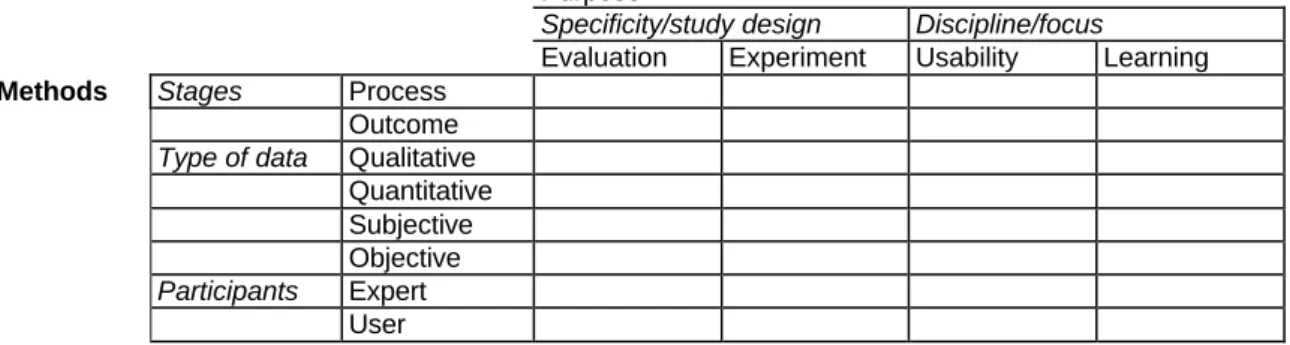
The above discussion of the nature of evaluation is summarised in the following two tables. The framework is not intended to be exhaustive, but provides a method of positioning studies within the broad range of evaluations of VLEs that are conducted. Table 1 combines the purpose and methods of evaluation in the form of a matrix. Although the dimensions are broken down into distinct categories (i.e. evaluation or experiment,
process or outcome measures), studies may incorporate elements of each.
Table 1: Framework for distinguishing between evaluation studies based on their purpose and the
methods that are used
Purpose
Specificity/study design Discipline/focus
Evaluation Experiment Usability Learning
Methods Stages Process Outcome Type of data Qualitative
Quantitative Subjective Objective Participants Expert
User
The second table (Table 2) takes the sample of measures discussed in 2.3 and indicates which methods apply. The table can be read in this direction (i.e. down the columns) or across the rows to provide examples of measures which generate, for example qualitative, subjective data.
Table 2: Methods used in measuring specific aspects of VLEs Measures
Usability heuristics
Frequency of
interactions
Quality of interactions
Learner perceptions
Learning outcomes
Methods Stages Process ü ü ü
Outcome ü ü ü
Type of data Qualitative ü ü ü
Quantitative ü ü ü
Subjective ü ü ü ü
Objective ü ü
Participants Expert ü
User ü ü ü ü
4. Pilot study
4.1 Theoretical position
The pilot study is part of a research project based on a socio-cultural approach to cognition and consequently to learning. Learning is assumed to be socio-cultural in nature. Instead of electing an individual using a system as the focus of evaluation, the research considers that it is the social activity — inside which the system is used — that must be analysed.
Using the concept of Legitimate Peripheral
Participation (Lave and Wënger, 1991),
learning is defined as a consequence of members of a community engaging in a given activity. It is assumed that while engaged in the activity the group develops and incorporates knowledge. However, there must be a purpose or motive for such activity. Members take part in the activity because they have mutual objectives they believe will be achieved.
This description is extremely broad and applicable to many different types of social groups, even those not commonly related to any type of learning activity. Within the framework adopted learning occurs, by definition, in any place. Institutions such as schools and universities may be communities that are more specialized in teaching and learning, however learning is assumed to be part of any social practice.
A course may be construed as a social activity. Students and teachers are members of a group performing tasks to achieve their objectives. While engaged in the course members use artefacts such as books, journals, magazines, etc. to perform tasks. A VLE is one possible artefact that is available to the group. Attributes of the interface should be analysed to identify, for example, how efficient and satisfying the system is to use. However, it is insufficient to investigate how the VLE affects activity by only measuring its usability. Clearly, the evaluation activity incorporates various levels of analysis and variables such as ease of use should not be neglected. What
is required, in addition, is to incorporate variables that reflect the social-cultural component of the teaching/learning activity for which the VLE is intended.
4.2 Proposed variables
Since the learning activity is described in terms of Lave and Wënger’s concept the research
uses three of their variables. These variables are engagement, participation and achievement of goals. Table 3 defines the three variables in general terms.
Table 3: the three variables selected for use in the study
Engagement The level of commitment a member has towards the activity, which is crucial for the establishment and achievement of objectives. It is measured by the number of utterances made during a chat session and the ratios number of utterances/number of participants and number of utterances/minute. It is also measured by the frequency with which a participant attends the chat sessions.
Participation The range of different tasks performed during the activity. It is established by identifying different types of contributions made by the participants within the data.
Achievement of goals The level of accomplishment of objectives and satisfaction with the activity. Questionnaires and course assignments are the source for the data. The focus of the study is the social activity
itself. This is defined as a group of individuals who join together to perform tasks to accomplish their objectives. By making the social activity the focus of the research, the evaluation of the VLE is placed within a context. The evaluation is no longer isolated from the situation in which it is used. It follows that making the system’s use artificial by carrying out a controlled experiment is not desirable and the study should be as natural as possible. Obviously, any study is artificial at some level. Nevertheless, the pilot was conceived as an experiment using a real online course.
4.3 Method
The pilot uses two independent groups to compare two different VLEs with the same course content. The two systems are Blackboard and VirtusClass, developed at the Universidade Federal de Pernambuco (UFPE), Brazil.
A free online course (Basic Layout) was announced in e-lists of students and graduates from the graphic design programme of UFPE, Brazil. This generated more than 60 responses. After responding to enquiries and arranging the most convenient schedule, two groups were created with 13 students in each. Students used texts, PowerPoint presentations and links to sites. Seven chat sessions were held, during which the course material was discussed.
4.4 Outcomes
This pilot study tested the suitability of the variables. Both quantitative and qualitative data were collected. Unfortunately, a major fault during one VirtusClass chat session caused the loss of 4 out of 7 sessions. Nevertheless, the remaining data was used to inform the design of subsequent studies. 4.5 Engagement
There was a tendency for more engagement with BlackBoard. The number of participants
per session and the ratio of number of utterances/number of participants and number of utterances/minute were consistently greater
than in VirtusClass.
There may be two possible reasons for this. Firstly most participants were familiar with VirtusClass but not Blackboard and they may therefore have been more engaged by a novel environment. In particular, students found the whiteboard tool exciting. In the first meeting, one of the students asks about this tool1:
21 SV > I am curious. How will we use the
above area?
28 Lec > This drawing tool is very cool, but I
don’t know yet if we will be able to use it. 29 Lec > the problem is always the same
1
The number at the beginning of each line in the table represents the sequence of utterances within the chat session. In this extract the first mention of the whiteboard tool was made in the 21st utterance.
30 Lec > how to draw with a mouse
31 LF > that’s terrific!!!!!
32 SV > it’s easy, easy...
The second possible reason is the reliability of the BlackBoard system compared to VirtusClass. There were difficulties in connecting to VirtusClass which appeared to upset participants and they clearly got distressed. More than one participant may have dropped out of the course due to these problems.
4.6 Participation
Both environments have different sections where participants can perform specific actions. As a general rule, VirtusClass offers
more options for student contributions while BlackBoard constrains them. For instance, in VirtusClass students are given the same status as instructors to post documents to everyone or suggest links to visit. Students can also initiate a discussion thread in the forum by themselves. It would therefore be expected that they would perform a greater number of roles in VirtusClass than BlackBoard. The only exception is the virtual classroom where BlackBoard’s participants can use a set of tools — such as the whiteboard — not present in VirtusClass. The different types of participation students can perform in each section are listed in Table 4.
Table 4: Types of participation
Section Type of participation student can perform
VirtusClass BlackBoard
Link references Access, Post, Search. Access. Document section Access, Post. Access.
Agenda Access, Post. Access.
Forum Access, Post, Initiate thread. Access, Post.
Virtual classroom Chat. Chat, Draw, Send particular message.
The virtual classroom and the forum seem to be special cases of participation. The dialogue inherent in these sections suggests participation should be analysed in qualitative terms. Stating viewpoints, supporting them, opposing other’s perspectives are different types of participation in a dialogue that may be particularly relevant to the learning activity. For instance, the significance of using the whiteboard as a medium for student reasoning seems to be indicated by a passage from the Blackboard group.
After discussing the importance of grids for a layout, the lecturer tried to point out that they should not constrain the design. A grid, the lecturer sustained, can sometimes limit the layout possibilities. Although students kept saying that this was true, every time they rephrased their comments, they appeared not to get the point. This is that some ideas may not occur to designers if they are not conscious of how a grid may constrain the very conception of the layout. Then RS decided to draw the grid himself:
393 RS > well, I will draw then…
394 RS > it lacks the horizontal lines… etc… but on that grid one can make several different layouts
The lecturer reaffirms the advantage of grids and explains his point once more:
401 Lect > that’s the great advantage of a grid, right?
402 Lect > it structures and permits variety 403 JB > and this is independent of its
complexity...
404 Lect > what I was trying to highlight is that it may, only may, force constraints when not cleverly used.
…
408 Lect > we must not allow the technique intended TO HELP
409 Lect > to become an OBSTACLE
410 RS > I see! Ok... it is great to keep these recommendations in mind to avoid stupid ideas when designing.
The lecturer then takes RS’ drawing of a rectangular grid and draws a circle over it while RS repeats the lecturer’s last sentence.
411 Lect > for instance…
412 RS > that’s true. it must HELP, and never OBSTRUCT.
...
415 Lect > all this square structure may very well lead us to avoid even thinking about a rounded picture
…
419 Lect > notice that the circle may be seen as inside a square
421 Lect > but we tend not to think about a rounded picture while using a right-angle structure
...
424 RS > I see... a matter of tendency 425 RS > like a newspaper ... we almost never
see non-rectangle graphics.
RS finally seems to appreciate the point, and introduces a new idea about graphics in newspapers. This may be because RS and the lecturer changed their type of participation, which made RS think about the problem in different terms.
4.7 Achievement of goals
The lecturer did not require a formal task and the achievement of goals was restricted to students’ impressions:
• “I found the document about calligraphy very interesting” (LL) • “I really enjoyed the debate we had
here” (EA)
• “I found the course incomplete… lacking a conclusion” (JB)
The pilot demonstrated the necessity of assessing the learning outcomes. It was decided to introduce a formal task — the design of a poster — into a second pilot. In addition, a questionnaire will be used to gather data such as personal satisfaction, particular difficulties and impressions about the learning achieved.
5. Conclusions
The pilot helped test the viability of the variables chosen for the study of VLE systems. It also produced valuable information for the design of the subsequent studies. The conclusions may be summarised as follows:
• The variables provide both qualitative and quantitative and objective and subjective data.
• Achievement of Goals needs to be assessed by practical tasks and a structured questionnaire.
• Technicalities such as connection reliability can severely hinder the experiment.
References
Boyle, T and Cook, J. (2001) “Online interactivity: best practice based on two case studies”, Association for Learning Technology
Journal, Vol 9, No 1, pp 94–102.
Brown, S, Hardaker, CHM and Higgett, NP. (2000) “Designs on the web: a case study of
online learning for design students”,
Association for Learning Technology Journal,
Vol 8, No 1, pp 30–40.
Chang, C-C. (2001) “A study on the evaluation and effectiveness analysis of web-based learning portfolio”, British Journal of
Educational Technology, Vol 32, No 4, pp
435–458.
Collings, P and Pearce, J. (2002) “Sharing designer and user perspectives of web site evaluation: a cross-campus collaborative learning experience”, British Journal of
Educational Technology, Vol 33, No 3, pp
267–278.
Dillon, A. (1992) “Reading from paper versus screens: a critical review of the empirical literature”, Ergonomics, Vol 35, No 10, pp 1297–1326.
Draper, S,W, Brown, MI, Henderson, FP and McAteer, E. (1996) “Integrative evaluation: an emerging role for classroom studies of CAL”,
Computers & Education, Vol 26, No 1–3, pp
17–32.
Gunn, C. (1997) “CAL evaluation: future directions”, Association for Learning
Technology Journal, Vol 5, No 1, pp 40–47.
Heppell, S. (2000) “eLearning: how might eLearning really change educational policy and practice?” http://www.ultralab.ac.uk/papers/elearning/. Holt, R, Oliver, M and McAvinia, C. (2002)
“Using web-based support for campus-based open learning: lessons from a study in dental public health”, Association for Learning
Technology Journal, Vol 10, No 2, pp 51–62.
ISO 9241–11 (1998) “Ergonomic requirements for office work with visual display terminals (VDTs)–guidance on usability”.
Jones, A, Barnard, J, Calder, J, Scanlon, E and Thompson, J. (2000) “Evaluating learning and teaching technologies in further education”,
Association for Learning Technology Journal,
Vol 8, No 3, pp 56–66.
Lave, J and Wënger, E. (1991) Situated
Learning: legitimate peripheral participation,
Cambridge University Press, Cambridge. Nielsen, J. (1993) Usability Engineering,
Academic Press, San Diego, USA.
Nielsen, J. (1994) “Enhancing the explanatory power of usability heuristics” in CHI 94
proceedings, B Adelson, S Dumais and J
Olson (Eds), ACM Press, Reading, MA, pp 152–158.
Oliver, M. (1997) A framework for evaluating the
use of educational technology, University of
North London, Learning and Teaching Innovation and Development (LaTID) London.
Oliver, M. (2000) “An introduction to the evaluation of learning technology”,
Educational Technology & Society, Vol 3, No
4, pp 20–30.
Preece, J, Rogers, Y, Sharp, H, Benyon, D, Holland, S and Carey, T. (1994)
Human-computer interaction, Addison Wesley,
Wokingham, England, p603.
Richardson, J. (2001) “An evaluation of virtual learning environments and their learners: do individual differences effect perception of virtual learning environments”, Interactive
Educational Multimedia, Vol 3, No, pp 38–52.
Scanlon, E, Jones, A, Barnard, J, Thompson, J and Calder, J. (2000) “Evaluating information
and communication technologies for learning”, Educational Technology & Society, Vol 3, No 4, pp 101–107.
Schumacher, GM and Waller, R. (1985) “Testing design alternatives: a comparison of procedures” in Testing design alternatives: a
comparison of procedures, Thomas M Duffy
and Robert Waller (Eds), Academic Press, Orlando, pp 377–403.
Woods, R and Keeler, J. (2001) “The effect of instructor’s use of audio e-mail messages on student participation in and perceptions of online learning: a preliminary case study”,