Louisiana’s
Birth to Five
Early Learning &
Development
Standards (ELDS)
STATE BOARD OF ELEMENTARY AND SECONDARY EDUCATION
Mr. Charles E. Roemer President 6th BESE District
Mr. Jay Guillot 5th BESE District
Mr. James D. Garvey, Jr. Vice President 1st BESE District
Ms. Carolyn Hill 8th BESE District
Ms. Holly Boffy Secretary/Treasurer
7th BESE District
Mr. Stephen Waguespack Member-at-Large
Ms. Kira Orange Jones 2nd BESE District
Dr. Judy Miranti Member-at-Large
Ms. Lottie P. Beebe 3rd BESE District
Ms. Connie Bradford Member-at-Large
Mr. Walter Lee 4th BESE District
Ms. Heather Cope Executive Director
TABLE OF CONTENTS
I. LETTER FROM SUPERINTENDENT I. ACKNOWLEDGEMENTS
III. INTRODUCTION
A. About this Document
B. Role of the Early Learning and Development Standards C. Guiding Principles
D. Effective Use of Early Learning and Development Standards with All Children E. Overview of the Early Learning and Development Standards
F. Use of this Document with Other Documents in Louisiana IV. LEARNING AND DEVELOPMENT STANDARDS CONTINUUM
• Approaches to Learning • Initiative and Curiosity
• Attention, Engagement, and Persistence
• Reasoning, Problem-Solving, and Creative Thinking
• Cognitive Development and General Knowledge • Creative Thinking and Expression
• Mathematics • Science • Social Studies
• Language and Literacy Development • Speaking and Listening
• Language
• Reading: Literature and Information in Print • Reading: Foundational Skills
• Writing
• Physical Well-Being and Motor Development • Motor Skills and Physical Fitness
• Health and Hygiene • Safety
• Social-Emotional Development • Social Relationships
• Self-Concept and Self-Efficacy • Self-Regulation
V. APPENDICES
III. ACKNOWLEDGMENTS
The publication of Louisiana’s Early Learning and Development Standards (ELDS) is the culmination of a year-long effort by many individuals. The goal is to provide a resource that can be used to continue to improve the quality of programs in the state in order to provide effective support for children’s learning and development.
We would like to thank the members of the Leadership Team who worked diligently to create Standards that will provide a common vision for Louisiana’s early childhood programs and that reflect the diversity of children served in Louisiana. Their ongoing commitment to research and excellence provided a strong foundation for the Standards and made this publication possible.
LOUISIANA DEPARTMENT OF EDUCATION
Anita Ashford Early Childhood Programs
Nicholy Johnson Early Childhood Programs
Petrouchka Moise Early Childhood Programs
Whitney Whealdon English Language Arts Program
Mandy Boudwin Mathematics Program
Mary Louise Jones, Ed.D. Early Childhood Programs
Cindy Ramagos Early Childhood Programs
Jenna Conway Early Childhood Programs
Kerry Laster, Ph.D. Network Team Leader
Carolyn Sessions
Standards and Curriculum Projects Kaye Eichler
Early Childhood Programs
Terri McClellan Early Childhood Programs
Ivy Starns Early Childhood Programs
DEPARTMENT OF CHILDREN & FAMILY SERVICES DEPARTMENT OF HEALTH & HOSPITALS
Gail Kelso
Child Development & Early Learning Section
Jacinta Settoon
Child Development & Early Learning Section
Sarintha Stricklin, Ph.D. Early Childhood Redesign Project
Brenda Sharp EarlySteps
SCHOOL SYSTEMS
HEAD START
Contessia Brooks Head Start West Feliciana Parish
Toni Ledet, Ph.D. ARC of Baton Rouge YWCA Early Head Start
Jeanette Vosburg State TTA Center
Head Start
Severina Despenza Head Start Orleans Parish
Judy Thompson Head Start East Baton Rouge Parish
Kahree Wahid
Head Start State Collaboration Office
CHILD CARE
Betty Blaize
The First Years/Excellence in Children Resource and Referral Agency
Paula Granger
The First Years/Excellence in Children Resource and Referral Agency
Wyatt Graves
Child Care Association of Louisiana Fundamentals Early Learning Center
UNIVERSITIES
Michelle DeMeulenaere Child Development Center
Louisiana State University
Janie Humphries, Ed.D. Early Childhood - Retired Louisiana Tech University
Emily Williamson Child Development Center
University of Louisiana at Monroe Stakeholder Group Patti Endsley
Child Development Center University of Louisiana at Lafayette
Angela Keyes, Ph.D.
Environment Rating Scales Assessment Team Tulane University
OTHER
Libbie Sonnier-Netto Early Childhood
Center for Development and Learning (CDL)
Martha South BrightStart
We would also like to thank Peter Mangione (WestEd) Susan Andersen (Early Childhood Consultant), Katherine Falen (Office of Child Care, Ad -ministration for Children and Families), and Allyson Dean (Office of Child Care, Ad-ministration for Children and Families) who served as expert reviewers to the draft Standards. Finally, we would like to thank our facilitators and lead writers, Catherine Scott-Little and Glyn Brown from the University of North Carolina at Greensboro for their work on the project.
IV. INTRODUCTION
The experiences and skills that children develop during the early years are critically important to their success later in school. What children learn during the first few years of life helps to lay the foundation for their future growth and development.
In order for children to reach their full potential during those early years, it is important that the adults around them provide an environment and experiences that promote growth and learning. This document, Louisiana’s Birth to Five Early Learning and Development Standards (ELDS), is designed to help early childhood educators do just that by describing the particular skills and abilities that children need to develop to be successful, and by providing ideas for fostering their development.
A. About this Document
Over the course of the past decade, the state of Louisiana has developed several documents to articulate expectations for children’s learning and development and provide guidance for early childhood educators. These documents (Figure 1) have been published under different titles and by different agencies within Louisiana.
FIGURE 1: LOUISIANA STANDARDS DOCUMENTS
Louisiana’s Early Learning Guidelines: Birth to Three
Birth to Age 3
Louisiana’s Early Learning Guidelines: Guide to Working with Threes
Children Age 3
Louisiana Standards for Programs Serving 4-Year-Old Children Children
How This Document Was Developed
To develop Louisiana’s Early Learning and Development Standards (ELDS), the Louisiana State Department of Education and the Department of Children & Family Services established a leadership team that was responsible for overseeing the revision of the Standards. Members of the leadership team examined research, looked at other states’ Standards, and considered policy statements from state and national organizations. To ensure consistency with the current K-12 Standards, they also examined the Louisiana Grade Level Expectations for Kindergarten and the Common Core State Standards. Finally, they reviewed all appropriate research literature to make sure the expectations were inclusive of chil -dren from a variety of circumstances and with differing levels of ability.
The leadership team developed an initial draft of the Standards and Indicators, and then worked with a variety of experts to review and im -prove the document. First, it was reviewed by a broader stakeholder group of early childhood educators and parents from across the state. This stakeholder group included representatives of higher education institutions, private childcare, Head Start, early intervention, as well as teachers and administrators of early education programs. Stakeholders provided comments and feedback on the content of the Standards, as well as the overall structure and format of the continuum twice. In addition to the stakeholder group, expert reviewers from outside of Louisiana were asked to provide feedback on the Standards. Finally, the leadership team sought feedback and comment from the public on a draft of the Standards and Indicators via an online survey. More than 240 early childhood educators and administrators from across Louisiana responded with comment and suggestions. All of the comments and suggestions that were received were invaluable toward shaping and strengthening the final version of the Standards.
B. Role of the Early Learning and Development Standards
The Early Learning and Development Standards are intended to be a framework for high-quality, developmentally appropriate early childhood programs and were designed to be used by early childhood educators throughout Louisiana. The term early childhood educator is intended to encompass all those (e.g., teachers, caregivers, administrators, parents, etc.) who are responsible for the care and education of children from birth to age 5. These Standards establish a common vision for what the state of Louisiana wants children to learn before they enter kindergarten. As such, they provide age-appropriate goals for children’s learning and development that can guide teachers, caregivers and others on what types of experiences and activities children should have during their earliest years.
These Standards and Indicators are intended to be a guide for teaching young children. They are neither a curriculum nor a checklist for assess -ing children’s development and learn-ing. Individual areas of the Standards are considered to be equally important and should be integrated into all experiences and activities. Finally, it is important to remember that while the Standards will help educators determine what is “typical” for children in an age group, they might not always describe a particular child’s development. When a child’s development and learning does not seem to fit what is included in the Standards continuum under his/her age level, look at the Indicators for younger or older age groups to see if they are a better fit for the child. The goal is to learn what developmental steps the child is taking now, and to meet the individual needs of that child on a daily basis.
Educational research has consistently proven that there is a strong correlation between the quality of early childhood experiences and later academic success. Therefore, it is imperative that Louisiana’s early childhood programs provide children with the foundational experiences needed for them to become successful learners. The Standards and Indicators provide adults with a guide for the skills they should focus on for children of different ages, and offer some general ideas for the types of experiences that will help children develop the skills and knowledge described in this document.
C. Guiding Principles
There are a number of principles that guided the development of the document, and are intended to guide adults who are using the document with children1:
Early learning and development are multidimensional; developmental domains are highly interrelated.
Development in one domain influences the development in other domains. For example, children’s language skills impact their ability to en -gage in social interactions. Therefore, developmental domains cannot be considered in isolation of each other. The dynamic interaction of all areas of development must be considered.
Young children are capable and competent.
All children are capable of positive developmental outcomes. Therefore, there should be high expectations for all young children. There are individual differences in rates of development among children.
Each child is unique in the rate of growth and the development of skills and competencies. Some children may have a developmental delay or disability that may require professionals to adapt expectations of individual children or adapt experiences so that they will be successful in at -taining the performance standard. Additionally, each child is raised in a cultural context that may impact a child’s acquisition of certain skills and competencies.
Children will exhibit a range of skills and competencies in any domain of development.
Preschool age children will exhibit a range of skills and competencies in any area of development. All children within an age group should not be expected to master each skill to the same degree of proficiency at the same time.
Knowledge of child growth and development and consistent expectations are essential to maximize educational experiences for children and for program development and implementation.
Early care and education professionals must agree on what it is they expect children to know and be able to do, within the context of child growth and development. With this knowledge, early childhood staff can make sound decisions about appropriate curriculum for the group and for individual children.
Families are the primary caregivers and educators of their young children.
Families should be aware of programmatic goals and experiences that should be provided for children and expectations for children’s perfor -mance by the end of the preschool years. Professionals and families should work collaboratively to ensure that children are provided optimal learning experiences. Programs must provide families with the information they may need to support children’s learning and development.
D. Effective Use of Early Learning and Development Standards with All Children
The Standards that are presented in this document apply to all children in Louisiana who are not yet age-eligible to enter kindergarten. This includes children with and without disabilities, children who are learning English, and children who are participating in any type of early care and education program.
Children with Disabilities
Children with disabilities are those who require some form of special care because of developmental delays to their cognitive, physical, or social-emotional functioning. Inclusion of children with disabilities in early childhood programs is a manageable and best-practice goal. It provides them with the opportunity to learn alongside typically developing peers and creates high expectations for every child, regardless of ability. Early childhood teachers and caregivers can help make this possible by adapting or modifying their classrooms, their interactions, or their materials/equipment to include children of all abilities.
The Early Learning and Development Standards are designed to be used for all children. Educators and families working with children with dis -abilities should strive to help them make progress in the areas described in this document; however, it is important to remember that children with disabilities may not demonstrate progress in the same way or at the same rate as typically developing children. They may need extra support in the form of adaptations and modifications, and teachers may also need to adjust their curriculum and instructional strategies to meet the individual learning needs of children with disabilities. One advantage of the Standards continuum is that it is easy to see what skills and knowledge are appropriate across the age levels from birth to age five. Teachers and caregivers working with children with disabilities may find it helpful to look at the Standards and Indicators provided for a younger age level if the child’s current level of learning and development is not consistent with the Standards and Indicators written for their age. Knowing where each child is on the continuum (and what their logical next steps are) will help educators plan experiences and appropriately support their progress.
Assistance in identifying and implementing specific strategies for children with special needs is available to all programs in Louisiana. For more information on specific strategies, as well as how to best serve special needs children, please refer to the Appendix F of this document.
English Language Learners (ELL)
The term English Language Learners (ELL) refers to children who are learning a second language at the same time they are continuing to de -velop their native or home language. It is important for teachers and caregivers to understand that ELL children de-velop language in much the same way that they acquire other skills—at their own rate. A child’s language development (both his/her home language and progress in learning English) will depend on the amount and type of language they hear other people using and the opportunities he/she has to practice language skills. Therefore, each child’s progress in learning English needs to be respected and supported as part of the ongoing process of learn -ing any new skill.
As teachers and caregivers work with ELL children, it is important to remember to address all areas of their learning and development—ELL chil -dren need to have opportunities to make progress on all of the Standards and Indicators described in this document. Research suggests that ELL children will learn concepts and display skills best in their home language during the time they are learning English. Therefore, whenever pos -sible, children should have opportunities to interact with and engage in both their home language and in English in rich and meaningful ways. For example, program staff might learn to use some basic phrases from a child’s home language, such as greetings or praise words. Programs can also invite the help of bilingual family members or volunteers who are willing to contribute their time in the classroom by interacting with
Teachers and caregivers should also remember that children can demonstrate any of the skills described in this document in their home lan-guage—they can demonstrate their understanding of health and safety practices, social skills with peers and adults, positive approaches to learning, language development, and knowledge of science, mathematics and other areas in their home language. In fact, teachers and care -givers can best see ELL children’s progress on the Standards and Indicators when children communicate in their home language, and it gives a more accurate picture of a child’s progress. For instance, when learning to count (an indicator within the Cognitive Development domain), children may count in their home language. This signals to teachers and caregivers that the child has learned this concept and has the poten-tial for transferring those skills to a second language. Again, teachers and caregivers who do not speak a child’s home language may need to enlist the help of bilingual staff or family members to ensure that the ELL child has the opportunity to learn and demonstrate progress on the Standards in his/her home language.
Finally, teachers and caregivers should remember that it is important to work closely with all children’s families, and this is especially true for English Language Learners. Families can provide valuable information about the family’s home language and how often the child hears Eng -lish being spoken. The families may also provide information about how the child learns best, and they can work to reinforce what the child is learning in the program with similar experiences at home. Families are a tremendous resource for understanding a child’s home culture, and they are key to working effectively with children from diverse cultures.
For more information on ELL children, please see the domain description for Language and Literacy Development. Also, for specific strategies for engaging ELL children in the classroom, please refer to the Appendix F of this document.
E. Overview of the Early Learning and Development Standards
What Ages are Covered in the Early Learning and Development Standards?
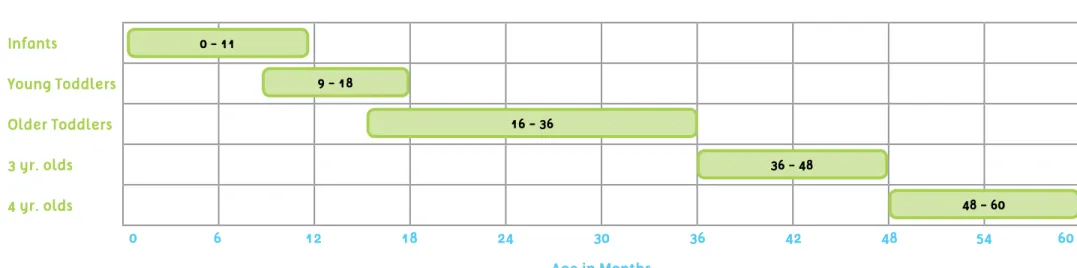
The Continuum of the Early Childhood and Development Standards is divided into five age levels: infants (birth to 11 months), young toddlers (9 to 18 months), older toddlers (16 to 36 months), three-year-olds (36 to 48 months), and four-year-olds (48 to 60 months). These age levels (Figure 2) were selected because they represent developmentally significant periods in a young child’s life. However, it is important for educators to remember that young children’s development is often uneven and progresses at different rates. Children may change dramatically in one area, while development progresses more slowly in another area. Children with disabilities may demonstrate even greater variation in their abilities to progress and reach developmental milestones.
Because children develop at different rates, there is overlap at the youngest age levels (birth to 11 months/infants; 9 to 18 months/young tod -dlers; and 16 to 36 months/older toddlers). Some children may not reach all of the Indicators described in the first age level by the time they are 11 months old. Likewise, some children under 16 months of age may display some of the skills and abilities that are listed at the Older Tod -dler level. The overlap reflects the fact that it is normal for children this age to vary a lot in when they demonstrate the skills and behaviors described in the Indicators written for infants and toddlers.
NOTE: Children should know and be able to do the skills in each age range by the time they reach the end of that age level.
FIGURE 2: AGE LEVELS
Infants
Young Toddlers Older Toddlers 3 yr. olds 4 yr. olds
0 6 12 18 24 30 36 42 48 54 60 Age in Months
0 - 11
9 - 18
16 - 36
36 - 48
How Are the Standards Organized?
The Early Learning and Development Standards are organized into five domains of children’s development:
• Approaches to Learning
• Cognitive Development and General Knowledge (including content areas of Creative Thinking and Expression, Mathematics, Science, and Social Studies)
• Language and Literacy Development;
• Physical Well-Being and Motor Development; and
• Social-Emotional Development
These five domains represent major areas of development and learning, and define essential learning for school readiness and children’s long-term success. The domains are designed to be interdependent and include all areas of children’s learning and development. Each domain be -gins with a brief description of the domain and an explanation of why it is important for children’s development and learning. Some ideas for promoting progress on the areas described in the Standards are also offered. This description is followed by the Standards Continuum (some -times called a “Continuum” for short) for each domain. The Continuum is a table that includes the Standards and Indicators for each age level. As the sample page (Figure 3 on page 15), Louisiana has elected to arrange the Indicators along a continuum so that all of the Indicators for the age levels, infants to four-year-olds are included on the same row. This allows teachers and caregivers to easily look across the age levels to see the progression that a child might make toward the Standard.
NOTE: The Mathematics Subdomain and the Language and Literacy Domain include the alignment to the Kindergarten Common Core State Standards.
Each Continuum is organized into subdomains which capture the specific areas of learning that make up the domain. For example, the do -main of Approaches to Learning is divided into three subdo-mains: Initiative and Curiosity; Attention, Engagement, and Initiative; and Reasoning, Problem-solving, and Creative Thinking.
Cognitive Development is an area of development that is somewhat broader than the other domains. It includes the subdomain areas of Creative Thinking and Expression, Mathematics, Science, and Social Studies. Each of these subdomains of Cognitive Development includes a description and explanation of its importance.
Within each subdomain is a set of Standards and Indicators. The standard is a statement that provides an overarching goal for skills and knowl -edge children should make progress toward. It provides a general statement of what children should know and be able to do that is applicable across age levels/groups.
The Indicators provide more specific information about what children should know or be able to do at each age level. They are written for a specific age level and provide a description of the skills, knowledge, and/or characteristics a child should be doing to indicate progress toward
Each of the Indicators is assigned a code that includes two numbers. This code appears at the end of each indicator in parentheses. The first number indicates age-level (i.e., 0 = infants; 1 = young toddlers; 2 = older toddlers; 3 = three-year-olds; and 4 = 4-year-olds), while the second number reflects the order of the item within the age level (see below).
0. to 4.
Age Level Indicator Number1, 2, 3, 4, etc.
For example, if an infant/toddler teacher is targeting Standard 1 in Approaches to Learning, he/she might refer to specific Indicators in the following ways, AL 1 – 0.1 or AL 1:0.1. Similarly, an Older Toddler teacher/caregiver might write an indicator as AL 1 – 2.1 or AL 1: 2.1.
Following the Standards for each domain, there is a list of strategies to support development and learning. The strategies are intended to help teachers and caregivers think about how to best use the Standards to guide what they do in the classroom. They are a guide for the type of teaching practices and interactions that adults can use to encourage children’s progress on the Indicators. This is not intended to be an exhaustive list of strategies, but is a place to start when planning activities to support children’s learning.
APPROACHES TO LEARNING: AL 1
SUBDOMAIN: INITIATIVE AND CURIOSITY
Standard AL 1: Engage in play-based learning to explore, investigate, and acquire knowledge about themselves and their world. Infants
(Birth to 11 months)
Young Toddlers (9 – 18 months)
Older Toddlers (16 – 36 months)
Three-Year-Olds (36 – 48 months)
Four-Year-Olds (48 – 60 months) AL 1 Indicators:
• Show interest in body parts (e.g., fingers, toes). (0.1) • Explore objects, materials,
and/or people using all the senses (e.g., picking objects up and putting them in mouth, focusing attention on an object or someone doing something, etc.). (0.2)
• Select a particular mate -rial, toy or place to explore on their own. (0.3)
• Use simple behaviors to meet own needs (e.g., feed self with finger food). (0.4)
AL 1 Indicators:
• Show curiosity and interest in actively exploring the environment. (1.1)
• Express choices and pref -erences. (1.2)
• Try to help with simple tasks and activities. (1.3)
AL 1 Indicators:
• Show curiosity and interest in daily experiences and activities. (2.1)
• Demonstrate a willingness to try new activities and experiences. (2.2)
• Actively explore the envi -ronment. (2.3)
• Demonstrate increasing interest and independence in completing simple tasks. (2.4)
• Insistent about preferences and may say “no” to adult. (2.5)
AL 1 Indicators:
• Demonstrate eagerness to learn through play and exploring the environment. (3.1)
• Complete a range of simple tasks on their own. (3.2)
AL 1 Indicators:
• Show curiosity, interest and a willingness to learn new things and try new experiences. (4.1)
• Choose a multi-step task and complete it on their own. (4.2)
Subdomain describes the broad categories of each Domain.
Domain is the area of child development being addressed in each section. Standard defines each Subdomain more specifically.
Example: AL 1 represents Standard 1 within the Approaches to Learning (AL) domain.
Indicator numbers represent a specific Indicator within a Standard and within a Specific Age Range. For example: 0.2 stands for Infants (0) and Indicator 2 in this Standard.
1.3 stands for Young Toddlers (1) and Indicator 3 in this Standard. 2.3 stands for Older Toddlers (2) and Indicator 3 in this Standard.
Specific Age Ranges define the group of children for which the Indicators apply.
Indicators define the Standard and specify what
children should know and be able to do by the end of
each age range.
F. Use of this Document with Other Documents in Louisiana
Early childhood educators often feel overwhelmed by the multitude of guidelines, requirements and recommendations that are part of the tools and information available. These Early Learning and Development Standards are designed to assist educators in improving the quality of care for all children in all settings by presenting goals for children’s development and learning. They are consistent with other Standards and guide -lines provided to early childhood programs in Louisiana. The practices that are considered “best practice” will promote children’s learning and development as described in this document, and are consistent with best practices in all types of programs and settings. Of course, programs and settings that have specific funding sources may require different policies, but all programs should be working toward improving quality to support children’s progress on the Standards and Indicators included in this document.
The graphic below (Figure 4) shows how these Birth to Five Early Learning and Development Standards compare to other documents that de -scribe expectations for children’s learning and development that are currently being used in Louisiana–specifically those from Head Start and Louisiana’s Kindergarten Standards. In most instances, the domains and areas of development listed under one document are very similar to those found in another; however, there are some differences across the three documents.
We believe that the practices and recommended strategies that promote high quality early education services will support children’s progress on the Standards and Indicators, and that as young children develop the skills and behaviors described in the ELDS and the Head Start Framework, they will be ready to meet the Kindergarten Standards once they enter kindergarten.
FIGURE 4: COMPARISON OF DOCUMENTS
Louisiana Early Learning
and Development Standards and Early Learning Framework Domains *Head Start Child Development Louisiana Kindergarten Standards
APPROACHES TO LEARNING
Approaches to Learning Approaches to Learning N/A
Creative Arts Development COGNITIVE DEVELOPMENT
Creative Thinking and Expression (Found in Approaches to Learning) N/A
Mathematics Mathematics Knowledge and Skills Mathematics (Common Core)
Science Scientific Knowledge and Skills Science (GLEs)
Social Studies Social Studies Knowledge and Skills Social Studies (GLEs) Logic and Reasoning
PHYSICAL DEVELOPMENT
Physical Well-Being and Motor Development Physical Development and Health Physical Development (GLEs) Health (GLEs)
LANGUAGE AND LITERACY DEVELOPMENT
Language and Literacy Development Language Development English Language Arts (Common Core) Literacy Knowledge and Skills
APPROACHES TO LEARNING
Standard 1: Engage in play-based learning to explore, investigate, and acquire knowledge about themselves and their world. Standard 2: Demonstrate attention, engagement, and persistence in learning.
Standard 3: Recognize, understand, and analyze a problem and draw on knowledge or experience to seek solutions. Standard 4: Demonstrate creative thinking when using materials, solving problems, and/or learning new information.
In the 1990s, the National Education Goals Panel recognized Approaches to Learning as an essential element of children’s school readiness. The term Approaches to Learning typically refers to behaviors and attitudes that show how children approach tasks/activities and how they learn. Approaches to Learning includes characteristics such as curiosity, problem-solving, maintaining attention, and persistence. These learn-ing behaviors can help strengthen and facilitate children’s learnlearn-ing across other school readiness domains. In fact, research has shown that approaches to learning is a distinct aspect of children’s school readiness and is a strong predictor of their later success in school. Children with positive approaches to learning perform better academically and have more productive interactions with others. While some of these skills seem to come naturally to some children, researchers believe that others can be nurtured and developed through a supportive, high-quality learning environment.
Exploring and Acquiring New Knowledge
For very young children, growing and learning begins with personal experiences, and their openness and curiosity about new discoveries. In -fants and toddlers learn about the world and gain new knowledge by taste, touch, smell, sight, sound and through their physical actions. They begin to develop an awareness of themselves and others through relationships and through their social interactions with those around them. Environments where children feel safe and secure nurture their interest in the world and support their own unique learning style. With a con -sistent environment and trusting, responsive adults, children have the emotional security necessary for exploring, growing and learning.
Attention and Problem-solving
The capacity to pay attention, to think creatively, and to solve problems are all important aspects of children’s approaches to learning that develop during the early childhood period. At around age three, children are able to complete short-term, concrete tasks and activities. As they progress and move closer to age five, they are able to concentrate for longer periods of time, and perform longer-term and more abstract tasks such as finishing an art project they started the previous day or following an established plan for an activity.
As children move into the preschool years, they begin to establish learning behaviors that are more directly tied to later school success as they continue to explore the world and also gain knowledge related to academic subject areas. It is important that early childhood educators help foster the development of children’s positive approaches to learning by providing an environment that is interesting and engaging, and allow -ing children opportunities and the freedom to explore in a safe, supportive environment.
Finally, regardless of the age, it is important for early childhood educators to understand that children vary in their learning styles and how they express their approaches to learning. For example, some children show great enthusiasm for trying new things, while others are more content to sit back and watch. This may be a result of temperament differences between children, or might be related to cultural differences because some cultures affirm the importance of curiosity while others encourage children to be more reserved. If a child’s learning behaviors seem to be related to temperament, it is important for teachers and caregivers to know that they cannot force a change to a child’s tempera -ment. They can, however, learn to be attuned to these differences and provide support and guidance to children as they need it. The Standards and Indicators included in this domain describe important aspects of approaches to learning that early childhood educators should seek to foster as they work with young children.
List of commonly cited components of Approaches to Learning:
» Intrinsic motivation to learn » Interest and joy in learning » Initiative
» Persistence
» Ability to plan, focus and control attention
» Flexible problem-solving and inventiveness
APPROACHES TO LEARNING: AL 1
SUBDOMAIN: INITIATIVE AND CURIOSITYStandard AL 1: Engage in play-based learning to explore, investigate, and acquire knowledge about themselves and their world. Infants
(Birth to 11 months)
Young Toddlers (9 – 18 months)
Older Toddlers (16 – 36 months)
Three-Year-Olds (36 – 48 months)
Four-Year-Olds (48 – 60 months) AL 1 Indicators:
• Show interest in body parts (e.g., fingers, toes). (0.1) • Explore objects, materials,
and/or people using all the senses (e.g., picking objects up and putting them in mouth, focusing attention on an object or someone doing something, etc.). (0.2) • Select a particular material,
toy or place to explore on their own. (0.3)
• Use simple behaviors to meet own needs (e.g., feed self with finger food). (0.4)
AL 1 Indicators:
• Show curiosity and interest in actively exploring the environment. (1.1) • Express choices and
pre-ferences. (1.2)
• Try to help with simple tasks and activities. (1.3)
AL 1 Indicators:
• Show curiosity and interest in daily experiences and activities. (2.1)
• Demonstrate a willingness to try new activities and experiences. (2.2)
• Actively explore the envi -ronment. (2.3)
• Demonstrate increasing interest and independence in completing simple tasks. (2.4)
• Insistent about preferences and may say “no” to adult. (2.5)
AL 1 Indicators:
• Demonstrate eagerness to learn through play and exploring the environment. (3.1)
• Complete a range of simple tasks on their own. (3.2)
AL 1 Indicators:
• Show curiosity, interest and a willingness to learn new things and try new experiences. (4.1)
• Choose a multi-step task and complete it on their own. (4.2)
APPROACHES TO LEARNING: AL 2
SUBDOMAIN: ATTENTION, ENGAGEMENT, AND PERSISTENCEStandard AL 2: Demonstrate attention, engagement, and persistence in learning. Infants
(Birth to 11 months)
Young Toddlers (9 – 18 months)
Older Toddlers (16 – 36 months)
Three-Year-Olds (36 – 48 months)
Four-Year-Olds (48 – 60 months) AL 2 Indicators:
• Focus attention on people around him/her. (0.1) • Attend briefly to different
people, sights and sounds in the environment. (0.2) • Try to make things happen.
(0.3)
AL 2 Indicators:
• Interact with people, objects or activities for short periods of time. (1.1)
• Show interest in activities, people and the environ-ment for a short period of time. (1.2)
• Show pleasure in completing simple tasks. (1.3)
AL 2 Indicators:
• Actively engage with people, objects, or activi-ties in the environment for longer length of time. (2.1) • Maintain attention to com
-plete a short, simple task with adult support. (2.2) • Complete self-chosen
activity and repeats the activity many times to gain mastery. (2.3)
AL 2 Indicators:
• Maintain focus on objects and activities of interest while other activities are going on in the environ-ment. (3.1)
• Maintain focus on a complex activity with adult support. (3.2)
• With prompting and sup -port, develop a simple plan for and work towards completion of short tasks, and activities. (3.3)
AL 2 Indicators:
• Stay engaged with oth -ers, objects, and activities despite interruptions or disruption. (4.1)
• Maintain attention in child-initiated and adult - directed activities despite distractions and interruptions. (4.2) • Plan and complete tasks
APPROACHES TO LEARNING: AL 3
SUBDOMAIN: REASONING, PROBLEM-SOLVING, AND CREATIVE THINKINGStandard AL 3: Recognize, understand, and analyze a problem and draw on knowledge or experience to seek solutions. Infants
(Birth to 11 months)
Young Toddlers (9 – 18 months)
Older Toddlers (16 – 36 months)
Three-Year-Olds (36 – 48 months)
Four-Year-Olds (48 – 60 months) AL 3 Indicators:
• Notice the effect of own actions when playing with a variety of objects and/ or interacting with others. (0.1)
• Interact with a toy or object in more than one way. (0.2) • Use simple actions to solve problems (e.g., scooting to reach favorite toy). (0.3) • Play with a variety of objects
and notice similar and differ -ent outcomes. (0.4)
• Look to adult for assistance (e.g., may vocalize to get adult’s attention). (0.5)
AL 3 Indicators:
• Repeat behaviors to pro -duce interesting effects, such as shaking a stuffed animal to listen to the sound that it makes. (1.1) • Observe others’ actions
with objects and materials to learn strategies for inter-action. (1.2)
• Solve familiar problems or tasks. (1.3)
• Use trial and error to solve a new problem or unfamiliar task. (1.4)
• Use gestures and simple language when help is needed. (1.5)
AL 3 Indicators:
• Demonstrate an under -standing of cause and effect (e.g., purposefully try to make things happen). (2.1)
• Repeat behaviors to pro -duce desired effect. (2.2) • Observe and imitate others’
when trying to carry out new tasks or actions. (2.3) • Apply new action or strat
-egy to solve problem. (2.4) • Use trial and error to solve
more complex tasks or problems. (2.5)
• Ask others for help if needed. (2.6)
• Use language when ask -ing for help from adults or peers. (2.7)
AL 3 Indicators:
• Experiment to see if the same actions have similar effects on different objects. (3.1)
• Remember and apply previously learned infor-mation to a familiar object, task or situation. (3.2) • Use a variety of strategies
to solve a problem when the first try is unsuccessful. (3.3)
• Ask adults for help on tasks, if needed. (3.4)
AL 3 Indicators:
• Identify and understand cause and effect relation -ships. (4.1)
• Apply prior knowledge and experiences to learn new skills during play. (4.2) • Use a variety of strategies to
investigate possible solutions, to accomplish a task, or to solve a problem. (4.3) • Make specific request for
help from both peers and adults as needed. (4.4)
APPROACHES TO LEARNING: AL 4
SUBDOMAIN: REASONING, PROBLEM-SOLVING, AND CREATIVE THINKINGStandard AL 4: Demonstrate creative thinking when using materials, solving problems, and/or learning new information. Infants
(Birth to 11 months)
Young Toddlers (9 – 18 months)
Older Toddlers (16 – 36 months)
Three-Year-Olds (36 – 48 months)
Four-Year-Olds (48 – 60 months) AL 4 Indicators:
• Try a new action with a familiar object when inter -acting with others. (0.1) • Manipulate objects in order
to explore them. (0.2)
AL 4 Indicators:
• Use familiar objects in new and unexpected ways. (1.1)
• Ask questions to obtain adult response. (1.2)
AL 4 Indicators:
• Use objects, art materials and toys in new and unex -pected ways. (2.1)
• Ask what, how, and why questions to seek information. (2.2)
AL 4 Indicators:
• Express unique ideas in both language and use of objects in a variety of situations. (3.1)
• Ask more complex questions for clarification and to seek meaningful information. (3.2)
AL 4 Indicators:
• Express unique ideas and approach tasks and ex-periences with flexibility, imagination and inventive-ness. (4.1)
• Gather information and ask complex questions in order to understand a new or familiar concept. (4.2)
STRATEGIES FOR APPROACHES TO LEARNING
Infants
• Recognize that children have their own individual temperament. Pro -vide experiences that are a good match for each baby’s temperament. • Place infants in a safe area large enough for them to move freely. Place
toys around the area to encourage movement.
• Allow infants time to try to solve problems on their own. Know each infant’s tolerance for frustration and his or her developing abilities. Allow the babies to experience challenges but help them before they become too frustrated. • Comment on their successes as they solve problems: “Jamal, you worked
hard to pick up that rattle.”
• Add interesting toys of different textures that are responsive to the action of the infant such as soft balls, rattles, cloth toys, squeeze toys, plastic keys, and mobiles.
• Talk with infants about what they are experiencing through their senses. Say, “That towel is wet. Remember when your shirt got wet.”
• Encourage creativity rather than imposing limits on how mobile infants use materials.
Toddlers
• Recognize and accept that caring for toddlers with their contrasting emotional states and mood shifts can be challenging. Be flexible in your ability to adapt to their constantly changing behaviors and moods. • Create simple interest areas for toddlers:
› Home living with baby dolls, blankets, handbags, caps and shoes. › Book area with sturdy books and space to sit.
› Art and expressive materials area with easel, thick paints, brushes, large pieces of paper, washable markers.
› Sensory area to include sand and water play with measuring cups, sieves and sifters.
• Allow children freedom to play with materials with a minimum of adult assistance. As toddlers interact with materials they come to understand concepts and relationships.
• Use language to interact and describe what toddlers are doing. “Yes, Olivia, the baby is going to sleep and you are patting her back.”
• Encourage children to try and figure out how things work by asking questions such as, “I wonder what would happen if you pulled that string?”
3-Year-Olds
• Offer choices.
• Make materials available that can be used or combined in a variety of ways. • Establish procedures, routines, and rules to instill responsibility.
• Structure the day so transitions and distractions are minimized.
• Recognize and plan for children’s differences and their diverse ways of learning.
• Watch for and acknowledge increasing complexity in children’s play (e.g., “Your tower of blocks became a fire station and now you’ve built a whole town”).
• Offer assistance only after determining a child’s need and intent.
• Celebrate perseverance as well as the completed project (e.g., make comments like “You’re the kind of person who doesn’t give up.”).
• Listen to children and build on their individual ideas and concepts.
4-Year-Olds
• Provide items for use in dramatic play that authentically reflect life (e.g., a real firefighter’s hat, a real doctor’s stethoscope, or an authentic kimono). • Stock the classroom with materials that appeal to both genders and a full
range of learning characteristics, cultures, and ability levels of children. • Use open-ended and leading questions to explore different interests or to ask children for suggestions (e.g., “How can you make the car go faster?” or “How does the water make the wheel turn at the water table?”). • Set an example by acknowledging one’s own “mistakes” and modeling
constructive reactions to them.
• Help children think and talk through different approaches to problems. • Ask probing questions when children are confused to bring them to a
COGNITIVE DEVELOPMENT AND GENERAL KNOWLEDGE: Creative Thinking and Expression
Standard 1: Develop an appreciation for music and participate in music and movement activities that represent a variety of the cultures and the home language of the children in the classroom.
Standard 2: Develop an appreciation for visual arts and create various forms of visual arts from different
culture and create various forms of visual arts..
Standard 3: Explore roles and experiences through dramatic art and play.
Creative arts development promotes creativity, individual expression, self-esteem, imagination, and appreciation of cultural diversity. Through music, movement, visual arts, and dramatic arts, young children are encouraged to explore and express themselves creatively. Creative ex-pression is important for many reasons, but partially because it supports children’s cognitive growth, problem-solving skills, and growing insight into the world around them. Creative arts provides children with an opportunity to explore and express him/herself in ways that stimulate brain growth and experience in many expressions of human intelligence. Such opportunities help children to develop their talents and recognize their own uniqueness.
Encouraging Creativity
From a very young age, children respond to color, sound, and movement. Bright colors, interesting textures or a variety of sounds help to stimu-late an infant’s natural interest and curiosity. Providing a variety of sights, sounds, smells, tastes, and textures for young children to explore helps nurture the development of creativity.
As children grow, they begin to use their imagination and think more creatively. The preschool years can be one of the most creative times in a child’s life as they look for ways to express their thoughts, ideas and feelings through music, drama, and visual art.
It is important for teachers and parents to understand that children’s creativity depends a great deal on the environment in which they live and play, as well as the adults with whom they interact. Creativity requires a certain amount of freedom and risk taking; therefore, it is important that adults create an atmosphere that encourages children and allows the occasional mistake. Teachers should offer creative activities that emphasize the experience rather than the outcome. These experiences should be concrete, hands-on learning activities, offered in a risk-free environment where all children are encouraged to express themselves freely.
Stages of Art Development
Scribbling Stage: (3-to 4-years of age)
Children use crayons, markers, and paint in zigzag fashion and circular motions. Later, the scribbles become more controlled. Their work is exploratory. Color is unrealistic. The child begins to draw symbols like circles, crosses, and lines.
Preschematic Stage: (4-to 7-years of age)
Age 4 – The child begins to show definite forms in representing a person, making a circle for the head and two vertical lines for legs. Some -times there is a mouth, arms, hands, feet, or shoes. Objects are drawn at random, and they are not in sequence or proportion. At this stage, form is more important than color. As children progress through this stage, size becomes more proportional, and they gain more brush control as their paintings begin to look more like illustrations.
Age 7 – The child has established a mental picture of an object that is repeated with each painted repetition of the object. For example, each time the child paints a house, it will look very much like all the other houses he/she has painted.
Schematic Stage: (6-to 9-years of age)
At this stage, sky lines (usually blue) and base lines (usually green) appear on the top and bottom of drawings. Items drawn between these lines usually are proportional, and they are on the base line as appropriate.
COGNITIVE DEVELOPMENT AND GENERAL KNOWLEDGE: CC 1
SUBDOMAIN: CREATIVE THINKING AND EXPRESSION (CC)Standard CC 1: Develop an appreciation for music and participate in music and movement activities that represent a variety of the cul-tures and the home languages of the children in the classroom.
Infants (Birth to 11 months)
Young Toddlers (9 – 18 months)
Older Toddlers (16 – 36 months)
Three-Year-Olds (36 – 48 months)
Four-Year-Olds (48 – 60 months) CC 1 Indicators:
• Show interest and respond to different voices and sounds. (0.1)
• Listen and respond to music by moving their bodies. (0.2)
CC 1 Indicators:
• Imitate sounds and move -ments to favorite songs or music. (1.1)
• Make sounds using musical toys and other objects (e.g. push toys, toys that make sounds or music, wooden blocks, etc.). (1.2)
• Move their bodies in simple ways (e.g., sway, clap hands) and use objects to produce sounds and/or music. (1.3)
CC 1 Indicators:
• Move and dance to favorite songs and music. (2.1) • Participate in familiar
songs and finger plays. (2.2)
• Use sounds/words or their bodies (clapping), instru -ments and other objects to imitate the beat and/ or rhythm from music with help from adults. (2.3) • Respond to changes in tone
and melody. (2.4)
• Move their bodies creative -ly. (2.5)
• Use objects and/or their voice to produce sounds and/or music that is unique or creative. (2.6)
CC 1 Indicators:
• Listen and respond to differ ent types of music (jazz, classical, country lullaby, etc.) through movement. (3.1)
• Participate in songs and finger plays. (3.2)
• Use instruments, sounds/ words, and/or their bodies to imitate or produce their own beat and/or rhythm. (3.3)
• Identify changes in tempo when listening to music. (3.4)
• Replicate changes in tempo. (3.5)
• Use instruments, props, and body to respond creatively to music. (3.6)
CC 1 Indicators:
• Express thoughts and feel -ings through movement and musical activities. (4.1) • Participate in different
types of music activities, including songs, finger plays, and playing instru-ments. (4.2)
• Use instruments, other ob -jects and/or their bodies to imitate and produce more complex beat and rhythm patterns. (4.3)
• Describe changes in tone, melody, rhythm, and tempo. (4.4)
• Use instruments, props, and body creatively to express self through music and movement. (4.5)
COGNITIVE DEVELOPMENT AND GENERAL KNOWLEDGE: CC 2
SUBDOMAIN: CREATIVE THINKING AND EXPRESSION (CC)Standard CC 2: Develop an appreciation for visual arts from different culture and create various forms of visual arts.
Infants (Birth to 11 months)
Young Toddlers (9 – 18 months)
Older Toddlers (16 – 36 months)
Three-Year-Olds (36 – 48 months)
Four-Year-Olds (48 – 60 months) CC 2 Indicators:
• Respond to or show inter -est in visual stimuli (e.g., mobiles, stuffed animals, prints, art work, etc.). (0.1)
CC 2 Indicators:
• Show interest in visual stimuli such as wall hang -ings, paint-ings, pictures, or photographs. (1.1)
• Explore art materials (e.g., mouthing, banging, grasp crayon in hand, make marks on paper, etc.). (1.2)
CC 2 Indicators:
• Choose to participate in various forms of art activi-ties. (2.1)
• Select materials and make decisions about how to create their own art (that may represent their own culture). (2.2)
• Use a variety of tools and materials to create art. (2.3)
CC 2 Indicators:
• With prompting and sup -port, describe what they like and do not like about various forms of art. (3.1) • Describe general features
(color, size, objects includ -ed) of a piece of art work. (3.2)
• Create artistic works with different types of art mate -rials, tools and techniques through individual and group art activities. (3.3)
CC 2 Indicators:
• Observe and/or describe what they like and do not like about various forms of art and how it makes them feel. (4.1)
• Describe specific elements of a piece of art (e.g., texture, use of colors, line, perspective, position of objects included). (4.2) • Create artistic works that
reflect thoughts, feelings, experiences, or knowledge using different materials, tools and techniques. (4.3)
COGNITIVE DEVELOPMENT AND GENERAL KNOWLEDGE: CC 3
SUBDOMAIN: CREATIVE THINKING AND EXPRESSION (CC)Standard CC 3: Explore roles and experiences through dramatic art and play. Infants
(Birth to 11 months)
Young Toddlers (9 – 18 months)
Older Toddlers (16 – 36 months)
Three-Year-Olds (36 – 48 months)
Four-Year-Olds (48 – 60 months) CC 3 Indicators:
• Observe and imitate the actions of others (e.g., imitates mother’s facial expression, holds a baby doll while mother holds a baby). (0.1)
• Explore toys and other objects. (0.2)
• Use everyday items (e.g., pots and pans, wooden spoons, cups) in their play. (0.3)
CC 3 Indicators:
• Use one object to represent another object. (1.1)
• Imitate voice inflections and facial expressions from a character in a story. (1.2) • Imitate more than one ac
-tion seen previously (e.g., picks up phone and paces while jabbering). (1.3)
CC 3 Indicators:
• Observe and/or engage in short dramatic perfor-mances with adult support. (2.1)
• Pretend to be a character in a story by imitating and repeating voice inflections and facial expressions. (2.2) • Engage in brief episodes
of make-believe play that involves sequenced steps, assigned roles, and/or an overall plan for the play. (2.3)
• Use one object to represent another object. (2.4)
CC 3 Indicators:
• Observe and/or engage in a variety of dramatic per-formances (e.g., puppetry, story-telling, dance, plays, theater). (3.1)
• With prompting and sup -port, role play or use pup-pets to act out stories. (3.2) • Recreate real-life experi
-ences (that may reflect their home culture or language) through pretend play. (3.3)
• Use one object to represent another object. (3.4)
CC 3 Indicators:
• Experience, respond to, and engage in a variety of dramatic performances (e.g., puppetry, story-tell -ing, dance, plays, panto-mime, theater). (4.1) • Role play or use puppets
to act out stories or play a character. (4.2)
• Represent fantasy and real -life experiences through pretend play. (4.3)
• Use objects to represent other objects. (4.4)
COGNITIVE DEVELOPMENT AND GENERAL KNOWLEDGE: Strategies for Creative Thinking and Expression
Infants
• Offer a wide variety of experiences to all infants, including children with disabilities. Make sure that these experiences encourage use of their senses: feeling, smelling, looking, hearing, and tasting.
• Provide infants with opportunities to be outside and experience the outdoors (e.g., listen to birds, touch the grass, pick up leaves).
• Give opportunities for children to use paint, crayons, and chalk; how -ever, they will need to be closely supervised in these activities.
• Accept that children may get dirty or messy as part of the learning process. • Set up musical mobiles for infants to watch and listen to.
• Let children listen and move to many types of music. For example, play soft, soothing music during naptime or energetic, bouncy music for chil-dren to dance to.
Toddlers
• Provide a variety of unstructured materials that toddlers can use creatively (e.g., art and expressive materials area with easel, thick paints, brushes, large pieces of paper, chalk, clay, etc.).
• Offer materials that are in the same category but are different in some way (such as size or texture), or that produce different results, such as painting with spatulas rather than brushes, or music shakers with differ -ent sound makers inside.
• Play music of all kinds – jazz, classical, folk, etc. – not just children’s songs. Review songs ahead of time to make sure that they are appropri -ate for young children.
• Dance and use creative movement activities with children using differ -ent kinds of music and props.
• Allow and encourage children to solve problems in their own way. • Encourage children to make up new songs, chants or rhymes.
• Display children’s artwork at eye level and be sure to talk often about their work.
3-Year-Olds
• Provide a variety of sensory materials for both indoor and outdoor play (e.g., clay, goop (water and cornstarch), chalk, wood pieces, play-dough).
• Invite children to talk about their artwork and describe it for others. If children are unable to describe verbally, make specific comments about observations about what you see (e.g., “you used a lot of blue in your picture”).
• Provide dress-up materials to encourage pretend play. Include a vari -ety of themes such as hardhats and tools for builders or stethoscope and scrubs for doctors.
• Listen to a wide variety of music. Talk about the variations in the music, such as loud/soft, fast/slow. Point out the sounds made by different instruments. • Introduce children to a variety of music forms. Encourage them to ex
-press themselves through dance and body movements.
4-Year-Olds
• Take pictures of children engaged in creative activities. Display these for families to see and so that children can easily recall things that they have done.
• Provide toys or materials that create real-life scenes such as a farm or school room (e.g., stuffed animals and puppets). Encourage children to pretend using these materials.
• Ask families to share music or recordings from home for the children to enjoy. Play songs and perform dances from different places around the world.
• Create opportunities in dramatic play where children can role-play familiar roles or situations (e.g., shopping in a grocery, ordering food in a restaurant, being the teacher).
• Display children’s artwork throughout the classroom and building. Encour -age children to answer questions and talk about the meaning of their work.
COGNITIVE DEVELOPMENT AND GENERAL KNOWLEDGE: Mathematics
Standard 1: Understand numbers, ways of representing numbers, and relationships between numbers and quantities. Standard 2: Understand basic patterns, concepts, and operations.
Standard 3: Understand attributes and relative properties of objects as related to size, capacity, and area. Standard 4: Understand shapes, their properties, and how objects are related to one another in space.
The preschool years are a wonderful time for children to become interested in mathematics. Mathematics helps children make sense of the world around them and helps them find meaning in the physical world. Through mathematics, children learn to understand their world in terms of numbers and shapes. They learn to reason, to connect ideas, and to think logically.
Young children develop mathematical concepts through meaningful and concrete experiences that are broader in scope than numerals and counting. In a developmentally appropriate play-based environment, teachers and caregivers can build on children’s everyday activities to help children learn mathematical ideas and develop positive attitudes toward mathematics.
Building a Foundation for Mathematics
With very young children – infants and toddlers – teachers can use descriptive language in everyday conversations to help build children’s understanding of quantity (e.g., “more”, “all gone”). Teachers and caregivers can also play games, sing songs, and read books that use num -bers and counting. For older preschoolers, teachers and caregivers might work with children to use mathematics skills, such as measuring and knowledge of shapes, to build something. They might also introduce games and activities that specifically deal with mathematics such as games that require sorting or comparisons.
Early childhood teachers must be flexible during daily routines and strive to capture teachable moments using open-ended questioning tech -niques to help children expand their mathematical thinking. They must also create an environment that encourages mathematical play and exploration. Including materials such as unit blocks, manipulatives, or a props for a dramatic play center where children include counting in their play (such as a store) helps form the foundation that children need to develop mathematical knowledge.
COGNITIVE DEVELOPMENT AND GENERAL KNOWLEDGE: CM 1
SUBDOMAIN: MATHEMATICS (CM)Standard CM 1: Understand numbers, ways of representing numbers, and relationships between number and quantities. Infants
(Birth to 11 months)
Young Toddlers (9 – 18 months)
Older Toddlers (16 – 36 months)
Three-Year-Olds (36 – 48 months)
Four-Year-Olds (48 – 60 months)
Kindergarten Math Common Core
Stan-dards Alignment
CM 1 Indicators:
• Attend to an adult counting. (0.1) • Respond to adult
question of whether or not they want more. (0.2)
CM 1 Indicators:
• Participate in simple counting activities. (1.1)
• Understand the con -cepts of “more” and “all.” (1.2)
CM 1 Indicators:
• Recite the number list to count to 6. (2.1) • With prompting and
support, count up to 3 and then backwards from 3. (2.2)
• Tell “how many” after counting a set of three or fewer items (e.g., fingers, blocks, crayons). (2.3) • Understand the con
-cepts of “one” and “two” (e.g., parent says, “take just one cookie”). (2.4) • With prompting and
support, counts one to three objects using one-to-one correspon-dence when doing simple routines. (2.5)
CM 1 Indicators:
• Verbally counts by ones to 10. (3.1) • With prompting and
support, count up to 5 and then backwards from 5. (3.2)
• Tell “how many” after counting a set of five or fewer items (e.g., fingers, blocks, cray -ons). (3.3)
• Counts one to five ob -jects (actual ob-jects or pictures of objects) with one-to-one cor -respondence or when doing simple routines. (3.4)
• Identify some written numerals but not in sequence. (3.5) • With prompting and
support, match four or five numerals with the correct number of objects. (3.6)
CM 1 Indicators:
• Verbally count by ones to 20. (4.1) • Count forward from a
given number be-tween 1 and 10, and count backward from 5. (4.2)
• Understand that the last number named tells the number of objects counted for a set of 10 or fewer objects. (4.3)
• Count out a specified number of objects from a set of 10 or fewer objects when asked. (4.4)
• Identify written numerals 0-10 in the everyday environ-ment. (4.5)
Counting and Cardinality (K.CC) K.CC 1: Count to 100 by ones and by tens.
K.CC 2: Count forward beginning from given number within the known sequence (in -stead of having to begin at 1).
K.CC 3: Write numbers from 0-20. Represent a number of objects with at written numeral 0-20 (with 0 representing a count of no objects).
K.CC 4: Understand the relationship between numbers and quantities; connect counting to cardinality.
SUBDOMAIN: MATHEMATICS (CM)
Standard CM 1: Understand numbers, ways of representing numbers, and relationships between number and quantities. Infants
(Birth to 11 months)
Young Toddlers (9 – 18 months)
Older Toddlers (16 – 36 months)
Three-Year-Olds (36 – 48 months)
Four-Year-Olds (48 – 60 months)
Kindergarten Math Common Core
Stan-dards Alignment
• Identify one or two written numerals when named. (2.6)
• Can match one or two written numerals with the correct amount of objects. (2.7)
• Understand the con -cepts of “more,” “all” or “none”. (2.8)
• Visually compare two sets of objects and identify which set has more. (2.9)
• Count two sets of objects and identify which set has more/ less/fewer. (3.7) • Identify an object or
person as first. (3.8)
• With prompting and support, match a number of objects with the correct writ -ten numeral from 0 – 10. (4.6)
• Compare sets of ob -jects using same/dif-ferent and more/less/ fewer. (4.7)
• Identify an object’s or person’s position as first or last. (4.8)
a. When counting ob-jects, say the number names in the standard order, pairing each object with one and only one number name and each number name with one and only one object.
b. Understand that the last number name said tells the number of objects counted. The number of objects is the same regardless of their arrangement or the or-der in which they were counted.
K.CC 6: Identify wheth -er the numb-er of objects in one group is greater than, less than, or equal to the number of objects in another group, e.g., by using matching and counting strategies.
K.CC 7: Compare two numbers between 1 and 10 presented as written numerals.