Original Research Article
Thyroid dysfunction in region of excess iodine intake of Eastern Nepal
Saroj Thapa
1*, Madhab Lamsal
2, Rajendra K. Chaudhari
2, Basanta Gelal
2,
Saroj Kunwar
3, Nirmal Baral
2INTRODUCTION
Iodine is an essential trace element required for the synthesis of thyroid hormones. It has been indicated that both iodine deficiency and iodine excess can result in an increased prevalence of thyroid disorders.1 The number of countries with excessive iodine nutrition is increasing gradually. Current data suggests that 12 countries have excessive iodine nutrition.2 The aim of the present study was find the occurrence of excess iodine nutrition in primary school children of Udayapur district situated in
Eastern part of Nepal and find the prevalence of thyroid dysfunction among those with excess UIC.
METHODS
We conducted a cross sectional study from August 2015 to July 2016 in Udayapur district located in Eastern part of Nepal. Primary school aged children (6 years to 12 years) were enrolled from three schools. We randomly selected 200 healthy school going children from the three schools. Sample size was calculated on the basis of latest prevalence of excess iodine nutrition in children of
ABSTRACT
Background: Iodine deficiency as well as iodine excess can result in an increased prevalence of thyroid disorders. The prevalence of excess iodine nutrition is increasing all over the world. The aim of the present study was to find the occurrence of iodine nutrition status in primary school children of Eastern Nepal and find the prevalence of associated thyroid dysfunction among those with excess urinary iodine concentration.
Methods: A community based cross sectional study was conducted in Udayapur district which is located in Eastern part of Nepal. Primary school aged children (6 years to 12 years) were enrolled in this study from three schools. Blood and urine samples were collected and assayed for urinary iodine concentration (UIC), free thyroid hormones (fT3 and fT4), and thyroid stimulating hormone (TSH).
Results: The median UIC was 232.27 µg/L. The iodine status showed that 15.5% (n=31) had low UIC, 21% (n=42) had above requirement and 36% (n=72) had excessive iodine nutrition status. The mean concentration of fT3 and fT4
was 2.87 pg/ml and 1.21 ng/dl respectively, while the median TSH concentration was 3.03 mIU/L. The prevalence of thyroid dysfunction was 10% (n=20) with subclinical hypothyroidism being the most common. Majority of participants with subclinical hypothyroidism had excess UIC.
Conclusions: Above requirement and excess iodine nutrition is more common in region where there is unregulated consumption and improper monitoring of iodized salt. Subclinical hypothyroidism is common in regions of excess iodine nutrition.
Keywords: Excess iodine, Subclinical hypothyroidism, School children
Department of Biochemistry, 1Kathmandu University School of Medical Sciences, Dhulikhel, 2BP Koirala Institute of Health sciences, Dharan, 3Modern Technical College, Lalitpur, Nepal
Received: 15 February 2018
Revised: 21 March 2018
Accepted: 22 March 2018
*Correspondence:
Dr. Saroj Thapa,
E-mail: [email protected]
Copyright: © the author(s), publisher and licensee Medip Academy. This is an open-access article distributed under the terms of the Creative Commons Attribution Non-Commercial License, which permits unrestricted non-commercial use, distribution, and reproduction in any medium, provided the original work is properly cited.
Eastern Nepal (prevalence of possible excess iodine nutrition =47%, 95% confidence interval, 85% power).3 We excluded children taking drugs that interfere with thyroid function and those having chronic illness. Informed written consent was obtained from the guardians of respective participating children. The ethical clearance for this study was given by the Institutional Review committee of BP Koirala Institute of Health Sciences (BPKIHS), Dharan. Basic demographic, anthropometric measurement and relevant history was taken. Random urine (10 ml) and venous blood samples (3 ml) were collected from participating children. Serum and urine samples were refrigerated at -20°C until analysis.
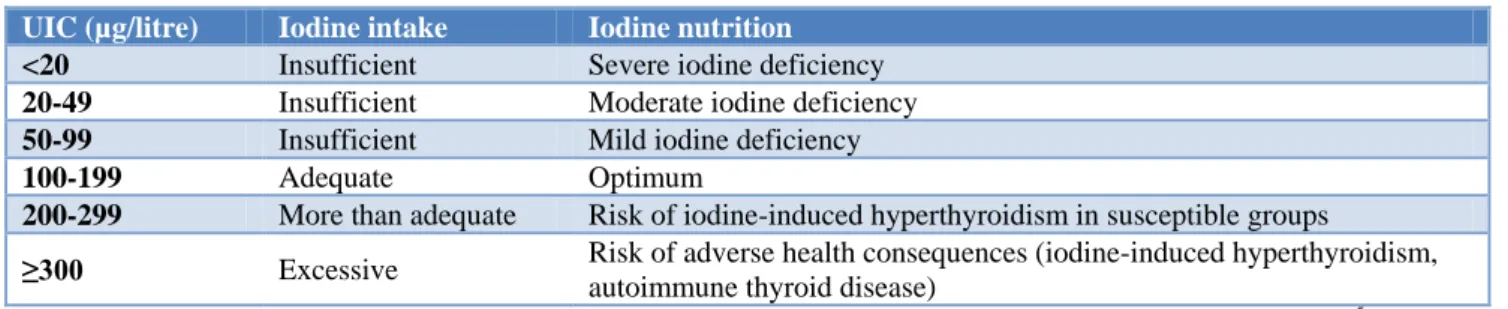
We used urinary iodine concentration (UIC) as an indicator of iodine status. Urinary iodine concentration was measured by ammonium persulfate digestion microplate (APDM) method.4 As per WHO guidelines on the basis of UIC, children were classified into different categories as shown in Table 1.5
Serum thyroid hormones i.e. free triiodothyronine (fT3),
free thyroxine (fT4) and thyroid stimulating hormone
(TSH) were used as an indicator of thyroid function status. Measurements of serum fT3, fT4 and TSH was
carried out by using ELISA commercial Kit from Diametra®. Normal reference range for thyroid hormones were fT3 (1.2–4.2 pg/ml), fT4 (0.8-2.2 ng/dl) and TSH
(0.39-6.16 mIU/L) according to kit manufacturer. Participants were classified as euthyroid, subclinical and overt hypo and hyperthyroid based on the thyroid hormone results. Data was entered in Microsoft excel 2013 and analyzed using SPSS version 21.0. Appropriate parametric and nonparametric tests were applied according to the distribution of data. P-value less than 0.05 was considered statistically significant.
RESULTS
Among the 200 school children enrolled in the study 54.5% (n=109) were male and 45.5% (n=91) were female. The mean age of the children was 10.13±1.66. Overall, the median UIC was 232.27 (129.9, 340.8) µg/L. The iodine status of primary school children showed that 15.5% were deficient in iodine, 48.5% were taking adequate iodine and 36% of children had excessive iodine nutrition status. The mean±SD of serum fT3 and fT4 and
median (IQR) of serum TSH concentrations was 2.87±0.52 pg/ml, 1.21±0.26 ng/dl and 3.03 (2.26, 4.34) mIU/L respectively. Thyroid function parameters across different iodine status group is shown in Table 2. The mean serum fT4 was lowest in the iodine deficient group
and the difference between the groups was statistically significant. Meanwhile median TSH was highest in the iodine excess group but the difference between the groups was not statistically significant.
Table 1: WHO classification of iodine nutrition status according to UIC.
UIC (µg/litre) Iodine intake Iodine nutrition
<20 Insufficient Severe iodine deficiency
20-49 Insufficient Moderate iodine deficiency
50-99 Insufficient Mild iodine deficiency
100-199 Adequate Optimum
200-299 More than adequate Risk of iodine-induced hyperthyroidism in susceptible groups
≥300 Excessive Risk of adverse health consequences (iodine-induced hyperthyroidism, autoimmune thyroid disease)
Adapted from Assessment of iodine deficiency disorders and monitoring their elimination: a guide for programme managers.5
Table 2: Different biochemical parameters according to iodine status.
Parameters Total (n=200)
Iodine status
Deficient UIC<100 µg/L (n=31)
Sufficient UIC 100- 199 µg/L (n=55)
Above requirement UIC 200-299 µg/L (n=42)
Excessive UIC ≥300 µg/L (n=72)
P value
UIC (µg/L) 232.27 (129.9,
340.8)
68.59 (41.94, 85.16)
150.51 (123.8, 175.27)
249.4 (228.05, 284.92)
366.16 (330.5,
403.37) <0.001
fT3 (pg/ml) 2.87±0.52 2.72± 0.42 2.93±0.48 2.87±0.6 2.88±0.55 0.357
fT4 (ng/dl) 1.21±0.26 1.09±0.28 1.24±0.26 1.26±0.24 1.2±0.26 0.03
TSH (mIU/L) 3.03 (2.26, 4.34) 2.9 (2.3, 4.19)
2.74
(2.18, 3.77) 3.01 (2.1, 4.38) 3.25
(2.46, 4.78) 0.10
Data expressed as mean±SD (fT3 & fT4), median (25th percentile, 75th percentile) UIC& TSH. P value was calculated at 95%
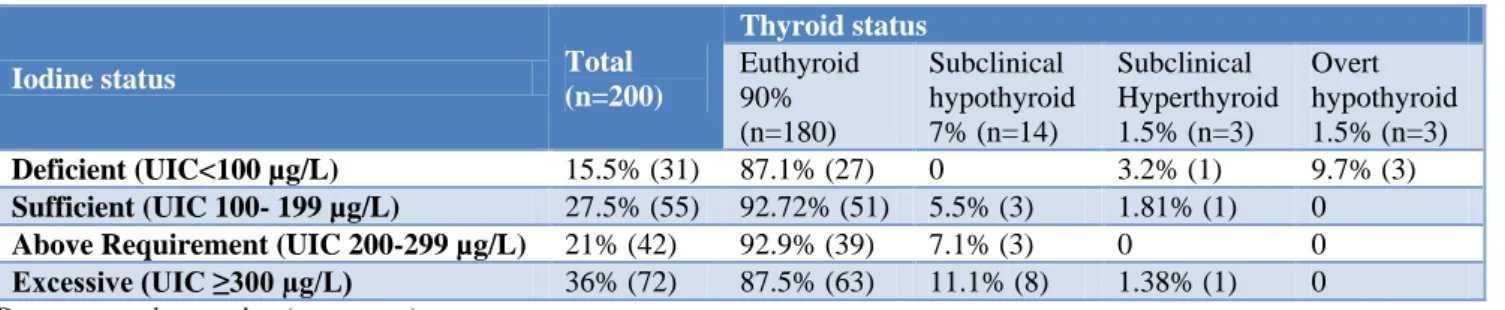
Table 3: Thyroid status across different iodine status group.
Iodine status Total
(n=200)
Thyroid status
Euthyroid 90% (n=180)
Subclinical hypothyroid 7% (n=14)
Subclinical Hyperthyroid 1.5% (n=3)
Overt hypothyroid 1.5% (n=3)
Deficient (UIC<100 µg/L) 15.5% (31) 87.1% (27) 0 3.2% (1) 9.7% (3)
Sufficient (UIC 100- 199 µg/L) 27.5% (55) 92.72% (51) 5.5% (3) 1.81% (1) 0
Above Requirement (UIC 200-299 µg/L) 21% (42) 92.9% (39) 7.1% (3) 0 0
Excessive (UIC ≥300 µg/L) 36% (72) 87.5% (63) 11.1% (8) 1.38% (1) 0
Data expressed as number (percentage).
The prevalence of thyroid dysfunction was 10% (20). The most common thyroid dysfunction found was subclinical
hypothyroidism 7% (14), followed by overt
hypothyroidism and subclinical hyperthyroidism. Most cases of subclinical hypothyroidism (n=8) had excess UIC as shown in Table 3.
Spearman’s rho correlation was applied between the thyroid parameters (fT3, fT4, and TSH) and UIC. The
correlation of UIC was very weakly positive with fT3
(r=0.094, p=0.184) but was not significant. Similarly, UIC was weakly positively correlated with fT4 and TSH (r=0.118, p=0.097) and (r=0.109, p=0.124) respectively but was not significant.
DISCUSSION
Iodine deficiency and excess both interfere with thyroid gland function.1 The median UIC in our study was 232.27µg/L which is indicative of above requirement level of iodine. Similar finding of above requirement level of iodine nutrition was also reported in national IDD survey in 20076 and various other sub-national surveys done in eastern Nepal.3,7-9
Our study showed that more than one third (36%) of children had UIC higher than 300 μg/L, which indicates excessive iodine nutrition. Similarly, 21% (42) had above requirement iodine status. Excess iodine nutrition in more than half of the participating children was also reported in studies done in various regions of eastern Nepal.3,7,8 These results demonstrate a possible transition in the iodine nutritional profile. Excessive iodine nutrition is mostly found in urban areas and could be due to the consumption of improperly monitored iodized salt. The average quantity of daily salt consumption should also be taken in account.
Overall, the mean serum fT3, fT4 and median TSH was
within reference range in our study. Similar finding of normal thyroid function parameters in similar age group was found in study done in Eastern Nepal and in New Zealand school children.7,10 We have also found non-significant difference in TSH concentration between iodine deficient, iodine sufficient and iodine excess groups.
The present study showed that the prevalence of thyroid dysfunction was 10% with majority of cases being subclinical hypothyroidism. Similarly, Chaudhari et al and Shakya et al have also reported higher prevalence of subclinical hypothyroidism among SAC in two district of eastern Nepal.3,7 The present study depicted higher prevalence of subclinical hypothyroidism among children with iodine excess. Similarly, various studies done in different parts of the world have also reported higher prevalence of subclinical hypothyroidism in iodine excess population.11-15 Compared with the adequate iodine intake level recommended by WHO/UNICEF/ICCIDD median
UIC (100–200µg/L), our data indicated that
UIC>300µg/L may increase the risk of developing hypothyroidism. This report differs from that of Shan et al who suggested that UIC of 200–300µg/L might be related to potentially increased risk of developing subclinical hypothyroidism.14
The exact mechanism by which chronic high iodine intake induces hypothyroidism remains unclear. Vitale et al and other experimental studies have revealed that high iodine intake damages endogenous thyroid peroxidase and induces apoptosis in these cells through a mechanism that involves the generation of free radicals, but whether the iodine-induced apoptosis contributes to chronic iodine-induced hypothyroidism is unknown.16,17
In the present study, no significant correlation was found between UIC and thyroid profile parameters. This was in accordance to the finding in study done by Skeaff et al in New Zealand school children.10 In contrast to our finding Chaudhari et al have shown weak negative correlation between TSH and UIC and weak positive correlations between UIC with fT3 and fT4.7 Johner et al found a
significantly positive association between UIC and TSH levels in a study done in thyroid-healthy children of Germany.18
concentration is the parameter recommended by the WHO to estimate iodine status of a population. The mean fT3, fT4, and TSH concentrations of the school children
fell within normal reference ranges, which was not unexpected as changes in these indices only occur in moderate to severe iodine deficiency or iodine excess for prolonged period.
There are several limitations of the present study. The sample size was small to proportionately reflect the iodine status of whole population as well as to see the correlation with thyroid parameters. Our study is cross sectional and therefore does not include individual changes over time.
Since the initiation of universal salt iodization program, there has been substantial progress towards the elimination of iodine deficiency disorder which used to be one of the major public health problem. Nepal is continuously moving towards the sustainable elimination of IDD but Iodine excess is occurring more frequently these days. It might be due to overconsumption or consumption of improperly monitored salt. Monitoring programs should be done at the community level to ensure optimal iodine nutrition status and prevent occurrence of iodine induced thyroid disorders.
ACKNOWLEDGEMENTS
We would kindly acknowledge B P Koirala Institute of Health Sciences (BPKIHS) for providing resources for the study.
Funding: No funding sources Conflict of interest: None declared
Ethical approval: The study was approved by the institutional ethics committee
REFERENCES
1. Sun X, Shan Z, Teng W. Effects of increased iodine intake on thyroid disorders. Endocrinology and Metabolism. 2014;29(3):240-7.
2. Network IG. Global Scorecard 2014: Number of iodine deficient countries more than halved in past decade. IDD newsletter, February. 2015.
3. Shakya PR, Gelal B, Baral N. High iodine intakes in school children in Eastern Nepal. IDD Newsletter. 2011;39(4):10-3.
4. Ohashi T, Yamaki M, Pandav CS, Karmarkar MG, Irie M. Simple microplate method for determination
of urinary iodine. Clinical chemistry.
2000;46(4):529-36.
5. World Health Organization. Assessment of iodine
deficiency disorders and monitoring their
elimination: a guide for programme managers. 2007. 6. National Survey and Impact Study for Iodine Deficiency Disorders (IDD) and availability of iodized salt in Nepal 2007. Kathmandu, Nepal: Ministry of Health and Population, Department of
Health Services, Government of India and Alliance Nepal, 2007.
7. Chaudhari RK, Gelal B, Brodie D, Baral N. Thyroid function & urinary iodine status in primary school age children of the hills & plains of Eastern Nepal. Indian pediatrics. 2012.
8. Khatiwada S, Gelal B, Shakya PR, Lamsal M, Baral N. Urinary iodine excretion among Nepalese school children in Terai Region. The Indian Journal of Pediatrics. 2016;83(1):15-7.
9. Nepal A, Gautam S, Khatiwada S, Shakya P, Gelal B, Lamsal M, et al. Iodine status of school age children in the two hilly districts Dhankuta and Tehrathum of Eastern Nepal. Sunsari Technical College J. 2013;1(1):38-41.
10. Skeaff SA, Thomson CD, Wilson N, Parnell WR. A
comprehensive assessment of urinary iodine concentration and thyroid hormones in New Zealand schoolchildren: a cross-sectional study. Nutrition J. 2012;11(1):31.
11. Szabolcs I, Podoba J, Feldkamp J, Dohán O, Farkas I, Sajgó M, et al. Comparative screening for thyroid disorders in old age in areas of iodine deficiency, long‐term iodine prophylaxis and abundant iodine intake. Clin Endocrinol. 1997;47(1):87-92.
12. Laurberg P, Pedersen KM, Hreidarsson A,
Sigfusson N, Iversen E, Knudsen PR. Iodine intake and the pattern of thyroid disorders: a comparative epidemiological study of thyroid abnormalities in the elderly in Iceland and in Jutland, Denmark. The J Clin Endocrinol Metabol. 1998;83(3):765-9. 13. Teng X, Shan Z, Chen Y, Lai Y, Yu J, Shan L, et al.
More than adequate iodine intake may increase
subclinical hypothyroidism and autoimmune
thyroiditis: a cross-sectional study based on two Chinese communities with different iodine intake levels. European J Endocrinol. 2011;164(6):943-50. 14. Shan ZY, LI YS, Wang ZY, Jin Y, Guan HX, Hu
FN. Effect of different iodine intake on the prevalence of hypothyroidism in 3 counties in China. 2005.
15. Laurberg P, Pedersen K, Vestergaard H, Sigurdsson G. High incidence of multinodular toxic goitre in the elderly population in a low iodine intake area vs. high incidence of Graves' disease in the young in a high iodine intake area: comparative surveys of thyrotoxicosis epidemiology in East‐Jutland
Denmark and Iceland. J Internal Med.
1991;229(5):415-20.
16. Vitale M, Di Matola T, D’ascoli F, Salzano S, Bogazzi F, Fenzi G, et al. Iodide excess induces apoptosis in thyroid cells through a p53-independent mechanism involving oxidative stress. Endocrinol. 2000;141(2):598-605.
17. Man N, Guan H, Shan Z, Li Y, Fan C, Guo X, et al. Long-term effects of high iodine intake: inhibition of thyroid iodine uptake and organification in
Wistar rats. Zhonghua yi xue za zhi.
18. Johner SA, Thamm M, Stehle P, Nöthlings U, Kriener E, Völzke H, et al. Interrelations between thyrotropin levels and iodine status in thyroid-healthy children. Thyroid. 2014;24(7):1071-9. 19. Rasmussen LB, Ovesen L, Bülow I, Jørgensen T,
Knudsen N, Laurberg P, et al. Relations between various measures of iodine intake and thyroid
volume, thyroid nodularity, and serum
thyroglobulin. American J Clin Nutr.
2002;76(5):1069-76.