VOLUME 17 ISSUE 2 (2019), Page 267 – 279
AWARENESS AND KNOWLEDGE OF TPO (ACT 172) AMONG
CONSTRUCTION INDUSTRY PROFESSIONALS AND LOCAL
PLANNING AUTHORITY PERSONNEL IN KLANG VALLEY
Nik Adlin Nik Mohamed Sukri1, Wan Tarmeze Wan Ariffin2
& Noriah Othman3
1,2Development Project Management FOREST RESEARCH INSTITUTE MALAYSIA
3Faculty of Architecture, Planning and Surveying UNIVERSITI TEKNOLOGI MARA
Abstract
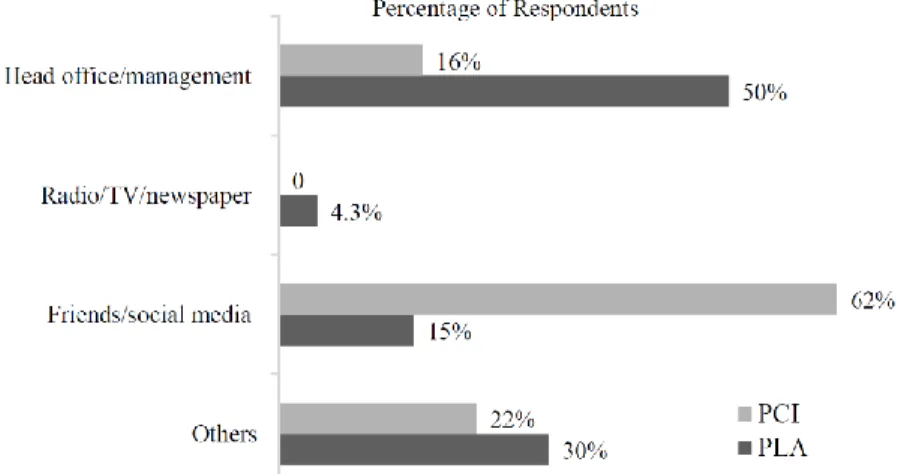
The need to care for trees, especially in urban areas, has become increasingly important for countries like Malaysia which are developing rapidly. Recognising the fact that construction activities could put trees at risks of death and damage, the Malaysian government introduced Tree Preservation Order (Act 172) in 1996. However, there were cases occurred afterwards whereby matured trees had been cut down for development without consent of the local authorities. This situation has raised many questions about the effectiveness of the TPO (Act 172) implementation, including on how far the TPO (Act 172) has been publicised and understood by those related to the construction industry, a pre-requisite for successful legislative implementation. This study assesses the current awareness and knowledge of the TPO (Act 172) among 60 professionals in the construction industry (PCI) and 47 personnel in local authorities (PLA) within Klang Valley through a questionnaire survey. The results show that the awareness level of TPO (Act 172) among PLA respondents was higher than that of PCI. While most of the PLA got acquainted with the TPO (Act 172) through their organisations, most of the PCI learned it from friends and social medias. It is recommended that the government should be more active in publicising the TPO (Act 172) such as through mass media and awareness campaigns.
INTRODUCTION
In 2016, the value of Malaysian construction projects was reported to reach RM83 billion (Kaur, 2015). Mega construction projects that are being carried out in big cities such as Kuala Lumpur and the surrounding municipalities could increase the possibility of tree damage, and to certain extent, of tree death, if care was not taken. Most of the irregularities and mistakes during construction work that threaten the trees can be avoided through appropriate construction project management, which includes the planning and execution of project activities (Ziemiańska & Suchocka, 2013).
Malaysia has introduced Tree Preservation Order (TPO) in the Town and Country Planning Act 1976 that gives power to the local authorities to preserve any tree or a group of trees and to protect the tress from being felled, topped, lopped, uprooted, damaged or destroyed, for instance, during construction or as the results of development activities. By implementing the TPO (Act 172), it is expected that all the involved parties have understood the order and that all trees are protected during construction projects. However, as elaborated by Nik Adlin, Noriah and Wan Termeze (2017), there have been cases from time to time, such as of the Melaka Raya in 2015 and of the Jalan Cochraine in 2016, in which matured trees were felled without the local authorities’ consent. Such cases have raised questions on whether or not TPO has been effectively implemented.
Houde (1997) suggests that for a tree preservation law to be effective, each staff in a local authority must be aware of requirements of tree preservation. In the context of Malaysia, it is important to ensure that the TPO (Act 172) is well understood by the local authorities before it is enforced to the construction industry for better protection of trees. With this in mind, a study was conducted, through a questionnaire survey, on the stakeholders of the public and private sectors related to construction activities to determine their awareness and knowledge on TPO (Act 172). The results could give some insights on the status-quo of publicity efforts carried out by the relevant government agencies to ensure that TPO (Act 172) is well understood by the public, and especially those in the construction industry.
MATERIALS AND METHODS
Questionnaire Survey
Survey Respondents
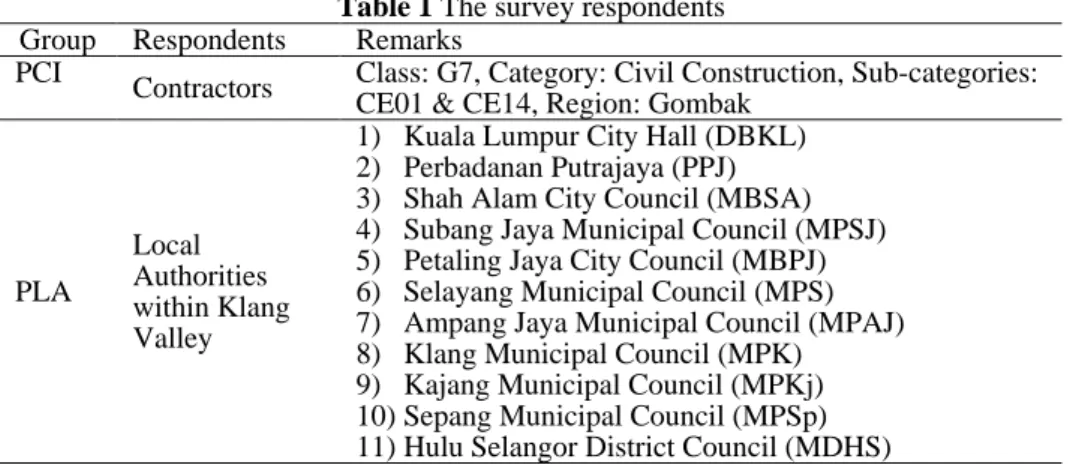
Information about companies (contractors) in the construction industry within Klang Valley was obtained through CIDB website (http://smb.cidb.gov.my). To ease the logistic (nearby the main author’s office), only contractors in Gombak area were surveyed. They were from the G7 class of Civil Construction category and of CE01 Road & Pavement Works (Pembinaan Jalan dan Pavmen) and CE14 Landscapes Works (Landskap di Luar Bangunan) sub-category groups (Table 1). These two sub-category groups were selected because they would be the ones who had to deal with decisions regarding the existing trees at the construction sites.
Table 1 The survey respondents
Group Respondents Remarks
PCI
Contractors Class: G7, Category: Civil Construction, Sub-categories: CE01 & CE14, Region: Gombak
PLA
Local Authorities within Klang Valley
1) Kuala Lumpur City Hall (DBKL) 2) Perbadanan Putrajaya (PPJ) 3) Shah Alam City Council (MBSA) 4) Subang Jaya Municipal Council (MPSJ) 5) Petaling Jaya City Council (MBPJ) 6) Selayang Municipal Council (MPS) 7) Ampang Jaya Municipal Council (MPAJ) 8) Klang Municipal Council (MPK)
9) Kajang Municipal Council (MPKj) 10) Sepang Municipal Council (MPSp) 11) Hulu Selangor District Council (MDHS)
The CIDB website accessed on February 2017 showed that they were 77 companies listed in the groups. Out of the 77, 23 companies were not shortlisted because their registered addresses were not in Gombak, but somewhere else in Puchong, Kelang, Petaling Jaya, Seri Kembangan, Puncak Alam, Cheras and Shah Alam. The rest of the companies were contacted through phone calls. 51 of the companies said that they were willing to participate and arrangement were made to deliver the PCI survey questionnaire forms by hand. Two survey forms were then delivered to each of these companies. From the 102 copies, only 60 PCI survey forms were answered and returned (collected at sites).
distributed, the study was able to get back 47 PLA survey forms. Many of the survey forms had not been returned because some of the targeted respondents were working outside of the office.
Questionnaire Form
The questions asked and the choices of answer in the survey form are as shown in Table 2. The questions were grouped into five, each with different intentions: a) as pre-requisite (Q1), b) to know the sources of information (Q2), c) confirming the knowledge (Q3 to Q6), d) to reinstate the good attitude towards trees and the importance of the TPO (Act 172) (Q7), and e) to allow self-evaluation by the respondents (Q8).
Table 2 Questions and the choices of answer
No. Question Choices of aAnswer
Q1
Do you know or have heard of the Tree Preservation Order?
a. Yes b. No
Q2
How do you know TPO or where have you heard about it? (can choose more than one answer)
a. Head office/management b. Radio/TV/newspaper c. Friends/social media d. Others
Q3 TPO (Act 172) is part of the following Act:
a. Akta Bandaraya Kuala Lumpur 1971
b. Akta Kualiti Alam Sekitar 1974
c. Akta Perancangan Bandar dan Desa 1976
d. Combination of the above Acts
Q4 TPO is an order: (can choose more than one answer)
a. Not to cut down all trees b. Not to cut down preserved trees c. Not to cut down trees of a girth > 0.8 m d. To cut down dead trees
e. To cut down dangerous trees
f. To replace the trees that have been cut down
Q5
In the TPO (Act 172), ‘felling a tree’ includes cutting down, topping, lopping, uprooting, damaging or destroying a tree.
a. Agree b. Disagree
Q6
If found guilty of violating the rules of the TPO, one can be (can choose more than one answer)
a. Fined RM100,000 b. Jailed for 6 months
c. Fined RM100,000 and jailed for 6 months d. Fined not more than RM10,000
e. Jailed for not more than 6 weeks
Q7
Trees are important, therefore I agree that (can choose more than one answer)
a. The TPO is implemented by the Govt. b. The developers and contractors are to
c. The Govt is to ensure that the TPO and the regulations are understood by the people
Q8
The level of my knowledge and understanding of TPO are:
a. High b. Medium c. Low
The first question was very straightforward, and the answer would decide whether or not the respondent’s next answers were to be taken into consideration. In other words, if a respondent answered “No” for question number 1, then the rest of his answers would not be used. Question number 2 was to know how the respondents were informed about the TPO (Act 172), whether from their organisation, mass-media (radio, TV, newspaper), friends (social media) or other sources. The given choices of answer would provide bases in determining the effectiveness of roles played and methods used by the respective parties responsible for the publicity of the TPO (Act 172).
Questions number 3 to 6 were designed to evaluate whether or not the respondents have read or seen statements of the TPO (Act 172). If they had, albeit briefly, then the selected answer for question number 3 must be “c. Akta Perancangan Bandar dan Desa 1976” (Town and Country Planning Act 1976). Those who have answered other than “c.” could be considered as never read or seen the TPO (Act 172) statements. The logic behind this assumption was that the TPO (Act 172) is part of the Akta Perancangan Bandar dan Desa 1976, thus without reading the Act 172, one would not have an idea about the Tree Preservation Order.
For questions 4 to 6, only those who understood the TPO (Act 172) statements, whether generally or thoroughly, could select the right answers. For example, in question 4, the most accurate answer is “b. Not to cut down preserved trees” (see clause 35A (1) and (2a) on page 60 of the Act 172). Furthermore, for question 5, the respondents who had thoroughly read and understood the TPO (Act 172) (Laws of Malaysia, 2006), especially the clause “felling a tree” includes cutting down, topping, lopping, uprooting, damaging or destroying a tree;” of Part 1 Interpretation 2. (1) on page 10 could pick the right answer which is “a. Agree”. Question 6 was related to the clause 35A (4) on page 61 which says “Any person who contravenes any provision in the tree preservation order commits an offence and is liable, on conviction, to a fine not exceeding one hundred thousand ringgit or to imprisonment for a term not exceeding six months or to both.”. As such, the right answers for question 6 are “a.”, “b.”, and “c.”.
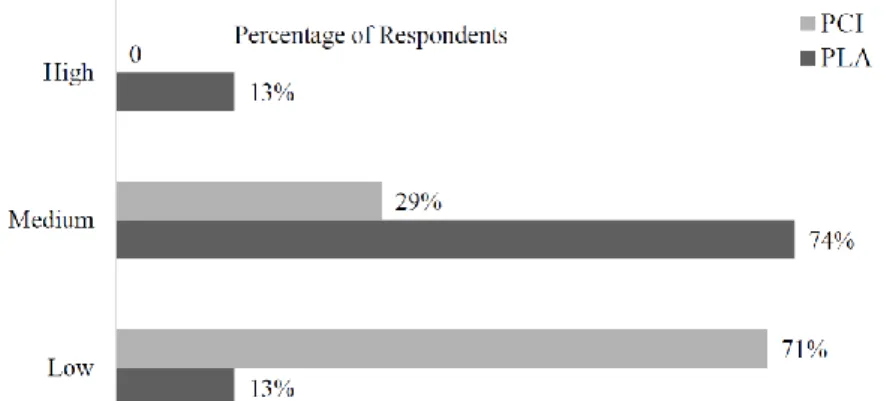
medium or low. However, regardless of what level they think they were at, their answers for questions 3 to 6 could validate or invalidate their claims.
RESULTS AND DISCUSSION
Demographic Profile of Respondents
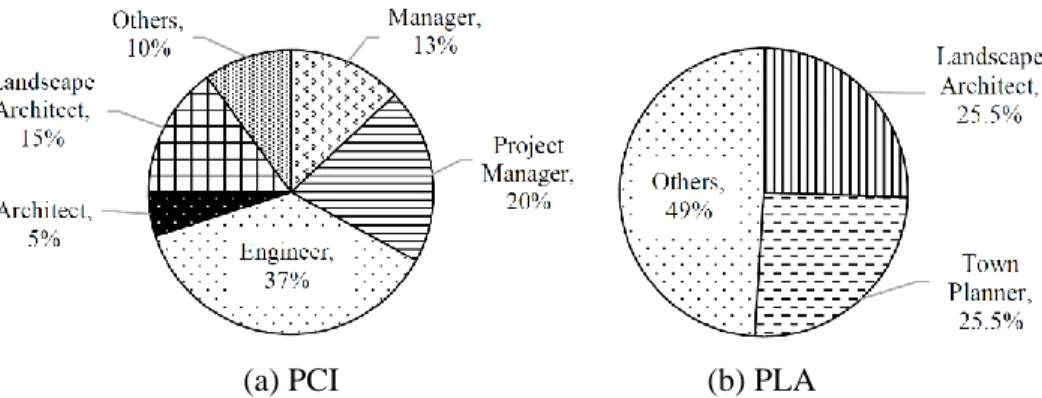
In terms of gender, most of the PCI respondents were male (87%) and 55% had more than 10 years of experience. The biggest group in post category was Engineer (37%), followed by Project Manager (20%), Landscape Architect (15%) and Manager (13%). Others were either Clerk of Work, Assistant Engineer or Technical Assistant (Figure 1(a)).
Figure 1 Post of respondents: (a) the construction industry and (b) the local authorities
Unlike those of PCI, the PLA respondents were consisted of slightly more female (53%) than male and almost half (47%) of them had been working for more than 10 years. By post, the numbers of Landscape Architect and Town Planner were equal and they made up more than half (51%) of the total respondents (Figure 1(b)). They could be from the departments of landscape and of town planning, respectively. Other respondents (49%) from the both departments and other tree related departments were Assistant Landscape Architect, Assistant Agriculture Officer, Assistant Town Planner, Park Manager, Arborist and Agriculture Officer.
Questionnaire Results
The results of the questionnaire survey for both PCI and PLA were compared (in terms of percentage) and are as shown in Figure 2 to Figure 9.
Basic Awareness of TPO (Act 172) – Q1
The answers to the first and straightforward question (Figure 2) reveal that 5 respondents (8%) and 1 respondent (2%) from PCI and PLA, respectively, declared that they did not know and have not heard about the TPO (Act 172), thus their answers for the next questions were ignored. Therefore, for the rest of questions, answers from only 55 PCI respondents and 46 PLA respondents were taken into account.
Figure 2 Respondents awareness of TPO (Act 172) (Q1)
Sources of the TPO (Act 172) Information – Q2
Figure 3 Sources of TPO (Act 172) information learnt by the respondents (Q2)
Testing the Knowledge on TPO (Act 172) – Q3 to Q6
Perhaps, the best way to test whether or not a person have read the TPO (Act 172) document is by asking what Act the TPO is under (Q3). Those who have read the document should know the right answer, which is the Akta Perancangan Bandar & Desa 1976 (Town and Country Planning Act 1976). As shown in Figure 4, the percentage of the respondent who ticked the correct answer were significantly different between PCI and PLA, which were 10% and 80%, respectively. These facts imply that even though most respondents from the construction industry have heard about the TPO (Act 172), most of them have not read the TPO (Act 172) document. As for PLA, the high percentage proves that the respondents have undertaken more formal learning or courses on the TPO (Act 172), probably organised by their bosses.
Figure 4 Respondents answers when asked which Acts the TPO is under (Q3)
The answers for Q5 (Figure 6) were again could reflect how the respondents, especially in the PLA group, got it right – basically because they have read the TPO (Act 172). The percentage (83%) was very close to that of the correct answer for Q3 (80%). Furthermore, about two-third of PCI respondents (67%) also guessed it correctly, even though they were presumed (through their answers for Q2) to never have read the TPO (Act 172) document. Perhaps, instinctively, the PCI respondents understood the basic principle of the TPO (Act 172), therefore trees that are meant to preserved must be protected not only from being felled, but from being damaged as well.
Figure 6 Respondents answers when asked if the term ‘felling a tree’ in the TPO (Act 172) document is to include ‘cutting down, topping, looping, uprooting, damaging
or destroying a tree’ (Q5)
Figure 7 displays the answers for the question (Q6) regarding court punishments for those who have violated the rules of the TPO (Act 172). For those answers ‘a., b. and c.’ are all correct but those who also answered ‘d.’ or ‘e.’ could be considered failing to answer the question rightly. For PCI, 20% of the respondents answered ‘d’, while for PLA 22% got it wrong. This results could imply that many have yet to realise the fact that violations of TPO (Act 172) rules are considered as very serious offences by the government, therefore heavy punishment must be imposed, both in terms of fine and jail.
The Importance of Trees and the TPO (Act 172) – Q7
Figure 7 Respondents answers when asked about the punishments for those who violate the rules of the TPO (Act 172) (Q6)
Figure 8 Respondents answers regarding the TPO (Act 172) implementation, compliance and promotion (Q7)
Self-Evaluation: Level of TPO (Act 172) Knowledge – Q8
the other hand, most of PLA respondents (74%) have ticked ‘medium’ level and the rest of them have declared ‘low’ (13%) and ‘high’ (13%).
Figure 9 Level of knowledge on the TPO (Act 172) declared by the respondents (Q8)
SUMMARY OF FINDINGS AND CONCLUSION
With regards to the awareness, in general, it was found that most of the respondent knew the existence of the TPO (Act 172) introduced by the government. Furthermore, the findings suggest that while most of respondents from the local authorities (PLA) have read the TPO (Act 172) document, most of those from construction industry (PCI) have not. Both groups of respondents have displayed positive attitudes towards the importance of trees and the TPO (Act 172) but PLA respondents had more confidence about their knowledge on the TPO (Act 172).
ACKNOWLEDGEMENT
The authors would like to extent their sincere gratitude towards all the construction companies and the local authorities for allowing their staff to participate in the survey.
REFERENCES
Houde, J. (1997). Public property tree preservation. Journal of Arboriculture, 23(2), 83-86.
Kaur, G. (2015, December 29). Construction sector to be busy in 2016 with projects worth
RM83bil. The Star Online. Retrieved from
https://www.thestar.com.my/business/business-news/2015/12/29/jobs-flow-to-drive-construction-sector
Nik Adlin, N. M. S., Noriah, O., & Wan Tarmeze, W. A. (2017). A Review on the needs to improve Malaysian Tree Preservation Order (TPO) (ACT 172). Planning
Malaysia, 15(4), 105-114.
Ziemiańska, M., & Suchocka, M. (2013). The planning and principles of tree protection in the investment process. Sustainable Development Applications, 4, 11-25