Efficient Constraint Validation for Updated XML Databases
Béatrice Bouchou, Ahmed Cheriat and Mírian Halfeld Ferrari Université François-Rabelais de Tours/Campus Blois - LI - France
E-mail: [email protected], [email protected], [email protected] Dominique Laurent
Université de Cergy-Pontoise - ETIS - UMR CNRS 8051 - France E-mail: [email protected]
Maria Adriana Lima
Pontifícia Universidade Católica de Minas Gerais - Poços de Caldas - Brazil E-mail: [email protected]
Martin A. Musicante
Universidade Federal do Rio Grande do Norte - DIMAp - Natal - Brazil E-mail: [email protected]
Keywords:XML, schema, constraints
Received:May 12, 2006
XML constraints are eitherschema constraintsrepresenting rules about document structure (e.g.a DTD, an XML Schema definition or a specification in Relax-NG), orintegrity constraints, which are rules about the values contained in documents (e.g. primary keys, foreign keys, etc.).
We address the problem of incrementally verifying these constraints when documents are modified by updates. The structure of an XML document is a tree, whose nodes are element (or attribute) names and whose leaves are associated to values contained in the document. Considered updates are insertion, deletion or replacement of any subtree in the XML tree. Schema constraints are represented by tree automata and tree grammars. Key and foreign key constraints are represented by attribute grammars, adding semantic rules to schema grammars, to carry key and foreign key values (to verify their properties).
Our incremental validation tests both schema and integrity constraints while treating the sequence of up-dates, in only one pass over the document. Only nodes involved in updates trigger validation tests. An analysis of complexity shows that worst cases are determined by the shape of the XML tree being pro-cessed (asymptotic upper bounds are presented). Experimental results show that our algorithms behave efficiently in practice.
Povzetek: Opisana je inkrementalna verifikacija podatkovnih baz XML.
1 Introduction
XML is now a standard for exchanging data and, by exten-sion, for representing information. For reliable exchange as well as for information system design, it is necessary to define rules that data must conform to.
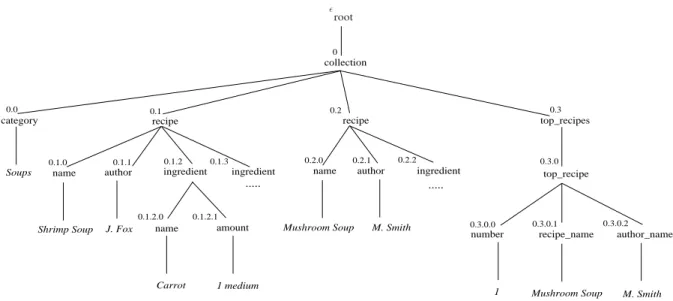
XML documents can be represented as unranked trees: nodes are identified by a position and associated to a la-bel, which is the name of an element or an attribute. Our tree representation of an XML document is exemplified in Fig.1. This figure shows the representation of part of an XML document, which will be used in some of our exam-ples. Notice that the data values in the XML document appear as leaves of its tree representation.
XML documents can be constrained either by struc-tural rules or semantic rules. Rules about the structure of documents are called a schema: there are several for-malisms to express these constraints, e.g. DTD, XML
Schema (XSD) [4] or Relax-NG [41]. It is a well known fact that a schema can be represented by a tree grammar. From this grammar, it is easy to derive a tree automa-ton [20, 43]: the validation of the document wrt the schema is the run of this tree automaton over the XML tree.
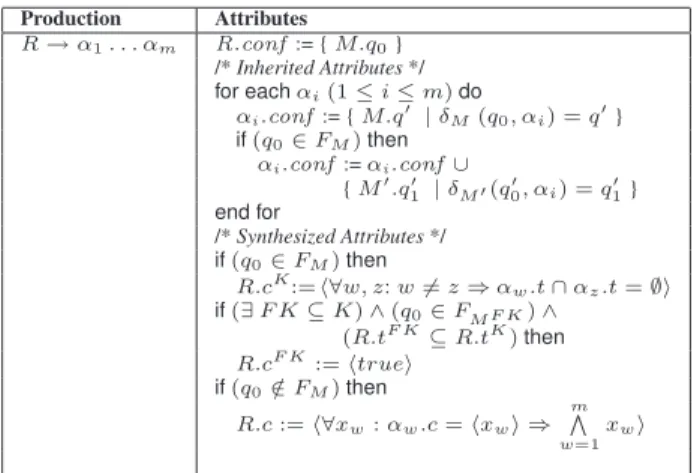
Integrity constraints impose restrictions to the values that may appear in XML documents. Integrity constraints (e.g., primary and foreign keys) are devised to improve the se-mantic expressiveness of XML, in the same way as their counterpart in relational databases. In this paper we pro-pose to represent integrity constraints by attribute gram-mars [8, 40], adding semantic rules to schema gramgram-mars, to carry key and foreign key values (to verify their proper-ties).
We address the problem of incremental validation of
corre-spond to the insertion, the deletion and the replacement of subtrees ofT. They are results of a user request’s pre-processing. A user can modify an XML document either by using a text editor such asXmlSpy[1] orStylus studio[46], or by means of a program, written in an update language such asXSLT[26] orUpdateX[47], which is embedded in XQuery [16].
In the case of a text editor, different scenarios are pos-sible: validity is tested while the user changes his docu-ment (this method is cumbersome and not realistic since it implies verification after each change) or validity tests are explicitly activated (by the user) after the performance of several changes. In the latter context, some updates can be “subsumed” by others (e.g., the user can build or change a part of the document and finally delete it). Thus, before ap-plying anincrementalvalidation method one should define which updates are to be taken into account. To this end, one can either use pre-processing over the set of changes per-formed by the user or compute the difference between the last verified version and the current (modified) one. In both cases, the overhead caused by this pre-processing may be greater than incremental validation profit, this is why most of the existing XML editors apply a complete re-validation. The use of a language to specify updates open different possibilities of work. Considering the integration of such an approach to a text editor framework, we may imagine that an update language editor would be capable of spec-ifying update positions and then our algorithms would di-rectly apply. More generally, an update language allows to specify updates such as, for example: increment by 10 percents all accounts of a given consumer. Thus, it allows to manage XML documents from a database point of view. To this end, update languages integrated in XQuery are the most promising solutions. The W3C has edited a first pub-lic working draft onXQuery Update Facility[22]: it recom-mends that the evaluation of any expression produces either a new XML document or a pending update list, which is a set of update primitives. An update primitive has a target node and consists in insertions, deletions or replacements to be operated at this node (or just before, or just after or just under this node, in case of insertions). The update list can be held in wait until an operation (upd:applyUpdate) is performed. An operation of validation (upd:revalidate) must exist.
Update operations considered in this paper can be seen as updates in such an update pending list.
Only updates that do not violate constraints are accepted. Thus, before applying updates on a valid tree, we need to test whether these updates do not violate the validity of the tree. The goal of an incremental validation method is to perform these tests without testing the entire tree, but just the part of it which is concerned by the updates. In accor-dance with thesnapshot semantics[14, 47], document va-lidity is assured just after considering thewholesequence of updates. The snapshot semantics consists in delaying update application to the end of query evaluation. In this
way, all updates always refer to the original document1. In the following, we roughly explain how the incremen-tal validation tests are performed. LetUpdateTablebe the sequence of updates to be performed on an XML tree T. To visit T we proceed in a depth-first visit of the XML document, triggering tests and actions according to the re-quired updates (in UpdateTable). To simplify our expla-nation, schema and integrity constraints are treated as sep-arated sub-routines. A system that makes these routines work together is a simple generalization of the one pre-sented in this paper. The sub-routines can be summarized as follows.
Schema constraint routine:
•When an update node is reached, the required update is taken into account (considered as done). Nodes which are descendant of update nodes are skipped i.e., they are not treated.
•For each nodepwhich is an ascendant of an update posi-tion avalidation stepis activated when reaching the close tag corresponding top. A validation step at positionp ver-ifies whetherp’s children (in the updated tree version) spect schema constraints. For instance, if a sequence re-quires updates on positions0.1.2and0.3of Fig. 1 then a validation step is activated on nodes0.1,0and².
• All other nodes (those that are not on the path between the root and an update position) are skipped,i.e., no action is triggered on them.
Integrity constraint routine:
•Similarly to the schema constraint routine, when an up-date node is reached, the required upup-date is taken into account (considered as done). However, contrary to the schema constraint routine, in the integrity constraint rou-tine the removal of a subtree (rooted at an update position p) triggers the subtree traversal for searching key and for-eign key values involved in the update. For instance, con-sider a key constraint on the document of Fig. 1 establish-ing that in acollection, arecipeis uniquely identified by itsnameandauthor. We assume that a deletion is required at position 0.1. The deletion “treatment” is activated (in order to find key values) when the open tag<recipe>is reached. After the traversal of the subtree rooted at position 0.1,i.e., when reaching the close tag </recipe>a ver-ification test is performed. This test consists in checking whether the key valuehShrimp Soup, J.F oxi(involved in the deletion) is referenced by a non deleted foreign key. To perform this test the routine uses an auxiliary struc-ture (calledkeyTree) created during the first key validation (from scratch). During the tree traversal necessary to ana-lyze an update sequence, some marks can be inserted into thekeyTreeto indicate that the document is temporarily in-valid. A subsequent update in the same transaction can re-establish validity and remove the mark.
1The language XQuery! (“XQueryBang”) [33] extends XQuery 1.0 with compositional updates, offering user-level control over update appli-cation. The user controls update semantics via an operator called“snap”
0.1.2
0.3.0.2 0.3.0.1
0.3.0.0 0.1.2.1
0.1.2.0
0.3.0 0.2.2
0.2.1 0.2.0 0.1.3
0.1.1 0.1.0
0.3 0.2
0.1 0.0
number author
name
name author name
Soups
category
0
...
collection
recipe recipe top_recipes
J. Fox Shrimp Soup
ingredient
...
ingredient
amount
Carrot 1 medium
Mushroom Soup M. Smith
ingredient
recipe_name
Mushroom Soup 1
top_recipe
author_name
M. Smith
root
²
Figure 1: Tree representation of an XML document.
•When reaching the root, a final test verifies if any viola-tion mark exists inkeyTree(i.e., a constraint violation not corrected until the end of the traversal).
•All other nodes are skipped. 2
XML trees are treated in the style of SAX [3], in order to allow the treatment of much bigger XML documents [42]2. This choice implies a complete XML tree traversal but it avoids the use of an auxiliary structure for incrementally verifying some kinds of schema constraints. It is worth noting that, although our algorithm visits all nodes in the XML tree, only some nodes trigger validation actions while others are just “skipped” (i.e., no action is activated when reaching them). The cost of skipping nodes is not rele-vant when compared to the cost of validation actions. Thus, in Sections 3.2 and 4.3 we consider the complexity of our method only wrt the total number of validation actions that should be performed.
The algorithms presented in this paper have been imple-mented in Java, and experimental results demonstrate ad-vantages of the incremental schema verification over the verification from scratch, for multiple updates over large XML documents. Experimental results obtained with our key and foreign key validation routines are also good, de-spite their theoretical complexity: curves grow almost lin-early with the size of the processed document. Tests for the incremental key verification programs give even better results than those for the verification from scratch.
The main contribution of this paper is the integration of incremental schema, key and foreign key validation, while dealing with multiple updates. It extends our previous work [7, 17, 18] not only in this aspect but also in the use of attribute grammars to deal with integrity constraint veri-fication.
2It is also possible to consider our routines in a DOM context. In this case space requirements are bigger, but time complexity can be smaller.
By dealing with unranked trees, usually much shorter than the binary ones, the complexity of our incremental schema validation method happens to be similar to the one proposed in [11, 45]. However, contrary to [11, 45], our update operations can be applied at any node of the XML tree and auxiliary structures are not necessary when using DTD and XSD. In terms of key validation, our proposition is close to [23], but contrary to them, we treat foreign keys and multiple updates. Moreover, our routines for schema validation and integrity constraint verification can work si-multaneously.
This paper is organized as follows. Section 2 introduces some necessary concepts. In Section 3 we consider the validation wrt schema constraints while in Section 4 we present our validation method wrt key and foreign key con-straints. In section 5 we conclude and discuss some per-spectives.
2 Background
An XML document is an unranked labeled tree where: (i) the XML outermost element is the tree root and(ii)every XML element has its sub-elements and attributes as chil-dren. Elements and attributes associated with arbitrary text have adatachild. Fig. 1 shows an XML tree.
To define our trees formally, letU be the set of all finite strings of positive integers (which usually we separate by dots) with the empty string ² as the identity. The prefix relationinU, denoted by¹is defined by:u¹viffu.w= vfor somew∈U.
Now, ifΣis an alphabet then aΣ-valued treeT (or just a tree) is a mapping T : dom(T) → Σ, wheredom(T) is a tree domain. A finite subset dom(T) ⊆ U is a (fi-nite) tree domain if: (1) u ¹ v, v ∈ dom(T)implies u ∈ dom(T)and(2) j ≥ 0, u.j ∈ dom(T),0 ≤ i ≤
Each tree domain may be regarded as an unlabeled tree,
i.e., a set of tree positions. We write T(p) = aforp ∈ dom(T) to indicate that the symbolais the label inΣ as-sociated with the node at positionp. For XML trees,Σis composed by element and attribute labels together with the labeldata. We consider the existence of a functionvalue
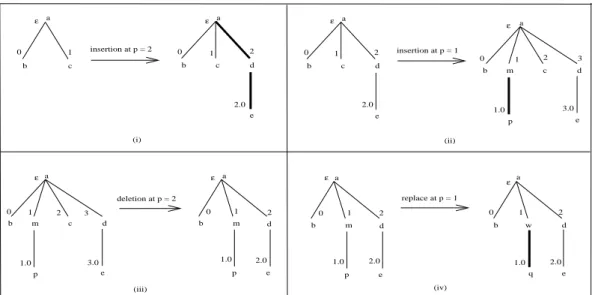
that returns the value associated with a givendatanode. Let T be an XML tree, valid wrt some integrity and schema constraints, and consider updates on it. We assume three update operations (insert,deleteandreplace) whose goal is to perform changes on XML trees. Fig. 2 illustrates the individual effect of each update operation overT.
In this paper we are interested in multiple updates,i.e., we suppose an input file containing a sequence of update operations that we want to apply over an XML tree The effective application of this sequence of updates depends on its capability of preserving document validity. In other words, a valid XML tree is updated (according to a given update sequence) only if its updated version remains valid. The acceptance of updates relies onincremental validation,
i.e., only the validity of the part of the original document directly affected by the updates is checked.
A sequence of updates is treated as one unique transac-tion,i.e., we assure validity just after considering the whole sequence of updates - and not after each update of the se-quence, independently. In other words, as a valid docu-ment is transformed by using a sequence of primitive oper-ations, the document can be temporarily invalid but in the end validity is restored. This extends our previous work in [7, 17, 18] and follows the ideas in [14, 47].
LetU pdateT ablebe the relation that contains updates to be performed on an XML tree. Each tuple inU pdateT able contains the information concerning the update positionp and the update operationop. In this paper we assume that U pdateT ableis the result of a pre-processing over a set of updates required by a user. In the resultingU pdateT able the following properties hold:
P1- An update position in anU pdateT ablealways refers to the original tree. Consider for instance the tree of Fig. 1. In anU pdateT ablean insertion operation refers to position 0.3even if a deletion at position0.1precedes it.
P2-An update on a positionpexcludes updates on descen-dants ofp. In other words, there are not inU pdateT able two update positionspandp0such thatp¹p0.
P3-U pdateT ablethen one of the operations involvingp can bereplaceordelete, but all others areinsert.
P4- Updates in anU pdateT ableare ordered by position, according to the document order.
3 Schema verification
A tree automaton can be built from a schema specified us-ing schema languages such as DTD, XSD or RELAX NG. In our approach, we use a bottom-up unranked tree automa-ton capable of dealing with both (unordered) attributes and (ordered) elements in XML trees [17].
Definition 1 - Non-deterministic bottom-up finite tree
automaton: A tree automaton over Σ is a tuple A =
(Q,Σ, Qf,∆) where Qis a set of states, Qf ⊆ Q is a set of final states and∆ is a set of transition rules of the forma, S, E → qwhere(i)a∈ Σ;(ii)S is a pair of dis-joint sets of states,i.e.,S = (Scompulsory, Soptional)(with Scompulsory ⊆QandSoptional ⊆Q);(iii)E is a regular
expression overQand(iv)q∈Q. 2
The tree automatonAobtained from a schema specifica-tionDmay have different characteristics according to the schema language used for D. These characteristics, dis-cussed below, match the taxonomy of regular tree gram-mars introduced in [42].
LetA= (Q,Σ, Qf,∆)be a tree automaton. Two differ-ent statesq1 andq2 inQarecompetingif∆contains dif-ferent transition rules (a, S1, E1→q1anda, S2, E2→q2) which share the same labela. Notice that we assume that no two transition rules have the same state in the right-hand side and the same label in the left-hand side, since two rules of this kind can be written as a single one. A regular ex-pressionEin a transition rulerestrains competitionof two competing statesq1andq2if for any sequence of statesαU, αV, andαW, eitherαUq1αV orαUq2αW fails to matchE. Based on the concepts of competing states and competition-restrictive regular expressions, regular tree languages are classified as follows:
C1−Regular tree languages (RTL): A regular tree lan-guage is a lanlan-guage accepted by any tree automaton spec-ified by Definition 1. The automaton obtained from a spe-cialized DTD recognizes languages in this class.
C2−Local tree languages(LTL): A local tree language is a regular tree language accepted by a tree automaton that does not have competing states. This means that, in this case, each label is associated to only one transition rule. The automaton obtained from a DTD recognizes languages in this class.
C3− Single-type tree languages (STTL): A single-type tree language is a regular tree language accepted by a tree automaton having the following characteristics: (i) For each transition rule, the states in its regular expression do not compete with each other and (ii) the set Qf is a sin-gleton. The combination of these two characteristics im-plies that although it is possible to have competing states, the result of a successful3execution of such an automaton can consider just a single type (state) for each node of the tree. The automaton obtained from a schema written in XSD recognizes languages in this class.
C4− Restrained-competition tree languages (RCTL): A restrained-competition tree language is a regular tree lan-guage accepted by a tree automaton having the following characteristics: (i) For each transition rule, its regular ex-pression restraints competition of states and (ii) the setQf is a singleton. No schema language proposed for XML is classified as a RCTL.
3.0
(iv) (iii)
(ii) (i)
replace at p = 1 deletion at p = 2
insertion at p = 1 insertion at p = 2
ε ε ε
ε ε
ε a
ε ε
2.0 1.0 2.0
1.0 2.0
1.0 3.0
1.0
1.0 2.0
2.0
e d 2 a
b c
0 1 3
m
p 1 0
c b
a
q 1 0
b d
e 2 w e
d 2 a
b c
0 1
e d 2 a
b c
0 1
p m
3 1
0
c b
a
2 d
e
2
p m
e d a
b
0 1 0 1
b a
d
e m
p 2
Figure 2: Update operations over a tree T. (i)Insertion at a frontier position. (ii)Insertion at a position ofdom(T). Right siblings are shifted right.(iii)Deletion. Right siblings are shifted left.(iv)Replace.
Notice that, as shown in [42], the expressiveness of the above classes of languages can be expressed by the hierar-chy LTL⊂STTL⊂RCTL⊂RTL (whereL1⊂L2means thatL2is strictly more expressive thanL1).
Example 1 LetA= (Q,Σ, Qf,∆)be a tree automaton where
Qf ={qC}. Consider the following transition rules withqA1and
qA2as competing states. Assume that statesq1,q2andq3are
de-fined by simple transition rules that do not introduce competition and do not have regular expressions involvingqA1andqA2.
(1) a,(∅,∅), q1q2? →qA1 (2) a,(∅,∅), q1q3? →qA2 (3) b,(∅,∅),(qA1|qA2)∗ →qB
(30) b,(∅,∅),(q
A1)∗ →qB
(4) c,(∅,∅),(qB)∗ →qC
In this context, consider different sets ∆containing subsets of the above rules: Firstly, consider a set∆with rules(1),(2),(3)
and(4). The language recognized byAis a RTL which is not a STTL. Secondly, assume that∆contains rules(1),(2),(30)and
(4). Then the language recognized byAis a STTL which is not a LTL. Finally, assume∆has no competing states (e.g., from the above rules, only rules(1),(30)and(4)are in∆). In this case,
the language recognized byAis a LTL. 2
The execution of a tree automatonAover an XML tree corresponds to the validation of the XML document wrt to the schema constraints represented byA. In its general form, arunrofAover an XML treeT is a tree such that: (i)dom(r) =dom(T)and(ii)each positionpis assigned a set of statesQp. The assignmentr(p) = Qpis done by verifying whether the attribute and element constraints im-posed top’s children are respected. The setQpis composed by all the statesqsuch that:
1. There exists a transition rule
a,(Scompulsory, Soptional), E→qinA. 2. T(p) =a.
3. Scompulsory ⊆ Qatt and Qatt\Scompulsory ⊆ Soptional whereQattis the set containing the states associated to each attribute child ofp.
4. There is a wordw = q1, . . . , qn inL(E) such that q1 ∈ Q1, . . . , qn ∈ Qn, whereQ1. . .Qn are the set of states associated to each element child ofp.
A runrissuccessfulifr(²)is a set containing at least one final state. A treeT isvalidif a successful run exists on it. A tree islocally validif the set r(²)contains only states that belong toA but that are not final states. This notion is very useful in an update context [17].
Restricted forms of schema languages permit simplified versions of run. For instance, in a run of a tree automa-ton for (simple) DTD, the sets Qp are always singleton. This situation considerably simplifies the implementation of item (4) above [17]. Moreover, implementations can be enhanced by considering the fact that XML documents should be read sequentially to be validated. While read-ing an XML document, we can store information useful to avoid the possible ambiguity of state assignment, expressed by the transition rules. For instance, in the implementation of the run of a tree automaton for XSD, each tree node can always be associated to one single state. This state is ob-tained by intersecting a set of “expected” states (computed during the sequential reading of the document so far) and the set of states obtained by the bottom-up application of the rules of the automaton (Proposition 1).
3.1 Incremental schema verification
treeT by triggering a local validation method only on po-sitions that are a prefix of an update positionp(including both the root position²andpitself).
Remark: When considering the most general classes of
schema languages, during an incremental validation, we need to know which states were assigned by a previous val-idation to each node of the tree being updated. A data struc-ture containing the result of the run over the original doc-ument should be kept. However, schema verification for languages in STTL (i.e., XSD) and LTL (i.e., DTD), does not impose the need for auxiliary, permanent data
struc-tures [42]. 2
ε
1
<root> </root>
<a> </a> <b> </b> <b> </b> 3 2
1 0
</c> <c>
3.0 2.1
2.0
</e> <e> <c> </c> <d> </d>
</c> 0.0 0.1
delete(0.1)
0.1.0 <d> </d>
2.1.0 2.1.1 <d> </d> <d> </d> <c>
<a> </a>
2
insert(1, t )
replace(3, t )
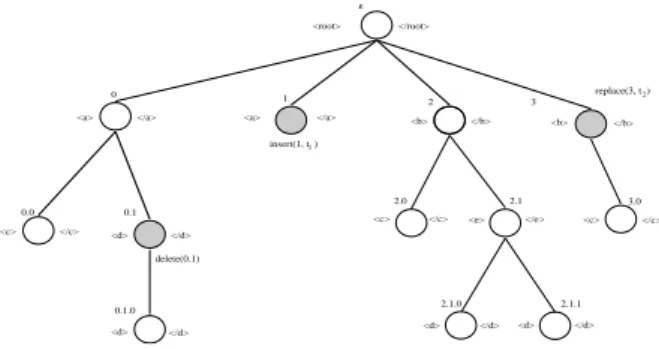
Figure 3: XML tree and update operations.
The following example illustrates our method in an intu-itive way.
Example 2 Consider the XML tree of Fig. 3, where update positions are marked. Bold arcs represent the necessary tree transversal for our method, to check the validity of the updates we want to perform.
Let us suppose that there is a tree automatonA, representing the schema to be verified. We also suppose that the original tree (Fig. 3) is valid w.r.t. A, and that the subtrees being inserted are
locally validw.r.t.A. It is interesting to remark that:
•When the open tag<d>(at position0.1) is reached, the dele-tion operadele-tion is taken into account and the subtree rooted at this position is skipped. To verify whether this deletion can be ac-cepted, we should consider the transition rules inAassociated to the parent of the update position. This test is performed when the close tag</a>(position0) is found. Notice that to perform this test we need to know the state assigned to position0.0, but we do not need to go below this position (those nodes, when they exist, are skipped).
•When the second open tag <a>(position1) is reached, the insertion operation is taken into account and the new, locally valid subtree,t1(rooted at this position) is inserted. This implies that if
all the updates are accepted, right-hand side siblings of position1
are shifted to the right. We proceed by reading nodes at (original) positions1and2. Notice that we can skip all nodes below position
2, since there is no update position below this point.
•The replace operation at position3combines the effects of a deletion and an insertion.
•The close tag</root>activates a validity test that takes into account the root’s children. This test follows the definition of the
run of the tree automaton. 2
The implementation of this approach is done by Algo-rithm 1. This algoAlgo-rithm takes a tree automaton representing
the schema, an XML document and a sequence of updates to be performed on the document. The algorithm checks whether the updates should be accepted or not. It proceeds by treating the XML tree in document order. During the execution, the path from the root to the current position pdefines a borderline between nodes already treated and those not already considered.
Our algorithm keeps two structures in order to perform the validation. The first one stores the states allowed at the current position by the tree automaton. The second one contains, for each position p0 on the borderline path, the
states really assignedto the left-hand side children ofp0.
In the following, we formally define these structures.
Definition 2 - Permissible states for children of a posi-tionp:Let PSC(p)be inductively defined on positionspas follows:
PSC(²) ={q| ∃a, S, E→qa∈∆ such thatt(²) =a, qis a state appearing inEandqa ∈ Qf} PSC(pi) ={q| ∃a, S, E→qa∈∆
such thatt(pi) =a, qis a state appearing inEandqa ∈PSC(p)}2
Roughly speaking, for each position pi(labeled a, child of node p), the set PSC(pi)contains the states thatcan beassociated topi’s children. To this end, we find those states appearing in the regular expressionE, for each rule associated to the labela. Notice however that we consider only transition rules that can be applied at the current node, according to the label ofpi’s father (i.e., only those rules having a head that belongs to the set of states PSC(p)). For instance, suppose two rules a, S1, E1 → qa1 and a, S2, E2 → qa2. Consider now that an elementstruct1 has a child that should conform to rulea, S1, E1 → qa1 while an elementstruct2has a child that should conform to rulea, S2, E2→qa2. When computing the state associ-ated to an element labeledathat is a child ofstruct1, state qa2is not considered. This is possible becausePSC(p)for the element being treated contains justqa1.
The following definition shows how each positionpis associated to a list composed by the set of states assigned by the tree automaton top’s children. This list is built tak-ing into account the updates to be performed on the XML document.
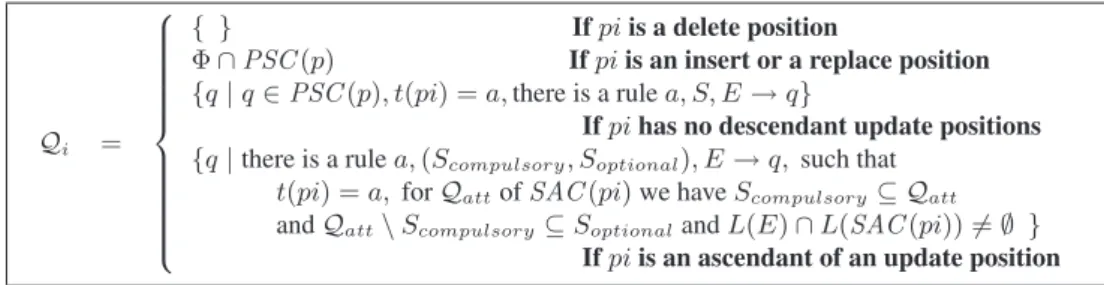
Definition 3 - State attribution for the children of a posi-tion p: Given a positionp, the list SAC(p) is composed by the sets of states associated (by the schema verifica-tion process) to the children of posiverifica-tionp, i.e.,SAC(p) = [Qatt,Q1, . . . ,Qn], where each setQi, for1 ≤ i ≤nis calculated as described in Fig. 4. Moreover, the set Qatt contains the states associated top’s children that are at-tributes. The set Φ contains the states associated to the root of the subtree being inserted at positionp, i.e., the
Qi =
{ } Ifpiis a delete position
Φ∩PSC(p) Ifpiis an insert or a replace position
{q|q∈PSC(p), t(pi) =a,there is a rulea, S, E→q}
Ifpihas no descendant update positions
{q|there is a rulea,(Scompulsory, Soptional), E→q, such that t(pi) =a, forQattofSAC(pi)we haveScompulsory⊆ Qatt andQatt\Scompulsory⊆SoptionalandL(E)∩L(SAC(pi))6=∅ }
Ifpiis an ascendant of an update position
Figure 4: Calculation of the setsQi.
The construction of each setQi in the listSAC(p) de-pends on the situation ofpwrt the update positions. When piis an update position the setQi takes into account the type of the update. Ifpiis an ancestor of an update posi-tion then it represents a posiposi-tion where a validity test may be necessary. In this case, Qi is the set of states associ-ated topiwhen the validation at this position succeeds. If there is no update over a descendant of pi, thenQi con-tains all possible states forpi. Now we present Algorithm 1 that is responsible for the construction of bothPSC(p)and
SAC(p), for each positionp.
Algorithm 1 - Incremental Validation of Multiple Updates Input:
(i)doc: An XML document
(ii)A= (Q,Σ, Qf,∆): A tree automaton
(iii)U pdateT able: A relation that contains updates to be per-formed ondoc.
Each tuple in U pdateT able has the form hpos, op, Tpos,Φi whereposis an update position (considering the tree represen-tation ofdoc),opis an update operation, Tposis the subtree to be inserted atpos(whenopis an insertion or a replace operation) andΦis the set of states associated to the root ofTposby the exe-cution ofAoverTpos(i.e., the result of the local validation). All inserted subtrees are considered to be locally valid.
Output: If the XML document remains valid after all operations inU pdateT ablethe algorithm returns the Boolean valuetrue, otherwisef alse.
(1) foreach eventvin the document (2) skip:=false;
(3) switchvdo
(4) casestart of elementaat positionp:
(5) ifa6=“<root>”{
(6) if∃u= (p,delete, Tp,Φ) ∈ U pdateT able
thenskip:=true;
(7) if∃u= (p,replace, Tp,Φ) ∈ U pdateT able
then{
(8) ComputeQp(Definition 3);
(9) if(Qp=∅)thenreport “invalid” and halt;
(10) SAC(f ather(p)) =SAC(f ather(p))@Qp; //AppendQptoSAC(f ather(p))
(11) skip:=true;
(12) }
(13) for eachu= (p,insert, Tp,Φ) ∈ U pdateT able do{
(14) ComputeQp(Definition 3);
(15) if(Qp=∅)thenreport “invalid” and halt;
(16) SAC(f ather(p)) =SAC(f ather(p))@Qp;
(17) }
(18) if6 ∃u0= (p0, op0, T0,Φ0)∈U pdateT able
such thatp≺p0{
//If there is no update over a descendant ofp
(19) ComputeQp(Definition 3);
(20) SAC(f ather(p)) =SAC(f ather(p))@Qp;
(21) skip:=true;
(22) }
(23) }
(24) ifa=“<root>”or¬skipthen{ //Ifpis an ascendant of an update position
(25) ComputePSC(p)(Definition 2);
(26) SAC(p) =SAC(p)@Qatt;
//Starting the construction of the listSAC(p)
(27) }
(28) ifskipthenskipSubT ree(doc, a, p);
(29) caseend of elementaat positionp:
(30) foreachu= (p.i,insrt, Tp.i,Φ) ∈ U pdateT able wherep.iis a frontier positiondo{
(31) ComputeQp.i(Definition 3);
(32) if(Qp.i=∅)thenreport “invalid” and halt;
(33) SAC(p) =SAC(p)@Qp.i;
(34) }
(35) ComputeQp(Definition 3);
(36) if(Qp=∅)thenreport “invalid” and halt;
(37) ifa6=“</root>”
thenSAC(f ather(p)) =SAC(f ather(p))@Qp;
(38) report “valid” 2
Algorithm 1 processes the XML document as it is done by SAX [3]. While reading the XML document, the algo-rithm uses the information inUpdateTableto decide which nodes should be treated. When arriving to an open tag rep-resenting a positionpconcerned by an update, different ac-tions are performed according to the update operation:
delete: The subtree rooted atpis skipped. This subtree will not appear in the result and thus should not be consid-ered in the validation process (line 6).
replace: The subtree rooted atpis changed to a new one (indicated by Tp in the UpdateTable). The set of states
Qp indicates whether the locally valid subtree Tp is al-lowed at this position. The set Qpis appended to the list
SAC(f ather(p))to form the list that should contain the states associated to each sibling ofp. The (original) sub-tree rooted atpis skipped (lines 7-12).
When we are in a position p (labeled a) where there is no update over a descendant (lines 18-22) we can skip the subtree rooted at p. The listSAC(f ather(p))is ap-pended with the set {q | there is a rulea, S, E → q in ∆ such thatq ∈ PSC(f ather(p))andT(p) = a}. In other words, inSAC(f ather(p)), the setQp contains the permissible states for the child at positionp. We use skip-SubTree(line 28) to “skip nodes” until reaching a position important for the incremental validation process. Notice that when such a position is reached,skipSubTreechanges the value of the variableskipaccordingly.
When reaching an open tag representing a position p that is an ascendant of an update position, the structures
PSC(p)andSAC(p)should be initialized (lines 24-27) . The setPSC(p)contains the states that can be associated to the children of the element at positionp(labeleda). To this end, we find the states appearing in the regular expres-sionE of rules associated to labela. Only rules that can apply to the current element are considered,i.e., only those having a head that belongs toPSC(f ather(p))(see Defi-nition 2).
When reaching a close tag representing a positionpwe verify firstly if there is an insert operation on the frontier position (i.e., on a positionpi 6∈ dom(T) such thatp ∈
dom(T)). In this case, the insertion is performed (lines 30-34) .
Next (lines 35-37), we should test whether thep’s chil-dren respect the schema. In fact, reaching a (not skipped) close tag (representing positionp), means that updates were performed overp’s descendants.
Schema constraints for the current node p (labeled a) are verified by taking into account the list SAC(p)(i.e., [Qatt,Q1, . . . ,Qn]) which, at this point, is completely built. Recall that the setQattcontains the states associated to the attributes ofpwhile the setsQ1, . . . ,Qncontain the states associated to each element child ofp(in the docu-ment order). In fact, at this point of the algorithm, our goal is to find the setQp to be appended toSAC(f ather(p)). This computation corresponds to the last case of Defini-tion 3.
More precisely, we consider the language L(SAC(p)) which is defined by the regular expression (q0
1 | q11 | . . . | qk1
1 ). . .(qn0 | q1n | . . . | qnkm) where each ki =
|Qi| and each qij ∈ Qi (with 1 ≤ i ≤ n). The resulting set of states Qp is composed by all states q for which we can find transition rules in ∆ of the form a,(Scompulsory, Soptional), E→q, that respect all the fol-lowing properties:(1)qis a state inPSC(f ather(p));(2) Scompulsory ⊆ Qatt; (3)Qatt\Scompulsory ⊆ Soptional and(4)L(E)∩L(SAC(p))6=∅.
Notice that Algorithm 1 considers all the updates over the children of a nodepbefore performing the validity test onp.
Example 3 LetA= (Q,Σ, Qf,∆)be a tree automaton where
Qf ={qr}. The set∆contains all the transition rules below to-gether with rulesdata,(∅,∅), ²→qdata, andα,(∅,∅), qdata→
d b
c
d
m n
b
c
a {q1} a
{q} {qd}
{qc}
{q2}
{qd}
{q0}
{qn}
{qm}
{qc}
x r
{q4}
???
x r
{q3}
{qr} ²
0
0.0
0.0.0 0.0.1
0.0.0.0
0.0.0.0 0.0.0.1 0.0.0.2
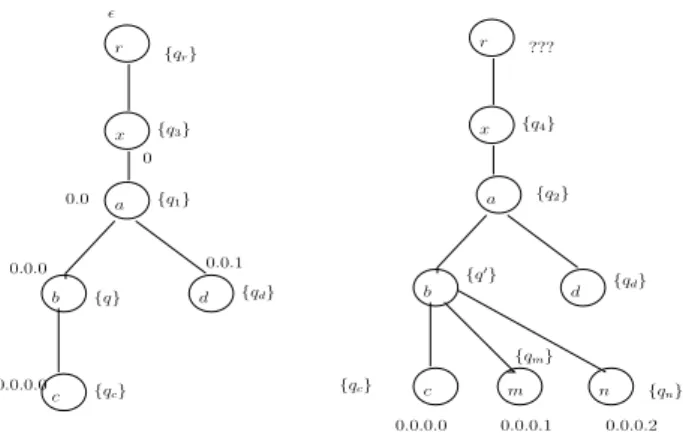
Figure 5: XML tree and its running tree: (a) before updates (b) after insertions.
qα(forα∈ {c, d, m, n}).
(1)r,(∅,∅), q3|q4.qc→qr (2)x,(∅,∅), q2→q4
(3)x,(∅,∅), q1→q3 (4)a,(∅,∅), q.qd∗→q1
(5)a,(∅,∅), q0.qd∗→q2 (6)b,(∅,∅), qc→q
(7)b,(∅,∅), qc.qm.qn→q0
Fig. 5(a) shows a valid XML tree wrt the schema constraints ex-pressed byA. Fig. 5(b) shows the tree we shall obtain after two insertions on the frontier position0.0.0.1. In both cases, the result of the running is showed by the set of states associated to each po-sition. Notice that the two insertions on0.0.0.1generate changes not only on the set of states associated to its father (0.0.0) but also on the sets of states associated itsancestors. Note that even the set of states associated to the root changes and the tree is not valid anymore! This example illustrates why, when dealing with non LTL , the validator tests the ancestors of the update position (and not just its parent). We propose an algorithm that performs tests until reaching the root, but optimizations are possible: one should perform tests until reaching a node whose associated set of states does not need to be changed.
To illustrate the execution of Algorithm 1, consider, in the table below, the situation of structuresPSC() andSAC() at some spe-cific instants, during the incremental validation process that take into account the updates illustrated by Fig. 5(b).
Position Situation Situation Situation ofPSC() ofSAC() ofSAC()
when we when we when we
reach<b> reach</b> reach<d>
0.0.0 {qc, qm, qn} [{qc},{qm},{qn}]
0.0 {q, q0, q
d} [ ] [{q0}]
0 {q1, q2} [ ] [ ]
² {q3, q4, qc} [ ] [ ]
According to Definition 2, when <b> is reached, states
qc, qm, qnare put inPSC(0.0.0)since they appear in rules(6)
and (7)(which have label band whose right-hand side are in
PSC(0.0)).
Indeed, when we reach<d>, the listSAC(0.0)is not empty any-more - it contains the set of the states we effectively associate to position0.0.0(chosen among those inPSC(0.0)and taking into
account the transition rules that apply). 2
Our algorithm is general, however, as shown in the fol-lowing proposition, for the case of single-type tree lan-guages,SAC(p)(for each positionp) is a list of singleton sets. In this case, the operationL(E)∩L(SAC(p))6=∅is reduced to the verification of a word to belong to a regular language.
Proposition 1 Given a schema defining languages in STTL, for each positionpin Algorithm 1, we have that the set of states assigned to element children that are not delete positions is always a singleton set, that is:
IfSAC(p) = [Qatt,Q1, . . . ,Qn]then| Qi |= 1, for all
1≤i≤n. 2
PROOF: By cases, on the definition of eachQi:
Ifpiis an insert or a replace position. In this case, we have
Qi = Φ∩PSC(p). If we suppose that{q1, q2} ⊆ Qi, then (i) Both statesq1 and q2 are in competition (since they belong
to Φ) and (ii) they belong to the same regular expression in a transition rule (since they belong toPSC(p)). The conjunction of the two conditions above contradicts the definition of a single-typed language, to which the schema belongs.
Ifpihas no descendant update positions.In this case the set
Qi = {q | q ∈ PSC(p), T(pi) = a,there is a rulea, S, E →
q}.
If we suppose that{q1, q2} ⊆ Qi, then, by the definition ofQi, the states q1 andq2 compete to each other (since there is only
one label associated to the positionpiof the tree), leading to a contradiction.
Ifpiis an ascendant of an update position. In this case the setQiis also defined as being composed by states which are in the right-hand side of a rule for a given labela. The existence of more than one state in this set contradicts the definition of a
single-typed language, to which the schema belongs. 2
Proposition 1 allows us to define a simplification on Al-gorithm 1, to use single states instead of sets of states, in such a way that, for these classes of tree languages, we can representSAC(p) = [Qatt,Q1, . . . ,Qn]as a set of states
Qattand a word of states.
Notice that while performing validation tests, a new up-dated XML tree is being built (as a modified copy of the original one). If the incremental validation succeeds, a
commit is performed and this updated version is estab-lished as our current version. Otherwise, the commit is not performed and the original XML document stays as our current version. The next section considers the imple-mentation of our method, comparing it to a validation from scratch.
3.2 Complexity and experimental results
As said in Section 1, the complexity of our method is pre-sented taking into account that the cost of “skipping” nodes
is not relevant when compared to the cost of validation ac-tions. In this context, notice that in Algorithm 1, valida-tion steps are performed only for those nodesp∈dom(T) which are ascendants of update positions.
LetEbe the regular expression defining the structure of p’s children. When a DTD or XSD schema is used, each validation step corresponds to checking whether a wordw is inL(E). The wordwis the concatenation of the states associated top’s children. Thus, for DTD or XSD schema each validation step isO(|w|).
When a specialized DTD schema is used, each valida-tion step corresponds to checking if there is a wordw = qi, . . . , qninL(E)such thatqi∈ Qi, . . . , qn ∈ Qn(see the definition of a run, in Section 3). In other words, we should test ifL(Eaux)∩L(E)6=∅, whereEauxis the regular ex-pression representing all the words we can build from the concatenation of the states associated top’s children,i.e., Eaux = (q01 |q11|. . .|q1k1). . .(qn0 |qn1 |. . .|qknn). This test is done by the intersection of the two automataMEaux andME. The solution of this problem runs in timeO(n2) wherenis the size of the automata [35, 36].
Thus, if we assume that nis the maximum number of children of a node (fan out) in an XML treeT, then a val-idation stepruns in timeO(n)(for DTD or XML schema) or in timeO(n2)(for specialized DTD).
Letm be the number of updates to be performed on a tree t (of depth h). Given an update position p, in the worst-case, a validation step should be performed for each node on the path betweenpand the root. For a worst-case analysis, we can also consider that allmupdates are per-formed on the leaves. We also suppose that all the paths from nodespto the root are disjoint. In this case, the com-plexity of our algorithm can be stated asO(m.n.h)(DTD or XML Schema) orO(m.n2.h)(when specialized DTD is considered).
Notice that, in a general XML setting, updates can hap-pen at any level of the tree (so that the limit imposed byh is seldom reached). Moreover, when dealing with multiple updates, part of the paths between the update nodes and the root are common to two or more of these updates. In this case, only one validation action is performed for the shared nodes.
The worst-case of our algorithm is reached for a very un-usual configuration of the tree being processed (the config-uration maximizing the productn.h). In this configuration, one half of the nodes are leafs, children of the root, while the others form a list (pending from the root).
Other singular configurations are:
• A flat tree, where all the nodes (except the root) are leaves, and children of the root node. In this case, the depth of the tree is one and the complexity expressions are reduced toO(m.n)(DTD or XML Schema) orO(m.n2) (specialized DTD).
XML Schema or specialized DTD).
• If we consider an n-ranked, balanced tree t, its depth is given by h = logn|t|, where |t| is the size of the tree. In this case, the complexity expressions are re-duced to O(m.n.logn|t|) (DTD or XML Schema) or O(m.n2.log
n|t|)(specialized DTD).
Notice that when dealing with a DTD, we just need to verify whether the state associated to the father of an up-date position changes (see [17]). This is easily done by us-ing transition rules. Thus, for multiple updates with DTD, we just need to perform verifications until reaching the fa-ther of the update position which is the nearest to the root. Example 3 illustrates that this optimization cannot be ap-plied to non-LTL schemas.
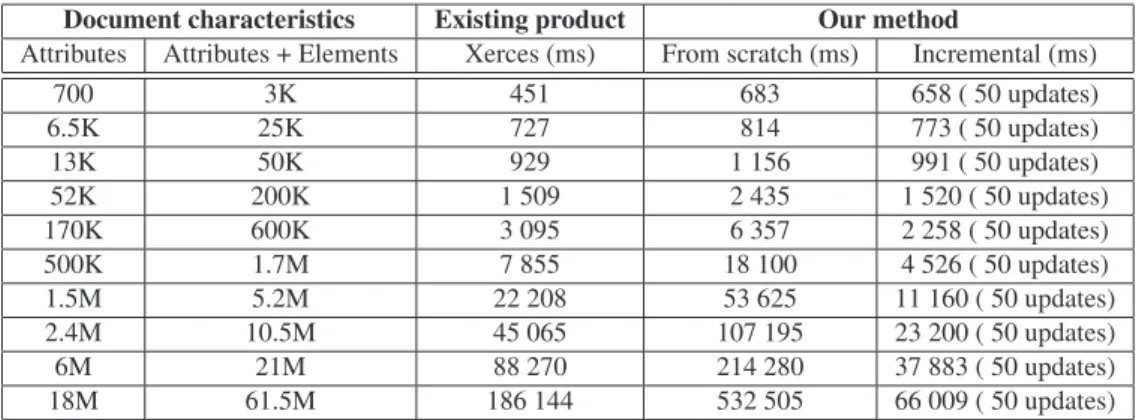
Experimental results (Table 1) show that our incremental algorithm behaves very efficiently in practice. In order to compare these approaches we use ten XML documents of different sizes (from3,000to61,000,000nodes). These documents are in the STTL class of languages and describe different car suppliers. They are valid wrt an XSD whose principal schema constraints are expressed by the following transition rules:
supplier,(∅,∅), q+
shopq∗garage →qsupplier
shop,(∅,∅), q∗
newV eh →qshop
garage,(∅,∅), q+
oldV eh →qgarage
vehicle,({id},{type}), qnameqcvqcat? →qnewV eh
vehicle,({id},∅), qnameqcvqkm? →qoldV eh
Given an XML document, we consider a sequence of 50 updates over it. Our implementation is just a prototype in Java. Experiments were performed on a 1.5 GHz Pentium M system with 512MB of memory and a 40GB, 5400rpm hard drive.
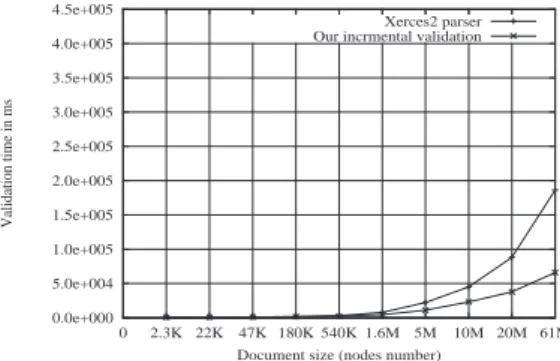
Table 1 and Fig. 6 show the superiority of Xerces [2] when only validation from scratch is considered. This is a natural result when comparing a prototype with a com-mercial product. However, when we compare our incre-mental validation method (Algorithm 1) to a validation from scratch approach Table 1 and Fig. 7 show that our incremental validation method is very efficient for large documents4. Indeed, it takes almost a third of the time needed for Xerces to validate 50 updates on a document having61,000,000nodes. Similarly, it takes about half of the time needed for Xerces to validate documents having 10,000,000nodes.
A sufficient condition for commutative update lists is given in [34]. In this paper, ourUpdateTablerespects this condition and thus, single updates can be performed in any order, without changing the result of the global update on the XML tree. However, as our validation process is done by using SAX, a left-right computation of updates is more efficient than one that considers tree nodes at random. If we do not care about loading all the XML file, a bottom up computation might be proposed, since all update positions
4For small documents, the number of updates represents changes over
a high percentage of the document. In this case, incremental validation cost is close to our validation from scratch cost and thus it is worse than Xerces, a commercial product.
0.0e+000 1.0e+005 2.0e+005 3.0e+005 4.0e+005 5.0e+005
61M 20M 10M 5M 1.6M 540K 180K 47K 22K 2.3K 0
Validation time in ms
Document size (nodes number) Xerces2 parser Our validation from scratch
Figure 6: Comparing validation from scratch performed by Xerces and our prototype.
0.0e+000 5.0e+004 1.0e+005 1.5e+005 2.0e+005 2.5e+005 3.0e+005 3.5e+005 4.0e+005 4.5e+005
61M 20M 10M 5M 1.6M 540K 180K 47K 22K 2.3K 0
Validation time in ms
Document size (nodes number) Xerces2 parser Our incrmental validation
Figure 7: Xerces (validation from scratch) ×Our incre-mental validation method.
activate validation verification on their ancestor nodes. In-deed, schema validation performance depends on the depth of update nodes as discussed before.
3.3 Related work
The importance of algorithms for the efficient validation of XML documents grows together with the use of schema languages. Algorithms for the incremental validation are very useful when dealing with very large XML documents, since they can substantially reduce the amount of time of the verification process. Several XML document editors such as XML Mind [5] and XMLSpy [1] include features for the validation of documents (wrt one or more schema languages). However, the documentation of most of these tools include little or no information on their validation al-gorithms.
Document characteristics Existing product Our method
Attributes Attributes + Elements Xerces (ms) From scratch (ms) Incremental (ms)
700 3K 451 683 658 ( 50 updates)
6.5K 25K 727 814 773 ( 50 updates)
13K 50K 929 1 156 991 ( 50 updates)
52K 200K 1 509 2 435 1 520 ( 50 updates)
170K 600K 3 095 6 357 2 258 ( 50 updates)
500K 1.7M 7 855 18 100 4 526 ( 50 updates)
1.5M 5.2M 22 208 53 625 11 160 ( 50 updates)
2.4M 10.5M 45 065 107 195 23 200 ( 50 updates)
6M 21M 88 270 214 280 37 883 ( 50 updates)
18M 61.5M 186 144 532 505 66 009 ( 50 updates)
Table 1: Experimental results.
trees of transition relations, one for eachline, representing the potentially legal evolutions of the line. This is impor-tant to notice because this is the reason why the method can hardly generalize to updates on whole subtrees: such an up-date would require to compute again ALL auxiliary data,
i.e., (i) the binary tree, (ii) the set oflinesand (iii) trees of transition relations. Indeed, the method is applied only for updates on nodes: insertion or deletion ofleaves, and re-naming of one node. In [11, 45], they propose two main in-cremental algorithms to validate a numbermof updates on the leaves of a given treeT. The first algorithm, for DTD and XSD, has time complexityO(m.log|T|), and uses an auxiliary structure of sizeO(|T|). The second algorithm, for specialized DTDs, has time complexityO(m.log2|T|) and also uses an auxiliary structure of sizeO(|T|).
Our approach deals with multiple updates and incremen-tal validation over an unranked tree. As we have already said, our algorithm visits all the nodes of an XML tree but only some nodes trigger the validation actions that repre-sent the relevant cost of the approach. Thus, we can say that our time complexity is similar to the one found in [11, 45]. For updates on leaves and for node renaming, their method may be more efficient than ours because the use of trees of transition relations is quite efficient for incremental word verification. However these updates are very special ones: for more general updates, as considered in our paper (in-volving whole subtrees), our method performs a minimum of tests without maintaining huge auxiliary structures.
Due to our use of unranked trees instead of the binary trees of [11, 45], each validation step on our method can be more expensive, but our XML tree is usually much shorter. Moreover, our work differs from that in [45] in four main aspects:
1. Our update operations can be applied at any node of the tree, and not just on the leaves. This feature permits us to change large areas of the XML tree with one single operation.
2. In [45], testing whether a word belongs to a language is done in an incremental way by storing an auxiliary struc-ture. This optimization might be easily integrated in our algorithm for verifying child state word, but it seems to be
interesting only in case of very large fan-out.
3. When dealing with DTD and XSD we do not use any auxiliary structures to store the result of a previous valida-tion process.
4. Integrity constraint verification for keys and foreign keys is naturally integrated to our algorithm (Section 4).
4 Integrity constraint verification
In this section we present our constraint language, called CTK (for Context-Target-Key), and we show that con-straints in CTK can be compiled to an attribute grammar. CTK is used to specify absolute and relative keys, together with foreign keys. As in [21], CTK uses path expressions built from a fragment of XPath. This XPath fragment in-cludes (a) the empty path ², (b) an element or attribute name, (c) a wildcard matching any single node name (_), (d) an arbitrary downward path (//) and (e) the concatena-tion of paths (P/QwhereP andQare paths, as defined by these rules). Indeed, this fragment is the same used by XML Schema to specify integrity constraints ([15]). No-tice that a given path defines a language whose symbols are XML labels. Path expressions are, in fact, regular ex-pressions over XML labels.
The following example illustrates how keys and foreign keys are specified. Next we define their syntax and seman-tics.
Example 4 The XML document represented by the tree T in Fig. 1 describes a collection of cooking recipes. Each collection maintains a categorized list of recipes, and a list of the top recipes. We want to validate this document wrt the following keys and foreign key, defined in CTK:
- K1 :(/, (./collection, {./category}))
It indicates that, for the whole document, every collection must be uniquely identified by its category.
- K2: (/collection, (.//recipe, {./name, ./author}))
It means that, in the context of a collection, a recipe is uniquely identified by its name and author.
- K3: (//recipe, (./ingredient, {./name}))
Similarly toK2, it indicates that, in the context of a recipe, each
- F K4: (/collection,(./top_recipes/top_recipe, {./recipe_name, ./author_name}) ⊆ (.//recipe,
{./name, ./author})) where (/collection,(.//recipe,
{./name, ./author}))is the keyK2.
The foreign key constraint indicates that, in a collection, the name and the author of a top recipe must already exist as the name and the author of a recipe (in the same collection, but
disregarding the order). 2
Definition 4 - CTK key and foreign key syntax [21]: A key is represented by an expression (P,(P0,{P1, . . . , Pm}))in which the pathP is called thecontext path; P0is thetarget pathandP1, . . . , Pmare thekey paths.
A foreign key is represented by (P,(P0
0,
{P1
0, . . . , P0m}) ⊆ (P0, {P1, . . . , Pm})) where(P,(P0,
{P1, . . . , Pm}))is a key K and P1
0, . . . , P0m are called
foreign key paths. 2
In this paper, key and foreign key specifications respect the following constraints: (a) Context and target paths should reach element nodes; (b) Key paths always exist and are unique and (c) Key (or foreign key) paths are required to end at a node associated to a value,i.e., attribute nodes or elements having just one child of typedata. Notice that our key specification corresponds to a special case of strong keys defined in [21] and thus it imposes theuniquenessof a key and equalityof key values (i.e., keys values cannot be null). This concept is similar to the concept of key in relational databases.
In the following definition we use the notion of tuple in anamed perspectiveas described in [6]. Thus, tuples are functions that associate a non-null value to each compo-nent (name). The order of values appearing in the tuple is not important since each component value is associated to its name (in our case, the name of the tuple component is an XML label,i.e., the name of the element or attribute whose value we want to consider). Thus, wrt the textual repre-sentation of an XML element, the definition below states that the order of elements (or attributes) is unimportant in defining equality.
Definition 5 - Semantics of CTK keys and foreign keys: An XML tree T satisfies a key(P,(P0,{P1, . . . , Pm})) if for each context positionpreached by following pathP from the root, the following two conditions hold:
(i) For each target positionp0reachable frompviaP0there
exists a unique positionphfromp0, for eachPh(1≤h≤ m), and
(ii) For any target positionsp0andp00, reachable frompvia
P0, wheneverτ0 =τ00(where tuples5 τ0 andτ00 are built
followingP1. . . Pmfromp0andp00, respectively) thenp0
andp00must be the same position.
Similarly, an XML tree T satisfies a foreign key (P,(P0
0,{P10, . . . , P0m})⊆(P0,{P1, . . . , Pm}))if:
5A tupleτhas the general formatτ = [τ(P1) :v1, . . . , τ(Pm) : vm]. We useτ(Ph)to denote the name (label) of the component ofτ
corresponding to the node reached viaPhfrom a given target position.
(i) It satisfies its associated key K = (P,(P0, {P1, . . . , Pm})), and
(ii) For each target positionp0
0reachable from the context positionpviaP0there exists a unique positionphfromp0,
for eachPh(1≤h≤m), and
(iii) Each tupleτ0= [τ0(P01) :v1, . . . , τ0(P0m) :vm], that was built following the paths P/P0
0/P01, . . . , P/P00/P0m is equivalent in value to a tuple τ = [τ(P1) : v1, . . . , τ(Pm) :vm], built following pathsP/P0/P1, . . . , P/P0/Pm. In other words, for each 1 ≤ h ≤ m, the τ0-component nameP0h corresponds to theτ-component namePhand their values are equal. 2
Example 5 In Example 4, if we assume an inversion of the two rightmost children of position0.3.0of Fig. 1 (author_nameon position 0.3.0.1andrecipe_nameon position0.3.0.2) then we obtain tuples[recipe_name: Mushroom Soup,author_name: M. Smith]and[name:Mushroom Soup,author:M. Smith]which are equivalent in value. This is because foreign key specification re-latesrecipe_nametonameandauthor_nametoauthor. Thus, ac-cording to Definition 5, the foreign key is satisfied. This remark is also valid when comparing key values.
2
In order to perform the validation of key constraints, we represent the paths in key definitions by finite state automata: for a context path P, we have the automaton M =hΘ,Σ, δ, e, Fi. This automaton will be referred to as the context automaton. It is defined to recognize the lan-guage generated by the path (regular expression)P.
Similar automata are defined for target, key and foreign key paths: For a target path P0, its corresponding target
automaton is defined as M0 = hΘ0,Σ, δ0, e0, F0i; and for
key or foreign key pathsP1, . . . ,Pm, their key or foreign key automata areM00=hΘ00,Σ, δ00, e00, F00i.
We denote byM.ethe current stateeof the finite state automatonM.M.eis theconfigurationof the automaton, representing a snapshot of it during its run. We illustrate the above definitions with an example.
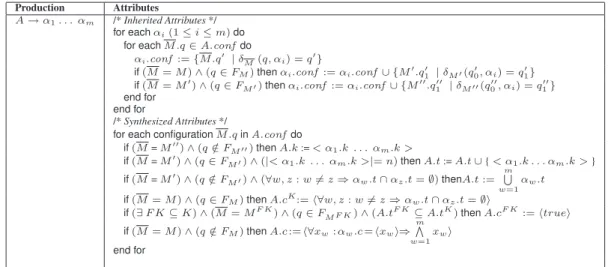
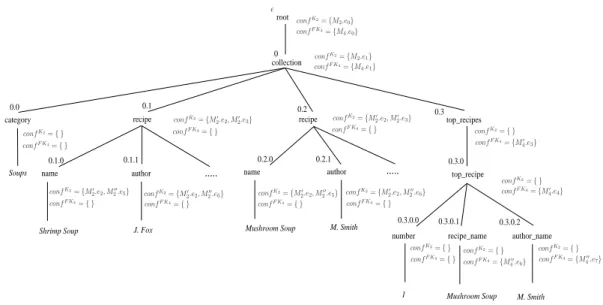
Example 6 Fig. 8 illustrates finite state automata that corre-spond to the (context, target and key) paths inK1,K2,K3 and
F K4of Example 4. Given the XML tree of Fig. 1, those finite
state automata are used in the tree traversal to perform constraints
validation. 2