The Drosera Extract as an Alternative in Vitro Supplement to
Animal Semen: Effects on Bovine Spermatozoa Activity and
Oxidative Balance
Eva Tvrdá
1,*, Jaroslav Michalko
2, Ildikó Matušíková
2, Norbert Lukáč
11Slovak University of Agriculture, Faculty of Biotechnology and Food Sciences, Department of Animal Physiology,
Tr. Andreja Hlinku 2, 949 76 Nitra, Slovakia
.2Slovak Academy of Sciences, Institute of Plant Genetics and Biotechnology, Akademická 2, 950 07 Nitra, Slovakia.
Abstract
In vitro storage and processing of animal semen is considered to be a risk factor to spermatozoa activity, possibly leading to reduced fertility and litter sizes following artificial insemination (AI). A variety of substances isolated from natural resources have the potential to exhibit protective or antioxidant properties on the spermatozoon, thus they may extend the lifespan of stored semen. Drosera (Drosera rotundifolia L.) has been shown to possess antimicrobial, anti-inflammatory and antioxidant properties, making the plant extract a potential candidate for preserving liquid animal semen during in vitro storage. This study compared the ability of different concentrations of
Drosera extract on the motility, viability and superoxide production of bovine spermatozoa during different time periods (0, 2, 6, 12 and 24h) of in vitro culture. Spermatozoa motility was assessed using the SpermVisionTM CASA (Computer aided sperm analysis) system. Cell viability was examined using the metabolic activity MTT assay and the nitroblue-tetrazolium (NBT) test was applied to quantify the intracellular superoxide formation. The CASA analysis revealed that Drosera extract supplementation was able to prevent a rapid decline of spermatozoa motility, especially in the case of concentrations ranging between 1 and 5 mg/mL (P<0.001 with respect to Times 6h, 12h and 24h). At the same time, concentrations ranging between 1 and 10 mg/mL of the extract led to a significant preservation of the cell viability throughout short-term (P<0.05 in case of Time 6h) as well as long-term periods of the experiment (P<0.01 with respect to Time 12h, and P<0.001 in case of Time 24h). 10 and 5 mg/mL of the extract exhibited antioxidant characteristics, translated into a significant reduction of the intracellular superoxide production, particularly notable at Times 12h (P<0.01) and 24h (P<0.001). The results indicate that the Drosera extract is capable of delaying the damage inflicted to the spermatozoon by the in vitro environment.
Keywords: Drosera, spermatozoa, motility, viability, superoxide production
1. Introduction
Over the last years, numerous studies have emphasized on the beneficial effects of oral antioxidant supplementation on spermatozoa physiology and fertility in animals and humans [1, 2]. Nevertheless, knowledge regarding the in vitro
effects of antioxidants on the sperm cell is still
* Corresponding author: Eva Tvrdá, +421-34-641-4288, [email protected]
very sparse or controversial. Meanwhile, in vitro
data are essential, as it has been systematically shown that diverse antioxidant molecules may protect the spermatozoon against oxidative injury and subsequent dysfunction (i.e. loss of motility and viability). This information may be viable for spermatozoa processing protocols performed in medical and veterinary laboratories for long-term spermatozoa preservation (cryoconservation) or assisted reproductive techniques. The in vitro
conditions for ROS (reactive oxygen species) overproduction and a subsequent structural and/or functional damage to the cell [3].
Supplementation of synthetic antioxidants to cell cultures is an effective way to prevent oxidative stress (OS). However, the safety of synthetic additives has been questioned leading to the renaissance of naturally occurring substances with antioxidant properties. The chemical diversity, structural complexity, availability, intrinsic biologic activity or lack of substantial toxic effects of natural products transforms them into ideal candidates for new therapeutics [4].
Drosera is a cosmopolitan genus of insectivorous plants and consists of approximately 170 species. Various Drosera species are used as important components in the traditional indian Ayurvedic preparation „Swarna Bhasma“ (Golden ash), used in several clinical manifestations including loss of memory, defective eyesight, infertility, overall body weakness and incidence of early aging. It is also used for the folkloric treatment of diseases like bronchial asthma, rheumatoid arthritis, diabetes mellitus and nervous disorders [5, 6].
Drosera species have been shown to contain a
variety of physiologically active compounds including flavonoids, ellagic acid and naphthoquinones [7] commonly exhibiting antimicrobial and anti-inflammatory properties, which are have been reported to be effective in cellular protection against diverse stress situations [8].
The present in vitro study is therefore aimed to find out the efficacy of the Drosera rotundifolia L. plant extract on bovine spermatozoa motility, viability and superoxide radical formation during a 24 hour in vitro cultivation, in order to provide information on its behavior in the male reproductive cell, as well as to define an optimal concentration of this extract for further experiments in veterinary andrology.
2. Materials and methods
Plant Material
Drosera rotundifolia L. plants were grown
aseptically on an agar medium (1/2 Murashige- Skoog, 10 % sucrose, 0.6 % plant agar, pH 5.2) in 225 mL plastic boxes and growth chamber under a 16/8 day/night period at 22°C [9].
Preparation of plant extracts
After plant material collection and drying, the plant tissues were crushed, weighed and soaked in ethanol p.a. (96 %, Sigma-Aldrich, St. Lois, USA) during two weeks at room temperature in the dark. Exposure to sunlight was avoided to prevent the degradation of active components. The ethanolic plant extracts were subjected to evaporation under reduced pressure at 40 °C in order to remove ethanol (Stuart RE300DB rotary evaporator, Bibby Scientific Limited, UK, and vaccum pump KNF N838.1.2KT.45.18, KNF, Germany). Crude plant extracts were dissolved in DMSO (Dimethyl sulfoxide; Sigma-Aldrich, St. Louis, USA) to equal 100.4 mg/mL as a stock solution [8, 9].
Sample collection and processing
Bovine semen samples were obtained from 10 adult breeding bulls (Slovak Biological Services, Nitra, Slovak Republic). The samples had to accomplish the basic criteria given for the corresponding breed. The samples were obtained on a regular collection schedule using an artificial vagina. After collecting the samples were stored in the laboratory at room temperature (22–25°C). Each sample was diluted in physiological saline solution (PS; sodium chloride 0.9 % w/v; Bieffe Medital, Italia) containing various concentrations of the Drosera extact (Sigma-Aldrich, St. Louis, USA; A – 50; B – 10; C – 5; D – 1; E – 0.5; F – 0.1 mg/mL) using a dilution ratio of 1:40. The samples were cultured at room temperature (22– 25°C). We compared the control (Ctrl) group (medium without Drosera supplementation, containing 0.5% DMSO) with the experimental groups.
Assessment of spermatozoa vitality characteristics
Spermatozoa motility (percentage of spermatozoa with a motility >5 μm/s; %; MOT) was examined with the help of the Computer-aided sperm analysis (CASA) system using the SpermVisionTM program (Minitube, Tiefenbach, Germany) and Olympus BX 51 phase contrast microscope (Olympus, Tokyo, Japan). The samples were placed into the Makler Counting Chamber (depth 10 μm, 37°C; Sefi Medical Instruments, Haifa, Israel) and immediately assessed. At least 1000 cells were evaluated in each sample [10].
Viability of the cells exposed to Drosera in vitro
the conversion of 3-(4,5-dimetylthiazol-2-yl)-2,5- diphenyltetrazolium bromide (MTT; Sigma-Aldrich, St. Louis, USA) to purple formazan particles by mitochondrial succinate dehydrogenase of intact mitochondria of living cells. Formazan can then be measured spectrophotometrically at a measuring wavelength of 570 nm against 620 nm as reference by a microplate ELISA reader (Multiskan FC, ThermoFisher Scientific, Finland). The data are expressed in percentage of control (i.e. optical density of formazan from cells not exposed to
Drosera). Results from the analysis were collected during five repeated experiments at each concentration.
The nitroblue-tetrazolium (NBT) test was used to assess the intracellular formation of superoxide radical [13]. This assay is conducted by counting the cells containing blue NBT formazan deposits, which are formed by reduction of the membrane permeable, water-soluble, yellow-colored, nitroblue tetrazolium chloride (2,2′-bis(4- Nitrophenyl)-5,5′-diphenyl-3,3′-(3,3′-dimethoxy-4,4′-diphenylene)ditetrazolium chloride; Sigma-Aldrich, St. Louis, USA) and superoxide radical. Formazan can be measured spectrophotometrically at a measuring wavelength
of 620 nm against 570 nm as reference by a microplate ELISA reader (Multiskan FC, ThermoFisher Scientific, Finland). The data were expressed in percentage of control (i.e. optical density of formazan from cells not exposed to
Drosera). Results from the analysis were collected during five repeated experiments at each concentration [14].
Statistical analysis was carried out using the GraphPad Prism program (version 3.02 for Windows; GraphPad Software, La Jolla California USA, www.graphpad.com). Descriptive statistical characteristics (mean, standard error) were evaluated at first. One-way ANOVA with Dunnett's post test was used for statistical evaluations. The level of significance was set at ∗∗∗
(P<0.001); ∗∗ (P<0.01); ∗ (P<0.05).
3. Results and discussion
Over the past years, Drosera has emerged as a plant exhibiting a complex biological activity. Due to its remarkably broad range of effects, especially
with respect to antibacterial, anticancer, antiinflamatory protection and longevity, the
Drosera genus has attracted a widespread
scientific and consumer interest [6-8].
Different studies have reported that Drosera
extracts are well absorbed and rapidly metabolized, at the same time they seem to be well tolerated and no distinct toxicity was reported [15, 16]. However, in vitro experiments show that
Drosera extracts may have a dose-dependent
activity on the cultured cells, displaying an interesting dichotomy: low doses may improve cell survival, yet high doses may lead to cell death [6].
The CASA assessment showed a continuous decrease of spermatozoa motility in all groups over the course of a 24h in vitro culture (Table 1). The initial (Time 0h) MOT was higher in the experimental groups B-E (0.5-10 mg/mL Drosera
extract) when compared to the control group (0 mg/mL Drosera extract), although without any statistical significance (P>0.05). A statistically significant motion-promoting effect of the
Drosera extract became visible after 2h,
specifically in the group C (P<0.05). Furthermore, 50 mg/mL Drosera extract (group A) caused a non-significant decrease of the spermatozoa motility (P<0.05). After 6h, the decline of spermatozoa MOT became significant in the group A (P<0.001) in comparison with the control, while we recorded a significantly higher spermatozoa motion in the experimental groups C and D (P<0.001). Examination at 12h of in vitro
culture showed that the spermatozoa motility was significantly increased in groups C, D and E (P<0.001) when compared to the control. Moreover a significantly decreased motion was detected in the group A (P<0.001) in comparison to the control. At the end of the experiment (24h), the motility parameter observed in the experimental groups supplemented with 0.1-10 mg/mL Drosera extract (experimental groups B – F) was significantly higher in comparison with the control (P<0.05 in case of group B; P<0.001 with respect to groups C-F). Meanwhile, MOT was significantly decreased in the group A (P<0.001), supplemented with the highest concentration of
the Drosera extract (50 mg/mL) after a
Table 1.Spermatozoa motility (%) in the absence (Ctrl) or presence (A-F) of Drosera extract during different time periods (Mean±SEM; n=10)
Groups
Ctrl A B C D E F
Time 0h
86.22±3.33 81.51±1.44 85.25±1.75 91.44±1.83 92.02±2.41 88.99±1.26 85.30±2.73
Time 2 h
80.99±3.10 72.91±2.58 79.88±2.48 88.85±4.02* 86.55±1.71 84.55±2.14 79.79±2.35
Time 6 h
66.10±1.50 37.21±2.15*** 68.54±1.84 84.07±2.21*** 81.04±2.21*** 73.08±1.76 65.95±2.09
Time 12 h
53.09±1.62 21.08±2.02*** 55.51±1.87 77.05±2.67*** 75.05±1.54*** 58.05±2.16 55.64±3.22
Time 24 h
40.11±3.11 8.09±1.24*** 47.65±1.51* 69.12±1.88*** 67.09±2.32*** 56.19±1.48*** 51.99±2.58**
∗∗∗(P<0.001); ∗∗(P<0.01); ∗(P<0.05). Ctrl – 0; A – 50; B – 10; C – 5; D – 1; E – 0.5; F – 0.1 mg/mL Drosera extract.
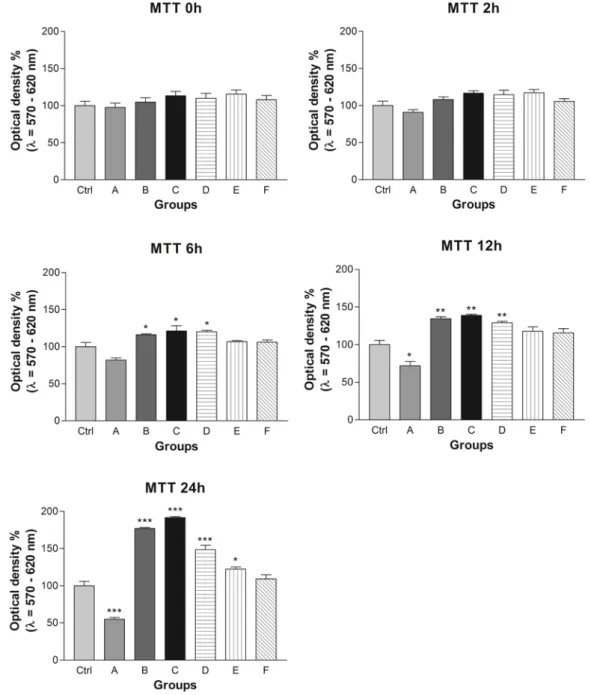
According to the MTT assay, instant Drosera
administration (Time 0h and 2h) had no significant effects on the sperm cell viability in any of the experimental groups (P>0.05; Figure 1). At 6h it was revealed that 1-10 mg/mL extract (groups B-D) had a stimulating and vitality-promoting effect on the bovine spermatozoon, alongside with statistically significant results (P<0.05) when compared to the control group (Figure 1). These beneficial effects remained visible and statistically relevant throughout Time periods of 12h (P<0.01), as well as 24h (P<0.05 in case of group E; P<0.001 with respect to groups B-D). Similar to the CASA analysis, the MTT test revealed an inhibition in the cell viability followed by the administration of 50 mg/mL Drosera
extract (group A), particularly during long-term timeframes of the in vitro culture (P<0.05 with respect to Time 12h; P<0.001 with regards to Time 24h).
It has been previously stated that Drosera species contain a grant variety of biologically active compounds, including flavonoids, quercetin, plumbagin or elagic acid [6], all of which have been extensively studied for their potential roles on spermatozoa production or in vitro survival. Improved spermatozoa motility and mitochondrial activity after quercetin administration was recorded in different studies on fresh as well as frozen semen samples from bulls or rats [17-19]. Moreover quercetin has been identified as a possible specific inhibitor of plasma membrane calcium-ATPase, inducing an increase of intracellular calcium, thus exhibiting modulatory effects on sperm capacitation [20]. In addition, this polyphenol has been showed to possess
inhibitory effects on the hyaluronidase and penetration activity of noncapacitated, capacitated or acrosome-reacted Cynomolgus monkey spermatozoa in a dose-dependent manner [21]. Meanwhile, ellagic acid has been shown to possess protective effect on chemically-induced testicular and spermatozoal toxicity in male rats. Administration of this substance re-established testosterone production decreased testicular apoptosis and led to mild improvements in the histopathological view of the testicular tissue. On the other hand, it failed to improve deteriorated sperm parameters due to induced testicular toxicity [22]. In a different toxicological study, ellagic acid supplementation markedly decreased abnormal sperm rates, and increased epidiymal sperm concentration as compared to the spermatogenesis in rats with chemically-induced testicular toxicity. Additionally, the induced histopathological damages were totally or partially recovered by ellagic acid administration [23]. On the other hand, plumbagin (2-methyl-5-hydroxy, 1:4naphthoquinone) administration exerted a significant effect in decreasing sperm motility and sperm count in mice [24], being presumably at least partially responsible for the antifertility effects of Drosera burmannii extracts administered to mice in the only study currently available to be focused on the direct effects of
Drosera extracts on in vivo reproductive
performance [25].
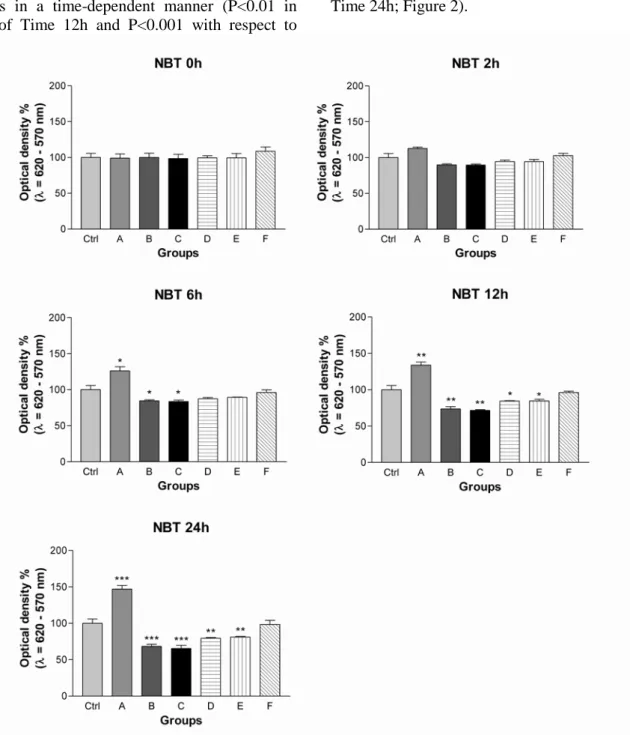
Although Drosera extract had no instant effects on the oxidative balance within the in vitro
mg/mL extract led to a significant decline of the superoxide formation in comparison to the control
(P<0.05). Drosera extract concentrations ranging
Figure 1. The effect of various concentrations of Drosera extract on the viability of bovine spermatozoa (n=10) at 0h, 2h, 6h, 12h and 24h. Each bar represents mean (±SEM) optical density as the percentage of controls, which symbolize 100%. The data were obtained from five independent experiments. The level of significance was set at ***
P<0.001; ** P<0.01; * P<0.05. Ctrl – 0; A – 50; B – 10; C – 5; D – 1; E – 0.5; F – 0.1 mg/mL Drosera extract.
from 0.5 to 10 mg/mL (groups B-E) exhibited a long-term and statistically significant antioxidant protection of the male germ cells and a subsequent prevention of the escalating intracellular superoxide production, considered to be the first step in the creation of oxidative stress (P<0.01 in case of 5-10 mg/mL, and P<0.05 with respect to
0.1 mg/mL at Time 12h; P<0.001 in terms of 5-10 mg/mL, P<0.01 with respect to concentrations of 0.5-1 mg/mL at Time 24h). On the other hand, high (group A) concentrations of Drosera
effects in a time-dependent manner (P<0.01 in case of Time 12h and P<0.001 with respect to
Time 24h; Figure 2).
Figure 2. The effect of various concentrations of Drosera extract on the spermatozoa (n=10) superoxide production at 0h, 2h, 6h 12h and 24h. Each bar represents the mean (±SEM) optical density as the percentage of controls, which symbolize 100 %. The data were obtained from five independent experiments. The level of significance was set at ***
P<0.001; ** P<0.01; * P<0.05. Ctrl – 0; A – 50; B – 10; C – 5; D – 1; E – 0.5; F – 0.1 mg/mL Drosera extract.
Numerous studies have emphasized on the fact that different Drosera species possess significant antioxidant and anticancer activities when tested in different in vitro models [4-8]. The antioxidant ability could be attributed to the exceptionally high content of phenolic compounds, particularly flavonoids with potent ROS-scavenging activities
[26]. Thus, Drosera extracts could be promising natural sources of antioxidants, possibly used in nutritional or pharmaceutical industry for the prevention of ROS-mediated diseases.
available methods [6], including the DPPH, ABTS or nitric oxide assay. All methods have provided evidence on a significant antioxidant potential of the extracts in comparison with the reference antioxidant, ascorbic acid. Ethanol as well as aqueous Drosera extracts exhibited significant scavenging effects on the hydroxyl radical (•OH), which results in the suppression of •OH generation and inhibition of peroxidation processes of biological molecules [27, 28]. At the same time, the extracts behaved as chelating agents forming sigma bonds with different metals reducing the redox potential, thereby oxidized forms of metal ions [6, 29].
Our NBT results complement the report by Asirvatham et al. [6] who studied the potential of
Drosera extracts to consume superoxide.
Superoxide is biologically important as it forms singlet oxygen and hydroxyl radical. Overproduction of superoxide radical may contribute to redox imbalance and is associated with harmful physiological consequences [29]. From their results, it was found that the ethanol and aqueous Drosera extracts showed potent superoxide scavenging activity compared to ascorbic acid.
Phenolic compounds have been repeatedly shown to have beneficial effects of the oxidative balance in male reproductive tissues and cells. As shown by
Ateşşahin
et al. [23] biologically active compounds frequently found in Drosera plants were able to significantly decrease lipid peroxidation, restore glutathione synthesis and catalase activity, associated with normal spermatogenesis and sperm viability. In a different study [22], polyphenol administration led to markedly decreased testicular thiobarbituric acid reactive substances level, and increased the glutathione level, glutathione peroxidase and catalase activities leading to an overall restoration of the oxidant/antioxidant balance in male reproductive cells and tissues.4. Conclusions
Our results, although preliminary, support the evidence for the dose-dependent in vitro
biological activity and scavenger potential of
Drosera extracts against oxidative stress induced in bovine spermatozoa. The development of new culture media offering a better protection to
spermatozoa from the oxidative damage and improve their energy requirements is absolutely necessary. Drosera extracts, in small amounts, could be used as a ROS scavenging and a metabolic promoting supplement, especially in routine andrology techniques such as in vitro
fertilization, artificial insemination or spermatozoa cryopreservation. These results obviously cannot foresee a definitive in vivo outcome, since a direct impact of Drosera extract supplementation on male subfertility needs to be explored further. To translate our findings into clinical practice, studies on the toxicity, pharmacokinetics and bioavailability of Drosera extracts in the organism are needed.
Acknowledgements
This work was co-funded by the European Community under the Project no. 26220220180: Building Research Centre „AgroBioTech" and the VEGA Project no. 1/0857/14.
References
1. Donnelly, E.T., McClure, N., Lewis, S.E.M., The effect of ascorbate and α-tocopherol supplementation in vitro on DNA integrity and hydrogen peroxide-induced DNA damage in human spermatozoa. Mutagenesis, 1999, 14(5), 505-512.
2. Agarwal, A., Sekhon, L., The role of antioxidant therapy in the treatment of male infertility. Human Fertility, 2010, 13(4), 217–225.
3. Saleh, R.A., Agarwal, A., Oxidative stress and male infertility: from research bench to clinical practice. Journal of Andrology, 2002, 23(6), 737-752.
4. Alarcón de la Rastra, C., Curcumin: a promising spice for therapeutics. Molecular Nutrition & Food Research, 2008, 52, 985.
5. Asirvatham, R., Christina, A.J.M., Anticancer activity of Drosera indica L., on Dalton’s Lymphoma Ascites (DLA) bearing mice. Journal of Intercultural Ethnopharmacology, 2012, 1(3), 9-14.
6. Asirvatham, R., Arockiasam, J.M.C., Murali, A., In vitro antioxidant and anticancer activity studies on
Drosera indica L. (Droseraceae). Advanced Pharmaceutical Bulletin, 2013, 3(1), 115-120.
7. Fukushima, K., Nagai, K., Hoshi, Y., Masumoto, S., Mikami, J., Takahashi, Y., Oike, H., Kobori, M.,
8. Kačániová, M., Ďurechová, D., Vuković, N., Kántor, A., Petrová, J., Hleba, L., Vatľák, A., Antimicrobial activity of Drosera rotundifolia L. Scientific Papers: Animal Science and Biotechnologies, 2014, 47(2), 366-369.
9. Michalko, J., Matušíková, I., The role of glucanases in digestion of carnivorous plant Drosera rotundifolia
L. Journal of Microbiology, Biotechnology and Food Sciences, 2012, 1, 671-678.
10. Massanyi, P., Chrenek, P., Lukáč, N., Makarevich, A.V., Ostro, A., Živčák, J., Bulla, J., Comparison of different evaluation chambers for analysis of rabbit spermatozoa motility using CASA system. Slovak Journal of Animal Science, 2008, 41, 60-66.
11. Mosmann, T., Rapid colorimetric assay for cellular growth and survival: application to proliferation and cytotoxicity assays. Journal of Immunological Methods, 1983, 65, 55–63.
12. Knazicka, Z., Tvrda, E., Bardos, L., Lukac, N., Dose- and time-dependent effect of copper ions on the viability of bull spermatozoa in different media. Journal of Environmental Science and Health Part A, 2012, 47, 1294-1300.
13. Esfandiari, N., Sharma, R.K., Saleh, R.S., Thomas, Jr., A.J., Agarwal, A., Utility of the nitroblue tetrazolium reduction test for assessment of reactive oxygen species production by seminal leukocytes and spermatozoa. Journal of Andrology, 2003, 24(6), 862-870.
14. Tvrdá, E., Lukáč, N., Lukáčová, J., Kňažická, Z., Massányi, P., Stimulating and protective effects of vitamin E on bovine spermatozoa. Journal of Microbiology, Biotechnology and Food Sciences, 2013, 2(1), 1386-1395.
15. Asirvatham, R., Arockiasam, J.M.C., Murali, A., Antitumor activity of ethanol and aqueous extracts of
Drosera burmannii vahl. in EAC bearing mice. Spatula, 2012, 2(2), 83-88.
16. Krychowiak, M., Grinholc, M., Banasiuk, R., Krauze-Baranowska, M., Głód, D., Kawiak, A., Królicka, A., Combination of silver nanoparticles and
Drosera binata extract as a possible alternative for antibiotic treatment of burn wound infections caused by resistant Staphylococcus aureus. PLoS One, 2014, 9(12), e115727.
17. Tvrdá, E., Lukáč, N., Lukáčová, J., Jambor, T., Hashim, F., Massányi, P., Dose- and time-dependent in vitro effects of quercetin on bovine spermatozoa activity and superoxide production. Folia Veterinaria, 2014, 58(4), 224-231.
18. Aravindakshan, M., Chauhan, P. S., Sundaram, K., Studies on germinal effects of quercetin, a naturally occurring flavonoid. Mutation Research, 1985, 144, 99-106.
19. Taepongsorat, L., Tangpraprutgul, P., Kitana, N., Malaivijitnond, S., Stimulating effects of quercetin on sperm quality and reproductive organs in adult male rats. Asian Journal of Andrology, 2008, 10, 249-258. 20. Córdoba, M., Pintos, L., Beconi, M. T., Differential activities of malate and isocitrate NAD(P)-dependent dehydrogenases are involved in the induction of capacitation and acrosome reaction in cryopreserved bovine spermatozoa. Andrologia, 2005, 37, 40-46. 21. Li, M. W., Yudin, A. I., VandeVoort, C. A., Sabeur, K., Primakoff, P., Overstreet, J. W., Inhibition of monkey sperm hyaluronidase activity and heterologous cumulus penetration by flavonoids. Biology of Reproduction, 1997, 56, 1383-1389.
22. Çeribaş, A.O., Sakin, F., Türk, G., Sönmez, M., Ateşşahin, A., Impact of ellagic acid on adriamycin-induced testicular histopathological lesions, apoptosis, lipid peroxidation and sperm damages. Experimental and Toxicologic Pathology, 2012, 64(7-8), 717-724. 23. Ateşşahin, A., Türk, G., Yilmaz, S., Sönmez, M., Sakin, F., Ceribasi, A.O., Modulatory effects of lycopene and ellagic acid on reproductive dysfunction induced by polychlorinated biphenyl (Aroclor 1254) in male rats. Basic & Clinical Pharmacology & Toxicology, 2010, 106(6), 479-489.
24. Sukardi, S., Yaakub, H., Ganabadi, S., Ahmad, Z., Abdul Hamid, R., Impaired sperm parameters of Balb/c mice fed plumbagin. Planta Medica, 2009, 75, PJI123. 25. Madhavan, V., Kumar, B.H.P., Murali, A., Yoganarasimhan, S.N., Antifertility activity of Drosera burmannii. Pharmaceutical Biology, 2009, 47(2), 128-131.
26. Anandakumar, A.M., Paulsamy, S., Sathishkumar, P., Senthilkumar, P., Preliminary phytochemical studies for the quantification of secondary metabolites of medicinal importance in the plant Acalypha fruticosa
Forssk. Journal of Applied and Natural Science, 2009, 1(1), 41-43.
27. Klein, S.M., Cohen, G., Cederaum, A.I. Production of formaldehyde during metabolism of dimethyl sulphoxide by hydroxyl radical generating system. Biochemistry, 1991, 20, 6006-6012.
28. Thambiraj, J., Paulsamy, S., Sevukaperumal, R., Evaluation of in vitro antioxidant activity in the traditional medicinal shrub of western districts of Tamilnadu, India, Acalypha fruticosa Forssk. (Euphorbiaceae). Asian Pacific Journal of Tropical Biomedicine, 2012, 2(1), S127-130.