EVOLUTION AND DIVERSIFICATION OF MUSEUM
FUNCTIONS: A REFLECTION OF MARKET DEMAND IN
PENANG, MALAYSIA
Suraiyati Rahman1 and Sathish Kumar Velayuthan2
1 School of Housing, Building and Planning,
UNIVERSITI SAINS MALAYSIA 2 Azman Hashim International Business School,
UNIVERSITI TEKNOLOGI MALAYSIA
Abstract
Changes in human values and technological advancements have led to the reinvention of museum interpretation. Studies have shown that the transformation of museums’ functions and emerging typology of museums occur globally. Initially, museums’ function was to educate society and preserve artefacts for public access, but nowadays, museums have expanded their functions and have become market driven. The increasing number of museum establishments in George Town, Penang has mixed impacts to the curatorship and interpretation of museums. The strategic location of George Town, Penang, its branding as a World Heritage Site, cultural heritage attractions, and local values have gained popularity as a touristic destination. Museums and galleries are the top attractions reviewed by users in TripAdvisor. This article investigates the transformation of functions and typology of museums on the basis of the top 20 museums in Penang listed in TripAdvisor. Content analysis from the secondary data was conducted to establish the pattern and trends of museums’ diversification in Penang. Findings revealed that the diversification of museums in Penang has expanded from histories such as natural, science, human, and art to history and art, technology, and specialty. Considering that George Town has been nominated as a World Heritage Site, museums have become consumer-oriented, and private ownership and collaborative partnership have grown drastically. This study contributes by showing that the diversification of museums’ function enhances creativity to meet future needs.
INTRODUCTION
The traditional manner of museum interpretation that exposes passive interpretation is no longer aligned with today’s society. With the advent of technology, users now prefer ‘info-cultural-entertainment’ experiences, which combine leisure, entertainment, culture, education and sociability (Hesseldahl, McGinley, & Monk, 2018; Homadovski, 2009; McCarthy & Wright, 2005; Stuedahl, D., Lowe, 2013). Nevertheless, museums have become recently popular as cultural attractions, art galleries and monuments. History museums, natural history, sciences, art, technology and virtual museums are examples of museum typology. Recently, consumers are demanding for different museum experiences, such as knowledge and entertainment-based offerings (Chung, Marcketti, & Fiore, 2014; Del Chiappa, Andreu, & Gallarza, 2014; Park & Vargo, 2012). This new demand has led to the transformation of museum functions and diversification, which emphasise on consumers’ preferences. Scholars cited issues of changing values of the current generation, which serve as a barrier for the conventional way of museums to appeal to consumers. The advancement of information technology and the influence of electronic word of mouth (e-WOM) influence the current shift experienced by the new type of museums. Privately owned museums and collaborative partnership are competitive in providing services to the market. Thus, museums have shifted to a market-oriented stance, and their new twofold function as knowledge and entertainment hubs has boomed. The present demand, which is influenced by technology-savvy travellers and market orientation, portrays changes in human values. This article attempts to investigate the transformation of functions and typology of museums on the basis of the top 20 museums in Penang listed in TripAdvisor.
LITERATURE REVIEW
Terminology and Functions of Museums
appreciation of cultural values and to instil the value of knowledge among the public.
A museum can be interpreted as a space or building that displays objects or artefacts of historical, artistic or scientific value. One of the aspects that define overall visitors’ experience in museums is customer service, which requires interaction between museum staffs and visitors (Sheng & Chen, 2012). Museums also provide opportunities for self-directed learning for people from different backgrounds and with different abilities. Museums serve as a place for public gathering for entertainment and leisure. As a medium that preserves local identity, a museum protects national, regional and community identity inherited from the past. This function was further acknowledged by Pitman and Hirzy (2004), who stated that museums play an important role in the continuity of inheritance while portraying the progression of human ideas. Therefore, museums function as an entity to enrich local culture, a pillar in disseminating knowledge and a venue for community engagement.
Types and Ownership of Museums
that surrounds us is being ‘museumised’ for educational heritage (Álvarez, Dávila, & Naya, 2017).
Technological Advancements and the Influence of Electronic Word of Mouth (e-WOM)
The advancement of technology has strengthened a shift towards user-friendly museum interpretation that enhances users’ experiences. To enhance visitors’ experiences and engagement, museums have started adopting the use of information communication and technologies (ICTs) and related features (Giacomo, Luisa and Martina., 2014). Meeting the demands of well-informed and technology-savvy visitors, the interactive interpretation approach of museums reflects the shift from product-oriented to consumer-orientated offerings in this sector.
This shift from a product orientation to consumer orientation has been longer to come for researchers interested in museums than in any other tourism service
(Giacomo, Luisa and Martina., 2014 p.421).
METHODOLOGY
A content analysis technique based on secondary data was conducted to examine the evolution of museum functions and diversification of types in Penang, Malaysia. Content analysis requires a systematic reading of texts or images that refer to codes to identify an emerging pattern that reflects meaningful content (Denzin & Lincoln, 2006, 2008). The data were sourced from previous literature related to museums in Penang, museum websites and TripAdvisor. Consumer reviews from top 20 museums in Penang listed in TripAdvisor were extracted. A cut-off date is set until 20 May 2020 in obtaining the top 20 museums to obtain the total reviews and star rating. The technique used is important in objectively and systematically examining the characteristics of museums according to their respective websites. The codes were extracted on the basis of the research objectives, such as the museum name, year of establishment, ownership, functions, location and descriptions. Themes on the typology of the museum were developed according to the descriptions.
FINDINGS AND DISCUSSION
Types and Functions of Museums in Penang before being Nominated as a World Heritage Site
George Town has a total of approximately 5,000 premises, which is the largest collection of pre-war premises in Southeast Asia. The conservation of historic buildings has become one of the approaches to prevent deterioration and to safeguard heritage buildings. Since the nomination of George Town as a World Heritage Site, the creative economy has grown tremendously in the inner city of George Town. As a part of the creative economy, privately owned museums have become an emerging business sector in George Town. In 1941, the first establishment of a museum in Penang was initiated, but it was a failed attempt due to the Japanese colonisation. Later, the Penang Museum and Art Gallery was opened on 14 April 1965 by the state governor (Ahmad, 2015). The Penang State Museum and Art Gallery has a collection of 300 displays for public viewing. In
addition, the University Museum was established in 1982 to focus on natural
Table 1: Types and Key Features of Museums in Penang before 2008
Name of
Museum Establishment and Ownership Type Location Features
1.Penang State
Museum and Art Gallery
1965 (State)
History Farquhar Street, George Town
Exhibits the history of the city, formations, culture of various races, colonial artefacts and population history.
2.Museum and
Gallery Tuanku Fauziah
1982
(University) Natural History & Science
Minden Campus, USM
Holds the finding on Perak Man in Lenggong Valley. Renowned for Archaeology, Sciences, Ethnography, Technology and Astronomy.
3.Penang Forestry Museum 1983 (Forestry Department) Natural History & Science
Telok
Bahang Home for all the information on the jungle, daily usage of woods & its industry in Penang, flora & fauna and related natural resources.
4.Penang
Islamic Museum 1995 (Private) History Acheen Street,
George Town
Exhibit the Islamic Culture, Leaders, Architecture, Islamic Education and related believes practised in Penang
5.P.Ramlee Gallery 2002 (National Achieves) Speciality (History) Perak Road, George Town
Exhibits the real-life history of the actor, film and musical practices and other involvement by the actor
6.Penang War
Museum 2002 (Private) History Batu Maung Exhibits military motorcycles, military intelligence room, Gun and used
cartridges, Japanese torture rooms and weapons, war replicas and related photos.
7.Khoo Kongsi
Museum and
Gallery
2002
(Private) History and Art Lebuh Cannon, George Town
The clan temple that retained its authentic character in the late 19th century. It includes association building, traditional theatre and clan houses.
8.i-box Glass
Museum Penang 2006 (Private) Art Jalan Burma Portrays decorative glass artworks and paintings as a reflection of people’s
lifestyle.
9.Sun Yat-Sen
Museum 2006 (Private) History and Art Armenian Street A beautifully preserved house of Sun Yat Sen’s historic period. Original
features, furniture’s, house fixtures
Diversification of Museum Typology and Function after the Nomination of George Town as a World Heritage Site
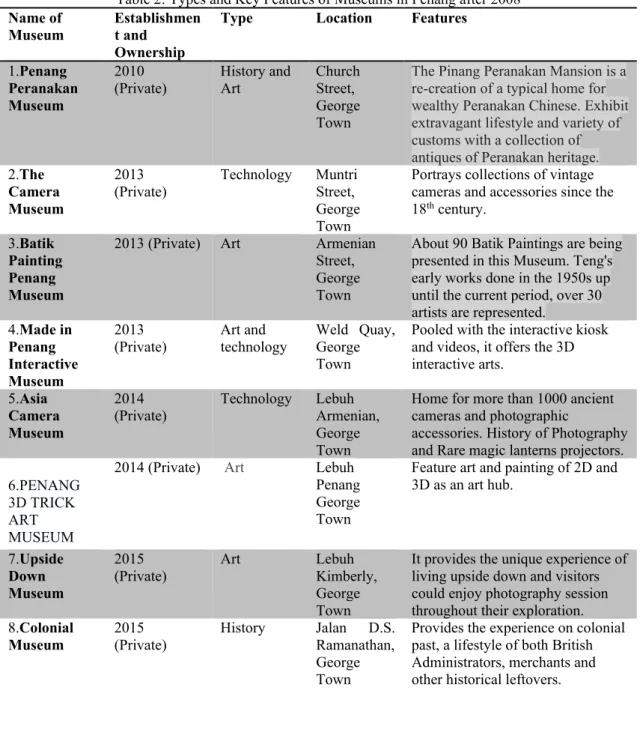
As shown in Table 2, museum trends have evolved in Penang. After the nomination of George Town as a World Heritage Site in 2008, more than 30
museums have opened, the majority of which are privately owned. Table 2 shows
that the number of museums that focus on art, specialty, history and technology has increased drastically. From 1965 to 2018, a total of 7 museums are categorised under art, followed by 5 museums under history, 4 museums under history and arts, 2 museums under natural history and science, 2 museums under technology and 2 museums and gallery under category specialty. Today, most museums in Penang are focused on the arts, whereas earlier museums focused on history, natural history and science. Knowledge-focused and interactive or leisure-based offerings started to emerge due to consumer demand. A similar
pattern was noted by Giacomo, Luisa and Martina (2014), in which museums
have started adopting interactive features and technology to enhance visitors’ experiences and engagement. Examples of such technology-based museums are Penang Camera Museum, Asia Camera Museum and Tech Dome Penang. These museums and galleries portray the transformation of technology innovation in curatorship. Secondly, the evolution of museums in Penang has notably added value in leisure, education and cultural preservation, which is aligned with the need for knowledge and entertainment offerings (Álvarez et al., 2017; Lee, 2010; Volkert, 2019). The development of consumer-oriented products (Brännback, 1999), customer orientation and ‘total customer care’ will provide superior value to customers, which leads to success in the global competition.
Private and Collaborative Ownership of Museums
and governmental bodies is evident in newly established museums and galleries, such as Tech Dome and Penang House of Music.
Table 2: Types and Key Features of Museums in Penang after 2008
Name of
Museum Establishment and
Ownership
Type Location Features
1.Penang Peranakan Museum 2010 (Private) History and Art Church Street, George Town
The Pinang Peranakan Mansion is a re-creation of a typical home for wealthy Peranakan Chinese. Exhibit extravagant lifestyle and variety of customs with a collection of antiques of Peranakan heritage. 2.The
Camera Museum
2013
(Private) Technology Muntri Street, George Town
Portrays collections of vintage cameras and accessories since the 18th century.
3.Batik
Painting Penang Museum
2013 (Private) Art Armenian Street, George Town
About 90 Batik Paintings are being presented in this Museum. Teng's early works done in the 1950s up until the current period, over 30 artists are represented.
4.Made in
Penang Interactive Museum
2013
(Private) Art and technology Weld Quay, George Town
Pooled with the interactive kiosk and videos, it offers the 3D interactive arts.
5.Asia
Camera Museum
2014
(Private) Technology Lebuh Armenian, George Town
Home for more than 1000 ancient cameras and photographic
accessories. History of Photography and Rare magic lanterns projectors.
6.PENANG 3D TRICK ART MUSEUM
2014 (Private) Art Lebuh Penang George Town
Feature art and painting of 2D and 3D as an art hub.
7.Upside
Down Museum
2015
(Private) Art Lebuh Kimberly, George Town
It provides the unique experience of living upside down and visitors could enjoy photography session throughout their exploration.
8.Colonial
Museum
2015 (Private)
History Jalan D.S. Ramanathan, George Town
9.Penang Ghost Museum
2015 (Private)
Art Lebuh
Melayu George Town
Features the horror and myth of all evils and ghost stories in Malaysia.
10.Penang Time Tunnel Museum 2015 (Private) Art and History
Jalan Green Hall, George Town
Presents the ancient discovery and old Penang since the year 1592 via 11 tunnels.
11.Wonder
Food Museum
2015
(Private) Art Lebuh Pantai, George Town
Showcases a variety of food and beverages locally served. Presents the larger version of those wonder foods representing the state as food heaven. 12.Penang Gold Museum 2016 (Private)
Art Lebuh
Bishop, George Town
Features the Gold & Silver collections, Gold Panning
Experience, Physical Gold & Silver Touching, Live Panning &
Demonstration, 3-D Murals.
13.Penang
House of Music
2016 (State Government and
Perbadanan Bekalan Air Pulau Pinang
Art and
Music Penang Road (Komtar Level 2)
Penang's glorious musical heritage and cultural diversity with carefully curated exhibitions and interactive features. Feature on communal music, a recreation of a radio booth and cinema.
14.TEDDYVI LLE
MUSEUM
2016 (private) Speciality Jalan Low Yat, Batu Feringghi
Malaysia’s first and largest
collection of Teddy Bears from various nations and eras; as early as the 1900s. 15.TECH DOME PENANG 2016 (a collaboration between State Government & private sector) Speciality (Science and Discovery Centre)
Jalan Penang, Komtar
Hub for technology learning and exchange ideas.
16.3D GLOW IN THE DARK MUSEUM
2016 (Private) Speciality
(art) Kimberly Street, George Town
First Glow-In-The-Dark Museum in Malaysia. The Dark Mansion appears to be one of the trendiest modern art museums as it integrates technology with arts.
17.ASIA COMIC CULTURAL MUSEUM
2017 (Private) Speciality
(arts) Jalan Magazine, George Town
Exhibit the history and
development of comics from the first beginnings to the present in 9 Asian countries including Malaysia.
Influence of e-WOM in Marketing Museums
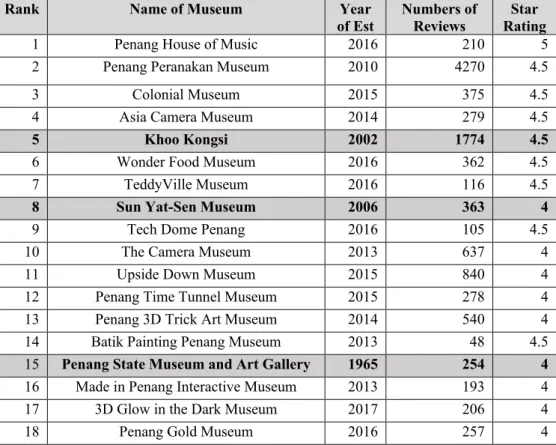
As shown in Table 3, the recently established museums were listed as top 20 museums in Penang compared with museums established before 2008. The top museum listed in TripAdvisor is Penang House of Music, which was launched in 2016. Although many newly museums were established within less than 10 years, their services and products were shared by users with a high rating on TripAdvisor compared to museums established before 2008. The second top museum in Penang is Penang Peranakan Museum with a total of 4,270 reviews with 4.5-star rating. The majority of users posted positive comments in terms of museum interpretation, the collection of exhibits, interior architecture and tour guide. Only three museums established before 2008 were included in the top 20 museums in TripAdvisor. These museums are Khoo Kongsi, Sun Yat Sen Museum and Penang State Museum and Art Gallery. Similarly, Li and Wang (2011) mentioned that marketing and promotions have evolved from a broadcasting medium to a participatory platform.
Table 3: Ranking of Museums according to Reviews and Star Rating
Rank Name of Museum Year
of Est Numbers of Reviews RatingStar
1 Penang House of Music 2016 210 5
2 Penang Peranakan Museum 2010 4270 4.5
3 Colonial Museum 2015 375 4.5
4 Asia Camera Museum 2014 279 4.5
5 Khoo Kongsi 2002 1774 4.5
6 Wonder Food Museum 2016 362 4.5
7 TeddyVille Museum 2016 116 4.5
8 Sun Yat-Sen Museum 2006 363 4
9 Tech Dome Penang 2016 105 4.5
10 The Camera Museum 2013 637 4
11 Upside Down Museum 2015 840 4
12 Penang Time Tunnel Museum 2015 278 4
13 Penang 3D Trick Art Museum 2014 540 4
14 Batik Painting Penang Museum 2013 48 4.5
15 Penang State Museum and Art Gallery 1965 254 4
16 Made in Penang Interactive Museum 2013 193 4
17 3D Glow in the Dark Museum 2017 206 4
Rank Name of Museum Year
of Est Numbers of Reviews RatingStar
19 Penang Ghost Museum 2015 163 3.5
20 Asia Comis Cultural Museum 2017 23 4.5
Source: Secondary Data TripAdvisor
CONCLUSION
A world-recognised seal such as a World Heritage Site and strategic location in the city centre are the factors that contributed to the increased number of museums established as a tourism product. Market response towards the heritage tourism industry boosts the opportunity to commodify heritage resources into profitable products, such as museums. Results revealed that the trend of transformation in museum function has diversified and oriented towards consumer preferences. Social media platforms are the emerging marketing strategy in influencing technology-savvy users in sharing their reviews on museums’ services and products. The transformation of museum roles in Penang has implications on the preservation of locality and cultural values as the primary role of museums. Despite the positive impact of creativity and collaboration among agencies, the implication on museums’ interpretation was due to market-oriented products and boosting visits. The absence of state intervention and museology institutions to ensure the preservation of cultural traditions militate against non-commodifiable aspects, such as intangible cultural heritage, everyday practices and the spirit of a place.
ACKNOWLEDGEMENT
The author(s) would like to extend their appreciation to the Ministry of Higher Education, Malaysia for granting the Fundamental Research Grant entitled ‘Establishing an Interpretation Model of Built Heritage Commodification for Tourism in Georgetown, Penang.' [Grant No. 203.PPBGN.6711405] that makes this study possible.
REFERENCES
Ab Samad, K., Shahidi, A.H, Rahim, A., Zuraidah, H. and Daeng H.J. (2012). Pendidikan Warisan di Muzium Malaysia Journal of Society and Spaces, 8(8), 35-48. Ahmad, A. T. (2015). Penang Museums, Culture and History. Kajian Malaysia, 33(2),
153-174.
Department of Museums Malaysia. (2017). Organization Chart. Retrieved June 14, 2017, from the Department of Museums Malaysia: Department of Museums Malaysia Ahmed, Y. A., Ahmad, M. N., Ahmad, N., & Zakaria, N. H. (2019). Social media for
knowledge-sharing: A systematic literature review. Telematics and Informatics,
37, 72–112.
Historica.
Barbieri, L., Bruno, F., & Muzzupappa, M. (2017). Virtual museum system evaluation through user studies. Journal of Cultural Heritage.
Brännback, M. (1999). The Concept of Customer -Orientation and Its Implication for Competence Development. Researchgate.
Chung, T. L., Marcketti, S., & Fiore, A. M. (2014). Use of social networking services for marketing art museums. Museum Management and Curatorship.
Del Chiappa, G., Andreu, L., & Gallarza, M. G. (2014). Emotions and visitors’
satisfaction at a museum. International Journal of Culture, Tourism, and Hospitality Research.
Denzin, N. K., & Lincoln, Y. S. (2006). The Sage Handbook of Qualitative Research, 2nd ed. Edited by Norman K. Denzin, and Yvonna S. Lincoln. Library.
Denzin, N. K., & Lincoln, Y. S. (2008). Methods of Collecting and Analyzing Empirical Materials. Collecting and Interpreting Qualitative Materials.
Gilmore, A., & Rentschler, R. (2002). Changes in museum management. Journal of Management Development, 21(10), 745–760.
Goulding, C. (2000). The commodification of the past, postmodern pastiche, and the search for authentic experiences at contemporary heritage attractions. European Journal of Marketing, 34(7), 835–853.
Hesseldahl, K., McGinley, C., & Monk, G. (2018). Using design thinking to develop new methods of inclusive exhibition making. In Studies in Health Technology and Informatics.
Homadovski, A. (2009). Transformations in Cultural Institutions - Contemporary Museum Destinations and Influences of Industrial Branding Values. Prostor. Koslow, J. (2019). Museums and digital culture: new perspectives and research. Museum
Management and Curatorship.
Lee, H.-K. (2010). Role of museums in managing design education: a case study.
International Journal of Education Through Art.
McCarthy, J., & Wright, P. (2005). Time, place and technology in museums: A dialogical approach to the experience. Re-Thinking Technology in Museums: Towards a New
Understanding of People’s Experience in Museums.
McPherson, G. (2006). Public memories and private tastes: The shifting definitions of museums and their visitors in the UK. Museum Management and Curatorship. Park, S.-Y., & Vargo, S. L. (2012). The Service-Dominat logic Approach to Tourism
Marketing Strategy. In: Strategic Marketing in Tourism Services.
Pitman, B., & Hirzy, E. (2004). Art Museums in Transformation. Trust Magazine.
Schweibenz, W. (1998). The ‘“Virtual Museum”’: New Perspectives for Museums to
Present Objects and Information Using the Internet as a Knowledge Base and Communication System. In Internationalen Symposiums für Informationswissenschaft.
Shaharir, S. A., & Zanuddin, H. (2018). Museum institutions in the digital age: The
insights of Malaysian museums’ use of Facebook. Journal of Social Sciences Research.
Sheng, C. W., & Chen, M. C. (2012). A study of experience expectations of museum visitors. Tourism Management.
content in the context of the distributed museum. Nordes.
Volkert, J. (2019). The future of museum and gallery design: purpose process, perception.
Museum Management and Curatorship.
Weilenmann, A., Hillman, T., & Jungselius, B. (2013). Instagram at the museum: Communicating the museum experience through social photo sharing. In
Conference on Human Factors in Computing Systems - Proceedings.