Introducing a Localized Cross-Border E-Commerce Model, case: Iran B2B
E-Commerce
Dr. A. Asosheh H. Shahidi-Nejad Faculty of Engineering Department of Information Technology Tarbiat Modares University, Tehran, Iran Tarbiat Modares University, Tehran, Iran email: [email protected] email: [email protected]
H. Khodkari Faculty of Engineering University of Tehran, Tehran, Iran
email: [email protected]
Abstract
By the explosive growth of B2B e-commerce transactions in international supply chains and the rapid increase of business documents in Iran’s cross-border trading, effective management of trade processes over borders is vital in B2B e-commerce systems. Structure of the localized model in this paper is based on three major layers of a B2B e-commerce infrastructure, which are messaging layer, business process layer and content layer. For each of these layers proper standards and solutions are chosen due to Iran’s e-commerce requirements. As it is needed to move smoothly towards electronic documents in Iran, UNedocs standard is suggested to support the contents of both paper and electronic documents. The verification of the suggested model is done by presenting a four phase scenario through case study method. The localized model in this paper tries to make a strategic view of business documents exchange in trade processes, and getting closer to the key target of regional single windows establishment in global trade e-supply chains.
Keywords: E-commerce, cross-border, electronic document management, international supply chain
Introduction
communication between traders in two different countries. Today one of the main targets of the world trade organization is to establish regional single windows which can increase the trade facilitation in different parts of world. Establishing a regional single window needs cross border gateways that can exchange trade documents efficiently. So first, the key necessity of managing the simplified documents over borders is to move toward national single windows. After that, the regional single windows can authorize the communication between countries.
E-commerce models are studied based on the three major logical layers. These three layers are messaging layer, business process layer and content layer. (Medjahed B. et all, 2003)(UNCEFACT, 2008)
Generally the localized model in this paper is a way to automate the process of exchanging trading documents. This can be a step through establishing the National single window of Iran and then with the more interoperability between the East Asian and Middle Eastern countries a regional single window can be improved in the future.
In this paper the second section is discussed basic concepts and standards required to introduce the cross-border B2B model in international supply chains. The third section is assigned to introduce the scope of the model and its components functionality in a big picture schema. The forth section discusses the model localization over B2B transaction layers, and finally the paper in concluded.
Backgrond
In this section; besides, studying B2B e-commerce in Iran, the background concepts and information such as standards and reference models which are used in localization of the B2B e-commerce cross border model are discussed.
A. B2B E-commerce in iran
Today the performance of the trade processes in Iran is a key trade success point. Iran has long borders with many of the countries in the region and its import and export processes can be done over road, rail, sea and air ways. So the central and strategic role of this country makes it a key trade point of goods transit in the Asia and Middle East region.
As today many of the main processes in the customs of Iran are done by the forms in the paper format, and the electronic services of the ministry of commerce are restricted to the merchants who trade in the side of Iran. The model simplifies the exchange of electronic documents in the B2B cross-border e-commerce of Iran trading. Here some of the systems which give the electronic services by the ministry of commerce in Iran are mentioned:
• Iran Code3 • Made In Iran4
These are the main electronic systems which are using today to facilitate trade processes in Iran. The systems are mentioned here as independent trade facilitators which can have interaction with the suggested model in this paper in the future.
By Joining Iran to the world trade organization by standardizing the data elements and trade processes can be a good move through improving the regional single window of Asia. And because Iran is a member of the United Nations,
From the designing point of view, one of the main advantages of document data harmonization in Iran is the reduction of data elements of the forms. So they can be reused in different documents as much as possible. This makes the country ready for using any standard forms of data. So the localized cross-border model in B2B e-commerce can make the trade processes make faster and safer which is one of the necessities of Iran’s trading today.
B. Single window
The Single Window is a system, which enables single submission entry and Single and synchronous processing of data and information. These can help the system to make a key service which is so effective in shipping goods over the borders which is: A Single Decision-making point for customs release and clearance of cargo. (Keretho, 2007) (Misovioca, 2008)
It is needed to go through establishing a National single window in Iran to get closer to joining a regional single window.
C. Buy-Ship-Pay reference model
In order to understand the complexity of international trade. This simple model can make a clear view of the key elements of a trade transaction, and consequently to properly compile the necessary trade facilitation measures. UN/CEFACT has set out this to model the international supply chain using an internationally accepted modeling technique to provide reference model, which gives a view of the international supply chain in its entirety. (UNCEFACT, 2008)
Figure 1. International supply chain (UNCEFACT, 2008)
As discussed above, the recommended measures, grouped into four categories, relate to the processes in this model.
• BUY - covering all commercial activities related to the ordering of goods;
• SHIP - covering all of the activities involved in the physical transfer of the goods, Including official controls;
• PAY - covering all of the activities involved in the payment for the goods (UNCEFACT, 2008)
After classifying the main categories of roles and processes in a cross-border supply chain, it is needed to have a closer view of different types that each of categories can include.
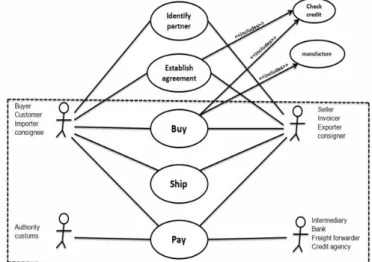
Different procedures and roles of the BSP model can be described by use case diagrams to show relation between roles and processes. Some processes are related to identifying business partner establish agreement which are being separated regarding the scope of cross-border model. (Figure 2)
Figure 2. Roles and use cases in the BSP model (UNCEFACT, 2008)
D. UNedocs data model
paper and electronic documents are a different implementation of a common document concept. This link ensures that traders can at any time choose the type of document technology that best meets their business requirements and technology capabilities. (Dill, 2007)
To establish a UNedocs project in the country these following four stages are suggested in implementing the UNedocs project in a sample trading environment:
• Better Paper Documents • Document Data Models • Digital Documents
• Systems: Automated document processing, Single electronic Window (Grainger, 2008)
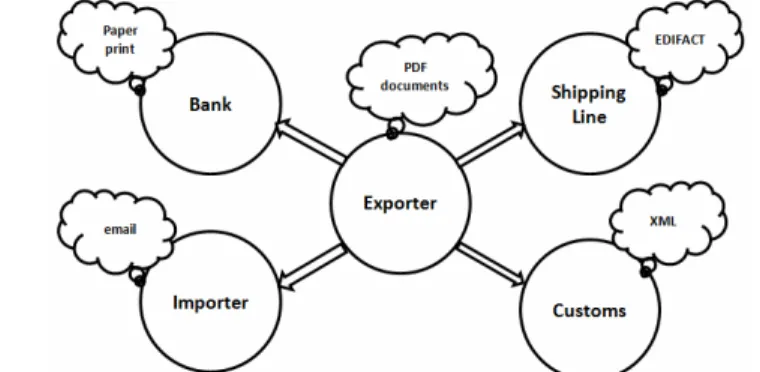
In other words, by the UNedocs project single documents can adapt in different information processing systems. (Figure 3)
Figure 3. Different information systems relationship (Pikart, 2007)
E. PKI standard
The trusted distribution of public keys is the primary purpose of a PKI. A PKI usually contains of one or more Trusted Third Parties (TTPs) called Certification Authorities8. A CA creates public key certificates, where a certificate is the concatenation of the name of an entity (the subject of the certificate) with the public key of that entity (and other data), all signed using a private digital signature key owned by the CA. (UNCEFACT, 2006)
In e-commerce, security of important information and reliable identification of trading partners are very important factors. Confidentiality, integrity, authentication, and non-repudiation are all security requirements. The key CA topologies are as follows: Root CA/Hierarchy Model, Certification(Mesh) Model, Bridge CA Model, Cross-Recognition Model, Certificate Trust List Model. (Probert, 2007)
Model Introduction
transactions in different B2B transaction layers.
A. Model scope
In this subsection the scope of the customization of the B2B cross border model is discussed.
Different levels of data integration exist which can be done to simplify the data sets. In this model the focus is on the last or international layer. Harmonizing in exchange data elements leads to effective cross-border trade. Generally, the scope of the model in this paper is about the international layer, so the main aim is to harmonize the trading transaction in processes and content. (Figure 4)
This shows that based on the layer of data harmonization which is needed in every situation; the proper standards and solutions in analyzing the model can be chosen. So, the standards in a cross border model have to support the cross border transactions.
Figure 4. Level of data harmonizing (Dill, 2007)
B. Model components
The buy-ship-pay reference model discussed as a way to simplify the processes and eliminate unnecessary details of a trade scenario and UNedocs as a project to cluster and manage the documents. These standards are suggested solutions to go through the single window policy.
First let’s have a high level view of the components of the system while a cross-border communication is happening. In every side the customs are placed which are leading to the national single window of the country. The documents in the National format are entering to the translator module which is changing the format of the documents to the standard UNedocs format. Then it can go through a middleware to be declared more and finally the cross-border single windows is the last gateway. Every country can use this model form its own side to the exchange gateway. (Figure 5)
C. Certificate authentication in the model
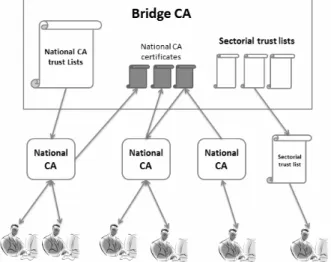
The relationship between CAs in this model is designed according to the basic models of PKI interoperability models as they were mentioned in the background section. Requirements can be supported by a variety of different key management architectures and the relationship topology which is suggested here is using the benefits of CA hierarchy model, certificate trust list and bridge CA model. (Figure 6)
Figure 6. The CA interoperability topology in the model
The benefits of this topology are:
• It will publish a trust list of national CAs. Those national CAs can retrieve the list themselves and are free to add and subtract CAs from the list and republish it to their government’s users according to their own national preferences.
• It may also publish trust lists of CAs in particular sectors – for example, a list of CAs accredited to provide health certificates.
• It will cross-certify with each national CA and make that certificate available to other CAs to perform their own cross-certifications.
Model Localization Over B2B Layers
In this section the components of the model are discussed over three different layers of communication between B2B e-commerce systems. Each subsection shows the relationship between exporter, importer, customs, regional single window and the National single window in both sides of a trade transaction.
A. Business process layer
In the business process layers, the reference model and the UNedocs project are used to manage the electronic docs, but as a key step of project management first the exact scope of the transactions which are included in the suggested model must be described. According to what was mentioned about UNedocs, it is said that this project is mainly about the electronic documents but not about identifying the trading partner or the use cases which are about before contract.
While the relation between roles and processes are discussed, the scope of the model can be described more precisely in the business process layer. The scope of processes which are considered in the localized cross-border model of this paper can be seen inside the dotted line in figure 2.
B. Messaging layer
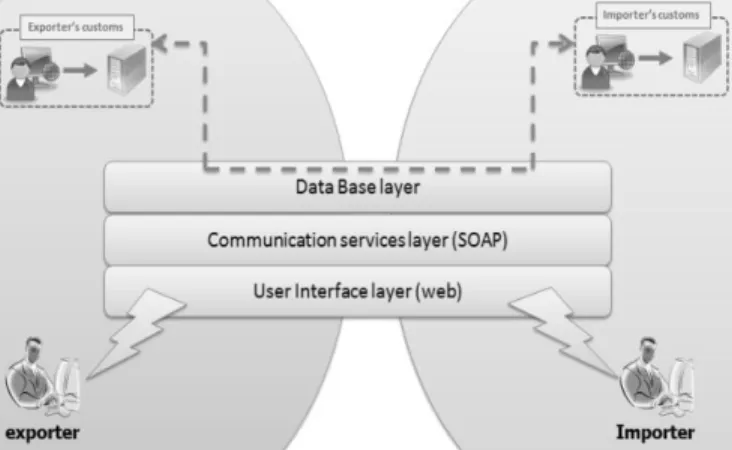
Figure 7. Messaging layer in the model
C. Content layer
The content layer of the localized model deals with the documents, the objects which have to exchange through borders from exporter to importer and the opposite. One of the main challenges of this model is joining the B2B e-commerce system of Iran to a regional single window. As in Iran, paper documents are being used in the trading processes, so international standards to create and align documents which change the current documents readable for other partners in the international supply chains must be chosen. This layer is discussed from two aspects, first standards to design forms and second a solution for Exchanging forms through a unique gateway. One more advantages of this model is data reusability. Same data elements in different forms can be detected and each layer can use the data elements which are entered in the system before. (Lim, 2007), (Moon, et al, 2011)
The most important rule considered in this hierarchy is to send and receive documents via next layers of system, and every document submission in the model needs an acknowledgement message to guarantee the integrity of the communication system. (Figure 8)
Certificate Authorization
As the PKI standards and the necessity of certificate authorization in B2B transactions were discussed before, finally, the role of certification authority center in relationship to other components of the cross-border e-commerce model is discussed.
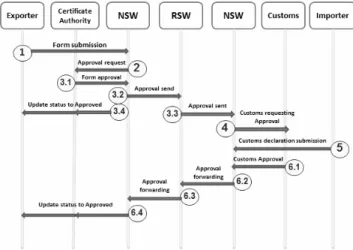
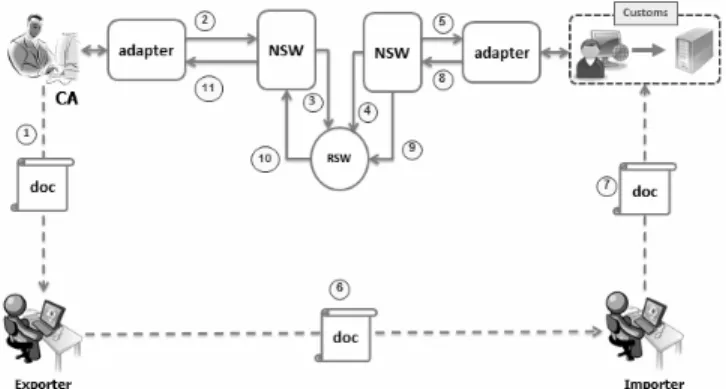
It is clear that the main supervision roles in authorization are once before entering a form into the cycle and once after finishing work with that document to save it as a used code. The assigned numbers in the figure 7, show the priority of tasks which happen in the scenario step by step. As the priority numbers show, in each country the National single windows receive forms and messages which are being sent through adaptors. This will turn the content of each message in the “national format” that is readable for the regional single window which supervises the transaction. Certification authority checks the forms number unique and makes it easier to trace each trade transaction. (Figure 9)
Figure 9. Certification authority scenario in the model
Figure 10. Model implementation schema
A Sample Process Analysis
In this section the verification of the suggested model is done according to a four phased scenario. In this scenario a communication between two trade points over borders, and the role of each of the model components are being discussed. These four phases are:
• Phase 1: Exporter sign in to system and application record
• Phase 2: Interaction between exporter and exporter national single window • Phase 3: Interaction between exporter and importer single windows
• Phase 4: Interaction between importer and importer single window
Now, the above phases through each of the following subsections are discussed. In each subsection, the functionality of each component in the cross-border model was discussed according to the schemas of messaging and content layers. (Figures 7 and 8)
A. Phase 1: Exporter sign in to system and application record
In this phase the exporter and CA center are the main actors of the scenario. The significant target is to record a successful sign in for the exporter in the national single window system. So, the exporter can go through next steps in the future phases.
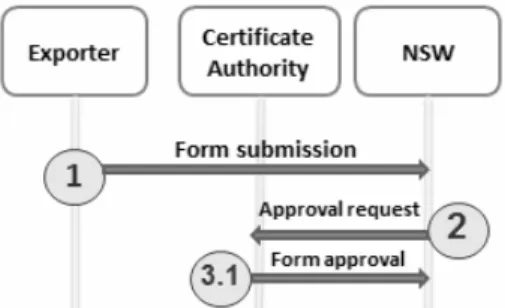
The detailed interactions between the model’s components include sending application form to sign in and receiving the CA approval. The exporter sends his request to start a transaction to the national single window. To record the sign in process, national single window asks the CA component for approval, and after receiving the approval message the transaction is being acceptable as a valid export process. It should be considered that in each step of the scenario the communication between actors like exporter, importer and CA are done by the single window component. (Figure 11)
Figure 12. Exporter sign in, messaging layer
After this phase the electronic record of the export transaction will be saved and kept to use in the next phase which is the interaction between exporter and exporter national single window. (Figure 12)
B. Phase 2: Interaction between exporter and exporter national single window
In the second phase of the scenario, main actors are exporter and CA center, but there are more components involved in this part of the process. The perquisites of this phase are about having a connection with the national single window and being able to send and receive forms and messages.
The validity of the form’s signature is being approved by the CA in the national and regional levels based on exporter’s private key.(Figure 13)
Figure 13.Exporter and NSW content layer
be checked by the regional single window. In the messaging scenario, the approval message is sent to the regional single window to be validated over regional regulations and after that the regional approval is sent back to the exporter as an approval of continuing the process.
In other words, the national single window is making the chain of communication complete while the regional single window is having supervision due to regulations.
Figure 14. Exporter and NSW, messaging layer
After receiving the regional approval, the last status of the form is being changed to “approved”. This shows that the process can go on to the thirds phase which is interaction between exporter and importer single windows. (Figure 14)
C. Phase 3: Interaction between exporter and importer single windows
The third phase is about Interaction between exporter and importer single window, main actors are CA center and customs of importer. Every document or its approval must be sent through national singles windows and regional single window. Like the second phase each component is responsible for either forwarding or approving the forms. As the importer side is being discussed here the customs is one of the main actors which have to approve the form as declaration process. (Figure 15)
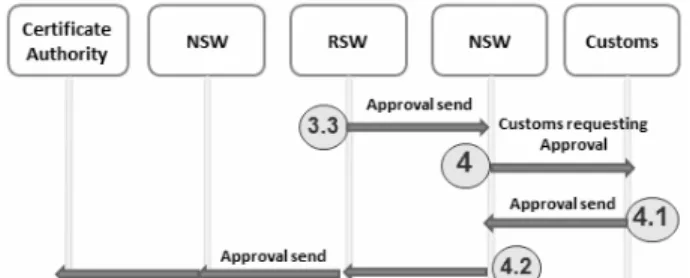
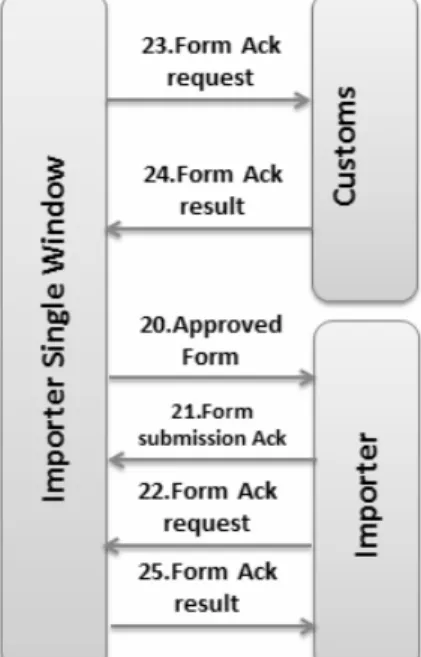
In the third phase of the scenario in the messaging layer, at last the approval of the form received is sent from customs to the CA center in the side of exporter. As the regional single window sends the approval to importers country, the national single window asks the customs for declaration through a form approval request.
This request is being responded by the customs as an approval message and the result will be sent to the CA component of the exporter’s country.(Figure 15)
When the CA receives the approval message from customs of importer country, the next phase starts which is Interaction between importer and importer single window.
D. Phase 4: Interaction between importer and importer single window
In the fourth phase Interaction between importer and importer single window are discussed. The main actors of this phase are importer and customs. Importer and customs are connected to each other via national single window of the importer.
After this phase the importer must be able to receive the final approval from its customs. But it is clear that again the relation between the customs and importer is being applied through importer national single window. (Figure 16)
Figure 16. Importer and NSW interaction, content layer
Figure 17. Importer and NSW interaction, messaging layer
By the end of this phase, customs and importer are sending the approval of a successful process to the national single window. If according to the regulation, the CA needs this final approval to be recorded in a file, this message can be sent to the CA of the exporter to be stored.
CONCLUSION
In this paper after having a look at B2B e-commerce in Iran, a new localized cross-border e-commerce model based on single window concept was introduced. This model can be implemented to carry out B2B transactions over borders and presented as a roadmap trough establishing a national single window in Iran. This can be a step though joining Iran to regional single windows in future steps.
Acknowledgment
The authors would like to thank Research Institute for ICT9 for their support of e-commerce lab established by 2010, at Tarbiat Modares University.
Endnotes
1. http://Sabtaresh.tpo.ir 2. http://amaresh.tpo.ir 3. www.irancode.ir 4. www.madeiniran.com 5. Buy – Ship - Pay 6. UNedocs
7. UNECE 8. CA
9. www.itrc.ac.ir
References
Dill M., (, 2007),UNedocs Extended Module for Integrated Data Exchange at Border Crossing, UNECE/UNESCAP UNedocs Workshop on Trade Facilitation
Grainger A,. (2008) ,Customs and trade facilitation: from concepts to implementation, World Customs Journal, Vol. 2, pp. 17—30 .
Kabak I. and Dogac A.,(2008) , A Survay and Analisys of Electronic Business Document Standards, Middle East technical university
Keretho S.,(2007), Single-Window e-Logistics: Policy Initiatives and Projects in Thailand, UNECE/UNESCAP Workshop on UNeDocsforSingle Window Facilities in Asia and the Pacific
Lim S., (2007) ,Cross-border Data Exchange in the Asia Pacific Region: Current Status and Future Directions, UNECE/UNESCAP Workshop on UNedocs for Single Window Facilities in Asia and the Pacific.
Medjahed B. et al.,(2003), Business to business interactions: issues and enabling technologies, the VLDB journal, Elsevier
Misovicova M., (2008) ,Single Window Overview and Best Practices, Singapore-ADB CAREC/ATRIUM Forum on Trade Facilitation .
Moon Hee-Cheol, Shing sang-Ryul, Kim Don-Yeong,(2011), Issues in the International Standards of Electronic Documents for Global e-Trade, Proceeding of the International Conference on Social Science, Economics and Art .
Phuaphanthong T., (2009) ,APEC Data Harmonization Toward Single Window Paperless Environment, APEC endorsed project.
regional workshop, cairo.
Probert S., (2007) ,A Roadmap for Implementation of UNedocs, SPECA-ASEAN Capacity Building Workshop on Trade Facilitation.
Stokes P., (2007) Single Window Experiences, UNECE Workshop on United Nations Electronic Documents.
Trust Fund for Trade Facilitation and Negotiations: (2006) ,The Electronic Submission of Trade Documentation .
United Nations Center for Trade Facilitation and Electronic Business,(2008),: The Harmonized Data Model Buy Ship Pay Subset for International Trade.
United Nations Center for Trade Facilitation and Electronic Business: (2008) ,Buy Ship Pay Modeling Guidelines .
United Nations Center for Trade Facilitation and Electronic Business: (2008) ,Facilitation Measures Related to International Trade Resources.
United Nations Center for Trade Facilitation and Electronic Business: (2006),A Roadmap towards Paperless Trade.