Hungarian Association of Agricultural Informatics European Federation for Information Technology in Agriculture, Food and the Environment
Journal of Agricultural Informatics. Vol.9, No. 1
journal.magisz.org
Spatial analysis of orchids diversity unveils hot-spots: The case of Zante Island,
Greece
Aristotelis Martinis1, Evgenia Chaideftou2, Charikleia Minotou3, Κonstantinos Poirazidis4
I N F O
Received 5 Dec 2017 Accepted 31 Jan 2018 Available on-line 23 Mar 2018 Responsible Editor: M. Herdon
Keywords:
Distribution, Suitability map, Altitude, Hydro-lithography, Species richness, Hot-spot
A B S T R A C T
The current study aims to analyze the ecological niche and mapping the distribution of species belonging to Orchidaceae family, in Zante Island and to determine hotspots at sites of high species richness. 967 observations were recorded into 110 tracks in 2015 and 120 tracks in 2016, where 47 orchid species were identified belonging to 9 genera. Using Maxent, the ecological niche of each species was analyzed and habitat suitability map was created using 12 environmental parameters. The suitability maps were transformed into a binary format according to the threshold “10th percentile training presence” and the transformed maps used to compute hot-spot regions by applying the SMD toolbox using the software ArcGIS.Zante Island is characterized by remarkably high orchid species richness since the synthetic model indicates presence of at least 10 species for the 53.2% of the island area. Topography, geology and landscape openness are determining factors for orchids’ diversity conservation. Altitude is the determining factor of differentiation in species distribution. Hydro-lithology was the following most significant interpreting parameter. The mapping analysis of species abundance units revealed that 12.5% of the island surface could be characterized as hotspots of high value for the conservation of orchid diversity.
1. Introduction
Interactions between biotic organisms and environmental variables, such as the relation of heliophyte orchids with light intensity (Naveh 1982), are of crucial importance for ecosystem evolution especially in the Mediterranean landscape. Selecting the proper environmental parameters and collecting field work data can result in the mapping of species distribution and their habitats suitability; such maps depict the predicted spatial distribution of species at wider areas. The combination of environmental parameters and taxa recordings can generate more robust modeling outcomes of species distribution (Elith & Leathwick 2009) principally because proper quantitative methods and tools are valuable for deriving credible conclusions (Tremlová & Münzbergová 2007). Noteworthy is the fact that species occurence modeling can produce multiple maps that are considered suited for floristic analyses because they reveal the existing reliance of species’ presence on biogeochemical requirements (Van der Maaten et al. 2012). The aforementioned are basic tools for
1 Aristotelis Martinis
Department of Environmental Technology, T.E.I. of Ionian Islands, Panagoula, 29 100, Zante, Greece [email protected]
2 Evgenia Chaideftou
Department of Environmental Technology, T.E.I. of Ionian Islands, Panagoula, 29 100, Zante, Greece [email protected]
3 Charikleia Minotou
IFOAM AGRIBIOMEDITERRANEO, Derigny 49, 10434, Athens, Greece [email protected]
4 Κonstantinos Poirazidis
Department of Environmental Technology, T.E.I. of Ionian Islands, Panagoula, 29 100, Zante, Greece <[email protected]
protecting species and preserving their diversity in regions with hot spots of high value (Rodríguez et al. 2007).
Orchidaceae is one of the prime and most diverse plant families (Tsiftsis et al. 2008) numbering more than 25.000 species of 800 genera worldwide (Popova et al. 2016). Despite its high species number, this family exhibits the highest percentage of extinction rate in the world. In Europe orchid species are reported to have been severely declined the last decades (Kull & Hutchings 2006). In most studies orchids are mainly investigated for their anatomy (Aybeke et al. 2010), medicinal substances and ethnobotanical uses (De Vos 2010), innovations in their breeding (Popova et al. 2016) or their presence is recorded in species lists (Melendo et al. 2003), but less studied are their conservation priorities (Pfeifer et al. 2010). Hence the determination of the ecological niche is considered elementary for the conservation of Orchidaceae species (Tsiftsis et al. 2008). Related issues such as the reduction in the distribution range of orchid species have been investigated for instance in Northern Europe (Kull & Hutchings 2006).
It is widely known that the majority of orchids interact with compatible mycorrhizal fungi throughout their lives, due to lack of endosperm in their seeds. Since orchid seed lack an endosperm and consist only of an embryo and a seed coat, this association is obligate during seed germination with the mycorrhizal fungus supplying the critical nutrients for germination and continue to rely on fungi for water and nutrient to some extent at adulthood (Rasmussen 2002; Warcup 1990; Jacquemyn 2016). Mariangela Girlanda and Silvia Perotto (2011), in their research on the of mycorrhizal fungal diversity in four photosynthetic Mediterranean meadow orchids, indicates that meadow orchids may prefer specific fungal partners in natural conditions.
In parallel, it is recognized that our knowledge of orchid ecology needs to be enhanced especially in terms of their geological and altitudinal preferences (Hágsater & Dumont 1996), while usually the studies investigating orchid ecological preferences are too few (Tsiftsis et al. 2008, Phillips et al. 2011) and most often such studies are conducted after a decline in the orchid distribution ranges has taken place (e.g. Kull & Hutchings 2006). A major factor resulting in such declines is habitat loss (Fischer & Stöcklin 1997). Consequently, studying the distribution of species’ abundance and how it is affected by geographical and environmental factors, as well as determining their ecological niche, is essential for enhancing the protection planning of the species of Orchidaceae family (Crain et al. 2014).
Nowadays the number of threatened species exceeds well our available resources for the protection and conservation of these species, indicating a firm need for prioritizing biodiversity protection with a focus on regions where are detected the earnest protection requirements. A promising approach is to determine 'hotspots' in areas of high endemism threatened by habitat loss and in areas of high species richness or presence of rare taxa (Myers et al. 2000). This may be particularly the case of areas undergoing fragmentation and such areas can be traditionally species-rich areas, entailing habitats that are hotspots, but due to fragmentation (or other threats) their occurring species run the risk of extinction (Piqueray et al. 2011). Species respond differently to threats like fragmentation (Lindborg 2007) and this is a main reason that species preferences are worth-investigating as they can be pivotal in conservation management (Piqueray et al. 2011).
2. Methodology
2.1. Study area and floristic recordings
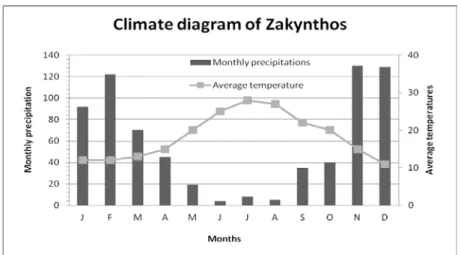
The Zante is located in the southwestern of Greece, in the Ionian Sea, between Greece and Italy. It is about 150 km south of Corfu (Kerkira) island and forms with Lefkada, Kefalonia, Ithaki, Paxi, Kythira and many others small islands, the Ionian archipelago (Eptanisa). Zante covers an area of 406 km2 with a population of about 42,000 people (Figure 1). The study area covers all the surface of this small island, in witch the climate is of Mediterranean type, with intense annual precipitation ranging from 800 to 900 mm (average of approximately 850 mm), showing a decreasing trend over time. The wet season starts in September and ends by May (Figure 2). The area is characterized by low and middle altitudes, where the largest altitude is located at the top of the mount Vrachionas and reaches 792 m. As consequence, there is an overlap of vegetation zones and the distribution of species. Thus, a high diversity of habitats is exhibited with a diverse mosaic of varied vegetation types (Pinus halepensis woods, shrubs, meadows, agricultural areas, olive groves, open burnt areas, sand dunes etc.).
Figure 1. Location of Zante Island in the Ionian Sea
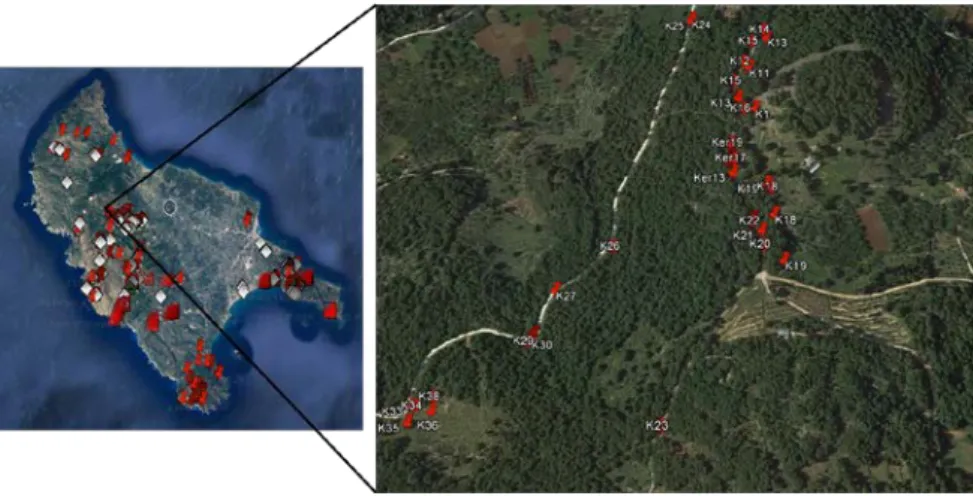
The first recordings of orchids’ distribution in Zante Island took place early in the 19th century (Delforge 1993, Gölz & Reinhard 1995). In our case, a total of 967 recordings were completed between 2015 and 2016, following different tracks with a 2-4 km length and 2-meter belts of either side of each track. Specifically, 110 tracks were trailed in 2015 and 120 tracks were trailed in 2016. All these routes were homogeneously distributed across the habitats of Zante Island (Figure 3). In totally two years of recording, were trailed 230 tracks with an overall length of approximately 650 km.
Figure 3. On the left, recordings in study area (white points: recordings in 2015 and red points: recordings in 2016. The right image shows some indicative recordings of orchids in the mountainous
region of Loucha - Gyri (Zante Island - Greece)
Each year (2015 and 2016), orchid recording took place between mid-February and end of May. In sites of high orchid abundance, the recording was repeated (in the beginning and at the end of spring). For each sampling site, a designed protocol was used for the recording of coordinates, observed species, analytical photographical images for species documentation, specific data for vegetation and geo-topographical parameters as well as data and of their conservation status and threats. In particular, the orchid species recording was conducted only using photographs and no orchid individual were sampled for conservation reasons. Orchid species were recorded at all representative biotopes of the island, open and shadowed forest, macquis, phrygana, previously burnt, and wetland ecosystems, with the aim to cover a wide spectrum of environmental parameters so that the suitability models approximate the real species distribution. The orchids were identified based on standard floras (Tutin et al. 1980) and named in line with the binomial concept of Linnaeus (Jarvis, Cribb 2009) following Euro+Med (2006-) and the Flora Ionica Inventory (Flora Ionica Working Group (2016 onwards)) cross-checked with Dimopoulos et al. (2013).
2.2. Data analyses and Individual models of habitat suitability
All recordings were introduced into a geographical database and individual models of habitat suitability were developed with the program Maxent (of maximum entropy) (Phillips et al. 2006), using 13 environmental parameters that affect the presence and distribution of Orchidaceae species, in three parameter groups of topography, vegetation and geology (Remm et al. 2008):
- The first group includes six parameters of topography: altitude, terrain gradient, effect of the relief exposure (quantitative northbound effect variable and eastbound quantitative variable) and relative topographic location (as a quantitative and qualitative variable).
- The third, includes two qualitative geological parameters: lithological and hydro-lithological rock formations, with 10 and 6 classes for the formations correspondingly (Appendix 1). 2.3. Habitat suitability models – Hot spot analysis
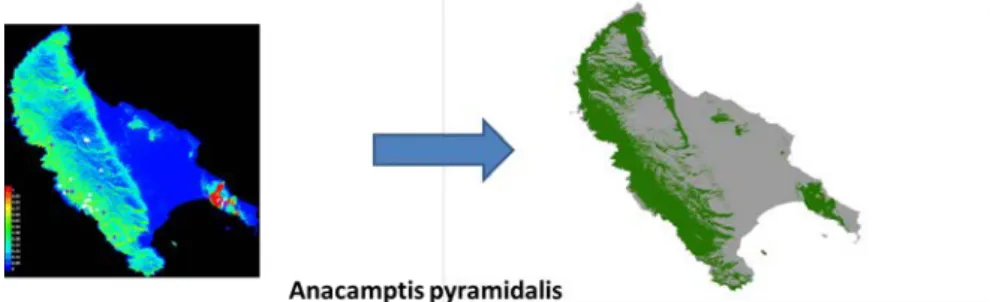
Habitat suitability models were estimated for each species, using Maxent (Phillips et al. 2006). These models were based on a mean value of 10 replicates, with the method of crossvalidated. The resulted habitat suitability maps, that its scale was firstly continuous between 0 and 1, was transformed into a binary file (presence – absence) using the threshold “10th percentile training presence” to consider the environmental complexity of the region and thus depict the species presence more conservatively, where 90% of the training samples are correctly classified (Figure 4). Considering this threshold, the 10% of excluded presences are potentially represent recording errors, ephemeral populations, or occurrence of unusual microclimatic conditions within an area.
The current models for the suitability prediction for species do not require data of verified species absence but they do compare the sites of the species presence with the range of the total change of the niche in the studied area, on the basis of determined factors. However, the statistical models do not recognise the most significant factors that define ecologically the presence of a species. On the other hand, if proper factors are used in the models, it is highly probable that this will result in a proper outcome (for instance a robust distribution of the species presence), though the ecological and management importance of this outcome may only have a trivial meaning. For the above reasons, the selection of the environmental parameters was based on two criteria: a) percentage over a 5% participation in the interpretation of the species distribution, and b) degree of correlation between the selected variables less than 0.8. The best regularization number (at a scale from 0.5 to 3 in increments of 0.5) for each model generality was calculated based on the criterion AICc, and when AICc was the same in 2+ models, then the most proper one was selected, namely the model with the lowest AUC.Diff using statistics in R. Note that the highest generality value corresponding to a spread distribution is the default value of 1 (Phillips and Dudik 2008).
Figure 4. Transformation of the individual suitability map (left) of Anacamptis pyramidalis to a binary file (right).
Based on the individual binary models, hot spot analysis was formed by applying the SMD toolbox (Brown et al. 2017) using the software ArcGIS (analysis at scale of 5000-meter squares). Then six spatial units based on species richness were computed via the tool Hot Spot Analysis (Getis-Ord Gi*) and the Euclidean distance.
3. Results and Discussion
3.1. Floristic results and Synthetic maps
90% of Delforge database. From the 47 species of our study, 29 of 7 genera were found to have adequate enough data to provide reliable models. Most of the models found to perform well with AUC values more than 0.8 (mean AUC value of all models equal to 0.849, with a standard deviation of 0.07). Combining independent models, a synthetic map of species richness was created (Figure 5a). This map is of particular value for designing and planning the conservation and protection of the Orchidaceae species, demonstrating that at a 53.2% of the island area, the presence of at least 10 orchid species is estimated (Figure 5b). At particular sites (comprising the 4.7% of the island area) it is estimated that at least 20 species up to 27 are present, mainly at the southwest of the Island (Figures 5b).
Figure 5. Synthetic map of species richness of Orchidaceae family (a) and three classes
of species richness of Orchidaceae (b) in Zante Island.
3.2. Environmental parameters in orchid distribution analyses (niche analyses)
The relation between species abundance and altitude is considered a key factor in floristic studies, as in relatively small geographical distances there are often significant climatic variations that largely determine the biodiversity of a region (Grytnes et al. 2006, Acharya et al. 2011), despite the fact that in many cases and for various taxa, altitude is not a defining factor of species abundance (Tsiftsis et al. 2008, Trigas et al. 2013). Apart from altitude, the range of species dispersion is also associated with other ecological and environmental parameters such as soil pH, aspect, slope, soil temperature, and climatic conditions, mainly precipitation and temperature. Taxa exhibit some degree of physiological tolerance to environmental pressures, while wide variations in species richness are strongly correlated with the climate (Lomolino 2001). Some researchers argue that species’ morphology and abundance are mainly due to an environmental factor, which may be different for each species (McCain 2007, Currie & Kerr 2008). In any case, apart from the altitude, the most important factors seem to be water and energy for many species (O’Brien 1998, Hawkins et al. 2003, Fu et al. 2006). In the particular case of orchids, the species distribution is critically correlated to edaphic and mycorrhizal specialization (Phillips et al. 2011). For rare orchids’ conservation, this implies the importance of microhabitats where present are the suitable endophytes, and fungi are properly distributed within the microhabitats. Hence changes in orchid species composition are not yet known to be driven by changes in endophytes across environmental gradients (Phillips et al. 2011).
Figure 6. The impact of altitude, where the peak appears at an altitude of approximately 200 m on Anacamptis pyramidalis (a) and Anacamptis coriophora (b), and the impact of altitude where the peak
appears at an altitude of approximately 600 m on Ophrys lutea (c) and Neotinea lactea (d)
Topography, geology and landscape openness are determining factors for orchids’ diversity conservation. This is congruent with the findings of Tsiftis et al. (2011) that highlighted the significance of the geological substrate as a surrogate of the soil conditions that inflict on orchid distribution. Hydro-lithology was the following most significant interpreting parameter (17 out of 29 models), with granular deposits dominating as suitable substrate, at south and east aspects of moderate inclination covered by less dense to sparse vegetation.
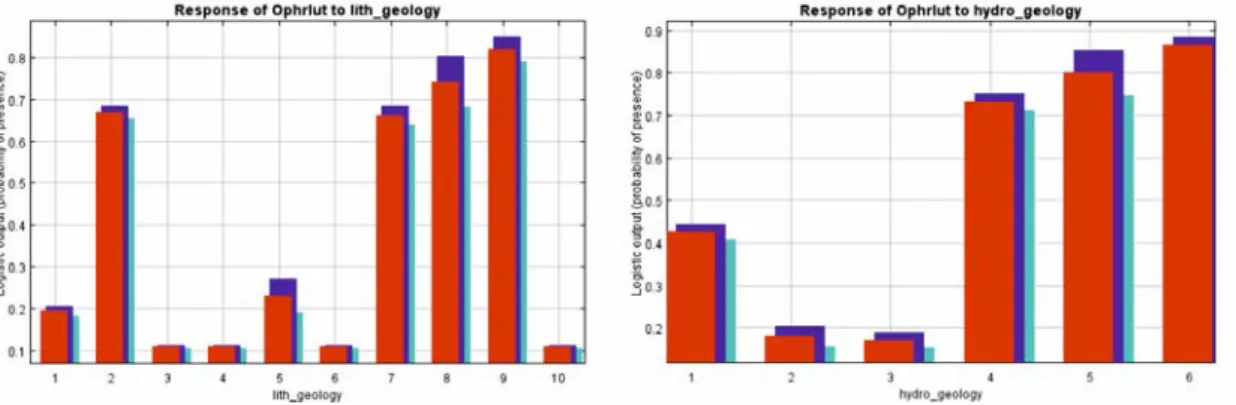
Ophrys lutea exhibits an incremental linear adaptation and the species presence was recorded throughout the altitudinal range of the island. According to recordings, the individuals of O. lutea are more robust and in complete flowering at medium altitudes, while at lower and higher altitudes their flowers are less and smaller. The species exhibits wide distribution also in relation to the geological substrate. Apart from the alluvial deposits, the species is recorded in all other types of geological substrates of the island, while in relation to water permeability, it prefers deposits with moderate, small and very low water permeability (Figure 8).
Figure 8. Geological and hydrological preferences of Ophrys lutea.
Ophrys tenthredinifera was recorded on limestone rocks and marble limestones, while in relation to the altitude it is present along the whole range of the altitude in the island (10-790 m), with robust individuals in full flowering. Anacamptis papilionacea also shows the same tolerance to altitude, while it prefers granular deposits with fluctuating permeability. On the contrary, the distribution of Orchis italica appears to be strongly influenced by the altitude. Orchis italica has robust populations up to altitude of 580 m and beyond a decline is observed in the population and in the individuals’ robustness. Serapias lingua is recorded at large populations in the island, at altitudes of 10-200 m, and besides alluvial deposits, it shows particular tolerance to all other types of rocks and water-permeability. A preference to low-middle altitudes in open areas of the above species has been also reported by Tsiftsis et al. (2008).
The erythrocyte deposits, mainly of carst cavities, as well as the limestones and dolomites, form the appropriate geological substrate for Anacamptis pyramidalis (Figure 9a); the limestone, and also marl's limestone, and gypsum substrates are appropriate for Ophrys ferrum-equinum (Figure 9c,d), while Himantoglossum robertianum shows preference to alluvial deposits of low water permeability and to granular deposits of fluctuating water permeability (Figure 9b). While the slope increases, the suitability of the site increases (Figure 9d). Calcareous soils and limestones have been associated with orchid diversity by others (e.g.Tsiftsis et al. 2011) while bedrock reactivity was identified as an important factor for species of Dactylorhiza (Štípková et al. 2017).
Figure 9. Individual models of the effect of abiotic parameters on Anacamptis pyramidalis (a), Himantoglossum robertianum (b) and Ophrys ferrum-equinum (c, d).
In relation to the rest of parameters, the majority of species were recorded at southern and eastern expositions, mainly on medium - and upper - slopes of moderate inclinations with more or less sparse vegetation.
The significance of different ecological preferences of species which may be related to the high species richness, has already been identified for Zante Island (Fourth author et al. 2015), suggesting that the landscape heterogeneity is a critical factor in preserving biodiversity. The present study confirmed the previous survey, since the research results of both studies are consistent, and also highlighted the importance of modeling and spatial-analysis that result in useful implications for conservation planners regarding protection of the rarer recorded species.
3.3. Hot Spot analysis
Hot Spot analysis revealed that four areas of Zante, which account for a total of 12.5% of the island area, are of great importance for protecting species biodiversity and could be classified as hotspots of high value for the conservation of orchid diversity (Figure 10). It is worth of noticing that in Zante Island have been recorded the rare Ophrys speculum (for the first time at only one site) as well as the rare Dactylorhiza romana, Limodorum abortivum and Spiranthes spiralis the only one specieswith autumn flowering. Alike, Štípková et al. (2017) also concluded on the usefulness of Maxent tool in determining hotspots of rare orchids in Czech Republick.
Figure 10. Hot Spot analysis for orchid diversity in Zante Island.
Perspectives and conclusion
The results of the present study, that it is the first time it is conducted in Zante Island, confirmed the richness of orchid species in the area, included rare species and recorded the most significant environmental parameters influencing the species distribution; whereas the hot spots of the highest significance for orchid species conservation were detected and mapped. For these species, it is indicated that apart from climatic conditions, the altitude is a determining factor for the majority of orchid species as well as the geological substrate, the slope and the aspect. It was also confirmed that the maps of species distribution which are derived from combining field work with geographical and spatial analysis have the potential to provide safe tools for decision making at spatial scales aiming at biodiversity conservation, through proper prioritization and development of strategies for conservation and protection of sensitive orchid species especially under climate change.
References
Acharya, BK, Sanders, NJ, Vijayan, L & Chettri, B 2011. ‘Elevational gradients in bird diversity in the Eastern Himalaya: an evaluation of distribution patterns and their underlying mechanisms’. PLoS One, vol. 6, p. e29097.
https://doi.org/10.1016/j.japb.2015.11.002
Aybeke, M, Sezik, E, & Olgun, G 2010. ‘Vegetative anatomy of some Ophrys, Orchis and Dactylorhiza (Orchidaceae) taxa in Trakya region of Turkey’. Flora, vol. 205, pp. 73-89.
Brown JL, Bennett JR, & French CM 2017. SDMtoolbox 2.0: the next generation Python-based GIS toolkit for landscape genetic, biogeographic and species distribution model analyses. PeerJ5: e4095;
https://doi:10.7717/peerj.4095
Crain BJ, Tremblay RL 2014. Do richness and rarity hotspots really matter for orchid conservation in lightof anticipated habitat loss? Diversity and Distributions, vol. 20, pp. 652-662. https://doi:10.1111/ddi.12179
Currie, DJ, Kerr, JT 2008. ‘Tests of the mid-domain hypothesis: a review of the evidence’. Ecol Monogr., vol. 78, pp. 3-18. https://doi:10.1890/06-1302.1
Delforge, P 1993. Les Orchidées de l'île de Zante (Nomos Zakynthos, Nissia Ioniou, Grèce). Observations et cartographie. Natural. belges 74 (Orchid. 6), pp. 113-172.
Dimopoulos, P, Raus, Th, Bergmeier, E, Constantinidis, Th, Iatrou, G, Kokkini, S, Strid, A, Tzanoudakis, D 2013. Vascular plants of Greece: An annotated checklist. Botanischer Garten und Botanisches Museum Berlin-Dahlem, Berlin; Hellenic Botanical Society, Athens. 372 pp. [Englera 31]
Elith, J, Leathwick, JR 2009. ‘Species distribution models: ecological explanation and prediction across space and time’. Annual Review of Ecology, Evolution, and Systematics, vol. 40, pp. 677-697.
Euro+Med 2006-. Euro+Med PlantBase - the information resource for Euro-Mediterranean plant diversity. Published on the Internet http://ww2.bgbm.org/EuroPlusMed/ [accessed 21/01/2018].
Fischer, M, Stöcklin, J 1997. ‘Local extinctions of plants in remnants of extensively used calcareous grasslands 1950–1985’. Conservation Biology, vol. 11, pp. 727-737. https://doi:10.1046/j.1523-1739.1997.96082.x
Flora Ionica Working Group (2016 onwards). Flora Ionica – An inventory of ferns and flowering plants of the Ionian Islands (Greece). Published at https://floraionica.univie.ac.at; accessed [21/01/2018]
Fu, C, Hua, X, Li, J, Chang, Z, Pu, Z & Chen, J 2006. ‘Elevational patterns of frog species richness and endemic richness in the Hengduan Mountains, China: geometric constraints, area and climate effects’. Ecography, vol. 29, pp. 919-927. https://doi:10.1111/j.2006.0906-7590.04802.x
Girlanda, M, Segreto, R, Donata, C, Liebel, H, T, Rodda, M, Ercple, E, Cozzolino, S, Gephard, G, and Perotto S 2011. Photosynthetic Mediterranean meadow orchids feature oartial mycoheterotrophy and specific mycorrhizal associations, American Journal of Botany, vol. 98(7), pp.1148–1163. https://doi.org/10.3732/ajb.1000486
Godefroid, S 2001. ‘Temporal analysis of the Brussels Flora as indicator for changing environmental quality’. Landscape and Urban Planning, vol. 52, pp. 203-224. https://doi.org/10.1016/S0169-2046(00)00117-1
Gölz, P, Reinhard, H 1995. Die Orchideenflora der ionischen Inseln Kefallinia und Zakinthos: Neue Beobachtungen und Erkenntnisse. Jour. Eur. Orch., vol. 27, issue 4, pp. 555-621.
Grytnes, JA, Beaman, JH 2006. ‘Elevational species richness patterns for vascular plants on Mount Kinabalu, Borneo’. J Biogeogr., vol. 33, pp. 1838-1849. https://doi:10.1111/j.1365-2699.2006.01554.x
Hágsater, E, Dumont, V, (Eds.) 1996. Orchids: Status, Survey and Conservation Action Plan. IUCN, Gland, Switzerland and Cambridge, UK.
Hawkins, BA, Field, R, Cornell, HV, Currie, DJ, Guégan, JF & Kaufman, DM 2003. ‘Energy, water, and broadscale geographic patterns of species richness’. Ecology, vol. 84, pp. 3105-3117.
http://repositories.cdlib.org/postprints/327. https://doi.org/10.1890/03-8006
Jacquemyn, H 2016. Habitat-driven variation in mycorrhizal communities in the terrestrial orchid genus Dactylorhiza. Sci. Rep. 6:37182, https://doi:10.1038/srep37182
Jarvis, C, Cribb, P 2009. Linnaean sources and concepts of orchids. Ann Bot., vol. 104(3), pp. 365–376.
https://doi:10.1093/aob/mcp005
Kull, T, Hutchings, MJ 2006. ‘A comparative analysis of decline in the distribution ranges of orchid species in Estonia and the United Kingdom’. Biological conservation, vol. 129, pp. 31-39.
Lindborg, R 2007. ‘Evaluating the distribution of plant life-history traits in relation to current and historical landscape configurations’. Journal of Ecology, vol. 95, pp. 555-564.
Lomolino, MV 2001. ‘Elevation gradients of species-density: Historical and prospective views’. Global Ecology and Biogeography, vol. 10, pp. 3-13. https://doi:10.1046/j.1466-822x.2001.00229.x
McCain, CM 2007. ‘Could temperature and water availability drive elevational species richness patterns? A global case study for bats’. Global Ecol Biogeogr., vol. 16, pp. 1-13. https://doi:10.1111/j.1466-822x.2006.00263.x
Melendo, M, Gimenez, E, Cano, E, Gomez-Mercado, F & Valle, F 2003. ‘The endemic flora in the south of the Iberian Peninsula: taxonomic composition, biological spectrum, pollination, reproductive mode and dispersal’. Flora, vol. 198, pp. 260-276.
Myers, N, Mittermeier, RA, Mittermeier, CG, da Fonseca, GAB & Kent, J 2000. ‘Biodiversity hotspots for conservation priorities’. Nature, vol. 403, pp. 853-858. https://doi:10.1038/35002501
O’Brien, EM 1998. ‘Water-energy dynamics, climate, and prediction of woody plant species richness: an interim general model’. J Biogeogr., vol. 25, pp. 379-398. https://doi.org/10.1046/j.1365-2699.1998.252166.x
Pfeifer, M., Passalacqua, NG, Bartram, S, Schatz, B, Croce, A, Carey, PD, Kraudelt, H & Jeltsch, F 2010. ‘Conservation priorities differ at opposing species borders of a European orchid’. Biological Conservation, vol. 143, pp. 2207-2220. https://doi.org/10.1016/j.biocon.2010.06.005
Phillips, S. J., Anderson, R.P., & Schapire R.E 2006. ‘Maximum entropy modeling of species geographic distributions’. Ecological Modelling, vol. 190, pp.231-259. https://doi.org/10.1016/j.ecolmodel.2005.03.026
Phillips, S. J., & Dudík, M 2008. ‘Modeling of species distributions with Maxent: new extensions and a comprehensive evaluation’. Ecography 31: 161–175. https://doi:10.1111/j.0906-7590.2008.5203.x
Phillips, RD, Brown, AP, Dixon, KW & Hopper, SD 2011. Orchid biogeography and factors associated with rarity in a biodiversity hotspot, the Southwest Australian Floristic Region. Journal of Biogeography, vol. 38, pp. 487–501. https://doi.org/10.1111/j.1365-2699.2010.02413.x
Fourth Author et al. 2015. In Proc. 1st Conference in GIS and Spatial Analysis in Agriculture and Environment, 28-29 May 2015, Ed D Kalyvas, Agricultural University of Athens, Greece, ISBN: 978-960-6806-18-6, Copyright 2016.
Popova, E, Kim, HH, Saxena, PK & Engelmann, F 2016. ‘Frozen beauty: The cryobiotechnology of orchid diversity’. Biotechnology Advances, vol. 34, pp. 380-403. https://doi:10.1016/j.biotechadv.2016.01.001
Rasmussen, HN 2002. Recent developments in the study of orchid mycorrhiza. Plant Soil, vol.244, 149–163.
https://doi.org/10.1023/A:1020246715436
Remm, K, Linder, M, Remm, L 2008. ‘Relative density of Wnds for assessing similarity-based maps of orchid occurrence’. Ecol Modell. https://doi:10.1016/j.ecolmodel.2008.10.017
Rodríguez, JP, Brotons, L, Bustamante, J & Seoane, J 2007. ‘The application of predictive modelling of species distribution to biodiversity conservation’. Divers Distrib, vol. 13, pp. 243-251. https://doi.org/10.1111/j.1472-4642.2007.00356.x
Štípková, Z, Romportl, D, Černocká, V, Kindlmann P. 2017. Factors associated with the distributions of orchids in the Zeleníky mountains, Czech Republic. European Journal of Environmental Sciences, vol. 7, issue 2, pp. 135-145. https://doi.org/10.14712/23361964.2017.13
Tremlová, K, Münzbergová, Z 2007. ‘Importance of species traits for species distribution in fragmented landscapes’. Ecology, vol. 88, pp. 965-977. https://doi.org/10.1890/06-0924
Trigas, P, Panitsa, M, Tsiftsis, S 2013. ‘Elevational gradient of vascular plant species richness and endemism in Crete–the effect of post-isolation mountain uplift on a continental island system’. PLoS One, vol. 8, no 3, p. e59425. https://doi:10.1371/journal.pone.0059425
Tsiftsis, S, Tsiripidis, I, Karagiannakidou, V & Alifragis, D 2008. ‘Niche analysis and conservation of the orchids of east Macedonia (NE Greece)’. Acta oecologica, vol. 33, pp. 27-35.
Tsiftsis, S, Tsiripidis, I, Trigas, P 2011. Identifying important areas for orchid conservation in Crete. European Journal of Environmental Sciences, vol. 1, issue 2, pp. 28-37.
Tutin, TG, Heywood, VH, Burges, NA, Moore, DM, Valentine, DH, Walters, SM, Webb, DA (Eds.; with the assistance of Chater, AO, Richardson, IBK). 1980. Flora Europaea, vol. 5: Alismataceae to Orchidaceae (Monocotyledones). Cambridge University Press, Cambridge. xxxvi+[1]+452pp., 5 map.
Van der Maaten, L, Schmidtlein, S, Mahecha, MD 2012. ‘Analyzing floristic inventories with multiple maps’. Ecological Informatics, vol. 9, pp. 1-10. https://doi.org/10.1016/j.ecoinf.2012.01.005
Appendix 1: Lithological and Hydro-lithological formations in the study area
Geological Parameters Code Description
Lithological
1 E-O.k
Eocene to Oligocene marly limestones with thin marly intercalations. At the contact of the marly series with the underlying limestones there is a thin intercalation of coarse -conglomerate with pebbles of Cretaceous to Eocene age limestones with no uncorformity
2 Ks-Pc.k Thin to thick bedded limestones intecalated with microbrecciated limestones
3 Mi Conlomerates, phsammite, brecciated limestone and marles 4 Pl Pliocene deposits of light-grey to white sandstones with clayey-marly intercalations. The lower horizons consist of blue marls
and marly sandstones
5 Pt Pleistocene coastal deposits of loose or cohesive conglomerates with marly cement, blue marls and calcarenites
6 T.br Triassic breccia. Gypsum and anydrite highly disturbed due to diapirism
7 Ts-Ji,k.d Triassic to Jurassic shallow-water limestones and dolomites
8 al Holocene alluvial deposits deriving from the transportation of various material into the lower parts of the island
9 g Gypsum coarse crystalline with well developed crystals and in beds of 5-20 m thickness
10 tr Holocene terra rossa consisted of loam and sandy loam of intense red colour
Hydro-lithological
1 A3 Practically impermeable or with selective water circulation formations, with small or very small permeability
2 K1 Limestones, dolomites, crystalized limestones, marbles with high to moderate permeability
3 P2 Miocene, Pliocene and Pleistocene deposits with moderate to small permeability
4 P3 Granular non sedimetary formations with small to very small permeability
5 P4 Granular sedimentary deposits with variable permeability
Appendix 2: The presence of orchid species in Zante Island and the number of recordings in 2015-2016 per species are displayed. Species nomenclature in line with Euro+Med (2006-) cross-validated with Dimopoulos et al. 2013 & Flora Ionica Working Group (2016 onwards): (*) asterisk in parenthesis indicates the species is listed as heterotypic synonym of the taxon. # indicates the taxon name as included in Dimopoulos et al. 2013.
Nr Orchid species Nr of recordings
1 Anacamptis coriophora subsp. fragrans (Pollini) R. M. Bateman, Pridgeon & M. W. Chase # 257 2 Anacamptis laxiflora (Lam.) R. M. Bateman, Pridgeon & M. W. Chase 5 3 Anacamptis papilionacea (L.) R. M. Bateman, Pridgeon & M. W. Chase 71
4 Anacamptis pyramidalis (L.) Rich. 186
5 Dactylorhiza romana (Sebast.) Soó subsp. romana # 3
6 Himantoglossum robertianum (Loisel.) P. Delforge 130
7 Limodorum abortivum (L.) Sw. 16
8 Neotinea lactea (Poir.) R. M. Bateman, Pridgeon & M. W. Chase 63
9 Ophrys apifera Huds. 4
10 Ophrys umbilicata Desf. subsp. umbilicata 8
11 Ophrys holoserica (Burm. f.) Greuter (*Ophrys bombyliflora Spreng.)
137 12 Ophrys holoserica (Burm. f.) Greuter subsp. holoserica #
(*Ophrys episcopalis Poir.)
16
13 Ophrys ferrum-equinum Desf. subsp. ferrum-equinum 118
14 Ophrys ferrum-equinum subsp. gottfriediana (Renz) E. Nelson 15
15 Ophrys fusca subsp. cinereophila (Paulus & Gack) Faurh. 29
16 Ophrys scolopax subsp. heldreichii (Schltr.) E. Nelson 2
17 Ophrys holoserica subsp. candica (Greuter & al.) H. A. Pedersen & Faurh. 1 18 Ophrys sphegodes Mill. subsp. sphegodes #
(*Ophrys sphegodes subsp. atrata (Rchb. f.) A. Bolòs)
17
19 Ophrys fusca subsp. iricolor (Desf.) K. Richt. 45
20 Ophrys lutea subsp. melena Renz 7
21 Ophrys lutea subsp. galilaea (H. Fleischm. & Bornm.) Soó 21
22 Ophrys lutea Cav. subsp. lutea 232
23 Ophrys sphegodes subsp. mammosa (Desf.) Soó ex E. Nelson 197
24 Ophrys scolopax Cav. subsp. scolopax 16
25 Ophrys scolopax Cav. 7
26 Ophrys speculum Link 3
27 Ophrys sphegodes Mill. 13
28 Ophrys sphegodes subsp. spruneri (Nyman) E. Nelson 55
29 Ophrys tenthredinifera Willd. 262
30 Ophrys umbilicata Desf. 7
31 Orchis anthropophora (L.) All. 31
32 Orchis italica Poir. 122
33 Orchis simia Lam. 5
34 Orchis mascula (L.) L. 3
35 Orchis pauciflora Ten. 16
36 Anacamptis palustris (Jacq.) R. M. Bateman, Pridgeon & M. W. Chase 3
Nr Orchid species Nr of recordings
38 Orchis quadripunctata Cirillo ex Ten. 260
39 Serapias bergonii E. G. Camus 29
40 Serapias cordigera L. 126
41 Serapias lingua L. 77
42 Serapias neglecta De Not. 49
43 Serapias neglecta subsp. ionica # 237
44 Serapias orientalis (Greuter) H. Baumann & Künkele 80
45 Serapias parviflora Parl. 31
46 Serapias vomeracea (Burm. f.) Briq. 20