Genetic Algorithms in Real-Time
Imprecise Computing
Leo Budin, Domagoj Jakobovi´c, Marin Golub
Faculty of Electrical Engineering and Computing, Zagreb, Croatia
This article describes the use of genetic algorithms in real-time systems that employ the imprecise computation paradigm. In real-time systems, the focus is on ensuring that a set of tasks each complete within their deadlines. Faults may occur in the computation or the environment that can cause missed deadlines. That is why the idea of using partial results, when exact ones cannot be produced within the deadline, has been introduced. This idea has been formalized using the concepts of any-time algorithms and imprecise computation and specific techniques have been developed for designing programs which can produce partial results and for developing sys-tems that can support imprecise computation techniques. Genetic algorithms are methods that can be, without any adaptation, used in an imprecise computation system. They produce a solution that bears a certain measure of reliability. During the process of their execution, this solution is constant ly improving. They can be used as a part of a real-time system, especially for optimizing tasks where the classical algorithms are not applicable or its computational time proves to be too expensive.
1. Introduction
Real-time systems are now used in a wide vari-ety of applications, including space and defence systems, process control and signal processing 4]. Conventionally, real-time systems are
de-signed to perform a given set of tasks where each task is bounded with its time constraints. A task set in a classical real-time system can also be interdependent; a successor-predecessor re-lation is defined between some of the tasks. In order for all of these constraints to be satisfied, a feasible schedule must be produced prior to or even during thesystem run. This, with the
general problem of scheduling resources being optimally NP-hard, calls for fast and effective methods for resolving the scheduling problem
3].
While the scheduling is in most cases fixed at design time, a static well-planned real-time system will never miss a deadline. In prac-tice, however, several dynamic situations may arise, which affects the scheduling. Tasks may overrun their expected computation time due to larger amount of input data or because an itera-tive algorithm takes a longer time to converge. The concept of imprecise and approximate com-putations has emerged as the basis of a new approach in dealing with these issues. When time and resources are not sufficient for com-putations to complete within the deadline, there may still be enough resources to produce ap-proximate results of acceptable, if not desired, quality.
The nature of many of the algorithms is such that they can adapt to the imprecise compu-tation concept; that is, an algorithm can pro-duce an approximate result before its regular execution time is finished. Genetic algorithms, an example of heuristic directed random search methods, fit perfectly with the idea of imprecise computing. They are iterative algorithms which refine their output with time and can handle a vast majority of computational and optimization tasks in everyday practice.
A genetic algorithm 2] may be viewed as an
evolutionary process wherein a population of
solutions evolves over a sequence of genera-tions. The algorithm maintains a set of solutions which are evaluated by fitness function in each generation. After evaluation, based on their fitness, they are selected for reproduction. Se-lection embodies the principle ofsurvival of the fittest: goodsolutions are selected for reproduc-tion andbad ones are eliminated. The selected solutions then undergo recombination of genetic operators crossover and mutation. Crossover causes exchange of genetic material between solutions. Crossed solutions can produce ones of better(or worse) fitness value. The role of
mutation is in restoring lost or unexplored ge-netic material. After performing gege-netic opera-tors, a generation cycle is concluded and a test is performed in order to determine whether the termination condition has been reached or not.
In this work the use of genetic algorithms in im-precise real-time systems is analyzed, the fea-tures of such systems are described, and a few guidelines are stated for their efficient design. A scheduling algorithm is designed which can be used in systems that include genetic algo-rithms, as well as in other real-time systems with imprecise computation.
2. Imprecise Computation Technique
Meeting timing or deadline constraints is one of the most important concerns in real-time sys-tems. Unfortunately, due to nonpredictive el-ements in dynamic real-time implementations, such as variations in processing times of algo-rithms and constantly changing environmental demands, it is sometimes impossible to schedule all of the tasks so that their deadlines are met at all times. This situation occurs quite often when the system is in peak load. Theimprecise com-putation techniquerepresents an approach that trades off the quality of the results produced by the tasks with the amounts of processing time required to produce the results. This technique insures that an approximate result of an accept-able quality is availaccept-able to the user whenever the exact result of the desired quality cannot be obtained in time.
A. Task requirements
In order for a real-time system to support im-precise computation, every time-critical task in the system has to be structured in a way that it can be logically decomposed into two subtasks: a mandatory subtask and an optionalsubtask. The mandatory subtask is the portion of compu-tation that has to be done for a task to produce a meaningful result and it has to be completed before the deadline. The optional subtask is the portion of the computation that refines the re-sult. It can be left unfinished at the expense of the quality of the overall result produced by the task.
There exist several methods to adapt the task execution so it can be used in imprecise com-putation. If a task generates the result in some form of iterative refinement, we can record the intermediate results at appropriate instances of the task execution. The mandatory part of a task executes first, producing a result with the mini-mum acceptable level of reliability. This result is then refined by the optional part which stores the current output value in predefined time in-tervals. Upon request, the latest recorded value of intermediate result is available to the user. This method for returning imprecise results is called themilestone method.
If the milestone method is not applicable, then it can be possible to compose a task where mandatory parts are interleaved with compu-tational steps that can be skipped in producing a minimally acceptable solution. These parts are calledsieve functions. If a sieve function is not completed, then its inputs, rather then outputs, are used by later mandatory computation. Iter-ative computation can also be viewed as a series of sieve functions.
When neither the milestone method nor the sieve method can be used, we can almost al-ways use themultiple versionsof the tasks. In this approach we need to provide two(or more)
is not possible to complete the primary version of a task by its deadline.
We have the maximum flexibility in schedul-ing when all the time-critical computations are designed to be monotone. The quality of the intermediate result produced by monotone al-gorithm is non-decreasing as it executes longer. The longer a monotone task executes before its termination, the smaller is the error of its imprecise result. Monotone algorithms exist in many problem domains such as numerical computation, statistical estimation and predic-tion, heuristic search or sorting. Efforts are also made to develop monotone algorithms in application domains where such algorithms are needed. When tasks are monotone, the schedul-ing can be done dynamically and on-line, or nearly on-line, because the scheduler can termi-nate a task at any time after it has produced an acceptable result.
B. Scheduling for a purpose
Given a set of tasks in a real-time system, we have to schedule them so that deadline con-straint is met for every task. Apart from sat-isfying timing constraint, we may also want to achieve a certain performance regarding some other criteria 5]. In imprecise real-time systems
there are several different performance metrics. If our goal is to minimize thetotalormaximum error, we will try to schedule the tasks in such a fashion that every task returns as good result as possible. The problem becomes more demand-ing if every task has a certain weight factor that determines exactly how important its result is to the system.
If we are given a certain total error threshold, we may want to minimize thenumber of lateor tardy tasks, that is, the ones whose mandatory subtask cannot even meet its deadline. Given the same threshold value, we may choose to
minimize the average response time or mean
flow time, i.e. the average amount of time a task spends in the system until it completes, which includes possible waiting as well as running.
The goal may also sometimes be to minimize the number of discarded optional tasks, the ones whose optional part is not computed. If the
real-time system is realized by using the multi-ple versions of the tasks, it is then often called the imprecise computation with 0/1 constraint.
Scheduling such a system to minimize total er-ror has proved itself to be very demanding.
3. Scheduling Genetic Algorithms
Genetic algorithms have not been excessively utilized in hard real-time systems so far. In such a system the user needs the output promptly and accurately, which genetic algorithms are not de-signed for. Of course, there always has to be an algorithm that will produce the result. In cases where there is no algorithm which will yield the correct result, or its execution might be too slow, or the problem is NP-hard, we might use a genetic algorithm. If a real-time system is also based on an imprecise computing model, a genetic algorithm as a task may be the solution. Genetic algorithms, as well as other heuristic random search methods(simulated annealing,
evolutionary strategies etc.), are monotone
al-gorithms that are suitable for implementation in an imprecise computation system. The system can record the current solution in every gener-ational cycle of the algorithm. The computa-tional time of the mandatory subtask of genetic algorithm is virtually non-existent, because the algorithm provides the initial solution in the first iteration. The optional part, on the other hand, has an undetermined execution time, because there is no way to know whether the algorithm has reached the correct solution. Formally, we can either denote the computational time of mandatory subtask as zero and of the optional subtask as infinite or vice versa, depending on the nature of the retime system. Genetic al-gorithms can also very easily be designed to execute in parallel. That approach can produce better results in the same amount of time on multiprocessor systems 6].
dependence of the results the genetic algorithm will produce on the execution time of the algo-rithm, we can perform a series of optimizations of the same class of the problem. One should keep track of the intermediate results and times when they were recorded, and determine the quality of the best result the algorithm can give. That way, for a given execution time, we could estimate the quality of the solution produced so far or schedule the amount of computation time needed for the desired result quality. It is impor-tant to note that this method also bears a certain measure of unreliability — there is no way we could predict the exact quality of the results, given only the execution time of the algorithm.
There are two ways of incorporating genetic algorithms into real-time systems. They can ei-ther replace a task or several of them or the sys-tem may consist entirely of genetic algorithms. In the first approach the genetic algorithm can perform a job for which there is no effective algorithm or the job is too time-consuming for a classical algorithm. If that is the case, the computation time of the mandatory part of ge-netic algorithm should be defined as infinite so it can run as long as possible. That way it will always be late, but only formally, as it can never complete in traditional sense anyway. The com-putational error of the algorithm is unknown and therefore can only be ignored.
What criteria should we consider when making a schedule for a real-time system including or consisting entirely of genetic algorithms? Min-imizing total or maximum error is not possi-ble because we have no mean to evaluate it. In classical imprecise computations the error is usually defined as a function of the time portion of the optional subtask that was discarded in the schedule, which cannot be measured if a task is a genetic algorithm. The user can, in that case, assign higher weight values to more important parts of the computation. The number of late tasks is also without meaning in such system, as well as the problems with 0/1 constraints.
As for the average response time, there is no sense in terminating a genetic algorithm if it is not absolutely necessary; it can only produce a better result over time. Thus, when scheduling genetic algorithms, we should allow each one to
execute as long as possible in order to get more accurate results. We can assign weight factors to each algorithm so that more important tasks get more execution time.
The scheduling algorithm should also take ad-vantage of the property of the genetic algo-rithms, which allows them to be easily con-figured to execute on more than one processor simultaneously. Such a parallelization can be achieved by dividing an algorithm into a num-ber ofthreads where each thread operates on a single set of solutions. The number of threads is not limited which in turn allows a genetic algorithm to run on as many processors as we can provide, whereas some other types of algo-rithms can appropriately run only on a certain maximum number of processors. That number is called the maximum degree of concurrency and is not defined for genetic algorithms. In the same time, a genetic algorithm divided in threads and executing on a number of proces-sors doesn’t have any multiprocessing overhead since no interprocessor communication or syn-chronization is needed. In fact, that parameter cannot be defined because of the undetermined computation time of the algorithm.
The migration problem, i.e. transferring the al-gorithm from one processor to another, is not an issue when genetic algorithms are in ques-tion. Since there exists only one set of solutions, available to all processors, on which the threads operate, any processor can continue the work of every other. More details on implementing parallel genetic algorithms can be found in 1].
4. Scheduling Algorithm
Having in mind the goals stated for scheduling imprecise real-time systems with genetic algo-rithms, a scheduling algorithm can be designed which will take in account those priorities. An imprecise real-time system is defined in a fol-lowing manner.
We are given a set of n preemptable tasks, in-dicated as T = fT1 T2 ::: Tng. Each task
is characterized by the following parameters, which are rational numbers:
ready time r0
i at which Ti becomes ready for
execution, deadline d0
i by whichTimust be completed,
mandatory processing time mithat is required
to execute the mandatory part ofTi (not
de-fined for genetic algorithms)
optional processing time oi for the optional
subtask(not defined for genetic algorithms) weight wi that is a positive number, greater
or equal to one, and measures the relative importance of the task.
The weights of the tasks are determined prior to the scheduling or executing and are considered to be constant. Should the importance of a task change during the system run, the schedule can be redesigned regarding new weight values and the current time instance as a new begin time of the system.
The dependencies between the tasks inT, if any, are specified by their precedence constraints; they are given by a partial order relation<
de-fined overT. The relationTi <Tj holds if the
execution ofTj cannot begin until the taskTiis
completed and terminated. In order for a sched-ule to be valid, all the precedence constraints must be satisfied. It is possible that the given deadline of a task is later than that of its succes-sors, or the given ready time may be earlier than that of his predecessors. Instead of working with given ready times and deadlines, modi-fied values are used that are consistent with the precedence constraints. Those values are com-puted as follows. If a task has no successors, the modified deadline is equal to its given deadline.
If there exist successors of a task Ti, letAi be
the set of deadline times of all successors ofTi.
The modified deadlinediofTiis
di=minfd 0
i minfdjgg 8dj 2Ai: (1)
Similarly, the modified ready time of a task that has no predecessors is equal to its given ready time. Let Bi be the set of ready times of all
predecessors ofTi. The modified ready timeri
ofTiis
ri =maxfr 0
i maxfrjgg 8rj2Bi: (2)
Working with the modified ready times and deadlines allows the precedence constraints to be ignored temporarily. If an algorithm finds an invalid schedule in which Ti is assigned a
time interval later than some intervals assigned to Tj and Ti < Tj, then a valid schedule can
be constructed by exchanging the time inter-vals assigned toTiandTjto satisfy their
prece-dence constraint without violating their timing constraints. Hereafter, by “ready times” and “deadlines” we mean modified ready times and deadlines.
The scheduling algorithm devised in this work is oriented towards scheduling genetic algorithms as tasks, but it can also be used in any impre-cise real-time system. We only have to keep in mind the algorithm’s assumptions and prior-ities, which are:
every task is supposed to be parallelizable; the algorithm schedules them as on the one-processor system, but a task is supposed to occupy all the available processors in its time interval;
the algorithm tries to give more time to more important tasks, but only as long as less im-portant tasks keep a certain minimum quan-tity of time(defined later in the text), which
can be set by the user;
if a task is scheduled more than one distinct time interval, the scheduling algorithm tries to rearrange the intervals to merge them into one.
the algorithm along with resolving an imprecise real-time system schedule. The real-time sys-tem which is going to be scheduled is defined in Table 1.
r i] d i] w i]
T1 0 6 3
T2 4 12 2
T3 0 14 1
Table 1.The Example Real-Time System. The given parameters are presented in the al-gorithm in the following data structures (their
values for the specified system are also given): n, the number of tasks in the system;
r i],i=1::n, array of(modified)ready times
of every task;
d i],i = 1::n, array of (modified)deadlines
of every task;
a ], array of distinct time values which is
ob-tained by sorting the lists of ready times and deadlines of all the tasks in T and deleting duplicate entries in the list, without the last one (i.e. all distinct values of r i] and d i]);
herea ]=(0 4 6 12);
w i],i=1::n, array of task weights;
h ], array of distinct weight values, sorted
in descending order and without the small-est value; hereh ]=(3 2);
mT i],i=1::n, array of minimum time
quan-tities for each task;
MT i], i = 1::n, array of the maximum
al-lowed time for each task,MT i]=d i];r i].
The minimum time for a task is defined as
mT i]= w i]
n
P
j=1 w j]
(d i];r i]): (3)
The user can redefine the minimum time a task is assigned, but in that case there may not always exist a feasible schedule.
Let the tasks’ indexes be arranged in such a fashion that d 1] d 2] ::: d n], i.e.
a task with a greater index has a later dead-line. The output of the scheduling algorithm is a list of time intervals along with an index of the task which is executed in that time. It consists of three phases: in the first phase the initial feasible arrangement is made. In the sec-ond phase the intervals are modified, if possi-ble, so that the tasks with higher weight values get even more computational time, keeping the other tasks with their defined minimum. Fi-nally, the algorithm finds the preempted entries in the third phase and tries to merge them if possible.
Additional data structures that are used in the process are:
L i] 2], list of time intervals; the first
compo-nent of the list element denotes the task index j = L(i 1) and the second one the allotted
durationt =L(i 2);
p, total number of entries in the list;
F i], i = 1::n, array which denotes the last
entry of the taskiin listL;
D i], i = 1::n, array of total time duration
given to the task i;
M i] 2], i = 1::l, array of amounts of time
an interval can be ’shifted’ in the schedule in both directions, the distance from the task’s ready time in one direction and its deadline in the other(defined in the algorithm).
In our example system, the defined minimum time quantities for tasks T1, T2 and T3 are 3, 8/3 and 7/3, respectively. We will, however,
redefine those values into, for example, 3, 3 and 2.5.
The total execution time of the system is di-vided by values in arraya ]in distinct time
in-tervals. For each interval the algorithm detects activetasks — the ones whose ready time comes earlier and deadline time later than the interval boundaries, i.e. the task is considered active if r task]<=a i]andd task]>=a i+1].
the list. New entries for existing tasks in the schedule can be given if a task’s scheduled time has reached its deadline - in that case a new set of entries for all active tasks must be introduced. The first phase of the scheduling algorithm is presented in Fig 1.
for every i in a ] {
W = weight sum of all active tasks if(p=0 or M L(p,1)] 2]=0)
for every active task j { p++
add entry L(p,1)=j F j]=p L(p,2)=w j]/W*(a i+1]-a i]) D j] += L(p,2) }
else
for every active task j { if(a i]=r j]) {
p++
add entry L(p,1)=j F j]=p L(p,2)=w j]/W*(a i+1]-a i]) D j] += L(p,2) }
else {
L(F j],2) += w j]/W*(a i+1]-a i]) D j] += L(F j],2) } }
if d L(p,1)]=a i+1] M L(p,1)] 2]=0 } c=0
for every i in L { M i] 1]=c-r L(i,1)] c += L(i,2)
M i] 2]=d L(i,1)]-c }
Fig. 1.The First Section of the Scheduling Algorithm.
After the first phase we have the following en-tries inLas(task, duration)andMas(left shift,
right shift):
L(task duration) M
(T1 4) (0 2)
(T3 3:333) (4 6:666) (T2 4:666) (3:333 0)
(T3 2) (12 0)
The values in arrayMdenote how much we can shift the specified time interval to the left(
ear-lier in time)or right (later in time)before the
boundaries reach the ready time or the deadline of the task.
In the next section the algorithm rearranges the schedule so the tasks with higher weight values get more computational time. A task, in fact an entry in the list, with higher weightborrows time from other entries with smaller weight val-ues. Time reallocation is undertaken with pre-serving the minimum time a task must have and not violating the determined ready times and
deadlines. An entry from the list can gain more time from any other entry as long as there is minimum time left(to the task in the other
en-try)and no time constraint is violated for any list
member in between. The reallocation is done in steps according to values in arrayh ]. If all
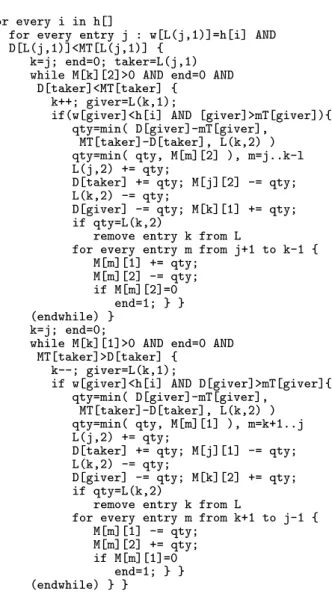
the tasks bear the same weight value, there is no change in the schedule. The second phase of the algorithm is listed in Fig 2.
for every i in h ]
for every entry j : w L(j,1)]=h i] AND D L(j,1)]<MT L(j,1)] {
k=j end=0 taker=L(j,1) while M k] 2]>0 AND end=0 AND
D taker]<MT taker] { k++ giver=L(k,1)
if(w giver]<h i] AND giver]>mT giver]){ qty=min( D giver]-mT giver],
MT taker]-D taker], L(k,2) ) qty=min( qty, M m] 2] ), m=j..k-l L(j,2) += qty
D taker] += qty M j] 2] -= qty L(k,2) -= qty
D giver] -= qty M k] 1] += qty if qty=L(k,2)
remove entry k from L
for every entry m from j+1 to k-1 { M m] 1] += qty
M m] 2] -= qty if M m] 2]=0
end=1 } } (endwhile) }
k=j end=0
while M k] 1]>0 AND end=0 AND MT taker]>D taker] {
k-- giver=L(k,1)
if w giver]<h i] AND D giver]>mT giver]{ qty=min( D giver]-mT giver],
MT taker]-D taker], L(k,2) ) qty=min( qty, M m] 1] ), m=k+1..j L(j,2) += qty
D taker] += qty M j] 1] -= qty L(k,2) -= qty
D giver] -= qty M k] 2] += qty if qty=L(k,2)
remove entry k from L
for every entry m from k+1 to j-1 { M m] 1] -= qty
M m] 2] += qty if M m] 1]=0
end=1 } } (endwhile) } }
Fig. 2.The Second Section of the Scheduling Algorithm.
After the second section the schedule for our example is as follows:
L(task duration) M
(T1 6) (0 0)
(T3 0:5) (2 7:5) (T2 5:5) (2:5 0)
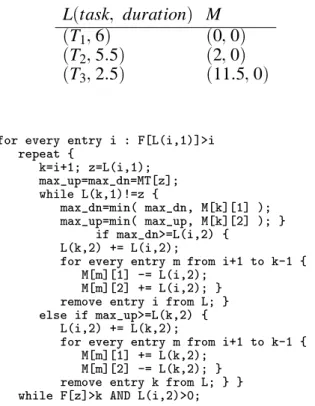
The tasksT1andT2have been given additional amounts of computation time taken from the task T3. The latter is, on the other hand, pre-empted withT2. In the last section the schedul-ing algorithm finds such duplicate entries and tries to resolve them, but only if such rearrange-ment would not interfere with the timing con-straints of the entries that are being shifted in time(which are all the ones between the
merg-ing two). The third phase of the algorithm is
shown in Fig. 3. Finally, the schedule for the example real-time system takes the following form:
L(task duration) M
(T1 6) (0 0)
(T2 5:5) (2 0) (T3 2:5) (11:5 0)
for every entry i : F L(i,1)]>i repeat {
k=i+1 z=L(i,1) max_up=max_dn=MT z] while L(k,1)!=z {
max_dn=min( max_dn, M k] 1] ) max_up=min( max_up, M k] 2] ) }
if max_dn>=L(i,2) { L(k,2) += L(i,2)
for every entry m from i+1 to k-1 { M m] 1] -= L(i,2)
M m] 2] += L(i,2) } remove entry i from L } else if max_up>=L(k,2) {
L(i,2) += L(k,2)
for every entry m from i+1 to k-1 { M m] 1] += L(k,2)
M m] 2] -= L(k,2) } remove entry k from L } } while F z]>k AND L(i,2)>0
Fig. 3.The Third Section of the Scheduling Algorithm. We now have a schedule in which the tasks with higher priorities have an optimal arrangement of computing time. In addition, there is no pre-empting which was one of the priorities during the design of the algorithm. If we are running on a multiprocessor system, a genetic algorithm or any other parallelizable algorithm can occupy all the available processors in its time interval. As it was mentioned before, the scheduling al-gorithm was devised primarily for scheduling genetic algorithms as tasks in an imprecise real-time system, but it can also be used for schedul-ing of ’ordinary’ imprecise systems’ tasks. If that is the case, the minimum task running time should be set to the computational time of the
mandatory part mi, and the maximum task run-ning time to the sum of the mandatory and the optional time oi. Finally, the user may choose to schedule the system with some of the ex-isting algorithms, in which case the mandatory and optional part of a genetic algorithm should only formally be defined as it was described in section III.
The schedule itself is static and fully determined prior to system execution. Further develop-ment of the algorithm would include dynami-cal scheduling of the tasks, which would allow certain parameters, as deadline times or task weights, to change during the process.
5. Acknowledgement
This work was carried out within the research project “Problem-solving Environments in En-gineering”, supported by the Ministry of Sci-ence and Technology of the Republic of Croa-tia.
References
1] BUDIN, L., JAKOBOVIC´, D., GOLUB, M.,(1998), Par-allel Adaptive Genetic Algorithm,Proc. Int. Conf. Neural Computing NC’98, Wienna, October 1998. 2] DAVIS, L.,(1991)Handbook of Genetic Algorithms,
Van Nostrand Reinhold, New York.
3] GARVEY, A., LESSER, V.,(1995), Representing and scheduling satisfying tasks,Imprecise and approx-imate computation, Kluwer Academic Publishers, pp. 23–34.
4] LEUNG, JOSEPHY-T.,(1995), A survey of schedul-ing results for imprecise computation tasks, Impre-cise and approximate computation, Kluwer Aca-demic Publishers, pp. 35–42.
5] LIU, J. W-S., LIN, K-J., SHIH, W-K., YU, A. C., CHUNG, J-Y., ZHAO, W., (1991), Algorithms for Scheduling Imprecise Computations, IEEE Com-puter, 24, pp. 58–68.
6] MICHALEWICZ, Z., (1992), Genetic Algorithms
+ Data Structures = Evolutionary Programs, Springer-Verlag, Berlin.
Received:April, 2000
Revised:June, 2000
Contact address:
Leo Budin Domagoj Jakobovi´c Marin Golub Faculty of Electrical Engineering and Computing Unska 3 HR-10000 Zagreb Croatia phone:+385 1 61 29 935
fax:+385 1 61 29 653
e-mail:leo.budin, domagoj.jakobovic, [email protected]
LEOBUDINis full professor of computer engineering at the Faculty of Electrical Engineering and Computing(FER), University of Zagreb,
Croatia, where he has been lecturing since 1962. He holds the Doctor-ate, M.Sc. and Dipl.-Ing. degrees in Electrical Engineering, all from the University of Zagreb. During his academic career he has been holding courses both the undergraduate and graduate levels at his home insti-tution as well as at other Faculties of the University of Zagreb, Osijek and Split, respectively.
Professor Budin has carried out important duties in the management of FER, being its Dean, Vice-Dean, Department Chair, as well as chairman of a number of Boards within the University of Zagreb. He has had a leading role in several important initiatives at the national level such as establishing of the University Computing Centre(SRCE), introduction
of the Computing Program at FER, and foundation ofCIT – Journal of Computing and Information Technologyfor which he also served as the first Editor-in-Chief. Having written a number of high-school textbooks on the topic, he is influencing the shaping of Computing education in general.
His research interest is in the general study of computers and com-puter systems, along with methodologies in system analysis and design, and computer applications in diverse fields of human activities, within which he has led a number of national research projects. He has also been involved in the work of the Department for Technical Sciences of the Croatian Academy of Sciences and Arts(HAZU). Professor Budin
has published more than 100 research and professional papers in jour-nals, conference proceedings and books in his areas of interest, and has co-authored the textbookComputer-Aided Analysis(in Croatian). He
has been advisor for a number of Ph.D. and M.Sc. theses.
Besides research he has succeeded in building a thriving collabora-tion with the industry, successfully consulting and leading many R&D projects. He has consulted the Croatian government, and is presently chairing the Committee on Information Technology of the Central Council for the Project Strategy of Development of the Republic of Croatia “Croatia in21stCentury”.
Professor Budin has been conferred several awards for significant sci-entific achievements, and has been both a Humboldt and a Fulbright scholar. He is member of IEEE, IEEE Computer Society, and ACM.
DOMAGOJJAKOBOVIC´received his B. Sc. degree in electrical
engineer-ing in 1996 from the Faculty of Electrical Engineerengineer-ing and Computengineer-ing, University of Zagreb. He is a research and teaching assistant at the same faculty since 1997. During 1995 and 1996 he was a visiting research scholar in Tunisia and Slovakia. His professional interests in-clude genetic algorithms, algorithm design and validation, knowledge representation and parallel kinematic structures.
MARINGOLUBreceived the B. Sc. and M. Sc. degrees in electrical