565
Simulation of The Heat Transfer Process Inside The Thatch Walls with The
Aim of Saving Energy in The Buildings
Hadi Baseri
1, Hamid Reza Nassehinia
2, Gholamreza Ghainy
2*
1)Dept. of Chemistry, Damghan university, Damghan, Iran2)Dept. of Environmental Health Engineering, Damghan Faculty of Health, Semnan University of Medical Sciences, Semnan, Iran.
Author for Correspondence:
Received: 29 Jan. 2016, Revised: 10 May 2016, Accepted: 22 May 2016
ABSTRACT
The insulation is one of the emphasized methods in recent years to reduce energy consumption in buildings. As an insulator, thatch has the advantages such as the accessibility of the site, the least energy consumption in its construction (low cost), recyclability and compatible with the nature and the environment. The aim of this study is determining of the heat transfer coefficient and thatch mechanical properties So that due to its advantages it used as insulation and thereby reducing energy consumption in buildings considered and used. In this study, the heat transfer process in a cylindrical turn of thatch was studied. In the conducted experiments the temperature changes inside a cylinder turn were determined for different values of the ratio of the Straw to the used soil and then the obtained results were simulated using the version 2.4 of the COMSOL software. The compressive strength and mechanical properties of thatch were tested. By increasing the consumed Straw weight of 50 to 90 kg per 1 cubic meter of soil, the heat conductivity coefficient from about 1.1 decreased to about 0.3 (W/m K), the contraction percentage decreased and the porous, the compressive strength and the thatch deformability increased in the failure. Thermal insulation and the mechanical properties of the thatch were improved by the mixing of appropriate ratio of straw to soil in the construction of thatch. It can be used in the plaster of the walls and the internal and external ceilings of the building.
Keywords
: Comsol Software, Heat Transfer, Thatch, Simulation.INTRODUCTION
The energy consumption in buildings is about 40% of the total world's energy consumption and about 50% of carbon dioxide in the air caused by the governance structure. Therefore, the building industry is the main consumer of energy. Energy is used for production, transportation of construction materials, construction of the buildings and for the heat and cold of the building. Each year, several billion dollars are spent in Iran for energy consumption in buildings and about % 35 of this energy could save by optimal consumption [1]. The fuel consumption per person is 5 times greater than the global average and 13 times greater than the fuel capita of China in Iran [2]. The thermal insulation is done in order to reduce the heat transfer and energy dissipation in the building [3]. By insulation the building and therefore decreasing the fuel consumption (decreasing the energy consumption) could prevent the spreading of the greenhouse gas, directly [4, 5]. Mud bricks and Thatch is a good insulating for the roof and the walls of buildings in the dry and desert areas and If it is to be implemented accurate, then it has the advantages such as decreasing the energy consumption,
566 companies are trying to improve the properties of thatch until increase the applications of this production. The conducted researches were related to the soil composite with the synthetic fibers such as polystyrene and the natural fibers such as the Straw, husk, the sugar beet pulp, on the adobe and brick, and to calculate the thermal conductivity coefficient of the composite has been applied the analysis approach of the repetition method in the thermal probe measurement values in other researches [13]. But no research has been done on the thatch. In this paper, the impact of the ratio of the Straw to the soil for providing the thatch on the thermal conductivity coefficient, the compressive strength and the weight and volume of thatch have been investigated. Then the experimental results have been simulated using the COMSOL software to calculate the thermal conductivity coefficient.
MATERIALS AND METHODS
Experimental
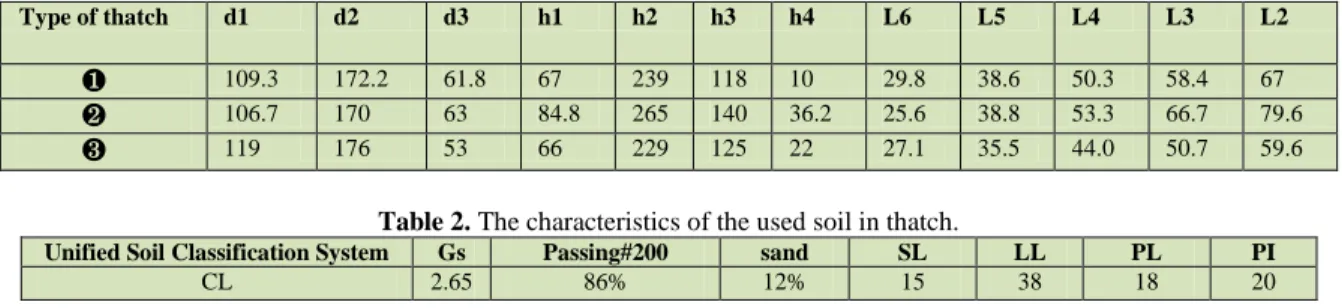
To study on the thermal properties of the thatch and the impact of the ratio of the Straw to the soil on the heat transfer rate of thatch, three thatch turn cylindrical with different ratios of the Straw to the soil, 50Kg of the Straw per one cubic meter of soil, thatch of type ❶, 70Kg of the Straw per one cubic meter of the soil, thatch of type ❷ and 90Kg of the Straw per cubic meter of soil, thatch of type ❸ like Fig. 1 were built that theirdifferent sizes have been presented in the table 1.
The heat transfer experiment was done for each thatch turn cylindrical separately, and its results were recorded. Used soil for producing thatch was prepared from the clay of Damghan mine. This soil has been used at the core of Damghan earth dams (Shahid Shah Cheraghi dam). The characteristics of grain, soil plasticity and its classification have been given in the table (2) that the classification of this soil is in the clay group with the low plasticity property (ASTM D2487) according to the Unified Soil Classification System instructions, [14]. It was used from soft wheat Straw, that its characteristics are sheeted with the length of 5 to 20mm and a width of about 1mm.
An electric sensor and a temperature controller were applied for fixing the temperature to about 500°C in this section of thatch turn. The other end of the cylinder has been contacted on a polystyrene container containing a mixture of water and ice with a thin film of aluminum between container and cylinder, therefore temperature was fixed in 0° C in the end of cylinder.
Fig. 1. (a) front view, the thermometers were located with a relative angle of 72 ° than each other (b) the side view of the thatch cylindrical turn that the distance of thermometers at the end of the cylinder has been determined.
By measuring the amount of melted ice at the specified time interval, the heat transfer rate from the environment and the end of the cylinder was measured. Another polystyrene container was used with identical characteristics and similar ice-water mix that with measuring of the melted ice amount has been determining the heat transfer rate of the environment at the same time interval specified. The amount of heat transfer of the end of the cylindrical was determined by subtracting the amount of the melted ice in one container of another. As Fig. 1 shows, at the various distances of the initial of the cylinder, the electric thermometers placed that they displayed the temperature of various points of it. The heating element was switched on for 24 hours until the moisture of thatch was evaporated and the electrical thermometers displayed a constant temperature in the fixed condition [15].
12 12
1
2
50.70 59.60
27.10 3 4 5 6 22.00
66.00
229.00 125.00
53.00
d3=
h1
h2
h3 L6
L5 L4 L3 L2 element
h4
35.50 44.00
1
2
3
4 5
6
72.0°
72.0°
72.0° 72.0°
Ø176.00 Ø119.00
d1=
567
Table1. The characteristics of the thatch cylindrical turn in millimeter for a variety of samples.
Table 2. The characteristics of the used soil in thatch.
PI PL
LL SL
sand Passing#200
Gs Unified Soil Classification System
20 18
38 15
12% 86%
2.65 CL
According to the similar researches to calculate the weight and volume relations and also the compressive strength of thatch, 10 cube samples with the sizes of 15 centimeters (similar to the concrete cubes to calculate the compressive strength of concrete) were provided from each types of thatch until for each experiment would been tested five samples of thatch [16]. The soil was sieved by the sieve of 10mm, and then after mixing the soil and straw, the water was added to the mixture until the thatch became formable enough. Thatch was stirred manually until thatch uniformity achieved. After 24 hours, the thatch was stirred manually again and molded. The cubic samples were used to calculate the volumetric- weight relations, the contraction amount and the compressive strength of the thatch. Sampling was done for calculating the moisture percentage after the experiment of the compressive strength. For the available straw amount in the samples, cylindrical sample with the diameter of 1cm of the cube sample of any type of the thatch was provided then the samples were placed in an oven at 105° C for 24 hours to dry so perfectly. The samples were dried and weighed and were kept at 550° C for six hours. The mass of straw was measured with the reweighed of the samples. For calculating the volumetric-weight relations of the straw, it was acting similar to the used method for calculating of the specific gravity of soil. In addition the weight and volume of thatch were calculated based on the weight and volume relations of the soil [17]. For calculating the compressive strength of the 28-day thatch was applied to the compressive strength device of soil mechanics laboratory of technical and professional center of Damghan. The amount of pressure was 200kPa per second of the experiment time. For calculating the compressive strength of the 56-day thatch was applied to the compressive strength device of the building material laboratory of the Shahrood Technology University. The coming down speed of the device grips was regulated 7mm per minute according to the Bouhicha and et al. research on the reinforced composite with barley straw in the compressive strength experiment [11].
Modeling
For calculating the thermal conductivity coefficient of thatch, the conducted test in the experimental section of this paper has been simulated using the Comsol software (version 2.4). In this simulation, after the geometric drawing of each one of the three expressed thatch cylindrical turns, the process of heat transfer of the system was modeled. In the modeling of the heat transfer process, it was assumed that the heat transfer has been done in three dimensions and in cylindrical coordinates and the heat has been conducted from the cylindrical turn internal cavity (the place of heating element) to its vertex (the place of cold water bath) by the conduction mechanism, and also the cylindrical turn has been exchanged the heat by the convective mechanism with the air of 20C°. In this paper, the results have been provided for a steady state (stationary), because as it was mentioned in the previous section, for reading the experimental data, sufficient time has been given to the system to fixation of temperatures by the thermometer. Considering the above assumptions and for different amounts of thermal conductivity coefficient (K), the temperature distribution inside the cylindrical turns has been calculated and with comparing between the experimental data and calculation results, the best value for K has been considered.
RESULTS
The heat transfer process
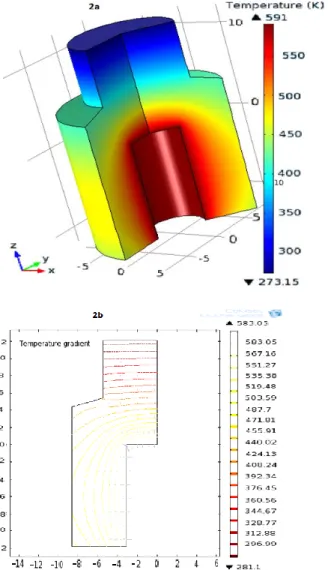
Temperature distribution inside thatch cylindrical turns that 50 kilograms of the Straw were mixed with one cubic meter of clay soil, thatch of the type ❶, has been shown in Fig. 2. Fig. 2a shows the temperature distribution in the form of three-dimensional and the Fig. 2b shows the isothermal surfaces in the form of two-dimensional. As can be seen in these figures, the maximum temperature of the system assigned to the cavity location of the heating element. By away from the cavity, the system temperature decreased and the lowest temperature was attributed to the vertex of the cylindrical turn that it directly was in contact with the cold water bath. Fig. 2b shows that the highest of the temperature Type of thatch d1 d2 d3 h1 h2 h3 h4 L6 L5 L4 L3 L2
❶ 109.3 172.2 61.8 67 239 118 10 29.8 38.6 50.3 58.4 67
❷ 106.7 170 63 84.8 265 140 36.2 25.6 38.8 53.3 66.7 79.6
❸ 119 176 53 66 229 125 22 27.1 35.5 44.0 50.7 59.6
568 change was along the axis of the cylinder that in this direction, the heat flew from the hot source to the cold water bath by thermal conductivity mechanism. But in the radial direction, the heat was be transferring to the air by convective mechanism and thus the created temperature difference in this direction was less than the axial direction. By changing the ratio of the Straw to the consumed soil, the thermal conductivity coefficient changed and thus
the temperature distribution inside the cylindrical turn also changed. Also due to human error, the sizes of the shapes and the location of the thermometers were different and therefore the temperature distribution was different in the cases where it has been changed the ratio of Straw to the consumed clay.
Fig. 2. (a) the three-dimensional temperature distribution within thatch element with the Straw amount of 50 kg per cubic meter of clay, thatch type ❶, and (b) the isothermal surfaces in the case of two-dimensional for the Straw amount of 50 kg per cubic meter of clay, thatch type ❶.
The Fig. 3 (a and b) shows the temperature distribution in the three dimensions state and within thatch cylindrical turns with the quantities of 70 and 90kg of Straw per 1 cubic meter of the soil (the thatch of type ❷ and the thatch of type ❸ ). It can be seen in this Fig.. When the ratio of Straw to the consumed soil increased, temperature distribution
569
Fig. 3. (a) and (b). The three-dimensional temperature distribution inside thatch elements with the values of 70 kilograms of straw per one cubic meter of clay, the thatch type ❷ and with the values of 90 kilograms of straw per one cubic meter of clay, thatch type ❸.
Fig. 4 shows the temperature distribution inside the thatch cylindrical turn with the ratio of 50kg Straw per cubic meter of clay,(the thatch of the type ❶). This Fig. shows the temperature distribution for different values of thermal conductivity coefficient (K) from 0.3 to 1.3. Also the measured experimental values in the experiments of thatch cylindrical turn have been shown in this Fig.. The comparison of experimental data with calculation results showed that the thermal conductivity coefficient of thatch in the ratio of 50 kilograms per cubic meter of clay, (thatch type ❶) was approximately equal to 1.1 W/mk.
Fig. 4: Temperature distribution inside the cylindrical turn clay with Straw the ratio of 50 kg per cubic meter of clay, (thatch type ❶, for different values of thermal conductivity coefficient). Line and line drawing folds represents calculation results (K=0.3 to 1.3) and solid points represent experimental data.
Fig. 5a and 5b.show the calculated temperature distribution for the ratios of 70 and 90kg Straw per
one cubic meter of clay, (the thatch of type ❷ and thatch of type of ❸) in different values of thermal conductivity coefficient with the experimental results of the temperature distribution. Comparing the experimental data and calculation results for these Fig.s, the thermal conductivity coefficient can consider 0.5 W/mK and 0.3 W/mK.
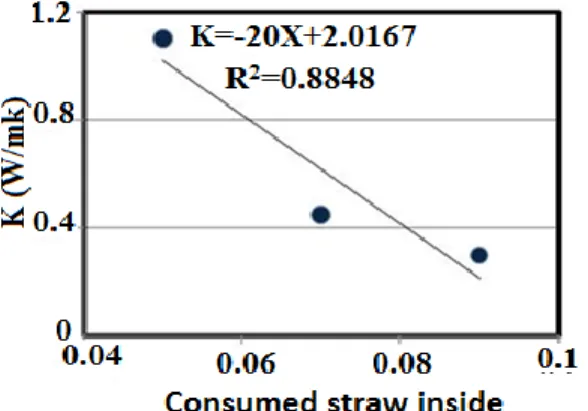
570 Fig. 6 shows the changes of thermal conductivity coefficient of thatch by changing the amount of consumed Straw. Based on the presented results in this Fig., by increasing the weight of consumed Straw of 50 to 90kg (per one cubic meter of clay) the thermal conductivity coefficient decreases from 1.1 to about 0.30.
Fig.6. Thermal conductivity coefficient changes of thatch according its Straw.
Mechanical properties thatch
The results of weight and volume and compressive strength relations of thatch have come in the Tables (3, 4) and Fig. 7 strain is dimensionless.
0 0.5 1 1.5 2 2.5 3
0 0.1 0.2 0.3 0.4
C o m p re ssi v e st re ss ( N /m m 2) Strain Thatch type Thatch type Thatch type
Fig7. the stress-strain graphs of thatch 56 days, the sample❶ 50 kg Straw per one cubic meter soil, the sample ❷ 70 kg Straw per 1 cubic meter of soil and the sample ❸ 90 kg Straw per 1 cubic meter of soil.
Table 3. the compressive strength and density relations results of the 28-day thatch.
❸ ❷
❶ Type of thatch
3.1 1.98 2.4
Maximum compressive strength (N/mm2)
1.80 1.59 2.24 Moisture percentage 1160 1206 1327
Density (Kg/m3)
1139 1187 1297
Dry density Kg/m3
Table 4. The compressive strength and volumetric and weighting relations results of the 56-day thatch.
Type thatch ❶ ❷ ❸ Volumetric shrinkage
percentage 14.5 11.6 9 Moisture percentage 1.69 1.45 1.49
Density (Kg/m3) 1308 1205 1146
Dry density (Kg/m3) 1286 1118 1130
Volume air percentage 32.2 33.8 30.7
Volume Straw
percentage 23.3 25.9 32.3 Volume soil percentage 44.5 40.3 37
DISCUSSION
According to the studies, thatch thermal conductivity coefficient changes depending on the amount of the consumed Straw inside thatch. Comparison of values of the thermal conductivity coefficient in Fig.s 4 and 5 showed that with increase in the consumed Straw from 50 to 90kg Straw per one cubic meter of soil, the thermal conductivity coefficient from 1.2 W/mK decreased to 0.3W/mK.
571 energy until its failure, therefore thatch of type ❸
has more resistant than the other two types for earthquake. Binici and et al. and Sharma and et al.
were achieved similar results in conducted research relating on the increasing the amount of straw in thatch composite in 2004 [16, 19]. According to data from the table 4 with an increasing in the Straw amount in the samples decreases the sample volumetric shrinkage and with increasing the moisture level of samples increases the shrinkage amount. In the conducted research by Yetgin and et al. in 2006, about the impact of the fiber on the mechanical properties of the brick, concluded that increasing the amount of fiber decreases the amount of the shrinkage and increase the moisture causes increasing in the amount of shrinkage [20]. According to the data in Tables 3 and 4, it can be concluded that with increasing of the straw in thatch decreases the density. With increasing the amount of straw in the making of thatch the required water for increasing formability and performance of thatch increases and the straw as a channel of air transmission can be effective in the drying up of the available water. Therefore, comparing the moisture percentage of samples in the Tables 3 and 4, after 28 days, the amount of moisture has been decreased and the speed of reducing of moisture percentage in the sample ❸ is more than sample ❷. But decreasing rate of moisture percentage in the sample ❶ is more than two the other samples, this decreasing rate can be explained by the amount of moisture percentage than the other two samples. With the increasing of the amount of available straw in a variety of thatch, the straw volume percentage increases according the table 4, the amount of available soil in a variety of thatch has decreased. The percentage of the available air in the thatch of the type ❶ and ❷ with increasing the straw amount has increased but it has decreased in thatch of type ❸. In the case; the porosity would be defined as the empty volume between the grains of the soil, that this volume has been occupied by air or straw, it can say that the porosity increases with increasing the straw in the sample. Al rim and et al. also concluded this result [10].
CONCLUSION
Increasing the consumed straw per one cubic meter of clay in thatch can’t only decrease the thermal conductivity coefficient, density and volumetric shrinkage of thatch but also it can increase flexibility, compressive strength, coherent and the porosity of thatch. Therefore, thatch can use as thermal insulation in building.
ETHICAL ISSUES
The study was approved by the ethics committee of Semnan University of Medical Sciences.
CONFLICT OF INTEREST
Authors of the manuscript did not have conflict of interest.
AUTHORS’ CONTIBUTION
The overall implementations of this study were the results of efforts by corresponding author. All authors have made contribution into the review and finalization of this manuscript. All authors read and approved the final manuscript.
FUNDING/SUPPORTING
The authors would like to appreciate the Deputy of the Research and Technology of Semnan University of Medical Sciences for its financial support for the research project No: 864.
REFERENCES
[1] HeidariBateni N, MwaranguTiri T. Optimum energy consumption management and its influence on sustainable development. International Journal of Scientific Research in Knowledge. 2014; 2(Special Issue): 94-98.
[2] Azari F, JalaliMajidi M, Borzui A, Daryee Z. Managing and optimization of energy consumption and offering strategies to materialize It. Journal of natural and social sciences. 2014; 3(3): 57-65. [3] Mardokh A. Energy management and thermal insulation in the building. (in Persian), Proceedings of The Third Conference Fuel Optimization in Buildings Tehran. 2003; 14&15 February: 1778-83. [4] Goodhew S, Griffiths R. Sustainable earth walls to meet the building regulations. Energy and Buildings. 2005; 37(5): 451-59.
[5] Olukoya Obafemi A.P, Kurt S. Environmental impacts of adobe as building material: the north Cyprus traditional building case. Case Studies Construction Materials. 2016; 4: 32-41.
[6] Quagliarini E, Lenci S, Iorio M. Mechanical properties of adobe walls in a Roman republican domus at Suasa. Journal of Cultural Heritage. 2010; 11(2): 130-37.
[7] Hjort B, Widen K. Introduction of sustainable low-cost housing in Ethiopia – an innovation diffusion perspective. Procedia economic and finance. 2015; 21: 454-60.
572 [9] Sheweka S. Using mud bricks as a temporary solution for Gaza reconstruction. Energy Procedia. 2011; 6: 236-40.
[10] Al Rim K, Ledhem A, Douzane O, Dheilly RM. Queneudec M. Influence of proportion of wood on the thermal and mechanical performances of clay-cement-wood composites. Cement & Concrete Composite.1999; 21(4): 269-76.
[11] Bouhicha M, Aouissi F, Kenai S. Performance of composite soil reinforced with barley straw. Cement and Concrete Composite. 2005; 27(5): 617-21.
[12] Quagliarini E, Lenci S. The influence of natural stabilizers and natural fibers on the mechanical properties of ancient Roman adobe bricks. Journal of Cultural Heritage. 2010; 11(3): 309-14.
[13] Goodhew S, Griffiths R. Analysis of thermal-probe measurements using an iterative method to give sample conductivity and diffusivity data. Applied Energy. 2004; 77(2): 205-23.
[14] DaryaKhaKPay Co. Experimental results of clay soil. 2003; Laboratory report. [ in persian], available from:
https://www.linkedin.com/company/daryakhakpay-company
[15] Govaer D. Apparent thermal conductivity of a local adobe building material. Solar Energy. 1987; 38(3): 165-68.
[16] Binici H, Aksoan O, Shah T. Investigation of fiber reinforced mud brick as a building material. Construction and Building Materials. 2005; 19: 313-18.
[17] Vafaeian M. Engineering Properties of Soil. 3ed. Arkan Press, Isfahan, Iran, 2005 [ Persian], available from:
http://ketab.org.ir/bookview.aspx?bookid=113944 [18] Lertwattanaruk P, Choksiriwanna J. The physical and thermal properties of adobe brick containing bagasse for earth construction. Built. 2011; 1(1): 54-61.
[19] Sharma V, Vinayak H.K, Marwaha B.M. Enhancing sustainability of rural adobe houses of hills by addition of vernacular fiber reinforcement. International Journal of Sustainable Built Environment. 2015; 4(2): 384-58.