Tailoring Software Development
Methodologies in Practice:
A Case Study
Sergio de Cesare
1, Chaitali Patel
2, Nicola Iacovelli
3, Antonio Merico
3and Mark Lycett
11Department of Information Systems and Computing, Brunel University, Uxbridge, United Kingdom 2Agilisys Ltd., London, United Kingdom
3Svimservice S.p.A., Bari, Italy
Software development methodologies(SDM)have been traditionally defined in a prescriptive manner with an underlying assumption of universal applicability. How-ever, as industrial practice suggests, this assumption is fundamentally flawed. Software development projects very rarely adopt a methodology in such a rigid fash-ion. Conversely, methodologies are normally adapted to meet specific contextual characteristics. This adap-tation, known as Method Tailoring (MT), generally occurs implicitly. Implicit adaptation has several draw-backs. Firstly, responsibility and consequences are not attributable to the decisions made during MT. Secondly, MT experience is not captured, thus not being shared and reused within the organization. As a consequence, implicit MT leads to reactive rather than proactive adap-tation with negative effects on both productivity and efficient use of resources. This paper presents a case study in which MT was applied. In order to elicit the tailoring process, a high-level conceptual framework was developed. The framework was drawn from the existing literature. As a result the know-how and experience accumulated during the practice of Method Tailoring was made explicit and organized for the benefit of future projects. The framework was applied a posteriori to a project carried out by a medium-sized software devel-opment company for the Italian national public health service.
Keywords: method tailoring, development context, re-flection, experience capture, method fragments
1. Introduction
Software development methodologies (SDM)
have been traditionally defined in a prescrip-tive manner with an underlying assumption of universal applicability. However, as industrial practice suggests[1, 2, 3, 4, 5], this assumption
is fundamentally flawed. Software develop-ment projects very rarely adopt a methodology in such a rigid fashion. Initially introduced as a means to alleviate the problems of the software crisis, SDM manifested serious limitations due to the lack of any predisposition to flexibly adapt to the needs of specific projects, domains and organizational settings. As a consequence, sig-nificant undesired effects were generated. Such effects include lack of a political and organiza-tional dimension, goal displacement, inhibition of creative thinking, and developers’ resistance to change (i.e., adopting practices that are dif-ferent from the familiar and consolidated ones) [6, 7]. In recent years the limitations of pre-scriptive methodologies have been recognized by both academics and practitioners [4]. The need to tailor methods to specific situations and context is now seen as imperative. The key issue in methodological support to software de-velopment today is flexibility and adaptation of methodologies. In response to these prob-lems and issues, at least four different solution streams can be identified.
Secondly, a methodology can be selected from those available on the market or in the pub-lished literature. This is known as the Contin-gency Approach. This solution preserves the rigidity and inefficiencies of the previous op-tion; moreover detailed knowledge of a wide range of methodologies would be needed in or-der to adequately make a sound judgment with significant effects on the cost of resources and training. Teams with specialist skills on indi-vidual methodologies would be required. Given the specific characteristics of each methodology
(e.g., paradigm, notations and terminology), the knowledge transfer would be difficult as well as the allocation of resources. In addition, many authors also argue that existing rigid methods cannot adequately cover all contingencies [2, 10, 9].
Thirdly, adaptation and flexibility can be achi-eved through mixing and matching parts (i.e., method fragments) of different methodologies
[8, 9, 11]. This is known as Method Engineer-ing. This solution has the benefit of not con-straining the development team with a prede-fined solution; however effort needs to be placed on harmonizing method fragments, e.g., differ-ent notations, techniques and terminology [8]. When fragments are derived from methodolo-gies with different underlying paradigms, har-monization becomes particularly problematic and may include, for example, paradigm trans-formations and mappings in order to conserve desired levels of integration and traceability[12, 13, 14]. As a result, Method Engineering has not been popular in practice.
The fourth solution stream is represented by Method Tailoring(MT). MT refers to the adap-tation of one methodological framework to spe-cific software development projects. The im-portance of tailoring SDMs is recognized by well-known standards and reference models such as IEEE/EIA 12207.0-1996 [15] and CMMI [16]. Past studies show that in prac-tice, organizations develop or adopt one SDM organization-wide and then tailor the method to specific projects. In particular, Guimaraes’
[17]study found that 77% of the firms that use SDM employ a single, formal methodology. An essential condition for MT to be effective is the adoption of a non-prescriptive and flexi-ble methodology. The evolution of SDM has proceeded in this direction[18, 19]. Currently, methodologies like the Rational Unified Process
(RUP) and the Object-oriented Process, Envi-ronment and Notation(OPEN)Process Frame-work(OPF) do not prescribe the use of a par-ticular process, but define a set of process com-ponents which can be selected and chosen to suit certain project/organizational characteris-tics[18]. The difference with the previous so-lution is the availability of process components
(or method fragments)developed with the same underlying paradigm. Problems of consistent and coherent mixing and matching of method fragments (e.g., process components) are sig-nificantly reduced. Consistency in notation and terminology increases the level of knowledge sharing and reuse across teams leading to eas-ier resource allocation. Method tailoring rep-resents a balanced solution. It maintains the benefits of ‘standardization’ while it allows for controlled flexibility and adaptation to specific contexts.
MT, although in a primitive form, has been conducted implicitly by practitioners even ear-lier than the research literature recognized the significance of the problem area [4]. Soft-ware developers and project managers have in-stinctively, and sometimes subconsciously, car-ried out tailoring in one form or another [7]. However, various problems arise when adap-tation of methods is conducted implicitly[20]. Firstly, responsibility and consequences are not attributable to the decisions made during MT. Secondly, MT experience and rationale for se-lecting/adapting method fragments are not cap-tured, thus not being shared and reused within the organization. As a consequence, implicit MT leads to reactive rather than proactive adap-tation with negative effects on both productivity and efficient(re)use of resources.
Modern methodologies currently provide the necessary building blocks to assemble a tai-lored process hence suggesting some form of contingent adaptation, however, besides flexi-ble methodologies, software developers require practical guidance in MT [7, 11]. The limited literature on the topic provides examples of the-oretical frameworks that can be applied to this problem; however, the frameworks themselves have not been empirically validated.
can assist software development teams and or-ganizations in the elicitation of their Method Tailoring processes. As a result, the know-how and experience accumulated during the practice of Method Tailoring is made explicit and or-ganized for the benefit of future projects. The proposed framework is applied to a real-world industrial project as a means of eliciting a pos-teriori the tailoring process applied during the project.
The paper is structured as follows. Section 2 briefly reviews the MT related literature from which common elements are derived and used to construct the framework presented in Section 3. Section 4 presents the case study and applies the framework to it. Section 5 presents final conclusions.
2. Background
Method Tailoring frameworks serve a dual pur-pose. Firstly, they define the fundamental com-ponents required for tailoring SDM. Secondly, frameworks represent a means of eliciting the tailoring process applied by software devel-opment teams and organizations in industrial projects. This section carries out a brief compar-ative analysis of MT frameworks derived from the literature. The analysis is aimed at synthe-sizing previous research work in order to high-light common issues, components and relation-ships that will form the basis of the framework presented in Section 3.
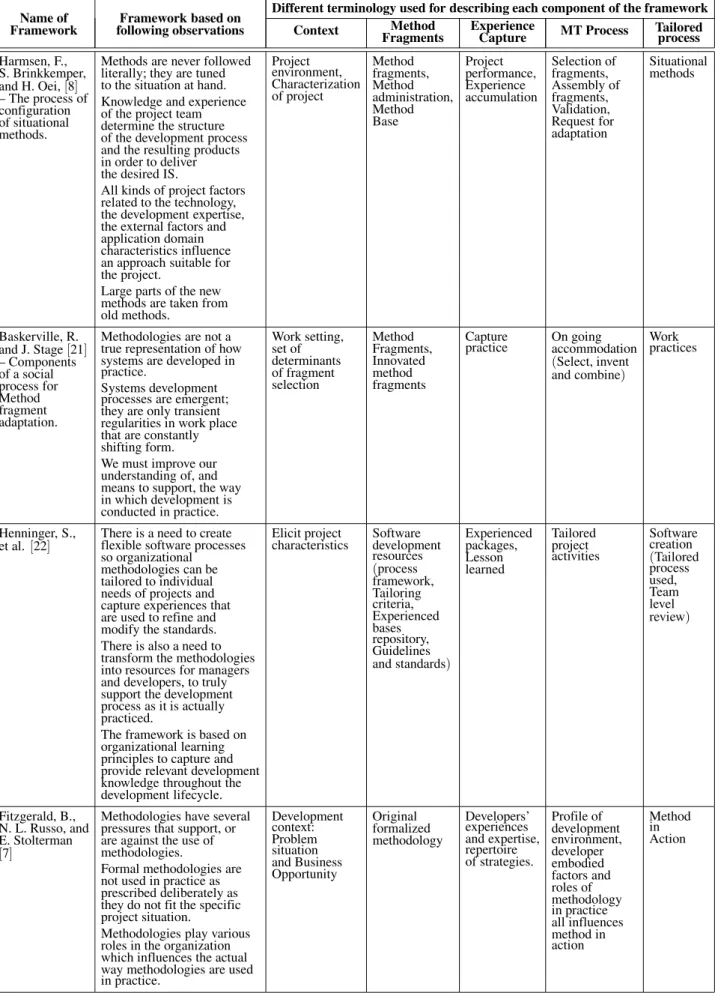
Among the few MT frameworks that have been developed the following are considered: Harm-sen, Brinkkemper et al. [8], Baskerville and Stage [21], Henninger, Ivaturi et al. [20] and Fitzgerald, Russo et al.[7]. As shown in Table 1, the analysis reveals a high degree of over-lap between the frameworks, both in terms of observations and components.
The common MT components, which will be detailed in section 3, are as follows:
• Context: refers to the contextualization of the project environment.
• Method Fragments: refers to well-identifi-able and named parts or components of the SDM and how such fragments are main-tained and managed.
• Method Tailoring Process: refers to the pro-cess of selecting method fragments and adap-ting the SDM.
• Tailored Method: refers to the documenta-tion and presentadocumenta-tion of the tailored process. • Experience Capture: refers to the means of reflection and capturing experience for reuse.
Although similar components are identified,two main differences characterize the MT frame-works. Firstly, the terminology used to describe the components differs. Table 1 highlights the main components(or activities)and the differ-ent terminology used to describe each concept within the component. Secondly, each author elaborates and focuses on different aspects of the MT framework. For example, [8] places emphasis on the maintenance(creation, deletion and modification) of method fragments, while
[8, 22, 11]concentrate their attention on model-ing tools, and[23, 24]focus on the capturing of experience. Therefore previous research tends to highlight specific areas of MT, rather than treat the process holistically.
Most of these frameworks (such as [21, 8, 9])
have been developed theoretically, based pri-marily on researchers’ deductive observations
(as summarized in Table 1), with limited expo-sure of the frameworks to live software devel-opment projects[21, 23, 25]. As a consequence, these frameworks remain high-level with the limitation of not providing examples of how the individual components are implemented in industrial settings.
This paper builds upon previous research work by detailing further the individual MT com-ponents in terms of questions which can help practitioners reflect upon how tailoring was car-ried out in individual projects as well as across projects at a wider organizational level.
3. Framework
Different terminology used for describing each component of the framework Name of
Framework following observationsFramework based on Context FragmentsMethod ExperienceCapture MT Process Tailoredprocess
Harmsen, F., S. Brinkkemper, and H. Oei,[8]
– The process of configuration of situational methods.
Methods are never followed literally; they are tuned to the situation at hand. Knowledge and experience of the project team determine the structure of the development process and the resulting products in order to deliver the desired IS.
All kinds of project factors related to the technology, the development expertise, the external factors and application domain characteristics influence an approach suitable for the project.
Large parts of the new methods are taken from old methods. Project environment, Characterization of project Method fragments, Method administration, Method Base Project performance, Experience accumulation Selection of fragments, Assembly of fragments, Validation, Request for adaptation Situational methods Baskerville, R. and J. Stage[21]
– Components of a social process for Method fragment adaptation.
Methodologies are not a true representation of how systems are developed in practice.
Systems development processes are emergent; they are only transient regularities in work place that are constantly shifting form. We must improve our understanding of, and means to support, the way in which development is conducted in practice.
Work setting, set of determinants of fragment selection Method Fragments, Innovated method fragments Capture
practice On goingaccommodation
(Select, invent and combine)
Work practices
Henninger, S.,
et al.[22] There is a need to createflexible software processes so organizational
methodologies can be tailored to individual needs of projects and capture experiences that are used to refine and modify the standards. There is also a need to transform the methodologies into resources for managers and developers, to truly support the development process as it is actually practiced.
The framework is based on organizational learning principles to capture and provide relevant development knowledge throughout the development lifecycle.
Elicit project
characteristics Softwaredevelopment resources (process framework, Tailoring criteria, Experienced bases repository, Guidelines and standards)
Experienced packages, Lesson learned Tailored project activities Software creation (Tailored process used, Team level review) Fitzgerald, B., N. L. Russo, and E. Stolterman
[7]
Methodologies have several pressures that support, or are against the use of methodologies.
Formal methodologies are not used in practice as prescribed deliberately as they do not fit the specific project situation.
Methodologies play various roles in the organization which influences the actual way methodologies are used in practice. Development context: Problem situation and Business Opportunity Original formalized methodology Developers’ experiences and expertise, repertoire of strategies. Profile of development environment, developer embodied factors and roles of methodology in practice all influences method in action Method in Action
have contributed to the tailoring process. Fun-damental are also the decisions(and underlying reasons) as to why parts of the methodology were adopted and/or changed. Documentation of the reasons underlying such decisions is im-portant for future development projects in order to identify possible reusable tailoring patterns. Figure 1 depicts the Method Tailoring elicitation framework applied to the case study in Section 4. The subsections that follow will describe each component along with relevant questions that can be applied to guide the elicitation of the tailoring process used in software development projects.
drives creates
refined by provide
input to
documents
Contex MethodTailoring TailoredMethod
Method Fragments
Reflection and Experience
Capture
Figure 1.Method Tailoring elicitation framework.
3.1. Context
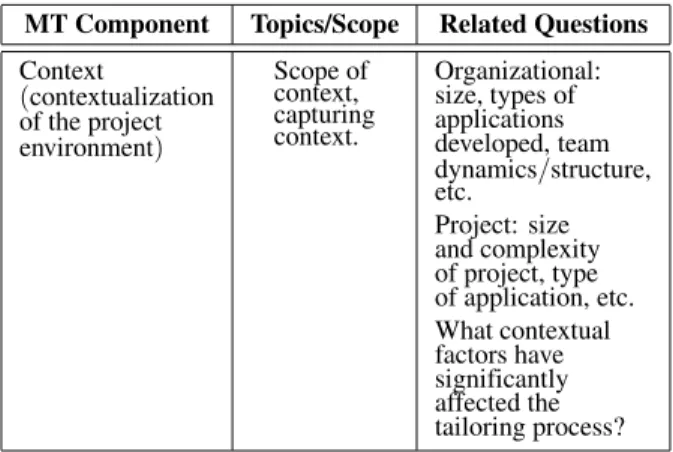
In the process of method tailoring, the starting point is a given, dynamic and evolving envi-ronment which is part of a larger organizational setting. This component is known as context. Fitzgerald et al. [7]consider context as a given that cannot be changed and is an input to the software development process. Fitzgerald et al. and Harmsen et al. [7, 8] consider the project environment to include both the supplier orga-nization as well as the customer orgaorga-nization. A distinction is also made between the project environment and characterization of the project. They state that the project environment includes existing information infrastructure, the users, and the organizational culture, while project contingency factors, such as application char-acteristics, external factors, technical factors, and the available development expertise are in some way determined forming project charac-terization.
MT Component Topics/Scope Related Questions
Context
(contextualization of the project environment)
Scope of context, capturing context.
Organizational: size, types of applications developed, team dynamics/structure, etc.
Project: size and complexity of project, type of application, etc. What contextual factors have significantly affected the tailoring process?
Table 2.Context.
Context in this framework includes character-istics that affect the selection and adaptation of method fragments. Glass[4]considers size, application domain, criticality and innovative-ness factors that differentiate projects and cap-tures context. Similarly, Cockburn [12] also considers size, criticality and project priority as differentiating project factors. Based on the comparative analysis of the literature, the con-text component in this framework has four cat-egories of factors that influence software devel-opment. These broad categories are: organiza-tional characteristics, team dynamics/structure, project characteristics and product characteris-tics. Methods are tailored to a particular con-text; hence it is important to investigate how this context is captured and defined in practice.
3.2. Method Fragments
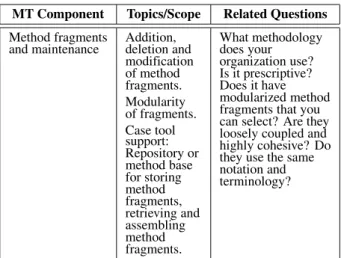
This component is often described by using the building blocks analogy. It is widely ac-cepted that in order to tailor methods, methods need to be composed of method fragments. A method fragment can be considered as a well-identifiable part of a SDM such as an artefact
of fragments as a prerequisite to tailor meth-ods. Method Fragments need to also have other characteristics that allow them to be assembled to form tailored methods. Modularized method fragments need to be loosely coupled to each other and highly cohesive[26, 25].
MT Component Topics/Scope Related Questions
Method fragments
and maintenance Addition,deletion and modification of method fragments. Modularity of fragments. Case tool support: Repository or method base for storing method fragments, retrieving and assembling method fragments.
What methodology does your organization use? Is it prescriptive? Does it have modularized method fragments that you can select? Are they loosely coupled and highly cohesive? Do they use the same notation and terminology?
Table 3.Method fragments.
3.3. Method Tailoring Process
This component refers to the actual process of selection and assembly of method fragments to fit the particular context. In the elicitation of the tailored method, it is important to identify how tailoring occurs in relation to the context
(both project and organization). This implies
MT Component Topics/Scope Related Questions
Method Tailoring
Process IncrementalME, selection and adaptation of method fragments to project characteristics, case tool support.
Is MT done? Is MT seen as an important activity or a negative activity as in not following the process rigorously? How do you tailor your process based on the context you have and the Method fragments? How are these method fragments selected in practice and how are they assembled? Who does the tailoring and when is it done? Have you formalized the method tailoring process? Does your organization have tailoring guidelines that you can follow?
Table 4.Method tailoring process.
understanding how method fragments are se-lected including what factors affect the addi-tion, removal or modification of fragments. If in the organization method tailoring is formal-ized in any way, then key questions concern the roles and responsibilities of those involved in the tailoring process and the way decisions are documented and maintained for future memory.
3.4. Tailored Method
The tailored method is the result of MT. This includes all elements that would be typically found in a SDM. Given its application in a spe-cific project, as well as future projects that share similar characteristics, it is essential to present, document and store the tailored method so that all interested parties can access and retrieve it. The format with which the tailored method is presented is essential to its future reusability and therefore acts as a template in other projects.
MT Component Topics/Scope Related Questions
Tailored Method Ability to reuse the tailored process, case tool support.
How is it applied and updated? How are templates produced, used and adapted?
Table 5.Tailored method.
3.5. Reflection and Capturing Experience
All the frameworks analyzed from the literature were based on one same observation; people in practice tailor methods based on past expe-riences. Hence it is important to capture this experience for others to reuse. This enables an organization to learn from past successes and mistakes. This component deals with the issue
MT Component Topics/Scope Related Questions
Capturing
experience Reflection,capturing method rationale, review process, reuse, case tool support.
What were the lessons learned in terms of benefits and limitations derived from the tailoring experience of the project? How is experience captured and preserved?
of capturing method tailoring experience and presenting it in a reusable way so others can use the information. For example, capturing rationale for selecting certain fragments is also important, as this helps gather knowledge so team members can use and learn from others experiences.
4. Case Study and Application of Framework
The framework described in the previous sec-tion was applied to a project carried out at S-Service, a medium-sized software development company located in southern Italy. S-Service is specialized in the development of informa-tion systems for the healthcare sector and local public administrations(PA).
This case study documents a large develop-ment project carried out for the Italian National Health Service(INHS). The project is aimed at the realization of a series of ‘software services’ strategically intended to improve the quality of service of the INHS allowing medics, healthcare staff and citizens to directly interact with local and regional health structures through the Inter-net. The services were called Network Appli-cation Services (NAS). Ten NAS were defined and allocated to distinct subprojects. The case study therefore refers to a coordinated project which was divided into ten subprojects. From a technological perspective, the NAS were based on web services.
The SDM adopted for this project was the Ratio-nal Unified Process (RUP). RUP was tailored to suit specific contextual organizational and project characteristics. The tailoring process was elicited a posteriori by applying the frame-work proposed in this paper. The elicitation of the tailored process was conducted manually and documented in specific artifacts/reports such as the quality plan. The following sub-sections are structured in line with the frame-work components and describe S-Service’s ex-perience in tailoring this specific project. Due to limitations of space, a representative extract of the case study documentation is presented. As the case study will demonstrate, the framework contributed in the following areas: (1)provided the project team and the organization with a
structured means of eliciting the tailoring pro-cess;(2)allowed the development team to docu-ment the experience of the project for the benefit of future development and maintenance efforts and (3) facilitated reflection and constructive self-criticism.
4.1. Context
RUP was originally adopted by S-Service in 2002. The decision to adopt RUP was strongly influenced by the emergence of object-oriented methodologies on the market. Given RUP’s characteristic of being a methodological frame-work rather than a rigid and binding method-ology, decisions were taken at the beginning of the project as to the processes, roles and artifacts that would be applied and managed. With the experience previously acquired, the project team adopted a tailoring process that had evolved from previous projects.
Contextual factors that most affected method tailoring for this project were as follows: • Team structure: presence of staff/team
mem-bers highly competent in the domain area with detailed knowledge of the business pro-cesses and regulations of the public health-care sector.
• Project characteristics: domain and type of client. In the Italian public healthcare sec-tor, as with all public bodies, contracts are acquired through a request for proposals and a public bidding process; hence very for-mal procedures, which require precise and detailed documentation of the system to be delivered.
• Product characteristics: there were require-ments of Enterprise Application Integration
(EAI) with existing legacy systems. This factor influenced the whole lifecycle which needed to take legacy and integration re-quirements into consideration.
From past tailoring experiences at S-Service, tailoring at the organizational level involved ad-justing the method to (1)the types of applica-tions normally developed(e.g., business appli-cations), (2)the organizational models and/or
the elimination of those components that were not likely to be applied (e.g., components spe-cialized for the development of real-time soft-ware).
4.2. Method Tailoring Process
The tailoring process was driven by the Qual-ity Assurance (QA)team in collaboration with the development team. A series of meetings took place at which tailoring decisions were made. These decisions were then formally doc-umented in the Quality Plan. The Quality Plan defines (for each individual project) the over-all method adopted. The tailoring process was initiated at the beginning of the project. Pre-vious experiences suggested that the tailored method could be either entirely decided at the start of the project or the method could be re-fined across various iterations as development progressed. A decision was made to define all workflow details and activities before the cor-responding workflow took place. This decision was also based on cost/benefit analyses carried out in order to assess the effect of an individual workflow and its activities on the project as a whole.
Based on S-Service’s past experience, it can be noted that tailoring most frequently occurred at the project level, instead of, for example, at the organizational or departmental levels. Gener-ally speaking, project level tailoring is mainly aimed at adapting the method to specific project characteristics. Often a method that is tailored for a project can be used as the basis for develop-ing future projects with similar characteristics, such as case tools, technological architecture and development environment. In this situa-tion, a method tailored at a project level has the potential of being used at a departmental level and therefore covering a class of common projects.
In the case study, method tailoring was a part of the overall development planning. As far as tailoring was concerned, planning involved: • Possible elimination of some of the original
method activities/tasks
• Addition of new activities/tasks;
• Adjustment (tweaking/redefinition) of ac-tivities/tasks to suit the project characteris-tics;
• Definition of checks(e.g., reviews/ inspecti-ons) on the deliverables aimed at assuring correctness, consistency and traceability of requirements all the way down to implemen-tation.
The above tailoring activities were motivated and documented in the Quality Plan. Within the Quality Plan reference was also made to other appropriate documents(e.g., naming standards document, planning document, etc.). The main contextual adjustments carried out during the project were as follows:
• The Business Modeling workflow was not applied in this project due to the previous in-depth knowledge that the project team had of the healthcare domain. The team was also very familiar with the procedures in place in order to obtain contracts from the National Health Service.
• The level of technical detail of the docu-mentation was tailored to meet the specific requirements of the customer(e.g., interme-diate revisions, additional support activities for testing, etc.)
• The software lifecycle model that was de-fined took into account integration require-ments with existing legacy systems.
4.3. Tailored Method
As previously mentioned, Method Tailoring was mainly documented in the Quality Plan. Other documents were also used. For example, the Configuration Management Plan documented, among other things, how software and docu-mentation should be configured, versioned and so on.
For this project the Quality Plan documented the following elements:
• Selected RUP workflows: Support and Man-agement workflows(e.g., configuration man-agement, project manman-agement, testing, etc.) were not selected since the corresponding processes were already catered for in the company’s standard procedures.
• A table was prepared in which the following information was reported for each workflow:
◦ Activity: Name of workflow detail activ-ity
◦ Objective: Goal of the activity or work-flow as it is defined by the method ◦ Inclusion: Specifies whether an activity
has been included in the tailored process. If an activity was not included, the rea-sons were given in the Notes column. ◦ Output: Outputs of activities and
work-flows were defined(i.e., artifacts)
◦ Notes: Annotations, suggestions, rea-sons were annotated
• Checks to carry out design and implemen-tation artifacts aimed at verification( consis-tency between inputs and outputs of each phase, traceability checks, respect of stan-dards, etc.) and validation(software testing with appropriate procedures). The checks were tailored depending on the deliverables produced and the tools used(e.g., Rational Rose).
The RUP deliverable templates were examined and adapted to the needs of the project; therefore producing tailored templates that were adopted by each subproject team.
Scheduling of the tailored project activities was documented in the Project Plan. The Project Plan defined:
• Roles and skills required to carry out the ac-tivities
• Resources required by the project (human, tools, infrastructure)
• Scheduling(e.g., Gantt chart) • Monitoring times and metrics • Predicted and actual project costs
• Evaluation(both technical and managerial)
of project activities aimed at highlighting critical aspects.
The plans were treated as ‘living’ documents, i.e. they were updated during the project in or-der to correct inadequate situations or to prevent critical situations caused by erroneous tailoring decisions.
4.4. Reflection and Capturing Experience
According to the organization’s standard proce-dures, the Project Manager is required to write a ‘Project Closure Report’ documenting the over-all project experience. The report is submitted to Senior Management and it contains an over-all analysis of the project including decisions made, reasons for deviating from predefined standards and objectives. In this case study, an evaluation of the tailoring decisions made was included in the report. The report was accompa-nied by a set of metrics that serve as indicators of project success.
At present, these metrics are recorded on paper documents. It is intended by the organization to develop a repository and populate it over time with information on all projects. This reposi-tory would support decisional processes(which methods to adopt, tailoring, etc.) and evalua-tions(benchmarking)for the development and maintenance of future projects.
Various benefits of MT have been identified and documented for this project. These benefits can be summarized as follows:
• Consistency of the development process wi-thin the same project;
• Consistency of the techniques used by the team members (same training, reduction in communication overheads, standard com-munication protocols);
• Consistency of artifacts, models and stan-dards;
• Potential reuse of the same process in similar projects(a sort of process polymorphism)by simply tweaking where necessary;
• Benchmarking and measurements applied in one project can be used as the basis for pre-dictions in other projects.
4.5. Method Fragments and Maintenance
and deliverables as well as support for the ini-tial definition of the project’s activities.
Generally speaking, for every tailored develop-ment project the following eledevelop-ments are “instan-tiated”: (1) a configuration library containing software artifacts and documentation and (2)
a “Development Standards” document defining for the specific project standards and techniques that analysts, designers and programmers must adopt. The “Development Standards” docu-ment generally includes a description of the repository’s logical structure. The repository contains workflow artifacts and a description of a “generalized method” that that can be special-ized if required. In this case study, for exam-ple, the repository would describe: RUP related packages and artifacts, naming conventions of packages and artifacts, package contents and relationships between packages.
The Development Standards document also de-fines development patterns that must be adopted for the realization of different architectural com-ponents. For example, the Model-View-Con-troller pattern used for the Web tier of appli-cations and a formal description of how such a pattern should be applied. There normally is one Development Standard document for each production line and referenced in each project. A production line is characterized by the same methodology, the same development technol-ogy and the same software architecture.
5. Conclusion
This paper presented a case study of a large-scale software development project in which the Rational Unified Process was tailored to suit the specific contextual characteristics of the orga-nization, project team, client and application type. A Method Tailoring framework derived from the literature was adopted to conduct the research.
The main findings of the case study were as fol-lows. The organization had previous tailoring experiences; as a consequence, the MT process was formalized in some aspects (e.g., defined tailoring roles and responsibilities along with formal documents in which decisions were an-notated) and not fully mature in other aspects
(e.g., repository management and benchmark-ing required more growth). From a procedural
perspective, tailoring was carried out iteratively
(for most part) and conducted hierarchically. Three levels were identified: organizational, de-partmental and project. In the project described in Section 4, the project itself was divided into ten subprojects. Even in this case successive re-finements were applied. The initial subprojects served as pilots for the following ones.
At a project level, methods at S-Service are selected from a repository of previously tai-lored RUP methods. The selection is based primarily on application type, system architec-ture and case tools adopted. The repository contains generalized methods that can be spe-cialized (through a form of process ‘polymor-phism’)to similar projects.
In terms of the MT framework presented in this paper, its validity is twofold. Firstly, it is grounded in previous research work docu-mented in the literature. Secondly, it has been applied to document a large-scale industrial case study. Although the work presented in this pa-per provides a contribution to the area of Method Tailoring, it does nonetheless have its limita-tions.
At this stage of the research, investigations have been conducted only on one case study. It is desirable to explore further development orga-nizations with different contextual characteris-tics(e.g., size)in order to identify commonali-ties and differences with the organization and project described in this paper. These fur-ther case studies would highlight, among ofur-ther things, how the dimensions(medium, large and very large)affect MT decisions and processes. Future research would allow for a further refine-ment of the framework. These relate to expand-ing each framework component(e.g., detailed questions and identification of further relation-ships between the components). This expan-sion would positively affect the work presented in this paper.
References
[1] F. P. BROOKS, No Silver Bullet – Essence and Accidents of Software Engineering.Computer,20
(1987), pp. 10–19.
[2] J. CAMERON, Configurable development processes.
[3] B. FITZGERALD, Formalized systems development methodologies: A critical perspective.Information Systems Journal,6(1996), pp. 3–23.
[4] R. GLASS, Through a Glass, Darkly. Methodologies: Bend to Fit? The Software Practitioner, Data Base Advances,27(1996), pp. 14–16.
[5] C. J. HARDY, J. B. THOMPSON,ANDH. M. EDWARDS, The use, limitations and customization of structured systems developement methods in the United King-dom, Information and Software Technology, 37
(1995), pp. 467–477.
[6] D. E. AVISON ANDG. FITZGERALD,Information Sys-tems Development: Methodologies, Techniques and Tools. Third ed.: McGraw Hill, 2003.
[7] B. FITZGERALD, N. L. RUSSO,ANDE. STOLTERMAN,
Information Systems Development: Methods in Ac-tion. McGraw Hill, 2003.
[8] F. HARMSEN, S. BRINKKEMPER,ANDH. OEI, Situa-tional Method Engineering for Information-System Project Approaches. In Methods and Associated Tools for the Information Systems Life Cycle, 55
(1994), Ifip Transactions a-Computer Science and Technology, pp. 169–194.
[9] K. KUMAR ANDR. J. WELKE, Methodology engi-neering: a proposal for situation-specific methodol-ogy construction. InChallenges and Strategies for Reseach in Systems Development, W. W. Cotterman and S. J. A., Eds.: John Wiley, 1992.
[10] B. FITZGERALD, N. L. RUSSO,ANDT. O’KANE, Soft-ware development method tailoring at motorola.
Communications of the ACM,46 (2003), pp. 64– 70.
[11] A. COCKBURN,Agile Software Development. Addi-son Wesley, 2002.
[12] J.-P. TOLVANEN, Incremental Method Engineering with Modeling Tools. InDepartment of Computer Science and Information Systems, Finland: Univer-sity of Jyvaskyla(1998), pp. 301.
[13] D. G. FIRESMITH ANDB. HENDERSON-SELLERS,The OPEN Process Framework. Addison Wesley, Lon-don, 2002.
[14] A. H. M. TERHOFSTEDE ANDT. F. VERHOEF, On the feasibility of situational method engineering.
Information Systems,22(1997), pp. 401–422. [15] IEEE/EIA, Industry Implementation of
Interna-tional Standard ISO/IEC 12207: 1995. Software life cycle processes. March 1998.
[16] M. B. CHRISSIS, M. KONRAD, S. SHRUM, CMMI. Guidelines for Process Integration and Product Improvement, Addison-Wesley, Boston, MA, 2003. [17] T. GUIMARAES, A study of application program development techniques. Communications of the ACM,28(1985), pp. 494–499.
[18] B. HENDERSON-SELLERS, Method engineering for OO systems development.Communications of the Acm,46(2003), pp. 73–78.
[19] G. J. HIDDING, Reinventing Methodology: Who Reads It and Why?Communications of the Acm,40
(1997), pp. 102–109.
[20] M. LYCETT, R. MACREDIE, C. PATEL,ANDR. PAUL, Migrating Agile Methods to Standardized Develop-ment Practice.Computer,36(2003), pp. 79–85. [21] R. BASKERVILLE AND J. STAGE, Accommodating
Emergent Work Pratices: Ethnographic Choice of Method Fragments. Presented atIFIP TC8/WG8.2 Working Conference on Realigning Research and Practice in Information Systems Development, Boise Idaho, 2001.
[22] S. HENNINGER, A. IVATURI, K. NULI, AND A. THIRUNAVUKKARAS, Supporting Adaptable Methodologies to Meet Evolving Project Needs. Presented atXP/Agile Universe, 2002.
[23] S. HENNINGER, Turning Development Standards Into Repositories of Experiences.Software Process Improvement and Practice,6(2001), pp. 141–155. [24] M. ROSSI, J.-P. TOLVANEN, B. RAMESH, K. L
YYTI-NEN,ANDJ. KAIPALA, Method Rationale in Method Engineering. Presented in the Proceedings of the 33rd Hawaii International Conference on Systems Science, Hawaii, 2000.
[25] M. I. KELLNER, L. BRIAND, AND J. W. OVER, A method for designing, defining, and evolving soft-ware processes. Presented in theProceedings of the Fourth International Conference on the Software Process, 1996.
[26] M. I. KELLNER, Connecting reusable software pro-cess elements and components. Presented in the
Proceedings of the 10th International Process Sup-port of Software Product Lines, 1996.
[27] I.-C. YOON, S.-Y. MIN, AND D.-H. BAC, Tailor-ing and verifyTailor-ing software process. Presented at
Eighth Asia-Pacific Software Engineering Confer-ence (APSEC’01), Macao, China, 2001.
Received:July, 2006
Revised:May, 2008
Accepted:May, 2008
Contact address:
SERGIO DECESAREholds a PhD in Information Systems from LUISS Guido Carli in Rome(Italy). He is currently a lecturer at Brunel Uni-versity where he teaches software modeling and Semantic Web tech-nologies. Sergio’s broad research interests are in the areas of business and software modeling, model-driven information systems development and the Semantic Web. His current research focuses on the development of ontological models for systems development/re-engineering and the subsequent transformation of such models into platform-independent and platform specific application models. Sergio has authored several papers published in international journals and conference proceedings related to modeling in software development.
CHAITALI PATEL holds an MSc in distributed information systems from Brunel University (West London). She is currently a Project Manager at Agilisys Ltd. in London where she manages software development and integration projects. Prior to this, Chaitali was a Soft-ware Process Improvement Consultant at CapGemini(UK.)Chaitali has a keen interest in software development methodologies and frame-works(particularly agile software development)and method tailoring. She has published a number of papers and presented in conferences and workshops in these areas.
NICOLAIACOVELLIholds a degree(with honors)in computer science from the University of Bari(Italy). From 1995 he works at Svimser-vice, a company of 250 employees located in Bari, which produces software solutions in the areas of Healthcare and the Public Admin-istration. Nicola is Quality Manager at Svimservice where he man-ages the study and adaptation of software development methodolo-gies, with particular reference to development/maintenance, project management, quality control, testing, estimation and measurement of software. Nicola is a member of the IEEE Computer Society, ACM and Gufpi-Isma(Gruppo Utenti Function Point Italia - Italian Software Metrics Association)with which he collaborates as a member of the SBC(Software Benchmarking Committee). He is affiliated with the UNINFO(Standards for the Information Technology and Related Ap-plications, associated body of UNI)acting as an expert reviewer of technical standards.
ANTONIOMERICOholds a degree in computer science from the Univer-sity of Bari(Italy). He has previously conducted research in the area of statistical models for query optimization in database systems. His current research interests include methodologies for the development of web services-based applications, function point analysis and archi-tectures. Antonio is currently Software Factory Manager at the Health Information Systems Department of Svimservice, a software solutions company located in Bari. He plans and coordinates activities of anal-ysis, design and implementation of health information systems with different methodologies, architectures and technologies.