Bronx Service Affected
No Bronx-bound (241 St-bound) trains at this station10:45 AM to 3 PM Mon to Fri
2
For 241 St-bound service from this station, take a Manhattan-bound to East 180 St and transfer to a 241 St-bound .
2
* Service change affects accessible stations
Visit mta.info for travel info, travel tools, widgets, apps and more...
2
Subway Alternative:
Gun Hill Rd Burke
Av Allerton
Av Pelham Pkwy
Bronx Park East E 180 St
Manhattan Bronx
Bus Alternative:
Bx39 bus service, making all 241 St-bound subway stops between Bronx Park East and 241 St.
* For additional accessible travel assitance call 511.
S M T W T F S
1 2 3 4 5 6 7 8 9 10 11 12 13 14 15 16 17 18 19 20 21 22 23 24 25 26 27 28
February 2014
WEEKDAYS
Every Which Way But Direct!
A Review of Service Diversion Communication
July 2014
New York City Transit Riders Council (NYCTRC) 347 Madison Avenue, New York NY 10017
Contents
I. Introduction 1
II. Background Research 3
III. Methodology 6
IV. Findings 7
V. Conclusions 11
VI. Recommendations 13
Appendix A:
Diverted!-But how do we know?
17
Appendix B: General Order Coordination Process 18
Appendix C: MTA’s Capital Program 19
Appendix D: Survey Forms 21
Appendix E: Individual Survey Results 30
Appendix F: MTA vs. London Underground
54
Appendix G: The Magnitude of Service Diversions 60
Appendix H: GO Personnel Training 62
References 65
I. Introduction
The city that never sleeps demands a transit system that never quits. Unlike other cities, New York City’s Metropolitan Transportation Authority (MTA) operates 24 hours a day, 7 days a week and has for over 100 years. This continuous service presents a problem unique to New York: when can the MTA maintain and repair the system? The only answer, of course, is to schedule construction work to occur simultaneously with passenger service. Unfortunately, this solution requires that trains be rerouted and passengers redirected, which in a subway system that accommodates over 5.5 million passengers on an average weekday, is no small feat. 1
Of all the MTA divisions, the service diversions required for scheduled maintenance are felt most greatly by the riders of the subway system. New York City Transit is in charge of lead-ing passengers through the maze of track service diversions and outages so that they can continue to use this city’s vital resource. NYC Transit must not only plan the service chang-es, they must also communicate those changes and how to navigate them to the ridership. When done well, this process can foster goodwill about the system, but when done poorly can easily cause riders to be lost, confused, and frustrated, resulting in an overall negative perception of the system.
The New York City Transit Riders Council (NYCTRC) has been concerned with system diver-sions for several years, and in 2012, the NYCTRC released Diverted! –But how do we know?, a report on subway service diversions and how they are communicated to the riders. The
Diverted! report concluded NYC Transit did not sufficiently ensure that: • All impacted station platforms and entrances had diversion notices • ADA impacted stations had ADA accessible travel alternative information • Travel alternatives were provided on all signage posted 2
Now, two years later, the Council is again being called on by riders to assess communication efforts during service diversions. Since the release of Diverted!, the Council has also become concerned that the frequency and intensity of service diversions has increased, putting more stress on riders. This increased intensity makes good communication across all plat-forms that much more important.
Although NYC Transit utilizes multiple technologies to communicate service diversions, the Council surveys focused on paper signage and service announcements because those are the two modes of communication universally available throughout the system. This uni-versality makes it imperative that the usage of paper signage and service announcements continue and improve.
The Council recognizes the tremendous effort NYC Transit staff deploys every day in redi-recting thousands of riders. In order to maximize the benefits of these efforts, appropriate resources must be allocated to ensure that communications to riders are handled by a right-sized staff at all levels including a stable, well informed and trained front line. Therefore, in this report the Council examined:
• The processes behind how service diversion information is created and communicated to riders
• How NYC Transit staff is trained to relay service diversion communications • The practical knowledge of service diversions gained through field surveys that
captured what information is included on service diversion signage, what service diversion announcements are made, crowding conditions, and passenger travel times
II. Background Research
NYC Transit General Orders
NYC Transit maintenance and capital projects require complex coordination between many NYC Transit departments and divisions, all of which are headed by the Department of Oper-ations Planning and the Division of Rapid Transit OperOper-ations (RTO). Work to be completed is administered through the use of General Orders (GOs). GOs detail:
• What work is to be completed
• Which departments are impacted
• Dates of work to be conducted
• Service diversions required to accommodate passengers 3
The complexity of the coordination process is compounded by the ever-changing environ-ment in which transit operates. Weather-related cancellations cause projects to be resched-uled; emergency situations such as signal and switch failures require immediate attention; unprepared contractors prevent projects from starting on time; and unprecedented natural disasters like Superstorm Sandy cause system-wide upheaval. Meanwhile the system’s in-creased ridership means more passengers are impacted with each GO that require a service diversion. In this report we are only reporting on GOs that require service diversions.
Off-Peak Ridership Challenge
Typically, GOs are scheduled during weekends and weeknights to reduce the impacts on riders. However, as ridership continues to increase, planning operations to impact the least number of riders becomes increasingly difficult. As can be seen in Figure 1, annual subway ridership has increased from 989 million in 1982 to 1.7 billion in 2013. Moreover, recent trends indicate that ridership is increasing on weekends and during late-night hours, even more than on weekdays. For example, during the five-year period from 2007 to 2012, weekday ridership grew just under 7 percent while weekend ridership grew over 10 per-cent.4 This weekend-heavy trend is especially apparent on the L line. From 2005 to 2010, L line weekday ridership doubled while weekend ridership in some cases either tripled or
3 A General Order is a document, issued by the Department of Subways’ Division of Rapid Transit Operations notifying all NYCT’s personnel of any special operating arrangements impacting normal train service. It also authorizes the performance of work on the tracks and structures of the rapid transit system by providing the required diversions of service and specific power and signal operations to support the work. A General Order is
quadrupled. For example, at the Morgan Avenue station in Bushwick, Brooklyn, weekday ridership increased by 59 percent, while weekend ridership grew by an astonishing 174 percent for the five-year period.5 As off-peak ridership increases, the number of passengers impacted by GOs will also increase.
Changing Investment Needs
In October 2013, the MTA Twenty-Year Capital Needs Assessment 2015-2034 was released. The report details the numerous investments that are needed by all MTA agencies to keep the system running with reliable service. NYC Transit, for example, requires a minimum of $68 billion between 2015 and 2034, in order to “maintain, replace, and upgrade its capital assets.”6 As seen in Figure 2, Signals is the largest needs category constituting $15.6 billion, or 23 percent of NYC Transit’s total investments. The MTA explains this investment saying, “a well-functioning signal system is critical for reliable service; currently, signal failure is a leading cause of train service delays.” 7 All of these investments require GO coordination of track outages and service diversions.
Figure 2: Twenty-Year Needs Capital Program Investments in Categories That Most Affect Passenger Travel
Source: MTA Capital Program, “MTA Twenty-Year Capital Needs Assessment 2015-2034”
Figure 1: Annual Subway Ridership 1981-2013
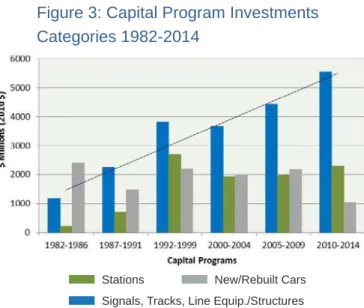
In the early years of the Capital Program, 17.7% of investments were allocated to overhaul-ing and rebuildoverhaul-ing subway cars. As the car stock became reliable, NYC Transit shifted its attention to infrastructure needs.8 Therefore, as can be seen in Figures 2 and 3, infrastruc-ture investments, particularly signal investments, have been steadily increasing. Total in-frastructure investments constitute 59 percent of total assets in need of replacements and upgrades by 2034. Unlike investments
like overhauling subway cars, though, investments in passenger stations, the signaling system, tracks, and line equip-ment and structures affect passenger service through station and track out-ages.
NYC Transit was unable to provide in-formation on track outages that mea-sures the amount of time active passen-ger tracks are out of service. However, this metric is crucial in understanding how increased investments in catego-ries such as signals and tracks have impacted riders.
In addition to ridership increases and changes in types of projects,
import-ant worker safety flagging rules were added in 2007 after the tragic deaths of two NYC
Transit track workers, Daniel Boggs and Marvin Franklin. The flaggingrules now require
trains traveling through a work areato reduce their speed to ten miles per hour from
approximately thirty to thirty-five miles per hour.9 Reduced speeds decrease the number
of trains that can be run each hour. Decreasing the number of normally scheduled trains from as much as thirty-two trains to as few as fifteen trains per hour depending on the line, results in greater passenger crowding and increased travel times.
All of these factors combined: increased ridership, increased track and signal investments,
and fewer trains due to new flagging rules contribute to growing passenger stress. The dis
-comfort of passengers makes the need for a strong and effective communication program all the more important.
Figure 3: Capital Program Investments Categories 1982-2014
Signals, Tracks, Line Equip./Structures
Stations New/Rebuilt Cars
Source: MTA Capital Programs 1982-2014
* 1992-1999 Capital Program was a seven-year program, while all other Capital Programs were five
III. Methodology
In order to have a more complete understanding of the current rider experience, the NYCTRC members conducted surveys examining the four travel alternatives provided by NYC Transit when GOs are scheduled. The four travel alternatives are:
1. Back riding 2. Existing bus service 3. Shuttle bus service 4. Parallel subway service
These travel alternatives are explained in detail in Appendix E: Individual Survey Results.
Council members conducted twelve service diversion surveys between January and March 2014. Three surveys of each of the four travel alternatives were conducted to capture in-formation particular to each alternative. Sample survey forms can be found in Appendix D: Survey Forms. Survey information included:
Communication to Passengers
• Availability and placement of station signage • On-board service diversion signage
• Dates and times of service diversions • Indication of travel alternatives • Directions to travel alternatives
• Inclusion of ADA accessible information
• Subway platform service diversion announcements
• On-board service announcements on trains, buses, and shuttle buses
Crowding Conditions
• Subway platform crowding conditions • Bus stop crowding conditions
• Crowding conditions on trains and buses
IV. Findings
The following is a summation of findings from all twelve surveys completed. Individual sur
-vey information can be found in Appendix E: Individual Survey Results.
Service Diversion Signage
Across surveys, the location of service diversion signage in subway stations was inconsis-tent. Surveyors found that some station signage was placed in obscure locations within stations or was not posted at all. Signage on subway cars was difficult to find, if found at all. This lack of continuity could cause travelers to be confused when it comes to way-finding, deciphering travel alternatives, and understanding accessible travel alternatives.
Station Signage
• In 9 out of 12 stations, signage was posted at station entrances; however 2 signs had been removed, reducing the count to 7 out of 12 (masking tape was still attached to station entrances)
• When laminated signs were posted at station entrances they were not removed • All station signage included dates and times of service diversions
• In 11 out of 12 surveys, travel alternatives were included on the signage Bus Signage
• All shuttle buses surveyed had signage directing passengers to shuttle bus loading areas
• On existing buses surveyed, none had signage directing passengers to existing bus stops. In addition, only one of the three surveys had existing bus service indicated as a travel alternative. On mta.info, service diversion information also includes existing bus service as travel alternatives, however this information was not found on the station signage at two of the three stations surveyed.
On-board Train Signage
• During back riding surveys, none of the six trains surveyed had on-board signage about the current service diversion. If signage was posted on-board it did not pertain to the current service diversion but to other current and future service
Accessible Station Signage
• In 9 out of 12 surveys, accessible travel was affected. Unfortunately, accessible travel information was not on the signage at two accessible stations. When accessible travel information was given it informed passengers to call 511 for travel assistance.
511 Note: Calling 511 is challenging due to multiple prompts. Upon reaching NYC Transit in the voice response system, the caller is first prompted to choose subway and bus status, then plan-a-trip, and finally wheelchair accessible travel. After these prompts the caller is directed to make a series of voice prompts to determine the location by borough and subway stop. This process is time consuming and frustrating due to the system’s frequent inability to distinguish what users are trying to say. Also, as cellphone reception is not available in most stations, 511 cannot be used by someone en route.
When station signage was not posted at all key points within stations, finding service diversion information was a challenge. Key points within stations include station entranc-es, on walls and columns approaching turnstilentranc-es, near turnstilentranc-es, and on station platform walls and columns. If signage is not posted consistently at all key points, information can be missed by passengers, leading to confusion and preventing passengers from making informed decisions.
The continued placement of weekday and weekend directories before passengers swipe their MetroCards is vital. The directories, in addition to station-specific signage helps to in -form passengers of system-wide service diversions. Also, if service diversion signage is not posted adequately in train cars, a passenger’s ability to replan their route when they learn of a change is limited.
Service Announcements
Surveyors found that service diversion announcements were inconsistent across station platforms and on trains and buses. Announcements were not made on all station platforms surveyed or on all trains. When automated and manual announcements were made, travel alternatives were clearly stated informing passengers of where to transfer to connecting services. While shuttle bus operators made service and stop announcements on all surveys, no bus operators on existing bus service made service or bus stop announcements.
• On 4 out of 4 shuttle buses, service/ stop announcements were made
One surveyor noted that the subway conductor informed passengers that the current stop was the transfer point to the opposite-direction trains to access skipped stops. This was noted as a good communication practice, guiding passengers through the route and giving key information at critical decision points.
While many NYC Transit personnel were available during an A line shuttle bus survey con-ducted on February 8, 2014, not all were properly equipped with knowledge of the service diversion to relay to passengers. NYC Transit personnel working the shuttle bus operation did not make clear to passengers where to go to board local and express shuttles. The surveyor asked multiple personnel where to board the express bus and the response was,
“I don’t know.” Approximately five to seven minutes later, a representative from the Depart
-ment of Buses arrived to assist NYC Transit personnel. It was apparent to the surveyor that passengers were confused as to where to go, which was exacerbated by extreme crowding conditions.
Crowding Conditions
Crowd sizes were acceptable during most of the surveys conducted. With a few exceptions, most station platforms trains, buses, existing bus stops, and shuttle bus stops had low to medium crowding conditions. Heavy crowding conditions were documented primarily on trains where passengers had to back-ride and make transfers. Heavy crowding conditions were also more apparent at shuttle bus stops. During one survey, passengers had to wait for the next shuttle bus due to overcrowding.10
Passenger Travel Times
Travel times during the surveys were greater than scheduled travel times for all but one survey conducted. The travel time of the 1 line parallel subway service survey conducted on March 22, 2014 (survey 11 in Figure 4), was only four minutes longer than the scheduled travel time.
Figure 4: Survey Travel Time Compared to Scheduled Travel Time
Cancelled GO Survey Information
The multiple storms our region endured this winter caused cancellations of several GOs during the survey period. On two occasions, a Council member began a survey only to find it had been cancelled at the last minute. The abrupt cancellations meant that station sig-nage was still posted and service diversion announcements were still being made, and the surveyors witnessed the confusion of their fellow passengers. The following lists highlight some of the events that transpired during those two surveys:
01/10/2014: Survey of 6 Train, south-bound from Parkchester to Hunts Point in the Bronx • When the surveyor arrived at Elder Avenue the booth attendant informed the
surveyor that the GO had been recently cancelled
• Attendant reported to surveyor that he had been “yelled at” all day by confused passengers
• GO posters were still displayed in the station, however no signage was present at the station entrance
• Count-down clocks were still displaying the service diversion information
• Audio announcements in the station stated, “no Manhattan-bound service,” although trains were making all stops toward Manhattan
03/02/2014: Survey of F train, south-bound from 57 St to 34 St-Herald Square in Manhattan • The GO was cancelled between the time the surveyor checked the MTA website and
the time she arrived at the station
• Station signage was displayed at the station entrance, informing passengers of the service diversion, even though the GO was recently cancelled
• Station signage read “No downtown trains at this station,” however downtown M trains were pulling into the station
V. Conclusions
Accurate and clear travel information is important for a rider to easily navigate any transit system. The type of information and the means by which it is delivered can also impact rid-er exprid-erience. Poorly displayed and inconsistent messaging can advrid-ersely impact a ridrid-er’s impression of the system and perception of system management. While conducting the surveys, the New York City Transit Riders Council found that signage related to NYC Transit service diversions lacks continuity and clarity. Anecdotal evidence found that these incon-sistencies led to negative rider experiences.
In the most recent surveys, the Council found:
1. NYC Transit frontline personnel are not always aware of what travel information to relay to passengers
2. Station agents sometimes create their own signage to help aid passengers because they are not consistently supplied with service diversion signage
3. Paper signage in stations is not consistently available, signage placement is insistent, and the information included on signage can be limited and therefore con-fusing
4. Station and on-board service announcements are not consistently made, making obtaining necessary information en route a challenge
5. When service diversions are cancelled, signage and announcements are not always updated or removed in a timely manner
This NYCTRC survey, following on the heels of the Council’s Diverted! report, suggests that NYC Transit is not prioritizing service diversion communications with the riders. Because the scope of these two surveys was limited by the size and capacity of the Council, the Council strongly urges NYC Transit to conduct an independent in-depth review of rider communications involved in the GO process. As changing investment needs, safety improve-ments, and an increasing ridership cause many more passengers to be impacted by GOs, NYC Transit needs to assess:
1. If the effort is right-sized for a positive rider experience
2. How to use business analytics to assess the quantity of track outages over
time that impact the rider experience in order to better understand staffing require
5. How significantly service diversions can impact a rider and influence their percep -tion of the system
6. The need to evaluate each service diversion and conduct lessons learned exercises for each one
While NYC Transit is expanding its technological capacity through the introduction of
On-the-Go kiosks and an expansion of the Public Address Systems throughout the B Divi-sion,11 it must not neglect more basic means of communication: paper signage and audible communication. Despite multiple station configurations, it is imperative that NYC Transit provide continuity across the system so passengers know where to look for service infor-mation. Common places that are the same for all stations are at station entrances, station booths, and near turnstiles. NYC Transit frontline personnel must have the necessary knowledge and training to assist riders when it comes to service diversions.12 Through basic yet important changes like these, NYC Transit can demonstrate that it has the rider foremost on its list of priorities.
The current GO effort often reflects poorly on the system itself, and risks riders interpret
-ing the effort as a demonstration of how maintenance or capital work is performed on the system as a whole. As the nature of GOs change, now is the time for NYC Transit to reassess how successfully it is presenting diversion information to the riders.
VI. Recommendations
During the surveys, the Council found that the greatest source of passenger frustration stemmed from how service changes were communicated. All the recommendations there-fore center on improved communications with passengers. The NYCTRC service diversion recommendations cover service diversion signage, platform and on-board service diversion announcements, MTA website information, and training and communication for MTA per-sonnel.
Nine Ways to Improve the Rider Experience
1. Establish a strong GO training program for NYC Transit personnel and
attendants
o Prior to the start of the GO, require a field pre-briefing and information
session with a run-through of affected stations to ensure all personnel know their roles and responsibilities
o All NYC Transit front line employees should know what information they need to provide to passengers during GO periods
o Ensure personnel are familiar with the area where the service diversion is located, enabling them to be knowledgeable of travel options in the immediate area
o Create a consistency checklist for tasks that need to be accomplished before each GO starts
o Conduct “lessons-learned” performance reviews after all GOs
2. Prioritize internal communication to station agents during GO work periods
o Station agents should understand what information needs to be provided to passengers regarding service diversions and travel alternatives
o When abrupt changes or cancellations to service diversions are made, station agents should be notified immediately to inform passengers of such changes
3. Consistently provide signage outside subway stations at street level before
entering the station
o Laminate station entrance signage
o Install enclosed display cases outside stations, attached to subway entrances, to hold and protect signage
4. Place signage along the path that riders follow as they enter a subway station
o Place station-specific signage at station entrances, on walls and columns
approaching turnstiles, and near turnstiles. Signage should be viewable, at eye level, at every key point before passing through the turnstile
o Post current service diversions signage on all station platforms
o Continue the posting of weekday and weekend system-wide planned service changes to serve as customer information centers
Source: MTA, September 2010
*edited to include signage near turnstiles
Source: NYCTRC
Customer Information Center Key Points Diagram
5. Outline all travel alternatives and service diversion information on signage o Improve the formula for where information needs to be included on station
signage
. Upper portion includes borough(s), direction(s), and line(s) affected; part of week; time of day; and calendar duration of service diversion
. Middle portion includes subway travel alternatives, accompanied diagrams, and borough directions
. Lower portion includes additional travel alternative(s), and website information
o Coordinate Planned Service Changes information from mta.info with station signage
o Communicate accessible travel options on signage for passengers who need accessible stations, and post at all accessible stations
o Import line colors onto signage to enable easy identification
6. Post and remove signage promptly
7. Create a policy requirement establishing that every train that will be directly
impacted by a service diversion will have signage posted explaining the impact and alternative travel options
8. Communicate service disruptions and travel alternatives on station platforms
and on both trains and buses in a consistent manner
o Prioritize installation of Public Address Systems in all stations so service diversion announcements with travel alternatives can be made
o Prioritize communication that reflects the service diversions for the line the
rider is currently traveling followed by system-wide diversions
o Bus operators should make all required stop announcements, ensuring both passengers who are transferring to bus service and existing bus passengers know when and where to exit the bus
o Include critical information about service diversions and travel alternatives in on-board train announcements. It is extremely helpful when conductors make additional announcements at transfer points to inform passengers they have reached the station where they need to transfer to connecting services.
9. Extend the Weekender format to weekdays to interactively show service
diversions
o As GOs are being scheduled more frequently during weekdays, the interactive map showing planned service changes and system delays available through the Weekender, should be extended as well
o Expand the Weekender to include a six month calendar “looking ahead” at planned service changes
o Rephrase language on the MTA website to include a time-stamp of the last service diversion update and instructions for users to check back for the lastest information. This is important to include due to frequent last-minute cancellations.
o Add context to the construction through links to the Capital Program,
improvement projects, and maintenance work so passengers know why their service is being diverted
o The service change information displayed on London Underground website may be a good model (See Appendix F: MTA vs. London Underground Website Service Diversion Information)
Appendix A: Diverted!-But how do we know?
Selected Recommendations
General
• Insure that all ADA stations affected by a service change have signage that specifically
addresses alternative accessible routes from that location
• Insure that all stations affected by a service change have signage that specifically
addresses alternative routes from that location
• Insure that signage is placed in an area highly visible to riders
Entrances
• NYCTRC has long advocated that dedicated spaces be set aside for service change
signage and specifically that frames be installed near station entrances
• Place station specific signs at all street level entrances even when other service is still
running at the station. Riders need to be informed of all service changes prior entering the station.
Platforms
• Conductors should supplement service notices with announcements about future stops when rerouted trains arrive in stations
Install SAID boards throughout the subway system • One initiative that would greatly enhance
the delivery of information about service diversions for riders would be the
installation of Station Advisory Information Display (SAID) boards throughout the subway system. Currently, SAID boards are only at a few select stations: Grand Central, Penn Station, Atlantic Terminal, and Times Square.
SAID Board at Grand Central Terminal
Appendix B: General Order Coordination
Process
Appendix C: MTA’s Capital Program - Why The
Need for Continued System Work?
In 1982, the MTA’s Capital Program was created to combat decades of underfunding and de-ferred maintenance that were crippling New York’s transit system. Prior to the Capital Pro-gram’s creation, expansion projects were prioritized over upkeep resulting in a disintegrat-ing existdisintegrat-ing infrastructure that made passenger travel often impossible. The Rudin Center’s 2004 paper on the achievements of the MTA Capital Program, From Rescue to Renaissance, presents a dreary picture of decline:
Tracks were not inspected on a regular basis. Stations were left to deteriorate. The subway system suffered repeated derail-ments – one every 18 days in 1981-82 – caused by crumbling tracks and structures. Trains routinely arrived late, if at all: in 1981, 325 train runs were abandoned on a typical day. Mean Distance Between Failure (MDBF), a standard measure of reliability, fell to a low of 6,640 miles for subway cars in 1981. Graffiti covered every surface; even the doors were broken on more than one-third of all subway cars.13
Since the 1982 inception of the MTA’s Capital Program, the MTA has invested nearly $115 billion in improving the performance and reliability of the network.14 Replacement of rolling stock, upgrades to shops and equipment, and the introduction of a scheduled main-tenance system have all contributed to the system’s increase in reliability. 15 For example, MDBF16 has drastically risen from 7,186 miles in 1982 to over 150,000 miles today and an-nual ridership has increased from 989 million to 1.7 billion.17 Wait assessment, a measure of the percentage of trains that are operating on or close to schedule, is slowly increasing to the desired one hundred percent.18 These improvements started a long run of General Orders that continues today.
13 Allison L.C. de Cerreño; Mark Seaman; Seth Young-English, From Rescue to Renaissance: The Achievements of the MTA Capital Program 1982-2004, (December 2004), 1-2, www.wagner.nyu.edu/rudincenter.
14 MTA 2010-2014 Approved Capital Program Amendment, (July 2013), 3.
15 Permanent Citizens Advisory Committee to the MTA , The Road Back: A Historic Review of the MTA Capital Program, (May 2012) ii.
-Mean Distance Between Failure (MDBF)
Appendix D: Survey Forms
Back Riding
Appendix E: Individual Survey Results
Back Riding
Back riding is a travel alternative offered when construction requires one platform of a sta-tion to close. For back riding, a passenger must first travel in the opposite direcsta-tion of the desired station. For example, a traveler wants to travel north from Station A to Station B, but the northbound platform of Station A is closed. The passenger must instead travel from the opposite platform of Station A south to Station C, where they will transfer to a north-bound train back to Station B.
Survey 1: 02/08/2014, 5:57 pm – 6:27pm
Communication to Passengers
Steinway Street Station
• Signage was placed outside the station at street level, however it had been removed • Signage was present inside the station on walls and columns
• Travel alternatives, dates, and times of the service diversion were displayed on signage
• Service diversion announcements were made in the station Quee
ns Pl aza
36 St Steinw ay St
46 St Northe rn Blvd
65 St Jacks on He
igh ts-Roos evelt Av
/
/
/
/
/
Back Riding Travel Direction (Westbound Platforms Closed)
START
STOP
E
• No service diversion announcements were made on-board Jackson Heights – Roosevelt Av Station (Transfer)
• The conductor on southbound train made service diversion announcements while the train was dwelling in the station
On-board train to Queens Plaza
• No service diversion signage was posted on-board
Crowding Conditions
• Platforms at Steinway Street and Roosevelt Avenue had medium crowding; platform benches were full and numerous people were standing
• Heavy crowding on the Roosevelt Av- bound train. Standing room only
• Medium crowding on the Queens Plaza-bound train with only a few seats available
Passenger Travel Time
Survey 2: 02/12/2014, 11:03am – 11:39am
*This survey was conducted to highlight the level of accessibility for wheelchair passengers and therefore was conducted at wheelchair accessible stations.
Communication to Passengers
Pelham Pkwy station
• No signage posted outside the station at street level
• Signage was posted inside the station on walls and in the agent’s booth
• Travel alternatives, dates, and times of the service diversion were displayed on signage
• Signage did not display accessible travel options for wheelchair passengers • Platform service diversion announcements were made at Pelham Pkwy
• Station count-down clocks were present in the station with accurate train arrival-time information, but did not display information on service diversion
On-board train to E 180 St station
• No service diversion signage was posted on-board
• No service diversion announcements were made on-board
E 1
80 St
Bro nx P
ark Eas t Pel ham Pkw y Alle rton Av Bur
ke Av
Gun
Hill Rd
/
/
/
/
Back Riding Travel Direction (North-bound Platforms Closed)
START STOP
N
E 180 St station
• No service diversion announcements were made in the station On-board train to Gun Hill Rd station
• No service diversion signage was posted on-board
• Service diversion announcements were made on-board
Crowding Conditions
• Pelham Pkwy platform had low crowding conditions
• E 180 St platform became more crowded with passengers making the connection to the northbound train
• On-board crowding conditions were medium to heavy; seats were full and people were standing on both trains
Passenger Travel Time
Pelham Pkwy station signage
Survey 3: 03/20/2014, 11:40am – 12:23pm
* Surveyor was able to use the northbound B train to get to Newkirk Plaza, as it was making local northbound stops
Communication to Passengers
Avenue M Station
• Signage was posted at street-level
• Signage was posted on the walls in the station
• Red tape was used to block off the southbound entrance after entering through the turnstiles
• Travel alternatives, dates, and times of the service diversion were displayed on signage
• Automated service diversion announcements were made on the platform and informed passengers that the Manhattan-bound B trains were making local stops On-board train to Newkirk Plaza Station
• No service diversion signage was posted on-board
• Service diversion announcements were made on-board
• Announcements stated the Manhattan-bound B trains were making local stops
New kirk
Pla za
Aven ue H
Aven ue J
Aven ue M
King s H
wy Aven
ue U
Con ey Is
la nd-Stillw
ell A v
/
/
Back Riding Travel Direction (South-bound Platforms Closed)
S START
/
STOP Neck Rd Shee pshead B ay Brig
hton Beach
Oce an Pk
wy West
8 S t-NY
Aquar ium
Newkirk Plaza Station
• Automated service diversion announcements were made on the platform detailing travel alternatives, where to transfer, and mentioned that B trains were making all local stops
On-board train to Coney Island-Stillwell Av Terminal
• No service diversion signage was posted on-board
• Conductor made an announcement at Kings Hwy, informing passengers to transfer to a Manhattan-bound Q or B train to connect to southbound skipped stations. • Conductor informed passengers that the train would be now making all local stops
to Coney Island-Stillwell Av
Crowding Conditions
• Platforms at Avenue M and Newkirk Plaza had low crowding conditions
• Northbound B train to Newkirk Plaza had low crowding conditions with plenty of available seats
• Southbound Q train had low to medium crowding conditions, and only a few seats were available
Passenger Travel Time
Existing Bus Service
Existing bus service is implemented when a NYC Transit bus stop is nearby for passengers to utilize. This is especially convenient when a bus route is running along the same corridor as the affected subway line.
Survey 4: 02/20/2014, 12:36pm - 12:58pm
Communication to Passengers
219 St Station
• Signage was posted outside the station at street level, however it had been removed • Signage was placed on the walls within the station
• One sign was placed on the glass door panel entering the station, however it was placed with the back of the sign facing the stairwell so incoming passengers could not read it
• Travel alternatives, dates, and times of the service diversion were displayed on signage
• Because no red-tape was used to close off the stairwells to the closed platform a man was waiting on the closed platform
/
/ /
/
Bx39 Bus Route (North-bound platforms closed) N 219 St 225 St 233 St Ner eid A
v Wak efield -241 St STOP START
2
On-board Bx39 bus to Wakefield-241 St Terminal
• The bus operator did not make any announcements until the one for “last stop”
Crowding Conditions
• No one was waiting for the Bx39 bus
• Low crowding on-board with plenty of seats available
Passenger Travel Time
Signage removed Inaccessible sign location Signage with existing bus info.
Survey 5: 03/05/2014, 11:04 am - 11:38 am
Communication to Passengers
Hewes St Station
• No service diversion signage was posted outside at street level
• Service diversion signage was not posted within the station; the only available information about this service diversion was posted with all upcoming service diversions, making it difficult to find
• The station booth clerk put up her own handwritten signs at the turnstiles informing passengers “no Queens-bound service at the station”
• Signage that was mixed with other notices did not display the B46 alternative existing bus route as a travel option
• No signage was posted directing passengers to the B46 bus stop On-board B46 bus to Myrtle Ave
• Bus operator was not making service and bus stop announcements
Crowding Conditions
• The bus stop had low crowding conditions
• After the stop at Woodhull Hospital, the bus became heavily crowded
/
/
/
B46 Bus Route (Jamaica Center-bound platforms closed)
E
Hew es S
t Lorimer St Flush ing Av Myr tle A
v
STOP
START
Hand-written sign at Hewes St Med-Heavy bus crowding
Signage removed Signage with back riding
alternative and no indication of existing bus service
Source: NYCTRC
Survey 6: 03/09/2014, 1:45pm - 2:19pm
Communication to Passengers
Westchester Sq. – East Tremont Av station
• No service diversion signage was posted outside the station at street level
• Service diversion signage was displayed on turnstiles, walls, and columns inside the station
• Train travel alternatives were displayed on signage, although not all bus alternatives were displayed on signage (surveyor boarded the Bx24 to travel north-bound to Pelham Bay Park, however this alternative was not listed. Only south-bound options for Bx4 and Bx4A were posted)
• Signage directing passengers to bus service was not present
*Bustime indicated that the Bx24 bus stop was located at Lane and E Tremont, however this is not the location for the Bx24. It stops at Westchester and Blondell Ave, a block away from the subway station
*Bustime only gave Bx8 information for Westchester and Blondell Ave, however the schedule on the bus stop pole indicated the Bx24 information
On-board Bx24 bus to Pelham Bay Park
• Bus operator did not make service or bus stop announcements
Crowding Conditions
• Bus stop had low crowding conditions with only four people
/
/
/
Bx24 Bus Route(north-bound platforms closed) N West che ster S q-Midd leto wn Rd Buhr e Av
Pelh am B
ay P ark East Trem ont Av STOP START
6
Passenger Travel Time
Signage with back riding alternative and no indication
of existing bus service Signage in agent’s booth Planned service changes
Shuttle Bus Service
Shuttle bus service is provided when both directions of a subway line are closed and no other modes of public transit are easily accessible. Even when other subway lines or bus routes are nearby, it may be determined that these alternatives cannot handle the addition-al passengers and therefore shuttle buses are provided.
Survey 7A: 02/08/2014, 1:45pm - 2:32pm
Communication to Passengers
Hoyt-Schermerhorn Station and Shuttle Bus stop
• At G train Hoyt-Schermerhorn station, attendants were directing passengers to shuttle buses on the platform level
• Attendants were at the turnstiles handing out transfer slips to the shuttle buses, giving directions, and warning passengers that there were large crowds at the shuttle buses
• Surveyor found verbal directions confusing because they were not guiding passengers in the same direction as the signage
• Shuttle bus signage was posted on station walls and outside station on bright yellow laminated paper Ho yt-Sche rmerh orn Nostra nd Av
Utica Av
A
Lafayett e Av
Clinto n-Wash ington Avs Frank lin Av
King sto n-Throop
Avs S
Local Shuttle Bus Route
/
/
/
/
/
/
/
STOP• Shuttle buses were directly outside of the subway station. However, it was difficult to determine which buses were local or express. Although there was a laminated sign indicating the location of the shuttle buses, there was no directional information provided, requiring a handwritten sign directing passengers across the street for Utica Avenue- bound shuttle buses.
On-board Shuttle Bus to Utica Avenue
• Automated announcements were made on the bus detailing the service changes and saying “allow for additional travel time”
• Bus Operator made bus stop announcements
Crowding Conditions
• Medium crowding at the shuttle bus stop at 1:53pm
• At 1:53pm, surveyor reached the Utica bound bus stop and tried to board the express bus, but it was too full. Surveyor had to wait for the next bus which was a local bus
• Bus was extremely crowded and full to the front door
Passenger Travel Time
Signage directing passengers to shuttle bus from the G line
Hand-written sign directing passengers to opposite direction shuttle buses
Med-Heavy crowding at shuttle bus stop
Survey 7B: 02/08/2014, 2:37pm - 3:16pm
Communication to Passengers
Utica Avenue Station and Shuttle Bus Stop
• Shuttle bus signage was posted on station walls and outside station on bright yellow laminated paper
• Travel alternatives, dates, and times about the service diversion were displayed on signage
• Many attendants were giving directions to passengers; one attendant was using a megaphone to direct passengers
• While most attendants were well informed, surveyor received incorrect directions from one attendant. Surveyor noticed this attendant was then repositioned.
• As shuttle buses arrived they were determined to be local or express depending on customer demand
o Bus operator did not know if her bus would be local or express o This made matters confusing when the buses were arriving
o A man from Dept. of Buses told the driver that she would be running express, not local as she had been doing
On-board Shuttle Bus to Jay St-Metro Tech station
• At Hoyt-Schermerhorn, people coming from the subway trying to head to Utica Avenue mistakenly boarded the bus. The bus operator directed them to the correct
Jay St -MetroT ech Ho yt-Sche rmerh orn Nostra nd Av
Utica Av
A
N
Express Shuttle Bus Route
• The bus operator was making bus stop announcements
Crowding Conditions
• Utica Avenue shuttle bus stop had a heavy crowd
• Extremely crowded, not everyone could get onto the bus
• On-board was extremely crowded
Passenger Travel Time
Heavy crowding at Utica shuttle bus stop
Laminated station entrance signage
Signage directing passengers to connect to the A line at Jay St-MetroTech
Survey 8: 02/22/2014, 10:48 am - 11:45 am
* This survey was conducted capturing both shuttle bus and parallel subway service, as each operated at dif-ferent segments of the survey route.
Communication to Passengers
149 St-Grand Concourse station
• Service diversion signage was posted outside at street-level
• Service diversion signage was posted on the columns of the station
• Travel alternatives, dates, and times about the service diversion were displayed on signage
• Signage was posted directing passengers to the shuttle buses 161 St-Yankee Stadium station
• No signage was posted directing passengers to transfer to D line service On-board announcements
• Prior to the survey, the surveyor traveled north on the 4 train to 149 St-Grand Concourse; the conductor was making announcements informing passengers to transfer to the D line for continuing service
• Announcements were made at Bedford Park Blvd, informing passengers that shuttle buses were available making 4 train stops to Woodlawn Terminal
/
/
/
/
/
/
/ / / /
/
/
Kingsbr idge Rd 170 St Mt Ed
en Av 176 St Burns
ide Av 183 S
t Fordha
m Rd 167 S
t 161 St
-Wood lawn Mosho
lu Pk wy Bedfo
rd Pk Blvd
-Yank ee Sta
dium
Lehman Colleg
e
Bedfo rd Pk
Blvd 174-175
Sts Tremo
nt Av 182-18
3 Sts Fordha
m Rd Kingsbr
idge R d 170 S
t 167 St 149 S
t-Gran d Conc
ourse
Shuttle Bus to 161 St-Yankee Stadium
Shuttle Bus to Woodlawn
N
START
STOP
Shuttle Bus/Parallel Subway Service ( 4 line stations closed)
4
D
Bedford Park Blvd station
• Signage was posted directing passengers to shuttle bus service
Crowding Conditions
• The shuttle bus stop had medium crowding conditions • The shuttle bus had heavy crowding conditions
• The D line platform had medium crowding conditions • The D train had medium crowding conditions
• The second shuttle bus stop at Bedford Park Blvd had low crowding conditions • On-board the second shuttle bus had low crowding conditions
Passenger Travel Time
Signage directing passengers to shuttle buses from 149
St-Grand Concourse Signage at shuttle bus stop
Low-medium platform crowding conditions at 161 St-Yankee Staudium (D line)
Survey 9: 03/8/2014, 11:48am - 1:09pm
Communication to Passengers
Prospect Park station
• Service diversion signage was posted outside at street-level
• Service diversion signage was posted on the walls inside the station
o The presence of the existing bus stop directly outside of subway station led to confusion
o Passengers were waiting for the shuttle buses at the existing bus stop, although the shuttle buses were loading around the street corner
• Travel alternatives, dates, and times were posted on signage with express and local bus stop information, while other signs simply were directing passengers to the shuttle bus area
• Directions to the shuttle buses were posted on the existing bus stop shelter
o Only one sign was posted which made finding the shuttle buses difficult
On-board announcements
• The bus operator made service and bus stop announcements
Crowding Conditions
• There were medium crowding conditions at the shuttle bus stop
Prospe ct Par
k Parks
ide Av Churc
h Av Beve
rley R d
Q
Aven ue M Aven
ue J Aven
ue H Newk
irk Plaza Cortel
you R d
Brigh ton Be
ach Shee
pshe ad Ba
y Neck
Rd Aven
ue U Kings
Hwy
Ocea n Pkw
y West 8
St -NY Aq
uarium Cone
y Islan d-Stillw
ell Av
2
Winth rop StFlatbu sh Av
Brookl yn Coll
ege
S
Q north & south-bound stations closed
Limited Shuttle Bus Route
/
/
/
/
/
/
/
/
/
/
/ / / / / /
STOP STARTPassenger Travel Time
Hand-written notice on sign, indicating direction to shuttle bus stop for Ocean Av-bound buses
Confused passengers waiting at existing bus stop, when shuttle buses were located around the street corner
Signage posted at stairwell, with attendant present for passenger assistance
Parallel Subway Service
Parallel subway service is when passengers can utilize a nearby subway line to complete their travels.
Survey 10: 01/12/2014, 11:41am - 12:17pm
Communication to Passengers
New Utrecht Av Station
• Service diversion signage was posted outside at street-level
• Signage was posted on turnstiles, walls, and station doors on the N train platform • Hand-written sign was made in the token booth
• Signage was present directing passengers to parallel D service 62 St station
• No signs on D platform indicating that the N would stop at this station
• Travel alternatives were listed on signage did not indicate trains would be making limited stops
S
18 Av 20 Av Bay P kwy
Kings H wy
Avenu e U
86 St
Cone y Islan
d-Stillw
ell Av 79 St 18 Av 20 Av
Bay P
kwy 25 Av Bay 5
0 St 71 St
62 St
New Utrecht Av
Parallel Subway Service(south-bound N platforms closed)
/
/
/
/
/
/
/
START STOPD
N
On-board and platform announcements
• No announcements were made at the platform level
• Conductor announced train was running express to Coney Island with a stop at Bay Parkway
• At Coney Island-Stillwell Av Terminal, conductor on the N train announced to passengers that this train would be making all N stops to Manhattan
Crowding Conditions
• Low crowding conditions at all platforms and on each train
Passenger Travel Time
Hand-written sign at 62 St
Coney Island-bound N trains
stop at D train platforms Signage at station entrance
Survey 11: 03/22/2014, 11:35 - 11:50 am
Communication to Passengers
168 St station
• Service diversion signage was posted outside at street-level • Travel Alternatives, dates, and times were displayed on signage
o There was a lot of information on the signage, including a service diversion diagram
o Travel alternatives consisted of shuttle buses, A train service, and the M3 bus • Service diversion signage was posted on columns inside the station, directing
passengers to the exits for shuttle bus service Announcements at 168 St station
• Announcements were made in the station complex at 168 Street, where the 1 line and the A line intersect
Crowding Conditions
• The A train platform at 168 Street and the A train had low crowding conditions
Passenger Travel Time
N
Inwo od
-207 S t
Dyckm
an St 190 S t
181 S t
175 S t 191 S
t Dyckma
n St
207 St 181 S t
168 S t
Parallel Subway Service(1 platforms closed)
/
/
/
/
START1
In-station signage directing passengers to shuttle buses
Station entrance signage, displaying too much info.
Station entrance signage with red tape
Source: NYCTRC
*Additional information for this survey consisted of the shuttle bus travel alternative infor-mation:
• After parallel subway service survey, surveyor walked over to the 207 St 1 line station
o Signage was posted outside at street-level telling passengers to use nearby A train service on the downtown entrance
o Signage was posted outside at street-level telling passengers to use shuttle buses on the uptown entrance
o Additional signage was present inside the station stairwell displaying where the shuttle buses operate, accompanied by a route diagram
o The information was important, but difficult to read through to make sense of
where to locate shuttle buses
o Surveyor, not familiar to the area, found it difficult to find shuttle buses since
Appendix F: MTA vs. London Underground
Website Service Diversion Information
• Current service status by line • Link to The Weekender
• Link to Future Date
• Current service status by line • Links to Now, Later and This
Weekend
Service Change Website Information
Source: mta.info
• Displays current service delays • Displays reason for delays, e.g.
signal problems
• Select a date to display subway System Delays
The Weekender Website Information
Source: mta.info
• Interactive System Map
• Select specific subway lines to view stations with service changes
• Select specific stations to view details and alternate travel options to/
Service Change Website Information
Source: tfl.gov.uk/modes/tube/
• Interactive system map • Line closures, severe
and minor delays • Station closures • Later today service
changes
• Weekend service updates
• Live departure boards
• Tube planned works
calendar
• Links to the Tube Improvement Plan
• Map displays system lines with closures and delays
• Station closures highlighted on map • Hovering over lines will display
closure/delay information with travel options
• Hovering over stations will display closure information with travel options
Tube Planned Works Calendar and Improvement Plan Website Information
Source: tfl.gov.uk/modes/tube/
• Calendar is interactive, displaying planned work for upcoming twelve weeks
• Hovering over calendar displays closure information
• Clicking on information box displays further details with links to upgrade plan for individual lines
Lessons Learned
London Underground Website
1. Interactive homepage system map
o Map displays line and station closures/delays
2. Planned works calendar
o Provides passengers with a look ahead at line and station service changes
3. Links to Tube Improvement Plans
o Overall Tube Improvement Plan o Individual line upgrade plans
Website Recommendations
MTA Website Recommendations
1. Extend The Weekender interactive
map format to weekday/night service change information
2. Establish a Planned Works Calendar
Appendix G: The Magnitude of Service
Diversions on the Broadway-7th Avenue Local
As an example of how much impact GOs can have on a rider, the Council looked at the schedules of GOs on the northern end Broadway-7th Ave Local 1 line in 2013. While the 7 line construction and Superstorm Sandy-related projects also have a large number of GOs that significantly impact passenger service, the Council decided the circumstantial nature of both makes them not representative of normal GO work. In 2013 our sample area, en-compassing 17 stations between the 103 Street and Van Cortlandt-242 St stations, endured a combined 146 days and nights of
ser-vice diversions, occurring predominantly during weekday hours.
Number of Service Diversions and GOs 1 Line (103 St to 242 St): Jan-Dec 2013
Three of the northernmost stations in this sample area were impacted the most. North-bound platforms of the 225 Street-Marble Hill, 231 Street, and 238 Street stations were impacted a total of 90 combined days and nights in 2013. The Southbound platform at 238 Street was impacted a total of 86 combined days and nights, and both 231 Street and 225 Street-Marble Hill were each impacted a total of 76 combined days and nights.
Source: Data compiled from MTA Today website, General Orders Bulletin
Northbound: combined days & nights Southbound: combined days & nights
Appendix H: GO Personnel Training
NYC Transit Riders Council - General Order Questions and Responses
In order to gain greater clarity on the processes behind planning for General Orders, the NYCTRC staff was in constant communcation with the Operations Planning Department of NYC Transit. The Operations Planning Department provided the Council with guidance through both emails and in-person meetings. The following is a selection of those corre-spondences relating to GO personnel training.
Questions:
• Is there any type of GO training program to educate NYC Transit personnel on what to do during a GO?
• Are NYC Transit employees informed on what information needs to be communicated to passengers during GO periods?
• Before a GO happens, what type of roles and responsibilities are communicated to NYC Transit personnel involved?
Answers:
As you know, there are many parts to a General Order (GO) from writing the GO to work-ing on the track or a signal to assistwork-ing customers durwork-ing service diversions. A subset of GO responsibilities include interacting with the public. Departments whose responsibili-ties include public engagement include bus drivers, station staff, Rapid Transit Operations (RTO) staff, and traffic checkers. Each group receives training and instructions on what to do during a General Order or Service Diversion.
Bus Operators are trained in the safe, courteous, and reliable transport of customers on a daily basis and the same standard applies while operating shuttle operations. Road Opera-tions determines the amount of supervision required for a shuttle operation and packages are prepared and distributed to the Bus Operators, which include shuttle routing and bus stops for the GO. Bus Operators are assigned specific “runs” that include scheduled leave times from the terminals. Prior to any GO, Road Operations personnel meet with Opera-tions Planning to discuss the service plan, which includes bus routing, running times, and
diversion signage. New hires receive a five-week training, and receive GO Support Training during that time. When a GO calls for a shuttle bus operation, traffic checkers are in charge of crowd control and bus loading on the street.
RTO staff handle platform safety, customer direction, and ensure that all passengers have exited the train before it leaves the station for its turnaround or terminal destination. Stations staff handle passenger egress and transfers. RTO and Stations staff get detailed instructions on their roles during a GO including: how to read a GO, when it goes into effect, their responsibilities, what the alternative service options are, if/what special announce-ments need to made during a GO, any special operating procedures, any suppleannounce-ments involved, if/what additional personnel are necessary to run the GO, who is in charge of the GO, and when the GO signage should be removed from the bulletin board.
As an example, here is what a customer may experience at an upcoming GO at Franklin Ave-nue in Brooklyn:
• When a customer exits the train, they will see RTO staff on the platform directing people to the proper exits for shuttle bus service. Passengers can follow the
directions from staff and/or follow the yellow “way finding arrows” that will lead to the shuttle bus operation.
• When the customer gets to the mezzanine, Stations staff will be there directing passengers and giving out transfer slips.
• When the customer reaches the street, they will see Operations Planning staff who will be directing customers to shuttle buses. They will help load the buses and manage crowd control.
Each staff person with a public engagement responsibility is informed on what needs to be communicated to passengers during each service diversion. Each team knows its general role and responsibility as a part of their overall job. For each specific GO or service diver -sion, staff get instructions on the proper exits, service plan, route of shuttle buses, and how to direct passengers to continue/complete their travel. Given the nature of the work, and the fact that GOs are going on much of the time, GO training is typically built-in to overall work training within each NYCT division. GOs can be better understood as the Transit way of life, rather than a special or tangential assignment.
Questions:
• If there is a debriefing session that occurs after a GO, that would be great to know as well.
• Is there a feedback loop to hear how the operation went? Is the feedback
provided orally or by filling out a form? Do they go over critical items such as, if announcements were made and if signs were posted correctly, etc...?
Answers:
Debriefing sessions are held whenever we run a new GO or try a new method of service di
-version, for example, FasTrack. When we started FasTrack, staff were in the field observing how things were going. Their job was to see if everything was happening as planned and instructed. Were announcements being made? Were signs posted everywhere? After a new scenario like this, we hold “Post-Mortem” debriefing sessions to discuss what worked, what didn’t, and what needs to be changed for the next GO/service diversion.
In addition to debriefing sessions after new GOs or service plans, we also at times sched
-ule and hold post-GO meetings with senior personnel to assess problems that arose, share lessons learned, and discuss ways to improve the process next time. This kind of exercise also takes place in pre-GO coordination meetings, where staff members share past expe-rience and offer suggestions of what to improve for the coming GO or for future GOs. In these meetings, everything from the posted signs to the bus destination signs to the service diversions are discussed in an effort to improve coordination and organization on the day of between staff and passengers.
Questions:
• Is there a checklist for NYC Transit employees to use to ensure every task gets accomplished?