RESEARCH NOTE
THE PERSONALIZATION PRIVACY PARADOX: AN EMPIRICAL
EVALUATION OF INFORMATION TRANSPARENCY AND THE
WILLINGNESS TO BE PROFILED ONLINE FOR
PERSONALIZATION
1
By: Naveen Farag Awad
Wayne State University Detroit, MI 48202 U.S.A.
[email protected] M. S. Krishnan
Business Information Technology University of Michigan Business School Ann Arbor, MI 48109
U.S.A.
Abstract
Firms today use information about customers to improve service and design personalized offerings. To do this successfully, however, firms must collect consumer information. This study enhances awareness about a central paradox for firms investing in personali-zation; namely, that consumers who value information transparency are also less likely to participate in personalization. We examine the relationship between information technology features, speci-fically information transparency features, and consumer willingness to share information for online personalization. Based on a survey
1V. Sambamurthy was the accepting senior editor for this paper. Prabhudev Konana was the associate editor. Sridhar Balasubramanian and Nirup Menon served as reviewers.
of over 400 online consumers, we examine the question of whether customer perceived information transparency is associated with consumer willingness to be profiled online. Our results indicate that customers who desire greater information transparency are less willing to be profiled. This result poses a dilemma for firms, as the consumers that value information transparency features most are also the consumers who are less willing to be profiled online. In order to manage this dilemma, we suggest that firms adopt a strategy of providing features that address the needs of consumers who are more willing to partake in personalization, therefore accepting that the privacy sensitive minority of consumers are unwilling to participate in personalization, despite additional privacy features.
Keywords: Online privacy, information transparency, Web site features, online experience, consumer privacy, online personali-zation, online information sharing, empirical studies of information systems, business value of information systems, information sharing practices.
Introduction
The ability to collect, analyze, and respond to user information is of growing importance. To survive, companies depend on vast quantities of information to build rapport with existing customers and attract new business (Culnan and Armstrong 1999). As the ease and availability of e-business reduces face-to-face interaction, firms must use consumer information to attempt to offer personalized service that will increase value and consequently, consumer loyalty. As Weill and Vitale (2001, pp, 24-25) state,
Information technology (IT) infrastructure and the information it contains, particularly customer information, will be a critical success factor for all e-business initiatives, thus raising the stakes for the management of the firm’s IT investments and assets.
However, implicit in the collection of consumer information is a concern for consumer privacy. Information privacy is one of the most important issues facing management practice (Mason 1986; Safire 2002); if managers are not careful, their firms may be the victims of consumer backlash for overstepping the bounds of expected information practices.
The objective of this paper is to examine the relationship between information transparency and consumer willingness to partake in personalization. Specifically, we examine two research questions. Do information transparency features, which provide knowledge of information and procedures, affect consumer willingness to be profiled online for personalized offerings? Does the effect of infor-mation transparency features on a consumer’s willingness to be profiled online differ across personalized service versus personalized advertising? This paper uses a utility maximization theory frame-work to examine these questions. The major contribution of this research is that it provides empirical evidence of a central paradox for firms investing in personalization.
In the next section, we review and discuss prior literature. We then discuss the theoretical model and hypotheses of this paper. In the fourth section, we explain the data and measurement. The analysis and results are presented, followed by a discussion of the results and their managerial implications. We conclude the paper with direc-tions for future research.
Prior Literature
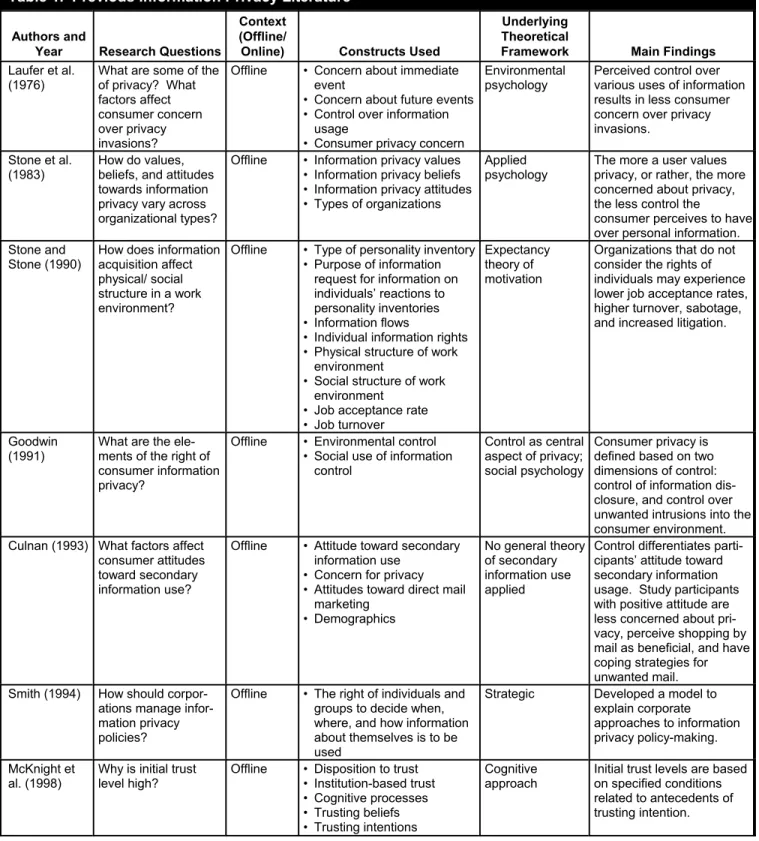
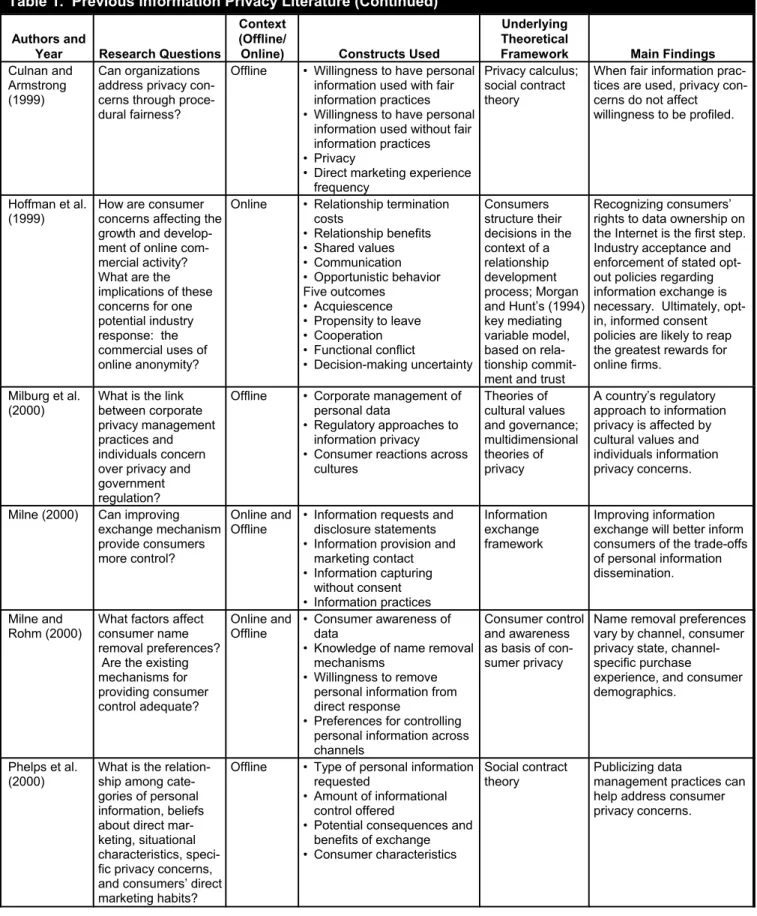
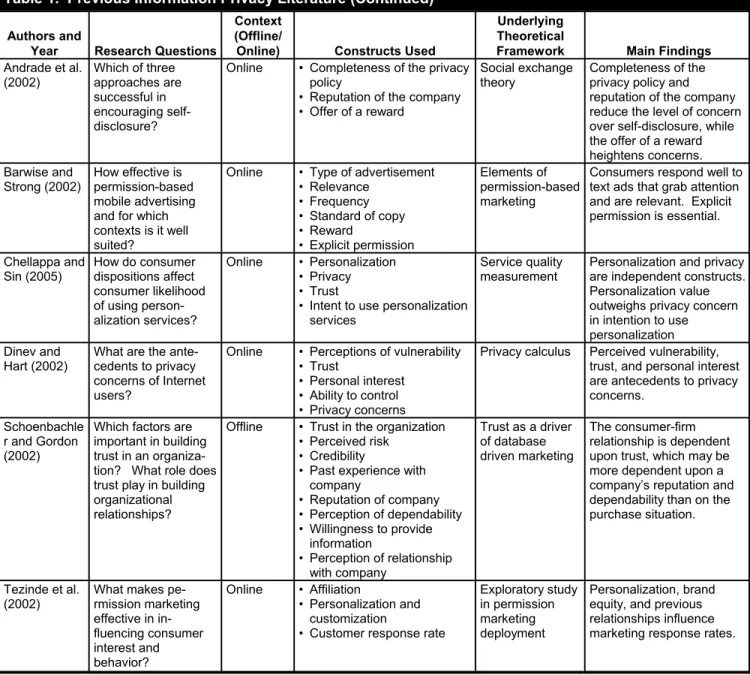
Public opinion surveys show that citizens are quite concerned about threats to their information privacy (Equifax 1996; Harris and Westin 1998; Westin 1997). Several of the expressed privacy concerns centered on the process firms utilize to collect and use personal data. Other studies have examined the likelihood consumers will partake in online personalization services from a purely consumer-characteristics standpoint. For example, Chellappa and Sin (2005) examine consumer attributes such as privacy concern and personalization value; they also examine how such attributes affect consumer likelihood of using personalization services. While we also include consumer attributes, the main focus of our study is the consumer-rated importance of perceived information transparency. By information transparency features we mean features that give consumers access to the information a firm has collected about them, and how that information is going to be used. Table 1 summarizes various examinations of the issue of information collection and information privacy. The table includes the constructs used in each paper, the setting (offline or online), as well as the theoretical foundations and main findings.
The information privacy research outlined in Table 1 is grounded in the basic definition of privacy found in psychology literature. Privacy is defined as “the ability of the individual to control the terms under which personal information is acquired and used” (Westin 1967, p. 7). Information privacy, then, refers to “the ability of the individual to personally control information about one’s self” (Stone et al. 1983, p. 461). Hence, it may be interpreted from this definition that one way to decrease the level of perceived privacy risk for the online consumer is to increase his or her level of control
over personal information. Previous research has suggested that issues of informational control are essential in creating a favorable consumer predisposition toward contributing information to online firms (Stewart and Segars 2002).
Knowledge has been shown to be a determinant of perceived control (Armitage and Conner 1999; Azjen and Driver 1991; Wortman 1975). We extend this idea of knowledge as a control mechanism to improving consumer comfort online, since previous research shows that adult Internet usage may be constrained by the perceived need for additional knowledge and better understanding of the medium (Klobas and Clyde 2000).
In this paper, we use a utility maximization framework to examine control, as implemented through IT-enabled information trans-parency. The main construct of interest in this paper is a consumer’s rated importance of information transparency features that online firms can provide. These features have a different meaning in the offline setting than in the online setting. In the offline setting, there is no clear way to visually access a consumer’s personal data when dealing with, for instance, a catalog marketer. Thus, such a func-tional distinction in the online setting versus the offline setting demands that the online context be studied separately. The contributions of this paper to the literature are
(1) While the bulk of previous research has examined willingness to share information in the offline setting, this paper adds to our understanding of willingness to be profiled for personalization in the onlinecontext.
(2) This paper examines a new construct: the importance of
information transparency features (such as data transparency, data removal, and time expirations of data) towards increasing consumer willingness to be profiled online.
(3) This paper explicitly contrasts two varying outcomes, adver-tising and service, in order to assess if a difference in outcome utility affects the willingness to share information.
(4) While prior studies have examined the likelihood of consumers partaking in online personalization from a purely consumer characteristic standpoint (e.g., Chellappa and Sin 2005), this paper studies both consumer characteristics and past consumer
experiences in the context of privacy concerns, and their association with willingness to be profiled online.
Table 1. Previous Information Privacy Literature Authors and
Year Research Questions
Context (Offline/
Online) Constructs Used
Underlying Theoretical
Framework Main Findings
Laufer et al.
(1976) What are some of theof privacy? What factors affect consumer concern over privacy invasions?
Offline • Concern about immediate event
• Concern about future events • Control over information
usage
• Consumer privacy concern
Environmental
psychology Perceived control overvarious uses of information results in less consumer concern over privacy invasions.
Stone et al.
(1983) How do values,beliefs, and attitudes towards information privacy vary across organizational types?
Offline • Information privacy values • Information privacy beliefs • Information privacy attitudes • Types of organizations
Applied
psychology The more a user valuesprivacy, or rather, the more concerned about privacy, the less control the
consumer perceives to have over personal information. Stone and
Stone (1990)
How does information acquisition affect physical/ social structure in a work environment?
Offline • Type of personality inventory • Purpose of information
request for information on individuals’ reactions to personality inventories • Information flows
• Individual information rights • Physical structure of work
environment
• Social structure of work environment
• Job acceptance rate • Job turnover
Expectancy theory of motivation
Organizations that do not consider the rights of individuals may experience lower job acceptance rates, higher turnover, sabotage, and increased litigation.
Goodwin
(1991) What are the ele-ments of the right of consumer information privacy?
Offline • Environmental control • Social use of information
control
Control as central aspect of privacy; social psychology
Consumer privacy is defined based on two dimensions of control: control of information dis-closure, and control over unwanted intrusions into the consumer environment. Culnan (1993) What factors affect
consumer attitudes toward secondary information use?
Offline • Attitude toward secondary information use
• Concern for privacy • Attitudes toward direct mail
marketing • Demographics
No general theory of secondary information use applied
Control differentiates parti-cipants’ attitude toward secondary information usage. Study participants with positive attitude are less concerned about pri-vacy, perceive shopping by mail as beneficial, and have coping strategies for unwanted mail. Smith (1994) How should
corpor-ations manage infor-mation privacy policies?
Offline • The right of individuals and groups to decide when, where, and how information about themselves is to be used
Strategic Developed a model to explain corporate approaches to information privacy policy-making. McKnight et
al. (1998)
Why is initial trust level high?
Offline • Disposition to trust • Institution-based trust • Cognitive processes • Trusting beliefs • Trusting intentions
Cognitive approach
Initial trust levels are based on specified conditions related to antecedents of trusting intention.
Table 1. Previous Information Privacy Literature (Continued) Authors and
Year Research Questions
Context (Offline/
Online) Constructs Used
Underlying Theoretical
Framework Main Findings
Culnan and Armstrong (1999)
Can organizations address privacy con-cerns through proce-dural fairness?
Offline • Willingness to have personal information used with fair information practices • Willingness to have personal
information used without fair information practices • Privacy
• Direct marketing experience frequency
Privacy calculus; social contract theory
When fair information prac-tices are used, privacy con-cerns do not affect willingness to be profiled.
Hoffman et al.
(1999) How are consumerconcerns affecting the growth and develop-ment of online com-mercial activity? What are the implications of these concerns for one potential industry response: the commercial uses of online anonymity?
Online • Relationship termination costs
• Relationship benefits • Shared values • Communication • Opportunistic behavior Five outcomes
• Acquiescence • Propensity to leave • Cooperation • Functional conflict
• Decision-making uncertainty
Consumers structure their decisions in the context of a relationship development process; Morgan and Hunt’s (1994) key mediating variable model, based on rela-tionship commit-ment and trust
Recognizing consumers’ rights to data ownership on the Internet is the first step. Industry acceptance and enforcement of stated opt-out policies regarding information exchange is necessary. Ultimately, opt-in, informed consent policies are likely to reap the greatest rewards for online firms.
Milburg et al. (2000)
What is the link between corporate privacy management practices and individuals concern over privacy and government regulation?
Offline • Corporate management of personal data
• Regulatory approaches to information privacy • Consumer reactions across
cultures Theories of cultural values and governance; multidimensional theories of privacy
A country’s regulatory approach to information privacy is affected by cultural values and individuals information privacy concerns.
Milne (2000) Can improving exchange mechanism provide consumers more control?
Online and Offline
• Information requests and disclosure statements • Information provision and
marketing contact • Information capturing
without consent • Information practices
Information exchange framework
Improving information exchange will better inform consumers of the trade-offs of personal information dissemination.
Milne and Rohm (2000)
What factors affect consumer name removal preferences? Are the existing mechanisms for providing consumer control adequate?
Online and Offline
• Consumer awareness of data
• Knowledge of name removal mechanisms
• Willingness to remove personal information from direct response
• Preferences for controlling personal information across channels
Consumer control and awareness as basis of con-sumer privacy
Name removal preferences vary by channel, consumer privacy state, channel-specific purchase
experience, and consumer demographics.
Phelps et al. (2000)
What is the relation-ship among cate-gories of personal information, beliefs about direct mar-keting, situational characteristics, speci-fic privacy concerns, and consumers’ direct marketing habits?
Offline • Type of personal information requested
• Amount of informational control offered
• Potential consequences and benefits of exchange • Consumer characteristics
Social contract theory
Publicizing data
management practices can help address consumer privacy concerns.
Table 1. Previous Information Privacy Literature (Continued) Authors and
Year Research Questions
Context (Offline/
Online) Constructs Used
Underlying Theoretical
Framework Main Findings
Andrade et al. (2002)
Which of three approaches are successful in encouraging self-disclosure?
Online • Completeness of the privacy policy
• Reputation of the company • Offer of a reward
Social exchange theory
Completeness of the privacy policy and reputation of the company reduce the level of concern over self-disclosure, while the offer of a reward heightens concerns. Barwise and
Strong (2002)
How effective is permission-based mobile advertising and for which contexts is it well suited?
Online • Type of advertisement • Relevance
• Frequency • Standard of copy • Reward
• Explicit permission
Elements of permission-based marketing
Consumers respond well to text ads that grab attention and are relevant. Explicit permission is essential.
Chellappa and Sin (2005)
How do consumer dispositions affect consumer likelihood of using person-alization services?
Online • Personalization • Privacy • Trust
• Intent to use personalization services
Service quality measurement
Personalization and privacy are independent constructs. Personalization value outweighs privacy concern in intention to use personalization Dinev and
Hart (2002) What are the ante-cedents to privacy concerns of Internet users?
Online • Perceptions of vulnerability • Trust
• Personal interest • Ability to control • Privacy concerns
Privacy calculus Perceived vulnerability, trust, and personal interest are antecedents to privacy concerns.
Schoenbachle r and Gordon (2002)
Which factors are important in building trust in an organiza-tion? What role does trust play in building organizational relationships?
Offline • Trust in the organization • Perceived risk
• Credibility
• Past experience with company
• Reputation of company • Perception of dependability • Willingness to provide
information
• Perception of relationship with company
Trust as a driver of database driven marketing
The consumer-firm relationship is dependent upon trust, which may be more dependent upon a company’s reputation and dependability than on the purchase situation.
Tezinde et al. (2002)
What makes pe-rmission marketing effective in in-fluencing consumer interest and behavior?
Online • Affiliation
• Personalization and customization
• Customer response rate
Exploratory study in permission marketing deployment
Personalization, brand equity, and previous relationships influence marketing response rates.
Theoretical Model
and Hypotheses
Consumer willingness to share information online involves evaluating the outcome of online profiling. Hence, consumers must determine the degree to which they will allow online profiling. A classic framework used to understand this consumer decision, from an economic perspective, is utility maximization theory. Utility maximization has been applied to consumer privacy in previous research to examine the market for privacy (Rust et al. 2002).
How-ever, other online privacy researchers have pointed out the short-comings of utility maximization theory. For example, the theory postulates the consumer’s goal of maximizing personal economic utility; however, consumers tend not to make a financial cost-benefit analysis of social contracts with unpredictable outcomes (Hoffman et al. 2002). This classic criticism dates back to 1964 when Blau (1964) suggested that utility maximization was difficult to apply to social exchanges because there is no precise value to social exchange. Another problem involves the lack of a clear distinction between the values of one social exchange from another.
Income
Importance of
Privacy Policies
Willing to be
profiled online
for Personalized
Service
Willing to be
profiled online
for Personalized
Advertising
+
+
-Gender
+
Education
+
-Importance of
Information
Transparency
-+
+
Privacy Concern
Previous Online
Privacy Invasion
Income
Importance of
Privacy Policies
Willing to be
profiled online
for Personalized
Service
Willing to be
profiled online
for Personalized
Advertising
+
+
-Gender
+
Education
+
-Importance of
Information
Transparency
-+
+
Privacy Concern
Previous Online
Privacy Invasion
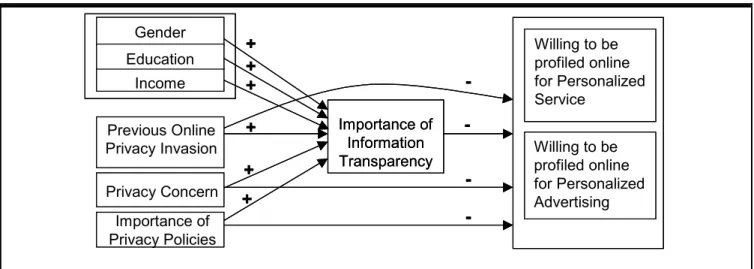
Figure 1. Research Model
Despite acknowledged theoretical weaknesses, previous research suggests that while consumers do not compute an exact cost-benefit analysis for each information exchange, they do weigh the involved tradeoff. This tradeoff has been directly studied offline as the
privacy calculus, which measures the usage of personal information against the potential negative consequences of disseminating personal information (Laufer and Wolfe 1977; Milne and Gordon 1993; Stone and Stone 1990). Our study examines this specific trade-off that consumers make in the online setting as we draw upon utility maximization theory to examine this apparent tradeoff. The consumer’s utility function is the following:
U(X) = Benefit -Cost (1)
where Benefit is derived through the degree of personalization received and Cost is a function of consumer privacy concerns, previous privacy invasion experience, and consumer-rated impor-tance of information transparency and privacy policies. Thus, we propose an implicit cost function as follows:
Cost = f (consumer privacy concern, previous privacy invasion, consumer-rated importance of information transparency, consumer-rated importance of privacy
policies) (2)
We control for consumer demographics, including income, education, and gender, when testing this model as it is likely that the effects positing in the model may vary with certain demographic variables. Thus, overall the net utility is based on the individual elements of the cost function.
This study focuses on whether information transparency features have an effect on consumer willingness to be profiled online. The overall research model for this paper is illustrated in Figure 1.
Hypotheses
Information Transparency
We examine the value of information transparency to consumers in two stages. First, we examine the degree to which consumer demographics, as well as the experience of previous online privacy invasions, shapes consumer-rated importance of information transparency. In the second stage, we examine the aforementioned effect of information transparency on consumer willingness to partake in online profiling. For the first stage, we expect consumer privacy concern and previous privacy invasions to be associated with a greater value of data transparency and control, and therefore a higher consumer-perceived value of information transparency. Thus, we hypothesize that consumer privacy concern and previous privacy invasions are associated with an increase in consumer-rated importance of information transparency.
Hypothesis 1a: Consumer-rated importance of informa-tion transparency increases with increased general con-sumer privacy concern level.
Hypothesis 1b: Consumer-rated importance of informa-tion transparency increases with consumers whom have previously had their privacy invaded online.
Westin (1991) found that a portion of the consumer population can be classified as privacy fundamentalists. These privacy fundamen-talists are extremely concerned about any use of their data and generally unwilling to provide their data to Web sites, even when privacy protection measures were in place. Cranor et al. (1999) found that privacy fundamentalists were twice as likely as other consumers to report having been a victim of an invasion of privacy on the Internet, and were also less willing to answer a survey question about their household income. It is our expectation that
these privacy fundamentalists have a high value for information transparency features, and simultaneously rate their willingness to partake in online personalization as very low. Thus, we hypothesize that consumers who rate the importance of information transparency features higher are more wary of sharing personal information, and will be less willing to participate in online personalization.
Hypothesis 2: Consumers who rate information trans-parency as important are more wary of sharing personal information and therefore less willing to participate in online profiling.
Privacy Policy
Firms attempt to address consumer concerns regarding online profiling by posting their privacy policy online. Privacy policies are written statements, usually posted on a firm’s Web site and presented during user registration, which explain information practices regarding the collection and usage of information. While a privacy policy is an aggregated written statement of the information practices, information transparency allows consumers to access their data as well as the firm’s use of such data. Since we are focusing on the consumer perspective in this paper, privacy policies and information transparency features are not substitutes. Prior literature has shown that consumers who express concern over their own privacy perceive little control over the use of their personal information (Stone et al. 1983). It follows that consumers who value the privacy policies of firms are likely more concerned about information transparency features as well.
We examine the degree to which consumer-rated importance of privacy policy is associated with consumer-rated importance of information transparency features. We expect that consumers who value the aggregate view presented in the privacy policy will also be more likely to value more specific details about the information and usage practices of the firm, accessed through information trans-parency features. We hypothesize the correlation in the direction of general to more specific, where privacy policies provide an overall view, and information transparency features provide more specific information. Thus, we hypothesize that consumer-rated importance of a privacy policy will be associated with the rated importance of information transparency.
Hypothesis 3: Consumer-rated importance of information transparency increases with increased consumer-rated importance of the existence of a firm’s privacy policy.
In the second stage of our model, we examine the importance of a privacy policy on consumer willingness to partake in online profiling. Consumers who value firm privacy policies are likely more wary of sharing their personal information with firms than consumers who do not. Thus, increased consumer-rated importance of privacy policies is likely associated with a decrease in consumer willingness to participate in online profiling.
Hypothesis 4: Consumers who rate the existence of a firm’s privacy policy as important, are more wary of sharing their information online, and are therefore less willing to partake in online profiling.
Consumer Privacy Concern
Consumer concerns are affecting Internet commerce. A 1997 study revealed that purchases via the Internet would receive a $6 billion boost by the year 2000 if consumers believed their privacy wasn’t at stake during such transactions (Greene 1997). From a theoretical standpoint, personal values, such as privacy concerns, affect the value a consumer associates with the outcome of personalization. Consumers with a higher level of privacy concern will likely perceive personalization offerings to be of less value than consumers with a lower level of privacy concern. We test this finding that users who express concern over their own privacy are likely less willing to share such information (Stone et al. 1983) in the online setting and, specifically, in accordance with utility maximization theory. Thus, we hypothesize that greater privacy concern is associated with less willingness to be profiled online.
Hypothesis 5: Consumer willingness to partake in online profiling decreases with a higher level of general privacy concern.
Previous Privacy Invasion
Personal experiences guide behavior in activities that can be subjectively deemed as privacy-related (Bates 1964). In addition, personal experiences cause a change in privacy concern over an individual’s lifetime (Harris 1991). In this paper, we examine previous privacy invasion experience. Online privacy invasion can range from unsolicited e-mail spam to identity theft. Consumers who have previously had their privacy invaded may not place much value on the expected outcome of useful personalization. This decreased value of personalization may result in a decreased willing-ness to partake in online profiling.
The role of past experience has been previously analyzed offline in two different formats, with mixed results. In one instance, con-sumers were asked if they had “experienced a previous invasion of privacy” (Culnan 1993). In a second instance, consumers were asked if they had previously dealt with the firm. In the first instance, prior privacy invasion experience was not shown to have a clear association with attitudes toward secondary information use offline. However, previous privacy invasion experience could affect an individual’s concern for privacy (Culnan 1993). In the second instance, prior firm experience distinguished those willing to store information in a customer profile and those who were unwilling to do so offline (Culnan and Armstrong 1999). In our research, we look at the former, prior privacy invasion experience, where previous results have not been conclusive. Previous research did not
find a significant association between previous privacy invasion experience and attitude toward secondary information use (Culnan and Armstrong 1999). However, we are attempting to assess the effect of previous privacy invasion experience in an online context, rather than the direct mail context. Therefore, we expect previous online privacy invasion experience to have a significant effect on the willingness to partake in online personalization. Thus, we hypothesize that previous privacy invasions are associated with a decreased consumer willingness to be profiled online.
Hypothesis 6: Consumer willingness to partake in online profiling decreases with those consumers who have previously had their privacy invaded.
Personalized Service and
Personalized Advertising
Previous research has shown that firms can improve the perceived value of services offered by mitigating a customer’s perceived risk (Heskett et al. 1990). The perceived benefit of an outcome, such as useful personalization, can motivate consumers to partake in online profiling despite privacy concerns. On the other hand, the perceived risk associated with an outcome can decrease the willingness to partake in online personalization. In this study, we examine two separate contexts with potentially two levels of benefit: personalized advertising and personalized service. We expect consumers to place different values on the two outcome contexts due to varying levels of perceived benefit from the activities. Such a difference in each outcome’s utility value to the consumer should, therefore, affect consumer willingness to share information. Note that while the costs associated with the consumer decision remain the same, the benefit is different. Through examining two service types of personalization, we aim to test how differing utilities, and consequently different benefits, are associated with a consumer’s decision to partake in online personalization.
Research Methodology
The context for this research is the use of personal information gathered through Web sites and user willingness to allow online collection and use of personal information by firms. The study is based on a fresh analysis of data from a survey conducted at a large Internet service provider during the summer and fall of 1998. The survey focuses on issues of personal information collection through specific online scenarios as well as general attitudes and user demographics. The survey was designed to focus on the way people respond to situations when personal information is collected online. In a pre-study, variance across participants in information sharing habits was best revealed through questions based on specific online scenarios (Cranor et al. 1999). Thus, specific purchasing scenarios, focusing on information goods and financial services, were utilized. The survey also aimed at determining participants’ general attitudes
and demographics. Attitude and demographic questions were taken from other studies, such as Westin (1997). For all constructs of this study, explicit questions were used as a mechanism for deriving information from the participants.
The survey was developed and pretested on nontechnical employees and summer students of the service provider, as well as with two classes at Harvard and Massachusetts Institute of Technology. Prospective survey participants were selected from the Digital Research, Inc. (DRI) Family Panel. The DRI Family Panel is a group of random Internet users that participate in product evaluations and survey responses for Family PC magazine. Approximately one-third of the panel members are Family PC
subscribers; most of the panel members who are not subscribers joined the panel after visiting the Family PC Web site. Invitations to complete the Web-based survey were e-mailed to 1,500 Family Panel members (selected randomly). This request resulted in 523 completed surveys in November of 1998—a response rate of 35 percent. Code numbers were used to ensure that each respondent completed only one survey; a sweepstakes was also offered as an incentive to participate.
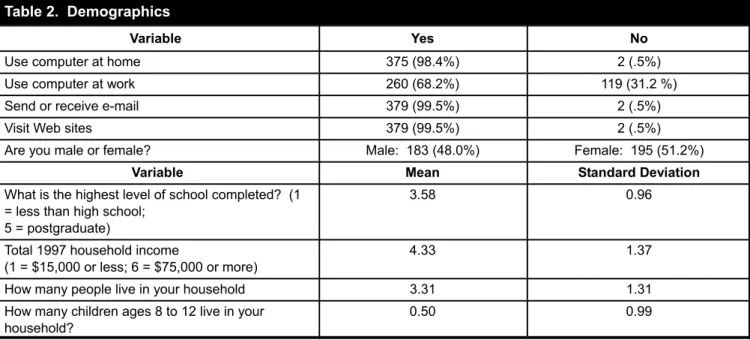
Similar to recent work on information privacy (Harris and Westin 1998; Stewart and Segars 2002), the sample differed from a nationally representative sample in education, Internet usage, and household income. All three of these categories were higher than the national average. Having a more educated population that is familiar with the Internet may imply that the overall sample is actually less worried about information misuse on the Internet than a national sample (Klobas and Clyde 2000). However, the population is also wealthier than the national average, which may indicate that they have more to lose financially should they experience identity theft. Summary demographic information is shown in Table 2.
All items selected for use in this study were chosen from a larger, more general questionnaire. Most of the items used were single questionnaire items. For example, a single item—whether a person would be willing to participate in online profiling for online personalized service—was used to measure a consumer’s willing-ness to be profiled for personalized service. We note this as a limitation of our study and suggest that future research could confirm the findings of this study with multi-item constructs. The item selection was based on the attitude the construct was attempting to assess. There were two constructs where multiple items were selected, namely privacy concern and information transparency. The items that comprised these constructs were factor analyzed, as explained below.
Construct Operationalization
The existing literature was examined to identify appropriate factors for consumers deciding to share their information online. In addition, exploratory interviews with online consumers were con-ducted. The consumers confirmed that the factors being examined
Table 2. Demographics
Variable Yes No
Use computer at home 375 (98.4%) 2 (.5%)
Use computer at work 260 (68.2%) 119 (31.2 %)
Send or receive e-mail 379 (99.5%) 2 (.5%)
Visit Web sites 379 (99.5%) 2 (.5%)
Are you male or female? Male: 183 (48.0%) Female: 195 (51.2%)
Variable Mean Standard Deviation
What is the highest level of school completed? (1 = less than high school;
5 = postgraduate)
3.58 0.96
Total 1997 household income
(1 = $15,000 or less; 6 = $75,000 or more)
4.33 1.37
How many people live in your household 3.31 1.31
How many children ages 8 to 12 live in your household?
0.50 0.99
did capture elements of the decision to share information online. Through this process, a set of 13 items, representing 4 different consumer decision factors, were selected. A total sample of 401 consumer responses was examined.
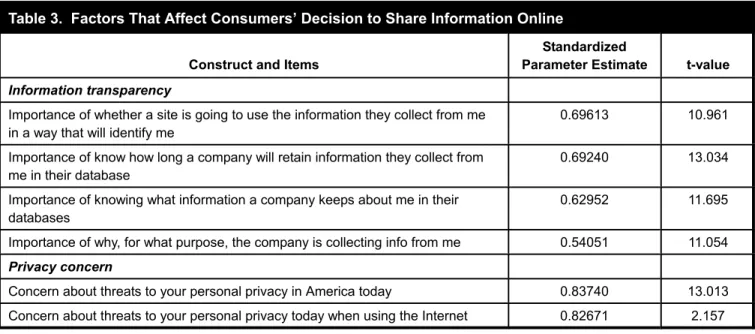
Confirmatory factor analysis was used to verify that our operational items captured the specific dimensions of the tradeoffs involved in consumer information sharing online. The three measurement properties considered minimally important for demonstrating validity of operational items are unidimensionality, construct reliability, and discriminant validity (Bagozzi 1980). The initial model structure had poor model fit. Thus, items with low loadings (less than 0.50) (Rivard and Huff 1988) were removed from the model. The final 10-item model, comprising 6 factors affecting consumers’ decision to share information online, is shown in Table 3. The indices of model fit illustrate the unidimensional validity of the items. All of the individual item loadings are high and significant. While the root mean squared error of approximation (RMSEA) should ideally be less than 0.05, a RMSEA that is less than 0.08 is practical evidence of good model fit (Browne and Cudeck 1993, p. 144). We acknowledge that our model fit is on the margin, as the RMSEA is 0.08, and we therefore examine other fit indices as well. The probability value for the model’s chi-square statistic should not exceed a standard cutoff of 0.05 (Bentler 1989, p. 37). In addition, another fit index that is commonly used is the goodness of fit index (GFI); values greater than 0.90 are considered good model fit (Bentler 1989).
Reliability of the factors exceeded the accepted threshold of 0.70 (Nunally 1967). The reliability of each factor was 0.87 for privacy concern and 0.75 for information transparency.
Variable Definitions
Consumer willingness to be profiled: To measure consumer willingness to be profiled for personalized service and personalized advertising, two dependent variables were used. These variables, measured via a five-point Likert sale, are (1) consumer willingness to be profiled by a familiar site for personalized service (PSERV) and (2) consumer willingness to be profiled by a familiar site for
personalized advertising (PADV). (All instrument question details can be found in Appendix A.)
Information transparency: Knowledge is a core element of perceived control. The link between knowledge and control has been studied in other information systems contexts, such as systems development (Kirsch 1996). Thus, one would expect that consumers who desire greater information transparency are really striving for greater control. We use the information transparency variable to measure consumer-rated importance of information transparency features. The information transparency variable was measured using four 3-point Likert-scaled items. All four items loaded unam-biguously on a single factor and were combined to form the information transparency (INFO_TRANS) construct (Cronbach’s alpha = 0.75). The items in the information transparency construct include (1) consumer-rated importance of whether a company gives consumers access to what information they keep about the consumer in their database, (2) consumer-rated importance of whether a site allows the consumer to determine the length of time that collected information will be retained, (3) consumer-rated importance of whether the site shows the consumer the purpose for which the site collects the information, and (4) consumer-rated importance of whether a site plans to use collected information in a manner that will identify the consumer.
Table 3. Factors That Affect Consumers’ Decision to Share Information Online Construct and Items
Standardized
Parameter Estimate t-value
Information transparency
Importance of whether a site is going to use the information they collect from me in a way that will identify me
0.69613 10.961 Importance of know how long a company will retain information they collect from
me in their database
0.69240 13.034 Importance of knowing what information a company keeps about me in their
databases
0.62952 11.695 Importance of why, for what purpose, the company is collecting info from me 0.54051 11.054
Privacy concern
Concern about threats to your personal privacy in America today 0.83740 13.013 Concern about threats to your personal privacy today when using the Internet 0.82671 2.157 Notes: Model fit indices:
Goodness of fit (P2) with 45 degree of freedom = 336.86 (p = 0.00)
Root Mean square error of approximation (RMSEA) = 0.08 Goodness of fit index (GFI) = 0.925
Privacy policy: The variable, importance of privacy policy (PRIV_POL), aims at providing a contrast to the information transparency independent variable. It is possible that consumers have no interest in knowing the details of what information is being stored and how it is used; rather, they may only be interested in knowing that the company has a privacy policy. Thus, we control for the importance of such a privacy policy through the use of a single three-point Likert-scaled item.
Prior research has shown that demographic variables are associated with an individual’s privacy concern. For example, Culnan (1995) found that demographics, direct marketing experience, and privacy concern were significantly associated with individual knowledge regarding information removal procedures. However, prior research also suggests that such demographic differences are captured by both attitudinal and behavioral variables (Azjen and Fishbein 1980). For this reason, we control for the demographic variables privacy concern and previous privacy invasion2 when examining consumer
willingness to partake in personalized service and personalized ad-vertising. However, in examining consumer importance of information transparency as a dependent variable, we control for gender, education, and income. These variables are controlled for to determine which factors affect consumer disposition toward information transparency. The consumer concern over information transparency is then used as an independent variable in examining the willingness to share information online.
Previous privacy invasion: An individual’s previous experience can shape their concern in information sharing. As in previous work (Culnan 1995), privacy invasion experience was measured using one variable, namely, whether a participant believed his or her privacy had been previously invaded (PREV_INV). A total of 73 respondents (19.2 percent) reported being victimized by what seemed to be an invasion of their privacy online (compared with 21 percent from Culnan’s 1995 study and 23 percent from the 1991 Equifax survey).
Privacy concern: Concern for information privacy is a tested, multidimensional construct (Smith et al. 1996; Stewart and Segars 2002). However, due to the limitations in using secondary data, we elected instead to control for general privacy concerns, as previously done by Culnan (1993). Two 4-point Likert-scaled items measured privacy concern. Both items loaded unambiguously on a single factor and were combined with the use of factor scores as weights to form a general privacy concern (PRIV_CONC) scale (r = 0.59, p < 0.0000; Cronbach’s alpha = 0.87).
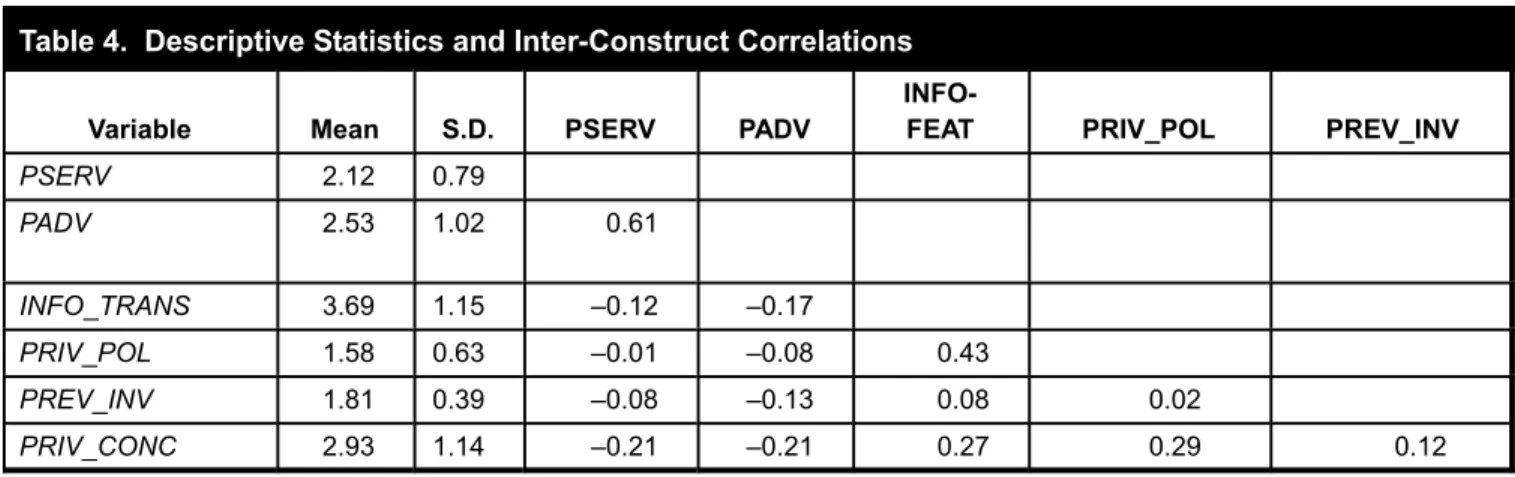
Table 4 contains correlations and descriptive statistics of the all variables (dependent and scaled independent variables).
Discriminant Validity
The correlation matrix for all items is presented in Table 5. We use the item-level correlation matrix to test the discriminant validity of information transparency and privacy concern constructs. Note that the correlations between items of the same constructs are significant
2We did run the model controlling for gender, education, and computer usage. The results of the variables of interest were unchanged, and the variables did not add much explanatory power to the models.
Table 4. Descriptive Statistics and Inter-Construct Correlations
Variable Mean S.D. PSERV PADV
INFO-FEAT PRIV_POL PREV_INV
PSERV 2.12 0.79
PADV 2.53 1.02 0.61
INFO_TRANS 3.69 1.15 –0.12 –0.17
PRIV_POL 1.58 0.63 –0.01 –0.08 0.43
PREV_INV 1.81 0.39 –0.08 –0.13 0.08 0.02
PRIV_CONC 2.93 1.14 –0.21 –0.21 0.27 0.29 0.12
Table 5. Descriptive Statistics and Inter-Item Correlations Variable
PRIV_ CONC1
PRIV_ CONC2
INFO_TR ANS1
INFO_TR ANS2
INFO_TR ANS3
INFO_ TRANS4
PREV_ INV
PRIV_ POL
PRIV_CONC1 1.0000
PRIV_CONC2 0.7823 1.0000
INFO_TRANS1 0.2263 0.1755 1.0000
INFO_TRANS2 0.2722 0.2453 0.4671 1.0000
INFO_TRANS3 0.0521 0.0678 0.4324 0.3985 1.0000
INFO_TRANS4 0.2450 0.2190 0.4732 0.4224 0.5629 1.0000
PREV_INV 0.1094 0.1007 0.0736 0.1046 0.0610 0.0257 1.0000
PRIV_POL 0.2596 0.2900 0.3368 0.3462 0.2762 0.3707 0.0253 1.0000
Table 6. SEM Results for Information Transparency
Variable INFO_TRANS
PRIV_POL 0.05*
PREV_INV 0.04
PRIV_CONC 0.03*
INCOME 0.04
EDUCATION 0.01
GENDER 0.03
Notes: Model Fit indices:
Goodness of fit (P2) with 29 degree of freedom = 137.04 (p
= 0.00)
Root mean square error of approximation (RMSEA) = 0.071 Goodness of fit index (GFI) = 0.938
Table 7. LISREL Results for Willingness to Partake in Online Personalized Service and Personalized Advertising
Variable PSERV PADV
INFO_TRANS –0.139* –0.07*
PRIV_POL –0.173 –0.141
PREV_INV –0.014 –0.048*
PRIV_CONC 0.554 0.007
Notes: Model fit indices:
Goodness of fit (P2) with 30 degree of freedom = 194.96 (p
= 0.00)
Root mean square error of approximation (RMSEA) = 0.089 Goodness of fit index (GFI) = 0.91
for a sample size of 532 responses. Using the item-level correlation matrix, discriminant validity is tested by counting the number of times each item correlates more highly with an item of another factor than with items of its own theoretical variable. It has been suggested that if the count is more than one-half the potential comparisons, then the discriminant validity is acceptable (Campbell and Fiske 1959). In our case, there are no major violations among the possible comparisons. The lowest correlation of the items within the information transparency construct is 0.3985; this correlation is higher than the highest across-construct correlation of information transparency with privacy policy (0.3707).
Results and Analysis
Hypothesis testing was conducted using a covariance fitting approach for estimating structural equation models (SEM). Polychoric correlations were estimated between the dichotomous item Previous privacy invasion and all other items. Table 6 illustrates the SEM results for the information transparency model.3
As predicted in hypotheses H1a and H1b, consumer privacy concern and consumer-rated importance of privacy policy are positively associated with consumer-rated importance of information transparency. Note that none of the demographic control variables are significant, suggesting that the demographic differences are captured in other attitudinal variables, as suggested by previous research (Azjen and Fishbein 1980). Another limitation of this study is that we do not have data on the quality of the firm’s privacy policy or of the quality of the firm’s features. Thus, while consumer-rated importance of online privacy policies and information transparency remain significant variables to examine, we recognize that there are limitations in the data set. The results of the second stage of the model, willingness to partake in online personalized service and personalized advertising, are shown in Table 7.4
As predicted in hypothesis H2, consumer-rated importance of information transparency is negative and significantly associated with willingness to be profiled online for models, personalized service, and personalized advertising. However, the demographic control variable of general online privacy concern (PRIV_CONC) is not significant for either model, thus H4 is not supported. The demographic variable of previous privacy invasion (PREV_INV) is not significant in the case of willingness to be profiled by a familiar
site for personalized service; it is, however, positive and significant in the case of willingness to be profiled by a familiar site for
personalized advertising. All of the significant parameter estimates are negative. For negative parameters, a larger negative magnitude suggests a greater likelihood for a decreased willingness to be profiled for personalized offerings.
Discussion
Academic Findings
Prior privacy invasion experience was significant only in the context of online advertising, not in the case of online service. Therefore, users with previous privacy invasion experience have a lower willingness to be profiled online for personalized advertising. However, such a result does not hold true with regard to online
service. In the context of utility maximization theory, this research shows that consumers do, indeed, assign a different value to the two outcomes. Thus, the difference in benefit values leads to a difference in significance of various elements of the utility function. Assuming consumers perceive the value of online service to be greater than online advertising, they will be more willing to partake in online personalization. Such greater utility of personalized ser-vice will make previous privacy invasion experience insignificant in the online service case, but significant in the online advertising case, as our results suggest.
Effective use of customer information is a critical success factor for firms online. The challenge for firms, then, becomes collecting and using information in such a way that consumers feel comfortable. This study examined, from the consumer perspective, whether information transparency features are associated with consumer willingness to take part in online profiling. The results suggest that firms are facing a paradox, as consumers who value information transparency features are also less likely to participate in per-sonalized offerings. We speculate that these results reveal that there is a segment of consumers, the privacy fundamentalists (Westin 1991), that are unwilling to participate in online personalization regardless of the privacy features implemented by the firm. Con-sequently, we suggest that firms concentrate their efforts on consumers that are more willing to partake in online personalization from the beginning.
In focusing on the more pragmatic majority of consumers, firms must be aware that consumers perceive different value levels in different outcomes. Our study tested the application of utility maximization theory and, indeed, consumers associate different outcomes with different utility levels. Personalized advertising is largely perceived as less beneficial (McLaughlin 2002) than person-alized service, and therefore previous privacy invasions came to bear for consumers. Prior work did not reveal a clear association between previous privacy invasion experience and attitudes toward secondary information use (Culnan 1993); therefore, this significant result in the case of online advertising is quite interesting. From a
3The model was also estimated using ordinary least squares. The model had significant explanatory power, as shown by the adjusted R2 value and is significant (Adj. R2 = 0.1732, Prob. > F =0.0000).
4The model was also estimated using an ordered probit model. The explanatory power of both the PSERV and PADV models, as shown by the log likelihood values, were significant (Log Likelihood = –430.845, Prob. >
P² = 0.0002, and Log Likelihood = –522.824, Prob. > P² = 0.0000, respectively).
managerial perspective, firms may attempt to offer value-added services to consumers, so that they will overlook previous negative experiences. In addition, it may be important for firms to commu-nicate the value of the personalization outcome to the consumers in order to encourage them to partake in online personalization.
Managerial Implications
Consumers that are concerned about having access to their information within company databases are less willing to share information. This result suggests that managers may need to focus on consumers who are intrinsically less privacy sensitive when offering online personalization. One way for managers to interpret this would be to assess privacy sensitive customers as a different segment, and provide customized service to customers who are more willing to partake in personalization from the outset. By attempting to provide value to consumers who are more willing to partake in personalization from the outset, firms are likely to increase consumer-perceived benefits of personalized service as well as personalized advertising. One caveat regarding our finding that consumers who perceived access to information as important are less willing to share information, is that this result may also be due to the timing of our data collection. Note that our data was collected at the infancy of the e-commerce era when firms were at the rudimentary stages of defining their transparency features and privacy policies. It is difficult to validate this line of argument with the current data available to us. We speculate that if high quality data transparency was provided to consumers in a secure environment with a clear privacy policy, these consumers may be persuaded to partake in personalization. So, managers may want to examine the quality of the data transparency features they provide, as well as the security of their online environment. A useful avenue for future research, therefore, may be to study the linkage between information trans-parency features and willingness to partake in personalization while controlling for the quality of transparency provided by firms and privacy policies.
While almost all online firms post a privacy policy, it is interesting to note that our study shows that such policies do not have significant value to consumers. Upon reflection, this result seems intuitive, as privacy policies largely go unread by consumers. In fact, according to Forrester Research, less than 1 percent of the visitors to six major online travel sites during April 2001 actually read privacy policies (Regan 2001). Thus, while consumers may rate a privacy policy as important, few of them actually take note of the policy when using a site. Thus, firms must consider the residual benefit of investing in their privacy policy beyond the regulated requirements.
In future research, we would like to contrast consumer perspectives with firm implementation levels. While our study was done completely from the consumer perspective, we are also interested in examining the interactions between consumer-rated importance of transparency and level of a firm’s investments in transparency. Future work will give further managerial insights as to which
information technology features add the most value to consumers, whether information transparency features are used, and to what degree the features are used.
Limitations
Like other empirical research, the results should be read within its inherent limitations. As described above, the study was based on secondary data analysis of a survey designed to measure opinions toward privacy and information sharing online. Note that all of the measures are subjective in nature and are prone to measurement errors that could affect the results of the analysis. Concern for information privacy is a tested, multidimensional construct (Smith et al. 1996; Stewart and Segars 2002). However, due to the limitations of the secondary data, we instead controlled for general privacy concerns, as previously done by Culnan (1993). Individual questionnaire items were designed to be unbiased. However, several items, such as previous privacy invasion, were measured using single questionnaire items.
We do not address trust as an independent construct explicitly. While trust is an important construct and has been modeled in prior privacy models, we focus on constructs surrounding data trans-parency and information policies, and their underlying relationship with trust. Another limitation of this study is the lack of data on the quality of the firm’s privacy policy; instead, we only determine whether such a policy exists. In addition, the sample has a slight bias in favor of more educated, affluent, and Internet-savvy individuals. Therefore, the results should be viewed with some caution. The strength of the research is that the data sample is consistent with other recent work regarding information privacy (e.g., Stewart and Segars 2002) and that the results are consistent with theory and enhance our understanding of a given paradox surrounding online personalization.
Conclusion
Personalized service is becoming increasingly valuable to consumers and firms (Awad and Krishnan 2002). However, investments in personalization may come at the cost of consumer privacy. Privacy has, therefore, become an issue of strategic importance for com-panies operating in the information-centric, networked global econ-omy. In order to provide consumer-driven personalized service, firms must target consumers who are willing to provide information.
In this paper, we further illuminated an existing dilemma regarding the application of online personalization; namely, that consumers who value information transparency features are less willing to be profiled online for personalized service and advertising. Thus, we suggest that firms invest their resources toward increasing perceived value for the consumers who are willing to partake in online personalization from the outset, as we also found that the perceived benefit of personalization affects the importance of previous privacy
invasion on that very willingness. In the case of personalized
service, where benefit is more apparent to consumers, previous privacy invasions are not significant, as the potential benefit of the service outweighs the potential risk of a privacy invasion. In the case of personalized advertising, on the other hand, the benefit is less apparent and the risk of an intrusion (i.e., e-mail spam) is more apparent. In such a case, previous privacy invasion is significant. Thus, companies must focus on reducing such perceived risk through implementing various online features.
In this study, we have provided results that managers can utilize to encourage consumer participation in online profiling for personalized service and advertising. Managers must realize that the perceived value provided to consumers can affect the degree to which their previous privacy issues come to bear. Firms must provide a benefit to offset the potential risk to consumers for sharing their information with the firm. Future research may examine, over time, the effectiveness of various information technology features for increasing consumer-perceived value of online personalization.
Acknowledgments
Financial support for this study was provided in part by the Michael R. and Mary Kay Hallman Fellowship, the Marcy Maguire Fellowship, the Information Systems Executive Forum at the University of Michigan Business School, and the Summer Research Opportunity Program at the University of Michigan.
References
Andrade, E. B., Kaltcheva, V., and Weitz, B. “Self-Disclosure on the Web: The Impact of Privacy Policy, Reward, and Company Reputation,” in Advances in Consumer Research (29), S. M. Broniarczyk and K. Nakamoto (Eds.), Association for Consumer Research, Valdosta, GA, 2002, pp. 350-353.
Armitage, C. J., and Conner, M. “The Theory of Planned Behavior: Assessment of Predictive Validity and ‘Perceived Control.’”
British Journal of Social Psychology (38:1), 1999, pp. 35-54. Awad, N. F., and Krishnan, M. S. “Price Dispersion and Online
Information: Quality or Quantity?,” University of Michigan Business School Working Paper, 2002.
Azjen, I. and Driver, B. L. “Prediction of Leisure Participation from Behavioral, Normative, and Control Beliefs: An Application of the Theory of Planned Behavior,” Leisure Sciences (13:3), 1991, pp. 185-204.
Azjen, I., and Fishbein, M. Understanding Attitudes and Predicting Social Behavior, Prentice-Hall, Englewood Cliffs, NJ, 1980. Bagozzi, R. P. Causal Models in Marketing, John Wiley & Sons,
New York, 1980.
Barwise, P., and Strong, C. “Permission-Based Mobile Adver-tising,” Journal of Interactive Marketing (16:1), 2002, pp. 14-24. Bates, A. P. “Privacy, A Useful Concept?,” Social Forces (42:4),
1964, pp. 430-434.
Bentler, P. M. EQS: Structural Equations Program Manual, BMDP Statistical Software, Inc., Los Angeles, 1989.
Blau, P. Exchange and Power in Social Life, John Wiley & Sons, Inc., New York, 1964.
Browne, M. W., and Cudeck, R. “Alternative Ways of Assessing Model Fit,” in Testing Structural Equation Models, J. S. Long and K. A. Bollen (Eds.), Sage Publications, Newbury Park, CA, 1993, pp. 136-162.
Campbell, D., and Fiske, D. “Convergent and Discriminant Validity by the Multitrait-Multimethod Matrix,” Psychological Bulletin
(56:2), 1959, pp. 81-105.
Chellappa, R. K., and Sin, R. “Personalization versus Privacy: An Empirical Examination of the Online Consumer’s Dilemma,”
Information Technology and Management (6:2/3), 2005, pp. 181-202.
Cranor, L. F., Reagle, J., and Ackerman, M. S. “Beyond Concern: Understanding Net Users’ Attitudes about Online Privacy,”
AT&T Labs Research Technical Report TR 99.4.3, 1999. Culnan, M. J. “How Did They Get My Name? An Exploratory
Investigation of Consumer Attitudes Toward Secondary Information Use,” MIS Quarterly (17:3), 1993, pp. 341-363. Culnan, M. J. “Consumer Awareness of Name Removal
Pro-cedures: Implications for Direct Marketing,” Journal of Direct Marketing (9:2), 1995, pp. 10-19.
Culnan, M. J., and, Armstrong, P. K. “Information Privacy Con-cerns, Procedural Fairness, and Impersonal Trust: An Empirical Investigation,” Organization Science (10:1), 1999, pp. 104-115. Dinev, T., and, Hart, P. “Internet Privacy Concerns and Trade-Off Factors: Empirical Study and Business Implications,” Working Paper, Florida Atlantic University, 2002.
Equifax. “Harris-Equifax Consumer Privacy Survey,” Equifax, Inc,
Atlanta, GA, 1991.
Equifax. “Harris-Equifax Consumer Privacy Survey,” Equifax, Inc,
Atlanta, GA, 1996.
Goodwin, C. “Privacy: Recognition of a Consumer Right,” Journal of Public Policy Management (10:1), 1991, pp. 149-166. Greene, M. “Who’s Zoomin’ Who on the Web?,” Black Enterprise
(28:3), October 1997, pp. 40-42.
Harris, L., and Associates, Inc. Harris-Equifax Consumer Privacy Survey, 1992, Equifax, Inc., Atlanta, GA, 1991.
Harris, L., and Westin, A. F. E-commerce and Privacy: What Net Users Want, Privacy and American Business, Hackensack, NJ, 1998.
Heskett, J. L., Sasser, W. E., and Hart, C. W. L. Service Break-throughs: Changing the Rules of the Game, The Free Press, New York, 1990.
Hoffman, D., Novak, T., and Peralta, M. A. “Information Privacy in the Market-Space: Implications for the Commercial Use of Anonymity on the Web,” Information Society (15:4), 1999, pp. 129-139.
Kirsch, L. J. “The Management of Complex Tasks in Organi-zations: Controlling the Systems Development Process,” Organi-zation Science (7:1), 1996, pp. 1-21.
Klobas, J. E., and Clyde, L. A. “Adults Learning to Use the Internet: A Longitudinal Study of Attitudes and Other Factors Associated with Intended Internet Use,” Library and Information Science Research (22:1), 2000, pp. 5-34.
Laufer, R. S., Proshansky, H. M., and Wolfe, M. “Some Analytic Dimensions of Privacy,” in Environmental Psychology: People and Their Physical Settings (2nd ed.), H. M. Proshansky W. G.
Ittelson, and L. G. Rivlin (Eds.), Holt, Rinehart, and Winston, New York, 1976, pp. 206-217.
Laufer, R. S., and Wolfe, M. “Privacy as a Concept and a Social Issue: A Multidimensional Development Theory,” Journal of Social Issues (33:3), 1977, pp. 22-42.
Mason, R. O. “Four Ethical Issues of the Information Age,” MIS Quarterly (10:1), 1986, pp. 4-12.
McKnight, D. H., Cummings, L. L, and Chervany, N. L. “Initial Trust Formation in New Organizational Relationships,” Academy of Management Review (23:3), 1998, pp. 473-490.
McLaughlin, L. “The Straight Story on Search Engines,” PC World, July 2002, p. 115 (available online at http://www.pcworld.com/ news/article/0,aid,97431,00.asp).
Milberg, S. J., Smith, H. J., and Burke, S. J. “Information Privacy: Corporate Management and National Regulation,” Organization Science (11:1), 2000, pp. 35-57.
Milne, G. R. “Privacy and Ethical Issues in Database/ Interactive Marketing and Public Policy: A Research Framework and Overview of the Special Issue,” Journal of Public Policy and Marketing (19:1), 1993, pp. 1-6.
Milne, G. R., and Gordon, M. E. “Direct Mail Privacy-Efficiency Trade-Offs Within an Implied Social Contract Framework,”
Journal of Public Policy and Marketing (12:2), 1993, pp. 206-215.
Milne, G. R., and Rohm, A. J. “Consumer Privacy and Name Removal Across Direct Marketing Channels: Exploring Opt-In and Opt-Out Alternatives,” Journal of Public Policy and Marketing (19:2), 2000, pp. 238-249.
Morgan, R. M., and Hunt, S. D. “The Commitment-Trust Theory of Relationship Marketing,” Journal of Marketing (58:3), July 1994, pp. 20-39.
Nunnally, J. Psychometric Theory, McGraw-Hill Book Company, New York, 1967.
Phelps, J., Nowak, G., and Ferrell, E. “Privacy Concerns and Consumer Willingness to Provide Personal Information,” Journal of Public Policy and Marketing (19:1), 2000, pp. 27-41. Regan, K. “Does Anyone Read Online Privacy Policies?,”
www.EcommerceTimes.com, June 2001 (available online at http://www.ecommercetimes.com/perl/story/11303.html). Rivard, S., and Huff, S. “Factors of Success for End User
Com-puting,” Communications of the ACM (31:5), May 1988, pp. 552-561.
Rust, R. T., Kannan, P. K., and Peng, N. “The Customer Economics of Internet Privacy,” Journal of the Academy of Marketing Science (30:4), 2002, pp. 455-464.
Safire, W. “The Intrusion Explosion,” The New York Times, May 2, 2002.
Schoenbachler, D. D., and Gordon, G. L. “Trust and Customer Willingness to Provide Information in Database-Driven Rela-tionship Marketing,” Journal of Interactive Marketing (16:3), 2002, pp. 2-16.
Smith, H. J. Managing Privacy: Information Technology and Corporate America, University of North Carolina Press, Chapel Hill, NC, 1994.
Smith, H. J., Milberg, S. J., and Burke, S. J. “Information Privacy: Measuring Individuals’ Concerns about Organizational Prac-tices,” MIS Quarterly (20:2), 1996, pp. 167-196.
Stewart, K. A., and Segars, A. H. “An Empirical Examination of the Concern for Information Privacy Instrument,” Information Systems Research (13:1), 2002, pp. 36-49.
Stone, E. F., Gardner, D. G., Gueutal, H.G., and McClure, S. “A Field Experiment Comparing Information-Privacy Values, Beliefs, and Attitudes Across Several Types of Organizations,”
Journal of Applied Psychology (68:3), 1983, pp. 459-468. Stone, E. F., and Stone, D. L. “Privacy in Organizations:
Theo-retical Issues, Research Findings, and Protection Mechanisms,” in Research Findings in Personnel and Human Resources Management, K. M. Rowland and G. R. Ferris (Eds.), JAI Press, Greenwich, CT, 1990, pp. 349-411.
Tezinde, T., Smith, B., and Murphy, J. “Getting Permission: Exploring Factors Affecting Permission Marketing,” Journal of Interactive Marketing (16:4), 2002, pp. 28-36.
Weill, P., and Vitali, M. Place to Space, Harvard Business School Press, Boston, 2001.
Westin, A. F. Commerce, Communication, and Privacy Online, Center for Social and Legal Research, Hackensack, NJ, 1997. Westin, A. F. “Domestic and International Data Protection Issues,”
How the American Public Vies Consumer Privacy Issues in the Early 90s—and Why, testimony before the Subcommittee on Government Information and Agriculture, Committee on Govern-ment Relations, U.S. House of Representatives, Washington, D.C., U.S. Government Printing Office, 1991, pp. 54-68. Westin, A. F. Privacy and Freedom, Athenaeum, New York, 1967. Wortman, C. “Some Determinants of Perceived Control,” Journal of Personality and Social Psychology (31:2), 1975, pp. 282-294.
About the Authors
Neveen F. Awad is an assistant professor of Information Systems at Wayne State University. Her research interests include business value of online information technology investments, managing the online customer experience, online advertising and search, econo-mics of privacy, online word of mouth, IT outsourcing, and pro-ductivity effects of unwanted software. Neveen received the Marcy Maguire Fellowship, awarded to a female Ph.D.student whose research carries the greatest potential business impact.
M. S. Krishnan is Area Chair and professor of Business Information Technology at the University of Michigan Business School. He is also a Michael R. and Mary Kay Hallman e-Business Fellow. His research interest include corporate IT strategy, chal-lenges in achieving business value from IT investments, and cus-tomer satisfaction for products in software and information tech-nology industries. Krishnan received the ICIS Best Dissertation Prize for his doctoral thesis, Cost and Quality Considerations in Software Product Management. In January 2000, the American Society for Quality selected him as one of the 21 voices of quality for the 21st century. He serves on the editorial boards of academic
journals including Management Science and Information Systems Research.