Foreword
The United States Department of Agriculture (USDA) and the United States Department of Energy (DOE) both place high importance on developing resources and conversion technologies for producing fuels, chemicals and power from biomass. The two departments are working together on several aspects of bioenergy. This report is the third to be produced from joint collaboration. This and other reports can be found at: http://www.eere.energy.gov/biomass/publications.html. The website for biomass feedstock research sponsored by the DOE’s Office of Energy Efficiency and Renewable Energy Office of the Biomass Program (OBP) can be found at: http:// bioenergy.ornl.gov/. More general information about OBP’s feedstock research program can be found at:
http://www.eere.energy.gov/biomass/ biomass_feedstocks.html.
The website for research and development sponsored by the USDA Forest Service can be found at: http://www.fs.fed.us/ research/.
The website for bioenergy research sponsored by the USDA Agricultural Research Service can be found at: http:// www.ars.usda.gov/research/programs/
programs.htm?NP_CODE=307.
Acknowledgements
The authors would like to acknowledge the support of the Office of the Biomass Program and in particular, John Ferrell and Sam Tagore.
The authors gratefully acknowledge the valuable contributions of Robert Guida, Rajita Majumdar, Borys Mararytsya, and Adam McCann of BCS, Incorporated in the review of the final draft and preparation of the print copy.
Notice
This report was prepared as an account of work sponsored by an agency of the United States government. Neither the United States government nor any agency thereof, or any of their employees, makes any warranty, express or implied, or assumes any legal liability or responsibility for the accuracy, completeness, or usefulness of any information, apparatus, product, or process disclosed, or represents that its use would not infringe privately owned rights. Reference herein to any specific commercial product, process, or service by trade name, trademark, manufacturer, or otherwise does not necessarily constitute or imply its endorsement,
recommendation, or favoring by the United States government or any agency thereof. The views and opinions of authors expressed herein do not necessarily state or reflect those of the United States government or any agency thereof.
Available electronically at: http://www.osti.gov/bridge
Available for a processing fee to U.S. Department of Energy and its contractors, in paper, from:
U.S. Department of Energy
Office of Scientific and Technical Information P.O. Box 62
Oak Ridge, TN 37831-0062 phone: 865.576.8401 fax: 865.576.5728
email: [email protected]
Available for sale to the public, in paper, from: U.S. Department of Commerce
National Technical Information Service 5285 Port Royal Road
Springfield, VA 22161 phone: 800.553.6847 fax: 703.605.6900
email: [email protected]
BIOMASS AS FEEDSTOCK FOR
A BIOENERGY AND BIOPRODUCTS INDUSTRY:
THE TECHNICAL FEASIBILITY OF A BILLION-TON
ANNUAL SUPPLY
Robert D. Perlack Lynn L. Wright Anthony F. Turhollow
Robin L. Graham
Environmental Sciences Division Oak Ridge National Laboratory
Bryce J. Stokes
Forest Service
U.S. Department of Agriculture
Donald C. Erbach
Agricultural Research Service U.S. Department of Agriculture
A Joint Study Sponsored by U.S. Department of Energy U.S. Department of Agriculture
Prepared by:
Oak Ridge National Laboratory P.O. Box 2008
Oak Ridge, Tennessee 37831-6285
Managed by:
UT-Battelle, LLC for the
U.S. Department of Energy under contract DE-AC05-00OR22725
DOE/GO-102005-2135 ORNL/TM-2005/66
Contributors
Howard Brown
Biomass Program Communications
National Renewable Energy Laboratory Golden, CO
Marilyn A. Buford National Program Leader
USDA Forest Service Washington, DC
Frederick J. Deneke Coordinator
USDA Forest Service Cooperative Forestry Washington, DC Achim Dobermann Project Leader
Department of Agronomy and Horticulture University of Nebraska
Lincoln, NE
James L. Easterly P.E. Principal
Easterly Consulting Fairfax, VA
Thomas Foust
Biomass Program Technology Manager
National Renewable Energy Laboratory Golden, CO
Dennis M. May Program Manager
USDA Forest Service
North Central Research Station St. Paul, MN
David B. McKeever Research Forester
USDA Forest Service Forest Products Laboratory Madison, WI
James E. McMurtrey III Research Agronomist (retired) USDA, Agricultural Research Service Hydrology and Remote Sensing Lab Beltsville, MD
Patrick D. Miles Research Forester
USDA Forest Service
North Central Research Station St. Paul, MN
John R. Mills Research Forester
USDA Forest Service
Pacific Northwest Research Station Portland, OR
Ralph Overend Research Fellow
National Renewable Energy Laboratory Golden, CO
Michael Pacheco
Director, National Bioenergy Center National Renewable Energy Laboratory Golden, CO
Robert B. Rummer Project Leader
USDA Forest Service Southern Research Station Auburn, AL
Hosein Shapouri Agricultural Economist
Office of Energy Policy and New Uses USDA Office of the Chief Economist Washington, DC
Kenneth E. Skog Project Leader
USDA Forest Service Forest Products Laboratory Madison, WI
Shahab Sokhansanj
Biomass Supply Systems Logistics Environmental Sciences Division Oak Ridge National Laboratory Oak Ridge, TN
Marie Walsh
Adjunct Associate Professor Bio-Based Energy Analysis Group University of Tennessee
Executive Summary ... i
1. Introduction ... 1
2. The Biomass Feedstock Resource Base ... 3
2.1 Land Resource for Biomass Production ...3
2.2 Biomass Feedstock Consumption ...3
2.3 Composition of the Current Resource Base ...3
3. Forest-Derived Biomass Resource Assessment ... 5
3.1 Forestland Resource Base ...5
3.2 Forest Resources ...6
3.3 Increasing Biomass Resources from Forests ...9
3.3.1 Logging Residues and Other Removals from the Forest Inventory ...9
3.3.2 Forest Residues from Fuel Treatment Thinning ...9
3.3.3 Forest Products Industry Processing Residues ... 14
3.3.4 Urban Wood Residues ... 15
3.3.5 Forest Growth and Increase in the Demand for Forest Products ... 16
3.4 Forest Resources Summary ... 16
4. Agriculture-Derived Biomass Resources ... 18
4.1 Agricultural Land Resource Base ... 18
4.2 Agricultural Resources ... 19
4.3 Evaluating the Biomass Potential of Agriculture ... 21
4.3.1 Scenario 1: Current Sustainable Availability of Biomass from Agricultural Lands ... 21
4.3.2 Scenario 2: Technology Change with Conventional Crops Only (No Land Use Change) ... 22
4.3.3 Scenario 3: Technology Change with Perennial Crops and Land Use Change ... 23
4.4 Factors Increasing Biomass Resources from Agriculture ... 24
4.4.1 Crop Yields ... 24
4.4.2 Residue-to-Grain or -Seed Ratios ... 25
4.4.3 Residue Collection Technology for Annual Crops ... 26
4.4.4 Cropland Tillage ... 27
4.4.5 Allocation of Cropland Acres to Perennial Crops ... 28
4.4.6 Grain to Ethanol or Bioproducts and Soybeans to Biodiesel... 30
4.4.7 Secondary Processing and Other Residues ... 30
4.5 Agricultural Resources Summary ... 32
5. Potential Concerns and Impacts ... 34
5.1 Forest-Derived Biomass Resources ... 34
5.2 Agriculture-Derived Biomass Resources ... 36
6. Summarized Findings ... 38
References ... 39
Glossary ... 44
Appendix A: Forest Resource Analysis ... 48
Figure 1. Annual biomass resource potential from forest and agricultural resources ...2
Figure 2. Summary of biomass resource consumption ...3
Figure 3. The biomass resource base ...4
Figure 4. Ownership break-up of U.S. forestland by region ...5
Figure 5. Projections of timber removals, growth, and inventory ...6
Figure 6. Total timberland biomass and forest residue inventory ...8
Figure 7. Estimate of the sustainably recoverable forest biomass ...8
Figure 8. Forest utilization relationships ... 10
Figure 9. Logging and other removal residues ... 10
Figure 10. Fire suppression cost and acres burned ... 11
Figure 11. Total treatable biomass resource on timberlands and other forestlands ... 12
Figure 12. Fuel treatments on timberland and other forestland ... 13
Figure 13. Summary of potentially available forest resources ... 16
Figure 14. Summary of cropland uses, idle cropland, and cropland pasture in the contiguous United States ... 18
Figure 15. Harvested acres of oats and soybeans, 1900–2000 ... 19
Figure 16. Agricultural productivity, 1948–1996 ... 20
Figure 17. Current availability of biomass from agricultural lands ... 21
Figure 18. Availability of biomass under increased crop yields and technology changes ... 22
Figure 19. Availability of biomass under increased crop yields, technology changes, and inclusion of perennial crops ... 23
Figure 20. Average corn yields, 1900–1999 ... 24
Figure 21. Breeding of new giant soybean cultivars for forage production ... 26
Figure 22. Soybean residues from large biomass (top) and conventional soybeans (bottom) ... 26
Figure 23. Crops under no-till cultivation ... 27
Figure 24. Summary of the allocation of agricultural land under alternative scenarios ... 29
Figure 25. Summary of potentially available agricultural resources ... 32
Figure 26. Summary of potential forest and agricultural resources ... 35
Table A.1. Current availability of logging residue and other removals ... 48
Table A.2 Availability factors for logging residue and other removals under current recovery conditions ... 48
Table A.3 Availability of logging residue and other removals under current recovery conditions ... 49
Table A.4 Availability of logging residue and other removals under future growth and recovery conditions ... 49
Table A.5 Total fuel treatment thinnings resource ... 50
Table A.6 Assumed availability factors for fuel treatment thinnings ... 50
Table A.7 Availability of fuel treatment thinnings... 51
Table A.8 Forest products industry processing residues ... 51
Table A.9 Summary of availability of urban wood residues... 52
Table B.1 Comparison of USDA baseline for major crops with change scenarios ... 54
Table B.2 Current availability of biomass from agricultural lands – baseline summary ... 55
Table B.3 Summary of biomass from agricultural lands under moderate crop yield increases without land use change ... 56
Table B.4 Summary of biomass from agricultural lands under high crop yield increase without land use change ... 57
Table B.5 Summary of biomass from agricultural lands under moderate crop yield increase with land use change ... 58
Table B.6 Summary of biomass from agricultural lands under high crop yield increase with land use change ... 59
Abbreviations and Acronyms
CAFO ... confined animal feeding operation CRP ... Conservation Reserve Program DOE ... U.S. Department of Energy
EERE ... Energy Efficiency and Renewable Energy FIA ... Forestry Inventory and Analysis (USDA program) FTE ... Fuel Treatment Evaluator
HFRA ... Healthy Forest Restoration Act LBS ... large biomass soybean MSW ... municipal solid waste
NCGA ... National Corn Growers Association OBP ... Office of the Biomass Program quad... quadrillion (1015) BTUs
R&D ... research and development RMR ... residue maintenance requirement RUSLE ... Revised Universal Soil Loss Equation SCI ... Soil Conditioning Index
TPO ... Timber Product Output
Executive Summary
The U.S. Department of Energy (DOE) and the U.S. Department of Agriculture (USDA) are both strongly committed to expanding the role of biomass as an energy source. In particular, they support biomass fuels and products as a way to reduce the need for oil and gas imports; to support the growth of agriculture, forestry, and rural economies; and to foster major new domestic industries — biorefineries — making a variety of fuels, chemicals, and other products. As part of this effort, the Biomass R&D Technical Advisory Committee, a panel established by the Congress to guide the future direction of federally funded biomass R&D, envisioned a 30 percent replacement of the current U.S.
petroleum consumption with biofuels by 2030.
Biomass — all plant and plant-derived materials including animal manure, not just starch, sugar, oil crops already used for food and energy — has great potential to provide renewable energy for America’s future. Biomass recently surpassed
hydropower as the largest domestic source of renewable energy and currently provides over 3 percent of the total energy consumption in the United States. In addition to the many benefits common to renewable energy, biomass is particularly attractive because it is the only current renewable source of liquid transportation fuel. This, of course, makes it invaluable in reducing oil imports — one of our most pressing energy needs. A key question, however, is how large a role could biomass play in responding to the nation’s energy demands. Assuming that economic and financial policies and advances in conversion technologies make biomass fuels and products more economically viable, could the biorefinery industry be large enough to have a significant impact on energy supply and oil imports? Any and all contributions are certainly needed, but would the biomass potential be sufficiently large to justify the necessary capital replacements in the fuels and automobile sectors?
The purpose of this report is to determine whether the land resources of the United States are capable of producing a sustainable supply of biomass sufficient to displace 30 percent or more of the country’s present petroleum
consumption – the goal set by the Advisory Committee in their vision for biomass technologies. Accomplishing this goal would require approximately 1 billion dry tons of biomass feedstock per year.
The short answer to the question of whether that much biomass feedstock can be produced is yes. Looking at just forestland and agricultural land, the two largest potential biomass sources, this study found over 1.3 billion dry tons per year of biomass potential (Figure 1) — enough to produce biofuels to meet more than one-third of the current demand for transportation fuels. The full resource potential could be available roughly around mid-21st century when large-scale bioenergy and biorefinery industries are likely to exist. This annual potential is based on a more than seven-fold increase in production from the amount of biomass currently consumed for bioenergy and biobased products. About 368 million dry tons of sustainably removable biomass could be produced on forestlands, and about 998 million dry tons could come from agricultural lands.
Forestlands in the contiguous United States can produce 368 million dry tons annually. This projection includes 52 million dry tons of fuelwood harvested from forests, 145 million dry tons of residues from wood processing mills and pulp and paper mills, 47 million dry tons of urban wood residues including construction and demolition debris, 64 million dry tons of residues from logging and site clearing operations, and 60 million dry tons of biomass from fuel treatment operations to reduce fire hazards. All of these forest resources are sustainably available on an annual basis. For estimating the residue tonnage from logging and site clearing operations and fuel treatment thinnings, a number of important assumptions were made:
z all forestland areas not currently accessible by roads were excluded; z all environmentally sensitive areas were excluded;
z equipment recovery limitations were considered; and
z recoverable biomass was allocated into two utilization groups – conventional forest products and biomass for bioenergy and biobased products.
manures, process residues, and other miscellaneous feedstocks. Important assumptions that were made include the following:
z yields of corn, wheat, and other small grains were increased by 50 percent; z the residue-to-grain ratio for soybeans was increased to 2:1;
z harvest technology was capable of recovering 75 percent of annual crop residues (when removal is sustainable);
z all cropland was managed with no-till methods;
z 55 million acres of cropland, idle cropland, and cropland pasture were dedicated to the production of perennial bioenergy crops;
z all manure in excess of that which can applied on-farm for soil improvement under anticipated EPA restrictions was used for biofuel; and
z all other available residues were utilized.
The biomass resource potential identified in this report can be produced with relatively modest changes in land use, and agricultural and forestry practices. This potential, however, should not be thought of as an upper limit. It is just one scenario based on a set of reasonable assumptions. Scientists in the Departments of Energy and Agriculture will explore more advanced scenarios that could further increase the amount of biomass available for bioenergy and biobased products.
1.
Introduction
Biomass is already making key energy contributions in the United States, having supplied nearly 2.9 quadrillion Btu (quad) of energy in 2003. It has surpassed hydropower as the largest domestic source of renewable energy. Biomass currently supplies over 3 percent of the total energy consumption in the United States — mostly through industrial heat and steam production by the pulp and paper industry and electrical generation with forest industry residues and municipal solid waste (MSW). In addition to the many benefits common to any renewable energy use, biomass is particularly attractive because it is the only current renewable source of liquid transportation fuel. This, of course, makes it an invaluable way to reduce oil imports — one of our nation’s most pressing energy and security needs. Biomass also has great potential to provide heat and power to industry and to provide feedstocks to make a wide range of chemicals and materials or bioproducts.
The overall mission of the U.S. Department of Energy’s (DOE) Office of Energy Efficiency and Renewable Energy (EERE) is to strengthen the nation’s energy security, environmental quality, and economic vitality in public-private partnerships that enhance energy efficiency and
productivity; bring clean, reliable and affordable energy technologies to the marketplace; and make a difference in the everyday lives of Americans by enhancing their energy choices and their quality of life. Consistent with this mission, DOE-EERE’s Biomass Program supports a research agenda to develop biomass feedstock production and
conversion technologies capable of providing for significant fractions of domestic demands for transportation fuels, electric power, heat, chemicals and materials.
The U.S. Department of Agriculture (USDA) through its agencies and offices has similar goals of reducing foreign oil dependence, improving the environment through the development of new sources of energy, increasing the use of agricultural crops and forest resources as
feedstocks for bioenergy and bioproducts, and creating jobs and enhancing income in America’s rural sector. The Biomass Research and Development Act of 2000 created the Biomass R&D Technical Advisory Committee to provide advice to the Secretaries of Agriculture and Energy on program priorities and to facilitate cooperation among various federal and state agencies, and private interests. The Technical Advisory Committee also established a national vision for bioenergy and biobased products. Included in its vision was the setting of a very challenging goal: biomass will supply 5 percent of the nation’s power, 20 percent of its transportation fuels, and 25 percent of its chemicals by 2030. The goal is equivalent to 30 percent of current petroleum consumption and will require more than approximately one billion dry tons of biomass feedstock annually — a fivefold increase over the current consumption (DOE, 2003).
The purpose of this report is to assess whether the land resources of the United States have the potential to produce a sustainable supply of biomass that can displace 30 percent of the country’s current petroleum consumption. This report does not attempt to outline R&D and policy agendas to attain this goal, nor does it attempt to assess the economic competitiveness of a billion-ton bioenergy and bioproducts industry, and its potential impacts on the energy, agriculture (food and feed production), and forestry sectors of the economy. Many of these issues are partially
addressed in the roadmap that accompanied the biomass vision (BTAC, 2002b). The roadmap explores the technical
Feedstock Resource Vision Goals Established by the Biomass Research
& Development Technical Advisory Committee (Source: BTAC, 2002a)
Biopower — Biomass consumption in the industrial sector will increase at an annual rate of 2% through 2030, increasing from 2.7 quads in 2001 to 3.2 quads in 2010, 3.9 quads in 2020, and 4.8 quads in 2030. Additionally, biomass consumption in electric utilities will double every 10 years through 2030. Combined, biopower will meet 4% of total industrial and electric generator energy demand in 2010 and 5% in 2020.
Biobased Transportation Fuels — Transportation fuels from biomass will increase significantly from 0.5% of U.S. transportation fuel consumption in 2001 (0.0147 quad) to 4% of transportation fuel consumption in 2010 (1.3 quads), 10% in 2020 (4.0 quads), and 20% in 2030. Biobased Products — Production of chemicals and materials from biobased products will increase substantially from approximately 12.5 billion pounds or 5% of the current production of target U.S. chemical commodities in 2001, to 12% in 2010, 18% in 2020, and 25% in 2030.
development of sustainable biomass systems. To provide some perspective, the next section of this resource
assessment report summarizes current biomass consumption and the biomass feedstock resource base. The biomass feedstock resource base from forests and agricultural lands are then discussed in more detail in the main body of the report.
2.
The Biomass Feedstock Resource Base
2.1 Land Resources for Biomass Production
The land base of the United States encompasses nearly 2,263 million acres, including the 369 million acres of land in Alaska and Hawaii. About 33 percent of the land area is classified as forest land, 26 percent as grassland pasture and range, 20 percent as cropland, 8 percent as special uses (e.g., public facilities), and 13 percent as miscellaneous uses such as urban areas, swamps, and deserts (Vesterby and Krupa, 2001; Alig et al., 2003). About one-half of this land has some potential for growing biomass. This percentage is nearly 60 percent without Alaska and Hawaii. Currently, slightly more than 75 percent of biomass consumption in the United States (about 142 million dry tons) comes from forestlands. The remainder (about 48 million dry tons), which includes biobased products, biofuels and some residue biomass, comes from cropland.
2.2 Biomass Feedstock Consumption
In 2003, biomass contributed nearly 2.9 quadrillion BTU (quad) to the nation’s energy supply, nearly 3 percent of total U.S. energy consumption of about 98 quads (EIA, 2004a). At 47 percent of total renewable energy consumption, biomass is the single largest renewable energy resource, recently surpassing hydropower (Figure 2). More than 50 percent
of this biomass comes from wood residues and pulping liquors generated by the forest products industry. Currently, biomass accounts for approximately
z 13 percent of renewably generated electricity,
z nearly all (97 percent) the industrial renewable energy use,
z nearly all the renewable energy consumption in the residential and commercial sectors (84 percent and 90 percent, respectively), and
z 2.5 percent of transport fuel use.
A relatively significant amount of biomass (~6 to 9 million dry tons) is also currently used in the production of a variety of industrial and consumer bioproducts that directly displace petroleum-based feedstocks (Energetics, 2003). The total annual consumption of biomass feedstock for bioenergy and bioproducts together currently approaches 190 million dry tons (Figure 3).
2.3 Composition of the Current Resource Base The biomass resource base is composed of a wide variety of forestry and agricultural resources, industrial processing residues, and municipal solid and urban wood residues (Figure 3). The forest resources include residues produced during the harvesting of forest products, fuelwood extracted from forestlands, residues generated at primary forest product processing mills, and forest resources that could become available through initiatives to reduce fire hazards and improve forest health. The agricultural resources include grains used for biofuels production, animal manures and residues, and crop residues derived primarily from corn and small grains (e.g., wheat straw). A variety of regionally significant crops, such as cotton, sugarcane, rice, and fruit and nut orchards can also be a source of crop residues. Municipal and urban wood residues are widely available and include a variety of materials — yard and tree trimmings, land-clearing wood residues, wooden pallets, packaging materials, and construction and demolition debris.
The remainder of this report addresses the potential availability of
biomass feedstock projected over a long term — roughly around mid-21st century when large-scale bioenergy and biorefinery industries are likely to exist. The report emphasizes primary sources of forest- and agriculture-derived biomass such as logging residues, fuel treatment thinnings, crop residues, and perennially grown grasses and woody crops. These primary sources have the greatest potential to supply large, sustainable quantities of biomass. While the primary sources are emphasized, secondary and tertiary (or residue) sources of biomass are also addressed in the report.
The amount of forest-derived biomass is based on an analysis of extant resources and trends in the demand for forest products. The biomass resource potential from agricultural land is based on creating scenarios that extrapolate from current agriculture and research and development trends. While the forestland area is much larger, agricultural land has a greater biomass resource potential due to a much higher level of management intensity. Forestlands, especially those held publicly, will always be managed less intensively than agricultural lands because forests are expected to provide multiple-use benefits including wildlife habitat, recreation, and ecological and environmental services. By contrast, active cropland and, to a lesser extent, idle cropland and cropland pasture are intensively managed, with crops and management practices changing on a year-to-year basis and land moving in and out of active production.
Forest Resources
Primar Primar Primar Primar Primaryyyyy
z Logging residues from conventional harvest
operations and residues from forest management and land clearing operations
z Removal of excess biomass (fuel
treatments) from timberlands and other forestlands
z Fuelwood extracted from forestlands
Secondar Secondar Secondar Secondar Secondaryyyyy
z Primary wood processing mill residues z Secondary wood processing mill residues z Pulping liquors (black liquor)
TTTTTererererertiartiartiartiartiaryyyyy
z Urban wood residues — construction and
demolition debris, tree trimmings, packaging wastes and consumer durables
Agricultural Resources
Primar Primar Primar Primar Primaryyyyy
z Crop residues from major crops — corn
stover, small grain straw, and others
z ·Grains (corn and soybeans) used for
ethanol, biodiesel, and bioproducts
z Perennial grasses z Perennial woody crops
Secondar Secondar Secondar Secondar Secondaryyyyy
z Animal manures
z Food/feed processing residues
TTTTTererererertiartiartiartiartiaryyyyy
z MSW and post-consumer residues and
landfill gases
The resource base includes a wide range of primary resources, and secondary and tertiary
residues. This report emphasizes primary resources.
3.
Forest-Derived Biomass Resource Assessment
3.1 Forestland Resource BaseThe total forestland in the United States is approximately 749 million acres — about one-third of the nation’s total land area. Most of this land is owned by private individuals or by the forest industry (Figure 4). Two-thirds of the forestland (504 million acres) is classified as timberland which, according to the Forest Service, is land capable of growing more than 20 ft3 per acre of wood annually (Smith et al., 2004). Although timberland is not legally reserved from harvesting, much of it is inaccessible or inoperable by forestry equipment. In addition, there are 168 million acres of forestland that the Forest Service classifies as “other.” This “other” forestland is generally incapable of growing 20 ft3 per acre of wood annually. The lower productivity is due to a variety of factors or site conditions that adversely affect tree growth
(e.g., poor soils, lack of moisture, high elevation, and rockiness). As a result, this land tends to be used for livestock grazing and extraction of some non-industrial wood products. The remaining 77 million acres of forestland are reserved from harvesting and are intended for a variety of non-timber uses, such as parks and wilderness.
The total forestland base considered for this resource analysis includes the 504 million acres of timberland and the 168 million acres of other forestland. The timberland acreage is the source of nearly all current forest-derived bioenergy consumption and the source of most of the potential. The other forestland is included because it has accumulated excess biomass that poses wildland fire risks and hazards. Much of this excess biomass is not suitable for conventional wood products but could be used for a variety of bioenergy and biobased product uses.
3.2 Forest Resources
The processing of harvested forest products, such as sawlogs and pulpwood, generates significant quantities of mill residues and pulping liquors. These secondary forest residues constitute the majority of biomass in use today (Figure 3). Secondary residues generated in the processing of forest products account for 50 percent of current biomass energy consumption. These materials are used by the forest products industry to manage residue streams, produce energy, and recover important chemicals.
Fuelwood extracted from forestlands for residential and commercial use and electric utility use accounts for about 35 million dry tons of current consumption. In total, the amount of harvested wood products from timberlands in the United States is less than the annual forest growth and considerably less than the total forest inventory (Figure 5), suggesting substantial scope for expanding biomass resource base from forestlands.
In addition to these existing uses, forestlands have considerable potential to provide biomass from two primary sources:
z residues associated with the harvesting and management of commercial timberlands for the extraction of sawlogs, pulpwood, veneer logs, and other conventional products; and
z currently non-merchantable biomass associated with the standing forest inventory.
This latter source is more difficult to define, but generally would include rough and rotten wood not suitable for conventional forest products and excess quantities of smaller-diameter trees in overstocked forests. A large amount of this forest material has been identified by the Forest Service as needing to be removed to improve forest health and to reduce fire hazard risks (USDA-FS, 2003; Miles, 2004).
These two categories of forest resources constitute what is defined as the primary source of forest residue biomass in addition to the fuelwood that is extracted for space heating applications in the residential and commercial sectors and
for some feedstocks by electric utilities. Perennial woody crops (also referred to as short-rotation woody crops) are also a potential primary biomass resource. Because these woody crops would be grown on agricultural lands, they are discussed in the agricultural resources section that follows (Section 4.0).
There is also a relatively large tertiary, or residue, source of forest biomass in the form of urban wood residues — a generic category that includes yard trimmings, packaging residues, discarded durable products, and construction and demolition debris.
All of these forest resources can contribute an additional 226 million dry tons to the current forest biomass consumption (approximately 142 million dry tons) – an amount still only a small fraction of the total biomass timberlands inventory of more than 20 billion dry tons (Figure 6). Specifically, these forest resources include the following:
z zz
zz The recovered residues generated by traditional logging activities and residues generated from forest
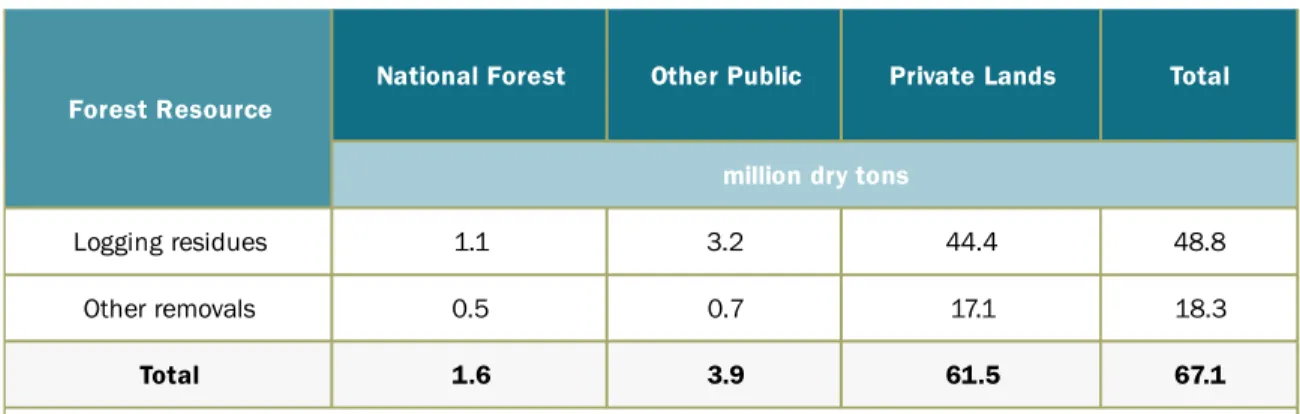
cultural operations or clearing of timberlands. Currently, about 67 million dry tons of residues are generated annually from these activities (Smith et al., 2004; USDA-FS, 2004a). About 41 million dry tons of this biomass material is potentially available for bioenergy and biobased products after consideration of equipment recovery limitations (Tables A.1 to A.3, Appendix A).
z zz
zz The recovered residues generated from fuel treatment operations on timberland and other forestland. Well over 8 billion dry tons of biomass has been identified for fuel treatment removal (Miles, 2004). The amount of this biomass potentially available for bioenergy and biobased product uses is estimated at 60 million dry tons annually. This estimate takes into consideration factors affecting forest access, residue recovery, and the merchandizing of the recoverable biomass into higher-value fractions (conventional wood products) and lower-value fractions (the biomass suitable for bioenergy and biobased product uses) (Tables A.5 to A.7, Appendix A). The fraction that could be available for bioenergy and biobased products is less than 1 percent of the total size of the fuel treatment biomass resource.
z zz
zz The direct conversion of roundwood to energy (fuelwood) in the residential, commercial, and electric utility
sectors. Thirty-five million dry tons of biomass is currently extracted by the residential and commercial sectors and by the electric power sector. Most of the fuelwood used by the residential and commercial sectors is used for space- and process-heating applications.
z zz
zz Forest products industry residues and urban wood residues. Utilization of unused residues generated by the forest products industry (8 million dry tons); urban wood residues discarded from construction and demolition activities (20 million dry tons); and residues from the disposal of tree trimmings, packaging residues, and wood-based consumer durables (8 million dry tons) can annually provide 36 million dry tons to the current 108 million dry tons currently used.
z zz
zz Forest growth and increase in the demand for forest products. In the long term, a continuation of current trends in the demand and supply of forest products could increase the potential contribution of forest biomass by another 89 million dry tons annually. The additional 89 million dry tons result from a combination of
sources and changing circumstances. An increase in the harvest of traditional forest products will create additional logging residues, and more efficient equipment will allow the recovery of a greater fraction of the logging residue. However, this increase will be offset somewhat by more efficient logging practices that will generate less wood residue per unit volume of the harvested forest products (Haynes, 2003). Demand growth for conventional forest products will create additional mill residue, and pulping liquor and urban wood
residues. However, the rate of increase in these secondary and tertiary forest residue sources will be tempered by product substitution, recycling and reuse, and more efficient manufacturing processes.
A summary of the amounts of biomass available annually and on a sustainable basis from forest resources is summarized in Figure 7. The approximate total quantity is 368 million dry tons annually. As noted, this includes about 142 million dry tons of biomass currently being used primarily by the forest products industry, as well as the 89 million dry tons that could result annually from a continuation of demand and supply trends in the forest products industry.
3.3 Increasing Biomass Resources from Forests
3.3.1 Logging Residues and Other Removals from the Forest Inventory A recent analysis shows that the annual removals from the forest inventory totaled nearly 20.2 billion ft3. Of this volume, 78 percent was for roundwood products, 16 percent was logging residue, and slightly more than 6 percent was classified as “other removals” (Smith et al., 2004). The total annual removals constitute about 2.2 percent of the forest inventory of timberland and are less than net annual forest growth (Figure 5). The logging residue fraction is biomass removed from the forest inventory as a direct result of conventional forest harvesting operations. This biomass material is largely tree tops and small branches left on site because these materials are currently uneconomical to recover either for product or energy uses (Figure 8). The remaining fraction, other removals, consists of timber cut and is burned in the process of land conversion or cut as a result of cultural operations such as precommercial thinnings and timberland clearing.
Data on the total amount of logging residue and other removals are available from the USDA Forestry Inventory and Analysis (FIA) program’s Timber Product Output (TPO) Database Retrieval System (USDA-FS, 2004a). This database provides volumetric information on roundwood products (e.g., sawlogs, pulpwood, veneer logs, and fuelwood), logging residues, other removals, and mill residues. For the United States, total logging residue and other removals currently amount to nearly 67 million dry tons annually: 49 million dry tons of logging residue and 18 million dry tons of other
removal residue (Table A.1, Appendix A).
Not all of this resource is potentially available for bioenergy and biobased products (Figure 8). Generally, these residues tend to be relatively small pieces consisting of tops, limbs, small branches, and leaves. Stokes reported a wide range of recovery percentages, with an average of about 60 percent potential recovery behind conventional forest harvesting systems (Stokes, 1992). With newer technology, it is estimated that the current recovery is about 65 percent. Other removals, especially from land-clearing operations, usually produce different forms of residues and are not generally as feasible or as economical to recover. It is expected that only half of the residues from other removals can be recovered. Of course, not all of this material should be recovered. Some portion of this material, especially the leaves and parts of tree crown mass, should be left on site to replenish nutrients and maintain soil productivity. Since many forest operations involve the construction of roads that provide only temporary access to the forest, it is assumed that these residues are removed at the same time as the harvest or land clearing operations that generate the residues. Limiting the recoverability of logging and other removal residue reduces the size of this forest resource from about 67 million to 41 million dry tons (Tables A.2 and A.3, Appendix A). About three-fourths of this material would come from the logging residue. Further, because of ownership patterns most of the logging residue and nearly all residues from other sources (e.g., land clearing operations) would come from privately owned land (Figure 9). 3.3.2 Forest Residues from Fuel Treatment Thinning
Vast areas of U.S. forestland are overstocked with relatively large amounts of woody materials. This excess material has built up over years as a result of forest growth and alterations in natural fire cycles. Over the last ten years, federal agencies have spent more than $8.2 billion fighting forest fires, which have consumed over 49 million acres (Figure 10). The cost of fighting fires does not include the costs of personal property losses, ecological damage, loss of valuable forest products, or the loss of human life. The Forest Service and other land management agencies are currently addressing
Forest Inventory and Analysis
The Forest Inventory and Analysis (FIA) program of the Forest Service is the nation’s forest census and has been in continuous operation since 1930 under various names (Forest Survey, Forest Inventory and Analysis). Its mission is to “make and keep current a comprehensive inventory and analysis of the present and prospective conditions of and requirements for the renewable resources of the forest and rangelands of the United States.” FIA reports on status and trends in forest areas and locations; on the species, size, and health of trees; on total tree growth, mortality, and removals by harvest; on wood production and utilization rates by various products; and on forest land ownership. FIA is the only program which provides consistent, credible, and periodic forest data for all forest lands (public and private) within the United States. FIA covers all U.S. forestlands, including Alaska, Hawaii, Puerto Rico, the U.S. Virgin Islands, and the U.S. Pacific territories. The FIA program is managed by the R&D organization within the USDA Forest Service in cooperation with state and private forestry and national forest systems. More information can be found at http://www.fia.fs.fed.us/. This analysis uses data from the FIA databases.
In August 2000, the National Fire Plan was developed to help respond to severe wildland fires and their impacts on local communities while ensuring sufficient firefighting capacity for future fires. The National Fire Plan specifically addresses firefighting capabilities, forest rehabilitation, hazardous fuels reduction, community assistance, and accountability. Recently, the Healthy Forest Restoration Act (HFRA) of 2003 was enacted to encourage the removal of hazardous fuels and utilization of the material, and protect, restore and enhance forest ecosystem components. HFRA is also intended to support R&D to overcome both technical and market barriers to greater utilization of this resource for bioenergy and other commercial uses from both public and private lands. Removing excess woody material has the potential to make available relatively large volumes of forest residues and small-diameter trees for bioenergy and biobased product purposes.
The Forest Service has identified timberland and other forestland areas that have tree volumes in excess of prescribed or recommended stocking densities that require some form of treatment or thinning operation to reduce fire risks and hazards, and are in close proximity to people and infrastructure (USDA-FS, 2003b). For timberlands, this was accomplished using the Fuel Treatment Evaluator or FTE (USDA-FS, 2004c; Miles, 2004), an assessment tool developed to identify, evaluate, and prioritize fuel treatment opportunities and facilitate the implementation of HFRA on all timberland areas. The FTE uses a stand density index approach to identify stands that are minimally fully stocked. Stands that exceed this threshold are identified as potential candidates for thinning
treatment. Treatable land areas are then sorted into fire regime condition classes to measure the extent a given area has departed from natural wildfire conditions. The condition classes range from minimally altered areas to areas that are significantly altered from historical norms and pose significant fire risks due to the heavy fuel loadings.
The FTE program requires individual tree data. Because this information was not collected for all “other forestland” areas prior to 1998, Forest Service personnel implemented FTE procedures manually for other forestland areas where individual tree data were available. The results for these areas were then extrapolated to similar areas, based on forest type and ecoregion, where individual tree data were not available. Since 1998, the FIA program has been collecting individual tree data on all forestland nationwide.
The FTE identified nationwide about 7.8 billion dry tons of treatable biomass on timberland and another 0.6 billion dry tons of treatable biomass on other forestland (Figure 11; Table A.5, Appendix A). Only a fraction of this approximately 8.4 billion dry tons is considered potentially available for bioenergy and biobased products on a sustainable annual basis. Many factors reduce the size of this primary biomass resource (USDA-FS, 2003).
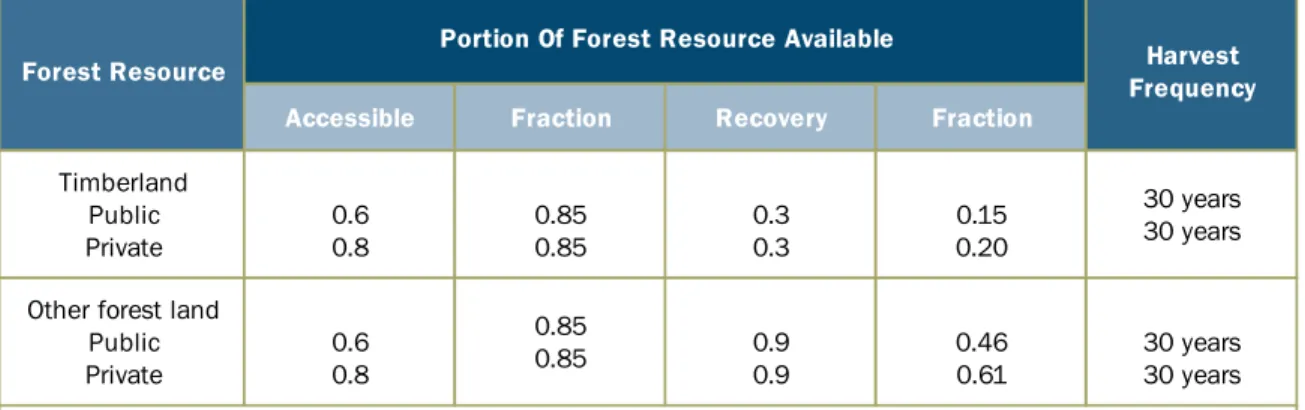
The first of these limiting factors is accessibility to the material from the standpoint of having roads to transport the material and operate logging/collection systems (Table A.6, Appendix A). This is rarely a technology-limited factor since there is equipment for nearly any type of terrain and for removing wood a long distance, even without roads (e.g., via helicopters, two-stage hauling, or long-distance cableways). However, there are usually economic and political constraints that inhibit working in roadless areas and more difficult terrain. Estimates of operational accessibility assume conventional types of operations by limiting the areas for consideration to roaded forestland. About 60 percent of the North American temperate forest is considered accessible (not reserved or high-elevation and within 15 miles of major transportation infrastructure) (FAO, 2001). The Forest Service’s final environmental impact statement for roadless area conservation indicates that about 65 percent of Forest Service acreage falls within roaded or non-restricted designations (USDA-FS, 2004b). Road density is much higher in the eastern United States, and in most cases, the topography is more accessible.
Operational accessibility is further limited by the need to avoid adverse impacts to soil and water. Steep slopes, sensitive sites, regeneration difficulty, or lack of adequate resource information may exclude an area from operational treatments. A summary of national forest land management plans from 1995 indicated about 60 percent of the western national forest timberland base to be “suitable” for timber production
operations (Timko, 2003). This would be a conservative estimate for other landowners as well, and an even more conservative estimate for eastern U.S. timberlands.
A more significant restriction is economic feasibility. Operating in steep terrain, in unroaded areas, or with very low-impact equipment is expensive. The value of the biomass (in its broad sense, meaning a combination of product value and treatment value) has to be weighed against the cost of removing the material. For example, May and LeDoux (1992) compared FIA data for hardwood inventory with economic modeling of the cost of harvest and concluded that only 40 percent of the inventory volume in Tennessee was economically available. Biomass, with a lower product value, would be even less available if the biomass has to cover the entire cost of the operation. If the biomass were to be produced as part of an integrated operation, it would be at most 40 percent available in the eastern hardwood example. The primary economic factor is the cost of transportation to processing mills.
The recoverability (i.e., the fraction of standing biomass removed offsite) of wood for bioenergy and biobased products is a function of tree form, technology, and timing of the removal of the biomass from the forests. In most cases, merchantable wood is removed, and the forest residues — in the form of limbs and tops, and small non-merchantable trees — remain scattered across the harvest area. This practice reduces recoverability when the biomass is removed in a second pass. However, when all biomass is harvested and processed using an integrated system, recovery is usually greatly improved, even greater than 90 percent. For example, a study by Stokes and Watson (1991) found that 94 percent of the standing biomass could be recovered when using a system to recover multiple products if the biomass from in-woods processing was actually utilized for bioenergy.
There is a concern about removal of large quantities of biomass from stands because of reduced long-term site productivity and loss of diversity and habitat associated with down-wood debris. Although the consequences are very site-specific, most negative impacts can be eliminated or minimized by leaving leaves, needles, and a portion of the woody biomass on site (Burger 2002).
The 8.4 billion dry tons of treatable biomass that is potentially available for bioenergy and biobased products was reduced by the following factors (Table A.6, Appendix A):
•
To allay any concerns about site impacts, recovered material using an integrated system is limited to 85 percent.•
Only 60 percent of the identified treatable areas are assumed to be accessible.•
Fuel treatment material is recovered on a 30-year cycle before any sites are re-entered.•
Harvested fuel treatment biomass is allocated into two utilization groups: (1) merchantable trees suitable for conventional or higher-value forest products as well as rotten trees, brush and understory, small saplings, and polewood trees; (2) the residues (e.g., tops, limbs, and branches) from the harvested larger trees suitable for bioenergy and biobased product uses. The conventional forest products fraction assumed is 70 percent, and the residue or bioenergy and biobased product fraction is 30 percent (USDA-FS, 2003).The combination of these factors significantly reduces the amount of fuel treatment biomass that can be sustainably removed on an annual basis. About 49 million dry tons can potentially be removed annually from timberlands, and about 11 million dry tons can be removed annually from other forestlands (Figure 12; Table A.7, Appendix A). Most of the fuel treatment biomass from timberlands would come from privately owned lands; slightly less than 20 percent of the material would come from national forests. In contrast, proportionately more of the fuel treatment biomass allocated to bioenergy and biobased products on other forestland land would come from publicly held lands. Most of
these lands are located in the western regions of the country. The 60 million dry tons of fuel treatment biomass assumes that a relatively large percentage (70 percent) goes to higher-valued products. If feedstock prices for biomass were to increase relative to conventional forest products, the amount of biomass available for bioenergy and biobased products could increase substantially.
3.3.3 Forest Products Industry Processing Residues 3.3.3.1 Primary Wood Processing Mills
The Forest Service classifies primary mill residues into three categories — bark, coarse residues (chunks and slabs), and fine residues (shavings and sawdust). In each of these categories, residues are further segmented into hardwoods and softwoods. Data on residue quantities are reported at any user-specified spatial scale, ranging from data of individual counties to state and national totals. Primary mill residues are desirable for energy and other purposes because they tend to be clean, uniform, and concentrated and have a low moisture content (< 20 percent). These desirable physical properties, however, mean that nearly all of these materials are currently used as inputs in the manufacture of products or as boiler fuel. Very little of this resource is
currently unused. According to Forest Service estimates, about 80 percent of bark is used as fuel and about 18 percent is used in low-value products such as mulch (USDA-FS, 2004a). For coarse residues, about 85 percent is used in the manufacture of fiber products and about 13 percent is used for fuel. About 55 percent of the fine residues are used as fuel and 42 percent used in products.
Primary timber processing mills (facilities that convert roundwood into products such as lumber, plywood, and wood pulp) produced 91 million dry tons of residues in the form of bark, sawmill slabs and edgings, sawdust, and peeler log cores in 2002 (USDA-FS, 2004a). Nearly all of this material is recovered or burned, leaving slightly less than 2 million dry tons available for other bioenergy and biobased product uses (Table A.8, Appendix A).
3.3.3.2 Secondary Wood Processing Mills
Residues are also generated at secondary processing facilities — mills utilizing primary mill products. Examples of secondary wood processing mill products include millwork, containers and pallets, buildings and mobile homes, furniture, flooring, and paper and paper products. Since these industries use an already processed product, they generate smaller quantities of residues. In total, the secondary mill residue resource is considerably smaller than the primary mill resource (Rooney, 1998; McKeever, 1998). The types of residues generated at secondary mills include sawdust and sander dust, wood chips and shavings, board and cut-offs, and miscellaneous scrap wood.
At the larger secondary mills, most of the residue produced is used on site to meet energy needs (such as heat for drying operations) or is recycled into other products. This is in contrast to practices at the smaller mills where much of the residue material goes unused (Bugelin and Young, 2002). The recovery of residue at smaller mills is more constrained because it may be generated seasonally and may be more dispersed.
Neither the Forest Service nor any other federal agency systematically collects data on secondary mill residue. One of the few estimates of the amount of secondary mill residue available is provided by Fehrs (1999). He estimates that 15.6 million dry tons is generated annually, with about 40 percent of this potentially available and
recoverable. The remaining fraction is used to make higher-valued products and is not available (Table A.8, Appendix A).
3.3.3.3 Pulp and Paper Mills
In the manufacture of paper products, wood is converted into fiber using a variety of chemical and mechanical pulping process technologies. Kraft (or sulfate) pulping is the most common processing technology, accounting for over 80 percent of all U.S.-produced pulp. In Kraft pulping, about half the wood is converted into fiber. The other half becomes black liquor, a by-product containing unutilized wood fiber and valuable chemicals.
Pulp and paper facilities combust black liquor in recovery boilers to produce energy (i.e., steam), and, more
importantly, to recover the valuable chemicals present in the liquor. The amount of black liquor generated in the pulp and paper industry is the equivalent of 52 million dry tons of biomass (Table A.8, Appendix A). Because the amount of black liquor generated is insufficient to meet all mill needs, recovery boilers are usually supplemented with fossil and wood residue–fired boilers. The pulp and paper industry utilizes enough black liquor, bark, and other wood residues to meet nearly 60 percent of its energy requirements. Currently, the forest products industry along with DOE are looking at black liquor gasification to convert pulping liquors and other biomass into gases that can be combusted much more efficiently.
3.3.4 Urban Wood Residues
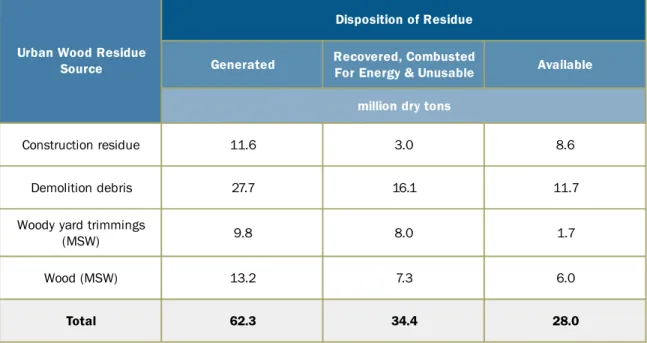
There are two principal sources of urban wood residues: MSW and construction and demolition debris. MSW consists of a variety of items ranging from organic food scraps to discarded furniture and appliances. In 2001, nearly 230 million tons of MSW was generated (EPA, 2003). Wood and yard and tree trimmings are the two sources within this residue stream that are potentially recoverable for bioenergy and biobased product applications. The wood
component includes discarded furniture, pallets, containers, packaging materials, lumber scraps (other than new construction and demolition), and wood residuals from manufacturing. McKeever (2004) estimates the total wood component of the MSW stream at slightly more than 13 million dry tons (Table A.9, Appendix A). About 55 percent of this material is either recycled as compost,
burned for power production, or unavailable for recovery because of excessive contamination. In total, about 6 million dry tons of MSW wood is potentially available for recovery for bioenergy and biobased products. The other component of the MSW stream — yard and tree trimmings — is estimated at 9.8 million dry tons. However, only 1.7 million dry tons is considered potentially available for recovery after accounting for what is currently used and what is unusable.
The other principal source of urban wood residue is construction and demolition debris. These materials are considered separately from MSW since they come from much different sources. These debris materials are correlated with economic activity (e.g., housing starts),
population, demolition activity, and the extent of recycling and reuse programs. McKeever (2004) estimates annual generation of construction and demolition debris at 11.6 and 27.7 million dry tons, respectively. About 8.6 million dry tons of construction debris and 11.7 million dry tons of demolition debris are considered potentially available for bioenergy and biobased products (Table A.9, Appendix A). Unlike construction debris, which tends to be relatively clean and can be more easily source-separated, demolition
All these sources of urban wood residue total 28 million dry tons. As noted by McKeever (1998), many factors affect the availability of urban wood residues, such as size and condition of the material, extent of commingling with other materials, contamination, location and concentration, and, of course, costs associated with acquisition, transport, and processing.
3.3.5 Forest Growth and Increase in the Demand for Forest Products The Fifth Resources Planning Act Timber Assessment projects the continued
expansion of the standing forest inventory despite the estimated conversion of about 23 million acres of timberland into more developed uses (Haynes, 2003). The size of the standing forest inventory will increase because annual forest growth will continue to exceed annual harvests and other removals from the inventory. The forest products industry will continue to become more efficient in the way it harvests and processes wood products. The demand for forest products are also projected to increase. However, the increase will be less than historical growth owing to a general declining trend in the use of paper and paperboard products relative to GNP and the relatively stable forecast of housing starts (Haynes, 2003). The increase in the consumption of forest products will be met by an increase in timber harvests; an increase in log, chip, and product imports; and an increase in the use of recovered paper. Further,
consumers will become more efficient in the use of wood products by generating fewer wood residues and increasing recycling rates.
These changes and trends will affect the availability of forest residues for bioenergy and biobased products. An overall increase in the amount of biomass available due to changes in the demand and supply of forest products will increase
the availability and use of forest residues by about 89 million dry tons annually by mid-21st century. Specifically, the
availability of logging and other removal residues could increase by about 23 million dry tons over the current annual resource estimate of 41 million dry tons. Fuelwood harvested for space- and process-heat applications could increase by another 16 million dry tons over current levels. Wood residues and pulping liquors generated by the forest products industry could increase by about 16 and 22 million dry tons, respectively. And, the amount of urban wood waste generated could increase by 11 million dry tons over currently available amounts.
3.4 Forest Resources Summary
Biomass derived from forestlands currently contributes about 142 million dry tons to the total annual consumption in the United Sates of 190 million dry tons. Based on the assumptions and conditions outlined in this analysis, the amount of forestland-derived biomass that can be sustainably produced is approximately 368 million dry tons annually — more than 2.5 times the current consumption. The distribution of this resource potential is summarized in Figure 13. This estimate includes the current annual consumption of 35 million dry tons of fuelwood extracted from
forestland for residential, commercial and electric utility purposes, 96 million dry tons of residues generated and used by the forest products industry, and 11 million dry tons of urban wood residue. As discussed previously, there are relatively large amounts of forest residue produced by logging and land clearing operations that goes uncollected (41 million dry tons per year) and significant quantities of forest residues that can be collected from fuel treatments to reduce fire hazards (60 million dry tons per year). Additionally, there are some unutilized residues from wood
processing mills and unutilized urban wood. These sources total about 36 million dry tons annually. About 48 percent of these resources are derived directly from forestlands (primary resources). About 39 percent are secondary sources of biomass from the forest products industry. The remaining fraction would come from tertiary or collectively from a variety of urban sources.
4.
Agriculture-Derived Biomass Resources
4.1 Agricultural Land Resource BaseAgriculture is the third largest single use of land in the United States. In 1997, the year of the most recent complete land inventory, agricultural land totaled some 455 million acres — 349 million acres of land in active use to grow crops, 39 million acres of idle cropland (including land enrolled in the Conservation Reserve Program or CRP), and 67 million acres of cropland used as pasture (Figure 14) (USDA-NRCS, 2003a). The amount of agricultural land actively used to grow crops has varied from 330 to 380 million acres over the last 30 years. Cropland tends to move in and out of active production because of soil and weather conditions at planting time, expected crop prices, and the presence of government programs. Some cropland is also permanently converted to other nonagricultural uses. Between 1997 and 2001, seven million acres of active cropland were lost to other uses (USDA-NRCS 2003a).
The agricultural land base considered for this resource analysis includes 342 million acres of active cropland, 39 million acres of idle cropland, and 67 million acres of cropland used as pasture (448 million acres total). All cropland acres are assumed to be potential contributors to agriculturally derived biomass feedstocks. Permanent pasture land might be another potential resource, but it is not considered in this analysis.
4.2 Agricultural Resources
Grains and oilseeds are the primary feedstocks used to produce most of the ethanol, biodiesel, and bioproducts consumed today. Food and feed processing residues and tertiary post-consumer residues are also used to generate a modest amount of electricity. These agriculture-derived biomass resources account for nearly 25 percent of the current biomass consumption. This amount of biomass, however, is small relative to currently available agricultural biomass resources and tiny relative to agriculture’s full potential. With appropriate economic incentives, and improved cropping practices and technologies, such as higher-yielding plants and more efficient harvest equipment, significant amounts of agricultural crop residues, and food and feed processing residues could be sustainably produced. Moreover, the amount of sustainable biomass derived from agricultural land could be increased further by dedicating some land to the production of perennial grass and woody crops.
U.S. agriculture has changed considerably since the early part of the 20th century (USDA-NASS, 2003a). The key technological drivers of this change were mechanization and dramatically increased yields of major grain and fiber crops. Mechanization dramatically reduced the need for horses for “horsepower,” and consequently oat production (for animal food) greatly declined. In the same time frame, soybean production increased but for different reasons (Figure 15). Increased crop yields were a direct result of research such as corn and wheat hybridization, and governmental price support policies. Agriculture also became more productive in the use of inputs to grow crops (Figure 16). A substantial increase in livestock production, especially cattle and poultry, also occurred.
Driven by a need to reduce erosion, maintain soil structure and nutrients, and build soil carbon levels, agriculture adopted sounder environmental and conservation practices. For example, no-till cultivation, the most environmentally friendly production system, is now practiced on more than 62 million acres, and another 50 million acres are part of another conservation tillage system (CTIC, 2004). Crop rotation is also much more common. In the mid-1990s for instance, the practice of rotating corn with soybeans increased from nearly half to about two-thirds of the planted corn acreage.
Agriculture is expected to continue to change and adapt to new technologies and circumstances. Biotechnology, for example, is transforming agriculture by making available genetically altered varieties of corn and soybeans. Biotech hybrids of corn now account for 40 percent of the total planted acreage (National Corn Growers Association, 2004). The future could also see agriculture becoming a more important supplier of bioenergy and biobased products to the U.S. economy. The production of ethanol from corn and other grains is projected to continue to grow (USDA-OCE, 2004, 2005). Biodiesel production has also grown significantly and could increase substantially in the future under an EPA mandate to reduce sulfur in diesel fuel (Stroup, 2004). The demand for new biobased products is also expanding. For example, innovative carbon-based technologies, such as the development of carbon-annotate fibers, could provide new markets for biomass.
4.3 Evaluating the Biomass Potential of Agriculture
To assess the potential biomass contribution from agriculture, a number of scenarios were evaluated. These scenarios include various combinations of changes in the following:
z yields of crops grown on active cropland, z crop residue-to-grain or -seed ratios,
z annual crop residue collection technology and equipment, z crop tillage practices,
z land use change to accommodate perennial crops (i.e., grasses and woody crops), z biofuels (i.e., ethanol and biodiesel), and
z secondary processing and other residues.
Crop yields are of particular importance because they affect the amount of residue generated and the amount of land needed to meet food, feed, and fiber demands.
The following three scenarios are summarized in this report:
Scenario 1: current availability of biomass feedstocks from agricultural land;
Scenario 2: biomass availability through a combination of technology changes focused on conventional crops only; and
Scenario 3: biomass availability through technology changes in both conventional crops and new perennial crops together with significant land use change.
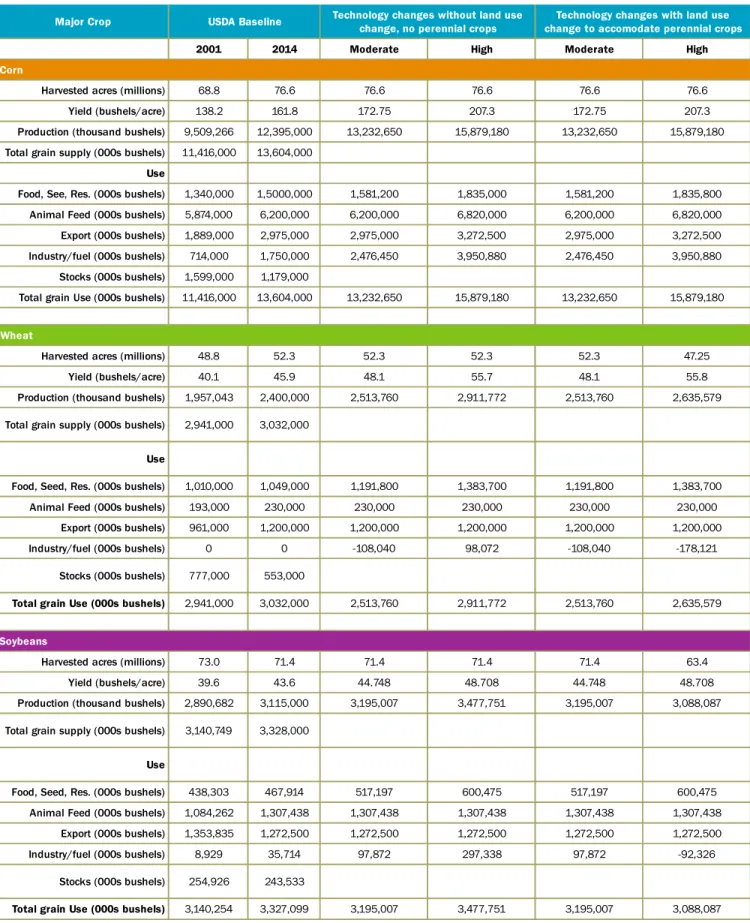
The types of crop technology changes assumed include yield increases, more efficient harvest technology, changes in tillage practice, and, for scenario three only, changes in residue to grain ratios. The agricultural biomass resources considered for each of these scenarios include residues from major crops, grains and oilseeds used for ethanol and biodiesel production, and residues and waste resources. Switchgrass and hybrid poplars are assumed for perennial crops, but any fast growing grasses or trees could be used. For the three major crops (corn, wheat, and soybeans), a comparison among the USDA baseline and Scenarios 2 and 3 is summarized in Table B.1, Appendix B.
4.3.1 Scenario 1: Current Sustainable Availability of Biomass from Agricultural Lands
Current availability is the baseline that summarizes sustainable biomass resources under current crop yields, tillage practices (20-40 percent no-till for major crops), residue collection technology (~40 percent recovery potential), grain to ethanol and biodiesel production, and use of secondary and tertiary residues. In sum, the amount of biomass currently available for bioenergy and bioproducts is about 194 million dry tons annually (Table B.2, Appendix B). This is about 16 percent of the 1.2 billion dry tons of plant material produced on agricultural land. It includes 113 million dry tons of crop residues, 15 million dry tons of grain (starch) used for ethanol production, 6 million dry tons of corn fiber, and 60 million dry tons of animal manures and residues (e.g., MSW and animal fats). The single largest source of this current potential is corn residues or corn stover (Figure 17; Table B.2, Appendix B), totaling close to 75 million dry tons.
4.3.2 Scenario 2: Technology Change with Conventional Crops Only (No Land Use Change)
Scenario 2 assumes an increase in crop yields for corn by 25-50 percent. Yields of wheat and other small grains, sorghum, soybeans, rice, and cotton are assumed to increase at rates lower than for corn. The rates of increase of all crops are the same as those used by USDA-OCE (2004, 2005) in their Baseline Projections (The USDA baseline for three major crops is summarized in Table B.1, Appendix B.). Acres for each crop are fixed at levels predicted for 2014 by USDA-OCE (2005). Soybeans contribute no crop residue under a moderate yield increase (~ 13 percent) but make a small contribution with a high yield increase (~23 percent). Collection equipment is assumed to be capable of recovering as much as 60 percent of residue under the moderate yield increases and 75 percent under the high yield increases but the actual removal amounts depend on the sustainability requirements. No-till cultivation is assumed to be practiced on approximately 200 million acres under moderate yield increases and all of active cropland under high yields. The amount of corn and soybeans available for ethanol, biodiesel or other bioproducts was calculated by first subtracting amounts needed to meet food requirements plus feed and export requirements. All remaining grain was assumed to be available for biofuels. This worked out to a more than three-fold increase over 2001 levels under the moderate yield increase and more than a five-fold increase under the high yield increase. Soy oil used for biodiesel increases dramatically from the 2001 level under both moderate and high yield increases. Further, about 75 million dry tons of manure and other secondary and tertiary residues and wastes, and 50 percent of the biomass produced on CRP lands (17 to 28 million dry tons) are assumed to be available for bioenergy production. Attaining these levels of crop yield increase and collection will require a continuation of research, deployment of new technologies, and incentives. Past trends indicate that such increases are certainly doable. This intensive scenario for use of crop residue results in the annual production of 423 million dry tons per year under moderate yields and 597 million dry tons under high yields (Figure 18; Tables B.3 and B.4, Appendix B). In this scenario, about two-thirds to three-fourths of total biomass are from crop residues.