Using the CEFR
:
Principles of Good Practice
October 2011
reference, itself always open
to amendment and further
development, in an interactive
international system of
co-operating institutions ...
whose cumulative experience
and expertise produces a
solid structure of knowledge,
understanding and practice
shared by all.’
Contents
Introduction...2
Section 1: Overview...3
What the CEFR is … and what it is not...4
A brief history of the CEFR...5
How to read the CEFR...7
The action-oriented approach...7
The common reference levels...8
Language use and the learner’s competences...9
Section 2: Principles and general usage...11
Principles for teaching and learning...12
Using the CEFR in curriculum and syllabus design...12
Using the CEFR in the classroom: teaching and lesson planning...13
Principles for assessment...16
Using the CEFR to choose or commission appropriate assessments...16
Using the CEFR in the development of assessments...17
Principles for development and use of Reference Level Descriptions...21
Using resources from Reference Level Descriptions in learning, teaching and assessment...21
Using the CEFR to develop Reference Level Descriptions...23
Section 3: Applying the CEFR in practice...25
Applying the CEFR in practice: Aligning Cambridge ESOL examinations to the CEFR...26
Point 1 – Shared origins and long-term engagement ...28
Point 2 – Integrated item banking and calibration systems...29
Point 3 – Quality management and validation systems...29
Point 4 – Alignment and standard-setting studies...30
Point 5 – Application and extension of the CEFR for English...31
Summary...31
Appendices...33
Appendix A – Reference Level Descriptions...34
Introduction
The.
Common European Framework of Reference for Languages:
Learning, teaching, assessment
.(CEFR).was.created.by.the.Council.
of.Europe.to.provide.‘a.common.basis.for.the.elaboration.of.
language.syllabuses,.curriculum.guidelines,.examinations,.
textbooks,.etc..across.Europe’.(2001a:1)..It.was.envisaged.
primarily.as.a.planning.tool.whose.aim.was.to.promote.
‘transparency.and.coherence’.in.language.education.
The.CEFR.is.often.used.by.policy-makers.to.set.minimum.language.requirements.for.a.wide. range.of.purposes..It.is.also.widely.used.in.curriculum.planning,.preparing.textbooks.and.many. other.contexts..It.can.be.a.valuable.tool.for.all.of.these.purposes,.but.users.need.to.understand.its. limitations.and.original.intentions..It.was.intended.to.be.a.‘work.in.progress’,.not.an.international. standard.or.seal.of.approval..It.should.be.seen.as.a.general.guide.rather.than.a.prescriptive. instrument.and.does.not.provide.simple,.ready-made.answers.or.a.single.method.for.applying.it... As.the.authors.state.in.the.‘Notes.for.the.User’:
We.have.NOT.set.out.to.tell.practitioners.what.to.do.or.how.to.do.it..We.are.raising. questions.not.answering.them..It.is.not.the.function.of.the.CEF(R).to.lay.down.the. objectives.that.users.should.pursue.or.the.methods.they.should.employ.
(2001a:xi)
The.CEFR.is.useful.to.you.if.you.are.involved.in.learning,.teaching.or.assessing.languages..We.have. aimed.this.booklet.at.language.professionals.such.as.teachers.and.administrators.rather.than. candidates.or.language.learners..It.is.based.on.Cambridge.ESOL’s.extensive.experience.of.working. with.the.CEFR.over.many.years.
The.CEFR.is.a.comprehensive.document,.and.as.such,.individual.users.can.find.it.difficult.to.read. and.interpret..The.Council.of.Europe.has.created.a.number.of.guidance.documents.to.help.in.this. interpretation..Helping.you.find.your.way.around.the.CEFR.and.its.supporting.documents.is.one.of. our.key.aims.in.creating.Using the CEFR: Principles of Good Practice..If.you.want.a.brief.overview.of.the. CEFR.read.Section.1.of.this.booklet..If.you.are.a.teacher.or.administrator.working.in.an.educational. setting.and.would.like.guidance.on.using.and.interacting.with.the.CEFR.then.reading.Section.2.will. be.useful.to.you..If.you.want.to.find.out.about.how.Cambridge.ESOL.works.with.the.CEFR.then.read. Section.3..Each.section.is.preceded.by.a.page.that.signposts.key.further.reading.
Section 1:
.Overview
‘The.Framework.aims.to.be.not.only.comprehensive,.
transparent.and.coherent,.but.also.open,.dynamic.
and.non-dogmatic.’.
Council of Europe (2001a:18)
Key Resources
Council of Europe (2001a) Common
European Framework of Reference for
Languages: Learning, teaching, assessment.
In particular ‘Notes for the User’ and
Chapters 3, 4 and 5.
What the CEFR is … and what it is not
The.CEFR.is.a.framework,.published.by.the.Council.of.Europe.
in.2001,.which.describes.language.learners’.ability.in.terms.of.
speaking,.reading,.listening.and.writing.at.six.reference.levels.
These.six.levels.are.named.as.follows:C2 Mastery
}
Proficient user C1 Effective.Operational.ProficiencyB2 Vantage
}
Independent userB1 Threshold
A2 Waystage
}
Basic user A1 BreakthroughAs.well.as.these.common.reference.levels,.the.CEFR.provides.a.‘Descriptive.Scheme’.(2001a:21).of. definitions,.categories.and.examples.that.language.professionals.can.use.to.better.understand.and. communicate.their.aims.and.objectives..The.examples.given.are.called.‘illustrative.descriptors’.and. these.are.presented.as.a.series.of.scales.with.Can.Do.statements.from.levels.A1.to.C2..These.scales. can.be.used.as.a.tool.for.comparing.levels.of.ability.amongst.learners.of.foreign.languages.and. also.offer.‘a.means.to.map.the.progress’.of.learners.(2001a:xii).
The.scales.in.the.CEFR.are.not.exhaustive..They.cannot.cover.every.possible.context.of.language. use.and.do.not.attempt.to.do.so..Whilst.they.have.been.empirically.validated,.some.of.them.still. have.significant.gaps,.e.g..at.the.lowest.level.(A1).and.at.the.top.of.the.scale.(the.C.levels)..Certain. contexts.are.less.well.elaborated,.e.g..young.learners.
The.CEFR.is.not.an.international.standard.or.seal.of.approval..Most.test.providers,.textbook.writers. and.curriculum.designers.now.claim.links.to.the.CEFR..However,.the.quality.of.the.claims.can.vary. (as.can.the.quality.of.the.tests,.textbooks.and.curricula.themselves)..There.is.no.single.‘best’.method. of.carrying.out.an.alignment.study.or.accounting.for.claims.which.are.made..What.is.required.is.a. reasoned.explanation.backed.up.by.supporting.evidence.
The.CEFR.is.not.language.or.context.specific..It.does.not.attempt.to.list.specific.language. features.(grammatical.rules,.vocabulary,.etc.).and.cannot.be.used.as.a.curriculum.or.checklist. of.learning.points..Users.need.to.adapt.its.use.to.fit.the.language.they.are.working.with.and.their. specific.context..
One.of.the.most.important.ways.of.adapting.the.CEFR.is.the.production.of.language-specific. Reference.Level.Descriptions..These.are.frameworks.for.specific.languages.where.the.levels.and. descriptors.in.the.CEFR.have.been.mapped.against.the.actual.linguistic.material.(i.e..grammar,. words).needed.to.implement.the.stated.competences..Reference.Level.Descriptions.are.already. available.for.several.languages.(see.Appendix.A).
Section.1:.Overview
A brief history of the CEFR
The.CEFR.is.the.result.of.developments.in.language.education.
that.date.back.to.the.1970s.and.beyond,.and.its.publication.in.
2001.was.the.direct.outcome.of.several.discussions,.meetings.
and.consultation.processes.which.had.taken.place.over.the.
previous.10.years.
The.development.of.the.CEFR.coincided.with.fundamental.changes.in.language.teaching,.with.the. move.away.from.the.grammar-translation.method.to.the.functional/notional.approach.and.the. communicative.approach..The.CEFR.reflects.these.later.approaches.
The.CEFR.is.also.the.result.of.a.need.for.a.common.international.framework.for.language.learning. which.would.facilitate.co-operation.among.educational.institutions.in.different.countries,.particularly. within.Europe..It.was.also.hoped.that.it.would.provide.a.sound.basis.for.the.mutual.recognition. of.language.qualifications.and.help.learners,.teachers,.course.designers,.examining.bodies.and. educational.administrators.to.situate.their.own.efforts.within.a.wider.frame.of.reference. The.years.since.the.publication.of.the.CEFR.have.seen.the.emergence.of.several.CEFR-related. projects.and.the.development.of.a.‘toolkit’.for.working.with.the.CEFR..The.concept.of.developing. Reference.Level.Descriptions.for.national.and.regional.languages.has.also.been.widely.adopted.. These.developments.and.their.associated.outcomes.will.continue.into.the.future,.adding.to.the. evolution.of.the.Framework..In.this.way.the.CEFR.is.able.to.remain.relevant.and.accommodate.new. innovations.in.teaching.and.learning.
1960s and 19
70s
Emerg
enc
e of the functional/
notional appr
oach
• The Council of Europe’s Modern Languages projects start in the 1960s and (following the 1971
intergovernmental symposium in Rüschlikon) include a European unit/credit scheme for adult education. It is in the context of this project that the concept of a ‘threshold’ level first arises (Bung 1973).
• Publication of the Threshold level (now Level B1 of the CEFR) (van Ek 1975) and the Waystage level (van Ek, Alexander and Fitzpatrick 1977) (now Level A2 of the CEFR).
• Publication of Un niveau-seuil (Coste, Courtillon, Ferenczi, Martins-Baltar and Papo 1976), the French version of the Threshold model.
• 1977 Ludwigshafen Symposium: David Wilkins speaks of a possible set of seven ‘Council of Europe Levels’ (North 2006:8) to be used as part of the European unit/credit scheme.
1980s The c ommunicativ e appr oach
• Communicative approach becomes established. Attitudes to language learning and assessment begin to change. Greater emphasis placed on productive skills and innovative assessment models. The concept of levels is extended in practice.
1990s
The de
velopment of the F
rame
w
ork and a
period of c
on
verg
enc
e
• 1991 Rüschlikon intergovernmental symposium ‘Transparency and Coherence in Language Learning in Europe’, the outcome of which is the setting up of an authoring group and an international working party. • Authoring group comprises head of the Language Policy Division, Joe Shiels plus John Trim, Brian North
and Daniel Coste. Key aims are:
– to establish a useful tool for communication that will enable practitioners in many diverse contexts to talk about objectives and language levels in a more coherent way
– to encourage practitioners to reflect on their current practice in the setting of objectives and in tracking the progress of learners with a view to improving language teaching and assessment across the continent.
• Publication of revised and extended Waystage and Threshold, and first publication of the Vantage level which sits above these at Level B2 of the CEFR (van Ek and Trim, 1990a/1998a, 1990b/1998b, 2001). • Pre-Waystage level called Breakthrough developed by John Trim.
2000s
Using the F
rame
w
ork and the
emerg
enc
e of the ‘
toolkit’
• 2001 final draft published simultaneously in English and French (Council of Europe). • 2001 European Language Portfolio launched.
• CEFR translated into at least 37 languages.
• ‘CEFR toolkit’ developed including manuals, reference supplements, content analysis grids and illustrative samples of writing and speaking.
• Council of Europe encourages development of Reference Level Descriptions for specific languages.
Section.1:.Overview
How to read the CEFR
Throughout.the.CEFR.book.the.emphasis.is.on.the.readers.and.
their.own.contexts..The.language.practitioner.is.told.that.the.
CEFR.is.about.‘raising.questions,.not.answering.them’.(2001a:xi),.
and.one.of.the.key.aims.of.the.CEFR.book.is.stated.as.being.to.
encourage.the.reader.to.reflect.on.these.questions.and.provide.
answers.which.are.relevant.for.their.contexts.and.their.learners.
The.CEFR.has.nine.chapters,.plus.a.useful.introductory.section.called.‘Notes.for.the.User’..The.key. chapters.for.most.readers.will.be.Chapters.2.to.5..Chapter.2.explains.the.approach.the.CEFR.adopts. and.lays.out.a.descriptive.scheme.that.is.then.followed.in.Chapters.4.and.5.to.give.a.more.detailed. explanation.of.these.parameters..Chapter.3.introduces.the.common.reference.levels.Chapters.6.to.9.of.the.CEFR.focus.on.various.aspects.of.learning,.teaching.and.assessment;.for. example,.Chapter.7.is.about.‘Tasks.and.their.role.in.language.teaching’..Each.chapter.explains. concepts.to.the.reader.and.gives.a.structure.around.which.to.ask.and.answer.questions.relevant. to.the.reader’s.contexts..The.CEFR.states.that.the.aim.is.‘not.to.prescribe.or.even.recommend.a. particular.method,.but.to.present.options’.(2001a:xiv).
The action-oriented approach
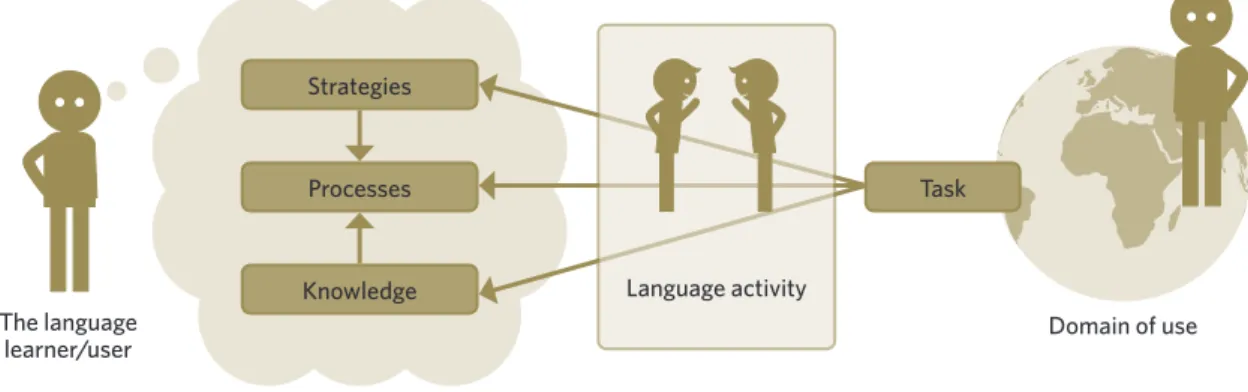
Chapter.2.of.the.CEFR.describes.a.model.of.language.use.which.is.referred.to.as.the.‘action-oriented. approach’,.summarised.in.the.following.paragraph.(2001a:9):
Language.use,.embracing.language.learning,.comprises.the.actions.performed.by.persons. who.as.individuals.and.as.social.agents.develop.a.range.of.competences,.both.general.and. in.particular.communicative language competences..They.draw.on.the.competences.at. their.disposal.in.various.contexts.under.various.conditionsand.under.various.constraints.to. engage.in.language activities.involving.languageprocesses.to.produce.and/or.receive.texts. in.relation.to.themes.in.specific.domains,.activating.those.strategies.which.seem.most. appropriate.for.carrying.out.the.tasks.to.be.accomplished..The.monitoring.of.these.actions. by.the.participants.leads.to.the.reinforcement.or.modification.of.their.competences. This.identifies.the.major.elements.of.the.model,.which.are.then.presented.in.more.detail.in.the. text.of.the.CEFR..It.also.sets.out.a.socio-cognitive.approach.(see.Weir.2005.for.more.detail),. highlighting.the.cognitive.processes.involved.in.language.learning.and.use,.as.well.as.the.role.of. social.context.in.how.language.is.learned.and.used..The.model.is.illustrated.in.Figure.2.below.
The language
learner/user Domain of use
Task Language activity
Processes Strategies
Knowledge
The.diagram.shows.a.language.user,.whose.developing.competence.reflects.various.kinds.of. cognitive.processes,.strategies.and.knowledge..Depending.on.the.contexts.in.which.the.learner. needs.to.use.the.language,.he/she.is.faced.with.tasks.to.perform..The.user.engages.in.language. activities.to.complete.the.tasks..These.engage.his/her.cognitive.processes,.which.also.leads. to.learning. The.diagram.highlights.the.centrality.of.language.activity.in.this.model..Language.activity.is.the. observable.performance.on.a.speaking,.writing,.reading.or.listening.task.(a.real-world.task,.or.a. classroom.task)..Observing.this.activity.allows.teachers.to.give.useful.formative.feedback.to.their. students,.which.in.turn.leads.to.learning.
The common reference levels
Like.other.frameworks,.the.CEFR.covers.two.main.dimensions:.a.vertical.and.a.horizontal.one... The.vertical.dimension.of.the.CEFR.shows.progression.through.the.levels..This.is.presented.in.the. form.of.the.set.of.common.reference.levels.(discussed.in.Chapter.3.of.the.CEFR).and.shown.in.. Figure.3.below.. Pr oficient User
C2
Can understand with ease virtually everything heard or read. Can summarise information from different spoken and written sources, reconstructing arguments and accounts in a coherent presentation. Can express him/herself spontaneously, very fluently and precisely, differentiating finer shades of meaning even in more complex situations.
C1
Can understand a wide range of demanding, longer texts, and recognise implicit meaning. Can express him/ herself fluently and spontaneously without much obvious searching for expressions. Can use language flexibly and effectively for social, academic and professional purposes. Can produce clear, well-structured, detailed text on complex subjects, showing controlled use of organisational patterns, connectors and cohesive devices.
Independent User
B2
Can understand the main ideas of complex text on both concrete and abstract topics, including technical discussions in his/her field of specialisation. Can interact with a degree of fluency and spontaneity that makes regular interaction with native speakers quite possible without strain for either party. Can produce clear, detailed text on a wide range of subjects and explain a viewpoint on a topical issue giving the advantages and disadvantages of various options.
B1
Can understand the main points of clear standard input on familiar matters regularly encountered in work, school, leisure, etc. Can deal with most situations likely to arise whilst travelling in an area where the language is spoken. Can produce simple connected text on topics which are familiar or of personal interest. Can describe experiences and events, dreams, hopes & ambitions and briefly give reasons and explanations for opinions and plans.
Basic User
A2
Can understand sentences and frequently used expressions related to areas of most immediate relevance (e.g. very basic personal and family information, shopping, local geography, employment). Can communicate in simple and routine tasks requiring a simple and direct exchange of information on familiar and routine matters. Can describe in simple terms aspects of his/her background, immediate environment and matters in areas of immediate need.
A1
Can understand and use familiar everyday expressions and very basic phrases aimed at the satisfaction of needs of a concrete type. Can introduce him/herself and others and can ask and answer questions about personal details such as where he/she lives, people he/she knows and things he/she has. Can interact in a simple way provided the other person talks slowly and clearly and is prepared to help.
Section.1:.Overview
The.language.skills.(reading,.writing,.listening,.spoken.interaction.and.spoken.production).are.dealt. with.in.Tables.2.and.3.of.the.CEFR..Table.2.(2001a:.26–27).differentiates.language.activities.for. the.purpose.of.self-evaluation..It.therefore.recasts.the.traditional.Can.Do.statements.into.I Can Do. statements.appropriate.for.self-evaluation.in.pedagogic.contexts;.for.example,.in.the.case.of.Reading. a.low-level.(A1).statement.is:
I.can.understand.familiar.names,.words.and.very.simple.sentences,.for.example.on. notices.and.posters.or.in.catalogues.
whereas.a.high-level.(C2).statement.is:
I.can.read.with.ease.virtually.all.forms.of.the.written.language,.including.
abstract,structurally.or.linguistically.complex.texts.such.as.manuals,.specialised.articles. and.literary.works.
Table.3.of.the.CEFR.(2001a:28–29).then.differentiates.the.levels.with.respect.to.qualitative.aspects. of.spoken.language.use.(range,.accuracy,.fluency,.interaction.and.coherence).
Language use and the learner’s competences
The.horizontal.dimension.of.the.CEFR.shows.the.different.contexts.of.teaching.and.learning.as. described.in.the.descriptive.scheme.laid.out.in.Chapter.2..This.is.dealt.with.in.Chapters.4.and.5. of.the.CEFR.with.the.former.covering.‘Language.use.and.the.language.user/learner’.and.the.latter. covering.‘The.user/learner’s.competences’..The.illustrative.scales.included.in.these.chapters.are. designed.to.help.differentiate.these.language.activities.and.competences.across.the.reference.levels.. The.headings.and.subheadings.in.Chapters.4.and.5.present.a.hierarchical.model.of.elements.nested. within.larger.elements..
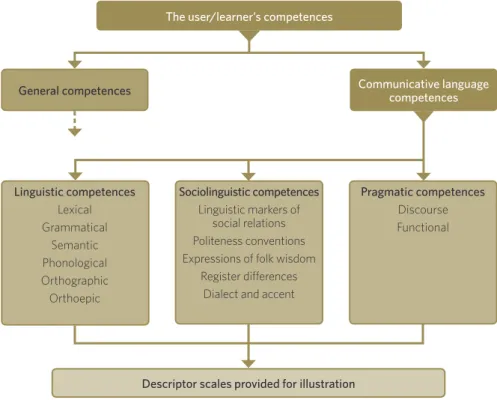
Figures.4.and.5.on.p.10.illustrate.this.by.showing.partial.views.of.Chapters.4.and.5.in.the.CEFR,.using. the.headings.and.subheadings.from.these.chapters..The.level.of.detail.involved.in.these.chapters. means.that.not.all.headings.can.be.shown,.and.dotted.arrows.indicate.additional.subheadings.not. illustrated.here..For.example.in.Chapter.4.‘The.context.of.language.use’.has.subheadings.including. ‘Domains’.and.‘Situations’.
Each.section.in.Chapters.4.and.5.first.explains.the.concepts.involved,.and.follows.this.with.illustrative. scales.relevant.to.that.section,.containing.Can.Do.statements.for.each.of.the.levels.A1.to.C2..For. example.in.Chapter.4.of.the.CEFR.(2001a:57).under.Section.4.4,.‘Communicative.language.activities. and.strategies’,.Section.4.4.3.‘Interactive.activities.and.strategies’.contains.separate.scales.for. ‘Overall.spoken.interaction’,.‘Understanding.a.native.speaker.interlocutor’,.‘Conversation’.and.so.on.
The context of
language use Communication themes tasks and purposesCommunicative language processesCommunicative Texts Communicative
language activities and strategies
Interactive activities and strategies Productive activities
and strategies Receptive activities and strategies Mediating activities and strategies communicationNon-verbal
Descriptor scales provided for illustration Written
interaction interactionSpoken Interaction strategies Language use and the language user/learner
Figure 4. A partial view of CEFR Chapter 4: Language use and the language user/learner
Communicative language competences
Descriptor scales provided for illustration The user/learner’s competences
General competences
Linguistic competences
Lexical Grammatical
Semantic Phonological Orthographic Orthoepic
Sociolinguistic competences
Linguistic.markers.of.. social.relations Politeness.conventions Expressions.of.folk.wisdom
Register.differences Dialect.and.accent
Pragmatic competences
Discourse Functional
Key Resources
Principles for teaching and learning
•. Council.of.Europe.(2001a).Common
European Framework of Reference
for Languages: Learning, teaching,
assessment..In.particular.Chapters.5,.
6,.7.and.8.
•. For.information.on.the.European.
Language.Portfolio.and.on.where.to.
find.exemplars.of.speaking.and.writing.
performance.at.different.CEFR.levels.go.
to:.
www.coe.int/t/dg4/portfolio/
.
Principles for assessment
•. Council.of.Europe/ALTE.(2011).Manual
for Language Test Development and
Examining. For use with the CEFR
•. Council.of.Europe.(2001a).Common
European Framework of Reference
for Languages: Learning, teaching,
assessment,.Chapter.9.
•. Council.of.Europe.(2009a).Relating
Language Examinations to the Common
European Framework of Reference
for Languages: Learning, Teaching,
Assessment (CEFR), A Manual.
Principles for development and use of
Reference Level Descriptions
•. Council.of.Europe.(2005).Guide for the
production of RLD.
Section 2:
.Principles.
and.general.usage
‘We.have.NOT.set.out.to.tell.practitioners.what.to.do.
or.how.to.do.it.’..
Principles for teaching and learning
The.CEFR.has.become.very.important.in.the.framing.of.language.
policy.and.the.design.of.curricula.and.syllabuses..In.practice,.the.
CEFR.can.provide.a.straightforward.tool.for.enhancing.teaching.
and.learning,.but.many.teachers.and.other.language.professionals.
find.the.document.difficult.to.use.without.further.guidance..
This.section.is.organised.around.two.levels.at.which.language.professionals.may.need.to.interact. with.the.CEFR.and.teaching:
•. using.the.CEFR.in.designing.curricula.and.syllabuses
•. using.the.CEFR.in.the.classroom:.teaching.and.lesson.planning..
Embedded.within.the.sections.are.four.principles.designed.to.help.you.understand.the.key.messages. of.the.CEFR:.
1.. Adapt.the.CEFR.to.fit.your.context. 2..Focus.on.the.outcomes.of.learning. 3..Focus.on.purposeful.communication..
4..Focus.on.the.development.of.good.language.learning.skills.
Using the CEFR in curriculum and syllabus design
It.is.important.to.remember.that.the.CEFR.is.a.framework.of.reference.and.so.must.be.adapted.to. fit.your.context..Linking.to.the.CEFR.means.relating.the.particular.features.of.your.own.context.of. learning.(the.learners,.the.learning.objectives,.etc.).to.the.CEFR,.focusing.on.those.aspects.which. you.can.find.reflected.in.the.body.of.the.text.and.in.the.level.descriptors..Not.everything.in.the.CEFR. will.be.relevant.to.your.context,.and.there.may.be.features.of.your.context.which.are.important.but. are.not.addressed.by.the.CEFR..
Aims and objectives
A.language.teaching.context.has.its.own.specific.aims.and.objectives..These.state.the.distinguishing. features.of.a.language.context,.whereas.the.CEFR.tends.to.stress.what.makes.language.contexts. comparable..
Aims.are.high-level.statements.that.reflect.the.ideology.of.the.curriculum,.e.g:. •. ‘We.wish.our.students.to.grow.into.aware.and.responsible.citizens.’.
At.a.slightly.lower.level,.aims.also.show.how.the.curriculum.will.seek.to.achieve.this,.e.g.:. •. ‘They.will.learn.to.read.newspapers,.follow.radio,.TV.and.internet.media.critically.and..
with.understanding.’
•. ‘They.will.be.able.to.form.and.exchange.viewpoints.on.political.and.social.issues.’
The.CEFR.is.a.rich.source.of.descriptors.which.can.be.related.to.these.lower-level.aims..This.allows. users.to.identify.which.CEFR.levels.are.necessary.to.achieve.these.aims,.and.by.matching.this.to.the. level.of.their.students.to.incorporate.them.into.a.syllabus.
Section.2:.Principles.and.general.usage
Objectives.break.down.a.high-level.aim.into.smaller.units.of.learning,.providing.a.basis.for.organising. teaching,.and.describing.learning.outcomes.in.terms.of.behaviour.or.performance..There.are.different. kinds.of.objective..For.example,.with.respect.to.the.aim.‘Students.will.learn.to.listen.critically.to.radio. and.TV’.the.following.kinds.of.objective.can.be.defined:
Language.objectives:
•. learn.vocabulary.of.specific.news.topic.areas. •. distinguish.fact.and.opinion.in.newspaper.articles. Language-learning.objectives:
•. infer.meaning.of.unknown.words.from.context. Non-language.objectives:
•. confidence,.motivation,.cultural.enrichment..
Process.objectives,.i.e..with.a.focus.on.developing.knowledge,.attitudes.and.skills.which.learners.need: •. investigation,.reflection,.discussion,.interpretation,.co-operation.
Linking to the CEFR
The.link.to.the.CEFR.is.constructed.starting.from.aims.and.objectives.such.as.the.ones.above,.which. have.been.specifically.developed.for.the.context.in.question..Finding.relevant.scales.and.descriptors. in.the.CEFR,.the.curriculum.designer.can.then.state.the.language.proficiency.level.at.which.students. are.expected.to.be.able.to.achieve.the.objectives..CEFR-linked.exemplars.of.performance.can. then.be.used.to.monitor.and.evaluate.the.range.of.levels.actually.achieved.by.the.students..It.also. allows.teachers.to.direct.students.towards.internationally.recognised.language.qualifications.at.an. achievable.CEFR.level.
These.objectives.can.be.modified.(either.upwards.or.downwards).to.accommodate.what.is. practically.achievable..This.can.then.be.reported.in.terms.that.will.be.readily.understood.by.others. in.the.profession,.and.which.will.allow.them.to.compare.what.is.being.achieved.in.one.context.with. what.is.being.achieved.in.another..
Using the CEFR in the classroom: teaching and lesson planning
Language.teaching.is.most.successful.when.it.focuses.on.the.useful.outcomes.of.language.learning.–. for.example,.on.what.exam.grades.mean.in.terms.of.specific.skills.and.abilities.rather.than.simply.the. grades.themselves..Linking.teaching.to.the.CEFR.is.a.very.effective.way.of.achieving.this..
A.clear.proficiency.framework.provides.a.context.for.learning.that.can.help.learners.to.orient. themselves.and.set.goals..It.is.a.basis.for.individualising.learning,.as.for.each.learner.there.is.an. optimal.level.at.which.they.should.be.working..It.allows.teaching.to.focus.on.the.strengths.and. weaknesses.which.are.helping.or.hindering.learners..It.enables.a.shared.understanding.of.levels,. facilitating.the.setting.of.realistic.learning.targets.for.a.group,.and.relating.outcomes.to.what.learners. can.do.next.–.successfully.perform.a.particular.job,.or.pursue.university.studies.using.the.language,. and.so.on.
The communicative approach
The.CEFR.invites.readers.to.be.explicit.about.their.own.beliefs.about.the.process.of.learning;.which. teaching.approaches.they.favour;.what.they.take.to.be.the.relative.roles.and.responsibilities.of. teachers.and.learners,.and.so.on..These.invitations.to.reflect.on.methodology.show.the.CEFR.as.an. open,.flexible.tool..
However,.there.are.some.broad.teaching.and.learning.principles.underlying.the.CEFR.approach..The. text.of.the.CEFR.emphasises.learners’.‘communicative.needs’,.including.dealing.with.the.business. of.everyday.life,.exchanging.information.and.ideas,.and.achieving.wider.and.deeper.intercultural. understanding..This.is.to.be.achieved.by.‘basing.language.teaching.and.learning.on.the.needs,. motivations,.characteristics.and.resources.of.learners.’.(2001a:3)
This.conveys.the.CEFR’s.communicative,.action-oriented.approach..This.approach.is.broad.and. should.be.coherent.with.the.aims.of.most.school.language.learning..It.is.based.on.the.model.of. language.use.and.language.learning.presented.in.Chapter.2.of.the.CEFR.
In.this.model.the.two.key.notions.are.tasks.and.interaction..Language.use.is.seen.as.purposeful,. involving.communication.of.meanings.which.are.important.to.learners,.in.order.to.achieve.goals..The. principle.underlying.this.is.that.learning.will.be.more.effective.where.language.is.used.purposefully.. Chapter.7.of.the.CEFR.is.entirely.devoted.to.task-based.learning..To.take.the.example.given.above:. given.the.high-level.aim.of.teaching.students.to.read.newspapers.and.discuss.topical.events,.a.range. of.tasks.can.be.envisaged.that.would.involve.students.in.reading,.discussing,.explaining.or.comparing. newspaper.stories;.in.selecting,.adapting.or.writing.material.for.a.classroom.newspaper..Tasks.such. as.these.also.give.scope.for.working.individually.and.in.collaborative.groups;.for.positively.criticising. each.other’s.work,.and.so.on..
The.CEFR.scales.describe.levels.in.terms.of.what.students.can.do.and.how.well.they.can.do.it.. Focusing.on.tasks.and.interaction.enables.teachers.to.understand.students’.performance.level.as. that.level.where.they.can.tackle.reasonably.successfully.tasks.at.a.level.of.challenge.appropriate.to. their.ability..This.is.not.the.same.as.demonstrating.perfect.mastery.of.some.element.of.language;.a. student.can.perform.a.task.successfully.but.still.make.mistakes..
The.importance.of.purposeful.communication.as.an.aspect.of.classroom.language.use.does.not. mean,.of.course,.that.a.focus.on.language.form.is.not.also.necessary..Reference.Level.Descriptions. can.give.very.useful.guidance.on.the.linguistic.features.which.students.may.master.well.at.a.
particular.CEFR.level,.and.those.where.they.will.demonstrate.partial.competence,.continuing.to.make. mistakes..This.helps.the.teacher.to.judge.what.are.realistic.expectations.at.each.level..Exemplars.of. speaking.or.writing.performance.at.different.CEFR.levels.are.very.useful.in.this.respect..A.link.to.the. Council.of.Europe.website.where.such.exemplars.can.be.found.is.given.on.p.11.
A plurilingual approach
Another.key.aspect.of.the.CEFR’s.approach.is.the.belief.in.plurilingualism..This.is.the.understanding. that.a.language.is.not.learned.in.isolation.from.other.languages..Studying.a.foreign.language. inevitably.involves.comparisons.with.a.first.language..Each.new.language.that.a.learner.encounters. contributes.to.the.development.of.a.general.language.proficiency,.weaving.together.all.the.learner’s. previous.experiences.of.language.learning..It.becomes.easier.and.easier.to.pick.up.at.least.a.partial. competence.in.new.languages..
This.view.of.language.learning.is.reflected.in.the.European.Language.Portfolio.(ELP),.an.initiative. developed.in.parallel.with.the.CEFR..The.Portfolios.are.documents,.paper-based.or.online,.developed. by.many.countries.or.organisations.according.to.a.general.structure.defined.by.the.Council.of. Europe..They.have.been.designed.for.young.learners,.school.children.and.adults..
Section.2:.Principles.and.general.usage
The.Portfolios.provide.a.structured.way.of.encouraging.learners.to.reflect.on.their.language.learning,. set.targets,.record.progress.and.document.their.skills..They.are.an.effective.aid.to.developing.
independence.and.a.capacity.for.self-directed.learning,.and.so.are.useful.in.language.study..Whether. or.not.teachers.choose.to.adopt.the.formal.structure.of.the.Portfolio,.they.should.think.about.how.to. encourage.learners.to.develop.the.skills.and.attitudes.to.language.learning.which.the.ELP.promotes.. This.includes.empowering.them.to.evaluate.their.own.or.their.fellow.students’.work..These.are. valuable.learning.skills,.most.readily.fostered.in.a.classroom.where.the.learning.pathway,.including. the.ground.to.be.covered.and.the.learner’s.current.point.on.the.pathway,.is.clearly.laid.out..
Principles for assessment
Anyone.who.has.tried.to.decide.on.the.most.appropriate.language.
test.for.their.students.will.be.aware.that.most.test.providers.now.
claim.links.to.the.CEFR..However,.users.need.to.make.sure.that.
they.understand.what.these.claims.are.based.on..
This.section.is.organised.around.the.two.levels.at.which.language.professionals.interact.with.the. CEFR.and.assessment:.
•. using.the.CEFR.to.choose.or.commission.appropriate.tests •. using.the.CEFR.in.the.development.of.tests..
The.first.of.these.sections.is.aimed.primarily.at.test.users.and.the.second.at.test.developers.. The.term.‘test.user’.covers.a.wide.range.of.groups.and.individuals.from.teachers.and.admissions. officers.at.colleges.to.policy.makers.in.government..Some.of.these.test.users.need.to.choose.the. most.appropriate.tests.for.their.learners.from.those.already.available..Others.may.be.in.a.position.to. commission.appropriate.tests.for.their.specific.purposes..Test.developers.are.organisations,.teams.or. individuals,.who.create.tests..
All.test.users.and.test.developers.share.the.need.to.understand.what.the.results.of.tests.mean.for.a. particular.purpose..Therefore,.whilst.the.following.principles.are.aimed.primarily.at.test.developers,. test.users.also.require.an.understanding.of.them;
1.. Adapt.the.CEFR.to.fit.your.context. 2..Build.good.practice.into.your.routine. 3..Maintain.standards.over.time.
Using the CEFR to choose or commission appropriate assessments
The.value.of.a.test.result.always.depends.on.the.quality.of.the.test..The.better.the.general.quality.of. the.test,.the.more.interpretable.the.test.result.in.relation.to.the.CEFR.
Test.users.should.ask.for.evidence.of.the.claims.made.for.the.results.of.a.test,.including.those.related. to.its.alignment.to.the.CEFR..In.this.respect,.test.users.should.see.themselves.as.customers.and. follow.the.advice.of.Weir.(Taylor.2004b):
When.we.are.buying.a.new.car.or.a.new.house.we.have.a.whole.list.of.questions.we.want. to.ask.of.the.person.selling.it..Any.failure.to.answer.a.question.or.an.incomplete.answer. will.leave.doubts.in.our.minds.about.buying..Poor.performance.in.relation.to.one.of.these. questions.puts.doubts.in.our.minds.about.buying.the.house.or.car.
Quality.may.equate.to.the.precision.with.which.a.test.result.describes.a.learner’s.ability..So-called. ‘low-stakes’.tests,.where.results.are.expected.to.be.used.for.less.important.purposes,.may.not.need. the.same.level.of.precision.as.tests.which.have.a.direct.effect.on.candidates’.education,.employment. or.migration,.but,.in.cases.of.very.poor-quality.tests,.it.is.often.very.difficult.to.know.what.abilities. have.actually.been.tested.and.therefore,.what.the.test.result.actually.represents..Tests.like.these. cannot.be.linked.to.the.CEFR.in.any.meaningful.way..
Section.2:.Principles.and.general.usage
Questions test users can ask about the test:
General:
•. Is.the.test.purpose.and.context.clearly.stated?
•. Are.the.test.tasks.appropriate.for.the.target.candidates? •. Were.experts.used.in.the.test.construction.process?
•. Have.test.items.and.tasks.been.through.a.comprehensive.trialling.and.editing.process? •. Is.the.test.administered.so.that.other.factors,.such.as.background.noise,.do.not.interfere.with.
measuring.candidate.ability?
•. Is.test.construction.and.administration.done.in.the.same.way.every.time?
•. How.are.candidate.responses.used.to.determine.test.results?.(raw.score,.weighted,.ability. estimated,.etc.)
•. If.the.results.are.grades,.how.are.they.set?
•. Is.there.guidance.on.how.the.results.should.be.interpreted?.If.so,.is.it.adequate?
•. How.does.the.test.provider.ensure.all.the.procedures.they.have.developed.for.test.provision.are. properly.followed.throughout.the.entire.process.of.test.provision?
•. What.impact.is.the.test.expected.to.have.on.candidates,.the.education.system.and.the. wider.society?
CEFR-specific:
•. Does.the.test.provider.adequately.explain.how.CEFR-related.results.may.be.used? •. Is.there.appropriate.evidence.to.support.these.recommendations?
•. Can.the.test.provider.show.that.they.have.built.CEFR-related.good.practice.into.their.routine? •. Can.the.test.provider.show.that.they.maintain.CEFR-related.standards.appropriately?
Using the CEFR in the development of assessments
The.CEFR.was.designed.to.be.applicable.to.many.contexts,.and.it.does.not.contain.information. specific.to.any.single.context..However,.in.order.to.use.the.CEFR.in.a.meaningful.way,.developers. must.elaborate.the.contents.of.the.CEFR..This.may.include,.for.example,.establishing.which. vocabulary.and.structures.occur.at.a.particular.proficiency.level.in.a.given.language,.writing.and. validating.further.Can.Do.statements.for.a.specific.purpose.or.developing.a.set.of.Reference.Level. Descriptions.(see.p.23)..
Defining the context and purpose of the test
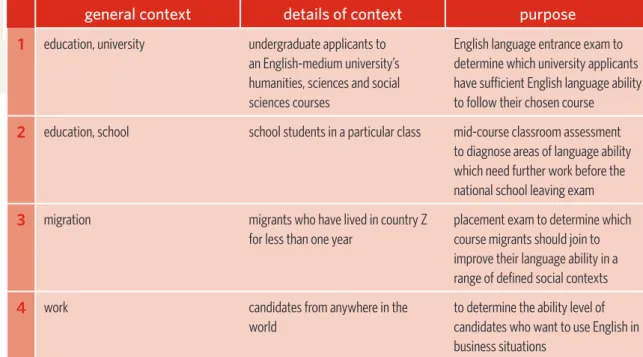
The.first.step.for.test.developers.in.adapting.the.CEFR.to.their.needs.is.to.clearly.define.the. context(s).and.specify.the.purpose(s).of.the.test..The.examples.in.Figure.6.on.p.18.show.that. there.is.a.very.wide.range.of.contexts.and.purposes.for.assessments..Some.cover.small,.probably. homogeneous,.groups.(e.g..2),.other.groups.are.large.and.diverse.(e.g..4)..Likewise,.the.purpose.of. an.assessment.can.be.very.specific.(e.g..3),.or.quite.general.and.applicable.to.many.contexts.of.use. (e.g..4)..If.the.context.and.purpose.of.the.test.is.decided.by.someone.else,.such.as.a.government. agency,.you.must.help.them.to.specify.the.context.and.purpose.as.clearly.as.possible.so.that.the.task. of.developing.the.test.can.be.completed.successfully.
general context details of context purpose
1 education, university undergraduate applicants to an English-medium university’s humanities, sciences and social sciences courses
English language entrance exam to determine which university applicants have sufficient English language ability to follow their chosen course 2 education, school school students in a particular class mid-course classroom assessment
to diagnose areas of language ability which need further work before the national school leaving exam 3 migration migrants who have lived in country Z
for less than one year
placement exam to determine which course migrants should join to improve their language ability in a range of defined social contexts 4 work candidates from anywhere in the
world
to determine the ability level of candidates who want to use English in business situations
Figure 6. Examples of contexts and purposes for assessment
Once.the.context.and.purpose.are.established,.it.is.possible.to.delineate.the.target.language.use. (TLU).situations..For.example,.for.the.university.applicants,.several.TLUs.can.be.imagined:.attending. lectures,.participating.in.seminars,.giving.presentations,.reading.books.and.papers,.writing.reports. and.essays;.and.each.TLU.may.suggest.a.different.combination.of.skills.and.language.exponents.. Furthermore,.demands.may.vary.on.different.courses:.those.such.as.law.may.require.higher.levels.of. ability.in.literacy-related.areas.than.others,.such.as.engineering. The.CEFR.can.help.in.defining.TLUs.with.its.descriptive.scheme..It.divides.language.use.into.four. separate,.wide-ranging.domains.(2001a:45): •. personal •. public •. occupational •. educational. Situations.occurring.within.one.or.more.of.these.domains.can.be.described.by.variables.such.as. the.people.involved,.the.things.they.do.in.the.situation,.and.objects.and.texts.found.in.the.situation. (2001a:46)..Depending.on.the.TLU.situations.considered.most.important,.the.examples.of.contexts. and.purposes.in.Figure.6.may.relate.to.these.domains.like.this:
•. university.. –.educational
•. school. –.personal,.public.and.educational
•. migration. –.personal,.public,.educational.and.possibly.occupational •. work. –.occupational.
Table.5.of.the.CEFR.provides.examples.for.each.category.within.each.domain..Further.schemes.of. classification.are.provided.to.describe.a.number.of.characteristics.in.Chapter.4,.such.as.the.relative. (mental).contexts.of.learners.and.interlocutors.(2001a:51),.communicative.themes.(2001a:51–3),. tasks.and.purposes.(2001a:53–6),.language.activities.and.strategies.(2001a:57–90).
Section.2:.Principles.and.general.usage These.categories.are.illustrated.with.Can.Do.descriptors.arranged.on.scales.corresponding.to.ability. level..The.descriptive.scheme.will.help,.therefore,.not.only.in.describing.the.TLU.situation.but.also. in.determining.the.minimal.acceptable.level.for.your.context..Users.need.to.be.aware,.however,.that. although.the.descriptive.scheme.is.illustrated,.the.CEFR.does.not.contain.an.exhaustive.catalogue. of.all.possible.TLU.situations,.or.descriptions.of.minimal.acceptable.ability.levels..Assessment. developers.will.need.to.determine.what.is.required.for.your.situation.based.on.the.guidance.set.out. within.the.CEFR. The.CEFR.considers.some.types.of.potential.candidates,.but.other.groups.–.notably.young.learners. –.are.not.very.well.covered.in.the.descriptive.scales,.as.they.were.developed.with.adults.in.mind.and. do.not.take.into.account.the.cognitive.stages.before.adulthood..If.your.target.group.of.candidates. consists.of.young.learners,.you.may.need.to.construct.your.own.series.of.scales.along.the.lines.of. those.to.be.found.in.the.CEFR. The.CEFR.is.accompanied.by.a.growing.‘toolkit’.which.is.designed.to.help.users.exploit.the.CEFR.. The Manual for Language Test Development and Examining. For use with the CEFR.(Council.of.Europe/ ALTE.2011).provides.further.guidance.on.this..Reference.Level.Descriptions.are.available.in.several. languages.(see.Appendix.A),.and.validated.Can.Do.statements.are.available.from.organisations.like. the.Association.of.Language.Testers.in.Europe.(ALTE).
Linking tests to the CEFR
At.this.point.in.the.process.of.developing.the.test,.substantial.work.towards.establishing.a.link.to.the. CEFR.will.already.have.been.done..However,.the.test.provider.often.needs.to.show.more.evidence. about.how.a.test.is.linked.to.the.CEFR.and.to.argue.convincingly.for.the.interpretations.that.they. recommend.for.the.test.results.based.on.the.CEFR.levels..This.leaves.the.test.provider.in.the.position. of.designing.a.research.and.evidence.gathering.programme.to.meet.these.needs..For.this.reason,.the. Council.of.Europe.published.Relating Language Examinations to the Common European Framework of Reference for Languages: Learning, Teaching, Assessment (CEFR), A Manual.(Council.of.Europe.2009a),. which.contains.a.range.of.procedures.to.help.test.providers.begin.to.build.their.argument..This. Manual.suggests.a.programme.with.five.main.elements:. •. familiarisation •. specification •. standardisation.training.and.benchmarking •. standard.setting.procedures •. validation. The.programme.of.linking.suggested.by.this.Manual,.and.the.procedures.it.contains.are.by.no. means.the.only.way.such.work.can.be.done,.and.they.are.not.necessarily.appropriate.in.every. context..It.is.important.for.test.providers.to.reflect.carefully.on.whatever.work.they.undertake,.as. it.is.their.responsibility.to.show.that.this.work.supports.the.interpretations.of.test.results.that.they. recommend.to.test.users..The.applicability.of.the.procedures.in.the.Manual.will.differ.according. to.context.and.aims..It.is.also.important.to.note.that.linking.work.should.not.be.seen.as.a.one-off.project.that.never.needs.to.be.revisited;.it.must.be.included.in.the.ongoing.development.and. management.of.the.test..This.is.elaborated.in.North.and.Jones.(2009).and.in.the.following.sections. of.the.current.document.
Test production
Tests.may.be.used.more.than.once,.or.made.in.several.different.versions.for.security.reasons..It.is. important.to.maintain.the.links.to.the.CEFR.throughout.each.cycle.of.test.development,.construction. and.use..The.best.way.to.do.this.is.to.make.sure.the.experts.involved.in.these.tasks.know.the.CEFR.well.and.are.able.to.use.it.in.work.like.vetting.items.for.content,.language.focus.and.difficulty.level.. Ways.must.be.found.to.maintain.this.knowledge,.so.that,.over.time,.their.work.relates.the.test.to.the. CEFR.in.the.same.way.. Detailed.specifications.help.ensure.that.each.test.version.will.be.comparable.with.the.others..For. training.purposes,.or.for.standardising.judgements.of.experts.involved,.the.CEFR.toolkit.offers.several. illustrative.samples.of.items,.tasks.and.candidate.performance.at.each.of.the.common.reference. levels..Such.expert.knowledge.is.needed.at.several.stages.throughout.test.construction: •. items.or.tasks.should.be.examined.by.experts.to.see.if.they.meet.the.criteria.in.the.specification •. items.or.tasks.should.be.edited.by.experts.to.ensure.that.any.necessary.changes.are.made •. the.test.should.be.constructed.so.that.it.meets.its.target.parameters.as.a.whole. Statistics.can.be.used.in.support.of.expert.judgement.to.determine.item.characteristics.using. empirical.data..This.allows.the.experts.to.combine.their.own.judgement.with.other.evidence..For. test.items.and.tasks,.for.example,.the.data.can.come.from.the.responses.candidates.give.in.live.test. situations,.or.in.pretests.(specially.organised.test.sessions.with.the.purpose.of.obtaining.response. data)..Estimated.item.difficulty.can.help.experts.to.see.whether.an.item.is.really.measuring.at.the. ability.level.they.expect.(Council.of.Europe/ALTE.2011).
Assessment standards
Making.sure.that.test.results.always.indicate.the.appropriate.CEFR.ability.level.requires.a.process.for. maintaining.these.standards.over.time..This.means.employing.techniques,.such.as.constructing.tests. using.known.characteristics.and.linking.tests.to.each.other,.standardising.markers.and.monitoring. their.work..It.should.also.be.noted.that.many.steps.already.outlined.in.this.section.will.help.greatly. in.maintaining.the.standards.of.the.test.over.time..For.example,.a.well-designed.process.of.editing. items.which.is.applied.to.each.test.form.in.the.same.way.will.help.to.ensure.comparability.across. forms..North.and.Jones.(2009).describe.maintaining.standards.in.relation.to.the.CEFR.A. constructing tests with known characteristics
When.a.statistical.difficulty.value.is.calculated.for.a.test.item,.a.further.procedure,.called. calibration,.can.make.the.difficulty.value.comparable.with.the.difficulty.values.of.items.from. previous.tests..This.procedure.requires.that.either.some.items.are.shared.between.the.tests,. or.that.some.candidates.sit.both.tests..Calibration.makes.it.far.easier.to.construct.a.new. version.of.the.same.test.at.a.comparable.level.of.difficulty.
B. linking tests to each other
Tests.can.be.linked.to.each.other,.so.that.the.same.standard.is.applied.each.time.a.test. is.used..Linking.is.used.here.as.a.technical.term.and.often.involves.complex.statistical. processes..However,.the.outcome.is.that.scores.or.grade.boundaries.are.converted.on.one. test.so.that.they.are.comparable.with.those.on.another.
C. standardising rater performance and monitoring
To.standardise.the.performance.of.raters,.a.number.of.key.supports.can.be.provided: . – A.clear.and.comprehensive.but.concise.rating.scale.–.these.may.be.based.on.the.Can.Do.scales. found.in.the.CEFR.but.should.be.more.detailed.and.specific.to.your.test.to.limit.ambiguity.. There.should.not.be.too.many.categories,.or.the.scale.becomes.difficult.to.internalise. . – Standardisation.training.–.raters.are.given.pre-rated.materials.and.asked.to.rate.them..Any. discrepancies.are.discussed.leading.to.a.clearer.understanding.of.how.to.apply.the.rating.scale.. Alternatively,.where.raters.are.equally.expert,.discussions.on.discrepancies.should.lead.to.a. single,.shared.interpretation.of.application.of.the.rating.scale. . – Monitoring.–.raters.are.monitored.by.experts.so.that.any.departures.from.the.intended.standard. are.detected.and.corrected.in.the.rating.of.live.tests..This.may.be.done.by.sampling.in.large-scale.operations,.or.by.peer.rating.and.discussion.in.situations.where.raters.are.equally.expert.
Section.2:.Principles.and.general.usage
Principles for development and use of Reference
Level Descriptions
Since.its.publication.in.2001,.the.Council.of.Europe.has.
encouraged.the.development.of.CEFR.Reference.Level.
Descriptions.for.national.and.regional.languages..
These.have.been.developed.for.various.languages.to.date.(see.Appendix.A)..The.main.purpose.of. Reference.Level.Descriptions.is:
[f]or.a.given.language,.to.describe.or.transpose.the.Framework.descriptors.that. characterise.the.competences.of.users/learners.(at.a.given.level).in.terms.of.linguistic. material.specific.to.that.language.and.considered.necessary.for.the.implementation. of.those.competences..This.specification.will.always.be.an.interpretation.on.the.CEFR. descriptors,.combined.with.the.corresponding.linguistic.material.(making.it.possible.to. effect.acts.of.discourse,.general.notions,.specific.notions,.etc.).
(Council.of.Europe.2005:4)
This.section.is.organised.around.the.two.levels.at.which.language.professionals.interact.with.the. Reference.Level.Descriptions:.
•. using.resources.from.the.Reference.Level.Descriptions.in.learning,.teaching.and.assessment •. using.the.CEFR.to.develop.Reference.Level.Descriptions.
The.first.of.these.sections.is.aimed.at.teams.working.on.the.development.of.Reference.Level. Descriptions,.either.for.a.language.where.one.has.not.been.attempted.before.or.where.an.existing. Reference.Level.Description.can.be.updated,.improved.or.extended..The.second.section.is.aimed.at. teachers.and.other.language.professionals.interested.in.how.they.can.make.use.of.already.published. Reference.Level.Descriptions..For.an.example.showing.how.the.CEFR.is.being.expanded.and.
described.for.English,.see.p.31.in.Section.3..
Some.key.principles.for.working.with.Reference.Level.Descriptions.are: 1.. Use.available.Reference.Level.Descriptions.as.a.reference.tool.
2..When.developing.Reference.Level.Descriptions.follow.a.systematic.approach.based.on. empirical.data.
Using resources from Reference Level Descriptions in learning, teaching
and assessment
When.using.resources.from.Reference.Level.Descriptions,.there.are.two.principles.to.keep.in mind:. •. Reference.Level.Descriptions.are.reference.tools.for.teachers,.language.testers.and.other.
language.learning.professionals.to.support.curriculum.design.and.item.writing..Reference.Level. Descriptions.should.not.be.viewed.or.used.as.a.replacement.for.a.teaching.or.testing.method;. for.a.course.curriculum.or.test.specifications.
•. Reference.Level.Descriptions.can.be.used.in.different.ways.according.to.the.learning.situation. and.requirements..It.is.up.to.the.Reference.Level.Description.user.to.decide.which.points.to. include.in.a.particular.course,.syllabus.or.test.depending.on.a.range.of.factors,.like:
.
– the.level.and.range.of.levels.of.learners.on.the.programme .
. – their.reasons.for.learning.English . – their.areas.of.interest . – their.first.language . – their.experience.of.learning.English.so.far . – other.sources.of.input.and.opportunities.to.practise.English.(UCLES/Cambridge.University. Press.2011). Reference.Level.Description.resources.facilitate.decisions.about.what.language.to.include.for. teaching.and.testing.at.each.CEFR.level. There.are.many.ways.in.which.language.professionals.such.as.teachers,.curriculum.planners.and. materials.or.test.writers.can.use.resources.fromReference.Level.Descriptions.to.enable.them.to. make.decisions.about.which.language.points.are.suitable.for.teaching,.learning.and.assessing.at.each. CEFR.level.. Some.areas.which.can.benefit.from.Reference.Level.Descriptions.are.listed.below,.with. exemplification.of.how.different.groups.of.language.professionals.might.use.resources.from. Reference.Level.Descriptions.within.these.areas.(adapted.from.UCLES/Cambridge.University.. Press.2011).
A. Deciding whether particular language points are relevant for a specific purpose, learner group and CEFR level
•. A.teacher.checking.whether.some.key.vocabulary.for.a.lesson.is.suitable.for.their.class. •. A.test.developer.checking.whether.a.particular.grammatical.point.is.suitable.for.an.A2.test. •. An.author.checking.what.aspects.of.a.grammatical.area.(e.g..past.tense).are.suitable.for.a.
B1.course.
B. Identifying suitable language points for a specific purpose, learner group and CEFR level
•. A.curriculum.planner.is.drawing.up.the.vocabulary.list.for.an.A1.course.. •. An.author.wants.to.identify.language.points.that.are.particularly.difficult.for.a.particular.group. of.learners.at.B1.level.(e.g..Spanish.learners.of.English).. •. A.test.developer.has.to.decide.which.structures.to.include.in.the.assessment.syllabus.for.a. C1.exam. •. A.teacher.is.looking.for.a.range.of.examples.of.‘refusing.a.request’.suitable.for.B2.learners.
C. Obtaining authentic learner language to illustrate language points at a specific CEFR level
•. A.teacher.is.putting.together.an.exercise.on.a.particular.language.point,.using.examples. produced.by.learners.at.the.same.level.as.their.class.. •. A.test.writer.is.looking.for.a.suitable.sentence.for.a.particular.test.item. •. A.curriculum.planner.wants.to.add.to.the.syllabus.examples.of.particular.structures.that.are. suitable.for.the.level. •. An.author.is.writing.a.unit.on.health.at.B1.level.and.wants.a.list.of.suitable.words.and.phrases. to.include.. •. A.teacher.is.looking.for.examples.of.‘asking.for.permission’.in.a.formal.work.context.suitable.for. a.B2.class.
D. Gaining a deeper understanding of language points within and across CEFR levels
•. An.author.wants.to.know.how.an.understanding.of.a.language.feature.(e.g..countable/
uncountable.nouns.in.English).progresses.from.A1.to.B1.CEFR.levels.to.work.out.what.should.be. included.in.an.A1.or.B1.level.course..
Section.2:.Principles.and.general.usage
•. A.teacher.wants.to.see.how.the.different.meanings.of.a.polysemous.word.(e.g..keep).are. normally.acquired.across.the.CEFR.levels..Which.meanings.should.students.learn.first?. •. A.test.writer.needs.to.know.what.lexical.items.combine.with.a.specific.structure.to.be.tested.at. B2.level.(e.g..what.verbs.are.most.suitable.for.a.test.item.on.the.passive.voice.in.English).. •. A.curriculum.planner.wants.to.make.sure.the.C2.curriculum.covers.the.language.of.‘presenting. a.counter-example’.in.both.formal.and.informal.contexts.. You.can.find.a.list.of.Reference.Level.Description.resources.per.language.as.well.as.a.link.to.sample. performances.and.tasks.illustrating.the.CEFR.levels.in.a.number.of.languages.in.Appendix.A.
Using the CEFR to develop Reference Level Descriptions
Since.the.six-level.scale.was.developed.(A1.to.C2),.the.Council.of.Europe’s.Language.Policy.Division. has produced.a.guide.to.assist.with.the.development.of.Reference.Level.Descriptions.(Council.of. Europe.2005),.which.outlines.some.general.principles,.including: •. each.Reference.Level.Description.or.set.of.Reference.Level.Descriptions for.a.given.language. implements.solutions.and.makes.choices.adapted.to.the.language.concerned. •. each.Reference.Level.Description.for.each.language.should.refer.to.a.level.of.the.Framework. and.its.descriptors,.and.provide.inventories.of.the.linguistic.material.necessary.to.implement. the.competences.thus.defined.and.explain.the.choice.of.forms. Taking.the.Council.of.Europe’s.guidelines.into.account.but.also.going.beyond.them,.a.number.of. steps.for.developing.CEFR.Reference.Level.Descriptions.for.individual.languages.are.outlined.here:. •. Familiarise.yourself.with.the.CEFR.(Council.of.Europe.2001a).and.the.CEFR.descriptors.you. will.be.exemplifying.(e.g..Written.Production.vs..Written.Interaction)..For.a.range.of.CEFR. familiarisation.activities.see,.for.example,.the.Manual.for.Relating language examinations to the CEFR.(Council.of.Europe.2009a). •. Employ.an.interdisciplinary.research.approach,.that.is,.get.expertise.from.a.range.of.language. fields.(e.g..theoretical.and.applied.linguistics,.second.language.acquisition/learning,. pedagogy,.etc.),.to.best.address.and.capture.the.complexity.of.language.learning.and.learner. performances.reflected.in.the.Reference.Level.Descriptions. •. Follow.an.empirical.approach.–.in.addition.to.using.expert.judgement,.base.your.Reference. Level.Descriptions.on.learner.data.that.is.aligned.to.and.exemplifies.the.CEFR.levels.–.for. example,.learner.corpora..For.methods.of.linking.empirical.data,.e.g..exam.data,.to.the.CEFR. see,.for.example,.the.Manual.for Relating language examinations to the CEFR.(Council.of.Europe. 2009a). •. Reference.Level.Descriptions.should.be.descriptive.–.they.should.describe.what.learners.know. and.can.do.at.each.CEFR.level..They.should.not.be.prescriptive,.designed.to.be.an.exhaustive. list.of.materials.to.be.taught.or.assessed.per.CEFR.level.. •. Provide.sample.learner.performances.for.Speaking.and.Writing.to.illustrate.the.Reference.Level. Descriptions.for.the.productive.skills..Provide.sample.Reading.and.Listening.tasks.to.illustrate. the.Reference.Level.Descriptions.for.the.receptive.skills. •. Engage.the.language.learning,.teaching.and.testing.community.during.the.development.of.the. Reference.Level.Descriptions..This.can.be.done,.for.example,.by.creating.a.project.network. which.involves.potential.users.of.Reference.Level.Descriptions,.by.organising.workshops.and. seminars,.and.by.inviting.feedback.on.your.project..Reference.Level.Descriptions.should.both. inform.and.be.informed.by.the.needs.of.the.community.of.its.users. •. Provide.relevant.literature.(e.g..lists,.research.papers,.reports).that.detail.the.Reference.Level. Descriptions.and.the.research.behind.them.
Developing.Reference.Level.Descriptions.is.usually.a.long-term.endeavour.involving.a.wide.range.of. resources.and.expertise..However,.different.scales.of.such.a.project.can.be.attempted.depending.on. the.resources.and.expertise.available..One.may.decide.to.focus,.for.example,.on.a.particular.CEFR. level.(e.g..B2);.or.skill.(e.g..Written.production);.on.a.group.of.learners.from.a.specific.linguistic. background.(e.g..French.learners.of.English);.on.a.particular.age.group.(e.g..teenage.learners).and. so.on..One.may.therefore.develop.Reference.Level.Descriptions.tailored.to.one’s.particular.context. and.needs.–.e.g..Reference.Level.Descriptions.that.illustrate/describe.the.Written.production.skills.of. French.high.school.(teenage).learners.of.English.at.B2..Developing.Reference.Level.Descriptions.for. a.very.specific.learner.group.or.learning.situation.is.appropriate.as.long.as.this.specific.scope.of.the. Reference.Level.Descriptions.is.made.clear.when.they.are.published.
Despite.the.scale.of.the.project.for.developing.Reference.Level.Descriptions:
….[i]t.should.be.remembered.that.producing.descriptions.of.the.CEFR.reference.levels,. language.by.language.and.level.by.level,.is.not.an.end.in.itself..The.purpose.of.the. descriptions.is.to.bring.transparency.to.the.aims.pursued.in.teaching.and.certification,. as.this.guarantees.fairness.and.comparability.in.language.teaching…..These.descriptions. are.designed.essentially,.after.and.like.the.Framework,.to.help.build.a.variety.of.teaching. programmes.that.contribute.to.(the).plurilingual.education….,.which.is.a.condition.and.a. practical.form.of.democratic.citizenship.
Section 3:
.Applying.the.
CEFR.in.practice
‘There.is.a.difference.between.having.a.very.good.
idea.of.what.the.relationship.is.and.confirming.it..
Cambridge.ESOL.is.an.exception,.because.there.is.a.
relationship.between.the.levels.in.the.CEF[R].and.the.
levels.of.the.Cambridge.ESOL.exams.’.
North (2006)
Key Resources
Cambridge ESOL (2011) Principles of
Good Practice: Quality management and
validation in language assessment.
www.research.cambridgeesol.org
for a complete archive of Research Notes.
Martyniuk, W (ed.) (2010) Aligning Tests
with the CEFR. Reflections on using the
Council of Europe’s draft Manual.
Applying the CEFR in practice: Aligning Cambridge ESOL
examinations to the CEFR
Ever.since.the.first.Cambridge.English.exam.was.introduced.in.
1913,.our.approach.has.always.been.to.develop.tests.that.meet.
specific.needs,.and.the.CEFR.plays.a.key.role.in.this.process.
Since.then,.Cambridge.ESOL.has.continually.extended.the.range.to.include.exams.at.a.wide.variety. of.levels.and.for.purposes.as.diverse.as.higher.education.and.migration;.business,.legal.and.financial. communication;.and.motivating.and.rewarding.young.learners.
These.are.complemented.by.a.range.of.qualifications.for.teachers,.and.by.a.very.wide.spectrum.of. supporting.services,.all.designed.to.support.effective.learning.and.use.of.English..Most.of.our.exams. can.be.taken.either.as.paper-based.or.computer-based.versions.
Section.3:.Applying.the.CEFR.in.practice
Point 1 – Shared origins and long-term engagement
The.Cambridge.examinations.informed.the.development.of.the.CEFR.and.have.been.informed.by. it..Cambridge.ESOL.has.been.continuously.involved.in.the.development.and.implementation.of. the.CEFR.since.its.earliest.stages.in.the.1980s..Since.then,.in.an.ongoing.engagement.over.more. than.20.years,.the.links.have.been.strengthened.through.a.process.of.convergence,.supported.by. ongoing.research.and.close.collaboration.between.Cambridge.ESOL.and.the.Council.of.Europe..
Point 2 – Integrated item banking and calibration systems
Well-established.calibration.systems.are.used.to.establish.comparisons.between.the.levels. of.the.Cambridge.English.exams.and.to.maintain.an.alignment.to.external.benchmarks.such. as.the.CEFR..This.system.is.built.into.routine.procedures.for.every.examination.session,. rather.than.just.applying.a.one-off.snapshot.of.a.single.session..Data.from.millions.of. candidates.over.more.than.20.years.is.used.to.validate.this.alignment.
Point 3 – Quality management and validation
Quality.management.systems.certified.to.ISO.standard.9001:2008.are.used.at.every.stage. in.the.development,.marking,.grading.and.evaluation.of.all.Cambridge.English.examinations.. These.processes.use.data.from.‘live’.examinations.conducted.throughout.the.world.and. involve.constant.cross-referencing.to.the.CEFR..Cambridge.ESOL’s.publication.Principles of Good Practice: Quality management and validation in language assessment (2011).sets.this.out.in. a.clear.and.accessible.way.for stakeholders.
Point 4 – Alignment and standard-setting studies
Since.2001.alignment.exercises.and.standard-setting.studies.have.been.carried.out.in.line. with.the.recommendations.made.in.the.extensive.supporting.documentation.produced. by.the.Council.of.Europe..These.studies.have.led.to.international.symposia.hosted.by. Cambridge.ESOL.and.ALTE,.case.study.conferences.and.reports.and.publications,.and. presentation.of.academic.papers.at.international conferences.
Point 5 – Application and extension of the CEFR for English
Cambridge.ESOL.continues.to.work.closely.with.the.CEFR.and.to.adapt.and.extend.it.in. useful.ways,.particularly.in.its.specific.application.to.English..This.has.included.producing.the. exemplar.materials.for.use.with.the.CEFR,.carrying.out.international.benchmarking.exercises. with.ALTE.(e.g..for.speaking),.supporting.the.development.of.the.Council.of.Europe.Manuals. and.user.guides,.and.leading.work.on.the.production.of.Reference.Level.Descriptions.for. English.(the.English.Profile Programme).
Point 1 – Shared origins and long-term engagement
The.CEFR.originates.in.well-established.levels.and.its.conceptual.framework.has.a.long-standing. basis.in.classroom.practices.dating.back.to.the.1970s..In.fact,.the.Cambridge.English.exams.played. an.important.part.in.the.early.development.of.the.CEFR.–.as.noted.by.Brian.North,.one.of.the.. co-authors.of.the CEFR.
‘….the.process.of.defining.these.[CEFR].levels.started.in.1913.with.the.Cambridge. Proficiency.Exam.(CPE).that.defines.a.practical.mastery.of.the.language.as.a.non-native. speaker..This.level.has.become.C2..In.1939,.Cambridge.introduced.the.First.Certificate. (FCE),.which.is.still.seen.as.the.first.level.of.proficiency.of.interest.for.office.work,.now. associated.with.B2.’
(North:2006)
1913 • Cambridge Proficiency Exam (CPE) launched – a test which played a large role in the development of level C2 of the CEFR .
1939 • Lower Certificate (now Cambridge English: First or FCE) launched – a test set at the level now associated with Level B2 of the CEFR.
1980–1990 • Cambridge, along with British Council, BBC English and others provides support for revising Threshold and Waystage resulting in the revised PET exam (B1 level) and a new KET exam (A2) in the early 1990s.
1990–2001 • The Association of Language Testers in Europe (ALTE) is set up in 1990 and develops the five-level ALTE Framework.
• 1991 Rüschlikon intergovernmental symposium – Dr Peter Hargreaves (Cambridge ESOL) speaks of ‘natural levels’. Advisory Group set up including Dr Michael Milanovic from Cambridge ESOL.
• Cambridge introduced item-banking and calibration systems. IELTS is calibrated using the same methods as the other Cambridge examinations.
• The Business English Certificates (BEC) developed in the 1990s and their levels are aligned to the CEFR in the same way as the other exams.
• Cambridge ESOL and ALTE conduct several studies which result in the ALTE Can Do Project (1998–2000), and the alignment of the Cambridge English exams. ALTE members adopt the CEFR levels.
Figure 8. The historical context – Cambridge ESOL and the CEFR
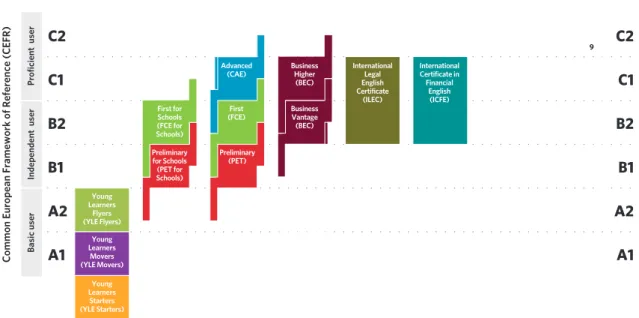
The.convergence.between.the.Cambridge.General.English.examinations.and.the.six.reference.levels. of.the.CEFR.continued.during.the.1990s..The.KET.(A2).and.PET.(B1).exams.were.directly.based. on.the.Waystage.and.Threshold.specifications,.and.the.introduction.of.CAE.(C1).was.designed.to. complete.five.levels.of.the.proficiency.framework.which.now.make.up.the.CEFR..The.introduction.of. the.Cambridge.Young.Learners.English.Tests.(YLE).in.1997.filled.in.the.A1.level.
At.the.same.time,.the.work.of.Cambridge.ESOL.and.its.partners.in.the.Association.of.Language. Testers.in.Europe.(ALTE).in.the.1990s.played.a.big.part.in.the.development.of.the.CEFR..
During.the.1990s,.the.ALTE.members.engaged.in.the.development.of.the.five-level.ALTE.Framework. –.a.project.to.establish.common.levels.of.proficiency.which.sat.alongside.the.CEFR..Cambridge. ESOL.and.the.ALTE.members.conducted.several.studies.to.explore.and.verify.the.alignment.of.the. ALTE.Framework.and.the.CEFR.levels..The.ALTE.Can.Do.Project.(1998–2000).for.example.was.an. important.empirical.approach.used.by.Cambridge.ESOL.for.alignment.to.the.CEFR,.and.contributed. to.the.adoption.by.the.ALTE.partners.of.the.six.CEFR.levels.(A1–C2)..
Section.3:.Applying.the.CEFR.in.practice
The.ALTE.Framework.and.Can.Do.projects.were.instrumental.in.confirming.what.learners.can. typically.do.at.these.levels..They.analysed.the.content.and.proficiency.level.of.the.tests.as.part.of. the.process.of.aligning.them.to.the.levels.of.the.ALTE.Framework.and.later.the.levels.of.the.CEFR.. Examples.of.typical.general.language.ability.plus.ability.in.each.of.the.skills.areas.and.in.a.range.of. contexts.were.found.to.be.consistent.with.the.CEFR.level.statements..
Point 2 – Integrated item banking and calibration systems
In.1990.Cambridge.ESOL.was.the.first.UK-based.examinations.board.to.introduce.an.item. banking.approach.to.calibrating.its.examinations.using.Rasch.modelling..This.is.an.approach.to.test. production.which.ensures.that.all.materials.can.be.consistently.related.to.the.same.scale.by.using. statistical.techniques.
As.a.result,.data.from.over.15.million.test.takers.has.been.analysed.over.the.last.two.decades..This. model.of.calibration.helps.ensure.that.the.proficiency.levels.reported.in.the.Cambridge.examinations. have.remained.stable.over.time.
Other.notable.research.projects.include.the.Common.Scale.for.Writing.project.and.a.series.of. volumes.in.the.series.Studies in Language Testing.which.look.in.detail.at.the.assessment.of.language. skills.in.relation.to.the.CEFR.
Point 3 – Quality management and validation systems
In.addition.to.the.CEFR.itself,.the.Council.of.Europe.has.provided.guidance.for.educationalists,. examination.providers,.policy-makers.and.administrators.in.the.form.of.recommendations.and.user. guides..See.for.example.Recommendation.CM/Rec(2008)7.of.the.Committee.of.Ministers.together. with.its.Explanatory.Notes.and.the.CEFR.’toolkit’.which.includes.manuals.and.supporting.resources. Along.with.partners.in.ALTE,.Cambridge.ESOL.has.contributed.to.this.toolkit,.including.the.two. manuals.–.the.Manual.for.Relating Language Examinations to the CEFR.(Council.of.Europe.2009a).and. the.Manual for Language Test Development and Examining.(Council.of.Europe/ALTE.2011).–.and.their. supporting.materials..
The.latter.focuses.on.designing.and.maintaining.tests.under.operational.conditions.and.provides. explicit.guidance.in.this.area..Alignment.of.a.test.to.the.CEFR.is.not.meaningful.unless.the.test. provider.can.demonstrate.that.it.has.systems.in.place.to.ensure.that.the.proficiency.standards.it.sets. are.consistent.over.time..
This.is.emphasised.in.the.Explanatory.Notes.of.the.Council.of.Europe’s.Recommendation.CM/ Rec.(2008)7.of.the.Committee.of.Ministers.which.clearly.states.that.when.making.cases.for. alignment,.examination.providers.need.to.account.for.‘the.quality.of.their.assessment.procedures. and.qualification.with.reference.to.the.principles.of.good.practice.which.exist.in.the.field.of.language. assessment.in.general.and.as.set.out.in.internationally.recognised.Codes.of.Practice’.
ALTE.has.also.developed.its.own.Code.of.Practice.and.Quality.Management.System.which.provide. the.basis.for.auditing.language.examinations.in.relation.to.professional.standards..Seventeen. essential.parameters.have.to.be.accounted.for.within.the.quality.profile.for.each.examination. and.audited.as.set.out.in.the.Procedures.for.Auditing..It.should.be.noted.that.only.one.of.these. parameters.deals.directly.with.alignment.to.a.framework.such.as.the.CEFR.
Cambridge.ESOL’s.approach.to.developing.and.administering.exams.is.based.on.a.set. of.formalised.processes.which.are.certified.to.the.ISO.9001:2008.standard.for.quality. management,.and.audited.on.an.annual.basis.by.the.British.Standards.Institution.(BSI)..