Proceedings of the
Sixth International Workshop on
Graph Transformation and Visual Modeling Techniques
(GT-VMT 2007)
Rule-Level Verification of Business Process Transformations
using CSP
D´enes Bisztray, Reiko Heckel
13 pages
Guest Editors: Karsten Ehrig, Holger Giese
Managing Editors: Tiziana Margaria, Julia Padberg, Gabriele Taentzer
Rule-Level Verification of Business Process Transformations
using CSP
D´enes Bisztray1, Reiko Heckel2
Department of Computer Science, University of Leicester
1[email protected],2[email protected]
Abstract:Business Process Reengineering is one of the most widely adopted tech-niques to improve the efficiency of organisations. Transforming process models, we intend to change their semantics in certain predefined ways, making them more flex-ible, more restrictive, etc.
To understand and control the semantic consequences of change we use CSP to capture the behaviour of processes before and after the transformation. Formalising process transformations by graph transformation rules, we are interested in verify-ing semantic properties of these transformations at the level of rules, so that every application of a rule has a known semantic effect.
It turns out that we can do so if the mapping of activity diagrams models into the semantic domain CSP is compositional, i.e., compatible with the embedding of pro-cesses into larger contexts.
Keywords:Business Process Reengineering, Activity Diagrams, Graph Transfor-mation, CSP, Verification
1
Introduction
Abusiness processis a flow of actions, representing the work of an individual, internal system, or external partner company, towards a definite business goal [Hav05]. Abusiness process modelis a specification of a set of business processes. Of the different aspects addressed by such models we will be interested in the behavioural one, theworkflow specification.
When organisations adapt to new markets or optimise their business processes, their workflows need to change, too. Business Process Reengineering is concerned with the systematic analysis and redesign of business process models. Depending on the objectives, changes may apply to the internal structure of the process model, preserving its semantics, or to the behaviour itself, making the workflow more flexible or more restrictive, adding new features, etc.
desired semantic effect, e.g., if the processes before and after the change are equivalent, if one is a restriction or extension of the other.
However, if the workflow models are sufficiently complex, a complete formal analysis of the corresponding CSP processes may be impossible or too costly. Therefore, we are are looking for a formalisation oflocalprocess transformations, which can be analysed separately for their semantic effect and sequentially composed in order to implement more complex changes.
To define process transformations, we formalise the abstract syntax of activity diagrams in terms of typed graphs, where a type graphT Gplays the role of a metamodel for the language and instance graphsGtyped overT Grepresent individual diagrams. Changes to these diagrams can then be specified by typed graph transformation rules, providing us with a formalisation of local workflow redesign steps.
Hence our approach combines two main ingredients: CSP as a semantic domain and analysis technique for workflow models, and rule-based graph transformations for specifying local re-design steps. The main question is about the relation of one with the other: How does a rere-design transformation affect the semantics of processes?
It turns out that the question can be answered at the level of rules if the mapping from activity diagrams to CSP is compositional in the sense that the mapping of a sub-activity diagram yields a sub-CSP process at the semantic level. Describing the mapping from activity diagrams to CSP by triple graph grammars [Sch94], we can use results from the theory of graph transformation to verify the compositionality of the mapping.
The paper is structured as follows: in Section2, we informally introduce the concept of se-mantics based verification of business process redesign. In Section3we present the mapping of activity diagram to CSP. Section4formally states the requirements needed to verify the semantic effect of transformations at the rule level and discusses them with respect to the mapping defined before. Section5concludes the paper.
2
Business Process Reengineering
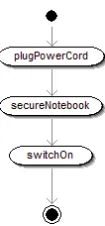
For a motivating example, we consider a simple transformation on a workflow that describes the unpacking of a notebook computer.
Figure 1: Sample process of unpacking a notebook
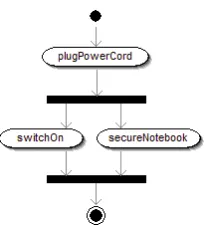
cord. Then, we secure the notebook with a cable lock. Finally, we have to switch on the computer. Analysing this process, we discover that this process could be made more flexible. For reacting to a situation where the cable lock is not available in time we may decide that the notebook can be switched on independently from securing it. The new process model, which allows both activities in either order as shown in Figure2, represents a semantic extension of the old one.
Figure 2: Redesigned notebook unpacking
Formally, the semantics of these processes is defined by standard CSP expressions. Up to substitution of process equations, the result of the mapping introduced in detail in Section 3
is shown below, with definition (1) describing the original process and equation (2-4) for the redesigned process.
U NPACKO=plugPowerCord→secureNotebook→switchOn→SKIPU NPACKO. (1)
U NPACKR=plugPowerCord→(S1kS2) (2) S1=secureNotebook→processJoin→SKIPS1 (3)
S2=switchOn→processJoin→SKIPS2 (4)
SKIPAis defined as a process which does nothing but terminating successfully, with alphabet
A∪ {X}[Hoa85].
Analysing the processes before and after the transformation, we discover that
• the original process has only one tracehplugPowerCord, secureNotebook, switchOni;
• ignoring the processJoin action, in the redesigned process there are the two traces hplugPowerCord, switchOn, secureNotebooki, hplugPowerCord, secureNotebook, switchOni.
The behaviour of the old process is thus present in the new one, i.e., traces(U NPACKO) ⊆
traces(U NPACKR).
Figure 3: Redesign rule
graph transformation rules as the one sketched in Figure3and apply the mapping to CSP on its left- and right-hand side.
PROCL=A→B→SKIPPROCL (5)
PROCR= (A→processJoin→SKIPAkB→processJoin→SKIPB) (6)
We can indeed observe that, after hiding the processJoin action, the traces of PROCL are
included in those of PROCR, and from general results about CSP trace refinement [Hoa85] it
follows that this relation is closed under the embedding of CSP processes into context. To benefit from this fact we have to formalise and study the mapping of activity diagrams to CSP, which is described in the following section by means of triple graph grammars.
3
Mapping Activity Diagram to CSP
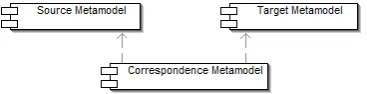
This section specifies a mapping from activity diagrams to CSP processes. Contrary to previous approaches [LBC00], we follow the approach of triple graph grammars (TGGs), where the ab-stract syntax of both activity diagrams and CSP processes are represented by typed graphs, i.e., instances of corresponding metamodels. A third metamodel as depicted in Figure4, is used to capture the relation between corresponding elements of diagrams and processes. A brief intro-duction to TGGs is provided, however the detailed explanation can be found in [Sch94].
Figure 4: Triple graph grammar concept
3.1 Abstract Syntax
(a) Abstract syntax for CSP (b) Abstract syntax for Activity Diagram
Figure 5: Abstract Syntax
• Ifbis a Boolean andE andF are process expressions, a Condition is an expressionE6<
b6>F(if b then E else F);
• ifEandF are expressions, Split is their sequential compositionE;F(upon termination of E, continue as F);
• if E and F are expressions Concurrency yields their synchronous parallel composition
EkF (perform E and F in lock-step synchronisation of shared events).
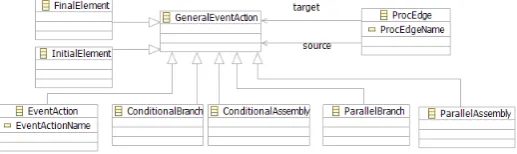
A simplified metamodel for activity diagram based on [OMG05] is shown in Figure 4(b). Nodes not present in the standard document include the BranchingNode and AssemblingNode. The BranchingNode is the superclass of the fork-like nodes that have one incoming edge and several outgoing edges. The AssemblingNode is the superclass for the join-like nodes, that have several incoming edges and one outgoing edge. Without loss of generality we restrict Action nodes to have only one incoming one outgoing edge.
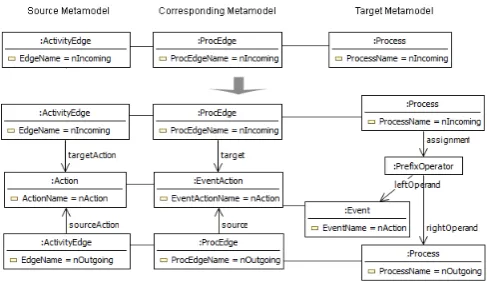
In order to be able to specify triple graph grammar rules, we require a correspondence meta-model as given in Figure6. The EventAction is connected via associations to both Event in the Activity Diagram metamodel and Action in the CSP metamodel. The same is assumed for Pro-cEdge as the intermediary of Process and ActivityEdge, etc. Such associations are omitted from the illustrations to simplify the layout.
3.2 Transformation Method
Next we illustrate the design of our transformation rules, concentrating on a single rule for a detailed representation while using a semi-formal notation based on the concrete syntax for the others.
Consider the following simple example rule for transforming an Action node. The concrete syntax of the transformation rule is depicted in Figure7.
Figure 7: Action rule with concrete syntax
The idea behind the mapping is to relate an Edge in the activity diagram to a Process name in CSP. A previously introduced edge/process nameAis defined in terms of a new prefix expression, and the continuation edge/process nameBis introduced.
Figure 8: TGG Rule
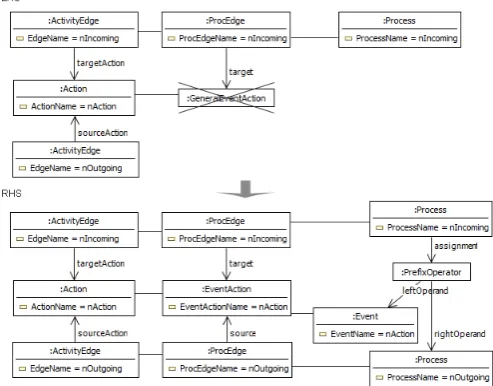
In order to be used for a transformation from activity diagrams to CSP (rather than a sym-metrical specification of their correspondence), the translation of the TGG rule to ordinary graph transformation rule is illustrated in Figure9. There are various tools that enable the automatic generation of graph transformation rules from TGG rules. We match the pattern of an Action with incoming and outgoing edges, and create the corresponding CSP elements. A negative ap-plication condition [EEPT06] is defined for the relational element to prevent us from applying the same rule twice.
Figure 9: Graph Transformation rule
Indeed, a pragmatic benefit of TGGs consists in the use of the correspondence model for controlling the progress of transformation. The creation of relational elements, in combination with negative application conditions on the correspondence and target model, allow us to retain the original model and restrict ourselves to non-deleting rules. These two properties will be important later.
3.3 Transformation Rules
In this section we define the remaining transformation rules based on the concrete syntax of CSP and activity diagrams.
First, we consider the InitialNode depicted in Figure 10. Although this node is not mapped to anything directly, its outgoing ActivityEdge is related to a process definition with the same name. This will be the first process.
Figure 10: InitialNode
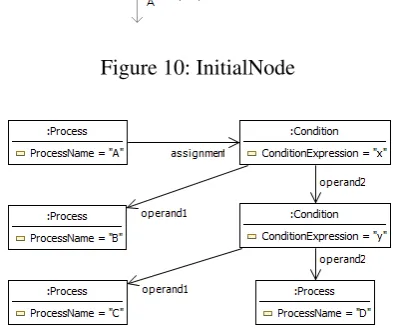
Figure 11: Abstract syntax tree for the result of DecisionNode transformation
Note that this transformation, which creates non-determinism at the syntactic level, leads to semantically equivalent processes. According to [OMG05],the order in which guards are eval-uated is undefined andthe modeler should arrange that each token only be chosen to traverse one outgoing edge, otherwise there will be race conditions among the outgoing edges. Hence, if guard conditions are disjoint, syntactically different nestings are semantically equivalent.
Figure 12: DecisionNode
The MergeNode is a simpler case, as illustrated in Figure 13. It is mapped to an equation identifying the processes corresponding to the two incoming edges.
Figure 13: MergeNode
other process that accidentally has events with similarly names. On the other hand we need synchronisation points in order to implement the joining of processes. Thus we add an event
processJointo the alphabet of every participating processes. Since events that are in the alpha-bets of all participating processes require simultaneous participation, this fact is used to join concurrent processes by blocking them until they can perform the synchronisation event.
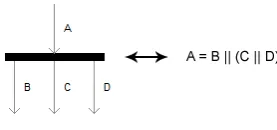
The rule for the ForkNode is shown in Figure14. The Concurrency operator is binary, so by processing the nodes one-by-one, we create a binary abstract syntax tree of Concurrency nodes like we did in Figure11for the Condition operator. SincePk(QkR) = (PkQ)kR, the different trees are semantically equivalent.
Figure 14: ForkNode
The transformation of JoinNode is depicted in Figure15. The first edge that meets the JoinN-ode is chosen to carry the continuation process, while the others terminate in aSKIP. As we mentioned, CSP expressions2-4) are based on this transformation. The process corresponding toDis substituted, since it terminates after the syncronisation.
Figure 15: JoinNode
4
Rule-Level Verification
In this section we provide a formalisation of the notions required to define the compositionality condition of the mapping and state the main objective of the approach as a theorem. As mentioned in Section 1, we handle business processes as typed graphs, and reengineering steps as graph transformations. Since the contributions in this section are based on equivalence and refinement of CSP processes, we summarise the necessary definitions based on [Hoa85].
Atraceis a finite sequence of symbols recording the events in which the process has engaged up to some point in time. The set of all traces of a processPis denoted bytraces(P). Processes
L m c / /R c m∗ G / /H
c(G) ? c(H)
c(L) S
K
S
c(R)
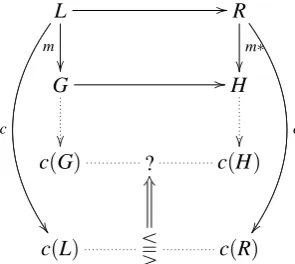
Figure 16: CSP correspondence for behaviour verification
distinguished process variableX. The relations of trace equivalence and refinement are closed under context, i.e.,P≡Q =⇒ E(P)≡E(Q)andPvQ =⇒ E(P)vE(Q).
Denoting the mapping from activity diagrams to CSP byc, the idea of rule-level verification is illustrated in Figure 16. The original business process is given by graph G, the redesigned one by the resulting graphH of the application of rule p:L→Rat matchmand comatchm∗. Applying the mappingcto the rule’s left- and right hand side, we compare the corresponding CSP expressions c(L) and c(R), checking, e.g., thatc(L)vc(R) (the right process has more traces than the left one). From this relation at the level of the rule we hope to conclude that the same holds for all its transformations, i.e.,c(G)vc(H). For such a property to hold, we make the following assumption on the mappingc.
Definition 1 (compositionality) A mapping c from graphs to CSP expressions is com-positional if for all injective graph morphisms m : L → G there exists a context E
such that c(G) ≡E(c(L)). Moreover, this context is uniquely determined by the part of
G not in the image of L, i.e., given a pushout diagram as below with injective mor-phisms only, and a context F with c(D) ≡ F(c(K)), then E and F are equivalent.
K l //
d L m
D g //G
Definition1applies particularly whereLis the left hand side of a rule andGis the given graph of a transformation. In this case, the CSP expression generated fromLcontains the one derived fromGup to equivalence, while the context is uniquely determined byG\m(L).
Theorem 1 If a mapping c from graphs to CSP expressions is compositional, for all transfor-mations G p,m +3H via rule p:L→R with injective match m, it holds that c(L),c(R)implies c(G),c(H), where,is any relation in{≡,v,w}.
B b0 //
G0
c +3
m0 Gn mn
C //
(2)
H0
c +3
Hn (1)
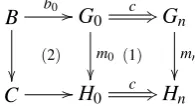
Figure 17: Extension diagram
c(G)≡E(c(L))andc(H)≡F(c(R)). Now,E(c(L)),E(c(R))sincec(L),c(R)and the rela-tion is closed under context. Finally,E(c(R))≡F(c(R))by the uniqueness of the context.
In the following we discuss how our mapping from activity diagram to CSP satisfies the com-positionality condition. Since we did not introduce our mapping formally, we only provide a sketch of a proof. The main argument is based on the Embedding Theorem [Ehr77] and its ex-tension to conditional graph transformations [Hec95]. In the basic version we assume a graph
H0 including a smaller one G0with inclusion morphismm0. For a sequence of transformation c: G0
∗ +3
Gn we create a boundary graphBand a context graphC. The boundary graph is
the smallest subgraph ofG0which contains the identification points and dangling points ofm0.
Since (2) is a pushout, the context graph can be determined. If none of the productions of c
deletes any item ofB, thenm0is consistent withcand there is an extension diagram overcand m0. This basically means thatHnis the pushout complement ofcandm0, thus can be determined
without applying the transformationconH0. Hence, the compositionality condition holds forc. Adding context and boundary graph to our picture, we get the extension diagram in Figure17. The initial graph G0 is either the LHS or the RHS of a production rule in the reenginering
transformation. With our previous notation,Gn equalsc(G0), i.e., our graph transformation
im-plements the mappingcand our inclusion graph morphism is the matchm0for the actual rule.
In our case, consistency of the embedding is trivial because, due to the use of triple graph grammars, our rules never delete nodes. Moreover, the embeddings we are interested in only add new context to the source model part of the graph, while negative conditions are only concerned with the correspondence and target part. This ensures that the embedding never violates any of the application conditions, i.e., the embedding theorem holds for the conditional transformations, too [Hec95].
Uniqueness of the context follows from the fact that the mappingcis deterministic.
5
Conclusion
In this paper we have studied the relation between two dimensions of model transformations: a semantic dimension representing a mapping of models into another formalism, and a dimension of change capturing the evolution of models. We have investigated an example and defined a condition which ensures that the effect of change on the semantics of models is predictable at the level of rules.
domain for analysing models. A similar approach has been proposed in [EGHK02], but without formalising it.
Future work consists in completing the definition of the mapping and the proof that it satisfies the compositionality condition. In relation to business processes we intend to add a concept of observable vs. hidden actions to make more flexible use of existing notions of process equiva-lence.
Acknowledgements: This work has been partially sponsored by the project SENSORIA, IST-2005-016004. The authors also wish to thank Hartmut Ehrig for pointing out an improvement of the main theorem of the paper.
Bibliography
[BEH06] L. Baresi, K. Ehrig, R. Heckel. Verification of model transformations: A case study with BPEL. In Bruni et al. (eds.), Proc. 2nd Symposium on Trustworthy Global Computing (TGC 2006), November 2006, Lucca, Italy. LNCS. November 2006.
[BMR+96] F. Buschmann, R. Meunier, H. Rohnert, P. Sommerlad, M. Stal.A System of Patterns. Pattern-Oriented Software Architecture Volume 1. John Wiley and Sons, 1st edition, August 1996.
[EEPT06] H. Ehrig, K. Ehrig, U. Prange, G. Taentzer. Fundamentals of Algebraic Graph Transformation (Monographs in Theoretical Computer Science). An EATCS Series. Springer-Verlag New York, Inc., Secaucus, NJ, USA, 2006.
[EGHK02] G. Engels, L. Groenewegen, R. Heckel, J. K¨uster. Consistency-preserving model evolution through transformations. In Jezequel et al. (eds.),Proc. UML 2002, Dres-den, Germany. LNCS 2460. Springer-Verlag, Oct. 2002.
[Ehr77] H. Ehrig. Embedding Theorems in the Algebraic Theory of Graph Grammars. In
Fundamentals of Computation Theory, Proceedings of the 1977 International FCT-Conference. Pp. 245–255. Poznan-K´ornik, Poland, September 1977.
[Hav05] M. Havey.Essential Business Process Modeling. Theory In Practice. O’Reilly Me-dia, August 2005.
[Hec95] R. Heckel. Embedding of Conditional Graph Transformations. In Valiente Feruglio and Rosello Llompart (eds.),Proc. Colloquium on Graph Transformation and its Application in Computer Science. 1995.
[Hoa85] C. A. R. Hoare.Communicating Sequential Processes. Prentice Hall International Series in Computer Science. Prentice Hall, April 1985.
[OMG05] OMG. Unified Modeling Language, version 2.0. Website, August 2005.
http://www.omg.org/technology/documents/formal/uml.htm
[Ros97] A. W. Roscoe. Theory and Practice of Concurrency. Prentice Hall, 1st edition, November 1997.