Volume 6 (2007)
Proceedings of the
Sixth International Workshop on
Graph Transformation and Visual Modeling Techniques
(GT-VMT 2007)
Triple Patterns: Compact Specifications for the Generation of
Operational Triple Graph Grammar Rules
Juan de Lara, Esther Guerra, Paolo Bottoni
14 pages
Guest Editors: Karsten Ehrig, Holger Giese
Managing Editors: Tiziana Margaria, Julia Padberg, Gabriele Taentzer
Triple Patterns: Compact Specifications for the Generation of
Operational Triple Graph Grammar Rules
Juan de Lara1, Esther Guerra2, Paolo Bottoni3
1
Escuela Polit´ecnica Superior Universidad Aut´onoma de Madrid (Spain)
2
Dep. Ingenier´ıa Inform´atica Universidad Carlos III de Madrid (Spain)
3
Dip. Informatica
Universit`a di Roma La Sapienza (Italy)
Abstract: Triple Graph Grammars (TGGs) allow the specification of high-level rules modelling the synchronized creation of elements in two graphs related through a correspondence graph. Low-level operational rules are then derived to manipulate concrete graphs. However, TGG rules may become unnecessarily verbose when el-ements have to be replicated from one graph to the other, and their actual derivation cannot exploit the presence of reoccurring patterns. Moreover they do not take ad-vantage from situations in which a normal creation grammar for one of the graphs exists, from which TGG operational rules can be derived to build the other graph.
We present an approach to generating TGG operational rules from normal ones, reducing the information needed to derive them, through the definition of Triple
Patterns, a high-level, compact, declarative, and visual notation for the description
of admissible structures in a triple graph. Patterns can be expressed with respect to classes defined in a meta-model, and instantiated with derived classes at the model level, thus exploiting the inheritance hierarchies. The application of the generated rules results into the (synchronized or batch) creation of the structures specified in the patterns. We illustrate these concepts by showing their application to the synchronized incremental construction of visual models and of their semantics.
Keywords: Graph Transformation, Triple Graph Grammars, Visual Languages.
1
Introduction
relevant semantic roles, see [BDD+04]), one would like to model the synchronized evolution of both models (although a batch update of the semantic model could also make sense). For tool integration applications, a (bi-)directional – batch or incremental – transformation is desir-able [Sch94]. Finally, one could be interested in checking the consistency of two given models.
Triple Graph Grammars (TGGs) [Sch94] were proposed by Sch¨urr as a means to model the transformation of two graphs (source and target) related through a correspondence graph (whose nodes have morphisms to elements in the other two graphs). The main idea is to model the synchronized evolution of the two graphs, as well as the correspondence graph relating both, by means of triple rules. From these creation triple rules, algorithms were given to produce
operational rules to perform a translation in either direction (from source to target or vice versa),
to create the correspondence graph given two already existing source and target graphs, or to check the validity of the correspondence graph.
In the aforementioned scenario of a syntax directed visual modelling tool, the use of TGGs may be too cumbersome. In these environments, one models by means of rules the possible user editing actions. This brings advantages in cases when one has to model complex editing actions, where many elements are created in the concrete syntax, but requires the designer to define complex TGG creation rules as well. It is however possible to identify patterns for such situations, whereby certain elements in the concrete syntax always play the same role in the semantic model. Therefore, we propose an approach in which the designer has to provide the creation grammar for the concrete syntax only, and some triple patterns specifying admissible relations between concrete syntax elements and semantic roles. We have defined a collection of algorithms which exploit these patterns to produce sets of TGG operational rules that either do a batch translation from concrete syntax to the semantic model, or produce the synchronized evolution of both. This reduces the amount of information that the designer has to input, since many triple patterns can be “applied” to a normal graph transformation rule.
The approach we present is suitable for integration in meta-modelling environments, as the algorithms explicitly take into account the inheritance hierarchies of the meta-models. Although the presented examples are taken from the Visual Languages area, these ideas are readily ap-plicable to general model-to-model transformations.
Paper Organization. Section2introduces TGGs, and some of the extensions we have pro-vided to the underlying graph model [GL07]. Section3 presents triple patterns and the algo-rithms for generating operational triple rules. In Section4, we take into account the inheritance hierarchy of the meta-model, presenting the concept of abstract triple patterns. Section5 com-pares with related research, and Section6discusses conclusions and future work.
2
Triple Graph Grammars
Triple graphs are made of three graphs: source, target and correspondence ones. Correspondence
graph nodes are used to relate elements in source and target graphs. Triple graphs are depicted as p : psrc
ps ←− pcorr
pt
edge e∈EX. Labels for nodes and edges can also be given.
In [GL07], we extended the underlying triple graph structure originally proposed in [Sch94] with attributes for nodes and edges, and a typing by a type triple graph (or meta-model triple) which may contain inheritance relations between nodes or edges. Moreover, we made the relation between the source and target graphs more flexible, by allowing partial morphisms from nodes in the correspondence graph to nodes and edges in the other two graphs.
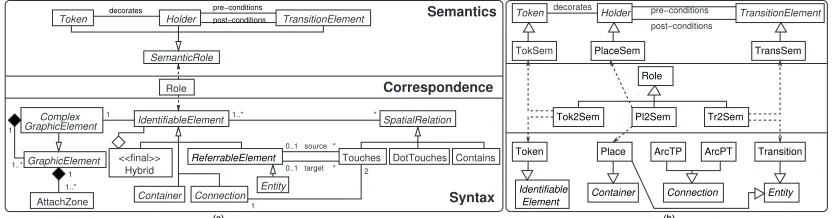
Figure1(a) shows an example meta-model triple taken from the area of visual modelling lan-guages. The lower part (source graph) contains a simplified meta-model with the base classes for the concrete syntax of a visual language [BG04]. Briefly, in a diagrammatic language, signifi-cant spatial relations exist among identifiable elements. The latter are recognizable entities in the language, to which a semantic role can be associated, and which are univocally materialized by means of a complex graphic element. Each such element is composed in turn of simpler graphic elements, each possessing one or more attach zones, which define its availability to participating in different spatial relations, such as containment or touching.
post−conditions
IdentifiableElement GraphicElementComplex
GraphicElement
AttachZone Hybrid
<<final>> Touches DotTouches Contains
SpatialRelation *
Container Connection Entity
Role
SemanticRole
Token Holder TransitionElement
pre−conditions decorates
post−conditions
ReferrableElement
Tok2Sem Pl2Sem Tr2Sem
Role
PlaceSem TransSem
Identifiable Element
Place ArcTP ArcPT Transition
Container Connection Entity
Token
1 1..*
1..*
Syntax
2
1 1..*
1
1
* *
Correspondence Semantics
(a) (b)
target source 0..1
0..1
Token Holder TransitionElement
TokSem
decorates pre−conditions
Figure 1: (a) Meta-Model Triple for the Syntax and Semantics of Visual Languages (b) Special-ized Meta-Model for Petri Nets.
The upper part (target graph) contains a meta-model that describes the possible abstract roles for a transition-based (i.e. token-holder) semantics (i.e. semantics in the style of Petri nets, UML 2.0 activity diagrams and automata). The correspondence graph assigns semantic roles to syntactic elements. When a meta-model for a new visual language is defined, the newly defined concrete syntax concepts inherit from the classes in the syntax meta-model. If the language has a transition-based semantics, then the designer can create concrete roles by subclassing the classes in the semantics meta-model. Thus, predefined, customizable model transformation libraries implementing the operational semantics can be reused for the new language. Figure1(b) shows the definition of the syntactic and semantic roles for Petri nets (we have omitted arc weights for simplicity of presentation). The significant spatial relations are refined (by means of a creation graph grammar, with some rules shown in Figures2(a) and3) to be the Touches relation between instances of ArcPT (ArcTP) and a source Place (Transition) or a target Transition (Place), and the Contains relation, between instances of Place and Token. Note that a Place can play both the role of an Entity, in relation to the arcs which refer to it, and that of a Container, in relation to the Tokens it holds.
com-ponents, L, K and R, where: L (the left hand side, LHS) contains the elements to be found in the host graph where the rule is applied; K contains the elements preserved by the rule application; and R (the right hand side, RHS) contains the elements that should replace the part identified by
L in the host graph. The DPO approach has been lifted to work with any (weak) adhesive HLR
category [EEPT06] (such as those for graphs, Petri nets, etc.). In [GL07] we showed that the category TriAGraphTriATGof attributed typed triple graphs (short triple graphs) and morphisms is an adhesive HLR category. Therefore, in our case, L, K and R are triple graphs.
t1 : Token : Contains : target : Touches : ArcTP : source
p2: Place
: target
: Touches : ArcTP : Touches
t1: Transition
: source : source
t1: Transition
t1 : Token : Contains p1: Place
: source
: ArcTP p2: Place : target
: Touches
: target
: Touches
: ArcTP
addTwoOutPlaces
{new}
: Touches : Touches
(a) (b)
{new}
Semantics
Corr.
Syntax
tr1: Tr2Sem ts1: Tok2Sem
trs1: TransSem tks1: TokSem
: post−conditions : post−conditions addTwoOutPlaces
ps1: Pl2Sem
: decorates
pls1: PlaceSem
ps2: Pl2Sem pls2: PlaceSem
: Touches p1: Place
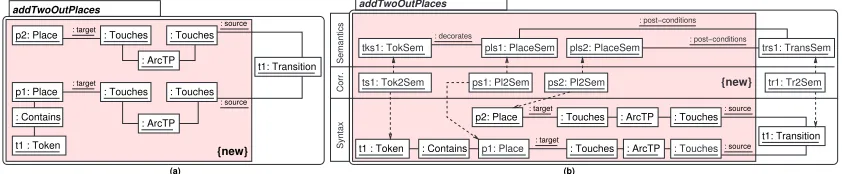
Figure 2: (a) Rule Modelling an Editing Action. (b) Triple Rule Modelling the Synchronized Creation of Semantic Roles.
The motivation for this work is the following. Given a normal graph grammar modelling the possible editing actions in a modelling environment (i.e. working in the concrete syntax only), how can we obtain triple rules that update or build synchronously the semantic model? As an example, Figure2(a) shows a rule modelling a complex editing action by which, given an existing transition, two places are created, connected with arcs from the transition to the places, and a token is inserted into one of the places. Figure2(b) illustrates the desired corresponding triple rule that synchronously creates the semantic elements together with the syntactic ones, designating the created places as post-conditions for the transition. We could build by hand a TGG rule for each single syntax editing rule. However, this task is repetitive, as elements in the concrete syntax are related in the same way to elements in the semantic model (as specified in the meta-model triple), i.e. a reoccurring pattern can be identified in the triple rules.
3
Triple Patterns
the target graph elements), rules for creating the correspondence graph, assuming that the source and target graphs are created, and rules for checking the validity of the correspondence graph.
A triple pattern p : psrc←−ps pcorr pt
−→ptaris a triple graph conformant to a meta-model triple. Formally, given a triple pattern p and a triple graph G, we say that G satisfies p (written G|=p)
if an injective triple graph morphism m : p→G exists.
Example. We first start by giving an intuition of the algorithm through an example. In this
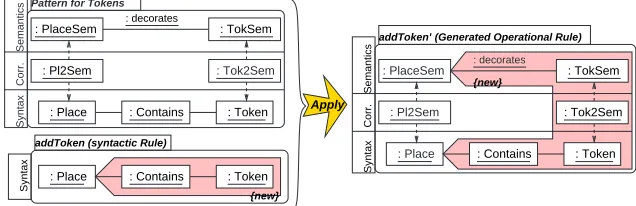
paper, we use triple patterns in order to specify in a visual, high level, acausal notation the kind of configurations we want to find in our semantic models when certain syntactic configurations are met (or the other way round). Thus, our triple patterns are triple graphs conforming to the meta-model of Figure 1. Figure3 shows a triple pattern depicting the needed structure in the syntactic model for a holder to have a token in the semantic model. In this case, a Place in the syntactic model has an associated PlaceSem role (a subclass of Holder) in the semantic model. Similarly, a Token in the syntactic model has a TokSem role in the semantic model (a subclass of class Token of the semantic meta-model). In the semantic model, a token decorates a holder, while at the syntactic level the place contains the token.
: Pl2Sem
: PlaceSem : TokSem
: decorates
: Place : Contains : Token
: Tok2Sem
Syntax
Semantics
Corr.
Pattern for Tokens
: Pl2Sem : PlaceSem
: decorates
: Place
addToken (syntactic Rule)
: Place
Apply
Syntax
{new}
addToken’ (Generated Operational Rule)
Syntax
Semantics
Corr.
{new}
: TokSem
: Contains
: Tok2Sem
: Token
: Token : Contains
Figure 3: Applying a Pattern to a Rule.
Figure3also shows a syntactic editing rule (“addToken”) modelling the creation of a token inside a place in the syntactic model. The objective of the algorithm (“Apply”) is to obtain the triple rule shown in the figure, where information about the actions to be done at the seman-tic level has been incorporated, together with the mapping between the syntacseman-tic and semanseman-tic models. Roughly, we first try to find a match from the pattern to the rule’s RHS. Then we glue the pattern and the RHS of the syntactic rule through the matching, to obtain the triple rule’s RHS. Finally, we construct the triple rule’s LHS by taking the elements in the correspondence and semantic graphs (of the RHS) which are related to elements which were already present in the syntactic rule’s LHS.
The following algorithm describes the application of a set of patterns to a non-deleting normal rule, resulting in one triple rule. Later, we show how the algorithm can be easily modified for its application to deleting (and non-creating) rules.
Apply(P: SetOfTriplePatterns, rl: Rule): TripleRule
Let P={pi}i∈I be a set of triple patterns of the form pi : pisrc psi
←− picorr pt i
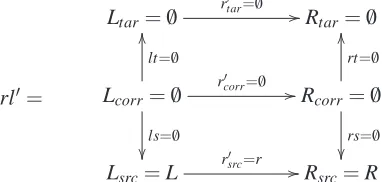
1. Initialize the triple rule rl0, copying rule rl in the source part of rl0. The resulting triple rule is written as rl0: Lrl0
r0
→Rrl0, where r0is a triple graph morphism (see Figure4).
Ltar= /0
r0tar=/0 //
Rtar=/0
rl0= Lcorr=/0 r
0
corr=/0 //
lt=/0
O
O
ls=/0
²
²
Rcorr=/0
rt=/0
O
O
rs=/0
²
²
Lsrc=L r
0
src=r //
Rsrc=R
Figure 4: Initialization of Triple Rule rl0.
2. ∀pi: pisrc ps
i
←− picorr pt i
−→ ptari ∈P:
(a) ∀pisrc m i j
→Rsrc, with mij an injective match from the source part of pi (i.e. pisrc) to the source part of Rrl0 (i.e. Rsrc):
i. if∃pisrcm
0i j
→Lsrcwith mij=r0src◦m0jithen do nothing (as no elements in the source part of the rule have been newly created for this match) else
ii. ∀O :(Osrc=pisrc) os ←−Ocorr
ot
−→Otarsuch that the diagram of Figure5(a) com-mutes, and that@O0x|Ox⊂Ox0 ⊆pix, x∈ {corr,tar}:
Otar mtvv
z
z
vv
Â Ä //
ptari
Rtar Ocorr = = = = os ² ² mcvv z z vv
Â Ä //
ot
O
O
picorr
pti O O psi ² ² Rcorr rs ² ² rt O O
pisrc
mij
z
z
vv
id // pisrc
Rsrc (a) Otar mtww { { ww
Â Ä //
pitar
t pww
{
{
ww
Rtar tr //R0tar
Ocorr os ² ² mcww { { ww
Â Ä //
ot
O
O
picorr
cp { { ww pti O O psi ² ² Rcorr rs ² ² rt O O
cr //R0corr rt0 O O rs0 ² ²
pisrc
mi j
{
{
ww
id //pisrc t pww
{
{
ww
Rsrc tr //R0src
(b)
Figure 5: (a) Glueing piwith the Right Hand Side of rl0. (b) Building the Pushout.
A. replace Rrl0 : Rsrc rs
previ-ous diagram, i.e. Rrl0 =PushOut(Rrl0,O,pi) 1. The pushout is shown in Figure5(b).
B. Add appropriate nodes to L
[ 1]∀n∈VRsrc// Check if we have to copy the correspondence node to L
[ 2] Newtar=Newcorr=Newunconn=/0 // Sets with newly added nodes to L
[ 3] if (∃n0∈VLsrcs.t. r 0
src(n0) =n) then // n is also in L
[ 4] // seek correspondence nodes which are not in L
[ 5] ∀c∈VRcorrs.t. rs(c) =n∧@c00∈VLcorrs.t. r0corr(c00) =c
[ 6] // add correspondence node to L
[ 7] VLcorr=VLcorr] {c0}and set ls(c0) =n0, r0corr(c0) =c [ 8] Newcorr=Newcorr] {c0}// add it to the set
[ 9] // check for nodes in the target graph of R which are not in L
[10] if (∃n00∈VRtar|rt(c) =n
00∧@o∈V
Ltar|r 0
tar(o) =n00) then
[11] // add node to target graph of L and to Newtarset
[12] VLtar=VLtar] {n
000}and set lt(c0) =n000, r0
tar(n000) =n00
[13] Newtar=Newtar] {n000}
[14]∀n∈Newtar// Add nodes to target graph for which no correspondence exists
[15] ∀m∈VRtars.t.(@m
0∈V
Ltar s.t. r 0
tar(m0) =m∧ ∃pathU(r0tar(n),m))2
[16] VLtar=VLtar] {m
0}, set r0
tar(m0) =m, Newunconn=Newunconn] {m0} [17]Newtar=Newtar]Newunconn
C. Add appropriate edges to LX (for X∈ {corr,tar}): [1] ∀n∈NewX// visit all new nodes...
[2] // check if some edge stems from r0X(n)and ends in a node∈L
[3] if (∃e∈ERX,m
0∈V
LX s.t. sourceRX(e) =r 0
X(n)∧targetRX(e) =r 0
X(m0)∧ [4] @e0∈ELX s.t. r0X(e0) =e) then
[5] // Add the edge to L
[6] ELX =ELX] {e
0}, r0
X(e0) =e, sourceLX(e
0) =n, target
LX(e 0) =m0
Note that in step ii, we look for a total match from pisrc to Rsrc, and partial matches from
picorr and pitar. Thus, the triple graph O models the domain of such partial matches. With the pushout, we add the part of pi which was not matched to the rule. In step ii.B we copy the
necessary correspondence nodes to the LHS, if they were added to the RHS by the pushout and the RHS node they refer to also belongs to the LHS. More than one correspondence node can be connected to a source or target graph node (line [5]). We also allow nodes in the target graph which are not connected with any correspondence graph node (added to the RHS by the pushout, and appropriately copied to LHS by lines [14-17]). These are useful if we want to model a source graph node related with many elements in the target graph, or “composite” connections in the target graph.
The application of a set of patterns to a rule acting on the target graph simply requires
substi-1 The pushout of triple graphs [GL07,Sch94] is built component-wise, where in addition all the faces of the two
cubes commute. Examples are shown in Figures5(b) and6
2 Predicate pathU(a,b)is true if a path from a to b exists (without taking into account the edge direction) where
no node in the path receives a morphism from correspondence graph nodes, except a. Moreover, b should not be
connected (directly or indirectly) with a newly created node, i.e. a node p s.t.@p0∈VLtarwith r
0
tuting src by tar in the previous algorithm. It is also easy to apply patterns to deleting rules (i.e. rules which delete elements but do not create anything), by substituting L by R in the algorithm.
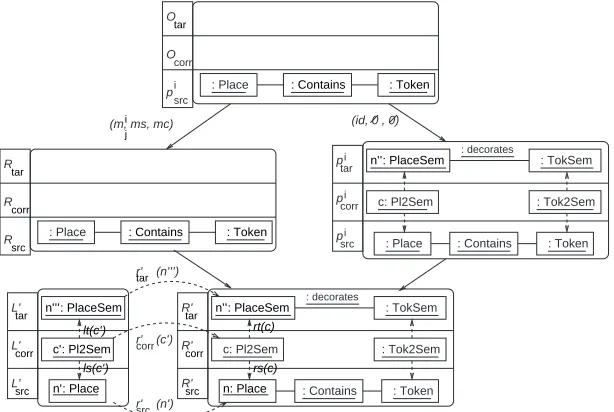
Example (continued). Figure6shows some details about the execution of steps 2.a.ii.B and
2.a.ii.C of the algorithm in the case of the rule and the patterns shown in Figure3. The upper part shows how the pushout is performed, and the lower part also shows how the new elements
c’ and n”’ are added to L in the generated TGG rule. Note that the PlaceSem object associated
with the Place belongs to L, as the Place object also belongs to L (step B in the algorithm).
src
: Place R
R R
: Place : Contains
: TokSem : Tok2Sem : Token c: Pl2Sem : decorates p corr p src p tar : Contains : TokSem : Tok2Sem : Token c: Pl2Sem : decorates R’ R’ R’ L’ L’ L’
(m, ms, mc) (id, 0 , 0)
: Place p
O O
r’ (n’’’)
r’ (c’)
r’ (n’)
corr src i i i i corr tar corr src i j n’’: PlaceSem n’’: PlaceSem tar corr
src n: Place rs(c) rt(c) tar tar corr src c’: Pl2Sem lt(c’) n’: Place ls(c’) n’’’: PlaceSem tar : Token
: Contains : Token
: Contains
Figure 6: Steps in the Application of the Pattern in Figure3.
Figure7shows additional patterns for the Petri nets example. According to the left pattern, output places of a transition in the syntactic graph are post-condition PlaceSem objects for the
TransSem object associated with the transition. The pattern to the right models the
correspon-dence for input places. By applying the three patterns to the rule in Figure2(a) (twice the pattern for post-conditions, and once that for tokens), we obtain the operational triple rule in Figure2(b).
Pattern for Pre−Condition Holders
: post−conditions : Touches : TransSem : Tr2Sem : Transition : source : Pl2Sem : PlaceSem : Place
: target : Touches
: ArcTP
Corr.
Sem.
Syntax
Pattern for Post−Condition Holders
: pre−conditions : Touches : TransSem : Tr2Sem : Transition : Pl2Sem : PlaceSem
: Place : Touches
: ArcPT
: source : target
Corr.
Sem.
Syntax
Figure 7: Additional Patterns for the Example.
More-over, the patterns do not have to take into account which elements are created and which are already existing, as this is specified in the normal rules to which patterns are applied. Thus, the pattern may be used in several ways (i.e. in parts of the rule which are newly created or in existing ones).
4
Abstract Triple Patterns
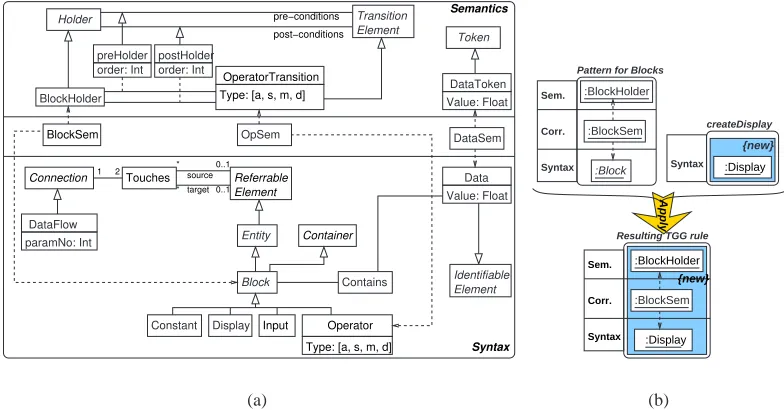
We consider now patterns with “abstract objects” and their application to rules also containing “abstract objects” (i.e. abstract rules). When looking for a match from an abstract pattern to a rule, abstract objects in the pattern can be matched with objects of more concrete classes in the rules. An abstract rule is equivalent to the set of concrete rules resulting from the valid substitu-tions of the abstract objects by instances of the subclasses of the abstract object class [BELT04]. In order to illustrate these concepts, we introduce a new example, which models the concrete syntax and the semantic roles for a visual language of arithmetic expressions. The meta-model triple is shown in Figure8(a). The language is made of blocks (abstract Block class), which can be interconnected through data flows (DataFlow class). Blocks contain data values (Data class), which are propagated through the data flows and processed by the blocks. There are four types of blocks: constants (i.e. blocks which store non-modifiable data values), displays (blocks that output a value), inputs (blocks which capture a value from outside the system), and operators. The latter manipulate data values, and can be adders, subtractors, multipliers and dividers. Data flows contain the argument position, which is needed for non-commutative operations.
*
Entity
Constant Display
Contains Identifiable
Element Value: Float
Data DataSem Value: Float
DataToken Token
OpSem
Block preHolder
order: Int
postHolder order: Int
BlockHolder
Holder Transition
Element
DataFlow paramNo: Int
Connection 1 Touches Referrable Element
Input Container
Type: [a, s, m, d] Operator
Syntax BlockSem
Semantics
Type: [a, s, m, d] OperatorTransition
post−conditions pre−conditions
2
target source
0..1 0..1 *
(a)
Syntax Sem.
Corr.
:Display :BlockHolder
{new}
createDisplay Pattern for Blocks
:Block :BlockSem :BlockHolder
Syntax Sem.
Corr.
Syntax
:BlockSem
Resulting TGG rule
{new}
:Display
Apply
(b)
Figure 8: (a) Meta-Model Triple for an Arithmetic Expressions Language. (b) Application of an Abstract Triple Pattern.
and operators are transitions. Differently from the Petri net case, operators have both the roles of transitions and holders (for the value resulting from the operation).
Before presenting the algorithm, we show the intuition using simple examples. Figure8(b) shows an abstract pattern to the left. The pattern shows the desired relation between blocks (any kind of block, as Block is an abstract class) at the syntactic level and BlockHolder objects in the semantic graph. The syntactic rule to the right models the creation of a display object. The application of the pattern to the rule results in a triple rule where the block object in the triple pattern has been matched to a display object, as display has a more concrete type.
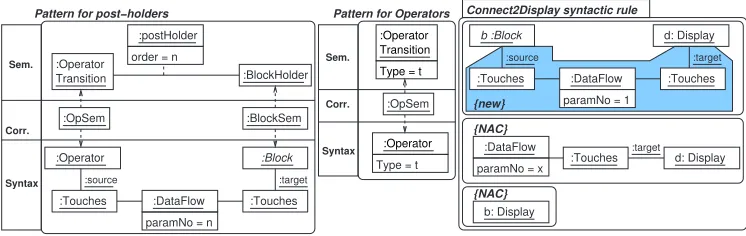
Consider now the situation depicted in Figure9. The left part shows two patterns. The first one describes that a BlockHolder is a post-condition for an OperatorTransition object at the semantic level when an Operator object is connected through a DataFlow to a Block abstract object. This pattern is abstract, and would be equivalent to four patterns, resulting from the substitutions of the Block object by objects of each one of its subclasses. The second pattern associates an
OperatorTransition object with an Operator object.
:Operator Transition
Type = t
:Operator
Type = t
Syntax Corr. Sem.
:postHolder
order = n
:BlockSem :BlockHolder
:Block
:Touches :DataFlow
paramNo = n :OpSem
:Operator Transition
:Touches :Operator
:source Corr.
Syntax Sem.
b :Block
:DataFlow
paramNo = x
d: Display
b: Display
:Touches :DataFlow :Touches
:Touches :target d: Display
Pattern for Operators Pattern for post−holders
:target
:source :target
{NAC}
{NAC}
paramNo = 1
{new}
Connect2Display syntactic rule
:OpSem
Figure 9: Abstract Triple Patterns and Abstract Rule.
The syntactic rule shown to the right models the connection of a block to a display and forbids the connection of two displays. In principle, the first pattern cannot be applied to the rule because, although the Block object in the pattern can get instantiated to the Display object in the rule, class
Operator is more concrete than class Block. However, there are cases when a Block is an operator.
Therefore what we have to do is to consider all concrete rules equivalent to the abstract one, and then apply the patterns. Here, we want to distinguish the case when an object is both a Block and an Operator, and the case where the object is a Block and not an Operator.
In order to define the construction of concrete rules from abstract patterns, we rely on the partial order¹induced by the inheritance relationship on the set of classes in the meta-model, so that A¹B if A inherits, even indirectly, from B, or if A is equal to B.
The following algorithm describes the previous processes.
AbstractApply(P: SetOfTriplePatterns, rl: Rule): SetOfTripleRules
Let P={pi}i∈I be a set of triple patterns of the form pi: pisrc psi
←− picorr pt i
−→pitarand rl : L←−l
K−→r R a non-deleting rule with L=K, and therefore rl : L→r R. The application of P to rl
results in a set of triple rules R0rl ={rl0j}as follows:
2. Let Rrl ={rlk} ∪ {rl}be the set of concrete rules equivalent to rl (see [BELT04]) and rl itself.
3. ∀rlk∈Rrl, R0rl=R0rl∪Apply(P,rlk). That is, we apply the patterns to each rule. Note that we allow a match from a pattern to a rule if a structural match is found, and if all types in the rule are more concrete or equal to the corresponding types in the abstract pattern.
4. ∀rl0∈R0rl: if∃rl00∈R0rl s.t. rl0is more concrete than rl00(rl0¹rl00) then R0rl =R0rl\ {rl0}. That is, we eliminate rules “subsumed” by others (same structure, equal or more concrete types).
5. ∀rl0∈R0rl: if∃rl00∈R0rls.t. rlsrc00 ¹rlsrc0 then add a NAC to rl0with all the nodes in rl00that are refinements of nodes of rl0, where rl0srcis the normal rule resulting by taking the source graphs of triple rule rl0.
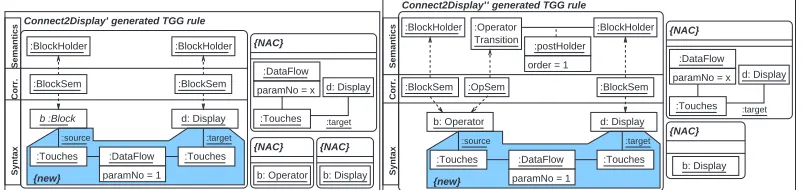
Figure10shows the result of applying the patterns in Figures8(b) and9to the abstract rule in Figure9. The first rule considers the case when Block objects are not Operators. The second considers the case when objects are Operators. Note how, due to the NACs, the application of these rules is mutually exclusive
b :Block
:Touches :DataFlow
:BlockSem :BlockHolder
d: Display
:Touches
:target
paramNo = 1 b: Display
{NAC}
b: Operator
:BlockHolder :BlockHolder
:BlockSem :BlockSem
d: Display
:Touches :DataFlow :Touches b: Operator
Syntax
Corr.
Semantics
b: Display
{NAC}
:DataFlow paramNo = x
:Touches :target
d: Display
:DataFlow paramNo = x
:Touches :target
d: Display
Connect2Display’ generated TGG rule
:source
{new}
{NAC} {NAC}
Connect2Display’’ generated TGG rule
:Operator Transition
:postHolder order = 1 :OpSem
:source :target
paramNo = 1
{new}
{NAC}
Syntax
Corr.
Semantics
:BlockSem :BlockHolder
Figure 10: Generated Operational TGG rules.
5
Related Work
Our approach is inspired by the seminal work in [Sch94] and aims at providing an efficient way to obtain TGG operational rules, whenever a grammar for one of the graphs already exists. In this scenario, patterns do not need to specify which elements should be created and which should already exist in one of the graphs, as this is expressed in the normal rule to which the pattern is applied. When specifying a declarative TGG rule, one has still to indicate which elements should be present, and which ones are new. Thus, patterns may be used in several ways, which makes them more flexible and declarative than normal TGG rules as defined in [Sch94].
Our contribution in this aspect is the observation that abstract patterns can be applied to rules with more abstract typing, and that a set of operational triple rules is generated which discriminates the right types by using negative application conditions. In addition, the concepts of triple rules with inheritance is fully formalized in the DPO approach in [GL07].
Due to lack of space, we have only presented the algorithms for translating in both directions; however generating operational rules for the scenarios described in [KS06] is also possible. In particular, it is possible to produce rules for creating the correspondence graph (assuming the source and target graphs already exist), to check the validity of the correspondence graph and for incremental updates. Further developments of TGGs can also be taken into account. For example, in [GW06], an efficient algorithm for incremental transformation was suggested, by relating the created nodes in the correspondence graph. Our patterns can also be used to create such relations.
A precedent to this work can be found in [G¨79], where G¨ottler describes a programming language as a triple with the syntax, the semantics and a functionφ describing how the semantic model is built from the syntactic one. In addition, he proposes meta-rules that modify either syntactic or semantic standard rules. In our case, we use triple patterns instead of meta-rules. Our triple patterns generate triple rules that are used to build the semantic model. Thus, they play the role of theφfunction in G¨ottler’s approach.
We believe this work is also relevant for the QVT community [QVT], as some efforts have been made to formalize QVT using TGGs. The most immediate similarities are found in the QVT relations, however attempts to formalize also the QVT Core have also been made[Gre06].
With respect to the application area of visual languages, Baar has proposed the use of TGGs to connect concrete and abstract syntax, so as to make it possible the static verification of the compliance between both [Baa06]. His proposal is however related to the structure of the visual sentence, and not to its operational interpretation. Moreover, it does not exploit inheritance, and requires the presence of display managers, relating the abstract and the concrete syntaxes.
6
Conclusions and Future Work
In this paper we have presented Triple Patterns as a compact means to obtaining operational TGG rules starting from normal graph grammar rules. We have shown that the approach is suitable for its combination with meta-modelling by considering the inheritance hierarchy in the meta-models. We have applied these ideas to the synchronized evolution of syntax and semantic models, improving previous work in [BDD+04].
There are several open issues. The first one is to study to which degree patterns can be au-tomatically derived from the meta-model triple. In general this process cannot be fully auto-mated. However, for our particular application case, it could be possible, as we just model three kinds of structures at the semantic level: Tokens decorating Holders, and Holders being pre- and post-conditions for TransitionElements. We could take the information of which classes in the semantic meta-model inherit from the base classes, and to which classes they are related in the syntax graph. However, for general applications, only an approximation can be derived.
extend the notion of abstract rule [BELT04] to allow abstract nodes also in R and in the target graph. For our application, this would allow the designer to include predefined patterns in the semantic level (using only predefined classes Token, Holder and TransitionElement), thus helping towards the automatic generation of the triple patterns from the meta-model triple.
Up to now we have not considered problems related to the manipulation of attributes, which is up to future work. In addition we have only considered positive patterns, but we are currently working to extending this approach with patterns containing also negative conditions. The al-gorithms we have presented assume that the syntactic rules are “bigger” than the patterns. The study of the opposite case is still an open problem. In principle, by considering partial matches from patterns to rules, one could devise ways to generate additional triple rules with extended context. It is also worth studying whether we can extend the application of a pattern to general rules (i.e. not only deleting or non-deleting). A first line of attack might consider the splitting of a general rule into a sequence of one deleting and one non-deleting rule.
Finally, we are considering the application of the notion of triple graph grammars and meta-rules to the generation of operational semantics, for example the token game in the case of Petri nets.
Acknowledgements: This work has been partially sponsored by the Spanish Ministry of Ed-ucation and Science with projects MOSAIC (TSI2005-08225-C07-06) and MODUWEB (TIN 2006-09678), and the EC’s Human Potential Programme under contract HPRN-CT-2002-00275, SegraVis. The authors gratefully thank the referees for their useful suggestions.
References
[Baa06] T. Baar. Correctly defined concrete syntax for visual models. In Proc. MoDELS/UML
2006. LNCS 4199, pp. 111–125. Springer, 2006.
[BDD+04] P. Bottoni, M. De Marsico, P. Di Tommaso, S. Levialdi, D. Ventriglia. Definition of visual processes in a language for expressing transitions. J. Vis. Lang. Comput. 15(3-4):211–242, 2004.
[BELT04] R. Bardohl, H. Ehrig, J. de Lara, G. Taentzer. Integrating Meta-modelling Aspects with Graph Transformation for Efficient Visual Language Definition and Model Ma-nipulation. In Proc. FASE. LNCS, pp. 214–228. Springer, 2004.
[BG04] P. Bottoni, A. Grau. A Suite of Metamodels as a Basis for a Classification of Visual Languages. In Proc. VL/HCC. Pp. 83–90. IEEE Computer Society Press, 2004.
[BGN+04] S. Burmester, H. Giese, J. Niere, M. Tichy, J. Wadsack, R. Wagner, L. Wendehals, A. Z¨undorf. Tool integration at the meta-model level: the Fujaba approach. J. Softw.
Tools Technol. Transfer 6:203–218, 2004.
[EEPT06] H. Ehrig, K. Ehrig, U. Prange, G. Taentzer. Fundamentals of Algebraic Graph
[G¨79] H. G¨ottler. Semantical Description by Two-Level Graph-Grammars for Quasihier-archical Graphs. In Proc. Workshop Graph Theoretic Concepts in Computer
Sci-ence – Graphs, Data Structures and Algorithms. Applied Computer SciSci-ence 13. Carl
Hansen Verlag, 1979.
[GL07] E. Guerra, J. de Lara. Event-Driven Grammars: Relating Abstract and Concrete Levels of Visual Languages. To appear in Software and Systems Modeling (SoSyM), 2007.
[Gre06] J. Greenyer. A Study of Model Transformation Technologies: Reconciling TGGs with QVT. Master/diploma thesis, University of Paderborn, July 2006.
[GW06] H. Giese, R. Wagner. Incremental Model Synchronization with Triple Graph Gram-mars. In Proc. MoDELS/UML 2006. LNCS 4199, pp. 543–557. Springer, 2006.
[KS06] A. Konigs, A. Sch¨urr. Tool Integration with Triple Graph Grammars - A Survey.
Electronic Notes in Theoretical Computer Science 148:113–150, 2006.
[MSUW04] S. J. Mellor, K. Scott, A. Uhl, D. Weise. MDA Distilled. Addison-Wesley, 2004.
[QVT] QVT specification, at http://www.omg.org/docs/ptc/05-11-01.pdf.
[Sch94] A. Sch¨urr. Specification of Graph Translators with Triple Graph Grammars. In Proc.