European Journal of Physical Education and Sport Science
ISSN: 2501 - 1235 ISSN-L: 2501 - 1235 Available on-line at: www.oapub.org/edu
DOI: 10.46827/ejpe.v6i7.3325 Volume 6 │ Issue 7 │ 2020
PARTICIPATION MOTIVATION AMONG YOUNG SOCCER
ATHLETES: RESEARCH EVIDENCE FROM GREECE
Panagiotis Alexopoulosi
Associate Professor, Department of Sports Management, University of Peloponnese, Greece
Abstract:
The purpose of this study was to determine participation motives of youth soccer players and to examine their participation motives with regard to their age, sport experience, and training volume levels. The sample of this empirical research consisted of 171 young soccer athletes from 16 different soccer teams, all located in the prefecture of Ilia, Western Greece. The well-known sports participation motivation questionnaire (PMQ) was used. Analysis of data was conducted by the use non-parametric k-independensamples t-tests. The results showed that among the components of the sports participation motivation, significant differences were observed for the aspects of achievement and the aspect of finding friendship. No other significant differences were found. The results of
this study confirm that sport experience and the athletes’ age is effective in motivating
athletes' continuation and commitment to their physical activity.
Keywords: soccer, sport motivation, young soccer athletes, motivation participation,
motivation scale
1. Introduction
One of the most prominent factors that stimulate and maintain individuals’ participation
in physical activity is their motivation (Roychowdhury, 2018). Understanding the motives for youth sport participation has become important issue for sport practitioners and researchers in the last few years. Sport psychology literature defines sport motivation as the combination of personality factors, social factors, and cognitive processes, which become dominant when a person takes part in an important physical exercise, or starts competing with others and aims for perfection (Klint & Weiss, 1987; Roberts, 1992). Indeed, during the last decades, the opportunity for individuals to participate in sport activities has tremendously increased, which is the most significant reason why
researchers thrive to determine the importance of sport participation motivation (Cunningham & Kwon, 2003). Examining sport participation from a participant’s perspective, a motivated behavior is primarily affected by a sportsman’s individual
characteristics (Gould, Feltz & Weiss, 1985; Weinberg & Gould, 2011). Specifically, an
athlete’s sport motivation is primarily determined by the person’s personality traits,
necessities and purposes. Hence, what seems to be extremely important in assessing the motivation for participation in sport activities is to understand the priorities and processes of participation motivation in order to carry on and maintain physical activity (Weiss & Petlichkoff, 1989). The perspective of sport and exercise psychology is twofold. The first is analysis pertaining to how actions in sports are regulated/controlled by psychic processes, and the second is how actions in sports and exercise regulate/control psychic processes (cognitive, motivational, volitional and affective/emotional processes (Hackfort, Duda & Lidor, 2005).
2. Literature Review
Sports psychology examines the psychological principles, processes, and psychological effects of sports on participants. At the same time, it examines the psychological processes and strategies through which the participants in sports are supported in order to maximize their performance, but also in the direction of psychological empowerment. Also, it focuses on the study of behavior, psychological processes, emotional, cognitive, motivational, or psychomotor processes. It includes issues related to those who are systematically involved in organized sports, i.e. athletes, coaches, administrators, support staff, parents and spectators (Theodorakis, Goudas, & Papaioannou, 2003). In addition, Landers & Arent (2007) report that exercise and physical activity often help people improve their cognitive function, reduce stress, and effectively treat depression, increase positive mood, increase self-esteem, and self-awareness. Biddle (1997) surveyed all of the articles published in the International Journal of Sport Psychology (IJSP) and the Journal of Sport and Exercise Psychology (JSEP; called Journal of Sport Psychology from 1979 to 1987) from 1985 to 1994. The most researched topics were motivation, anxiety, imagery, self-efficacy/confidence, exercise and mental health, and group dynamics, while simultaneously it was revealed that most of the publications consisted of experimental (30.3%) or survey (38.0%) methodologies.
activity (excitement of the sport, personal accomplishment, improving one's skills, testing skills against others, and just doing the skills) are consistently rated as being most important, whereas more extrinsic or outcome-related factors (pleasing others, winning rewards, winning the game) are consistently rated least important (Wankel & Kreissel, 1985).
In the last few years, numerous different theoretical and empirical approaches have been proposed to help the research community develop a standardized instrument
to effectively examine and study the motives that underlie an athlete’s participation to
any kind of sport activity. One of the first approaches appeared to study participation motivation involved the examination of the theoretical correlates of different motives that pertain to physical activity. Examples of such questionnaires that were developed leveraging this method included the 28-item Sport Motivation Scale (SMS; Fortier, Vallerand, Biere, & Provencher, 1995), the 32-item Exercise Motivation Scale (EMS; Li, 1999), the 44-item Exercise Motivation Inventory (EMI; Markland & Hardy, 1993), the 69-item Exercise Motivation Inventory-2 (EMI-2; Markland & Ingledew, 1997), the 23-69-item Motivation for Physical Activity Measure (MPAM), and the 30-item Motivation for Physical Activity Measure – Revised (MPAM-R; Ryan, Frederick, Lepes, Rubio, & Sheldon, 1997).
3. Material and Methods
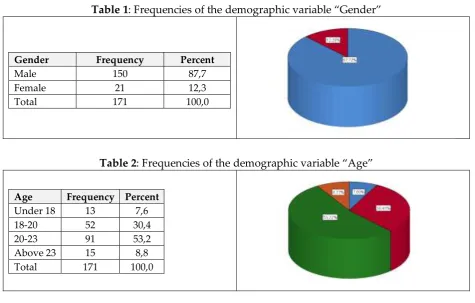
Participants included 171 young soccer athletes (male athletes: n=150, 87,7%; female athletes: n=21, 12,3%). These young athletes came from 16 different soccer teams (14 male soccer teams and 2 female soccer teams). All the soccer teams were located in the prefecture of Ilia, Western Greece. The sample included participants at four age levels (18 years old and below, 18-20 years old, 20-23 years old, 23 years old and over). The sample also included participants at four experience levels (2 years and less, 3-4 years, 5-6 years, 7 years and more), and also included participants at three training volume levels (5 hours per week and less, 6-8 hours per week, more than 9 hours per week). The selection of the sample occurred through a non-probability casual sampling. For this purpose, all coaches and officials were contacted before the beginning of the competitions and informed about the nature and objectives of the study and the principle of confidentiality. Next, their authorization was obtained to contact and invite the athletes to participate in the study. Data were collected before the beginning of the training. The questionnaire was distributed among the participants and was collected after 20 minutes.
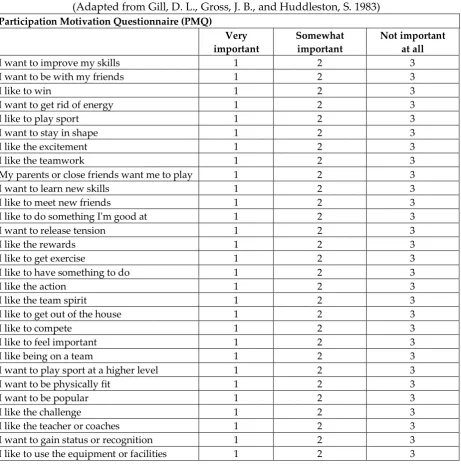
(Buonamano et al., 1995; Garyfallos & Asterios, 2011; Guillén-Garcia et al., 2005; Gürbuz et al., 2007; Kirkby et al., 1999; Koivula, 1999; Salselas et al., 2007; Shang, 1997; Sirard et al., 2006; Zahariadis & Biddle, 2000). Also, PMQ almost represents a weighted measurement scale instrument that it has proved to have satisfactory reliability, thus leading to unbiased results. In this study, the questionnaire evaluated motivational factors affecting sport participation based on eight factors, namely: achievement/status, teamwork, fitness, energy release, situational factors, skill development, friendship, and fun through a three-level scale (very important=3, somewhat important=2, and not important at all=1). The reliability of this questionnaire has been reported by Zahariadis and Biddle (2000), using Cronbach's alpha coefficient, as 0.88. Also, the total internal consistency of the sport participation motivation questionnaire has been estimated as 0.87. In this study, the internal consistency for the subscales was found to be generally adequate (coefficients alpha ranged from .67 to .90). More analytically, Cronbach's alpha for the dimensions of achievement/status, teamwork, fitness, energy release, situational factors, skill development, friendship, and fun was .86, .75, .90, .67, .72, .75, .80 and .85 respectively. Descriptive statistics were used to measure the frequencies of the demographic variables of the questionnaire, along with the Likert-type items that measure the subscales of sport participation motivation. Moreover, inferential tests, such as independent-samples t-test (parametric test), and Friedman test (non-parametric test) were used to compare the levels of sports participation motivation of young soccer athletes, regarding their age, their sport experience, and their training volume. Data were analyzed using SPSS software version 23. Statistical significance was set at p < .05.
4. Results and Discussion
Examining the demographics of the participants, research results revealed the following: A. Gender: the participants were male soccer players (N=150, 87,7%) and female
soccer players (N=21, 12,3%).
B. Age: the participants were between 20-23 years old (n=91, 53,2%), between 18-20 years old (n=52, 30,4%), above 23 years old (n=15, 8,8%), and under 18 years old (n=13, 7,6%).
C. Training Volume: the participants were training for about 6-8 hours per week (n=116, 67,8%), for 5 hours and less (n=43, 25,1%), and for 9 hours and more per week (n=12, 7%).
D. Sport Experience: the participants had experience in sports between 5-6 years of experience (n=78, 45,6%), between 3-4 years of experience (n=72, 42,1%), less than 2 years of experience in sports (n=14, 8,2%), and more than 7 years of experience in sports (n=7, 4,1%).
participating in physical activity were (a) to release energy (M=0,227, SD=0,444) (b) obtain achievement and status (M=2,228, SD=0,221) (c) to achieve teamwork (M=2,292, SD=0,365) and d) to maintain fitness (M=2,298, SD=0,337). These findings corroborate earlier research findings.
Table 1: Frequencies of the demographic variable “Gender”
Gender Frequency Percent
Male 150 87,7
Female 21 12,3
Total 171 100,0
Table 2: Frequencies of the demographic variable “Age”
Age Frequency Percent
Under 18 13 7,6
18-20 52 30,4
20-23 91 53,2
Above 23 15 8,8 Total 171 100,0
Table 3: Frequencies of the demographic variable “Training Volume”
Training Volume Frequency Percent 5 hours and less 43 25,1
6-8 hours 116 67,8
9 hours and more 12 7,0
Total 171 100,0
Table 4: Frequencies of the demographic variable “Sport Experience”
Sport Experience Frequency Percent 2 years and less 14 8,2
3-4 years 72 42,1
5-6 years 78 45,6
7 years and more 7 4,1
Table 5: Descriptive statistics of PMQ subscales
Descriptive Statistics
N Mean Std. Deviation
Fun 171 2,3173 ,28929
Situational Factors 171 2,3080 ,27773
Friendship 171 2,3070 ,41039
Skills Development 171 2,3012 ,38148
Fitness 171 2,2982 ,33733
Teamwork 171 2,2924 ,36553
Achievement / Status 171 2,2851 ,22165
Energy Release 171 2,2778 ,44428
Valid N (listwise) 171
The inferential statistics (Kruskal-Wallis, non-parametric k-independent samples tests), that were employed to examine for possible significant differences between different groups of participants, regarding the subscales of PMQ, showed that there were no significant differences between the different groups of participants, for any of the 8 PMQ subscales.
Table 6: Kruskal-Wallis test for differences regarding the age of participants
Test Statisticsa,b
Achievement / Status
Teamwork Fitness Energy
Release
Situational Factors
Skills Development
Friendship Fun
Kruskal-Wallis H 5,191 1,295 2,526 2,478 1,846 5,659 2,022 1,577
df 3 3 3 3 3 3 3 3
Asymp. Sig. ,158 ,730 ,471 ,479 ,605 ,129 ,568 ,665
a. Kruskal Wallis Test b. Grouping Variable: Age
Table 7: Kruskal-Wallis test for differences regarding the training volume of participants
Test Statisticsa,b
Achievement / Status
Teamwork Fitness Energy
Release
Situational Factors
Skills Development
Friendship Fun
Kruskal-Wallis H ,444 4,059 ,064 1,565 3,107 1,754 5,035 1,565
df 2 2 2 2 2 2 2 2
Asymp. Sig. ,801 ,131 ,969 ,457 ,211 ,416 ,081 ,457
a. Kruskal Wallis Test
b. Grouping Variable: Training Volume
Table 8: Kruskal-Wallis test for differences regarding the sport experience of participants
Test Statisticsa,b
Achievement / Status
Teamwork Fitness Energy
Release
Situational Factors
Skills Development
Friendship Fun
Kruskal-Wallis H 1,885 1,858 1,637 4,299 ,681 ,420 ,764 3,870
df 3 3 3 3 3 3 3 3
Asymp. Sig. ,597 ,602 ,651 ,231 ,878 ,936 ,858 ,276
a. Kruskal Wallis Test
5. Conclusion
This study intended to determine participation motives of youth soccer players and examine their participation motives with regard to their age, sport experience, and training volume levels. Analysis revealed no significant differences among young soccer athletes of different sport experience, regarding their participation motives, based on all the subscales of PMQ. This means that, there is no significant difference between the dimensions of the sport participation motivation for young soccer athletes of different age, of different training volume, and of different sport experience. These results are similar to those of Jacobson (2014), who did not find any difference between the motivation of team and individual athletes. In his research, only the enjoyment component in team athletes was higher than individual athletes. Probably one of the reasons for the lack of difference in the Jacobson (2014) research, was the different sport disciplines and the low number of participants. These cases probably affected the difference in results. Also, the ranking of motives for participation in sports revealed that fun, situational factors, and friendship are the most important factors for young soccer athletes to participate in sport activities. Therefore, considering that motivation plays an important role in the onset and continuation of exercise, understanding the most important motivations from the perspective of young soccer athletes is very important, and will help extend the percentages of participation and therefore limit the percentages
of young athletes’ dropout of sports.
However, despite the valuable results obtained, the present study also had some limitations. The data were collected from a limited area in Greece, and the sample size was not weighted between genders. In this study, Gill et al. (1983) questionnaire was used. Therefore, it may not cover all the motivations of athletes. It is suggested that these limitations be considered in future studies.
Acknowledgements
The author would like to acknowledge all the officials, coaches, and athletes from the sport clubs of Prefecture of Ilia, West Greece that participated in this study, for their seamless cooperation and support to this research effort.
About the Author
Panagiotis D. Alexopoulos is an Associate Professor in the Department of Sports Management and Organization, at the University of Peloponnese, and also the Dean of Faculty of Human Movement Sciences and Quality of Life, at the University of Peloponnese. He is the Director of the Academic Laboratory, entitled “Services Management & Organization and Quality of Life Laboratory”, at the University of
References
Buonamano A, Cei A, Mussino A, 1995. Participation motivation in Italian Youth Sport. The Sports Psychology, 9, 265-281.
Caglar E, Asci F, Deliceoglu G, 2009. Does participation motivation of youth soccer players change with regard to their perceived ability? Ovidius University Annals, Series Physical Education and Sport/Science, Movement and Health, 9(1), 18-22. Cunningham G.B, Kwon H, 2003. The theory of planned behaviour and intentions to
attend a sport event. Sport Management Review, 6 (2), 127-145.
Fortier, M. S., Vallerand, R. J., Brière, N. M., & Provencher, P. J. (1995). Competitive and recreational sport structures and gender: A test of their relationship with sport motivation. International Journal of Sport Psychology, 26(1), 24-39.
Garyfallos A, Asterios P, 2011. Motivation of 10-12 years old Cypriot students toward sports participation. Journal of Physical Education and Sport, 11, 401-405.
Gill D.L., Gross J.B., Huddleston S, 1983. Participation motivation in youth sports. International Journal of Sport Psychology, 14 (1), 11-14.
Gould D, Feltz D, Weiss M, 1985. Motives for participating in competitive youth swimming. International Journal of Sport Psychology, 16, 126–140.
Guillén-Gracía F, Weis G, Navarro-Valdivieso M, 2005. Motivos de participación deportiva de niños brasileños atendiendo a sus edades. Apunts, 80, 29-36.
Gürbuz B, Altyntas A, Aaci F, Hülya A, 2007. Participation motives of 9-15 years old Turkish soccer players. Journal of Sports Sciences and Medicine, 10(Suppl), 88-91. Hackfort D, Duda J. L, Lidor R. (Eds.), 2005. Handbook of research in applied sport and exercise psychology: International perspectives. Morgantown, WV: Fitness Information Technology.
Jones G.W., Mackay K.S., Peters D.M., 2006. Participation motivation in martial artists in the West Midlands region of England. Journal of sports science & medicine, 5 (CSSI), 28.
Kirkby R, Kolt G.S, Liu J, 1999. Participation motives of young Australian and Chinese gymnasts. Perceptual and Motor Skills, 88, 363-373.
Klint K, Weiss M, 1987. Perceived competence and motives for participating in youth sports: A test of Harter's competence motivation theory. Journal of Sport Psychology, 9, 55–65.
Koivula N, 1999. Sport participation: differences in motivation and actual participation due to gender typing. Journal of Sport Behavior, 22, 360-380.
Li F, 1999. The Exercise Motivation Scale: Its multifaceted structure and construct validity. Journal of Applied Sport Psychology, 11, 97-115.
https://doi.org/10.1080/10413209908402953
Markland D, Hardy L, 1993. The exercise motivations inventory: Preliminary development and validity of a measure of individuals' reasons for participation in regular physical exercise. Personality and Individual Differences, 15(3), 289-296.
Roychowdhury D, 2018. A comprehensive measure of participation motivation: Examining and validating the Physical Activity and Leisure Motivation Scale (PALMS). Journal of Human Sport and Exercise, 13(1), 231-247. doi:
https://doi.org/10.14198/jhse.2018.131.20
Ryan R, Frederick C, Lepes D, Rubio N, Sheldon K, 1997. Intrinsic motivation and exercise adherence. International Journal of Sport Psychology, 28, 335-254.
Salselas V, Gonzalez-Boto R, Tuero C, Marquez S, 2007. The relationship between sources of motivation and level of practice in young Portuguese swimmers. Journal of Sports Medicine and Physical Fitness, 47, 228-233.
Shang C.M, 1997. A study on the motivation of middle school students in participating in track and field competitions. Chinese Electronic Periodical Service, 22, 375-386. Tenenbaum, Gershon & Morris, Tony & Hackfort, Dieter & Filho, Edson. (2013). Sport
and Exercise Psychology.
Wankel L.M, Kreisel P.S.J, 1985. Factors underlying enjoyment of youth sports: Sport and age group comparisons. Journal of Sport Psychology, 7, 51-64.
Weinberg R. S., Gould D, 2011. Foundations of sport and exercise psychology. Champaign, Human Kinetics.
Weiss M.R., Petlichkoff L.M, 1989. Children’s motivation for participation in and
withdrawal from sport: Identifying the missing links. Pediatric Exercise Science, 1 (3), 195-211.
Appendix
Table 9: The Participation Motivation Questionnaire (Adapted from Gill, D. L., Gross, J. B., and Huddleston, S. 1983)
Participation Motivation Questionnaire (PMQ)
Very important
Somewhat important
Not important at all
I want to improve my skills 1 2 3
I want to be with my friends 1 2 3
I like to win 1 2 3
I want to get rid of energy 1 2 3
I like to play sport 1 2 3
I want to stay in shape 1 2 3
I like the excitement 1 2 3
I like the teamwork 1 2 3
My parents or close friends want me to play 1 2 3
I want to learn new skills 1 2 3
I like to meet new friends 1 2 3
I like to do something I'm good at 1 2 3
I want to release tension 1 2 3
I like the rewards 1 2 3
I like to get exercise 1 2 3
I like to have something to do 1 2 3
I like the action 1 2 3
I like the team spirit 1 2 3
I like to get out of the house 1 2 3
I like to compete 1 2 3
I like to feel important 1 2 3
I like being on a team 1 2 3
I want to play sport at a higher level 1 2 3
I want to be physically fit 1 2 3
I want to be popular 1 2 3
I like the challenge 1 2 3
I like the teacher or coaches 1 2 3
I want to gain status or recognition 1 2 3
Creative Commons licensing terms