Open houses are a great way to introduce your services to your patrons, especially those who may not otherwise be regular visitors. Librarians at the Engineering Library on the Pennsylvania State University, University Park campus developed a tailored open house event to connect with the College of Engineering community and introduce patrons to the resources and services available in the library. The Engineering Library benefited greatly from these events, and students now feel more comfortable approaching librarians with questions. The open houses have also provided a way for the librarians to learn more about the needs of their fac-ulty and students.—Editors
W
ith several libraries on the Pennsylvania State University’s University Park campus, the En-gineering Library can be easily missed. The library is one of four smaller branch libraries and occupies a top corner of a large College of Engineer-ing buildEngineer-ing which makes it difficult for faculty, staff, and students to locate. In addition, historically, the College of Engineering community has considered themselves self-sufficient and use the library infrequently. Engineering re-searchers have “adapted quickly to the online environment and expect information to be on hand instantaneously.”1 As a result, some users may be unaware of the resources and services available in the library. A solution to these problems was to develop a personalized approach to a standard open house event which catered to the distinctive needs of En-gineering Library users. Specifically, the plan was to target an individual department in the College of Engineering and showcase the specific library resources that would be most relevant to that unit.There were three primary goals for the open house:
1. To get students and faculty to the Engineering Library; 2. To introduce the students and faculty to their librarians; 3. To show students and faculty that librarians are
avail-able to help and support them.
BACKGROUND
Libraries seek innovative ways to connect with their users. For academic libraries that serve traditional student popula-tions, eighteen- to twenty-two-year olds, one of the barriers to making connections is library anxiety. The anxiety is the fear of librarians, research processes, and physical library space.2 The goal is to “make it more likely they will come
Vanessa Eyer
Vanessa Eyer, Assistant Librarian, is a liaison librarian in the Engineering Library at the Penn State’s University Park campus. She holds a Bachelor of Science in Mathematics from Penn State and a Masters in Library and Information Science from the University of Pittsburgh. She is committed to learning more about how she can serve her students, faculty and the STEM community through outreach. ORCID identifier: http://orcid.org/0000-0002-1392-8647. Correspondence concerning this column should be directed to Nicole Eva and Erin Shea, email: [email protected] and [email protected].
Attracting Users in
a Special Library
A Personalized
back for assistance throughout their academic careers.”3 Libraries have tried various ways to alleviate users’ anxiety and make the library a valued resource. The focus of this article is on library open house events. These events strive to “provide students with a positive introduction to the library that will elicit interest and encourage feelings of comfort and connection with the library.”4 The Penn State Libraries have achieved this by having open house attendees interact one-on-one with librarians or library staff.5 For most academic libraries, new students are the target audience for open house events. By targeting new students, library anxiety is allevi-ated early in the student’s academic career. This means many open house events are held during orientations or the first several weeks of classes.6
The librarians at the University of Waterloo found that “students may forget most of the information they are ex-posed to [at open house events], but that they will likely take away a general impression or feeling about the library.”7 This makes it important to ensure open house events are fun for users. This can be done by including games with prizes and having giveaways for attendees.8 The inclusion of these activities and giveaways provides incentive for students to attend the event. Indiana University Purdue University In-dianapolis (IUPUI) University Library ensures that everyone has an enjoyable time by having the attitude that “everyone is welcome, everyone wins, and we all have fun.”9 The process demonstrates that the library is not all about dry research and students do not need to be afraid of it.
It may be difficult for some libraries to provide give-aways or prizes for open house events, but these items can include donations from database vendors or library promo-tional items such as pens, pencils, highlighters, notepads, key chains, or bookmarks.10 IUPUI found that “students are happy to receive just about anything as a prize.”11 The give-aways can be used to provide additional information about the library and its resources by offering a tangible reminder of the information learned during the open house event. All of these efforts have proven to provide students with an introduction to library resources and services and to help alleviate library anxiety.
To ensure a significant number of users attend, the event must be well marketed. Marketing can be done using methods already available to the library. These can include advertisements on library websites, blogs, social media sites, university newsletters, and flyers.12 It may also be wise for librarians to visit faculty members to inform them of the importance of the event and ask them to pass along the in-formation to their students. Attendance at open house events increases when a faculty member encourages or requires their students to visit the event.13 The faculty promotion of the open house has the added benefit of demonstrating the library’s value to students who emulate the academic habits of their professors. This may require librarians to make an effort to connect with faculty before open house events but the rewards may be significant for the library and students. These methods can lead to successful open house events
but extra effort is needed to ensure science, technology, engineering, and mathematics (STEM) users are introduced to the library.
A significant amount of the published literature on open house events focuses on orientation events for new students but there is little information available on outreach efforts specific to STEM disciplines. Much of the research related to events for STEM users concentrates on providing sessions that inform users of library technological services that would be of interest to them.14 The literature suggests that very few, if any, have considered holding events to orient STEM users to the physical library and its resources and services.
Connecting with STEM users during an open house poses some additional challenges due to the culture of infor-mation exchange within STEM disciplines. “Scientists [also] favor a culture of collaboration and support among their scientific communities and information is shared through discipline-specific networks . . . that often exist independent of the library.”15 This requires the library to use a ‘hook’ to interest STEM users in the library. Librarians need to ensure that open house events feature activities that attract STEM students. These activities should include practical or inde-pendent learning activities to appeal to students’ preferred learning styles.16 It is also important to be aware of the needs of STEM students and to plan events in locations and at times that are convenient for these users. Librarians at the University of California, Santa Cruz found that “requiring the [STEM] users to come even the short distance between the science buildings and the library was enough to deter many of them.”17 This requires librarians to work closely with STEM departments and faculty to ensure open house events are relevant and well attended by these users. All of these efforts allow students to create positive and personal connections to the library. This connection will serve them throughout their academic career and ensure that library resources are utilized to their fullest potential.
GETTING STUDENTS AND FACULTY IN AND
THE MESSAGE OUT!
Keeping in mind that STEM events require extra effort to ensure attendance, the open houses at the Penn State Engi-neering library are designed and coordinated by the engi-neering librarians with assistance from the library staff. As a result these more personal touches are a valuable draw for students and faculty. The events are three hours long and held throughout the semester to accommodate the varying schedules of the engineering students and faculty. Each open house is held inside the Engineering Library in a space lo-cated in the front of the library, to ensure that students and faculty can clearly see the activities in progress.
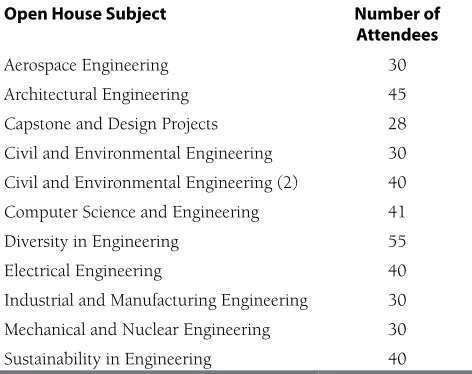
their topics and attendance figures are outlined in table 1. There are many outlets used to ensure that students and faculty are aware of an upcoming event. To attract a variety of student attendees, relevant campus student groups related to the featured topic are contacted. For example, the Out in Science, Technology, Engineering and Mathematics (oSTEM) and Society of Women Engineers (SWE) student groups were contacted regarding the Diversity in Engineering open house. The groups were invited to attend the event and interact with attendees or contribute literature about their group that could be included in the event display. University organizations such as the Forum on Black Affairs (FOBA) and the Africana Research Center were contacted as well and asked to contribute similar information. At the Diversity in Engineering open house, the library was happy to have students from oSTEM in attendance and items from FOBA on display. The Diversity in Engineering Open House was an extremely popular event, and the most successful open house to date with fifty-five attendees.
The librarians also work in collaboration with the admin-istrative assistants in the College of Engineering to place an announcement in the appropriate undergraduate, graduate, and department newsletters. To ensure maximum exposure of the event a digital message board announcement and print flyer are also created and distributed throughout the college and university libraries. The librarians make sure the print flyers are hung on bulletin boards in College of Engineer-ing buildEngineer-ings. The EngineerEngineer-ing Library’s mascot is always featured in the flyer and digital signage to capture students’ attention (figures 1 and 2). The events are also highlighted on the Engineering Library’s webpage and posted on social media outlets such as Facebook and Twitter. In addition many attendees will tell their peers, increasing attendance at the next open house.
Engineers also appear to be intrigued by historical events related to disasters. To that end, having open houses around the date of major events in engineering history have proven
successful. For example, the Mechanical and Nuclear En-gineering open house was held in March in recognition of the thirty-fifth anniversary of the Three Mile Island nuclear reactor accident.
The librarians and staff create the materials, like flyers and display items, for each event. Each item is developed with a simple design to ensure that the time commitment from the staff and librarians for these events is kept to a minimum. In addition, the use of a similar structure for open house materials decreases the time commitment for the librarians and staff as they become more familiar with open house preparations. By utilizing the resources and talents within the libraries, the Engineering Library has been able to maintain a $40 budget per open house.
Table 1. Open House Subjects and Attendance
Open House Subject Number of
Attendees
Aerospace Engineering 30
Architectural Engineering 45
Capstone and Design Projects 28
Civil and Environmental Engineering 30
Civil and Environmental Engineering (2) 40
Computer Science and Engineering 41
Diversity in Engineering 55
Electrical Engineering 40
Industrial and Manufacturing Engineering 30
Mechanical and Nuclear Engineering 30
Sustainability in Engineering 40
Figure 1. Flyer
HOLDING THEM ONCE THEY ARRIVE
During the open house students and faculty can meet their subject librarian and discuss any questions they may have about their research and studies. There are a variety of items on display to grab the attendees’ interest and get them think-ing about important topics in engineerthink-ing. The events feature a “Recently Published” book display (figure 3), a database, and a research guide related to the highlighted topic. Spe-cialized items are also placed on display like portraits of famous engineers, interactive engineering kits, historical timelines, and photos of significant events in engineering history related to the highlighted topic. When a student or faculty member arrives he or she is encouraged to browse the items on exhibit and check out any books that are found to be interesting. The database and research guide are placed on display on a large interactive computer screen in the front of the space. Students are given a brief 1–2 minute descrip-tion of the informadescrip-tion displayed on the screen and asked if they have any questions about the content. The computer is also easily accessible if attendees would like to ask additional research questions.
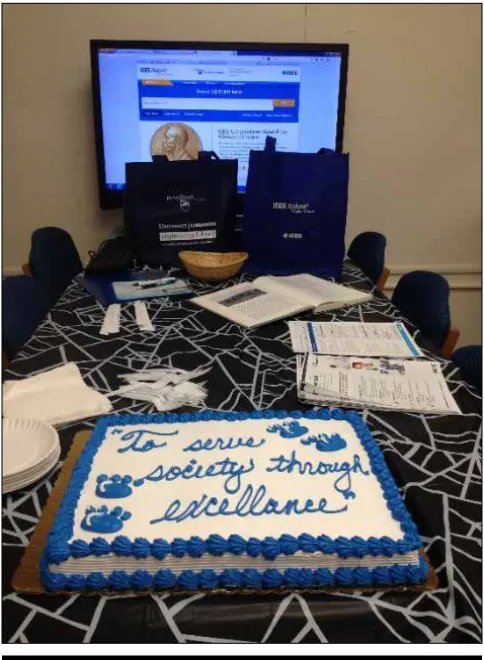
A prize drawing is also held where two winners receive a tote bag filled with goodies usually collected at library con-ferences such as pens, notebooks, etc. In addition, the tote bag contains a t-shirt with the flyer image for the specific event on it. The prizes are placed on display and attendees are asked to fill out a drawing slip with their name and de-partment affiliation. There is also cake, which is purchased from a local grocery store with a well-known saying taken from the highlighted department or subject area written on it (figure 4). Additional pictures from the open houses can be found on the Engineering Library’s Flickr page: https:// www.flickr.com/photos/psuengineeringlib/sets/.
RESULTS AND ASSESSMENT
Assessment for the open houses is gathered both from infor-mation collected from the drawing slips attendees complete and from one-on-one feedback with participants during the event. Attendees come from a variety of majors, with quite a few coming from the highlighted department. On average each event has about thirty to forty attendees. The attendees are primarily students; however, there have been a few oc-casions when college staff and faculty members will attend. Some faculty have also started to assign the open houses as extra credit for their classes. Faculty attendance has proven useful because it offers an opportunity to reintroduce them to the library’s physical space and services.
The casual environment of the open houses has helped students feel more at ease when speaking with a librarian. Many feel comfortable talking about their classes that may or may not be related to the highlighted department, which has led to an increase in reference questions during the open houses. Common questions are related to learning
more about methods to find articles. Some students are also looking for resources to help with classes they are taking outside of their major. These questions have allowed elec-tronic resources, beyond those on display, to be shown and demonstrated. Students also like to talk about their upcom-ing graduations, job opportunities, and to simply appreci-ate the nice break from studying with cake and friendly Figure 3. Recently Published Book Display
conversation. There have been several repeat student attend-ees at each open house, which has helped establish stronger relationships between the librarians and students.
The students are also interested in the print books on display during the open house events, which was a surprise. Students have mentioned that these books were exactly what they needed to help them with a project and they were not aware of the kind of books that the library had available. Fur-thermore, information received through conversations at the events has assisted with collection building for the library’s professional development resources. The professional devel-opment collection contains books that assist students with building their leadership, public speaking, technical writing, and interviewing skills. Several students mentioned that they were preparing to find a job after graduation, working on a thesis, or completing final projects. Because of this, the li-brary has increased the number of resources and tools in the professional development collection to assist in these efforts. In addition, with the success of the Diversity in Engineering Open House, the library has included more materials in the general collection that relate to diversity issues.
CONCLUSION
The open house initiative has provided great exposure for the Engineering Library and sparked collaborative opportu-nities between the library and other departments on campus. For example, at the October 2015 Civil and Environmental Engineering open house, the Pennsylvania State University Sustainability Institute provided a roadshow for students on methods to properly sort their recycling and what can be re-cycled. The open houses are also providing ways for student organizations to connect with students. At the Capstone and Design Projects open house, members of the Pennsylvania State University Advanced Vehicle Team attended the event to encourage other students to get involved with their pro-gram. The events have offered a way for students and faculty to learn more about the helpful resources the Engineering Library has to offer. Due to the informal atmosphere of the open house events, the greatest achievement is how they are changing the students’ perception of the library and its librarians, and the increased comfort level students have in approaching them.
The open houses have allowed the librarians to get a better sense of the needs of the faculty and students in the College of Engineering. The librarians are encouraged by the success of these events and recognize the importance of hav-ing multiple events each semester to continue to support and educate new faculty and students who arrive at Penn State each year. In addition, the events have provided the oppor-tunity for all College of Engineering students, faculty, and staff to re-acquaint themselves with the library’s benefits, resources, and services. As these events are topic-based, the featured resources change each year and are based on recent publications in the field, which helps students, faculty, and
staff stay current in their disciplines. The events have also al-lowed the librarians to reach students that they may not have been able to see in a traditional library instruction setting. According to the College of Engineering website, as of Feb-ruary 1, 2016, for Fall 2015 there were 9,267 undergraduate and graduate students enrolled in the College of Engineer-ing at Penn State’s University Park Campus and the number has continued to increase steadily in the last three years.18
The library is looking into new and creative ways to reach more students. These new initiatives include, the “Dog-tor-Who contest,” inspired by the fiftieth anniversary of the British television show, Doctor Who. Students are asked to complete a form successfully identifying the signature clothing of their favorite Doctor Who characters worn by the Engineering Library mascot in a whiteboard drawing. The contest is a fun event to help students take a break from their studies. Other initiatives include inviting professional organizations to speak to the students and faculty about job interview preparations and how to get published. The library and open house events are also serving as a site for student organization outreach as well. These events are a positive way to develop stronger relationships with patrons. Penn State’s Engineering Library on the University Park Campus is committed to continuing their efforts in this type of out-reach.
Acknowledgments
A special thank you to Nan Butkovich, Chari Davenport, An-gela R. Davis, Brett Eyer, Kevin Harwell, Linda Musser, Bonnie Osif, J. Harlan Ritchey, Linda Struble, Christopher Walker, and Diane Zabel for all of their support and assistance.
References
1. Jill Wilson, “Ultimate Outreach: Exploring the Outreach Sea within the Engineering, Math and Physical Sciences Libraries at Cornell University,” Science & Technology Libraries 32 (2013): 68–83, http://dx.doi.org/10.1080/0194262X.2012.758459. 2. Ellysa Stern Cahoy and Rebecca Merritt Bichel, “A Luau in the
Library,” College & Undergraduate Libraries 11 (2004): 49–60, http://dx.doi.org/10.1300/J106v11n01_06.
3. Cahoy and Bichel, “A Luau in the Library,” 55–56.
4. Nancy Collins and Eva Dodsworth, “Reaching First-Year Stu-dents during Orientation Week,” Partnership: The Canadian Journal of Library and Information Practice and Research 6, no. 2 (2011): 1–8.
5. Cahoy and Bichel, “A Luau in the Library,” 49–60.
6. Willie Miller and Mindy Cooper, “Library WOW! Fun Outreach and Orientation in an Academic Library,” Indiana Libraries 33, no. 2 (2014): 58–60; Cahoy and Bichel, “A Luau in the Library,” 49–60.
7. Collins and Dodsworth, “Reaching First-Year Students,” 3. 8. Miller and Cooper, “Library WOW!” 58–60; Cahoy and Bichel,
“A Luau in the Library,” 49–60; Collins and Dodsworth, “Reach-ing First-Year Students,” 1–8.
9. Miller and Cooper, “Library WOW!” 60.
10. Cahoy and Bichel, “A Luau in the Library,” 55–56. 11. Miller and Cooper, “Library WOW!” 60.
Science & Technology Libraries 21 (2001): 87–95, http:// dx.doi.org/10.1300/J122v21n01_08; Melissa Dennis, “Out-reach Initiatives in Academic Libraries, 2009–2011,” Refer-ence Services Review 40 (2012): 368–83, http://dx.doi.org/ 10.1108/00907321211254643.
13. Cahoy and Bichel, “A Luau in the Library,” 55–56. 14. Soehner and Wei Wei, “Bridge Beyond the Walls,” 87–95. 15. Jill Wilson, “Ultimate Outreach,” 70.
16. Tammy Stitz, “Learning From Personal Experience What’s Needed in Information Literacy Outreach: An Engineering Stu-dent Returns to Her Alma Mater as an Engineering Librarian,”
Science & Technology Libraries 29 (2010): 189–99, http://dx.doi .org/10.1080/0194262X.2010.497706.
17. Soehner and Wei Wei, “Bridge Beyond the Walls,” 94.