Available online throug
ISSN 2229 – 5046
International Journal of Mathematical Archive- 8(7), July – 2017 1
SECURE RESTRAINED CONVEX DOMINATION IN GRAPHS
ENRICO L. ENRIQUEZ*
Department of Mathematics,
School of Arts and Sciences, University of San Carlos, 6000 Cebu City, Philippines.
(Received On: 08-06-17; Revised & Accepted On: 05-07-17)
ABSTRACT
L
et 𝐺 be a connected simple graph. A restrained convex dominating set 𝑆 in a connected graph 𝐺 is a secure restrained convex dominating set, if for each element 𝑢 in 𝑉(𝐺)\𝑆 there exists an element 𝑣 in 𝑆 such that 𝑢𝑣 ∈ 𝐸(𝐺) and (𝑆 \{ 𝑣 })∪{ 𝑢 } is a restrained convex dominating set. The secure restrained convex domination number of 𝐺, denoted by 𝛾𝑠𝑟𝑐(𝐺), is the minimum cardinality of a secure restrained convex dominating set in 𝐺. A secure restrained convex dominating set of cardinality 𝛾𝑠𝑟𝑐(𝐺) will be called a 𝛾𝑠𝑟𝑐-𝑠𝑒𝑡. In this paper, we give some realization problems will be given. In particular, we show that given positive integers 𝑘 and 𝑛 such that 𝑛 ≥ 5 and 𝑘 ∈{ 1,2, . . . ,𝑛 −2,𝑛 }, there exists a connected graph 𝐺 with |𝑉(𝐺)| =𝑛 and𝛾𝑠𝑟𝑐(𝐺) =𝑘. Further, we characterize the secure restrained convex dominating sets in the join of two graphs and give some important results.Mathematics Subject Classification: 05C69.
Keywords: convex domination, restrained convex dominating set, secure restrained convex dominating set.
1. INTRODUCTION
Domination in graph was introduced by Claude Berge in 1958 and Oystein Ore in 1962 [11]. However, it was not until 1977, following an article [4] by Ernie Cockayne and Stephen Hedetniemi, that domination in graphs became an area of study by many researchers. One type of domination parameter is the secure domination number in a graph. This was studied and introduced by E.J. Cockayne [5]. Secure dominating sets can be applied as protection strategies by minimizing the number of guards to secure a system so as to be cost effective as possible. Other type of domination parameter is the restrained domination number in a graph. This was introduced by Telle and Proskurowski [9] indirectly as a vertex partitioning problem. Moreover, restrained dominating set can found in [8]. One practical application of restrained domination is that of prisoners and guards. Here, each vertex not in the restrained dominating set corresponds to a position of a prisoner, and every vertex in the restrained dominating set corresponds to a position of a guard. To effect security, each prisoner's position is observed by a guard's position. To protect the rights of prisoners, each prisoner's position is seen by at least one other prisoner's position. To be cost effective, it is desirable to place a few guards as possible. In [12], Pushpam and Suseendran paper's "Secure Restrained Domination in Graphs" studied few properties of secure restrained domination number of certain classes of graphs and evaluate 𝛾𝑠𝑟(𝐺) values. Convexity in graphs has been discussed and studied in [7]. On the other hand, convex domination in graphs has been defined and studied in [10]. In [2], Enriquez and Canoy, introduced the concepts of secure convex and restrained convex domination in graphs. In this paper, we give some realization problems and characterize the secure restrained convex dominating sets in the join of two graphs. For general concepts we refer the reader to [6].
2. RESULTS
From the definitions above, the following result is immediate.
Remark 2.1: Let 𝐺 be a nontrivial connected graph of order𝑛 ≥ 2. Then (i) 𝛾(𝐺)≤ 𝛾𝑟𝑐𝑜𝑛(𝐺)≤ 𝛾𝑠𝑟𝑐(𝐺); and
(ii) 𝛾𝑠𝑟𝑐∈ {1,2, . . ,𝑛 −3,𝑛 −2,𝑛}.
It is worth mentioning that the upper bound in Remark 2.1(ii) is sharp. For example, 𝛾𝑠𝑟𝑐(𝑃𝑛) = 𝑛 for all𝑛 ≥ 2. The lower bound is also attainable as the following result shows.
Theorem 2.2 (Realization Problem 1): Given positive integers 𝑘 and 𝑛 such that 𝑛 ≥ 5 and 𝑘 ∈ {1,2, . . . ,𝑛 −2,𝑛}, there exists a connected graph 𝐺 with |𝑉(𝐺)| =𝑛 and 𝛾𝑠𝑟𝑐(𝐺) =𝑘.
Proof: Consider the following cases:
Case-1: Suppose that 𝑘= 1. Let 𝐺=𝐾𝑛. Then |𝑉(𝐺)| =𝑛 and 𝛾𝑠𝑟𝑐(𝐺) = 1.
Case-2: Suppose that 𝑘= 2. Let 𝐺=𝐾𝑛− 𝑒 for some 𝑒 ∈ 𝐸(𝐾𝑛) (see Figure 1).
Figure-1: A graph 𝐺 with |𝑉(𝐺)| =𝑛 and 𝛾𝑠𝑟𝑐(𝐺) = 2
The set 𝑆= { 𝑥1,𝑥𝑛 } is a 𝛾𝑠𝑟𝑐-𝑠𝑒𝑡 of 𝐺. Hence, |𝑉(𝐺)| =𝑛 and 𝛾𝑠𝑟𝑐(𝐺) = 2.
Case-3: Suppose 3≤ 𝑘 ≤ 𝑛 −2. Let 𝑟=𝑛 − 𝑘+ 1 (𝑟 ≥ 3). Consider the graph 𝐺 =〈 { 𝑣 } 〉+ (𝐾𝑟∪ 𝐾�𝑘−2) (see Figure 2).
Figure-2: A graph 𝐺 with |𝑉(𝐺)| =𝑛 and 𝛾𝑠𝑟𝑐(𝐺) =𝑘
The set 𝑆= { 𝑥1,𝑣,𝑎1,𝑎2, . . . ,𝑎𝑘−2 } is a 𝛾𝑠𝑟𝑐-𝑠𝑒𝑡 of 𝐺. Hence, |𝑉(𝐺)| =𝑟+ (𝑘 −2) + 1 =𝑛and 𝛾𝑠𝑟𝑐(𝐺) = (𝑘 − 2) + 2 =𝑘.
Case-4: Suppose 𝑘=𝑛. Let 𝐺=𝐾1,𝑛−1. Then |𝑉(𝐺)| =𝑛 and 𝛾𝑠𝑟𝑐(𝐺) =𝑘. This proves the assertion.
Theorem 2.3 (Realization Problem 2): Given positive integers 𝑘,𝑚 ≥ 2 and 𝑛 ≥ 6 such that 1≤ 𝑘 ≤ 𝑚 −1 and 𝑚 ∈{ 2,3, . . . ,𝑛 −2,𝑛 }, there exists a connected graph 𝐺 with |𝑉(𝐺)| =𝑛, 𝛾𝑠𝑟𝑐(𝐺) =𝑚, and 𝛾𝑟𝑐𝑜𝑛(𝐺) =𝑘.
Proof: Consider the following cases:
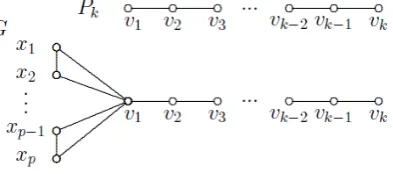
Case-1: Suppose that 𝑚=𝑛. Let the path 𝑃𝑘= [𝑣1,𝑣2, . . . ,𝑣𝑘] and the path 𝑃𝑝= [𝑥1,𝑥2, . . . ,𝑥𝑝] with 𝑘 ≥ 2, 𝑝 ≥ 2. Consider the graph 𝐺 obtained from 𝑃𝑘 by adding the edges 𝑥𝑖𝑣1, where 𝑖= 1,2, . . . ,𝑝 (see Figure 3).
Figure-3: A graph 𝐺 with 𝛾𝑠𝑟𝑐(𝐺) =𝑛=𝑚 and 𝛾𝑟𝑐𝑜𝑛(𝐺) =𝑘
The sets 𝐴1= { 𝑣1,𝑣2, . . . ,𝑣𝑘 } and 𝐵1=𝑉(𝐺) are, respectively, a 𝛾𝑟𝑐𝑜𝑛-𝑠𝑒𝑡 and a 𝛾𝑠𝑟𝑐-𝑠𝑒𝑡 of 𝐺. It follows that |𝑉(𝐺)| =𝑛=𝑚=𝛾𝑠𝑟𝑐(𝐺) and 𝛾𝑟𝑐𝑜𝑛(𝐺) =𝑘.
© 2017, IJMA. All Rights Reserved 3
Figure-4: A graph 𝐺 with 𝛾𝑠𝑟𝑐(𝐺) =𝑘+ 1 =𝑚 and 𝛾𝑟𝑐𝑜𝑛(𝐺) =𝑘
The set 𝐴2= { 𝑣1,𝑣2, . . . ,𝑣𝑘 } is a 𝛾𝑟𝑐𝑜𝑛-𝑠𝑒𝑡 of 𝐺 and the set 𝐵2= { 𝑦1,𝑣1,𝑣2, . . . ,𝑣𝑘} is a 𝛾𝑠𝑟𝑐-𝑠𝑒𝑡 of 𝐺. Hence, 𝛾𝑟𝑐𝑜𝑛(𝐺) =𝑘, 𝛾𝑠𝑟𝑐(𝐺) =𝑘+ 1 =𝑚, and |𝑉(𝐺)| =𝑟+𝑘=𝑛.
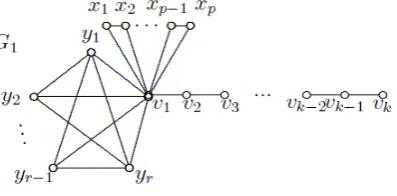
Suppose that 𝑘<𝑚 −1. Let 𝑟=𝑛 − 𝑚+ 1 and 𝑝=𝑚 − 𝑘 −1. Consider the graph 𝐺 in Figure 4 and let 𝐺1 be the graph obtained from 𝐺 and the path 𝑃𝑝= [𝑥1,𝑥2, . . . ,𝑥𝑝] with 𝑝 ≥ 2 by adding the 𝑥𝑖𝑣1, where 𝑖= 1,2, . . . ,𝑝 . The set 𝐴3= { 𝑣1,𝑣2, . . . ,𝑣𝑘 } is a 𝛾𝑟𝑐𝑜𝑛-𝑠𝑒𝑡 of 𝐺1 and the set 𝐵3= {𝑦1,𝑥1,𝑥2, . . . ,𝑥𝑝,𝑣1,𝑣2, . . . ,𝑣𝑘} is a 𝛾𝑠𝑟𝑐-𝑠𝑒𝑡 of 𝐺1 (see Figure 5).
Figure-5: A graph 𝐺1 with 𝛾𝑠𝑟𝑐(𝐺1) =𝑝+𝑘+ 1 =𝑚 and 𝛾𝑟𝑐𝑜𝑛(𝐺1) =𝑘
Hence, 𝛾𝑟𝑐𝑜𝑛(𝐺1) =𝑘, 𝛾𝑠𝑟𝑐(𝐺1) =𝑝+𝑘+ 1 =𝑚, and |𝑉(𝐺1)| =𝑟+𝑝+𝑘=𝑛. This proves the assertion.
Corollary 2.4: The difference 𝛾𝑠𝑟𝑐− 𝛾𝑟𝑐𝑜𝑛 can be made arbitrarily large.
Proof: Let 𝑛 be a positive integer. By Theorem 2.3, there exists a connected graph 𝐺 such that 𝛾𝑠𝑟𝑐(𝐺) =𝑛+ 1 and 𝛾𝑟𝑐𝑜𝑛(𝐺) = 1. Thus, 𝛾𝑠𝑟𝑐(𝐺)− 𝛾𝑟𝑐𝑜𝑛(𝐺) =𝑛. Therefore, 𝛾𝑠𝑟𝑐− 𝛾𝑟𝑐𝑜𝑛can be made arbitrarily large.
Lemma 2.5: If 𝑆 is a secure restrained convex dominating set in a graph 𝐺, then 𝑆 is a secure convex dominating set in 𝐺.
Proof: Suppose that 𝑆 is a secure restrained convex dominating set in 𝐺. Then 𝑆 is a restrained convex dominating set in 𝐺, that is, 𝑆 is a convex dominating set in 𝐺. Let 𝑢 ∈ 𝑉(𝐺)∖ 𝑆. Then there exists 𝑣 ∈ 𝑆 such that 𝑢𝑣 ∈ 𝐸(𝐺) and 𝑆𝑢= (𝑆 ∖ {𝑣})∪ {𝑢} is a restrained convex dominating set in 𝐺, that is, 𝑆𝑢 is a convex dominating set in 𝐺. Hence, 𝑆 is a secure convex dominating set in 𝐺.
The converse of the above Lemma is not necessarily true. For example, consider the graph $𝐺$ below (see Figure 6). The set 𝑆= {𝑥,𝑦,𝑧,𝑤} is a secure convex dominating set in 𝐺 but not a secure restrained convex dominating set in 𝐺.
Figure-6: A graph 𝐺 with 𝛾𝑠𝑐𝑜𝑛(𝐺) = 4
We need the following Theorems and Corollary for our next result.
Theorem 2.6 [2]: Let 𝐺 be any connected graph. Then 𝛾𝑠𝑐𝑜𝑛(𝐺) = 1 if and only if 𝐺 is complete.
Theorem 2.7: Let 𝐺 be a connected graph of order 𝑛 ≥ 3. Then 𝛾𝑠𝑟𝑐(𝐺) = 1 if and only if 𝐺 is complete.
For the converse, suppose that 𝐺 is complete. Then for every 𝑣 ∈ 𝑉(𝐺), the set 𝑆= { 𝑣 } is a convex dominating set of 𝐺. Since 𝑛 ≥ 3, there exists 𝑥,𝑦 ∈ 𝑉(𝐺)∖ 𝑆 such that 𝑣𝑥,𝑥𝑦 ∈ 𝐸(𝐺). Hence, 𝑆 is a restrained convex dominating set of 𝐺. Since 𝑆 ∖{ 𝑣 }∪ { 𝑧 } is also a restrained convex dominating set of 𝐺 for all 𝑧 ∈ 𝑉(𝐺)∖ 𝑆, it follows that 𝑆 is a 𝛾𝑠𝑟𝑐-𝑠𝑒𝑡 of 𝐺. Therefore, 𝛾𝑠𝑟𝑐(𝐺) = 1.
The following result is a quick consequence of Theorem 2.7.
Corollary 2.8: Let 𝐺 and 𝐻 be nontrivial connected graphs. Then 𝛾𝑠𝑟𝑐(𝐺+𝐻) = 1 if and only if 𝐺 and 𝐻 are complete graphs.
Corollary 2.9: 𝛾𝑠𝑟𝑐(𝐺 ∘ 𝐻) = 1 if and only if 𝐺 is a trivial graph and 𝐻 is a nontrivial complete graph.
A nonempty subset 𝑆 of 𝑉(𝐺), where 𝐺 is any graph, is a clique in 𝐺 if the graph 𝐺[𝑆] =〈𝑆〉 induced by 𝑆 is complete. A clique 𝑆 in 𝐺 is a \textit{clique dominating} set if it is a dominating set. It is a secure clique dominating set in 𝐺 if for every 𝑢 ∈ 𝑉(𝐺)∖ 𝑆, there exists 𝑣 ∈ 𝑆 ∩ 𝑁𝐺(𝑢) such that (𝑆 ∖ { 𝑣 })∪ { 𝑢 } is a clique dominating set in 𝐺. The secure clique domination number of 𝐺, denoted by 𝛾𝑠𝑐𝑙(𝐺), is the minimum cardinality of a secure clique dominating set of 𝐺.
Theorem 2.10 [1]: Let 𝐺 and 𝐻 be non-complete graphs. Then 𝑆 ⊆ 𝑉(𝐺+𝐻) is a restrained convex dominating set in 𝐺+𝐻 if and only if one of the following holds.
(i) 𝑆 is a clique dominating set in 𝐺. (ii) 𝑆 is a clique dominating set in 𝐻.
(iii) 𝑆=𝑆𝐺∪ 𝑆𝐻, where 𝑆𝐺 and 𝑆𝐻 are cliques in 𝐺 and 𝐻, respectively.
Theorem 2.11 [2]: Let 𝐺 and 𝐻 be connected non-complete graphs. Then a proper subset 𝑆 of 𝑉(𝐺+𝐻) is a secure convex dominating set in 𝐺+𝐻 if and only if one of the following statements holds:
(i) 𝑆 is a secure clique dominating set in 𝐺 and |𝑆|≥ 2. (ii) 𝑆 is a secure clique dominating set in 𝐻 and |𝑆|≥ 2.
(iii) 𝑆= { 𝑣 }∪ { 𝑤 } where { 𝑣 } and { 𝑤 } are dominating sets in 𝐺 and 𝐻 respectively.
(iv) 𝑆= { 𝑣 }∪ 𝑆𝐻where { 𝑣 } is a dominating set in 𝐺, and |𝑆𝐻|≥ 2, and 𝑆𝐻 is a secure clique dominating set in 𝐻. (v) 𝑆=𝑆𝐺∪ { 𝑤 } where { 𝑤 } is a dominating set in 𝐻, and |𝑆𝐺|≥ 2, and 𝑆𝐺 is a secure clique dominating set in 𝐺. (vi)𝑆=𝑆𝐺∪ 𝑆𝐻 where |𝑆𝐺|≥ 2, |𝑆𝐻|≥ 2, and 𝑆𝐺 and 𝑆𝐻 are secure clique dominating sets in 𝐺 and
𝐻respectively.
The following characterizes the secure restrained convex dominating sets in the join of two connected non-complete graphs.
Theorem 2.12: Let 𝐺 and 𝐻 be connected non-complete graphs. Then a proper subset 𝑆 of 𝑉(𝐺+𝐻) is a secure restrained convex dominating set in 𝐺+𝐻 if and only if it is a secure convex dominating set in 𝐺+𝐻.
Proof: Suppose that 𝑆 is a secure restrained convex dominating set in 𝐺+𝐻. Then 𝑆 is a secure convex dominating set in 𝐺+𝐻 by Lemma 2.5.
For the converse, suppose that 𝑆 is a secure convex dominating set in 𝐺+𝐻. Then statement (𝑖) or (𝑖𝑖) or (𝑖𝑖𝑖) or (𝑖𝑣) or $(𝑣)$ or (𝑣𝑖) of Theorem 2.11 holds. Suppose first that statement (𝑖) holds. Then 𝑆is a restrained convex dominating set in 𝐺+𝐻 by Theorem 2.10(𝑖). Since 𝑉(𝐺+𝐻)∖ 𝑆 ≠ ∅, let 𝑧 ∈ 𝑉(𝐺+𝐻)∖ 𝑆.
Suppose that 𝑧 ∈ 𝑉(𝐺). Then by assumption, there exists 𝑎 ∈ 𝑆such 𝑎𝑧 ∈ 𝐸(𝐺)⊂ 𝐸(𝐺+𝐻) and 𝑆𝑧= (𝑆 ∖ { 𝑎 })∪ { 𝑧 } is a convex dominating set in 𝐺 (and hence in 𝐺+𝐻). To show that 𝑆𝑧 is a restrained dominating set, let 𝑢 ∈ 𝑉(𝐺+𝐻)∖ 𝑆𝑧. If 𝑢 ∈ 𝑉(𝐺), then 𝑢𝑤 ∈ 𝐸(𝐺+𝐻) for all 𝑤 ∈ 𝑉(𝐻)∖ 𝑆𝑧⊂ 𝑉(𝐺+𝐻)∖ 𝑆𝑧 and 𝑢𝑥 ∈ 𝐸(𝐺)⊂ 𝐸(𝐺+𝐻) for some 𝑥 ∈ 𝑆𝑧. If 𝑢 ∈ 𝑉(𝐻), then 𝑢𝑦 ∈ 𝐸(𝐺+𝐻) for all 𝑦 ∈ 𝑉(𝐺)∖ 𝑆𝑧⊂ 𝑉(𝐺+𝐻)∖ 𝑆𝑧 and 𝑢𝑥 ∈ 𝐸(𝐺+𝐻) for some 𝑥 ∈ 𝑆𝑧. Thus, for each 𝑢 ∈ 𝑉(𝐺+𝐻)∖ 𝑆𝑧, there exists 𝑥 ∈ 𝑆𝑧 such that 𝑢𝑥 ∈ 𝐸(𝐺+𝐻) and there exists 𝑡 ∈ 𝑉(𝐺+𝐻)∖ 𝑆𝑧 such that 𝑢𝑡 ∈ 𝐸(𝐺+𝐻). This implies that 〈𝑉(𝐺+𝐻)∖ 𝑆𝑧〉 has no isolated vertices. Hence 𝑆𝑧 is a restrained dominating set of 𝐺+𝐻, that is, 𝑆𝑧 is a restrained convex dominating set of 𝐺+𝐻. Similarly, if 𝑧 ∈ 𝑉(𝐻), then 𝑆𝑧 is a restrained convex dominating set in 𝐺+𝐻. Accordingly, 𝑆 is a secure restrained convex dominating set in 𝐺+𝐻.
Next, if statement (𝑖𝑖) of Theorem 2.11 holds, then 𝑆 is a restrained convex dominating set in 𝐺+𝐻 by Theorem 2.10(𝑖𝑖). By using similar proofs when statement (𝑖) of Theorem 2.11 holds, 𝑆 is a secure restrained convex dominating set in 𝐺+𝐻.
© 2017, IJMA. All Rights Reserved 5 Suppose that 𝑢 ∈ 𝑉(𝐺). Since 𝑆 is a secure convex dominating set in 𝐺+𝐻, there exists 𝑥 ∈ 𝑆, say 𝑥=𝑤, such that 𝑢𝑤 ∈ 𝐸(𝐺+𝐻) and 𝑆𝑢= (𝑆 ∖ { 𝑤 })∪ { 𝑢 } is a convex dominating set in 𝐺+𝐻 and 𝑆𝑢= { 𝑣,𝑢 }⊂ 𝑉(𝐺). This implies that 𝑆𝑢 is a clique dominating set in 𝐺. Thus, 𝑆𝑢 is a restrained convex dominating set in 𝐺by Theorem 2.10(𝑖). Similarly, if 𝑢 ∈ 𝑉(𝐻), then 𝑆𝑢 is a restrained convex dominating set of 𝐺+𝐻. Accordingly 𝑆 is a secure restrained convex dominating set in 𝐺+𝐻.
Suppose that statement (𝑖𝑣) of Theorem 2.11 holds. Since 𝑆= { 𝑣 }∪ 𝑆𝐻, where { 𝑣 } and 𝑆𝐻 are cliques in 𝐺 and 𝐻 respectively, it follows that 𝑆 is a restrained convex dominating set in 𝐺+𝐻 by Theorem 2.10(𝑖𝑖𝑖). Since 𝑉(𝐺+𝐻)∖
𝑆 ≠ ∅, let 𝑢 ∈ 𝑉(𝐺+𝐻)∖ 𝑆.
If 𝑢 ∈ 𝑉(𝐺), then 𝑆𝑢= (𝑆 ∖ { 𝑣 })∪ { 𝑢 } =𝑆𝐻∪ { 𝑢 }. Since { 𝑢 } and 𝑆𝐻 are cliques in 𝐺 and 𝐻 respectively, it follows that 𝑆𝑢 is a restrained convex dominating set in 𝐺+𝐻 by Theorem 2.10(𝑖𝑖𝑖). Now, if 𝑢 ∈ 𝑉(𝐻), then there exists 𝑤 ∈ 𝑆𝐻 such that 𝑢𝑤 ∈ 𝐸(𝐻) and (𝑆𝐻∖ { 𝑤 })∪ { 𝑢 } is a clique dominating set in 𝐻. This implies that 𝑆𝑢= (𝑆 ∖ { 𝑤 })∪ {𝑢 } = ({ 𝑣 }∪ 𝑆𝐻∖ { 𝑤 })∪ { 𝑢 }. Since { 𝑣 } and (𝑆𝐻∖{ 𝑤 })∪ { 𝑢 } are cliques in 𝐺 and 𝐻 respectively, it follows that 𝑆𝑢 is a restrained convex dominating set in 𝐺+𝐻 by Theorem 2.10(𝑖𝑖𝑖). Accordingly, 𝑆is a secure restrained dominating set of 𝐺+𝐻. Similarly, if statement (𝑣) of Theorem 2.11 holds, then 𝑆 is a secure restrained dominating set of 𝐺+𝐻.
Finally, if statement (𝑣𝑖) of Theorem 2.11 holds, then 𝑆 is a secure restrained convex dominating set in 𝐺+𝐻 (using similar proofs).
The following result is a quick consequence of Theorem 2.12.
Corollary 2.13: Let 𝐺 and 𝐻 be connected non-complete graphs. Then
𝛾𝑠𝑟𝑐(𝐺+𝐻) = �𝑉(𝐺2,+𝐻), 𝑖𝑓𝛾(𝐺) = 1 =𝛾(𝐻𝑖𝑓) 𝑜𝑟𝑜𝑡ℎ𝑒𝑟𝑤𝑖𝑠𝑒𝛾𝑠𝑐𝑙(𝐺) = 2 𝑜𝑟𝛾𝑠𝑐𝑙(𝐻) = 2
REFERENCES
1. E.L. Enriquez, and S.R. Canoy,Jr., On a Variant of Convex Domination in a Graph. International Journal of Mathematical Analysis, Vol. 9, 2015, no. 32, 1585-1592. http://dx.doi.org /10.12988 /ijma. 2015. 54127. 2. E.L. Enriquez, and S.R. Canoy, Jr., Secure Convex Domination in a Graph. International Journal of
Mathematical Analysis, Vol. 9, 2015, no. 7, 317-325. http://dx.doi.org/10.12988/ijma.2015.412412.
3. E. Enriquez. S.R. Canoy, Jr., Secure Convex Dominating Sets in Products of Graphs. Applied Mathematica Sciences, Vol 9, 2015, no. 56, 2769-2777. http://dx.doi.org/10.12988/ams.2015.52114.
4. E.J. Cockayne, and S.T. Hedetniemi Towards a theory of domination in graphs, Networks, (1977) 247-261. 5. E.J. Cockayne, O. Favaron and C.M. Mynhardt Secure domination, weak Roman domination and forbidden
subgraphs, Bull. Inst. Combin. Appl. 39(2003) 87-100..
6. G. Chartrand and P. Zhang, A First Course in Graph Theory. Dover Publication, Inc., New York, 2012. 7. G. Chartrand, and P. Zhang Convex Sets in Graphs. Congressus Numerantium, 136 (1999), 19-32.
8. G.S. Domke, J.H. Hattingh, M.A. Henning, L.R. Markus, Restrained Domination in Graphs with Minimum Degree two, J. Combin. Math. Combin. Comput. 35(2000) 239-254.
9. J.A. Telle, A. Proskurowski, Algorithms for Vertex Partitioning Problems on Partial-k Trees, SIAM J. Discrete Mathematics, 10(1997), 529-550.
10. M.A. Labendia, S.R. Canoy, Jr., Convex Domination in the Composition and Cartesian Product of Graphs,
Czechoslovak Mathematical Journal, 62(2012), 1003-1009.
11. O. Ore. Theory of Graphs. American Mathematical Society, Provedence, R.I., 1962.
12. P.R. Pushpam, and C. Suseendran, Secure Restrained Domination in Graphs. Math.Comput.Sci, (2015)9:239-247. DOI 10.1007/s1786-015-0230-4.
Source of support: Nil, Conflict of interest: None Declared.