HYDROGEN BONDING AND ACTIVITY ANALYSIS OF
CHOLANE CLASS OF STEROID DERIVATIVES
Sonia Sharma
[a]and Rajni Kant
[a]Keywords: cholane; biological activity, intermolecular hydrogen bonding, bifurcated hydrogen bond, solute-solvent interaction
Most of the crystallographic analysis that follows from structure determination involves interpretation of the molecular geometry and a working knowledge of a variety of intra- and intermolecular interactions based purely on geometrical considerations (distance and angle cut off criteria). In this paper, a total of fifty-nine structures of cholane derivatives have been chosen for the prediction of their biological activities and hydrogen bonding interaction analysis. Intermolecular interactions of the type X-H…A [X=C, O, N; A=O, Cl, N, Br] in all the structures have been computed and discussed primarily on the basis of distance-angle scatter for better understanding of molecular packing in cholane derivatives. In some structures, bifurcated hydrogen bonds have been observed. Solute-solvent/solvent-solute interactions have also been investigated to understand more complicated processes that occur for biomolecules in aqueous solution.
*Corresponding Authors Fax: +91 191 243 2051 E-Mail: [email protected]
[a] X-ray Crystallography Laboratory, Department of Physics & Electronics, University of Jammu, Jammu Tawi -180 006, India.
Introduction
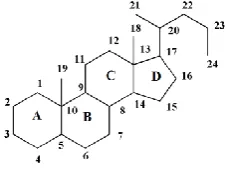
In steroid biochemistry and pharmacology, the carbon skeleton or nucleus consisting of four-ring structure of which three are six-membered cyclohexane rings, one is five-membered cyclopentane ring and a side chain of five carbon atoms located at C17 position of steroid nucleus is regarded as a cholane molecule. Figure1 presents the representative illustration of cholane molecule.1 The end
product of cholesterol metabolism is bile acids which are dihydroxylated and trihydroxylated steroids with 24 carbon atoms i.e., cholane.2
Figure 1. Basic cholane molecule (C24) with standard atomic numbering scheme
Bile acids, their conjugates, and bile salts are natural products that represent the 67% of the soluble components of bile. The most abundant mammalian bile acids are hydroxy derivatives of cholanoic acid and in humans, these consist mainly of cholic acid and chenodeoxycholic acid.3 The bile acid group also includes conjugates of
deoxycholic acid and lithocholic acid, commonly known as secondary bile acids, produced from cholic and chenodeoxycholic acids by intestinal bacteria
dehydroxylation.4 Beforeexcretion into the bile, acids are
conjugate either with glycine or taurine to produce the bile salts.5 These salts enter the small intestine where they
facilitate lipid absorption.6,7 Bile acids are largely
reabsorbed from the intestine8,9 and pass back to the liver
in the enterohepatic circulation. Cholic and chenodeoxycholic (and its 7-hydroxy epimer ursodeoxycholic) acids have important pharmaceutical applications related to their ability to dissolve cholesterol gallstones and for the treatment of bile acid deficiency and cholestatic liver diseases.10,11 Antiviral properties of bile
acids have also been investigated.12 Bile acids have
potential medical applications as analgesics,13 sensitizers
of Gram negative bacterial to antibiotics,14 and
radiopharmaceuticals.15
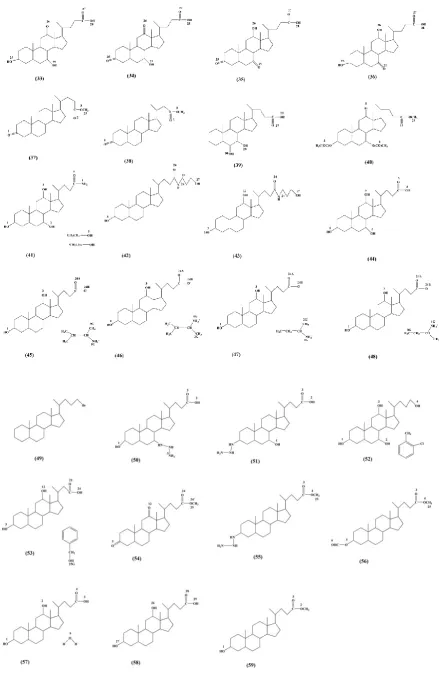
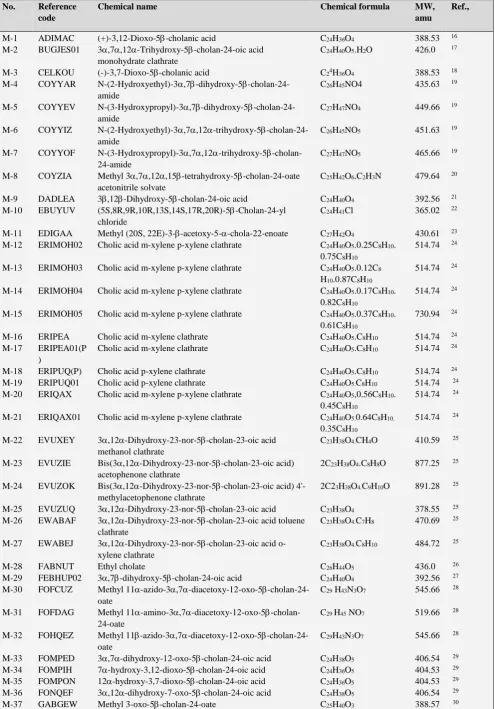
The present work provides comprehensive information about biological activity, structural features and packing interactions/hydrogen bonding in cholane derivatives. Here, we have identified a series of fifty-nine derivatives of cholane from the literature (CSD). The chemical structure of each compound and its numbering is presented in Figure 2. The reference code, chemical name, chemical formula, molecular weight and published reference of each structure is presented in Table 1. 16-44
Biological activity relationship
Table 1. CSD code, chemical name, chemical formula, molecular weight. and reference of molecules 1-59
No. Reference code
Chemical name Chemical formula MW,
amu
Ref.,
M-1 ADIMAC (+)-3,12-Dioxo-5-cholanic acid C24H36O4 388.53 16
M-2 BUGJES01 3,7,12-Trihydroxy-5-cholan-24-oic acid monohydrate clathrate
C24H40O5.H2O 426.0 17
M-3 CELKOU (-)-3,7-Dioxo-5-cholanic acid C24H36O4 388.53 18
M-4 COYYAR N-(2-Hydroxyethyl)-3,7-dihydroxy-5 -cholan-24-amide
C26H45NO4 435.63 19
M-5 COYYEV N-(3-Hydroxypropyl)-3,7-dihydroxy-5 -cholan-24-amide
C27H47NO4 449.66 19
M-6 COYYIZ N-(2-Hydroxyethyl)-3,7,12-trihydroxy-5 -cholan-24-amide
C26H45NO5 451.63 19
M-7 COYYOF N-(3-Hydroxypropyl)-3,7,12-trihydroxy-5 -cholan-24-amide
C27H47NO5 465.66 19
M-8 COYZIA Methyl 3,7,12,15-tetrahydroxy-5-cholan-24-oate acetonitrile solvate
C25H42O6.C2H3N 479.64 20
M-9 DADLEA 3,12-Dihydroxy-5-cholan-24-oic acid C24H40O4 392.56 21
M-10 EBUYUV (5S,8R,9R,10R,13S,14S,17R,20R)-5-Cholan-24-yl chloride
C24H41Cl 365.02 22
M-11 EDIGAA Methyl (20S, 22E)-3--acetoxy-5--chola-22-enoate C27H42O4 430.61 23
M-12 ERIMOH02 Cholic acid m-xylene p-xylene clathrate C24H40O5.0.25C8H10.
0.75C8H10
514.74 24
M-13 ERIMOH03 Cholic acid m-xylene p-xylene clathrate C24H40O5.0.12C8
H10.0.87C8H10
514.74 24
M-14 ERIMOH04 Cholic acid m-xylene p-xylene clathrate C24H40O5.0.17C8H10.
0.82C8H10
514.74 24
M-15 ERIMOH05 Cholic acid m-xylene p-xylene clathrate C24H40O5.0.37C8H10.
0.61C8H10
730.94 24
M-16 ERIPEA Cholic acid m-xylene clathrate C24H40O5.C8H10 514.74 24
M-17 ERIPEA01(P )
Cholic acid m-xylene clathrate C24H40O5.C8H10 514.74 24
M-18 ERIPUQ(P) Cholic acid p-xylene clathrate C24H40O5.C8H10 514.74 24
M-19 ERIPUQ01 Cholic acid p-xylene clathrate C24H40O5.C8H10 514.74 24
M-20 ERIQAX Cholic acid m-xylene p-xylene clathrate C24H40O5,0.56C8H10.
0.45C8H10
514.74 24
M-21 ERIQAX01 Cholic acid m-xylene p-xylene clathrate C24H40O5.0.64C8H10.
0.35C8H10
514.74 24
M-22 EVUXEY 3,12-Dihydroxy-23-nor-5-cholan-23-oic acid methanol clathrate
C23H38O4.CH4O 410.59 25
M-23 EVUZIE Bis(3,12-Dihydroxy-23-nor-5-cholan-23-oic acid) acetophenone clathrate
2C23H38O4.C8H8O 877.25 25
M-24 EVUZOK Bis(3,12-Dihydroxy-23-nor-5-cholan-23-oic acid) 4'-methylacetophenone clathrate
2C23H38O4.C9H10O 891.28 25
M-25 EVUZUQ 3,12-Dihydroxy-23-nor-5-cholan-23-oic acid C23H38O4 378.55 25
M-26 EWABAF 3,12-Dihydroxy-23-nor-5-cholan-23-oic acid toluene clathrate
C23H38O4.C7H8 470.69 25
M-27 EWABEJ 3,12-Dihydroxy-23-nor-5-cholan-23-oic acid o-xylene clathrate
C23H38O4.C8H10 484.72 25
M-28 FABNUT Ethyl cholate C26H44O5 436.0 26
M-29 FEBHUP02 3,7-dihydroxy-5-cholan-24-oic acid C24H40O4 392.56 27
M-30 FOFCUZ Methyl 11-azido-3,7-diacetoxy-12-oxo-5 -cholan-24-oate
C29 H43N3O7 545.66 28
M-31 FOFDAG Methyl 11-amino-3,7-diacetoxy-12-oxo-5 -cholan-24-oate
C29 H45 NO7 519.66 28
M-32 FOHQEZ Methyl 11-azido-3,7-diacetoxy-12-oxo-5 -cholan-24-oate
C29H43N3O7 545.66 28
M-33 FOMPED 3,7-dihydroxy-12-oxo-5-cholan-24-oic acid C24H38O5 406.54 29
M-34 FOMPIH 7-hydroxy-3,12-dioxo-5-cholan-24-oic acid C24H36O5 404.53 29
M-35 FOMPON 12-hydroxy-3,7-dioxo-5-cholan-24-oic acid C24H36O5 404.53 29
M-36 FONQEF 3,12-dihydroxy-7-oxo-5-cholan-24-oic acid C24H38O5 406.54 29
M-38 GIMRAW (5R,8R,9S,10S,13R,14S,17R,20R)-3-oxo-5 -24-norcholanic acid
C23H36O3 360.52 31
M-39 GOKCUF 6,7-Dihydroxy-5-cholan-24-oic acid C24H40O4 392.56 32
M-40 GOKDIU01 3,7-diacetoxy-12-oxo-5-cholan-24-oic acid methyl ester
C29H44O7 504.64 33
M-41 GUXDUY01 3,7,12-Trihydroxy-5-cholamide bis(ethanol) clathrate
C24H41NO4.2C2H6O 499.73 34
M-42 HOLVOU 3-Hydroxy-N-(3-hydroxypropyl)-5-cholan-24-amide C27 H47NO3 433.66 35
M-43 JAQFIR N-(3-Hydroxypropyl)-3,12-dihydroxy-5 -cholan-24-amide
C27H47NO4 449.66 36
M-44 JEYDEW01 3,7,12-trihydroxy-5-cholan-24-oic acid C24H40O5 408.56 27
M-45 KIBRAQ (S)-3-Methyl-2-butylammonium (+)-deoxycholate C5H14NC24H39 O4 479.72 37
M-46 KIBREU (R)-3-Methyl-2-butylammonium (+)-deoxycholate C5H14NC24H39O4- 479.72 37
M-47 KIBRIY (S)-2-Butylammonium (+)-deoxycholate C4H12NC24H39O4 465.70 37
M-48 KIBROE (R)-2-Butylammonium (+)-deoxycholate C4H12NC24H39O4 465.7 37
M-49 MOSWUN (20R)-24-Bromo-5-cholane C24H41Br 409.48 38
M-50 MUTFAJ 7-Azido-3-hydroxy-5-cholan-24-oic acid C24H39N3O3 417.58 39
M-51 MUTFEN 3-Azido-7-hydroxy-5-cholan-24-oic acid C24H39N3O3 417.58 39
M-52 PEQKIH Cholane-3,7,12,24-tetrol 1-chloro-2-methylbenzene solvate
C24H42O4.C7H7Cl 521.18 40
M-53 SUQBUB01 3,12-Dihydroxy-23-nor-5-cholan-23-oic acid benzyl alcohol clathrate
C23H38O4.C7H8O 486.69 25
M-54 VIQPOB (5,8,9,10,13,14,17,20S)-Methyl 3,12-dioxocholan-24-oate
C25H38O4 402.55 41
M-55 VODKEF Methyl 3-azido-5-cholan-24-oate C25H41N3O2 415.61 42
M-56 VODKIJ Methyl 3-formyloxy-5-cholan-24-oate C26H42O4 418.60 42
M-57 YECPUT 3,12-Dihydroxycholan-24-oic acid hemihydrate C24H40O4.0.5H2O 803.14 43
M-58 ZZZPNS01 3,12-Dihydroxy-5-cholan-24-oic acid C24H40O4 392.56 21
M-59 ZZZPPO01 Methyl 3-hydroxy-5-cholan-24-oate C25H42O3 390.59 44
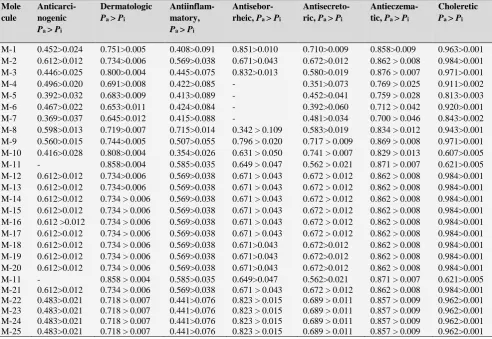
Table 2. Pa and Pi values for the molecules 1-59
Mole cule
Anticarci-nogenic Pa > Pi
Dermatologic Pa > Pi
Antiinflam- matory, Pa > Pi
Antisebor-rheic, Pa > Pi
Antisecreto-ric, Pa > Pi
Antieczema-tic, Pa > Pi
Choleretic Pa > Pi
M-26 0.483>0.021 0.718 > 0.007 0.441>0.076 0.823 > 0.015 0.689 > 0.011 0.857 > 0.009 0.962>0.001 M-27 0.483>0.021 0.718 > 0.007 0.441>0.076 0.823 > 0.015 0.689 > 0.011 0.857 > 0.009 0.962>0.001 M-28 0.554>0.015 0.713 > 0.007 0.599>0.032 0.445 > 0.083 0.704 > 0.010 0.865 > 0.008 0.983>0.001 M-29 0.651>0.011 0.768 > 0.005 0.570>0.038 0.724 > 0.033 0.632 > 0.015 0.888 > 0.005 0.980>0.001
M-30 - 0.585 > 0.017 - - - 0.735 > 0.034 0.855>0.002
M-31 0.465>0.023 0.616 > 0.014 0.334>0.133 - 0.380 > 0.064 0.764>0.027 0.909>0.002
M-32 - - - - - 0.735 > 0.034 0.855>0.002
M-33 - - - - 0.617 > 0.016 0.849 > 0.010 0.988>0.001
M-34 - - - 0.838 > 0.011 0.988>0.001
M-35 - - 0.457>0.071 0.761 > 0.026 - 0.838 > 0.011 0.988>0.001
M-36 0.575>0.014 0.731 > 0.006 0.445>0.075 0.751>0.028 0.612>0.017 0.849>0.010 0.988>0.001 M-37 0.377>0.035 0.799 > 0.004 0.507>0.055 0.813>0.017 0.690>0.011 0.843>0.011 0.922>0.001 M-38 0.392>0.032 0.792 > 0.005 0.438>0.078 0.898>0.004 0.704>0.010 0.872>0.007 0.938>0.001 M-39 0.471>0.022 0.750 > 0.005 0.425>0.083 0.629>0.050 0.515>0.027 0.897>0.005 0.920>0.001 M-40 0.511>0.018 0.687 > 0.009 0.507>0.055 0.520>0.069 0.575>0.020 0.827>0.013 0.971>0.001 M-41 0.401>0.030 0.691 > 0.008 0.457>0.070 0.447>0.083 0.408>0.055 0.744>0.032 0.934>0.001 M-42 0.356>0.040 0.693 > 0.008 0.353>0.121 - 0.499 > 0.030 0.769 > 0.025 0.740>0.003 M-43 0.336>0.046 0.655 > 0.011 0.357>0.118 - 0.536 > 0.024 0.712 > 0.042 0.771>0.003 M-44 0.612>0.012 0.734 > 0.006 0.569>0.038 0.671 > 0.043 0.672 > 0.012 0.862 > 0.008 0.984>0.001 M-45 0.466>0.023 0.759 > 0.005 0.491>0.060 0.792 > 0.021 0.642 > 0.014 0.844 > 0.010 0.934>0.001 M-46 0.466>0.023 0.759 > 0.005 0.491>0.060 0.792 > 0.021 0.642 > 0.014 0.844 > 0.010 0.934>0.001 M-47 0.466>0.023 0.759 > 0.005 0.491>0.060 0.792 > 0.021 0.642 > 0.014 0.844 > 0.010 0.934>0.001 M-48 0.466>0.023 0.759 > 0.005 0.491>0.060 0.792 > 0.021 0.642 > 0.014 0.844 > 0.010 0.934>0.001
M-49 0.338>0.045 - 0.537 > 0.066 - 0.829 > 0.013 0.622>0.005
M-50 0.305>0.056 0.658 > 0.010 - - 0.304 > 0.089 0.840 > 0.011 0.814>0.003 M-51 - 0.652 > 0.011 0.310>0.152 - 0.327 > 0.081 0.821 > 0.014 0.817>0.003 M-52 0.542>0.016 0.741 > 0.005 0.569>0.039 0.496 > 0.073 0.606 > 0.017 0.793 > 0.020 0.952>0.001 M-53 0.367>0.037 0.741 > 0.005 0.403>0.094 0.784 > 0.022 0.627 > 0.015 0.799 > 0.019 -
M-54 0.367>0.037 0.741 > 0.005 0.403>0.094 0.784 > 0.022 0.627 > 0.015 0.799 > 0.019 0.932>0.001 M-55 - 0.658 > 0.010 - - 0.345 > 0.075 0.779 > 0.023 0.510>0.008 M-56 - 0.667 > 0.010 - 0.338 > 0.110 0.430 > 0.048 0.819 > 0.015 0.771>0.003 M-57 0.560>0.015 0.744 > 0.005 0.507>0.055 0.796 > 0.020 0.717 > 0.009 0.869 > 0.008 0.971>0.001 M-58 0.560>0.015 0.744 > 0.005 0.507>0.055 0.796 > 0.020 0.717 > 0.009 0.869 > 0.008 0.971>0.001 M-59 0.525>0.017 0.757 > 0.005 0.506>0.055 0.733 > 0.031 0.646 > 0.014 0.861 > 0.008 0.945>0.001
Biological-activity spectrum provides the rationale for predicting biological activity types for different compounds. Any component of this spectrum of a given compound is assumed to be detectable under suitable experimental conditions. By using a qualitative representation of biological activity, it is possible to compare and mix activity data for obtaining robust quantitative models.45 Multilevel Neighbourhoods of
Atoms (MNA) descriptors are helpful in describing the crystal structures.46 These descriptors are successfully
applied for predicting the biological activity in drug-like compounds.47 The MNA descriptors represent various
structure property relationships including many types of biological activity,48 carcinogenicity,49 drug-likeness,50etc.
The three-dimensional (3D) coordinate data of all the compounds have been selected as an input for the PASS software to predict the bioactivity relationship.49
The biological activity spectra have been correlated empirically on the basis of structure-activity relationship which provides different Pa (probability of activity) and
Pi (probability of inactivity) values. Based on statistics
of MNA descriptors for active and inactive compounds, two probabilities have been calculated for each activity: Pa- probability of the compound being active
and Pi- probability of the compound being inactive.
Influence of these descriptors can be positive (if they are found in compounds with particular activity) or negative (if they are found in compounds without the particular activity) or even neutral. The Pa and Pi values for the
molecule (1-59) have been computed by the pass
software52 and are given in Table 2.It is quite interesting
to note that most of the cholane derivatives possess high
choleretic, dermatologic, antieczematic, antisecretoric and
antiseborrheic activity while anti-inflammatory and
anticarcinogenic activity is not much significant.
Hydrogen Bonding
Carbon forms weak hydrogen bonds likeC-H…O which is ubiquitous and occurs in most molecular crystals53,54
Hydrogen bonding is directional, mostly noncovalent interaction which is fundamental element of chemical structure55 and reactivity.56 On the basis of some studies
which have been carried out by various workers on hydrogen bonding,54, 57-58 we got interested in the analysis
of various kinds of hydrogen bonded interactions present in cholane derivatives (1-59) and the study has been carried out to (i) generate H-bonds by calculating the d,
Table 3. Geometry of C-H...O, O-H...O, N-H…O, C-H…Cl, C-H…N and C-H...Br intermolecular interactions.
Molecule [Number of donors and acceptors]
Intermolecular interactions, X-H...A
H...A(Å) d X...A(Å) D X-H...A(Å) θ
M-1 ADIMAC Donors=10 Acceptors =6
O4-H4AC...O3' O4'-H4BC...O3 O2-H2AA...O1' C23-H23C...O3' C1-H1AA...O1 C19-H19A...O1 C6'-H6BB...O2 C19'-H19E...O2' C6'-H6BA...O2' C8'-H8BA…O2'
1.841 1.814 2.704 2.385 2.645 2.527 2.717 2.653 2.495 2.604
2.672 2.654 3.186 3.327 3.561 3.419 3.516 3.632 3.311 3.399
169.7 179.2 110.3 158.8 153.8 151.3 138.0 177.7 139.5 136.3
The key structural feature distinguishing the hydrogen bond from the other non-covalent interactions is its preference for linearity.59 A better way to analyse
preferences is to draw d-θ and D-θ scatter plots. The plots include all contacts found in molecules (1-59) with d < 2.915Å and D<3.834 Å at any occurring angle. The
graphical projections of d-θ [d (H...A) against θ (X-H...A)] and D-θ [D (X...A) against θ (X-H...A)] scatter plots have been made for intermolecular interactions which are shown in Figure 3a and 3b. The following observations have been made:
Figure 3 (a) d-θ scatter plot for intermolecular C-H...O, O-H...O, N-H...O, C-H...Cl, C-H...N and C-H...Br. (b) D-θ scatter plot for intermolecular C-H...O, O-H...O, N-H...O, C-H...Cl, C-H...N and C-H...Br.
The density of spots for d(H...A) [= 2.5-2.75 Å] and D
(X...A) [= 3.30-3.65 Å ] is predominant [θ (X-H...A) range ~130-170°] in case of C-H...O hydrogen bonds.
The density of spots for O-H...O intermolecular hydrogen bonds is quite high in a given range of values for
d (H...A) =1.80-2.25 Å and D (X...A) =2.60-2.95 Å and θ (X-H...A)=150–180°.
The relative frequency of occurrence of various types of O-H...O, H...O, N-H…O, H…N, H…Cl and C-H...Br intermolecular hydrogen bonds is 48.85, 42.95, 6.23, 1.31, 0.32 and 0.32 %, respectively and it is shown in Figure 4.
Figure 4. Relative frequency of occurence (in%) for various types of intermolecular hydrogen bonding.
Densely populated clusters at short distances and fairly linear angles have been found and each point in these clusters represents a hydrogen bond. Plots analogous to these figures exist in the literature for other kinds of hydrogen bonds, such as O-H...O, C-H...O, etc.60,61
Similar features (preference for linearity) have been depicted by these plots which indicate that the angular characteristics of all kinds of hydrogen bonds are related. On comparison of the frequency of contacts from H(C) to O, N, Cl and Br, it has been concluded that H(C) atoms have a statistical preference for contacts to ‘O’ rather than ‘N’, ‘Cl’ or ‘Br’ atoms. Thus, with oxygen as an acceptor, the frequency of occurrence of C-H...O hydrogen bond becomes very high (42.95 % in the present case). In all the molecules (1-59), the C atoms act as donors but not as acceptors in all the bonds. Most of the C-H...O contacts have distance d (H...O) less than 2.7 Å and based on the
criterion that the van der Waals distance should be <2.7 Å, it was regarded as a certain indication of hydrogen bonding.
X2-H...A). Atom A here is a bifurcated acceptor. In some cases, an atom can act both as donor as well as acceptor simultaneously. Bifurcated hydrogen bonds are commonly observed in O-H…O and N-H…O hydrogen bonded structures.62 They are also observed in C-H…O/N
patterns. In the present study, bifurcated or trifurcated hydrogen bonds have been observed mostly in C-H…O and O-H…O hydrogen bonded structures and in almost all the structures (with Z’=1, 2 and 3), with oxygen
acting as a bi or tri or multifurcated hydrogen bond acceptor.
The solute-solvent intermolecular interactions and the effect of solvent on the properties of organic and biological molecules has been successfully described by various workers using different and complementary theoretical models.63-65 In this direction the investigation
as carried out on the solvation mechanism66 and the
specific role of the solute-solvent interactions could be used as a tool for supramolecular structures.67,68 The
specific C-H…O hydrogen bonds between solute and solvent play an important role in solid state chemistry.69 In
the present work we have come across a few cases where solute-solvent interactions have been observed. Some of the prominent solute–solvent interactions as obtained in the present case are: [O2-H38…O6(W), O5-H40…O6(W), C14-H17…O6(W),C9-H13,O6][M-2], [O2'-H75…O9][M-23], [O2-H37…O9][24], [N1-H40…O5][41], and the solvent-solute interactions are: [C31-H31B…O3][M-19], [O5-H42…O2][M-22], [C54-H82…O3][M-23], [NIG-H15…O24A, NIG-H15…O24B][M-45], [NIG-H26…O24A, NIG-H26…O24B][M-46], [NIG-H56…O3, NIG-H54…O24A, NIG-H54…O24B][M-47], [NIG-H143…O3, NIG-H1G1…O24A][M-48], [O25G-H46…O12][M-53] respectively. A representative view of such an interaction in molecule M-2 is shown in Figure 5.
Figure 5. Solute-solvent/solvent-solute interactions in molecule (M-2).
Conclusion
The relationship between X-ray crystallography and structure- activity relationships have high affinity to indicate the drug-likeness and conserved arginine in the binding site for the steroid receptors. The molecules in the unit cell are linked by C-H…O/O-H…O interactions and most of these are associated through the keto and the
hydroxyl group located at C3/C12 position of the cholane derivatives. These secondary interactions help in understanding the stacking of molecules in the unit cell as supramolecular entity. It is depicted that unusual substitution with the basic steroid moiety/nucleus may change the biological activity of the molecule.
Acknowledgement
One of the authors, Rajni Kant is thankful to the Indian council of Medical Research, New Delhi for research funding under project grant no: BIC/12(14)2012.
References
1Makin, H. L. J., Biochemistry of Steroid Hormones, Oxford:
Blackwell Scientific Publications, 1975, 5.
2Noponen, V., Nonappa, V., Lahtinen, M., Valkonen, A., Salo,
H., Kolehmainen, E., Sievanen, E., Soft Matter, 2010, 6, 3789.
3Bortolini, O., Fantin, G., Fogagnolo, M., Chirality, 2010, 22,
486.
4Bortolini, O., Medici, A., Poli, S., Steroids, 1997, 62, 564.
5Makin, H. L. J., Biochemistry of Steroid Hormones, Oxford:
Blackwell Scientific Publications, 1975, 43.
6Holt, P. R., Arch. Int. Med., 1972, 130, 574.
7Hoffman, A. F., Mekjian, H. S., In: The Bile Acids (Nair P. P &
Kritchevsky D, eds), Plenium Press, New York, 1972, 2, 103.
8Dietschy, J. M., J. Lipid Res., 1968, 19, 297.
9Lack, L., Weiner, I. M., In : The Bile Acids (Nair P. P &
Kritchevsky D, eds), , Plenium Press, New York, 1973, 2, 33.
10Paumgartner, G., Stiehl, A., Gerok, W., Trends in bile acid
research. Dordrecht: Kluwer Academic Publishers, 1989.
11Enhsen, A., Kramer, W., Wess, G., Drug Discov. Today, 1998,
3, 409.
12Berlati, F., Ceschel, G., Clerici, C., Pellicciari, R., Roda, A.,
Ronchi, C., Use of bile acids as antiviral agents. WO 94/00126, 1994.
13Ruff, M. R., Hill, J. M., Kwart, L. D., Pert, C. B., US 5446026,
1995.
14Li, C., Budge, L. P., Driscoll, C. D., Willardson, B. M., Allman,
G. W., Savage, P. B., J. Am. Chem. Soc., 1999, 121, 931.
15Campazzi, E., Cattabriga, M., Marvelli, L., Marchi, A., Rossi,
R., Pieragnoli, M.R., Fogagnolo, M., Inorg. Chim. Acta, 1999, 286, 46.
16Kikolski, E. M., Davison, M., Lalancette, R. A., Thompson, H.
W., Acta Crystallogr., Sect. E. Struct. Rep. Online, 2006, 62, o2641.
17Shibakami, M., Tamura, M., Sekiya, A., J. Am. Chem. Soc.,
1995, 117, 4499.
18Kikolski, E. M., Lalancette, R. A., Thompson, H. W., Acta
19Valkonen, A., Lahtinen, M., Kolehmainen, E., Steroids, 2008,
73, 1228.
20Al-Aboudi, A., Mohammad, M.Y., Haddad, S., Al-Far, R.,
Choudhary, M. I., Atta-ur-Rahman, Steroids, 2009, 74, 483.
21Jover, A., Meijide, F., Soto, V. H., Tato, J. V., Nunez, E. R.,
Ton-Nu, H. T., Hofmann, A. F., Steroids, 2004, 69, 379.
22Cox, P. J., Nahar, L., Turner, A. B., J. Chem. Res., 2001, 162.
23Shingate, B. B., Hazra, B. G., Pore, V. S., Gonnade, R. G.,
Bhadbhade, M. M., Tetrahedron, 2007,63, 5622.
24Nakano, K., Mochizuki, E., Yasui, N., Morioka, K., Yamauchi,
Y., Kanehisa, N., Kai, Y., Yoswathananont, N., Tohnai, N., Sada, K., Miyata, M., Eur. J. Org. Chem., 2003, 2428.
25Kato, K., Sugahara, M., Tohnai, N., Sada, K., Miyata, M., Eur.
J. Org. Chem., 2004, 981.
26Nonappa, Lahtinen, M., Behera, B., Kolehmainen, E., Maitra,
U., Soft Matter, 2010, 6, 1748.
27Nonappa, Lahtinen, M., Ikonen, S., Kolehmainen, E.,
Kauppinen, R., Cryst. Growth Des., 2009, 9, 4710.
28Salunke, D. B., Hazra, B. G., Gonnade, R. G., Bhadbhade, M.
M., Pore, V. S., Tetrahedron, 2005, 61, 3605.
29Bertolasi, V., Ferretti, V., Pretto, L., Fantin, G., Fogagnolo, M.,
Bortolini, O., Acta Crystallogr., Sect.B: Struct. Sci., 2005, 61, 346.
30Virtanen, E., Valkonen, A., Tamminen, J., Kolehmainen, E., J.
Mol. Struct., 2003, 650, 201.
31Dufort, M. D., Davison, M., Lalancette, R. A., Thompson, H.
W., Acta Crystallogr., Sect. C: Cryst. Struct. Commun., 2007, 63, o646.
32Bertolasi, V., Ferretti, V., Fantin, G., Fogagnolo, M., Z.
Kristallogr., 2008, 223, 515.
33Salunke, D. B., Hazra, B. G., Gonnade, R. G., Pore, V. S.,
Bhadbhade, M. M., J. Mol. Struct., 2008, 892, 246.
34Yoswathananont, N., Sada, K., Nakano, K., Aburaya, K.,
Shigesato, M., Hishikawa, Y., Tani, K., Tohnai, N., Miyata, M., Eur. J. Org. Chem., 2005, 5330.
35Valkonen, A., Koivukorpi, J., Lahtinen, M., Kolehmainen,E.,
Acta Crystallogr., Sect. E: Struct. Rep. Online, 2009, 65, o650.
36Valkonen, A., Lahtinen, M., Virtanen, E., Kaikkonen, S.,
Kolehmainen, E., Biosens. Bioelectron., 2004, 20, 1233.
37Jacobs, A., Bathori, N. B., Nassimbeni, L. R., Sebogisi, B. K.,
CrystEngComm., 2013, 15, 931.
38Ketuly, K. A., Hadi, A. H. A., Ng, S. W., Acta Crystallogr.,
Sect.E: Struct. Rep. Online, 2009, 65, o1124.
39Felici, M., Carballada, P. C., Smiths, J. M., Nolte, R. J. M.,
Williams, R. M., Cola, L. D., Feiters, M. C., Molecules, 2010, 15, 2039.
40Liu, W. T., Kin, Y., Nakano, K., Hisaki, I., Tohnai, N., Miyata,
M., Chem.Lett., 2013, 42, 143.
41Katona, B. W., Rath, N. P., Anant, S., Stenson, W. F., Covey,
D. F., J. Org. Chem., 2007, 72, 9298.
42Valkonen, A., Lahtinen, M., Tamminen, J., Kolehmainen, E., J.
Mol. Struct., 2008, 886, 197.
43Singh, K. S., Kaminsky, W., Nat. Prod. Commun., 2011, 6,
1237.
44Virtanen, E., Valkonen, A., Tamminen, J., Kolehmainen, E., J.
Mol. Struct., 2003, 649, 207.
45Verma, R., Jasrotia, D., Chand, B., J. Chem. Crystallogr., 2008,
38, 567.
46Filimonov, D. A., Poroikov, V. V., Borodina, Y., Gloriozova,
T., J. Chem. Inf. Comput. Sci., 1999, 39, 666.
47Rajnikant, Dinesh and Chand, B., Ind. J. Biochem, Biophys.,
2007, 44, 458.
48Poroikov, V. V., Filimonov, D. A., Computer- assisted
predictions of biological activity in search for and optimization of new drugs, Iridium Press, Moscow, 2001, 149.
49Suchkov, A. P., Filimonov, D. A., Stepanchikova, A. V.,
Poroikov, V. V., Environ. Res., 2001, 12, 327.
50Anzali, S., Barnickel, G., Cezanne, B., Krug, M., J. Med.
Chem., 2001, 44, 2432.
51Poroikov, V. V., Filimonov, D. A., Ihlenfeldt, W. D.,
Gloriozova, T. A., Lagunin, A. A., Borodina, Y., Stepanchikova, A. V., Nicklaus, M. C., J. Chem. Inf. Comput. Sci., 2003, 43, 228.
52(a)Geronikaki, A., Druzhilovsky, D,, Zakharov, A., Poroikov,
V., SAR and QSAR Environ Res., 2008, 19, 27. (b)Filz, O. A., Poroikov, V. V., Russian Chem Rev., 2012, 81(2), 158.
53Desiraju, G. R., Acc. Chem. Res., 1991, 24, 270.
54Steiner, T., Crystallogr. Rev., 1996, 6, 1.
55Murrel, J. N., Randi, M., Williams, D. R., Proc. Roy. Soc.
London Ser A, 1965, 284, 566.
56Kojic-Prodic, B., Molcanov, K., Acta Chim. Slov., 2008, 55,
692.
57Steiner, T., Acta Cryst B, 1998, 54, 456.
58Desiraju, G.R., Steiner, T., The weak hydrogen bond in
structural chemistry and biology. Oxford University Press Inc., New York, 1999.
59Steiner,T., Angew. Chem., Int. Ed. Engl., 2002, 41, 48.
60Steiner, T., Saenger, W., J. Am. Chem. Soc., 1992, 114, 10146.
61Steiner,T., Saenger, W., Acta Cryst B, 1992, 48, 819.
62Jeffery, G. A., Saenger, W., Hydrogen bonding in biological
structures. Springer-Verlag, Berlin, 1991.
63Kollman, P., Chem. Rev., 1993, 93, 2395.
64Cramer, C. J., Truhlar, D. G., Chem. Rev., 1999, 99, 2161.
65Baldridge, K. K., Jonas, V., Bain, A. D., J. Chem. Phys., 2000,
113, 7519.
66Allen, M. P., Tildesley, D. J., Computer simulation of liquids,
Oxford University Press, New York, 1987.
67Coutinho, K., Canuto, S., Zerner, M. C., J. Chem. Phys., 2000,
112, 9874.
68Canuto, S., Coutinho, K., Trzesniak, D., Adv. Quantum Chem.,
2002, 41,161.
69Desiraju, G. R., Steiner, T., The weak hydrogen bond in
structural chemistry and biology. Oxford University Press Inc., New York, 1999, 116.