Study on Hypertext Reading in Students’
Autonomous Learning
Tingting Zhao
Department of College English, Yuncheng University, Yuncheng, China
Jie Qin
School of Foreign Languages, Shanxi Normal University, Linfen, China
Abstract—The study was conducted on 100 non-English major sophomores for one semester in a University of Shanxi Province in China with the purpose to explore the variation of sophomore’s learning achievements through hypertext English reading based on Schematic Theory and Constructionist Theory. The results show that hypertext reading is beneficial to improve students’ learning, which is consistent with the conclusion that hypertext reading model is relatively a feasible and efficient way to improve students’ autonomous learning and achievement.
Index Terms—hyperlinks, hypertext reading, autonomous learning
I. INTRODUCTION
Nowadays, more and more people are obtaining information through rich media. In the education field, researchers are applying hypermedia to learning and teaching. Hypermedia, a computer-based learning environment (Jonassen & Reeves, 1996), combines dynamic elements such as audio, videos, and animation with static elements such as text, graphics, and image with hyperlinks in a hypermedia environment (Tomek, I., et al., 1991). In the hypermedia environment, the structure of links makes the foundation of dynamic knowledge typically. Therefore, students can access every link they want according to their learning goals and interests. Hypertext or hypermedia differs from traditional text-based learning in five key areas: “non-linear access to information, various information access, integrated information access, ease of access to information and free access to information” (Duchastel, 1990). Empirical researches have got different results on the effective role of the hypermedia learning, though these five key factors could promote learners’ dynamic engagement in the knowledge construction (Williams, 1996). Study shows that some students benefit from the hypermedia learning environment (Jacobson & Archodidou, 2000), but others find it difficult to use the learning environments to even develop their conceptual knowledge (Azevedo et al., 2004; Greene & Azevedo, 2006).
II. LITERATURE REVIEW
Mayer and his partners’ extensive work (Mayer et al., 2001; 2002) reveals that the cognitive overload could appear quickly if learners obtain information for cognitive resources. Although the Internet offers learners a lot of opportunities to obtain information, exposure to new information may not necessarily affirm prepared and organized process carefully (Harris, 1996). Assumed the significant part of prior domain knowledge to facilitate memory process (Schneider et al., 1990), lacking the prior domain knowledge may cause more problems in comprehending hypertext than traditional text (Foltz, 1996). The potential learning outcomes broadened the vision through use of the Internet, so students may be more limited when they have low prior knowledge. Encountering the inconclusive results of this field, researchers argue that hypermedia research should be based on learning and instructional theories and employ reliable and valid assessment tests (Gall, 1994; Tergan, 1997). Number of links seems to be an important variable, and hypertext designers are interested in it. Zhu (1999) made a comparison between learners’ reading from hypertexts with either 3–7 links or 8–12 links. Learners made a good performance when they had fewer links in hypertext, testing the reading achievement on a multiple-choice question and written summary. Some researchers have examined the role of prior domain knowledge in hypertext reading (Balcytiene, 1999; Calisir & Gurel, 2003; Potelle & Rouet, 2003; Shin et al., 1994).
Johannes Naumann et al. (2008) revealed that learners high on reading skill or working memory capacity can benefit from learning strategy training, however, learners lack of such skill, performed worse in both training conditions compared to the control condition. Piret Luik and Jaan Mikk (2008) reported the findings that the high proficient students benefited from the Internet, analogies and lower density of terms in the material, while the low proficient
students benefited from exact instructions, familiar examples, answers and icons from the keyboard. Jeffrey A. Greene et. al. (2008) found that gifted students utilized more sophisticated self-regulatory strategies more often than other students, and they were more likely to use less effective strategies that are less possible to enhance the knowledge acquisition. Daniel C. Moos and Roger Azevedo (2008) collected 49 undergraduates with various levels of prior knowledge by using think-aloud and pre-test data to explore the relationship between prior knowledge and self-regulation in hypermedia learning. It is indicated that prior knowledge is related to learners’ planning and monitoring positively and related to their use of strategies negatively during the hypermedia learning. Hsin-chou Huang et al. (2009) examined learners’ reading strategies on the Internet and the effectiveness of strategy use in reading comprehension. Using global strategies greatly contributed to better comprehension, especially for low-achieving students. Jeffrey Alan Greene et al. (2010) studied how students acquired declarative knowledge of historical thinking skills and a historical topic by utilizing a hypermedia learning environment (HLE). Pei-Lin Liu et al.(2010) revealed that the computer-assisted concept mapping learning strategy was more beneficial for the low-achieving students than high-achieving students. Furthermore, this learning strategy promoted students’ other English reading strategies, such as enforcing, listing and reviewing.
III. THEORETICAL BACKGROUND
The term schema is originally from Gestalt psychology of the 1920s and was later rejuvenated in the Artificial Intelligence work of the 1970s and 1980s. It has become steadily established and further developed in applied linguistics, where schematic knowledge is viewed as an important element of a language user’s competence (Widdowson, 1983; Skehan, 1989; Skehan & Foster, 2001) and therefore also of main importance in language acquisition (Skehan, 1989). Schemata are abstract, highly organized, generic knowledge structures in one’s mind. The process of understanding a text is thus viewed by schema theorists as an interactive process between the text and the readers’ prior knowledge. Schemata are higher-level complicated knowledge structures (Van Dijk, 1983) that have the function of “ideational scaffolding” (Anderson, 1984). Furthermore, as Taylor and Crocker (1981) illustrate, a schema is:
a cognitive structure that consists in part of a representation of some defined stimulus domain. The schema contains general knowledge about that domain, including specification of the relationships among its attributes, as well as specific examples or instances of the stimulus domain. The schema provides hypotheses about incoming stimuli, which include plans for interpreting and gathering schema-related information. (p. 91)
Schemata were later divided into formal schema and content schema by Carrell (1983). Formal schema is the background knowledge of the rhetorical, formal organizational structures of different kinds of texts; and content schema is the background knowledge of the content area of a text. Carrell further point out those appropriate schemata must be activated to improve comprehension efficiently during text processing.
IV. RESEARCH SETTINGS AND PROCEDURES
Effects of hyperlinks in hypertext reading have aroused the interest of many researchers. Previous studies on effects of hyperlinks in hypertext reading produced quite mixed results. There was not a consensus on the effects of hyperlinks in hypertext reading. So the author tries to incorporate their research findings into her study on the effects of hyperlinks on facilitating Chinese students’ reading comprehension.
This study aims to investigate whether hyperlinks in hypertext reading facilitate students’ reading comprehension compared with traditional text reading, and if they do, whether the number of hyperlinks has an effect on efficient reading. Three research questions are thus addressed as follows:
1. Do hyperlinks in hypertext reading facilitate Chinese students’ English reading compared with traditional text reading?
2. Do the numbers of different hyperlinks have different effects on the scores of English reading comprehension among Chinese students? How about the effects?
the test. The paper was arranged to first test the students whose English proficiency were higher than the subjects of this experiment. And then a Questionnaire was required for them to choose: 1-very easy; 2-easy; 3-neither easy nor difficult; 4-difficult; 5-very difficult.
The test was processed in the design of Visual Basic. Having finished the comprehension test, the reading time, the linking numbers and the scores could be calculated by the computer. Input these data into SPSS and analyze the result of the test.
TABLE 1
INDEPENDENT-SAMPLES TEST RESULTS OF PRE-TEST
Factors t Sig.(2-tailed) MD SED
Time -0.608 .544 -84.10 138.229
Score 1.338 .184 2.350 1.7569
Note: *p<.05.
From the Pre-test table, it is seen that the Independent-sample T-test did not show a statistically significant difference between these students (sig. = 0.184 > 0.05). Independent-samples T tests indicated that there were no statistically significant differences on English reading. They were almost on the same English proficiency level.
V. RESULTS AND DISCUSSION
With all the data collected and scored, statistic analysis can thus be made to answer the three research questions and testify the three corresponding hypotheses of the present study. To answer Research Question 1, Paired-Samples T Test was carried out to the data collected in the Experiment. Research Question 2 was addressed by the researcher adopting Multiple Comparison to analyze the data collected from the control group in the Experiment. All statistical analysis was performed by using the SPSS 11.5 package and the alpha for achieving statistical significance was set at 0.05.
TABLE 2
PAIRED-SAMPLES TTEST STATISTICS
Factors Group N Mean SED
Score HG 50 74.100 8.745
TG 50 67.200 8.830
Note: HG= hypertext reading group; TG= traditional text reading group; N= the number of participants.
TABLE 3 PAIRED-SAMPLES TTEST
t df Sig.(2-tailed) Mean
Score(HG-TG) 10.265 49 .000 * 6.900 *P<.05.
From the tables, it is noted that the Paired-samples T Test was performed using comprehension test score as a dependent variable. There was a significant difference in comprehension test scores for the hypertext group and traditional text group (sig. = 0.000 < 0.05). Please see Table 1 for means and Table 3 for Paired-samples T Test.
The results of the post-test clearly suggest that among most Chinese L2 learners in the case of the participants in this experiment, hypertext reading facilitates their English reading. Because hyperlinks provide some background knowledge that helps students understand the text better. L2 learners’ background knowledge plays a very important role in their English reading. Hypertext reading contains much information to enrich the background knowledge. We may assume that in real hypermedia learning situations, it is highly likely that learners will have more links about what they were unfamiliar, thus even further reducing the chance of their misunderstanding.
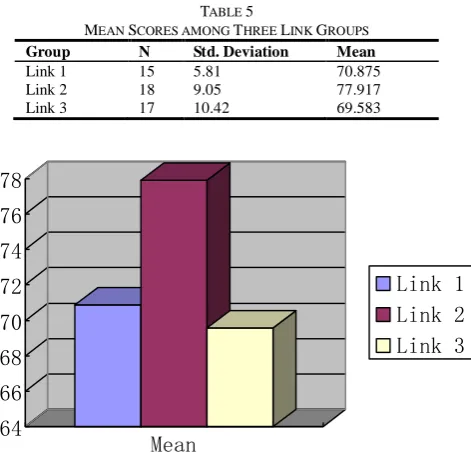
While doing English reading comprehension, the students used some hyperlinks to get more information about the text. The hyperlink numbers ranged from 1-15. So the author labeled the link number 1 to 5 as group Link 1, 6 to 10 as group Link 2, and 11 to 16 as group Link 3. The following table will give us the description of the difference between different link groups and the achievement scores.
TABLE 4 MULTIPLE COMPARISON
Sig. MD SED
Link 1 vs. Link 2 .006* 7.042 2.446 Link 2 vs. Link 3 .028* 8.333 3.687 Link 1 vs. Link 3 .733 1.292 3.760
Note: *p<.05.
TABLE 5
MEAN SCORES AMONG THREE LINK GROUPS
Group N Std. Deviation Mean
Link 1 15 5.81 70.875
Link 2 18 9.05 77.917
Link 3 17 10.42 69.583
64 66 68 70 72 74 76 78
Mean
Link 1 Link 2 Link 3
Figure 1 Mean Scores among Three Link Groups
From Table 5 and Figure 1, it is found that the students in Group Link 2 (link numbers from 6 to 10) got the highest mean scores. It can be explained that less links won’t help improving reading, while more links would increase the cognitive load and therefore impair learning. In the whole process of reading comprehension, the students activate their prior background knowledge in their mind or employ hyperlinks to enrich their background knowledge. Only the appropriate number (from 6 to 10) will be helpful for reading. In this sense, we can conclude that only the proper number (from 6 to 10) of hyperlinks in English hypertext reading help and facilitate Chinese student’ English reading comprehension.
VI. CONCLUSIONS,IMPLICATIONS AND LIMITATIONS
This study contributes to the research on learning about hypertext reading in several ways: (1) it provides evidence that hyperlinks can improve learning. (2) it explores how background knowledge could affect those who are learning to use hyperlinks in hypertext reading. (3) it improves our understanding of schemata. Schemata theory suggests that prior schema plays an important role in learning. (4) it also looks into how hyperlinks may improve learning, and the effectiveness of the use of hyperlinks in hypertext reading. It is a unique attempt to find the effectiveness of hyperlinks for knowledge acquisition when participants have dissimilar knowledge structures compared with the information to be learned. One possible extension can be using the same research method, yet with a stronger schema manipulation to find how dissimilar knowledge structures affect learning in presence of hyperlinks.
The results of the present study have important implications for SLA and FLL, especially for English language teaching and learning in China. Theoretically, this study yields insight into the nature of hyperlinks in hypertext reading and addresses the importance of background knowledge in reading comprehension. Methodologically, the present investigation employs Visual Basic software that promotes the efficiency of calculating the data. Pedagogically, the study suggests that teachers and learners should be aware of the role of background knowledge and schemata in English reading.
Overall, the implications seem to support future investigation that improves text design and presentation rather than selection for learning from hypertext or traditional text. In this particular study, learning from hypertext and traditional text depended on the similar individual differences. The main focus of future research should be not how hypertext learning might be different than learning from traditional text, but rather how to incorporate the findings from this study concerning visual-spatial working memory and meta-cognitive accuracy into hypertext design.
In all, multimedia and hypertext are powerful and widely used instructional tools. This is the very study to empirically investigate whether the cognitive processes of selection, organization, and integration, described by the generative theory of multimedia learning, can be separately supported with specifically designed annotations. The results of this study offer support for the generative theory of multimedia learning. This study offers a new visualization of the theory which puts a greater emphasis on the more circular nature of cognitive processing.
Reading Comprehension is only one part of a whole testing paper, which makes it impossible to check the time amount of every subject allocated for Reading Comprehension. Besides, when the subjects participated in the school formal tests, they were likely to be under greater stress than in class, thus it was not easy to control their use of formal schematic reading strategies. Consequently, the testing results might not be effective enough to reflect the impact of formal schemata on the students’ reading. Fourth, hyperlinks might harm learning if the number of hyperlinks increases. We need to have more research on the effect of hyperlinks.
REFERENCES
[1] Azevedo, R., & Cromley, J. G. (2004). Does training on self-regulated learning facilitate students’ learning with hypermedia?
Journal of Educational Psychology, 96(3), 523-535.
[2] Azevedo, R. (2005). Computer environments as metacognitive tools for enhancing learning. Educational Psychologist, 40(4), 193-197.
[3] Balcytiene, A. (1999). Exploring individual processes of knowledge construction with hypertext. Instructional Science, 27, 303-328.
[4] Caliser, F., & Gurel, Z. (2003). Influence of text structure and prior domain knowledge of the learner on reading comprehension,
browsing and perceived control. Computers in Human Behavior, 19(2), 135-145.
[5] Carrell, P. L. (1983). Three components of background knowledge in reading comprehension. Language Learning, 33,
183-207.
[6] Daniel, C. Moos. & Roger, Azevedo. (2008). Self-regulated learning with hypermedia: the role of prior domain knowledge.
Contemporary Educational Psychology, 33, 270-298.
[7] Duchastel, P. C. (1990). Examining cognitive processing in hypermedia usage. Hypermedia, 2, 221-233.
[8] Foltz, P. W. (1996). Comprehension, coherence, and strategies in hypertext and linear text. In J. Rouet, A. Dillon, & R. J. Spiro
(Eds.), Hypertext and cognition (pp. 109-136). Mahwah, NJ: Erlbaum.
[9] Gall, J. E., & Hannafin, M. J. (1994). A framework for the study of hypertext. Instructional Science, 22, 207-232.
[10] Greene, J. A., & Azevedo, R. (2006). Adolescents’ use of self-regulatory processes and their relation to qualitative mental model shifts while using hypermedia. In S. Barab, K. Hay, & D. Hickey (Eds.), Proceedings of the 7th international conference of the learning sciences (pp. 203-209). Mahwah, NJ: Erlbaum.
[11] Harris, J. (1996). Information is forever in formation; knowledge is in the knower: Global connectivity in K-12 classrooms.
Computers in the Schools, 12, 11-22.
[12] Jacobson, M., & Archodidou, A. (2000). The design of hypermedia tools for learning: fostering conceptual change and transfer
of complex scientific knowledge. Journal of the Learning Sciences, 9(2), 145-199.
[13] Jeffery, Alan Greene. (2010). Fostering historical knowledge and thinking skills using hypermedia learning environments: the
role of self-regulated learning. Computers & Education, 54, 230-243.
[14] Jonassen, D., & Reeves, T. (1996). Learning with technology: using computers as cognitive tools. In D. Jonassen (Ed.),
Handbook of research for educational communications and technology (pp. 694-719). NY: Macmillan.
[15] Mayer, R. E., Heiser, J., & Lonn, S. (2001). Cognitive constraints on multimedia learning: When presenting more material results in less understanding. Journal of Educational Psychology, 93(1), 187-198.
[16] Mayer, R. E., & Moreno, R. (2002). Aids to computer-based multimedia learning. Learning and Instruction, 12, 107-119. [17] Pei-Lin Liu et al. (2010). Effects of a computer-assisted concept mapping learning strategy on EFL college students’ English
reading comprehension. Computers & Education, 54, 436-445.
[18] Piret, Luik & Jaan, Mikk. (2008). What is important in electronic textbooks for students of different achievement levels/Computers & Education, 50, 1483-1494.
[19] Potelle, H., & Rouet, J. F. (2003). Effects of content representation and readers’ prior knowledge on the comprehension of
hypertext. International Journal of Human-Computer Studies, 58, 327-345.
[20] Schneider, W., Korkel, J., & Weinert, F. (1990). Expert knowledge, general abilities, and text processing. In W. Schneider & F. Weinert (Eds.), Interactions among aptitudes, strategies, and knowledge in cognitive performance (pp. 235-250). New York: Springer-Verlag.
[21] Shin, E. C., Schallert, D. L., & Savenye, W. C. (1994). Effects of learner control, advisement, and prior knowledge on young
students’ learning in a hypertext environment. Educational Technology Research and Development, 42(1), 33-46.
[22] Skehan, P. (1989). Individual Differences in Second Language Learning. London: Edward Arnold.
[23] Skehan, P. & Foster, P. (2001). Cognition and tasks. In P. Robinson (Eds.), Cognition and Second Language Instruction (pp. 183-205). Cambridge University Press.
[24] Tergan, S. (1997). Conceptual and methodological shortcomings in hypertext/hypermedia design and research. Journal of Educational Computing Research, 16(3), 209-235.
[25] Tomek I, Khan S, Muldner T, et al. (1991). Hypermedia introduction and survey. Journal of Microcomputer Application, 14: 63-103.
[26] Van Dijk, J., & Kintsch, W. (1983). Strategies of discourse comprehension. New York: Academic Press.
[27] Widdowson, H. G. (1983). Learning Purpose and Language Use. Oxford: OUP.
[28] Williams, M. (1996). Student control and instructional technologies. In D. Jonassen (Ed.), Handbook of research on educational communications and technology (pp. 957-983). NY: Macmillan.
TingtingZhao was born in Shanxi, China in 1983. She received her M.A. degree in Applied Linguistics from Lanzhou University, China, 2012. She is currently a lecturer in the Department of College English, Yuncheng University, Yuncheng, China. Her research interests include college English teaching and second language acquisition.