ISSN-L: 2501 - 1235 Available on-line at: www.oapub.org/edu
doi: 10.5281/zenodo.2585619 Volume 5 │ Issue 6 │ 2019
THE RELATION BETWEEN ORGANIZATIONAL IDENTIFICATION,
HOPE AND PERCEİVED STRESS OF STUDENTS
IN SPORTS SCIENCES FACULTY
Serdar Sucani Faculty of Sport Sciences,
Erciyes University, Kayseri, Turkey
Abstract:
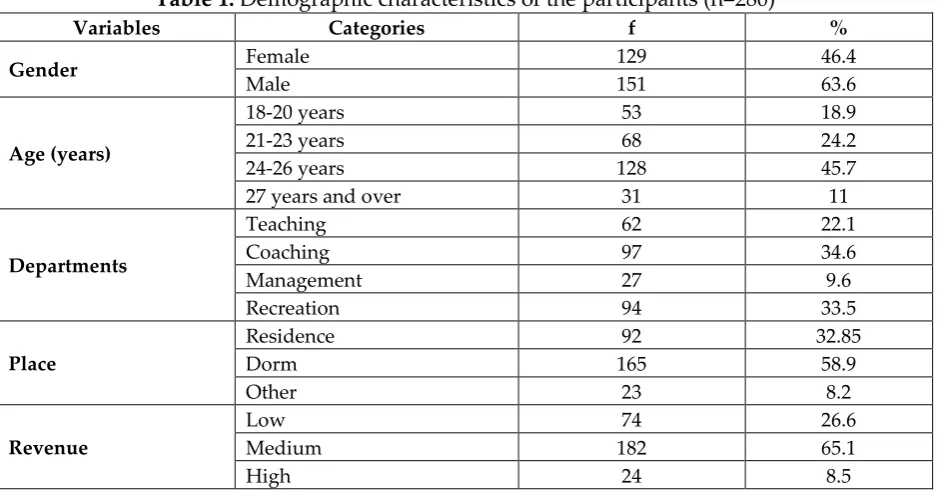
The aim of this study was to determine the relationship between the students’ level of organizational identification, level of hope and perceived stress. The study group consisted of 280 students studying at the Faculty of Sport Sciences of Erciyes University in 2017-2018 academic year. When we look at the students’ demographic information; 63.6% male; 34.6% coaching department; 45.7% between the ages of 24-26; 58.9% stay in dormitory; 65.1% were middle income level. Participants were administered the Organizational Identification Scale (OIS), Perceived Stress Scale (PSS-10) and Adult Hope Scale (AHS). As a result of the correlation analysis, there was a positive and significant relationship between the organizational identification and level of hope scores of the students (p<0.01). In addition, there was a high and negative correlation between organizational identification and perceived stress scores of coaches (p<0.01). As a result of the regression analysis, the level of hope of the students on organizational identification; on the level of organizational identification of students; the perceived stress of the students was a significant predictor of the level of hope (p<0.01).
Keywords: students, sports, organizational identification, stress, hope
1. Introduction
Universities are not just to give their students a profession, high quality of life, satisfied with their relationship, can produce thought, having a purpose, aims to raise healthy and healthy individuals (İmamoğlu and Gültekin, 1993). The faculties of sports sciences provide the students with theoretical and practical knowledge as well as the teaching of appropriate attitudes and skills. After starting university education, students face stress factors that affect their academic life and quality of life (Sheu, Lin and Hwang, 2002; Pulido-Martos, Augusto-Landa, Lopez-Zafra, 2012). Stress is defined as the reaction that
occurs in the event of a physical or psychological strain caused by an action or situation (Hellriegel, Slocum and Woodman, 1992). Stress in another definition, threatening the bodily and spiritual boundaries of the organism and enforced, it is defined as the pressure, tension and psychological tension that an individual feels due to abnormal conditions in the physical and social environment (Deniz and Yılmaz, 2005; Durna and Eren, 2006).
Stress has effects that are dangerous for the well-being of a person, reducing their capacity and forcing them (Ünal and Ümmet, 2005). Students face many problems that challenge their physical and psychological capacity (Çakmak and Hevedanlı, 2005). The main stress sources of university students are; housing, adolescence, economy, interpersonal problems, adaptation problems, family retreat, employment problems, school problems and security problems.
Stress, which has a wide, comprehensive and negative effect on health and daily life (Kinman, 1998). Complaints, cheating, absenteeism, dissatisfaction, low productivity, weakening in cooperation, increasing warnings and penalties, career stagnation, deterioration and tensions in relations, weakening the image of the organization and low organizational identification (Yılmaz and Ekici, 2003).
Organizational identification is a form of social identification whereby an individual perceives a sense of belonging and oneness with an organization, its activities, and members (Ashforth and Mael 1989). Organizational identification affects many factors and is influenced by many factors (Kaya, 2007). Organizational identification is influenced by factors such as demographic characteristics, monotony, stress, physical conditions, management style, organization size, centralization, communication and reward (Güçlü, 2006). The relationship between stress and organizational identification is twofold: First, those with high levels of organizational identification feel more stressful. Second, organizational identification protects the person from the negative effects of stress (Leong, Furnham and Cooper 1996).
It is important for the students to establish a psychological connection with the organization, their behaviors and organizational effectiveness. People perceive themselves as more attractive (Berscheid and Walster, 1978; Bryne, 1971). Therefore, students may find organizations that are similar to them and identify with them. Organizational identification, the “desire to be together” of personal premises, to be more involved with other people, to have more friends, more communication, more social (McClelland, 1985) and increase the sense of belonging (Wiesenfeld, Raghuram and Garud, 2001).
Individuals, along with emotional commitment, see the organization as a family and feel it as part of the family (Allen and Meyer, 1990). People need to socialize, love and join the group. Therefore, a high level of “desire to be together” it also increases the commitment of the organization.
organizational identification. As a matter of fact, research has been said that there is a positive relationship between self-perception with organizational identification (Shamir and Kark, 2004) and emotional commitment (Van Dyne and Pierce, 2004; Pierce and Gardner, 2004; McColl-Kennedy and Anderson, 2005).
Individuals will feel as if they identify with the institution and this positive emotion will be reflected in the self-perception (Turner et al., 1987). It was said that there was a significant relationship between self-perception and organizational identification (Qureshi, Shahjehan, Zeb and Saifullah, 2011). In order for an individual to be emotionally connected to the organization, the aim of the organization must be perceived (Meyer and Allen, 1997). The more negative the individual's feelings about the situations, the higher the perceived stress level (Gümüştekin and Öztemiz, 2005).
Students may experience stress due to unfavorable situations in their relationships. Because of the problems in their relationship and the fact that they are separated from their family, depressive mood may occur (Wohl, DeShea and Wahkinney, 2008). Students who have problems in university life due to situational factors lose their hope and perceive more stress.
People’s behavior is directed towards a purpose, and these aims determine the direction of mental activities. The methods of achieving the purpose are the perception that the person can produce appropriate methods to achieve his or her aim (Snyder, Rand and Sigmon, 2002). Hope is a positive motivation for the relationship between motivation and methods of achieving a goal. People with high levels of hope assume that there are many methods to achieve their goals (Snyder et al., 1991).
In childhood, coping with goal-directed barriers improves hopeful thinking. People are protected from the problems they face with this hopeful thinking. The hope mechanism works continuously, which shows the strength of hope based on the situation. (Snyder et al., 1997).
The low level of hope negatively affects the development of the career, as well as in every aspect of life, disrupting peace, blocking development and negative emotions. While there is a positive correlation between internal motivation, interest, effort and positive emotions and hope, there is a negative relationship between stress and depressive feelings (Snyder et al., 2000; Snyder et al., 2002; Pekrun et al., 2002; Vilaythong et al., 2003).
2. Method
2.1 Participants and Study Design
Figure 1: The research model
The study group consisted of 280 students studying at the Faculty of Sport Sciences of Erciyes University in 2017-2018 academic year. When we look at the students’ demographic information; 63.6% male; 34.6% coaching department; 45.7% between the ages of 24-26; 58.9% stay in dormitory; 65.1% were middle income level.
Table 1: Demographic characteristics of the participants (n=280)
Variables Categories f %
Gender Female 129 46.4
Male 151 63.6
Age (years)
18-20 years 53 18.9
21-23 years 68 24.2
24-26 years 128 45.7
27 years and over 31 11
Departments
Teaching 62 22.1
Coaching 97 34.6
Management 27 9.6
Recreation 94 33.5
Place
Residence 92 32.85
Dorm 165 58.9
Other 23 8.2
Revenue
Low 74 26.6
Medium 182 65.1
High 24 8.5
2.2 Instruments
2.2.1 Perceived Stress Scale (PSS-10)
The Perceived Stress Scale (PSS)-10 item version was developed by Cohen et al. (1983) to measure the individual’s appraisals of stressful life events (Cohen et al., 1983). Its validity and reliability studies were performed by Erci (2006) and Bilge et al. (2009) and were then adapted to Turkish society. Items were designed to reveal the degree to
Organizational Identification
which respondents found their lives unpredictable, uncontrollable, and overwhelming in the last one month. The PSS-10 is a five point Likert scale ranging from (0=never to 4=very often). There are four reverse items which are written positively (items 4,5,7 and 8). Total scores range from 0 to 40 with higher scores indicating higher perceived stress. The internal consistencies of the original scale change from 0.75 to 0.86. In the present study PSS-10 had internal consistency (Cronbach’s alpha) of α=0.71.
2.2.2 Adult Hope Scale (AHS)
Adult Hope Scale, 12 items with responses measured in Likert format, 4 items for hope agency, 4 items for hopes and 4 items for filler consists of 4 items. Overall hope scores range from 8 to 32 and higher scores mean more hope (Snyder et al., 1991). The Cronbach's alpha path, the agency and the AHS were 0,756, 0,731 and 0,838, respectively. In this study, the internal consistency of AHS (Cronbach's alpha) was α = 0.73.
2.2.3 Organizational Identification Scale (OIS)
The one-dimensional scale developed by Mael (1988) was used for measuring the organizational identification levels of the individuals. The scale consists of six statements. A five-point Likert scale was used for evaluating the statements. The lowest score is (6) and the highest score is (30). The Cronbach alpha reliability coefficient of the scale was calculated to be 0.81. The validity and reliability of the scale was performed by Güleryüz (2004) and it was used in various other studies. According to Güleryüz (2004) the reliability of the scale is 0.80. In this study, the Cronbach alpha internal consistency coefficient was 0.78.
2.3 Data Analysis
The data obtained in the research were presented as frequency (f), percentage (%), arithmetic mean (X) and standard deviation (SS). Pearson Correlation Coefficient, Simple and Multiple Regression Analysis were used for the relationship between variables. The SPSS package software was utilized for analyses of collected data; and significance was determined as p<0.05.
3. Results
Table 2: Correlation test results regarding the relation between “Organizational Identification”,
“Hope Level” and “Perceived Stress” variables
Variables X SS 1 2 3
1. Organizational Identification 3.83 .87 1
2. Hope Level 21.37 1.28 0.008** 1
3. Perceived Stress 28.12 1.07 -0.029** -0.419 1
As a result of the correlation analysis, there was a positive and significant relationship between the organizational identification with the level of hope scores of the students (p<0.01). There was a high, negative and significant correlation between organizational identification with perceived stress scores of students (p<0.01). In addition, there was a high, negative and significant correlation between perceived stress scores and level of hope scores of students (p<0.01) (Table 2).
Table 3: Regression test results regarding the relation between “Organizational Identification”
and “Hope Level” variables
Variables Model Summary Anova Coefficients
Constant Dependent R2 R F p β t p
Hope Level Organizational
Identification 0.164 0.405 36.862 0.001
2.58 4.413 0.001
0.87 6.161 0.001 Y (Organizational Identification) = 2.58 + 0.87 (Hope Level)
Table 4: Regression test results regarding the relation between “Hope Level” and
“Organizational Identification” variables
Variables Model Summary Anova Coefficients
Constant Dependent R2 R F p β t p
Organizational
Identification Hope Level 0.389 0.595 34.634 0.001
0.406 0.422 0.001
0.269 6.280 0.001 Y (Hope Level) = 0.406 + 0.269 (Organizational Identification)
Table 5: Regression test results regarding the relation between “Hope Level” and “Perceived
Stress” variables
Variables Model Summary Anova Coefficients
Constant Dependent R2 R F p β t p
Perceived Stress Hope Level 0.163 0.316 21.566 0.001 5.839 33.534 0.001 -0.455 -4.614 0.001 Y (Hope Level) = 5.839 – 0.455 (Perceived Stress)
Table 6: Correlation test results regarding the relation between “Hope Level”, “Perceived
Stress” and “Organizational Identification” variables
Variables Model Summary Anova Coefficients
Constant Dependent R2 R F p β t p
Organizational
Identification Hope Level 0.173 0.434 23.107 0.001
4.536 12.979 0.001
0.308 4.675 0.017
Perceived Stress -0.291 -2.311 0.001
Y (Hope Level) = 4.536 + 0.308 (Organizational Identification) – 0.291 (Perceived Stress)
identification were a significant predictor of the level of hope of students (F=23.107) (p<0.01).
4. Discussion and Conclusion
Hope is an important way of thinking that guides human life. When we think that this thought is formed from childhood, the studies with children are considered important. Therefore, the development and acquisition of hopeful ideas will make children more ready for life. In our country, there are studies about the level of hope of students (Akman and Korkut, 1993; Denizli, 2004; Kemer, 2006; Kemer and Atik, 2005).
Organizational identification contributes to one’s levels of hope and optimistic construct. Students who are organizational identification can deal with potential stressors effectively. On the contrary, students who suspect their own abilities to control stressful events suffer more distresses which may impair their level of functioning. In light of this, high level organizational identification students incline to perceive stressful events and obstacles with less apprehension and may regard this as a good chance for them to prove themselves. The results of this study demonstrated that high organizational identification students incline to create more agency thinking to pursue goal, or more pathways thinking to generate alternative paths to succeed. Prior research also supported that high level organizational identification affects how people cope with negative events (Asselmann et al., 2016). High level organizational identification students are able to generate more pathways and agency thinking than low level organizational identification students.
Stress is an important mediator in the association between organizational identification with hope. Improving organizational identification enables students to employ high hope to combat with stressors. On the other hand, students who lacked hopeful thinking often failed to work with high level organizational identification. In line with our findings, McGregor and Little (1998) indicated that achievable goals is associated with well-being.
organizational identification (Shamir and Kark, 2004) and self-esteem and hope levels (Aydoğan, 2010).
According to our findings, a high, negative and significant relationship was found between perceived stress and organizational identification. Accordingly, as organizational identification increases, the perceived stress level decreases. In some studies, no correlation was found between organizational identification and stress level (Gül, Oktay and Gökçe, 2008; Efeoğlu, 2006), and some studies found a negative correlation between organizational identification and stress (Leong, Furnham and Cooper, 1996). The findings are consistent with some research results.
The expectation of competence is the capacity to apply selection and selection in their own life, as well as the ability of the person to perceive the ability to control the events that affect his life (Bandura, 1997). Job experience and professional education with the education they receive increases the competence and hopes of university students to make career decisions. In addition, there was a high, negative and significant relationship between the perceived stress of the students with level of hope. Accordingly, the higher the level of hope, the lower the level of perceived stress.
Self-efficacy in making a career decision is to decide on one’s career and to believe in its own capacity (Taylor and Betz, 1983). A positive relationship between self-efficacy and hope level of career decision making has been demonstrated by various studies (Betz, Hammond and Multon, 2005; Diemer and Blustein, 2007; Robitschek, 1996; Sung, Turner and Kaewchinda, 2013).
In another study, a significant relationship was found between university students’ self-efficacy and career perceived stress (Tein, Sandler and Zaytra, 2000). In addition, there was a negative correlation between the level of students’ academic achievement and stress (Pekrun, Goetz, Titz and Perry, 2002). In another study, high levels of hope were positively associated with success, physical and psychological health (Snyder et al., 2002; Vilaythong et al., 2003). Compared with those low in hope, high-hope individuals showed diminished stress reactivity and more effective emotional recovery (Ong, Edwards and Bergeman, 2006), and the role of hope in preventing psychological problems and increasing psychological resilience has been demonstrated (Snyder et al., 2000). The findings are consistent with some research results.
In conclusion, this investigation shows that perceived stress affects organizational identification directly. Students high in perceived stress are more likely to be low in organizational identification. Therefore, the current findings increase our understanding of the relationships between organizational identification and perceived stress.
References
Allen, N.J., Meyer, J.P. (1990). The Measurement and Antecedents of Affective, Continuance and Normative Commitment to the Organization. Journal Of Occupational and Organizational Psychology. Vol.63(1): 1-18.
Arslan, M.M. (2009). Teknik ve endüstri meslek lisesi öğretmenlerinin örgütsel güven algıları. Eğitimde Kuram ve Uygulama, 5(2): 274-288.
Ashforth, B.E., Mael, F. (1989). Social Identity Theory and the Organization. Academy of Management Review, 4, 20-39.
Akman, Y., Korkut, F. (1993). A Study on the Hope Scale. Journal of Hacettepe University Faculty of Education, 9; 193-202.
Asselmann, E., Wittchen, H. U., Lieb, R., Höfler, M., Beesdo-Baum, K. (2016). Does Low Coping Efficacy Mediate The Association Between Negative Life Events and Incident Psychopathology? A Prospective-Longitudinal Community Study Among Adolescents and Young Adults. Epidemiology & Psychiatric Sciences, 25(2): 1-10. https://doi.org/10.1017/S204579601500013X
Aydoğan, S. (2010). İlköğretim II. Kademe Öğrencilerinin Umut Ve Benlik Saygısı Düzeylerinin Bazı Değişkenler Açısından İncelenmesi. Selçuk Üniversitesi Sosyal Bilimler Enstitüsü Çocuk Gelişimi Ve Ev Yönetimi Anabilim Dalı Okul Öncesi Eğitimi Bilim Dalı. Yüksek Lisans Tezi, Konya.
Berscheid, E., Walster, E.H. (1978). Interpersonal Attraction. Addison-Wesley, Reading, MA.
Betz, N.E., Hammond, M.S., Multon, K.D. (2005). Reliability and Validity of Five-Level Response Continua for the Career Decision Self-Efficacy Scale. Journal of Career Assessment, 13(2), 131-149. https://doi.org/10.1177/1069072704273123
Byrne, D., Baskett, G.D., Hodges, L. (1971). Behavioral Indicators of Interpersonal Attraction, Journal of Applied Social Psychology 1: 137-149.
Bandura, A. (1997). Self-efficacy: The exercise of control. New York: W.H. Freeman and Company
Bilge, A., Öğce, F., Genç, R.E., Oran, N.T. (2009). Psychometric Compatibility of The Turkish Version of The Perceived Stress Scale. Journal of Ege University School of Nursing, 25(2): 61-72.
Çakmak, Ö., Hevedanlı, M. (2005). Eğitim ve fen edebiyat fakülteleri biyoloji bölümü öğrencilerinin kaygı düzeylerinin çeşitli değişkenler açısından incelenmesi. Elektronik Sosyal Bilimler Dergisi, 4(14), 115-127.
Deniz, M.E., Yılmaz, E. (2005). Üniversite Öğrencilerinde Duygusal Zeka Ve Stresle Başa Çıkma Stilleri Arasındaki İlişkinin İncelenmesi, Türk Psikolojik Danışma ve Rehberlik Dergisi, Cilt: 3(25), 17-26.
Durna, U., Eren, V. (2006). Üç Bağlılık Unsuru Ekseninde Örgütsel Bağlılık, Doğuş Üniversitesi Dergisi, 6(2): 210-219.
Dilbaz, N., Seber, G. (1993). Umutsuzluk Kavramı: Depresyon Ve İntiharda Önemi. Kriz Dergisi 1(3): 134-138.
Efeoğlu, İ.F. (2006). İş-Aile Yaşam Çatışmasının İş Stresi, İş Doyumu ve Örgütsel Bağlılık Üzerindeki Etkileri: İlaç Sektöründe Bir Araştırma, Yayımlanmamış Doktora Tezi, Çukurova Üniversitesi, Adana.
Cohen, S., Kamarck, T., Mermelstein, R. (1983). A Global Measure of Perceived Stress. Journal of Health and Social Behavior. 24(4): 385-396.
Erci, B. (2006). Reliability and validity of the Turkish version of perceived stress scale. Journal of Anatolia Nursing and Health Sciences, 9(1): 58-63.
Güçlü, H. (2006). Turizm Sektöründe Durumsal Faktörlerin Örgütsel Bağlılık Üzerindeki Etkisi, (Yayımlanmamış Doktora Tezi), Anadolu Üniversitesi, Sosyal Bilimler Enstitüsü.
Gül, H., Oktay, E., Gökçe, H. (2008). İş Tatmini, Stres, Örgütsel Bağlılık, İşten Ayrılma Niyeti ve Performans Arasındaki İlişkiler: Sağlık Sektöründe Bir Uygulama, Akademik Bakış, Sayı: 15, Uluslararası Hakemli Sosyal Bilimler E‐Dergisi.
Güleryüz, E. (2004). Örgütsel özdeşim ölçeğinin Türkçeye uyarlanması. Yayınlanmamış çalışma, Ankara.
Gümüştekin, Y., Öztemiz, A. (2005). Örgütlerde Stresin Verimlilik Ve Performansla Etkileşimi, Çukurova Üniversitesi Sosyal Bilimler Enstitüsü Dergisi, 14 (1): 271-288.
Hellriegel, D., Slocum, J.W., Woodman, R.W. (1992). Organizational behavior, 8th ed., South-Western College Pub, Cincinnati, Ohio:
İmamoğlu, O., Gültekin, Y.Y. (1993). Önerilen Dengelenmiş Toplumsal Birey Modeli Işığında Üniversite Gençliğinin Sorunları, Türk Psikoloji Dergisi, 8(30): 27-41. Leong, C.S., Furnham, A., Cooper, C.L. (1996). The Moderating Effect of Organizational
Commitment on the Occupational Stress Outcome Relationship, Human Relations, 49(10): 1345-1363.
Kaya, O. (2007). Örgütsel Bağlılık: Emniyet Genel Müdürlüğü Merkez Biriminde Bir Uygulama, (Yayımlanmamış Yüksek Lisans Tezi), Gazi Üniversitesi, Eğitim Bilimleri Enstitüsü, p.10.
Kınman, G. (1998). Pressure Points ‐ A Survey into the Causes and Consequences of Occupational Stress in UK Academic and Related Staff,
http://www.uofaweb.ualberta.ca/aasua//pdfs/pressurepoints.pdf (Erişim:
10.02.2019).
Mael, F.A. (1988). Organizational Identification: Construct Redefinition and a Field Application with Organizational Alumni, Unpublished doctoral dissertation, Wayne State University, Detroit.
McClelland, D.C. (1985). Human motivation. Glenview, IL: Scott, Foresman.
McColl-Kennedy, J.R., Anderson, R.D. (2005). Impact of leadership style and emotions on subordinate performance, The Leadership Quarterly, 13: 545-559.
Morganett, S.R. (2005). Yaşam Becerileri, Ankara: Pegem Publishing.
Olkkonen, M.-E., Lipponen, J. (2006). Relationships between organizational justice, identification with organization and work unit, and group-related outcomes. Organizational Behavior and Human Decision Processes, 100(2): 202-215. http://dx.doi.org/10.1016/j.obhdp.2005.08.007
Kemer, G. (2006). The role of self-efficacy, hope, and anxiety in predicting university entrance exam scores of eleventh-year students. Unpublished master's thesis, Middle East Technical University, Ankara.
Kemer, G., Atik, G. (2005). Comparison of hope levels of high school students in rural and urban areas according to perceived social support level from family. VIII. National Psychological Counseling and Guidance Congress. 21-23 September, İstanbul.
McGregor, I., Little, B.R. (1998). Personal Projects, Happiness, and Meaning: on Doing Well and Being Yourself. J. of Personality & Social Psy. 74(2): 494-512.
https://doi.org/10.1037//0022-3514.74.2.494
Ong, A.D., Edwards, L.M., Bergeman, C.S. (2006). Hope as a Source of Resilience in Later Adulthood. Personality and Individual Differences, 41: 1263-1273.
Pierce, J.L., Gardner, D.G. (2004). Self-Esteem within the Work and Organizational Context: A Review of the Organization-Based Self-Esteem Literature, Journal of Management, 30(5): 591-622.
Pulido-Martos, M., Augusto-Landa, J.M., Lopez-Zafra, E. (2012). Sources of stress in nursing students: a systematic review of quantitative studies, International Nursing Review, Vol.59(1): 15-25.
Pekrun, R., Goetz, T., Titz, W., Perry, R.P. (2002). Academic emotions in students’ self-regulated learning and achievement: A program of quantitative and qualitative research. Educational Psychologist, 37, 91-105.
http://dx.doi.org/10.1207/S15326985EP3702_4
Qureshi, J.A., Shahjehan, A., Zeb, F., Saifullah, K. (2011). The effect of self-esteem and organizational identification on organizational citizenship behavior: A case of Pakistani public sector university, African journal of business
management 5:3448-3456.
Robitschek, C. (1996). At-risk youth and hope: Incorporating a ropes course into a summer jobs program. The Career Development Quarterly, 45(2): 163-169.
Shamir, B., Kark, R. (2004). A single‐item graphic scale for the measurement of organizational identification, Journal of Occupational and Organizational Psychology, 77: 115-123.
Sheu, S., Lin, H.S., Hwang, S.L. (2002). Perceived Stress and Physio-Psycho-Social Status of Nursing Students during Their Initial Period of Clinical Practice: The Effect of Coping Behaviors. International Journal of Nursing Studies, 39: 165-175.
Snyder, C.R., Harris, C., Anderson, J.R., Holleran, S.A., Irving, L.M., Sigmon, S.T. (1991). The will and the ways: Development and validation of an individual-differences measure of hope. Journal of Personality and Social Psychology, 60: 570-585. Snyder, C.R., Hoza, B., Pelham, W.E., Rapoff, M., Ware, L., Danovsky, M., et al. (1997).
The development and validation of the Children’s Hope Scale. Journal of Pediatric Psychology, 22(3): 399-421.
Snyder, C.R., Feldman, D.B., Taylor, J.D., Schroeder, L.L., Adams, V. (2000). The roles of hopeful thinking in preventing problems and enhancing strengths. Applied and Preventive Psychology, 15: 262-295.
Snyder, C.R., Rand, K.L., Sigmon, D.R. (2002). Hope theory: A member of the positive psychology family. In Snyder, C. R., Lopez, S. J. (Eds.), Handbook of Positive Psychology (pp. 257-276). NY: Oxford University Press.
Snyder, C.R., Shorey, H.S., Cheavens, J., Pulvers, K.M., Adams, V.H., Wiklund, C. (2002). Hope and Academic Success in College. Journal of Educational Psychology. 94(4): 820-826. https://doi.org/10.1037/0022-0663.94.4.820
Sung, Y., Turner, S., Kaewchinda, M. (2013). Career Development Skills, Outcomes, and Hope among College Students, Journal of Career Development, 40(2): 127-145. Taylor, K.M., Betz, N.E. (1983). Applications of self-efficacy theory to the understanding
and treatment of career indecision. Journal of Vocational Behavior, 22(1), 63-81.
http://dx.doi.org/10.1016/0001-8791(83)90006-4
Tein, J.Y., Sandler, I.N., Zautra, A.J. (2000). Stressful life events, psychological distress,
coping, and parenting of divorced mothers: a longitudinal study, J Fam Psychol., 4(1): 27-41.
Turner, J.C., Hogg, M.A., Oakes, P.J., Reicher, S.D., Wetherell, M.S. (1987). Rediscovering the Social Group: A self-categorization Theory, New York: Blackwell
Ünal, S., Ümmet, D. (2005). Örgütsel Stres Kaynakları Ve Öğretmenlerin Baş Etme Stratejileri, Pamukkale Üniversitesi Yayınları, Denizli.
Van Dyne, L., Pierce, J.L. (2004). Psychological Ownership and Feelings of Possession: Three Field Studies Predicting Employee Attitudes and Organizational Citizenship Behavior, Journal of Organizational Behavior, 25(4): 439-459.
Vilaythong, A.P., Arnau, R.C., Rosen, D.H., Mascaro, N. (2003). Humor and hope: Can humor increase hope? Humor, 16(1): 79-89.
Yılmaz, A., Ekici, S. (2003). Örgütsel Yaşamda Stresin Kamu Çalışanlarının Performansına Etkileri Üzerine Bir Araştırma, Yönetim ve Ekonomi, Celal Bayar Üniversitesi İktisadi ve İdari Bilimler Fakültesi Dergisi, 10(2): 1-20.
Wiesenfeld, B.M., Raghuram, S., Garud, R. (2001). Organizational Identification among Virtual Workers: The Role of Need for Affiliation and Perceived Work-Based Social Support, Journal of Management, 27(2): 213-229.
Wohl, M., DeShea, L., Wahkinney, R.L. (2008). Looking Within: Measuring State Self-Forgiveness and Its Relationship to Psychological Well-Being, Canadian Journal
Creative Commons licensing terms
Authors will retain the copyright of their published articles agreeing that a Creative Commons Attribution 4.0 International License (CC BY 4.0) terms will be applied to their work. Under the terms of this license, no permission is required from the author(s) or publisher for members of the community to copy, distribute, transmit or adapt the article content, providing a proper, prominent and unambiguous attribution to the authors in a manner that makes clear that the materials are being reused under permission of a Creative Commons License. Views, opinions and conclusions expressed in this research article are views, opinions and conclusions of the author(s). Open Access Publishing Group and European Journal of Physical Education and Sport Science shall not be responsible or answerable for any loss, damage or liability caused in relation to/arising out of conflict of interests, copyright violations and inappropriate or inaccurate use of any kind content related or integrated on the research work. All the published works are meeting the Open Access Publishing requirements and can be freely accessed, shared, modified, distributed and used in educational, commercial and