International Journal Advances in Social Science and Humanities
Available online at: www.ijassh.com
RESEARCH ARTICLE
Capacity Building of Priests of Roman Catholic Churches: A Case Study
of Archdiocese of Madras and Mylapore
Kiran A Vijay*
Department of Commerce,Guru Nanak College Velachery, Chennai, India.
*Corresponding Author: E-mail: [email protected]
Abstract
Capacity building refers to development of skills and competencies needed in the daily interaction with others. In order to provide service to the church members, priests ought to possess specialised skills and competencies. This paper surveys the church personnel [priests] pattern in the Archdiocese of Madras and Mylapore with regard to the socio-economic and personal background information. It also analyses the priests’ views on their roles and responsibilities as a part of capacity building skills. A total of 157 priests available and serving in the Archdiocese of Madras and Mylapore were included in the sample, out of which 146 responses were received.
Keywords: Capacity building, Roman Catholic Church, Priests; Archdiocese of Madras and Mylapore, India, Survey.
Introduction
Personnel managers (Bishops) need to recognize the expanding nature of the technological changes and professional challenges that they face in the modern world and realize to improve the range of professional competencies required to adapt and manage the changing technology successfully. Today’s environmental pressures are forcing managers (Bishops) to focus on accelerating technology, innovation, technical complexities, social and legal issues, cost, risk, competence, skills of staff and technology itself. Current
developments are directly affecting the
knowledge, competencies and skill requirements of the priests to do their job effectively. It has become imperative to have generic and traditional skills in addition to acquisition of ICT skills, which must be continuously updated.
The world is changing and growing, the ideas and methods of humanity are constantly being rearranged and becoming more advanced. The Church must not be out-distanced. It is only a changing and growing Church that can be all things to all people. The church facilitates a closer partnership between the priests and the laity. According to George [1] clergy involved in ministry would soon realise that management is an important requirement for pastoral
effectiveness. It is essential in order to plan intelligently and organise sensible practices whereby people can work together. Anderson claims that the clergy, who is not in a position to manage effectively, may experience ministry with frustration and discouragement and this will result in under-utilizing the effective involvement of the gifts and skills of people in the Church [2].
In order to perform their functions more effectively as Christian leaders, Ngara proposes that clerics need ongoing training in Church management. Today the laity think that priests are outdated and do not know the latest management techniques in managing their churches. Hence to overcome this slackness, it is proposed to all priests to develop Capacity Building with specialised skills and competencies for effective management [3].
Concept of Capacity Building Skills and
Competencies
building has been defined as "activities which strengthen the knowledge, abilities, skills and behaviour of individuals and improve institutional structures and processes such that the organisation can efficiently meet its mission and goals in a sustainable way” [4]. It often refers to assistance which is provided to priest, usually through on-going formation, which helps to develop a certain skill or competence, or for general upgrading of performance ability. Most capacity is built by societies themselves, sometimes in the priests themselves, sometimes in the parish churches and sometimes in the private sector. In order to provide service to the church members priests [personnel] are ought to possess with specialised skills and competencies. The skills are the indicators of good job performance.
Types of Capacity Building Skills
Managing Tasks refers to the self-regulation strategies required to perform a specific piece of work.
Managing Self refers to self-regulation
strategies of applying motivation and
self-organisational aspects of individual
performance with the objective of improving one’s productivity.
Managing Career refers to the
self-management strategies an individual adapts to progress in his work life.
Managing others refers to management
strategies for interacting and working with others at the work place [5].
Archdiocese of Madras Mylapore
According to the tradition, Christianity was introduced in India by St. Thomas, on the 12 Apostles of Jesus Christ. He was martyred on St. Thomas Mount in 72 AD and his remains were buried at Mylapore in the sepulchre which lies in San Thome Cathedral Basilica, Chennai. When the Portuguese arrived by sea route in 1498, they found the church flourishing. They occupied Goa
In 1510 and regarded commerce and conversion to Christianity as intimately related to one another. The great majority of population in their possession entered Roman Catholic Church. The Diocese of Goa was established in 1533. Its territory extended from cape of Good Hope to India and onward till China. Being so vast, the necessity arose of creating other dioceses among which are Cochin in 1557 and Mylapore in 1606.
As per the 2013 Statistics, in India there are 166 dioceses, 10,715 Churches, 22,451 priests personnel and the Catholic population of 175,35, 429. As far as Tamilnadu is concerned, there are 20 dioceses and Archdiocese of Madras and Mylapore is one among them. This paper deals with the priests serving in this diocese. In the Archdiocese of Madras and Mylapore, there are 123 parish churches, 157 priest personnel and the Catholic population is 3, 31, 881. On an average one (1) priest for every 2,113 people to serve [6].
Objectives
This paper examines the Capacity building skills of the priests in the Archdiocese of Madras and Mylapore for successful ministry in the Church. The objectives of the study are:
To survey the present church personnel pattern in the Archdiocese of Madras and Mylapore; To understand the social and economic
background of the priests; and
To analyse the priests views on their roles and responsibilities, as a part of capacity building skills.
Methodology
Conducting a survey is one of the primary tasks in any research work. The researcher has concentrated on one of the ancient Archdiocese of Madras and Mylapore out of 166 dioceses in India and 20 dioceses in Tamilnadu. The total population for the study comprised of 157 priest personnel servicing the Archdiocese of Madras and Mylapore. The census method was employed to collect the data from the respondents (Priest Personnel) through questionnaire and the data has been analysed and interpreted in the light of the objectives.
Analysis and Discussion
The structured questionnaire was distributed to all the 157 priests personnel and out of which 146 have responded and the response rate is 92.99%. The general background information and socio-economic background details of the priests are shown in the APPENDIX – A.
Capacity
Building
Skills
and
Competencies of Priests
The efficiency and effectiveness of the church administration and marching forward in the society will depend on the authorities of the church and more so in the service aspect of the
respective church depends on the priest concerned.
Table 1: Roles and responsibilities of priest
S.
No. Roles and Responsibilities of Priest Not Satis
fied C an ’t say Satis fied M od era tely Satis fied Highl y Satis fied M ean St d. Deviat io n Ra nk
1 Work with Leadership on achieving goals and
expectations of the Diocese 94 (64.4) 21 (14.4) 12 (8.2) 8 (5.5) 11 (7.5) 1.77 1.26 20 2 Negotiate with the authorities (Bishop) to gain high
level of commitment for necessary team resources 22 (15.1) 31 (21.2) 20 (13.7) 42 (28.8) 31
(21.2) 3.20 1.39 14
3 Encourage fair play with the fellow priests and ensure all team members
97 (66.4) 16 (11.0) 12 (8.2) 11 (7.5) 10
(6.8) 1.77 1.27 19
4 Take pro-active steps in eliminating the personnel who do not adhere to the existing rules and regulations 83 (56.8) 32 (21.9) 11 (7.5) 11 (7.5) 9
(6.2) 1.84 1.22 18
5 Helps the team with conflict resolution and educate them on how to Constructively solve the problem
72 (49.3) 19 (13.0) 10 (6.8) 25 (17.1) 20
(13.7) 2.33 1.55 17
6 Review and monitor team progress towards goals 0 (.0) 8 (5.5) 23 (15.8) 44 (30.1) 71
(48.6) 4.22 0.91 4
7 Make the work interesting and engaging 2
(1.4) 3 (2.1) 35 (24.0) 21 (14.4) 85
(58.2) 4.26 0.98 2
8 Develop a self managing team 0
(.0) 0 (.0) 18 (12.3) 25 (17.1) 103 (70.5) 4.58 0.70 1
9 Motivate and inspire team members 27
(18.5) 41 (28.1) 52 (35.6) 15 (10.3) 11 (7.5) 2.60 1.13 16 10 Lead and facilitate constructive communication 11
(7.5) 24 (16.4) 111 (76.0) 0 (.0) 0 (.0) 2.68 0.61 15 11 Build a star team but not a team of stars 8
(5.5) 9 (6.2) 11 (7.5) 43 (29.5) 75 (51.4) 4.15 1.15 5 12 Demonstrate strong commitment to excellent
religious service to the society
0 (.0) 0 (.0) 53 (36.3) 51 (34.9) 42
(28.8) 3.92 0.81 10
13 Understands and supports the religious culture and context of the church
11 (7.5) 13 (8.9) 13 (8.9) 39 (26.7) 70
(47.9) 3.99 1.27 8
14 Understands socio-political and economic context in which the church exists
12 (8.2) 12 (8.2) 13 (8.9) 40 (27.4) 69
(47.3) 3.97 1.28 9
15 Demonstrate the knowledge of theology and
Christianity 10 (6.8) 18 (12.3) 15 (10.3) 40 (27.4) 63 (43.2) 3.88 1.28 11
16 Adhere to code of ethics 6
(4.1) 6 (4.1) 14 (9.6) 43 (29.5) 77 (52.7) 4.23 1.06 3 17 Share knowledge and expertise with fellow priests 13
(8.9) 18 (12.3) 24 (16.4) 38 (26.0) 53 (36.3) 3.68 1.32 13 18 Actively pursue personal and professional growth
through continued education 9 (6.2) 11 (7.5) 39 (26.7) 36 (24.7) 51 (34.9) 3.75 1.19 12
19 Display excellent communication skills 9
(6.2) 11 (7.5) 12 (8.2) 45 (30.8) 69
(47.3) 4.05 1.19 6
20 Recognises the value of priest network 8
(5.5) 8 (5.5) 21 (14.4) 44 (30.1) 65
(44.5) 4.03 1.14 7
Keeping this in mind, the researcher has identified 20 variables that represent the roles and responsibilities of the priests and the same were examined and analysed on 5 point scaling as
shown in table 1. Based on the Mean and Standard Deviation values, the first 5 ranks are as follows:
Table2 :Variables
S. No. Variables Mean SD Rank
1. Develop a self managing team 4.58 0.70 I
2. Make the work interesting and engaging 4.26 0.98 II
3. Adhere to code of ethics 4.23 1.06 III
4. Review and monitor team progress towards goals 4.22 0.91 IV
The data has been further analysed by following hierarchical cluster analysis. The dendrogram using average linking method for those variables
is shown in Fig. 1. From the dendrogram, at 58% level, two meaningful clusters have been formed.
Figure 1: In cluster I (table 2) 16 variables were grouped. In cluster II (table 3) 4 variables were grouped.
Table 3: Cluster I – Mostly sought Roles and Responsibilities of Priests
S. No. Variable
No. Roles and Responsibilities of Priests Agree
Dis agree 1 2 Negotiate with the authorities (Bishop) to gain high level of commitment for
necessary team resources 93 53
2 6 Review and monitor team progress towards goals 138 8
3 7 Make the work interesting and engaging 141 5
4 8 Develop a self managing team 146 0
5 9 Motivate and inspire team members 78 68
6 10 Lead and facilitate constructive communication 111 35
7 11 Build a star team but not a team of stars 129 17
8 12 Demonstrate strong commitment to excellent religious service to the society 146 0
9 13 Understands and supports the religious culture and context of the church 122 24
10 14 Understands socio-political and economic context in which the church exists 122 24
11 15 Demonstrate the knowledge of theology and Christianity 118 28
12 16 Adhere to code of ethics 134 12
13 17 Share knowledge and expertise with fellow priests 115 31
14 18 Actively pursue personal and professional growth through continued education 126 20
15 19 Display excellent communication skills 126 20
16 20 Recognises the value of priest network 130 16
Total 1975 361
As seen from table 3, the agree values for the 16 variables comes to 1975 and disagree values has been arrived at 361. The agree and disagree ratio
Table 4: Cluster II – Moderately sought roles and responsibilities of priests
S. No. Variable No. Roles and Responsibilities of Priests Yes No
1 1 Work with Leadership on achieving goals and expectations of the Diocese 31 115
2 3 Encourage fair play with the fellow priests and ensure all team members 33 113
3 4 Take pro-active steps in eliminating the personnel who do not adhere to the existing rules
and regulations 31 115
4 5 Helps the team with conflict resolution and educate them on how to Constructively solve
the problem 55 91
Total 150 434
In cluster II, 4 variables have been grouped as shown in table 4. The agree values for these variables comes to 150 and disagree values are 434. The agree and disagree ratio is 150:434 or 1:3 which indicates that these variables are moderately sought. Hence this cluster has been
named as “Moderately sought Roles and
Responsibilities of the Priests”.
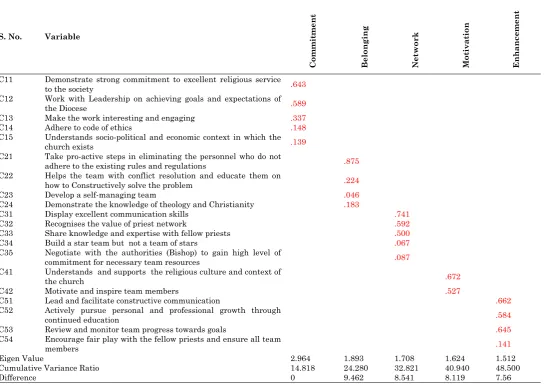
The Factor Analysis of the obtained scores the
roles and responsibilities of the priests under
Rotated Component Matrix in 5 components
which emerged and the Eigen values thus calculated for the above variable are shown in table 4. It can be seen that the variables have been grouped into 5 components namely
‘Committed’, ‘Belongingness’, ‘Network’,
‘Motivation’ and ‘Enhancement’.
It can be seen that the first five factors have Eigen Value are greater than 1. The 1 was the criteria for retention of a factor which indicates that, only first factor “Commitment” are to be extracted. Even though the variances were not given evenly distributed in the rotated some of the squared loading (percentage ranges between 7.560 % and 14.818%; cumulative variance ratio 48.500%), the Eigen Values are in ranges between 1.512 and 2.964. This indicates that the five factors are interpretable.
Table 5: Rotated Component Matrix for the Roles and Responsibilities of the Priests
S. No. Variable
C
o
mmitm
en
t
B
el
ongin
g
Netwo
rk
M
oti
va
ti
on
Enha
nce
me
nt
C11 Demonstrate strong commitment to excellent religious service
to the society .643
C12 Work with Leadership on achieving goals and expectations of
the Diocese .589
C13 Make the work interesting and engaging .337
C14 Adhere to code of ethics .148
C15 Understands socio-political and economic context in which the
church exists .139
C21 Take pro-active steps in eliminating the personnel who do not
adhere to the existing rules and regulations .875
C22 Helps the team with conflict resolution and educate them on
how to Constructively solve the problem .224
C23 Develop a self-managing team .046
C24 Demonstrate the knowledge of theology and Christianity .183
C31 Display excellent communication skills .741
C32 Recognises the value of priest network .592
C33 Share knowledge and expertise with fellow priests .500
C34 Build a star team but not a team of stars .067
C35 Negotiate with the authorities (Bishop) to gain high level of
commitment for necessary team resources .087
C41 Understands and supports the religious culture and context of
the church .672
C42 Motivate and inspire team members .527
C51 Lead and facilitate constructive communication .662
C52 Actively pursue personal and professional growth through
continued education .584
C53 Review and monitor team progress towards goals .645
C54 Encourage fair play with the fellow priests and ensure all team
members .141
Eigen Value 2.964 1.893 1.708 1.624 1.512
Cumulative Variance Ratio 14.818 24.280 32.821 40.940 48.500
Table 6: Personality Traits of the Priests
S. No.
Personality Trait
Frequency Percentage
1 Commitment 36 24.7
2 Belonging 25 17.1
3 Network 24 16.4
4 Motivation 35 24.0
5 Enhancement 26 17.8
Total 146 100
The number of respondents under each component is shown in table 5. The five components are named by single term as ‘Personality Traits’. It can be seen that respondents under each component are almost evenly distributed ranging from 16.4% to 24.7%.
Further it can be seen that ‘Commitment’ (24.7%) and ‘Motivation’ (24%) were given equal importance under personality traits, followed by ‘Enhancement’ (17.8%) and ‘Belongingness’ (17.1%).
Table 7: Social Background Vs. Personality Traits
S. No. Traits Urban Rural
1 Commitment 1(2.8) 35(97.2)
2 Belonging 3(12.0) 22(88.0)
3 Network 14 (58.3) 10(41.7)
4 Motivation 12(34.3) 23(65.7)
5 Enhancement 11(42.3) 15(57.7)
Total 41(28.1) 105(71.9)
From the table 7, for social background Vs. Personality Trait, it is seen that commitment (97.2%) and motivation (65.7%) were prominent among the rural respondents, whereas network (58.3%) and motivation (34.3%) were given importance among the urban respondents.
Conclusion
The effective human resource management is a challenge for any organisation and church as a service organisation is not an exception. The
efficient and effective human resource
management practices in the Selection,
Recruitment (Priestly Formation) and orientation,
training and development can help the church and equip the priests to perform a variety of roles and assume different responsibilities. A priest needs to have some key characteristics to be able to be a successful leader and preaching others to lead. Further, the priests shall have the ability to conduct a religious meetings, set goals and objectives, create service bent of mind and motivate the followers and fellow priests. The human resource management in the context of church should be linked with the strategic planning, tool and techniques that helps in improving the religious service performance of the church.
References
1. George C (1987) Leading and Managing your Church. New Jersey: Fleming H. Revell Company. p. 72.
2. Anderson L (1990) Mastering Church Management. Portland: Multnomah Press. p. 8.
3. Ngara E (2004) Christian Leadership.A Challenge to the African Church. Nairobi: Paulines Publication. p.50.
4. World Customs Organization (WCO) (2009) The WCO Capacity Building Development Compendium 2009, WCO, Brussels, Quoted by Echegaray,
Ricardo. Academic reform for the training of international trade professionals. World Customs Journal, 3 (2): 109-112.
5. Ramesh Babu B (2014) Human Resource Development in the Academic Libraries in the Knowledge Age: Need to develop Capacity Building Skills in the New Generation of LIS Professionals. In: Integrating ICT Academic Libraries: Making a Difference in Knowledge Age, ed. By P. S. Kattimani and Suresh Jange. Gulbarga: Central University of Karnataka.
APPENDIX - A
Consolidated Data of General background information and socio-economic background information of the priests
1. General background information of the respondents
a)Classification of Respondents by age No. of Respondents Percentage
Below 35 years 15 10.3
Between 36 and 45 Years 53 36.3
Between 46 and 55 Years 27 18.5
Between 56 and 65 Years 22 15.1
Above 65Years 29 19.9
b) Classification of Respondents by Place of Birth
Tamil Nadu 128 87.67
Kerala 16 10.95
Pondicherry 1 0.69
Burma 1 0.69
c) Classification of Respondents by their Family Size
Single Person 7 4.8
Two Members 56 38.3
Three Members 79 54.1
Four Members 3 2.1
Six Members 1 0.7
d) Classification of Respondents by Educational
Qualification
Secondary School 3 2.1
Pre University 17 11.6
Graduate degree 34 23.3
Post Graduate degree 74 50.7
Master of Philosophy (M.Phil.) 10 6.8
Doctor of Philosophy (Ph.D.) 8 5.5
e) Classification of Respondents by Years of Experience
Below 10 Years 52 35.6
Between 11 and 20 Years 27 18.5
Between 21 and 30 Years 28 19.2
Between 31 and 40 Years 22 15.1
Between 41 and 50 years 12 8.2
Above 50 Years 5 3.4
2. Socio-economic background information of the respondents
a) Social Background of the Respondents No. of Respondents Percentage
Urban 41 28.1
Rural 105 71.9
Higher Income 11 7.5
Middle Income 63 43.2