ISSN: 2501 - 1235 ISSN-L: 2501 - 1235 Available on-line at: www.oapub.org/edu
doi: 10.5281/zenodo.1469027 Volume 4 │ Issue 12 │ 2018
THE EFFECTS OF DIFFERENT TRAINING METHODS
ON SHOOTING PERFORMANCE IN SOCCER PLAYERS
Engin GüneşAtabaş1, Ayşegül Yapıcı2i
1Pamukkale University,
Institute of Health Sciences, Denizli, Turkey
2Pamukkale University,
Faculty of Sport Sciences, Denizli, Turkey
Abstract:
The aim of this study; the effect of different jump and speed training protocols applied to players on the shooting speed and accuracy performance. In this research, 14 healthy male soccer players from Serinhisar soccer team playing in Denizli Super Amateur League participated voluntarily. Soccer players participated in different two days practices. On the first day, training was jump-based, while on the second day the training was speed-based. The practices were done with three days break. The soccer player shoot two different shoots repeatedly in a 20-minute workout, and the average of his shoot speeds was recorded with the radar gun. In the evaluation of the accuracy performance, whether the ball reached the goal or not taken as a criterion while the goalkeeper was placed in the goal. Descriptive analyses of soccer players' shooting speeds and accuracy performances were calculated with mean and standard deviation values. Since taken parametric assumptions, it was analysed by t-test. The level of significance was taken as p<0.05. On the first and second day measurements, there was a statistically significant difference in the comparison between the shoot speeds, accuracy performance and lactate values (p<0.05). In the study, while there is a 20% accuracy rate in the shoot accuracy in the speed-based training, there is a 60% accuracy rate in the training jump-based training. Shooting speed was higher in speed-based training than jump-based training. The lactate values were higher in speed-based training than jump-based training. The results of this study; it was found that the speed-based training was more effective than the jump-based training in the shooting speed, but it was found to be less effective in shooting accuracy. This study may help trainers to assess the applicability of different training methods to improve shoot performance, one of the most important factors determining the score on the soccer.
Keywords: soccer, jump, speed, performance
1. Introduction
Soccer is an aerobic-anaerobic activity with alternating phases of high loads such as sprinting, rapid changes of direction, jumping and sudden stopping, and, according to the criteria of structural complexity, it can be classified as a polistructural and complex sport activity (Strojer et al., 2004). Three important factors affecting performance in soccer are; each of the technical, tactical, and conditional aspects (motor and functional abilities: speed, explosive power, coordination, agility, precision and flexibility) can play a role in different proportions depending on the characteristics of the encountered. Conditional performance from these items is proportionally greater than 50% (Bangsbo, 1996; Reilly et al., 2000).
The fact that today's soccer is played faster than the old one and the physical power never lose its importance in this pace and remains as one of the most important pieces of soccer reveals how important the training of players is in this direction. An international soccer player performs about 1350 activities containing 220 high-speed running during a game (Mohr et al, 2003). For this reason, the success in sports or the availability of the athlete as a whole depends entirely on the fitness and coordination abilities of the athlete, such as physical structure, technical, tactical (McMillan et al., 2005). The explosive force, speed, anaerobic power and endurance in the soccer game are the biggest measure of the quality difference between the athletes.
Fatigue arises early in athletes who are not physically fit enough to disrupt neuromuscular coordination and reduce the technical capacity, making it difficult to administer the wanted tactics (Kellis et al., 2006; Mohr et al., 2005). For the soccer, the athlete will be quicker than either without or with the ball, jumping higher from the higher balls, staying stronger in the bilateral tactics, will always keep him one step ahead of his opponents. The shoot into the goal is one of the technical skills required to score during the competition and is related to the technique of kicking and improves the likelihood of scoring and winning a match when performed with a proper kick technique (Skogvang et al., 2000). The opponent has more chance to shoot more in the goal, and the team has the opportunity to score more goals and win the match (Kellis et al., 1999).
capacities of the players are of great importance in the results to be obtained in the competition (Stolen et al., 2005).
Activities of different intensity that players did during the competition were analyzed according to the distance covered and these were defined as walking, jogging, running, sprint and backward activities. In general, in a soccer match, an average of 3000-3500 m walking, 4500-5000 m jogging, 2000-2500 m running and 300-450 m activities such as sprinting have been reported (Mohr et al, 2003; Andrzejewski et al., 2013). Percentage ratios of the distance covered in the game by total game percentage; 25% walking, 37% jogging, 20% low intensity running, 11% sprint and 7% backward activities (Ingebrigtsen et al., 2015). For the success of today's soccer, there is a great need for the speed and explosive strength of soccer players. The fact that the athlete is able to run faster than the ball and/or the ball without the ball eliminates the skill difference between the opponent and his superiority with his opponent. An athlete who can jump faster and higher than his opponent will get a significant advantage for the success of the movement. Although the physical inadequacy of the player may appear as an obstacle in the air shoots, it can move to advantageous position by acting with a superior speed and explosive strength before the opponent. The aim of this study; the effect of different jump and speed training applied to players on the shooting speed and accuracy performance.
2. Material and Methods
2.1. Participants
Fourteen healthy male soccer players (age 26.75 ± 6.74 year, height 173.91 ± 0.08 cm, body mass 71.45 ±6.04 kg) all members from Denizli Super Amateur League in the Serinhisar Soccer Team participated in this study. Standard calibrated scales and stadiometers were used to determine the height and body mass. Participants had fifteen years of training and competitive experience. Testing sessions were performed upon completion of the preparatory training period, prior to the beginning of the competitive season. During this period an average of 8 training sessions were performed by the players every week. Out of that, about 50% was devoted to long-distance aerobic-type training, 25% to interval training and 15% to sprint training. The players also spend some time practicing special technical drills (about 10% of total distance) in the soccer field. In addition, the players had 3-4 sessions of strength training every week that included mainly weight lifting of different forms. Athletes who had recently suffered from a serious injury were not included in this study. The players were informed of the experimental procedures and signed an informed consent form. All the procedures were conducted in accordance with the standards of the Institutional Ethics Committee.
2.2. Procedures
tests were performed in the afternoon, using outdoor soccer area. The air temperature was 26-28°C during all tests.
2.3. Speed Training Protocol
Prior to each speed training protocol, players performed a thorough warm-up
consisting of 10 minutes of jogging at 60-70% of HRmax and then 5 minutes of exercise
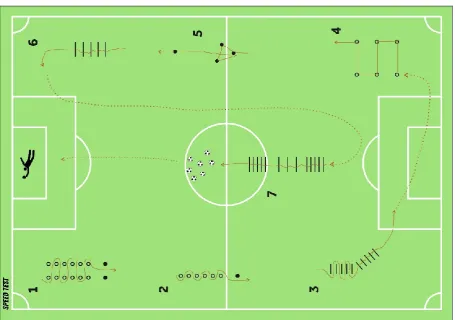
involving fast leg movements (e.g., skipping, cariocas) over short distances of 5 to 10 m and 3-5 single 15 m shuttle sprints with 2 minutes of passive recovery. A study consisting of 7 different sprint stations was applied to the athletes at full range. In order to avoid any congestion in the application of the stations, the study was divided into two groups of 14 athletes. The study lasted 20 minutes without interruption, and at the end of 20 minutes it was requested to shoot the athlete. After the shoot, 7 stations are only required once again to apply and shoot again.
Figure 1: Speed exercises applied to athletes
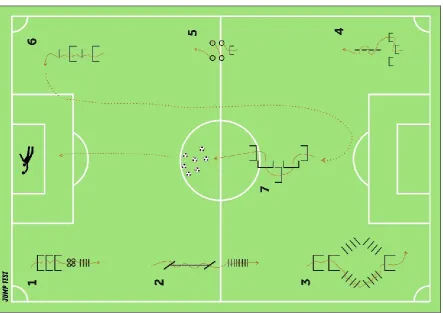
2.4. Jumping Training Protocol
without interruption, and at the end of 20 minutes it was requested to shoot the athlete. After the shoot, 7 stations are only required once again to apply and shoot again.
Figure 2: Jumping exercise applied to athletes
2.5. Lactate Measurements
Blood lactate was taken from an earlobe 3 minutes after the completion of the speed and jumping training protocol. Using a portable lactate analyzer (Lactate Plus, Nova Biomedical, USA).
2.6. Throwing Velocity Measurements
Bushnell Sports Radar (Sports Radar, Bushnell, USA), which has a velocity range of 16-177 km.h-1 and can detect velocities up to 27 meters with an error margin of 2 km.h-1
was used for the throwing velocity measurements of the players. For the measurements, all the throws were sent to the regular soccer goal, the players were released in shoots. The goalkeeper was used in all shooting measurements. Since one of the primary data the study focused on was the throwing velocity, the players were asked to throw the ball to a point they wanted by focusing well and at the highest possible velocity. The 14 players were divided into 2 groups of 7 randomly, regardless of their playing positions in the game. In order to reduce the margin of error of the throws taken by the players
and to determine the correct velocity the radar was located behind the goal at a 0◦ angle
to the throwing position (direct line). Velocities were detected in km.h-1 by the sports
2.7. Throwing Accuracy Measurements
Since one of the primary data the study focused on was the throwing velocity, the players were asked to throw the ball to a point they wanted by focusing well and at the highest possible velocity. Evaluation of the performance of accuracy is taken as a criterion for whether or not the goal is scored in the goal and the goalkeeper is placed in the goal. Goal bound throws with and without accuracy are evaluated separately.
2.8. Statistical Analysis
The descriptive analyzes of the athletes' throwing performance were calculated with percentage values. The data are reported as means and standard deviations. Statistical comparisons between two measurements were done by Paired t-test. All analysis was executed in SPSS for Windows version 22.0 and the statistical significance was set at p<0.05.
3. Results
The effects of different jump and sprint training applied to soccer player’s speed and accuracy performance are given below. The descriptive statistics of subjects and physical capacities measurements are given in Table 1.
Table 1: Descriptive statistics of athletes
Variables (n=14) Min Max X±SS
Age (year) 21 32 17.5±0,53
Height (cm) 167 180 166±0,11
Body Mass (kg) 65 84 69.88±11,07
Table 2: Analysis shooting velocity of athletes
Variables (n=14) X±SS t p
Speed training protocol 61.25±3,35 -711 0,031*
Jump training protocol 60.45±3,11 -605 0,043*
*p<0.05
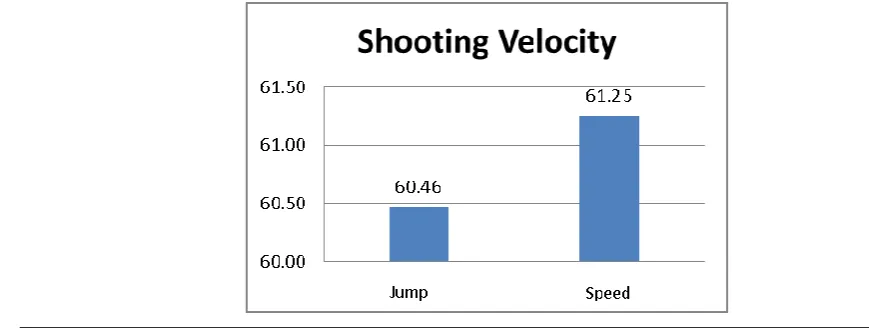
The average of the shoots taken by the athletes after jump training protocol was
60.46 km/h-1 and the average of the speed training shoots was 61.25 km/h-1.
Table 3: Analysis shooting accuracy of athletes
Variables (n=14) Jump Training Protocol Sprint Training Protocol
Accuracy (%) 38,46% 23,08%
Athletes' shooting accuracy percentage frequencies are examined, the accuracy after jump tests is 38,46%; the accuracy after the speed tests 23.08% was found.
In contrast to the shooting speeds of the athletes, a higher hit rate was observed after the jump training protocol in the shoot accuracy.
Table 4: Lactate levels of athletes
Variables (n=14) X±SS t p
Speed training protocol 4.33±1,9 -1,298 0,027*
Jump training protocol 3.19±1,7 -618 0,04*
*p<0.05
It was observed that the speed tests had a higher level of fatigue in athletes compared to the jump tests when the lactate levels of the athletes were examined.
4. Discussion
The development of the soccer game systems causes the game to be played faster and more energy is spent. Therefore, this change has made the features required in athletes more comprehensive. In the selection of the player, considering the relationship of the candidate with the ball, it should not be enough, but it must have the characteristics of speed and explosive power (Krustrup et al., 2006).
Although speed includes genetic characteristics, it is closely related with strength. The versatile strength plays a major role in increasing speed. As the increase in speed is related to acceleration, this can be achieved by increasing the driving forces (Reilly, 1994; Skogvang et al., 2000). In soccer, speed should be considered in two ways, symmetrical speed is great importance especially for wingers, but soccer needs both symmetric and asymmetric speed due to its feature. It is possible to talk about a strong anaerobic capacity for an athlete with a symmetrical speed, but for an athlete with an asymmetrical speed, both the anaerobic power and the superiority of the quickness and change of direction abilities occur (Balsom, 1994).
The participants, distance in 20 minutes each 6600 m. In their study, Barros et al. (2007) found that 55 professional soccer players playing in the Brazilian 1st League had an average distance of 8012 m during the competition, while Di Salvo et al (2007) and Helgerud et al. (2001), the elite soccer players in the youth league, the average distance of 8107 m in the competition, while the players, Thatcher and Batterham (2004), the British Premier League players playing an average of 6741 m, young players in the distance, the average 6274 m. observed. The total distance covered in the match analysis by analysing different categories of soccer’s is similar to the total distance in the test protocol applied in the study.
Activities in soccer matches are categorized into different severities, such as walking, running, jogging, sprinting and running backwards. In their study, Bangsbo et al. (1991) reported that 14 soccer players playing in professional leagues performed 3600 m walking, 5200 m jogging, 2100 m running and 300 m sprint during the match. Barros et al. (2007) determined the same distances for 55 soccer as the average 5537 m walking, 4307 m jogging, 437 m running, Reinzi et al (2000), the distance at international players, average 3068 m walking, 6111 m jogging , 887 m running and 268 m sprint. Castagna et al. (2003), in their analysis, reported that the average distance of sprinters during the match was 468 m, while Thatcher and Batterham (2004) found that the distance was 360 m.
observed in the previous studies that the distance in addition to the determined activities (walking, jogging, sprint and running) in the distance. Castagna et al. (2003) stated that the average distance of soccer players during the match was 114 m back, Thatcher and Batterham (2004), this distance was 803 m, Reilly and Thomas (1976), 668 m, and Withers et al (1982) this distance is 1066 m.
There is no backward activity in the exercise protocol applied in the study. It was also observed that there were differences in activities and distances in different severity during the match. Although this may seem to be debatable in terms of the suitability of the exercise protocol applied, it can be concluded that the test is feasible if other activities (tackle, change of directions, movements with ball, shoots) and match conditions are performed by soccer players in match.
In the study, lactate levels of the athletes after the jump tests observed as 3.19 ± 0.09 mmol/L; also speed tests observed as 4.33 ± 1.01 mmol/L. It was observed that the lactate concentrations during the match varied between 3 to 6 mmol/L (Bangsbo, 1996). Lactate levels of professional soccer players were examined during the match. It was found that the lactate values of the players in the first half varied between 2.1-10.3 mmol / L. In the second half, it was stated that the average was between 1.8-5.2 mmol/L. Lactate levels were found to be 4.9 mmol/L at the end of the first half and 3.7 mmol/L at the end of the second half. Towards the end of the match, a decrease in lactate levels was observed. It was observed that there was a significant correlation between the high levels of high run and the increase in lactate level (r=0.61; p <0.05) (Bangsbo, 1996). Capranica et al. (2001) observed that, in general, lactate concentrations of soccer players ranged from 3.1 to 8.1 mmol/L during the game. Brewer and Davis (1994), the lactate levels of a soccer match in the study examined the first half of lactate values in female soccer players at an average of 5.1 mmol/L, the second half of the end of an average of 4.6 mmol/L.
In our study, when the lactate levels of the subjects were compared with fatigue; lactate values after sprint and jump tests showed statistically significant difference (p<0.05). This difference was observed as an increase in the end of the studies. This increase shows that the desired fatigue formation occurs.
The speed and jump protocol applied in the study consist of different forms of circuit training. The athletes performed 7 different circuit training for 20 minutes during the study. When the study is examined; after the speed tests, the shooting accuracy was 23.08 ± 0.43%. Shooting velocity was found to be 61.25 ± 6.04. After the jump tests, the shooting accuracy was found to be 38.46 ± 0.48%. The shooting velocity was determined as 60.46 ± 6.17.
sprint performances decreased after the first half and at the end of the second half and after the periods of increased play intensity (p<0.05).
The lack of significance may be due to a gender related differences and subject characteristics such as age and training age. This issue should also be noted as “limitations of the study”. It is the power of this study that there are no comparative studies on several training protocols in Super Amateur League soccer players. There is therefore the need for further study on the importance of physical conditioning for shooting.
5. Conclusions
It was observed that speed training was found to be more effective at the shooting velocity than jump training also jump training were more effective in shooting accuracy than speed training. It can be applied to soccer clubs in different leagues. It can be applied by increasing the number of subjects in different age groups.
In this study, the effect of the fatigue factor after two different training protocols on the athletes' shooting performance was clearly revealed. The results of this study will help the coaches in terms of the applicability of different training methods to improve the shooting accuracy performance, which is one of the most important factors determining the score in soccer. Trainers are encouraged to use the models that will enable them to get tired later in the match by using modern training methods and technology.
Conflicts of interest
The author declares no conflict of interest.
Acknowledgements
The author would like to thank all athletes for their willingness to participate in this study.
References
Andrzejewski M, Chmura J, Pluta B, Strzelczyk R, Kasprzak A. 2013. Analysis of sprinting activities of professional soccer players. Journal of Strength and Conditioning Research. 27(8): 2134-40.
Balsom P. 1994. Sprint Performance in soccer, Science and Football.
Bangsbo J, Norregard L, Thorsoe F. 1991. Activity profile of competition soccer. Canadian Journal of Sports Science. 16 (2): 110-16.
Barros L, Ferreira M.J, Queiro´s B, Ferreira I.C.F.R, Baptista P. 2007. Total phenols, ascorbic acid, b-carotene and lycopene in Portuguese wild edible mushrooms and their antioxidant activities. Food Chemistry. 100, 413-419.
Bosco C, Belli A, Astrua M, Tihanyi J, Pozzo R, Kellis S, et al. 1995. A dynamometer for evaluation of dynamic muscle work. European Journal of Applied Physiology and Occupational Physiology, 70: 379-386.
Brewer J, Davis J. 1994. The female player. In: Ekblom B, editor. Soccer (Soccer). London: Blackwell Scientific. 95-99.
Castagna C, Abt G. 2003. Intermatch variation of match activity in elite Italian soccer referees. Journal of Strength and Conditioning Research.17 (2): 388-92.
Capranica L, Tessitore A, Guidetti L, Figura F. 2001. Heart rate and match analysis in pre-pubescent soccer players. Journal of Sport Science. 19:6, 379-84.
Di Salvo V, Baron R, Tschan H, Calderon Montero F.J., Bachl N., Pigozzi F. 2007.
Performance characteristics according to playing position in elite
soccer. International Journal of Sports Medicine. 28(3): 222-227.
Helgerud J, Engen L.C, Wisloff U, Hoff J. 2001. Aerobic endurance training improves soccer performance. Medicine Science of Sports Exercise. 33(11): 1925-31.
Ingebrigtsen J, Dalen T, Hjelde G.H, Drust B, Wisløff U. 2015. Acceleration and sprint profiles of a professional elite football team in match play. European Journal of Sport Science. 15(2): 101-10.
Kellis E, Katis I, Vrabas S. 2006. Effects of an intermittent exercise fatigue protocol on biomechanics of soccer kick performance. Scand J Med Sci Sports. 16: 334-344. Kellis E, Kellis S, Manou V, Gerodimos V. 1999. Concentric and eccentric knee flexor
moment-angular velocity relationships in pubertal and adolescent soccer players. Journal of Sport Sciences. 17(1): 7.
Krustrup P, Mohr M, Steensberg A, Bencke J, Kjaer M, Bangsbo J. 2006. Muscle and blood metabolites during a soccer game: implications for sprint performance. Med Sci Sports Exercise. 38(6): 1165-74.
McMillan K, Helgerud J, Macdonald R, Hoff J. 2005. Physiological adaptations to soccer specific endurance training in professional youth soccer players. British Journal of Sports Medicine. 39: 273- 277.
Mohr M, Krustrup P, Bangsbo J. 2003. Match performance of high standart soccer players with a special reference to development of fatigue. Journal of Sports Science. 21(7), 519- 28.
Mohr M, Krustrup P, Nybo L, Nielsen J.J, Bangsbo J. 2004. Muscle temperature and sprint performance during soccer matches--beneficial effect of re-warm-up at half-time. Scandian Journal of Medicine Science Sports. 14(3): 156-62.
Mohr M, Krustrup P, & Bangsbo J. 2005. Fatigue in soccer: A brief review. Journal of Sports Science. 23, 593-599.
Reilly T. and Thomas V. 1976. A motion analysis of work-rate in different positional roles in professional football match play. Journal of Human Movement Studies. 2: 87-97.
Reilly T. 1997. Energetics of high-intensity exercise (soccer) with particular reference to fatigue. Journal of Sports Science. 15: 3, 257- 63.
Reilly T, Bangsbo J, Franks A. 2000. Anthropometric and physiological predispositions for elite soccer. Journal of Sports Science. 18: 669-683.
Rienzi E, Drust B, Reilly T, Carter J.E.L, Martin A. 2000. Investigation of anthropometric and work-rate profiles of elite South American international soccer players. Journal of Sports Medicine and Physical Fitness 40, 162-16.
Skogvang B, Peitersen B, Stanley-Kehş K. 2000. Soccer Today. Wadsworth/Thomson Learning, 5, 20-28.
Smaros G. 2004. Energy usage during a football match. In L. Strojer J, Hansen L, Hansen K. Physiological profile and activity pattern of young soccer players during match play.
Medicine Science Sports Exercise. 36 (1): 168- 74.
Stolen T, Chamari K, Castagna C, Wisløff U. 2005. Physiology of Soccer: an update.
Sport Medicine, 35(6), 501-536.
Thatcher R. and Batterham A.M. 2004. Development and validation of a sport-specific exercise protocol for elite youth soccer players. Journal of Sports Medicine and Physical Fitness. 44, 15-22.
Withers R.T. et al. 1982. Match analysis of Australian professional soccer players. Journal of Human Movements Studies. 8: 159-176.
Creative Commons licensing terms