ISSN-L: 2501 - 1235 Available on-line at: www.oapub.org/edu
doi: 10.5281/zenodo.1411064 Volume 4 │ Issue 10 │ 2018
RELATIONSHIP OF CORE STRENGTH AND
ISOKINETIC KNEE STRENGTH WITH VERTICAL JUMP
PERFORMANCE IN VOLLEYBALL
Manish Shukla1i,
Vivek Pandey2
1PhD, Department of Exercise Physiology
LNIPE, Gwalior, India
2I/C Registrar & Head,
Department of Exercise Physiology, LNIPE, Gwalior, India
Abstract:
Background: The game of Volleyball requires the players to perform dynamic
movements in receiving the ball and performing explosive movements in spiking and blocking. Vertical jump (VJ) becomes one of the basic motor ability in volleyball owing to its frequent involvement during spiking, blocking, and setting the ball for attack. Although considerable work has been done, the relationship between core strength (Trunk Flexion (TF) & Back Extension (BE)) and vertical jump remains unclear. Thus, the present study was aimed at finding relationship between core strength-endurance
and vertical jump performance. Method: 20 male players (Age=18.05±0.76 years;
Height=192.75±5.88cm; Weight=77.67±7.37kg) from Indian National U-20 Volleyball
team were tested on an Isokinetic Dynamometer at 600*s-1, 900*s-1 and 1200*s-1 angular
speeds for strength testing, on DAVID systems for trunk flexion and back extension and
on sergeant test for vertical jump. Results: Core strength-endurance (TF & BE) and
isokinetic concentric Quadriceps strength at 1200*s-1 (CDQ120) for dominant leg were
significantly positively correlated to vertical jump (TF vs VJ: r=0.507, p=0.023; BE vs VJ: r=0.453, p=0.045; CDQ120 vs VJ: r=0.595, p=0.006) while isokinetic strength for non-dominant leg approximated significance with increasing velocities. Also, core strength (TF & BE) was significantly positively related with FlightTime (FT) (TF vs FT: r=0.497,
p=0.026; BE vs FT: r=0.568, p=0.009). Conclusion: The significant positive correlation of
core strength with vertical jump and FlightTime establishes core strength as an integral component of sports training in Volleyball. Although, eccentric quadriceps strength and hamstring strength were not positively correlated to vertical jump, they help in safe landing mechanism and reduce injury-risks. The small sample size of the study warrants further investigations with larger sample size to confirm the findings.
│ │
Keywords: core strength, isokinetic knee strength, vertical jump, flighttime, isokinetic
dynamometer
1. Introduction
Volleyball is among one of the popular sports played worldwide.1,2,3 The game of
Volleyball requires the players to perform dynamic movements in receiving the ball and performing explosive movements in spiking and blocking. Vertical jump is considered as one of the basic motor ability in volleyball owing to its frequent
involvement during spiking, blocking, and setting the ball for attack.4
Muscle strength-endurance is an important fitness component which determines
sports performance.5 Muscular Power is the ability of an individual to overcome
resistance in shortest time. Since the vertical jump is performed by collective efforts of muscles of hip, knee, and ankle joint, these muscles become prime candidates for
assessment and training in sports like volleyball, basketball, and soccer.6,7 The Isokinetic
assessment of strength has gained popularity over the years due to its resemblance to the actual movement and greater involvement of muscles throughout the range of
motion as opposite to isotonic and isometric movement.5,8,9,10 Isokinetic dynamometers
are used to measure peak torque, average power and total work done at different speed protocols at different body joints.
Recently, Knee extensor and ankle planterflexor muscles have received much
attention in those sports which require explosive vertical jumping movements11 because
of their involvement in vigorous extension of knee and production of large ground reaction force respectively. Also, core stability has emerged as a new determinant of vertical jump performance due to its role in anchoring the coordination in explosive
movements of upper and lower extremities.12,13,14,15,16,17 Although trunk flexion has shown
insignificance with vertical jump performance15 but since the game of volleyball
requires explosive vertical jumps coupled with dynamic shoulder movement, the “core” becomes promising candidate component for further investigation. Core might also contribute in keeping body sail in air for fractionally longer thus benefitting
attackers to adjust their spike. The vertical jump is assessed by many methods.3,18
Sargent Jump has been a consistent means of measuring vertical jump performance as
maximum vertical jump height minus standing height.19
2. Methods and Materials
The study aimed to investigate the relationship of isokinetic concentric knee extensor strength and core strength-endurance with vertical jump in Volleyball.
2.1 Subjects
For the purpose of the study, 20 players (male, age- 17 to 20 years) from Indian National Under-20 Volleyball team were selected purposively in May-July, 2018. They trained three-session a day, 90-120 minute per session. All players were healthy and reported no history of injury (hip, knee and ankle) and were equally motivated to participate in the study. All the players were informed about the purpose of the study and duly filled informed-consent were obtained from selected players. The protocol of research on human subjects was reviewed and approved by an ethical commission within institution in accordance with the Declaration of Helsinki and written consent was
obtained from concerned team officials at the start of the study39.
2.2 Design
The participants were tested on anthropometric variables: height and weight according
to International Standards for Anthropometric Standards20 (ISAK, 2001) and BMI was
calculated. Thigh circumference was measured at upper thigh just below the buttocks. Calf girth was measured at widest girth midway between the ankle and knee. The participants performed warm-up on treadmill at 7kmph for 5 minutes followed by dynamic stretching exercises for 5 minutes.
2.3 Vertical jump
The procedure was explained and demonstrated to them. The subjects performed sergeant jump using wall mounted inch tape. First they stood tall by the side of the wall and extended dominant hand fingertip to mark standing height. Next, they performed a countermovement consisting of bending knees and hips while at the same time flexing the trunk. Each subject was instructed to lower themselves to a most comfortable point at the same time moving their arms back into hyperextension. Then the subjects would leap vertically as high as possible using both arms and legs, assisting the body upwards
and the highest point reached was marked and recorded.19 3 trials were allowed.
Vertical jump was calculated using following equation:
Vertical Jump= Max. Jumping Height – Max. Standing Height
│ │
2.4 Flight Time
During vertical jump, the Flight Time was measured with Digital Stopwatch (Casio HS-80TW Digital Stopwatch) from the moment of toe-off to the moment of toe-strike on the ground. The average of 3 trials was calculated and recorded.
2.5 Isokinetic knee strength testing
The knee strength of dominant and non-dominant leg was assessed with Humac Norm
Testing & Rehabilitation System (CSMi Medical Solutions, USA).21 Concentric and
eccentric peak torque of the Quadriceps, Hamstring Muscles of dominant and
non-dominant leg of the participants was evaluated at angular velocities of 60°*s-1, 90°*s-1
and 120°*s-1. The participants were explained the procedure. Each participant was tested
in the seated position and fixed to the seat from their body, waist, and femur. The axis of rotation of the knees (lateral femoral epicondyle) was aligned with the mechanical axis of the dynamometer, and the resistance thigh pad was placed just proximal to the knee. Moreover, they held the handles of the seat on both sides to prevent the freeness
of the arms and had support from the seat.22
Before testing, the subjects were allowed 3 familiarization trials. Then, the
subjects performed 5 maximal concentric/eccentric knee extension at 60°*s-1, 90°*s-1 and
120°*s-1 for both legs. Subjects were allowed 3- min rest between each protocol. Since,
relative isokinetic Quadriceps strength was considered a better indicator of leg strength as compared to absolute isokinetc Quadriceps strength thus eliminating the effect of body weight in strength testing, isokinetic Peak Torque/ Body Weight (PT/BW) of Quadriceps and Hamstring Muscle (N*m) was evaluated for each player.
2.4 Core strength-endurance testing
Core Strength-endurance was assessed with DAVID R-2100 Lumbar-Thoracic Extension/Flexion System (DAVID Health Solutions, Finland). First, the maximum voluntary contraction (MVC) was assessed with 1RM. 60% MVC was used for testing
core strength-endurance.23 The participant was motivated to perform maximum
repetitions until exhaustion at 60% MVC for both trunk flexion and back extension.
2.5 Statistical Analysis
3. Results
Descriptive statistics (Mean, Std. Deviation, and Shapiro-Wilk Normality test) for Age, Height, Weight, ThighGirth, CalfGirth, BMI, Trunk Flexion, Back Extension, Flight Time and Vertical Jump performance was reported (Table 1). Shapiro-Wilk test for normality shows that data on Age violates the assumption of normality at 0.05 level of significance due to the participants being selected from specific age group (17-20 yrs). All other variables were normal and Pearson Product Moment correlation was calculated.
Table 1: Descriptive Statistics
Mean Std. Deviation Shapiro-Wilk Test for Normality
Statistics df Sig.
Age (in years) 18.05 0.76 0.816 20 0.002
Height (Ht) (in cm) 192.75 5.88 0.915 20 0.078**
Weight (Wt) (in kg) 77.67 7.37 0.916 20 0.082**
Thigh Girth (TG) (in cm) 52.53 2.78 0.926 20 0.132** Calf Girth (CG) (in cm) 36.38 2.15 0.968 20 0.707**
BMI 20.93 1.98 0.959 20 0.519**
Trunk Flexion (TF) (in no.) 44.90 6.86 0.910 20 0.064** Back Extension (BE) (in no.) 59.25 12.98 0.957 20 0.494** Flight Time (FTime) (in sec) .754 .123 0.956 20 0.459** Vertical Jump (VJ) (cm) 62.86 5.18 0.963 20 0.616**
Table 2: Pearson Product Moment Correlation (r)
between Vertical jump and Isokinetic Concentric Leg strength
Vertical Jump Concentric Strength Dominant Leg Quadriceps Hamstring Non-dominant Leg Quadriceps Hamstring
600 900 1200 600 900 1200 600 900 1200 600 900 1200
Pearson r Sig. N .391 .088 .427 .061 .595 .006* -.196 .408 .052 .827 .080 .737 .418 .066 .395 .084 .430 .058 .064 .790 .140 .556 .152 .524 20
*significant at 0.05 level of significance.
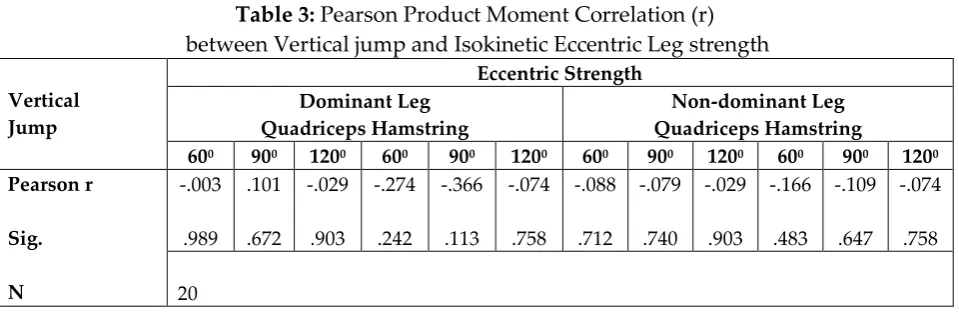
Table 3: Pearson Product Moment Correlation (r)
between Vertical jump and Isokinetic Eccentric Leg strength
Vertical Jump Eccentric Strength Dominant Leg Quadriceps Hamstring Non-dominant Leg Quadriceps Hamstring
│ │
From Table 2 and 3, it was evident that only isokinetic concentric Quadriceps strength at 1200*-1s for dominant leg was significantly related with vertical jump performance (p<0.05). Also, although not significantly related to vertical jump, isokinetic concentric Quadriceps strength for dominant leg at 600*s-1 and 900*s-1 was approximating significance for relationship to the vertical jump performance. Likewise isokinetic concentric Quadriceps strength for non-dominant leg also exhibited a trend towards being significantly related to vertical jump performance with increasing angular speeds. Also, no speed protocols for isokinetic eccentric Quadricpes strength were significantly related to vertical jump performance. Neither the concentric nor the eccentric Quadriceps strength for non-dominant leg was significantly correlated to vertical jump. Also, Hamstring strength of dominant and non-dominant leg was not significantly related to vertical jump at any speed protocol in concentric or eccentric contraction.
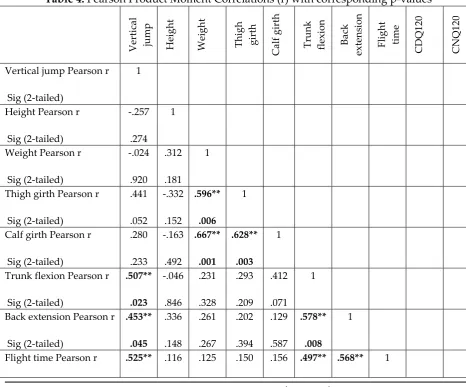
Table 4 summarizes the correlation of all the variables with Vertical Jump performance and the significant relationship of Flight Time with Vertical jump performance (p<0.05). Also, found were the significant correlations of Flight Time with Trunk Flexion, Back Extension, Concentric Dominant leg Quadriceps and Concentric Non-Dominant leg Quadriceps strength (p<0.05).
Table 4: Pearson Product Moment Correlations (r) with corresponding p-values
Ve rtica l jum p Heigh t Weigh t Thi g h gi rth Ca lf gi rth Tr un k flex io n B ack ex tens io n Fl ig h t tim e CDQ 12 0 CNQ1 20
Vertical jump Pearson r
Sig (2-tailed)
1
Height Pearson r
Sig (2-tailed)
-.257
.274 1
Weight Pearson r
Sig (2-tailed) -.024 .920 .312 .181 1
Thigh girth Pearson r
Sig (2-tailed) .441 .052 -.332 .152 .596** .006 1
Calf girth Pearson r
Sig (2-tailed) .280 .233 -.163 .492 .667** .001 .628** .003 1
Trunk flexion Pearson r
Sig (2-tailed) .507** .023 -.046 .846 .231 .328 .293 .209 .412 .071 1
Back extension Pearson r
Sig (2-tailed) .453** .045 .336 .148 .261 .267 .202 .394 .129 .587 .578** .008 1
Sig (2-tailed) .017 .627 .599 .529 .511 .026 .009 CDQ120 Pearson r
Sig (2-tailed) .595** .006 -.163 .491 -.076 .751 .302 .196 -.069 .774 .326 .160 .402 .079 .535** .015 1
CNQ120 Pearson r
Sig (2-tailed) .430 .058 .057 .810 .282 .229 .351 .129 .213 .367 .417 .067 .391 .089 .510** .022 .806** .000 1
** significant at 0.05 level of significance.
CDQ120= Concentric Dominant Leg strength at 120 degree speed CNQ120= Concentric Non-Dominant Leg strength at 120 degree speed
4. Discussion
Vertical Jump is a foremost important motor fitness component required in such games as Basketball, Volleyball, Soccer and many others. Anthropometric properties along with appropriate physical fitness components are important prerequisites for outstanding performance of sports skills and play a distinguished role in sports’
successful achievements.24 In the sport like Volleyball where a high power-output
demand is placed during repeated attacking and defensive vertical jumps, vertical jump performance becomes prime focus component of research and training.
The results from present study comply with Fattahi et al.24 who reported lower
limb strength and abdominal endurance to be important factors determining vertical jump performance. In our study, we found that vertical jump was significantly correlated to isokinetic concentric Quadriceps strength of Dominant leg at increasing
angular speeds (600*s-1, 900*s-1 & 1200*s-1)25 whereas it showed trend towards being
significant for Non-Dominant leg Quadriceps strength which is consistent with the idea of equal bilateral training. According to our results, amongst the parameters included in the study, the most important ones related to vertical jump performance turned out to be Isokinetic Concentric Quadriceps strength of Dominant as well as Non-Dominant leg and core strength-endurance. Also, not less important are the thigh Girth and Calf Girth
although not been significant24 since the amount of vertical jump depends greatly on
vertical ground reaction force and greater physiological cross-sectional area of muscle
determines power.26,27
Core strength was also significantly correlated to vertical jump performance28 in
contrast to the findings of Ozmen29 and Nesser et al.13 who stated that trunk flexion was
negatively related to vertical jump performance in Soccer. The method of core strength assessment might be a major factor for such relationship with motor fitness
performance during sport12,13,30,31,32,33 due to a lack of test specificity. Theoretically, Core
│ │
training in vertical jump performance.34 A possible reason, although unexplained, why
the high Flight Time is generally considered beneficial in Volleyball is that it provides fractional advantage to the players to adjust their attack according to opponent players’ position on court and thus deceive opponent defense.
Although the isokinetic eccentric Quadriceps strength of Dominant and Non-Dominant leg was not related to vertical jump performance but this makes this strength
no less important in training.35,36,37,38 Also, no significant relationship was found between
vertical jump and Hamstring strength in Dominant and non-dominant leg. Eccentric strength in knee has been related to safe and efficient landing mechanisms.
4.1 Limitations
Although the results of the study are promising, these must be interpreted with caution as the sample size was small (20) thus necessitating further research with large samples to validate these findings. Also, the positional differences in Volleyball (spiking, setting, blocking and libero) were not taken into consideration while analyzing the data and there might be differences in motor fitness and anthropometric parameters owing to their playing position, thus further investigations are warranted to establish the findings from the present study.
5. Conclusion
The competitive performance in the game of Volleyball largely depends on vertical jump that puts repetitive high power demands on the lower limbs to propel the body up in the air. Therefore, the factors related to vertical jump become critical in sports training. The present study proposes anthropometric measures (thigh and calf girth), Isokinetic Quadriceps concentric strength of Dominant and Non-Dominant leg and core strength-endurance as possible factors related to vertical jump performance. In the light of limitations of the present study, further investigations are necessitated to cement these findings. Although the significant findings of the present study might be encouraging, but since, Pearson correlation (r) is often misleading and may not explain cause-effect relationship between variables of interest, higher order multivariate analysis (i.e. Path Analysis, Structural Equation Modeling, Multiple Regression) should be employed in future studies to validate these results.
5.2 Recommendations
Acknowledgements
A word of gratitude is devoted to Prof. Abhimanyu Singh (BHU, Varanasi) for his consistent support and valuable guidance during the testing and documentation and Mr. R.K. Shukla (Exercise Physiology Lab Manager, LNIPE, Gwalior) for his valuable time and support during the course of work. We also thank lab staff and colleagues for their help during various phases of compilation of the article.
Conflict of interest
Authors state no conflict of interest.
Disclosure statement
No author has any financial interest or received any financial benefit from this research.
References
1. Bahr R, Bahr IA. Incidence of acute volleyball injuries: A prospective cohort
study of injury mechanism and risk factors. Scandinavian Journal of Medicine & Science in Sports 1997;7: 166-171.
2. Kilic O, Maas M, Verhagen E, Zwerver J, Gouttebarge V. Incidence, aetiology
and prevention of musculoskeletal injuries in volleyball: a systematic review of the literature. European Journal of Sport Science 2017;17:765-793.
3. Czaplicki A, Śliwa M, Szyszka P, Sadowski, J. Biomechanical assessment of
strength and jumping ability in male volleyball players during the annual training macrocycle. Polish Journal of Sport Tourism 2017;24:221-227.
4. Kabaciński J, Murawa M, Fryzowicz A, Dworak LB. A comparison of isokinetic
knee strength and power output ratios between female basketball and volleyball players. Human Movement 2017;18(3):40-45.
5. Śliwa M, Sacewicz T. Biomechanical assessment of the strength of volleyball
players in different stages of the training macrocycle. Polish Journal of Sport Tourism 2015;22:148-152.
6. Carlock J, Smith S, Hartman M, Morris R, Ciroslan D, Pierce K. Relationship
between vertical jump power estimates and weightlifting ability: a field-test approach. Journal of Strength and Conditioning Research 2004;18(3):534-539.
7. Son C, Stewart A, Ward J, Farrar K. Lower body strength-training versus
proprioceptive exercises on vertical jump capacity: A feasibility study. Journal of Chiropractic Medicine 2018;17(1):7-15.
8. Jaszczuk J, Wit A, Trzaskoma Z, Iskra L, Gajewski J. Biomechanical criteria of
│ │
9. Jaric S, Ugarkovic D, Kukolj M. Evaluation of methods for normalizing muscle
strength in elite and young athletes. Journal of Sports Medicine and Physical Fitness 2002;42:141-151.
10.de Ruiter CJ, Vermeulen G, Toussaint HM, de Haan A. Isometric knee-extensor
torque development and jump height in volleyball players. Medicine & Science in Sports & Exercise 2007;39:1336-1346.
11.Radua LE, Făgăraşb SP, Graurc C. Lower Limb Power in Young Volleyball
Players. Procedia - Social and Behavioral Sciences 2015;191:1501–1505.
12.Nesser TW, Lee WL. The relationship between core strength and performance in
division I female soccer players. Journal of Exercise Physiology Online 2009;12(2):21-28.
13.Nesser TW, Huxel KC, Tincher JL, Okada T. The relationship between core
stability and performance in division i football players. The Journal of Strength & Conditioning Research 2008;22(6):1750-1754.
14.Okada T, Huxel KC, Nesser TW. Relationship between core stability, functional
movement, and performance. Journal of Strength and Conditioning Research 2011;25(1):252-261.
15.Clayton MA, Trudo CE, Laubach LL, Linderman JK, De Marco GM, Barr S.
Relationships between isokinetic core strength and field based athletic performance tests in male collegiate baseball players. Journal of Exercise Physiology Online 2011;14(5):20-30.
16.Stockbrugger BA, Haennel RG. Validity and reliability of a medicine ball
explosive power test. Journal of Strength and Conditioning Research 2001;15(4):431-438.
17.Hoffman JR, Cooper J, Wendell M, Kang J. Comparison of Olympic vs.
Traditional power lifting training programs in football players. Journal of Strength and Conditioning Research 2004;18(1):129-135.
18.Borrás X, Baljus X, Drobnic F, Galilea P. Vertical jump assessment on volleyball: a
follow-up of three seasons of a high-level volleyball team. Journal of Strength and Conditioning Research 2011;25:1686-1694.
19.Saiyed MZ, Pais V, Shaikh A, Shemjaz AM, Pais S. Relationship of limb girth,
segmental limb length, hamstring flexibility with vertical jump in male sports players. International Journal of Current Research and Review 2015;7(4);72-75.
20.International Society for the Advancement of Kinanthropometry. International
Standards for Anthropometric Assessment. Potchefstroom, South Africa; 2001.
21.Li RC, Wu Y, Maffulli N, Chan KM, Chan JL. Eccentric and concentric isokinetic
knee flexion and extension: a reliability study using the cybex 6000 dynamometer. British Journal of Sports Medicine 1996;30(2):156-160.
22.Bulgan C. The relationship between isokinetic knee strength and squat jump
23.Vezina MJ, Hubley-Kozey CL. Muscle activation in therapeutic exercises to improve trunk stability. Archives of Physical Medicine Rehabilitation 2000;81(10):1370-1379.
24.Fattahi A, Ameli M, Sadeghi H, Mahmoodi B. Relationship between
anthropometric parameters with vertical jump in male elite volleyball players due to game’s position. Journal of Human Sport & Exercise 2012;7(3):714-726.
25.Davis DS, Briscoe DA, Markowski CT, Saville SE, Taylor CJ. Physical
characteristics that predict vertical jump performance in recreational male athletes. Physical Therapy in Sport 2003;4(4):167-174.
26.Maughan RJ, Watson JS, Weir J. Strength and cross-sectional area of human
skeletal muscle. Journal of Physiology 1983;338:37–49.
27.Hiikkinen K, Keskinen KL. Muscle cross-sectional area and voluntary force
production characteristics in elite strength- and endurance-trained athletes and sprinters. European Journal of Applied Physiology 1989;59:215-220.
28.Imai A, Kaneoka K, Okubo Y, Shiraki H. Effects of two types of trunk exercises
on balance and athletic performance in youth soccer players. International Journal of Sports Physical Therapy 2014;9(1):47-57.
29.Ozmen T. Relationship between core stability, dynamic balance and jumping
performance in soccer players. Turkish Journal of Sport and Exercise 2016;18(1):110-113.
30.Nikolenko M, Brown LE, Coburn JW, Spiering BA, Tran TT. Relationship
between core power and measures of sport performance. Kinesiology 2011;43(2):163-168.
31.Cowley PM, Fitzgerald S, Sottung K, Swensen T. Age, weight, and the front
abdominal power test as predictors of isokinetic trunk strength and work in young men and women. Journal of Strength and Conditioning Research 2009;23(3):915–925.
32.Cowley PM, Swensen TC. Development and reliability of two core stability field
tests. Journal of Strength and Conditioning Research 2008;22(2):619–624.
33.Tse MA, McManus AM, Masters RSW. Development and validation of a core
endurance intervention program: implications for performance in college-age rowers. Journal of Strength and Conditioning Research 2005;19(3):547–555.
34.Araujo S, Cohen D, Hayes L. Six weeks of core stability training improves
landing kinetics among female capoeira athletes: a pilot study. Journal of Human Kinetics 2015;45:27–37.
35.Chu D. Jumping into Plyometrics. Human Kinetics, USA; 1998.
36.36 .Herman DC, Onate JA, Weinhold PS, et al. The effect of feedback with and
without strength training on lower extremity biomechanics. American Journal of Sports Medicine 2009;37: 1301-1308.
37.Hopper D, Elliot B, Lalor J. A descriptive epidemiology of netball injuries during
│ │
38.Hewitt TE, Ford KR, Hoogenboom BJ, Myer GD. Understanding and preventing
acl injuries: current biomechanical and epidemiological considerations-update 2010. North American Journal Of Sports Physical Therapy 2010;5:234-251.
39.41st World Medical Assembly. Declaration of Helsinki: recommendations
Creative Commons licensing terms