
ARTIGO ORIGINAL
Evaluation of Hearing in Patients with
Multiresistant Tuberculosis
Avaliação da Perda Auditiva em Doentes com Tuberculose Multirresistente
1. Serviço de Otorrinolaringologia. Centro Hospitalar de Vila Nova de Gaia/Espinho. Vila Nova de Gaia. Portugal. 2. Departamento de Audiologia. Escola Superior de Tecnologias da Saúde. Porto. Portugal.
3. Serviço de Pneumologia. Centro Hospitalar e Universitário de Coimbra. Coimbra. Portugal.
4. Centro de Referência Regional para a Tuberculose Multisseristente da Região de Saúde do Norte. Vila Nova de Gaia. Portugal. Recebido: 01 de Setembro de 2014 - Aceite: 23 de Dezembro de 2014 | Copyright © Ordem dos Médicos 2015
Leandro RIBEIRO1, Claudia SOUSA2, Aida SOUSA1, Catarina FERREIRA3, Raquel DUARTE4,
António FARIA E ALMEIDA1, Artur CONDÉ1
Acta Med Port 2015 Jan-Feb;28(1):87-91
RESUMO
Introdução: A tuberculose multirresistente e a extensivamente resistente constituem atualmente a principal ameaça ao controlo da tuberculose a nível mundial. O seu tratamento exige o uso de um esquema terapêutico com fármacos de segunda linha por um período mínimo de 20 meses, onde se incluem aminoglicosídeos durante um período de cerca de oito meses. Estes estão associados a alte-rações cocleovestibulares permanentes.
Material e Métodos: Estudo transversal que pretende avaliar a função auditiva em indivíduos que terminaram tratamento por tubercu-lose multirresistente (com esquema que incluia aminoglicosídeos) no Centro de Referência Regional para a Tubercutubercu-lose Multirresis-tente da Sub-Região de Saúde do Norte entre os anos de 2009 e 2012. Os doentes que preencheram os critérios de inclusão foram convocados para a realização de: exame objetivo otorrinolaringológico, audiograma tonal e vocal, otoemissões acústicas por produtos de distorção nas frequências de 2000-5000 Hz e timpanograma.
Resultados: Entre 2009 e 2012 foram referenciados 27 casos para o Centro de Referência para a tuberculose multirresistente da Região Norte, tendo-se verificado cinco óbitos. Dos 22 indivíduos convocados, compareceram 11. Estes possuíam idades compreen-didas entre os 31 e os 59 anos (41 ± 10). A amicacina foi usada em 80% e a capreomicina nos restantes. Seis (60%) dos utentes estudados apresentaram surdez neurossensorial. As otoemissões acústicas foram negativas em todos os doentes com hipoacúsia neurossensorial, o que confirma a sua origem coclear.
Discussão/ Conclusão: Os resultados deste estudo sugerem a necessidade de existir uma monitorização audiológica mais frequente nos indivíduos com tuberculose multirresistente tratados com aminoglicosídeos permitindo detectar mais precocemente a perda au-ditiva.
Palavras-chave: Aminoglicosídeos; Perda Auditiva; Tuberculose Multirresistente.
ABSTRACT
Introduction: Multidrug-resistant tuberculosis and extensively drug-resistant tuberculosis constitute a major threat to worldwide tuberculosis control. The treatment demands the use of a therapeutic regimen in second-line drugs for a minimum period of 20 months, which includes aminoglycosides over a period of about eight months. These are associated with permanent cochleovestibular changes.
Material and Methods: This cross-sectional study aims to evaluate the auditory function in individuals who completed treatment for resistant tuberculosis (with scheme that included aminoglycosides) at the Center of Regional Reference for multidrug-resistant tuberculosis located in the North of Portugal, between the years 2009 and 2012. Patients who met the inclusion criteria were submitted to tonal and vocal audiograms, otoacoustic emissions at 2000-5000 Hz frequencies, and a tympanogram.
Results: Between 2009 and 2012, 27 patients were referred to the Centre of Regional Reference for multidrug-resistant tuberculosis, in the North Region of Portugal, resulting in five deaths. Of the 22 individuals invited, 11 attended. These were aged between 31 and 59 years (41 ± 10). Amikacin was used in 80% of patients. Six patients (60%) had sensorineural hearing loss.
Discussion/ Conclusion: The results of this study suggest the need for a more frequent audiological monitoring in patients with multidrug-resistant tuberculosis treated with aminoglycosides allowing early detect hearing loss.
Keywords: Aminoglycosides; Hearing Loss/ chemically induced; Tuberculosis, Multidrug-Resistant.
INTRODUCTION
Multidrug-resistant tuberculosis (MDR-TB) defined as the simultaneous presence of resistance to isoniazid and rifampin, and extensively-drug resistant tuberculosis (XDR-TB), considered as MDR-TB with associated resistance to any fluoroquinolone plus at least to one of the follow-ing – amikacin, kanamycin or capreomycin – in strains of
Mycobacterium Tuberculosis1-4 and in coinfection with HIV,
is currently the major threat to the worldwide control of tu-berculosis.5,6 Treatment requires the use of an alternative
therapy regimen including second-line drugs for a 20-month
minimum period of time3, including aminoglycosides for
ap-proximately 8 months. These are associated to permanent cochlear and vestibular damage.1-10
The National Reference Centre for MDR-TB (Centro
de Referência Nacional para a TB-MDR) was founded
ARTIGO ORIGINAL The North Health Region Reference Centre for MDR-TB (Centro de Referência Regional para a TB-MDR da Região
de Saúde do Norte [CRRTB-MDR-Norte] was launched
within the Fight Against Tuberculosis Program of the North Regional Health Administration 2008-2010 (Programa de Luta Contra a Tuberculose da Administração Regional de
Saúde do Norte 2008-2010), responsible for the follow-up
and support to treatment of patients with MDR-TB in this region.
Referral of patients undergoing MDR-TB treatment to the ENT Department is routinely performed at the
CRRTB-MDR-Norte reference centre.
MATERIAL AND METHODS
This cross-sectional descriptive study aimed to assess the auditory function in patients having completed their treatment for MDR-TB/XDR-TB (with an aminoglycoside regimen) at the CRRTB-MDR-Norte over the 2009-2012 timeframe. Patients with congenital hearing loss or cochlear disorders prior to treatment, as well as those with known conductive hearing loss or with abnormal findings in otoscopic examination at the time of treatment completion were excluded from the study.
The patients meeting inclusion criteria were called to attend to ENT examination and underwent the following: (1) pure-tone audiometry and speech audiometry, (2) high
frequency pure-tone audiometry (8-16 KHz), (3) distortion-product otoacoustic emissions testing (DPOAE) in the 2,000-5,000 Hz frequency range and (5) tympanometry. The presence of any cochlear symptoms, current or previous to TB-treatment, patient’s occupational and noise exposure history, type of tuberculosis (pulmonary, extrapulmonary or disseminated), ototoxic medications, as well as treatment duration were assessed in the ENT examination.
Air and bone conduction were tested and pure-tone average (PTA) was calculated (average of auditory thresholds at the 500-4,000 Hz frequency range). A 25 dB hearing loss (HL) threshold was defined, above which hearing loss was considered.. This was ranked in:
I – mild hearing loss: 26-40 dB HL PTA; II – moderate hearing loss: 41-70 dB HL PTA; III – severe hearing loss: 71-90 dB HL PTA; IV – profound hearing loss: ≥ 91 dB HL PTA.
Speech Reception Threshold (SRT) was calculated in the pure-tone audiometry testing. DPOAE were ranked as present or absent and tympanometry results as type A, B or C.
RESULTS
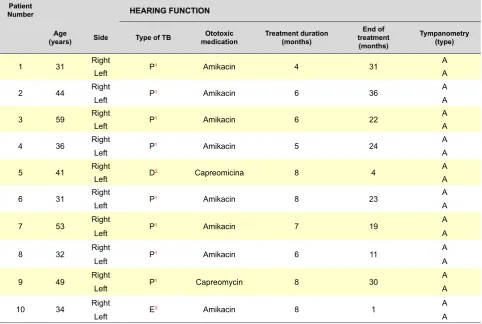
In total, 27 patients with MDR-TB or XDR-TB were referred to the CRRTB-MDR-Norte over the 2009-2012 timeframe and 5 deaths (18.5%) occurred in patients with co-morbidities (Table 1).
Table 1A - Evaluation of hearing function in patients with MDR-TB attending to the CRRTB-MDR-Norte (continued)
Patient
Number HEARING FUNCTION
Age
(years) Side Type of TB medicationOtotoxic Treatment duration(months)
End of treatment
(months)
Tympanometry (type)
1 31 Right P1 Amikacin 4 31 A
Left A
2 44 Right P1 Amikacin 6 36 A
Left A
3 59 Right P1 Amikacin 6 22 A
Left A
4 36 Right P1 Amikacin 5 24 A
Left A
5 41 Right D2 Capreomicina 8 4 A
Left A
6 31 Right P1 Amikacin 8 23 A
Left A
7 53 Right P1 Amikacin 7 19 A
Left A
8 32 Right P1 Amikacin 6 11 A
Left A
9 49 Right P1 Capreomycin 8 30 A
Left A
10 34 Right E3 Amikacin 8 1 A
Left A
ARTIGO ORIGINAL Our study involved 11 (7 female) of the 22 patients
that were called for examination, corresponding to a 50% response rate. One patient with congenital hearing loss was excluded from the study. MDR-TB was found in all the patients. None of the patients presented with any cochlear or vestibular symptom or any abnormal finding in otoscopic examination prior to treatment.
The average age of the ten patients included in the study was 41 (± 10) and 4 to 8 months (6.6 ± 1.4) was the time duration of treatment with ototoxic medications. The early interruption of treatment was commonly associated to the development of renal or auditory toxicity.
Amikacin was the most frequently used medication (80%).
A 65% incidence rate of hearing loss was found in our study, corresponding to 13/20 ears: 2/20 (10%) with mild, 7/20 (35%) with moderate and 2/20 (10%) with severe and profound neurosensory hearing loss, respectively.
The auditory average thresholds on each tested frequency (125-16,000 Hz) are shown in Fig. 1.
DISCUSSION
To our knowledge, this is the first study carried out in Portugal regarding the assessment of hearing loss in patients with MDR-TB or XDR-TB treated with ototoxic drugs.
Hearing loss is one the most devastating side effects of aminoglycoside in resistant tuberculosis. It is believed to be related to external ciliated cell apoptosis triggered by reactive oxygen species generation,2,9 which may explain for
the absence of DPOAE in patients with hearing loss found in our study. The damage to the external ciliated cells starts at the base of the cochlea and progress to the apex and to the Organ of Corti in more severe forms, with hearing loss initially occurring at high frequencies.2,3,4,6 The average auditory
thresholds across frequencies are shown in Fig 1. The lack of consensus regarding the definition of hearing loss and the high variability in the evaluation methodologies are reflected in the 21.3% to 70.1% variability found in literature.2,3,5,7,10
Nevertheless, it should be pointed out that the percentage of patients with hearing loss is higher in prospective studies, in which there is a standardized evaluation and involving all the patients, suggesting that the clinically less significant forms of hearing loss may go unnoticed in smaller studies and with less robust methodologies.
Few factors are known that may clearly increase susceptibility to the ototoxicity caused by aminoglycoside. Most risk factors described in animal models are difficult to prove or do not correlate in human studies. Even though animal studies have demonstrated that ototoxicity is more prevalent with higher dose, frequency of administration and treatment duration,11 a systematic review of 48 studies
Table 1B - Evaluation of hearing function in patients with MDR-TB attending to the CRRTB-MDR-Norte (conclusion)
Patient
Number HEARING FUNCTION
Tympanometry
(type) DPOAE PTA/SRT (dB)
High-frequency (KHz) audiogram (dB) Otoscopy
8 10 12.5 16
1 A Absent 26/30 65 60 80 ∞ Normal
A Absent 33/20 60 55 70 ∞
2 A Absent 100/∞ ∞ ∞ ∞ ∞ Normal
A Absent 100/∞ ∞ ∞ ∞ ∞
3 A Absent 65/55 75 70 ∞ ∞ Normal
A Absent 60/90 90 80 ∞ ∞
4 A Absent 62/55 105 95 ∞ ∞ Normal
A Absent 54/57 85 70 ∞ ∞
5 A Present 14/37 15 15 40 ∞ Normal
A Present 12/27 30 30 55 ∞
6 A Present 23/37 80 90 ∞ ∞ Normal
A Present 24/23 70 75 ∞ ∞
7 A Absent 53/50 95 ∞ ∞ ∞ Normal
A Absent 58/50 85 ∞ ∞ ∞
8 A Absent 84/∞ 105 ∞ ∞ ∞ Normal
A Absent 80/∞ 100 ∞ ∞ ∞
9 A Present 17/27 35 70 70 ∞ Normal
A Absent 35/33 95 80 ∞ ∞
10 A Present 10/20 5 5 5 30 Normal
A Present 9/15 10 5 5 30
ARTIGO ORIGINAL
published in 2010 has failed to support these claims.12
The same happened with other factors as patient’s age, gender or tobacco consumption.2,3,5,7 Genetic predisposition
is a well-known risk factor. The A1555G mutation in mitochondrial DNA is associated to non-syndromic hearing loss and increases susceptibility to ototoxicity caused by aminoglycoside.13 In the future, screening of this mutation
with genetic testing may be useful in order to recognize patients more susceptible to ototoxic cochlear damage. As this form of hearing damage is permanent and irreversible, monitoring of hearing function is crucial during treatment with ototoxic medications. Although there is a shared understanding among the different medical associations4, it is accepted that hearing function should
be tested before starting treatment with an audiogram and at least monthly thereafter up to 3-6 months upon discontinuation.4,6,9,14 This assessment should include the
frequencies above 8,000 Hz in order to increase the test’s sensitivity since hearing loss starts and is more severe in higher frequencies, as already described. Any 20 dB loss on a single frequency or 10 dB in two contiguous frequencies should warn the physician about of ototoxicity.14 Whenever
this is detected, treatment interruption, doses and frequency reduction or change to a less ototoxic medication are available options. This decision should be individualized and should depend on clinical severity, duration of treatment, sensitivity profile of the strain, availability of efficient and safe alternatives, as well as on hearing loss severity and progression.
The fact that this was a retrospective study, without any baseline or pre-treatment hearing evaluation confers a major limitation to the study. In addition we cannot exclude a
selection bias due to the participation of patients with hearing loss symptoms. Despite the exclusion of any patients with hearing loss symptoms previous to the administration of the ototoxic medications, this does not ensure that the patients involved in the study had no other subclinical forms of hearing loss with a possible major impact on our evaluation. This fact increases the need for prospective studies with a larger sample of patients to be carried out, perhaps nationwide, involving the five MDR-TB Regional Reference Centres (Centros de Referência Regionais para
a TB-MDR).
CONCLUSION
The high incidence of hearing loss found in our study increases the need to establish operation protocols in close relationship among the Reference Centres and the ENT Departments, in order to improve early detection and referral of hearing loss.
OBSERVATIONS
This manuscript was presented as a poster to the 61st Con-gresso da Sociedade Portuguesa de Otorrinolaringologia e
Cirurgia Cérvico-Facial, Lisbon, 1-4th May 2014.
CONFLICTS OF INTEREST
The authors declare there were no conflicts of interest in writing this manuscript.
FINANCIAL SUPPORT
The authors declare that there was no financial support for writing this manuscript.
Figure 1 - Patient hearing-loss average thresholds (measured on a dB HL [hearing loss] scale) across several frequencies 120
100 80 60 40
Right
Left 20
ARTIGO ORIGINAL REFERENCES
1. Vilariça A, Gomes C, Pina J. Análise comparativa entre tuberculose multirresistente e tuberculose extensivamente resistente – Epidemiologia e factores preditivos. Rev Por Pneumol. 2008;14:829-42. 2. Javadi MR, Abtahi B, Gholami K, Safari Moghadam B, Tabarsi P, Salamzadeh J. The incidence of amikacin ototoxicity in multidrug-resistent tuberculosis patients. Iran J Pharm Res. 2011;10:905-11. 3. Seddon JA, Thee S, Jacobs K, Ebrahim A, Hesseling AC, Schaaf HS.
Hearing loss in children treated for multidrug-resistent tuberculosis. J Infect. 2013;66:320-9.
4. Seddon JA, Godfrey-Faussett P, Jacobs K, Ebrahim A, Hesseling AC, Schaaf HS. Hearing loss in patients on treatment for drug-resistent tuberculosis. Eur Respir J. 2012;40:1277-86.
5. Ramma L, Ibekwe T. Cochleo-vestibular clinical findings among drug resistant tuberculosis patients on therapy - a pilot study. Int Arch Med. 2012;31:5-13.
6. Duggal P, Sarkar M. Audiologic monitoring of multi-drug resistant tuberculosis patients on aminoglycoside treatment with long term follow-up. BMC Ear Nose Throat Disord. 2007;12:7-15.
7. Jager P, Altena R. Hearing loss and nephrotoxicity in long-term aminoglycoside treatment in patients with tuberculosis. Int J Tuberc Lung Dis. 2002;6:622-7.
8. Vasconcelos KA, Lima MA, Frota S, Ruffino Netto A, Kritski AL. Avaliação
audiométrica de pacientes em tratamento para tuberculose pulmonar. J Bras Pneumol. 2012;38:81-7.
9. Xie J, Talaska A, Schacht J. New developments in aminoglycoside therapy and ototoxicity. Hear Res. 2011;281: 28–37.
10. Törün T, Güngör G, Ozmen I, Bölükbaşi Y, Maden E, Biçakçi B, et al. Side effects associated with the treatment of multidrug resistant tuberculosis. Int J Tuberc Lung Dis. 2005:9:1373-7.
11. Wu WJ, Sha SH, McLaren JD, Kawamoto K, Raphael Y, Schacht J. Aminoglycoside ototoxicity inadult CBA, C57BL and BALB mice and the Sprague-Dawley rat. Hear Res. 2001;158:165–78.
12. America Speech-Language-Hearing Association. Evidence-based systematic review (ESBR): drug-induced hearing loss – aminoglycosides. 2010. [Consultado 2014 Fev 03]; Disponível em http://www.asha.org/. 13. Prezant TR, Agapian JV, Bohlman MC, Bu X, Oztas S, Qiu WQ, et al.
Mitochondrial ribosomal RNA mutation associated with both antibiotic-induced and non-syndromic deafness. Nat Genet. 1993;4:289–94. 14. America Speech-Language-Hearing Association. Audiological
António FARIA E ALMEIDA, Artur CONDÉ

![Figure 1 - Patient hearing-loss average thresholds (measured on a dB HL [hearing loss] scale) across several frequencies](https://thumb-us.123doks.com/thumbv2/123dok_us/7815635.2086790/4.567.75.498.83.314/figure-patient-hearing-average-thresholds-measured-hearing-frequencies.webp)
