International Journal of Advances in Management, Economics and Entrepreneurship Available online at:
www.ijamee.info
RESEARCH ARTICLE
Algorithm Trading and High Frequency Trading Boon or Bane in
Indian Context
Dhruv Chakervarti*
,Dasika Chaitanya
Naree Monjee School of Management Studies,India.
Abstract
This paper attempts to unearth the reasons qualitatively by using Grounded Theory to systematically study Algorithm trading and High Frequency trading” in Indian Stock markets. The study is an attempts to understand the phenomenon using a sample of traders and a survey was conducted to understand the phenomenon and its acceptance amongst trader community. The first phase based on initial set of questions was to explore the awareness levels analyse pertaining to “Algorithm trading and High Frequency trading” in Indian Stock markets; and second phase of study attempted towards understanding the reasons for non-implementation of “Algorithm trading and High Frequency trading” in Indian Stock markets. The study reveals that Indian traders are aware about the Algorithm and High Frequency Trading. The study is tending towards indicating that Algorithm trading and High Frequency trading are a bane based on the current Indian scenario.
Introduction
Purpose, Scope and Limitation
The Capital markets across globe have witnessed paradigm shift with the use of technology getting more and more involved in the financial markets. The Indian markets have seen the change from the physical share trading to the electronic screen trading and now the buzz words are Algorithm trading and the High Frequency Trading. HFT which is fast becoming the new technology and has been widely used in the western markets, is also finding its way to the Indian sub-continent.
The paper attempts to explore whether such technology driven platforms which put our capital markets at par with the international ones should be promoted or should we not permitted technology intervention at all as they do not provide the level playing field to all the market participants. In addition, the use of Algorithmic Trading reduces human intervention significantly. This is a cause of concern from the Indian economy perspective where unemployment rate is already high.
Algorithm Trading in India
Automated or algorithmic trading is a system for trading through programmed software that can make around 800 transactions per second. The software-helped trading was allowed by Bombay Stock Exchange (BSE) and National Stock Exchange (NSE) in 2005.
But it was only in 2008, after the Securities and Exchange Board of India (SEBI) allowed Direct Market Access, or electronic interaction with the order books of exchanges, that this facility started gaining wide acceptance.
Today, around 16 to 17 per cent of trading on the Bombay Stock Exchange (BSE) and National Stock Exchange is algorithmic, with about 80 to 90 companies engaged in it.
26, were cancelled by the BSE, following unexpected volatility which was blamed on algorithmic trading.
The expertise of algo traders is also being questioned.
Abhijit Biswas, “lot of people with only computer science knowledge are getting into this field, who can do some serious damage. Regulators need to come up with stringent norms for a proper certifying process for algorithmic trading, like the trade association of mutual funds (AMFI) for mutual funds”.
Historical Events
Dow Jones Flash Crash
The situational dynamics of the Dow Jones Flash Crash have been explained by Manshu [1] in his article on Algorithm and High Frequency Trading in India. This has been further explained by Henrick Johnsson and Andreas Stephan [2] in their thesis in which they have investigated the use of HFT in the Swedish market and shed light on how HFT interacts with the market.
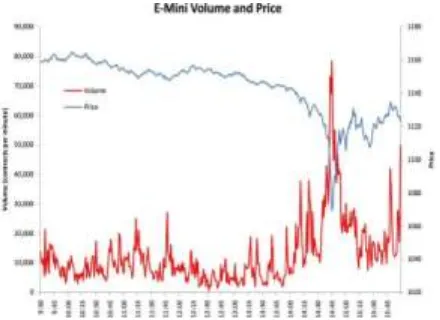
On May 6 2010 – a flash crash took place in the Dow in which several companies and blue chips lost a lot of their value in a matter of minutes, and the NYT reported that shares of big companies like P&G and Accenture saw ridiculous prices like a penny or a $100,000. The prices were later restored to more usual levels. In less than a quarter, The New York stock Exchange dropped 600 points, leaving the loss for today nearly 1000 points. Just a few minutes later the NYSE bouncing back nearly 600 points.
The SEC (U.S. Securities and Exchange Commission) investigated this. Somewhere around 2:30 p.m. Waddell & Reed, a US based management and financial firm, started to execute a massive sell program of 75,000 E-mini contracts. Generally, a sell program of that size would not be executed at once, but rather spread over a couple of hours. HFTs were the first buyers of the first set of sell orders, and taking a temporary strong position. Thus in this stage it were HTFs and intermediaries that provided liquidity to the market. Just a few minutes
after they bought the set of contracts sold by fundamental seller, HFTs began to aggressively sell contacts to reduce their assets pool. At this stage HFTs were no longer a provider of liquidity, instead they competed for liquidity with the selling program.
The total HFTs volume increased rapidly just before and under the Flash Crash. As E-mini prices rapidly fell and many traders were unable to submit orders and HFTs repeatedly bought and sold to each other generating an effect called “hot potato”. HFTs traded 27,000 contracts during this period, which made up for around 50% of the total trading volume. E-mini fell about 7% and at 2:45 a trading pause were automatically activated in the E-mini. Opportunistic buyers started to execute buy orders which lead to a strong recovery in prices. HFTs traders continued their strategy of quick selling and buying contracts, while more than half of the intermediaries left the market.
Although, there weren’t any reports of regular investors losing money because of these events, it does show that these computer trading programs pose risk, and can cause damage because of the way they are structured. Even in India – BSE canceled all the futures traded on muhurath trading this year, and at least an initial report blamed an algo trader from Delhi for causing havoc because of their trades (Business Standard) These were the similarities between the US and India, but there is a difference too. It appears that it’s only a question of how profitable these operations are in the US and the profits of firms that engage in this runs in billions or tens of billions whereas in India – the profitability is itself questionable. An alternative explanation for this could be lack of enough volumes or enough of an edge to be as profitable as they are in the US.
thousands of orders in a bid to depress the price of the "e-mini" futures on the S&P 500.
Figure 1: Dow Jones index fat finger as on May 6 (Source: SEC)
When the prices fell he swooped, buying them up, and profiting accordingly.They say his behaviour contributed to the fact that, when a huge trade was executed over in the United States, there wasn't enough liquidity, and the market was unable to handle it.
Figure 2: Chart showing as more "E-mini" futures were traded, their prices crashed (Source: SEC)
The Flash Crash: Fat Finger or Algo, Emkay Must Pay
Deepak Shenoy [3] in his article throws light on the situation of Emkay Global Crash where a manual error lead to execution of 59 orders which were “rogue” in nature and pointed out that the Nifty circuit breakers did not work though claimed otherwise.
The event happened on October 5, 2012 at 9:50 AM on Friday morning, when the markets were expected to keep going up forever because there were new reform agendas. However, the markets went curiously the other way. Stunned traders watched the index fall over 15% down approximately 920 points to 4888.2 from a
close of nearly 5800 the previous day.
Figure 3: Nifty index showing fat finger as on October 5,2013 (Source: NSE-TAME)
The market opened normally and Nifty opened at 5815. At 9.50.58, the Nifty circuit filter triggered, upon which the cash market was closed automatically. The Nifty fall was apparently on account of the entry of 59 erroneous orders, which resulted in multiple trades for an aggregate value of over Rs.650 crore. These erroneous orders were entered by a trading member, Emkay Global Financial Services, on behalf of an institutional client which resulted in executing trades at multiple price points across the entire order book, thereby causing the circuit filter to be triggered.
While the exchange systems functioned normally without any glitch, the above abnormal trades caused market closure automatically, due to the index circuit filter getting triggered. The market was reopened by the Exchange at 10.00.22 and trading resumed at 10.05.00 and the market functioned normally.
Emkay’s Response
On October 5, 2012, while executing an order to transact a Nifty cash basket, in Nifty-50, a dealer committed a bona fide error. The error was in entering the value of the order as the quantity of Nifty-50 basket to be transacted. The order got transmitted to the NSE trading server as a single large Nifty basket order comprising of Nifty-50 stocks. Immediately on realizing the error, Emkay promptly got in touch with the NSE and kept in touch with them to co-ordinate all future course of action until the entire erroneous outstanding position was closed out.
The project attempts to analyse the sentiment associated with this technological change as eyed by the trader’s fraternity and figures out that whether it should be implemented and practiced on a broad scale or not in Indian markets. In the process of achieving the objective, the project also tests the awareness of test sample about Algorithm and High Frequency Trading. The second phase of the study is to understand the reasons for implementation or non implementation of algorithm trading .
To understand the sentiments qualitative technique of grounded theory was used, restricting the sample to thirty respondents only.
Limitations
The questionnaire was framed and circulated among thirty traders currently working at BSE who were experienced in the field. The results obtained from a sample of traders can’t be considered as the opinion of the whole trader fraternity.
Algorithm Trading is dealt with confidentiality in most of the companies approached by the researcher and any questions regarding the project were not entertained.
Since, the sample included people who were less experienced in Algorithm Trading the results can be a little misleading.
Sources and Methods
As has been stated previously, a questionnaire was framed on the topic and was circulated among 30 traders from BSE and few institutional investment firms. The nature of the questions was kept open ended to have a general opinion from the traders. The responses were recorded and grounded theory analysis was applied to them. Grounded theory is a method of qualitative analysis i.e. it is done when the data cannot be quantified. The nature of our questionnaire is open ended and the answers are the opinions of the respondent in favour or against the project topic. Since, they can’t be quantified hence, we use grounded theory analysis for the same.
Grounded Theory
Grounded Theory can be simply defined as
‘The discovery of theory from data systematically obtained from social research’ [4]. Grounded theory was developed in the early 1960’s by Glaser and Strauss. With its theoretical orientation based in sociology, Grounded Theory strives to understand and explain human behaviour through inductive reasoning processes. Because of its emphasis on the utilization of a variety of data sources that are grounded in particular contexts, Grounded Theory provides a natural theoretical fit when designing research studies.
Moreover, Grounded Theory offers a practical and flexible approach to interpret complex social phenomena and it provides a strong intellectual justification for using qualitative research to develop theoretical analysis. Globally, grounded theorists start with inductive logic. Inductive logic means that the researcher does not start with a hypothesis or theory and then prove or disprove it, but rather the researcher first starts by collecting data in the setting, concurrently analyzes it, and then generates a hypothesis.
Step by Step Procedure for Performing Grounded Theory Analysis / Grounded Theory Method
Research Question Grounded theory is used when there is no existing theories or limited theories that’s of interest to the researcher. There are two questions, solutions for which need to be found out in our research:
Would the implementation of technology innovation in the trading sector/the Indian Stock markets on a broad scale prove to be a boon or a bane in the long run ?
Are people aware and to what extent about the existence of such technological interventions in our stock markets and what is their sentiment towards adoption of technological change?
Recruitment
conducted. This sample of people is also called Theoretical Sample.
For our research, the theoretical sample consists of 30 traders who are experienced in the field for more than 10 years. The theoretical sample consists of predominantly traditional brokers at BSE, not practising Algorithm trading as they are the ones who get directly impacted if Algorithm trading is pursued on a broad scale.
The sample also includes Algorithm traders who are experienced in the field and were willing to entertain and answer questions within the scope of the research.
Data Collection
Questionnaires and interviews is the main type of data collection in grounded theory. Interview questions always need to be open ended as every respondent has a different opinion and perspective of assessment of a particular question asked.
For our research, we have resorted to the same method. A questionnaire has been framed for the topic with about 15 open ended questions. The researcher has gone to every member of the theoretical sample, interviewed him and recorded the response of Google Forms.
Data Analysis There are three stages of data analysis:
Open Coding
This is the first stage of data analysis. Here the researcher reads different transcripts and determines different categories or themes that are found in the data.
Open Coding basically means having an open mind to what the respondents are saying and determining the different kind of categories you can obtain from the data. These categories are also called ‘codes’. For this, the researcher has done an analysis for every question as follows:
The first set of questions was framed keeping in mind the factor of awareness. Basically, the questions were meant to gauge the awareness on Algorithm trading
and its presence in the Indian markets. From the theoretical sample taken for conducting the analysis, everyone has answered this question, which means that the traders at BSE were aware about its presence in the Indian markets.
Further, an attempt was made to identify the source from which they got to know about Algorithm Trading. This again tests the parameter of awareness, as the source from which they got to know also needs to be aware of the presence of such technology intervention in the Indian markets. The respondents mostly responded with markets, print media and friends which assures us about the extent awareness of the same.Next the sentiment of the theoretical sample associated with Algorithm trading as need of the hour was tested. We all are aware that India is tapping into technological innovation and conglomerates find it as the chariot for their development in future. The responses received form the sample space though were predominantly in disagreement (around 55% of the responses tend to disagree) to incorporate technology in the trading segment of the Indian capital markets. At the same time, all the respondents believed that Algorithm Trading is not being adopted in our country.
It was also observed that irrespective of whether the respondents are ‘for’ or ‘against’ Algo trading, they all believed that regulatory bodies do not have sufficient participation in Algorithm trading. Few believe that the government isn’t promoting Algorithm trading to a large extent and emphasised the need for awareness programs and training programs for the same. Others believe that the Government is not taking measures to curb the malpractices associated with the same and is not doing anything to regulate Algorithm traders in order to provide traditional traders a level playing field to compete.
intraday trading. They do believe in the human instincts associated with any trade which obviously can’t be inculcated in a machine.
It was found that Indian markets are not ready for accepting and implementing Algorithm trading on a daily basis. From the responses, it was observed that most of the respondents believed that people of India do not like to invest in stock markets. The primary reason behind this is the risk free investments they get by investments in Fixed deposits. They were not attracted if they got anything less than 10% which is difficult and not sure to achieve even after taking a risk and investing in the stock market. The respondents believed that there was no motivating factor for investment in stock market and implementation of Algorithm trading would not suffice to attract people for such investment. In addition, some of them emphasised the need for young traders in the field as they believed that majority of the old traders sitting at BSE were stereotypical, inflexible to change and not keen on learning new technology.
From an economic perspective it was felt that Algo trading would lead to increase in employment only for engineers and skilled who knew and understood complex coding. In fact most of them believed that it would lead to decrease in job opportunities as machines would replace human beings on an exchange floor which would decrease our economic value. In fact many of them expressed the fear of the impact created by placing the economy in the hands of unexperienced programmers rather than experienced traders in the field.
They also agreed that practicing Algorithm trading leads to an increase in liquidity. Most of them opined that it lead to liquidity in places where it was not required in the market i.e. in already liquid markets. They believe that the increase in this liquidity causes short term volatility and favours the institutional investors who deal in the field as it leads to variation in prices of the stock market.
However, most of them agreed that adoption
of Algorithm trading on a broad scale would not bring the Indian market at par with the international markets. The adoption of western technology in all sectors of our economy does not make our markets at par with the international markets. Our economy is labour intensive as opposed to other countries and since Algo trading leads to unemployment it harms the market. In addition, Indian markets are liquidity driven which inturn is driven by the sentiment of traders which many not be the model of foreign markets.
Axial Coding
In axial coding, the researcher uses the codes to show how the categories relate to each other. Axial coding helps in development and formation of the theory. Researcher looks at a number of factors like the core phenomenon, causal conditions, strategies and consequences. At the end he finally connects all the dots, the categories to each other. Researchers explain the links between different categories by logic diagram or a theoretical model.
Categories determined in the open coding:
Awareness
Source
Need of Hour
Unaffordable Technology
Unnecessary investment
Algorithm can’t look at macroeconomics
Malpractices
Inflexible mentality of brokers
Algorithms can’t do fundamental analysis
Irresponsible Government
Awareness and training programs
Can’t trust machines blindly
Common man not interested in stock market investment
Unemployment
Employment only to the over-educated
Decrease in economic value
Liquidity in the wrong area
Technology adoption achieves nothing
Before it Gets Implemented
The following constructs come into picture before Algorithm Trading gets implemented:
Awareness
Need of Hour
Unaffordable Technology
Unnecessary investment
Irresponsible Government During its Implementation
The following constructs need to be taken into consideration during the implementation of Algorithm trading:
Inflexible mentality of brokers
Liquidity in the wrong area
Common man not interested in stock market investment
Awareness and training programs
After its Implementation
The following constructs need to be taken into consideration during the implementation of Algorithm trading:
Algorithm can’t look at macroeconomics
Algorithms can’t do fundamental analysis
Malpractices
Technology adoption achieves nothing
Unemployment
Employment only to the over-educated
Decrease in economic value
Can’t trust machines blindly
For the process to be successful it is imperative for the constructs of each stage to be dealt with seriously and sorted out successfully in order to ensure smoother implementation of Algorithm trading if felt necessary by the authorities in the Indian markets.
Selective Coding
Here we explain the story behind how the model explains the process, how all the categories are related. Selective Coding is an overall explanation of the theory.
By this the researcher is trying to give a birds eye view of the factors that need to be taken into consideration before, at the time and after the implementation of Algorithm trading on a broad scale in the Indian markets.
The Before Stage (The Technology Driven Stage)
In this stage it is imperative for the traders to be aware about the mere existence of Algorithm trading in the Indian markets. It is imperative for the traders to feel the need for change and respect the technological deviation from the traditional system. They should believe that the technological orientation is justifiable and will help them rather than creating problems in the long
run. The brokers should not feel any burden on part of the technology hence the two factors highlighted above unaffordable technology and unnecessary investment for hiring technology engineers in the field needs to be sorted before starting the implementation of Algorithm trading.
The Present Stage (The Negative Sentiment Driven Stage)
As opposed to the previous stage, this stage consists of identification and rectification of negative sentiment of traditional traders for reasons other than technological (considering they have been dealt with in the previous stage). As we know, there is a negative sentiment associated with the topic which makes the traditional brokers rather resistant to accept the change. The main reason behind this is the lack of Government interest in the initiative to promote Algorithm trading which needs to be taken care for observing a little flexibility for the same. In addition, the Government can also take steps for ensuring the provision of liquidity where required thus ensuring that Algorithm trading cannot just be competitive. In addition, the common man needs to be motivated to invest in the Indian stock market. Our population is 1.25 billion today and not even 10% of people’s savings go in investments. The common man needs
to be ensured that this method would surely lead to higher returns than what he can get from simple investments in FDs.
The After Stage (The Determining Phase)
There are a number of factors that influence this phase. If Algorithm trading can’t prove out to be a boon in the future then there would be no point of its broad implementation. Traders majorly believe in technical analysis while trading. But it does not mean they do not look at the fundamental parameters and economic parameters at all. In fact, entering any traders office at BSE the first thing which any researcher will notice would be a set of computers and TV with news constantly running on it. As someone rightly said sentiment drives liquidity in our markets. Whenever there is a bad news in the World or India for instance, the very recent Brexit, or even the monsoons causing floods in a particular area, it is bound to effect a negative impact on the stock markets which can’t obviously be tracked by Algorithm and need human intervention. In addition, when there is a good news, like the passing of GST bill etc. then the positive sentiment drives up the market.
At this stage, obviously competitiveness among the traders needs to be regulated, as when all of them would have Algorithmic trading all of them would manipulate the markets for their gains which would not only lead to short term volatility, the risk of fat fingers would also increase. Considering that people still are unwilling to invest in stock markets, any kind of investment for technological growth would be meaningless and would not prove that our markets have come at par with the international ones.
Unemployment is another factor to be looked upon as the implementation of this technology does mean machine replacing man which would not satisfy job creation in our country in fact render unemployment. We as it is have high unemployment rates, population explosion and also 33% of our population is only educated. In fact, according to recent survey by the Times of India 91% of Indians feel technology as a threat to their jobs. The decrease in job
creation would infact lead to increase in unemployment rates of the country and affect our macroeconomic and stock market data.
Result of Analysis
The respondents to indepth interviews were 30 traders experienced in the field, a negative sentiment towards the implementation of Algorithm trading has been majorly observed. It can be inferred that as far as the current scenario goes the Indian Capital Market is not in a position to handle algo or high frequency trading. It acts biased, in favour of the large investors because it’s them who have the ability of investing and withdrawing to such an extent. Furthermore, the problem with our market is the lack of knowledge about it, as discussed earlier. In fact there is more chance of a disastrous situation to arise which can get the market in a frenzy for the slightest error or miscalculation. This possibly creates scare in the market regarding the topic because miscalculations on the interpretation of trends by traders is not an exception and there is no scope for error correction thanks to the very high speeds.
In addition, algorithmic and high frequency trading might just be another reason leading to less creation of jobs, eventually leading to unemployment. The technology like the algo trading is of no use as it can kill lot of jobs for those who were into arbitrage and jobbing Hence, though Indian traders are aware about the presence Algorithm trading in Indian markets directly or indirectly, yet the analysis proves its implementation as bane in Indian context.
Conclusion
The factors to be taken into consideration for implementation of Algorithm trading in Indian markets
structure along with latest innovations as we progress.
India is a labour intensive economy. We already know that unemployment is the major reason of concern today. If there is one job opening anywhere in any corporate in India for any position, there are thousands of applicants to fill that position, whereas in case of foreign economies the scenario is completely the opposite. There it’s difficult to find people who would be willing to work. Hence, man replacing machine concept of Algorithm Trading is apt there but not in Indian context.
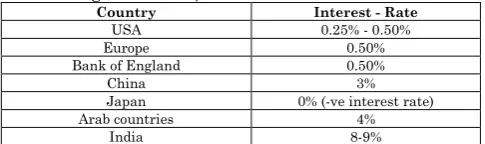
Here, people are savings oriented. They prefer to save and keep in FDs as they get 8-9% returns risk free rather than investment in the stock market which can’t ensure them those returns and is an additional risk. On the contrary, taking reference from this years interest rate data given below:
Table 1: Latest Interest rate data (Source: Forum Views magazine - BSE)
Country Interest - Rate
USA 0.25% - 0.50%
Europe 0.50%
Bank of England 0.50%
China 3%
Japan 0% (-ve interest rate)
Arab countries 4%
India 8-9%
In countries like US and UK which have adopted the system, the interest rates are only 0.5%. Hence, people there do not believe in savings and are motivated for investments in the stock markets for higher returns.
As, we have seen there are problems associated with Algorithm and High Frequency Trading and we can’t implement it on a broad scale in India taking current Indian market scenarios into consideration as stated above. However, the least we can do is make a few changes to improvise the trading culture and make it Tech friendly [5-7].
References
1 Manshu (2011) Algorithm and High Frequency Trading in India, retrived from http://www.onemint.com/2011/10/31/algorithm ic-and-high-frequency-trading-in-india/
2 Johnsson Henrick, Stephan Andreas (2013) High Frequency Trading: Market abuse and how to reestablish confidence in the market?, Jönköping International Business School, pp. 11-12, 2.2 Flash Crash
3 Shenoy Deepak (2012) The Flash Crash: Fat Finger or Algo, Emkay Must Pay, retrived from : http://capitalmind.in/2012/10/the-flash-crash-fat-finger-or-algo-emkay-must-pay/ 4 Glaser Barney G, Strauss. Anselm L (1967)
The Discovery of Grounded Theory: Strategies for Qualitative Research, Chicago, Aldine Publishing Company, pp. 1
5 Glaser Barney, Holton Judith, “Remodelling Grounded Theory”, http://www.jstor.org/stable/40981068, pp. 47-68
6 El Hussein Mohammed (2014) Using Grounded Theory as a Method of Inquiry: Advantages and Disadvantages”, The Qualitative Report, 19:1.