
Journal of Electrical Engineering,
Electronics, Control and Computer Science –
JEEECCS, Volume 6, Issue 19, pages 7-12, 2020
Significance of Smart Grids in Electric Power
Systems: A Brief Overview
Umair Shahzad
Department of Electrical and Computer Engineering, University of Nebraska-Lincoln,
Lincoln, NE, USA [email protected]
Abstract – Energy demand is a vital issue which must be dealt with great significance. With the advent of innovative communication technologies and advancements in power systems, the trend of conventional grid is gradually shifting to the modern grid. Smart grids play an important role in various energy issues. The paper discusses the basics of smart grids including; its definition, major advantages and challenges, key elements, chief impacts, and communication technologies deployed. In the end, a suggested novel methodology, employing smart grid, is also provided. The information provided in this paper has been gathered from published literature and various studies found on the subject, as well as ongoing projects. Successful implementation of smart grids will open more pathways for future research direction in power systems.
Keywords- energy; modern grid; communication technologies; smart grids; power systems; energy demand
I. INTRODUCTION
According to The National Institute of Standards and Technology (NIST), a smart grid is a modernize grid that allows bidirectional power flow and utilizes two-way communication and control functions that will generate an array of novel applications. The implementation of a smart grid system that is capable of self-healing and providing power from multiple and widely distributed sources, including renewable sources, will help to meet the rising consumer energy needs as well as providing almost 99.9% reliable energy [1].
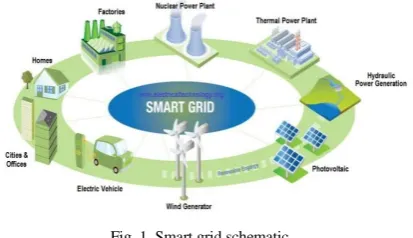
This paper gives an overview of the smart grid with its technical elements, advantages, and major challenges encountered. The intent is to create greater public knowledge about the smart grid by elaborating the effect, the smart grid system will have, on the electric power system as well as society. This will be highlighted, through the discussion of research, found on the technological and economic impacts of a smart grid system. A schematic of a typical smart grid is shown in Figure 1.
This paper includes materials from studies performed by research groups including: The National Institute of Standards and Technology (NIST), Electric Power Research Institute (EPRI), National Energy Technology Laboratory (NETL), and North American Electric Reliability Corporation (NERC). Various high-quality research papers as well as information
and presentations given by Government agencies, especially of the U.S., including the Department of Energy (DOE) were also used in enhancing this paper.
Fig. 1. Smart grid schematic
II. COMPONENTS OF SMART GRID
The Smart Grid is comprised of three elements that work in cohesion to provide efficient and reliable energy. The complex interconnectivity of communication, computational, and new emerging devices will be discussed in this section. Technological advances and improved monitoring systems help in continuing to improve the electric power grid [2-5].
A. Demand Response and Advanced Metering Continuous supply of power is one of the key objectives of the Smart Grid. This is the need of the hour with continually growing demand on the power system and the requirement for enhanced reliability. Due to characteristically interconnected and interdependent nature of the grid, enhancing wide area monitoring and situational awareness is essential to attain this aim. A fault at a specific location in the power system can swiftly change into an extensive problem, with catastrophic results. Wide Area Situational Awareness (WASA) is the design of technologies to augment the monitoring of the power network across large areas. This successfully allows power system operators with a vast and consistent scenario of the entire functioning grid.
load times. Demand response can significantly reduce peak load by using the relationship between energy price and energy need for the consumer and producers benefit.
Advanced Metering Infrastructure (AMI) permits utilities to collect, monitor, and examine energy consumption data for grid management, line or generator outage notice, and billing purposes using bidirectional communication links. Although, Automatic Meter Reading (AMR) already exists, it only utilizes unidirectional communication to achieve meter reading chiefly for billing functions. AMI can be improved to deliver consumers with historical energy consumption data, contrasts of energy use throughout the day, real-time cost information, and enhancement of energy consumption during peak load times. Although a valuable consumer asset, AMI networks require a momentous investment and have yet to be implemented in most consumer-based applications.
Some researchers have briefly reviewed the data transmission methods. These methods are mostly used in cell phones, hardware processing of personal computers, remote monitoring, and sporadic measurements. The data transmission intensity can be increased using data transmission methods. This process refers to a new research on secure, efficient, and reliable communications issues. Broadband over Power line (BPL) technology can be considered as one of the data transmission methods for AMR in terms of data rate and data transfer distance. With the spread of the internet network, connection of Wi-Fi-based Wireless Sensor Networks (WSN) and the AMR system is bound to advance.
B. Cyber Security
The smart grid is a digital system that depends on the use of information technology that must transfer data securely throughout the grid. Although, electrical utilities have been applying cyber security devices into their operations since last twenty years, recent cyberattacks and acts of terrorism around the world have led to a larger emphasis being placed on cyber security for digital devices. Cyber security is a vital section of the smart grid, as it includes the protection of information that can be confidential, while also protecting the integrity of the digital part of the smart systems. The Smart grid will unceasingly monitor itself to sense insecure circumstances that could affect its high reliability and benign operation. Cyber security will be incorporated into all systems, including physical, to ensure the protection of sensitive and vital data from all users and customers.
C. Communication Technologies
The continuing advancement of communication technology has allowed for improvements in the electric grid that have led to the creation of the smart grid. Improvement in communication and monitoring devices allow electrical grids to be more advanced with better response than they have ever been before. The focus of this subsection will be on the main types of communication devices found in a typical smart grid system.
Global System for Mobile communications (GSM) is the standard which most cell phones use in Europe. This technology is gradually growing in other parts of the world, with over 2 billion people currently using this form of system. Most GSM networks use 900 MHz and 1800 MHz but in the United States, the 850 MHz and 1900 MHz frequency ranges are common. This technology has the capability to be used on mobile monitoring devices to communicate using the internet just like a mobile phone.
General Packet Radio Service (GPRS) is a system used to transmit data at speeds up to 60 Kbits per second. GPRS is a well-applied system that is quite dependable for standard mobile data exchange and suits most moderate data needs. Once connections and settings are established, the network can be used, without further adjustments to the system or communication devices.
Exchanged Data rates for GSM Evolution (EDGE) is a fresh advancement, based on the GPRS system, and has been categorized as a '3G' standard, since it can run at up to 473.6 Kbits per second. If a smart grid system is compatible with EDGE, it can be applied to large data transmission such as receiving large amount of power flows. To use EDGE, source and load sites must be adapted to receive transmissions of this type. High Speed Downlink Packet Access (HSDPA) is a technology, based on the 3G network, which can support speeds of up to 7.2 Megabits per second.
Another technology, which plays an important role in smart grids, is ZigBee. ZigBee is an IEEE 802.15.4-based specification, for a combination of high-level communication protocols, used to create personal area networks, with small, low-power digital radios, such as for automation functions. The technology is designed to be cheap than other wireless personal area networks (WPANs), such as Bluetooth or Wi-Fi. Applications include wireless light switches, electrical smart meters with in-home-displays, and traffic management systems.
The main deciding factors for using the above-mentioned technologies are cost, required function, and overall accuracy, reliability, and quality of power system.
D. System Technologies
Smart grid system technological advances, brought on mainly through the advancement in embedded systems and microprocessors, have allowed for smaller, more accurate devices to be used in monitoring the usage and flow of electricity on the electric grid. These newly developed devices allow the producers and consumers to provide and use energy in a more efficient and reliable way.
that is adapted to its specific requirement, while also refining power network reliability and security. FACTS, give a network, the ability to increase power transfer over long power lines and lessen active power oscillations. This gives power companies the ability to efficiently use their present transmission networks, considerably upsurge the obtainability and reliability of their networks, and consequently, increase transient stability. Some common examples of FACTS are static compensator (STATCOM), static VAR Compensator (SVC) and silicon-controlled rectifier (SCR)-controlled series reactance.
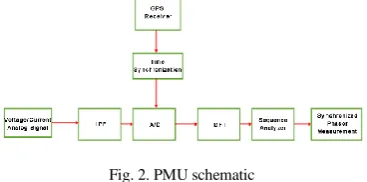
Phasor Measurement Units (PMUs) are devices which measure the electrical waves on an electrical grid using a common time source for synchronization. Time synchronization permits synchronized real-time measurements of many remote measurement points on the system. The resulting measurement is called a synchro phasor. PMUs are normally incorporated into protective relays. A schematic block diagram of a PMU is shown in Figure 2 [6]. The analog AC waveforms are digitized by an analog-to-digital converter for every phase. A phase-locked oscillator, along with a GPS reference source, delivers the required high-speed synchronized sampling. The result is a time tagged phasor that can be transmitted at rates up to 60 samples per second. PMUs can measure voltages and currents on critical locations of a power network and can output precisely time-stamped voltage and current phasors. This information can be utilized to evaluate system conditions like changes in frequency, active and reactive powers, line voltages, line contingencies and other useful information desired by the operator. PMU technology can enhance power economics, by allowing augmented power flow over existing lines, instead of having to create new, more efficient lines. Consequently, transmission line bottleneck will be improved throughout the electrical grid.
Fig. 2. PMU schematic
A simple block diagram for arrangements of PMUs in a smart power system is shown in Figure 3.
Fig. 3. PMU arrangement in a smart power system
III. IMPACTS AND CHALLENGES OF SMART GRIDS
The implementation of smart grid comes with a wide range of advantages and challenges that vary depending upon social, political, and environmental views of the consumers and shareholders of companies trying to implement the smart grid. This section will elaborate the impact and challenges faced by smart grids in the following crucial areas: social, economic, environmental, and technical [7-11].
A. Social Impact
Consumer electrical usage is changing as society is becoming digital due to an increase in energy consumption by consumer electronics. Residential sectors are expected to see the largest amount of load growth. This trend is influencing electric service providers to move towards smart grids that will provide uninterrupted and highly reliable power. In the U.S., present day electric service outages range from 90 to 214 minutes, on average, per year. Smart grid technology, reduces these outages, using self-healing grids which are important due to the growth of modern economies that are largely reliant upon computers and information technologies. The impact of the smart grid that will first be noticed by consumers and society is the ability to participate in smart grid programs that in the long-term benefit all of society and the overall creation of the smart gird. Smart grid gives more control to the consumer. The consumer can choose where, when, and how they get their electrical energy. This motivates consumers to incorporate renewable energies, which in turn greatly alleviates the energy burden of non-renewable sources (coal, oil, gas etc.) Society will greatly benefit from an increase in choices allowing for more consumer input and control in the advancement of the energy sector.
B. Economic Impact
dollars will be earned. One of the main concerns, along with the high cost, required in the implementation of the smart grid, is that over one-half of the 500,000 utility workers in the United States will be eligible to retire in the next five years. This will create a vacuum of talent and experience, creating a need to replace a highly trained and motivated work force. This poses to create problems in the application of smart grid technology as having work forces that lack experience can cause major delays and increased costs associated with improving the power grid. Although, smart grid systems will incur an expensive initial investment that many investors must pay for, the impact of a smart grid system economy will far outweigh the initial costs. The key concern in the economic impact of a smart grid system will be whether the investors and market will allow companies to move towards a smarter electrical system.
C. Environmental Impact
The smart grid helps to facilitate an improved environment by reducing greenhouse gases and other pollutants. Reduced amount of greenhouse gas means less global warming and acid rain. Smart grids reduce emissions by reducing the use of inefficient generating sources, such as certain forms of fossil-fuel-powered plants. The smart grid provisions the use of renewable energy, including consumers owning their own generating devices, and creates an opportunity to store and sell excess energy back to the grid. The smart grid will also allow the eventual replacement of fossil fuel powered vehicles with electric vehicles, further reducing emissions. According to EPRI, the smart grid combined with a portfolio of generation and end-user options, could decrease overall CO2 emissions by 58%, relative to 2005 emissions, by 2030. Emission reductions from the smart grid are predicted to be 60 to 211 million metric tons of CO2 per year in 2030 [12].
The ability of smart grids to deliver energy in a more efficient manner, by reducing energy losses, and its ability to motivate users, to use less energy, makes it an ideal platform, to be used with green energy. Through the improvement of transmission and energy storage devices, the future electric grid will be able to store energy from devices such as solar panels and wind turbines and evenly distribute the power when needed. Improved efficiencies in the electric grid will also lower the environmental impact of producing electricity by lowering the losses in an electric system. Although, the price of green energy has been declining in recent years, as improvements in technology and regulations on fossil fuels have been enacted, the current price of green energy is still more expensive than traditional fossil fuel generated power. The cost of green energy and the overall lack of knowledge from the public have slowed the advancement of green energy and smart grid systems. The implementation of a smart grid system will positively impact the environment and will encourage the use of green energy sources. The environmental impacts of smart grid systems go far beyond money value as there cannot be a price tag put on the value of cleaner air and a healthy planet.
D. Technical Impact
The smart grid improves the reliability and efficiency of the electrical system. It keeps the user informed, who can modify the way, they consume and purchase electricity. Through this ability to choose, the consumer can help to drive new technologies and markets by making sure their money is used on innovative technologies and in ways that benefit themselves.
The smart grid creates the ability to accommodate all generation and storage options. It gives the consumer the ability to get their energy from large centralized power plants, like the ones that are currently used in today’s power grid, or produce and store their own power from things such as home solar panels or wind farms
E. Challenges Faced by Smart Grids
The smart grid system is a complex system that faces a wide array of challenges. Smart equipment such as Intelligent Electronic Devices (IEDs) will require robust amounts of embedded computing equipment that must be replaced every 5–10 years. Along with the vigorous computing systems, the communications technologies being implemented in smart grid systems are at different levels of development and implementation. This further produces issues as to what devices will be best suited for the long-term future of the smart grid system. Management of all the data that will be communicated is another challenging aspect of future smart grid systems. The management of data is an extremely time-consuming process that is made further complicated through the immense scale of a smart grid system. Another issue with adoption of smart grid technology seems to be an absence of awareness by people involved in designing smart grid systems at a high level and an absence of consistent regulatory guidelines. The present electrical network consists of numerous distributed nodes which are strongly coupled. Since all network components have organically grown over years, finding out where intelligence needs to be placed is quite complicated. Another main issue is to integrate substitutable components from various distinct providers. There is a dire requirement for interoperability standards that will permit utilities to purchase components from any retailer knowing that they will work with each other and with present equipment at all possible levels.
IV. DISCUSSION AND RESULTS
soon. Along with Solar-City and Tesla, many utilities have found that by switching to smart meters they are wasting less electricity and are providing a better-quality product to their customers. In the future, the challenges of cyber security and reliability requirements of the smart grid must be analyzed. Moreover, the impact of smart meter data collection and renewable generation integration needs to be researched. Suitable approaches for analysis, such as Dynamic Game Theory should be incorporated in the future analysis. Some pertinent and up-to-date work related to these challenges can be found in [14]- [19]. Probabilistic approaches must be considered for analyzing smart grid systems as uncertainty in power systems is constantly on the rise [20].
CONCLUSION
This research paper focused on the importance of smart grids in electric power systems. The main concepts of the smart grid, as well as the benefits and challenges were discussed. The goal of the paper is to leave the reader seeing the importance of the smart grid system and how its advancement improves the present state of electric power systems. The smart grid is not just about utilities and technologies; it is about giving the consumer, the information, and tools, they need to make choices about their energy usage. Smart meters will allow the users to monitor their energy usage. Incorporated with real-time pricing, this will let them to save money by using reduced power when electricity is most expensive. The smart grid system relies heavily on constantly changing and improving technology. Many issues facing the smart grid must be handled through the improvement of current technologies or the creation of new technologies that have yet to be discovered. A possible future research work can be to investigate the protection of smart grid under various faults. Figure 4 depicts this suggested work. A digital camera can be used to monitor the state of system. Depending on fault type and duration, the information from camera, in the form of audio, video and image can be sent to automated device to trip. The results can be compared with the scenario under the protection analysis of conventional grid (not smart).
Fig. 4. Suggested future work for smart grid [6, 13]
REFERENCES
[1] Bayindir, R, Colak, I. and G. Fulli. Smart Grid Technologies and Applications. Renew. Sustain. Energy Rev. 2016; 66(1); 499–516.
[2] Bharothu, J.N., Sridhar, M., and Rao, R.S. A Literature Survey Report on Smart Grid Technologies. International Conference on Smart Electric Grid, Guntur: 2014, p. 1-8. [3] Bigerna, S., Bollino, C.A. and Micheli, S. Socio-economic
Acceptability for Smart Grid Development – A Comprehensive Review. J. Clean. Prod. 2016;131; 399–409.
[4] Kolokotsa, D. The Role of Smart Grids in The Building Sector. Energy Build. 2016; 116; 703–708.
[5] Lakshminarayana, S. Smart Grid Technology & Applications. Power and Energy Systems Conference, Bangalore: 2014, p. 1-6.
[6] Shahzad, U. and Asgarpoor, S. A Comprehensive Review of Protection Schemes for Distributed Generation. Energy and Power Engineering, 2017; 9(8); 430–463.
[7] Ming, Z., and Kelei, H. The Future Development of Smart Grid in China. 8th Int. Conf. Intell. Comput. Technol. Autom. Beijing: 2015, p. 1-9.
[8] Shomali, A. and Pinkse, J. The Consequences of Smart Grids for The Business Model of Electricity Firms. J. Clean. Prod. 2016;112(5); 3830–3841.
[9] Tuballa, M.L. and Abundo, L.M. A Review of the Development of Smart Grid Technologies. Renew. Sustain. Energy Rev. 2016; 59; 710–725.
[10] Zikalala, D.P. and Chowdhury, P.S.P. Prospects, and Challenges of Implementing Smart Grid Technologies in South Africa. International Conference on Renewable Power Generation. Beijing: 2015, p. 1-5.
[11] Smart Grid Consumer Benefits (Accessed 20 Dec. 2019). Available at http://www.whatissmartgrid.org/smart-grid-101/consumer-benefits
[12] Shahzad, U. Global Warming: Causes, Effects and Solutions, Durreesamin Journal. 2015; 1(4); 1-7.
[13] Shahzad, U., Kahrobaee, S. and Asgarpoor, S. Protection of Distributed Generation: Challenges and Solutions, Energy and Power Engineering, 2017; 9(10); 614–653.
[14] Markstenier, S., Vallant, H., and Nahrgang, K. Cybersecurity Requirements Engineering for Low Voltage Distribution Smart Grid Architectures Using Threat Modeling, Journal of Information Security and Management. 2019; 49; 1-16. [15] Dezaki, H., Hariri, A., and Hejazi, M.A. Impacts of Load
Modeling on Generalized Analytical Reliability Assessment of Smart Grid under Various Penetration Levels of Wind/Solar/Nonrenewable Distributed Generations.
Sustainable Energy, Grids, and Networks. 2019; 20; 1-16. [16] Yen, S.W., Morris, S., Ezra, M.A.G., and Huart, T.J. Effect of
Smart Meter Data Collection Frequency in an Early Detection of Shorter Duration of Voltage Anomalies in Smart Grids.
International Journal of Electrical Power and Energy Systems. 2019; 109; 1-8.
[17] Worighi, I., Maach, A., Haafid, A., Hegazy, O., and Mierlo, J. V. Integrating Renewable Energy in Smart Grid System: Architecture, Virtualization and Analysis. Sustainable Energy, Grids, and Networks. 2019; 18; 1-13.
[18] Li, Z., Liu, Y., and Xin, R. A Dynamic Game Model for Resource Allocation in Fog Computing for Ubiquitous Smart Grid. Wireless and Optical Communications Conference: 2019, p. 1-5.
[19] Ellery, M.L., Ndawula, M.B., and Hernando, I. Reliability Enhancement of LV Rural Networks using Smart Grid Technologies. International Conference on Smart Energy Systems and Technologies: 2019, p. 1-5.
[20] Shahzad, U. and Asgarpoor, S. Probabilistic Evaluation of Line Loading and Line Active Power in an Active Distribution Network using Numerical and Analytical Approaches. North American Power Symposium: 2018, p. 1-6.
AUTHOR’S PROFILE
![Fig. 4. Suggested future work for smart grid [6, 13]](https://thumb-us.123doks.com/thumbv2/123dok_us/7805443.2084978/5.595.102.291.561.640/fig-suggested-future-work-smart-grid.webp)
