1
I n t r od u c t io n
to T e a m - b a s e d
Organizations
He makes tools (and does so within more than one technical tradition), builds shelters, takes over natural refuges by ex-ploiting fire, and sallies out of them to hunt and gather his food. He does this in groups with a discipline that can sustain complicated operations; he therefore has some ability to exchange ideas by speech. The basic biological units of his hunting groups probably prefigure the nuclear family of man, being founded on the institutions of the home base and a sexual differentiation of activity. There may even be some complexity of social organiza-tion in so far as fire-bearers and gatherers or old creatures whose memories made them the data banks of their ‘societies’ could be supported by the labour of others. There has to be some social organization to permit the sharing of co-operatively obtained food, too. There is nothing to be usefully added to an account such as this by pretending to say where exactly can be found a prehistorical point or dividing line at which such things had come to be, but subsequent human history is unimaginable without them.
J.M. Roberts (1995). The History of the World.
Harmondsworth, UK: Penguin, p. 18
The activity of a group of people working cooperatively to achieve shared goals via differentiation of roles and using elaborate systems of communication is basic to our species. The current enthusiasm for team working in organizations reflects a deeper, perhaps unconscious, recognition that this way of working offers
the promise of greater progress than can be achieved through individual endeavour or through mechanistic approaches to work. This is the way we have always lived, loved and worked. We have raised our young in groups, hunted wildebeest, built our cities and grown and harvested our crops, largely in groups with, as Roberts says, a discipline that can sustain the complicated process of team working.
To live, work, and play in human society is to cooperate with others. We express both our collective identity and our indi-viduality in groups and organizations. Our common experiences of living and working together bind us with each other and with our predecessors. Today we face new demands that make cooperative work in teams more vital and more challenging. To meet the pressures of the global marketplace, organizations are moving away from rigid, hierarchical structures to more organic, flexible forms. Teams are developing and marketing products, solving production problems, and creating corporate strategy. Managers are experimenting with participation, high-commitment organizations, self-managing work teams, labour–management cooperation, and gain-sharing programmes. These innovations, though they have different backgrounds, all involve the explicit use of teams to accomplish central organizational tasks. The team rather than the individual is increasingly considered the basic building block of organizations.
Teamwork is spilling out across organizational and national boundaries. Many manufacturers form teams with suppliers to boost quality, reduce costs and assure continuous improve-ment. International alliances are becoming the accepted way to participate in the global marketplace. American and Japanese automakers and other traditional competitors have developed a wide variety of cooperative strategies. Increasingly, people with different organizational and national loyalties from diverse cultural backgrounds and unequal status are asked to work together. And teams from commercial organizations are linking with those from universities to develop exciting, useful and radical innovations.
In this book, we outline not so much how to build effective teams – there are many books that address this issue – but rather how to build organizations that are structured around teams. This is because, in contrast with the wealth of advice on teambuilding and teamworking, there is astonishingly little guidance or advice to managers on how to build team-based
organizations. The overall challenge is to answer the question: how can we build organizations that ensure the effectiveness of work teams and of their organizations? This book provides a synthesis of know-ledge about how to build organizations that are team-based rather than individually based, with a clear focus on the psychological and social processes and emerging relationships that can facilitate or obstruct successful teamwork across organizations. The book is based on evidence gathered by the authors over 20 years through practical management experience, research work in organizations, and consultancy experience across the public (e.g. health care), manufacturing and service sectors in helping to introduce team-based working (TBW).
The book has six main sections describing the six main stages of developing TBW in an organization. Chapters 2–7 follow a common structure. The aims and activities of each of the stages are described and then appropriate support materials and tools are provided. The CD accompanying this book provides these materials in a format in which they can be downloaded for use by managers and consultants intent on introducing TBW in their organizations.
1.1
The Six Stages of TBW
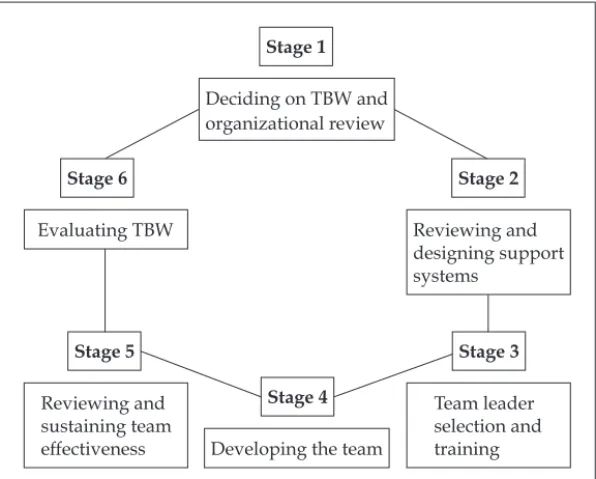
The six stages of TBW are:
1 Deciding on TBW: understanding the value and benefits of TBW and conducting an organizational review. Before introducing TBW it is important to understand the existing structure, culture and extent of team working in the organ-ization. This stage also involves developing a plan for the implementation of TBW.
2 Developing support systems: this stage requires an examination of support systems relevant to TBW such as training, reward systems, communication, and interteam relations, and making plans to adapt or develop them for TBW.
3 Team leader and team member selection: establishing criteria for team leader and team member selection and implementing appropriate recruitment and selection processes. Team leader training is important – leading teams is very different from other kinds of leadership so team leaders need to be equipped with the necessary knowledge skills and attitudes.
4 Developing effective teams: understanding and enabling the team development process, which includes clarifying objectives, roles, communication processes and decision-making processes. 5 Reviewing and sustaining team effectiveness: in this stage, teams must be coached to set criteria for the evaluation of team performance and to identify required changes to improve performance.
6 Reviewing TBW: The final stage involves evaluating the contribution of TBW to the organization’s effectiveness and making any necessary changes to ensure the continued and optimal contribution of TBW to the organization.
The six-stage model illustrated in Figure 1.1 will be used throughout the book as a route map of the journey of introduc-ing TBW in your organization.
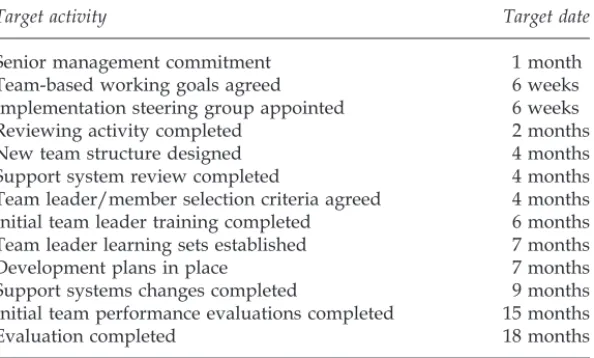
The introduction of TBW is a journey along which there are key milestones. These are listed in Table 1.1 along with some indication of the likely minimum time from the start date of the TBW change process by which each milestone could have been reached.
Figure 1.1 The six-stage model of TBW Stage 6 Evaluating TBW Stage 1 Deciding on TBW and organizational review Stage 2 Reviewing and designing support systems Stage 5 Reviewing and sustaining team effectiveness Stage 3 Team leader selection and training Stage 4
Table 1.1 Key milestones in the TBW process
Target activity Target date
Senior management commitment 1 month
Team-based working goals agreed 6 weeks
Implementation steering group appointed 6 weeks
Reviewing activity completed 2 months
New team structure designed 4 months
Support system review completed 4 months
Team leader/member selection criteria agreed 4 months
Initial team leader training completed 6 months
Team leader learning sets established 7 months
Development plans in place 7 months
Support systems changes completed 9 months
Initial team performance evaluations completed 15 months
Evaluation completed 18 months
1.2
Managing Expectations
and Timescales
Introducing TBW into an organization is not a ‘quick fix ’. The process of introducing TBW requires deep and wide-ranging changes within the organization. Achieving these changes takes time and you should expect that their initial implementation will take at least one year, and that ensuring that the changes are firmly bedded down within the organization will take at least two years. TBW requires a change of structure – for example, changing the way people work with each other, share information and make decisions – and also a change of culture. In addition, working in teams requires different knowledge, skills and attitudes. That is why many different groups within the organization will be affected by the team development process. Managers should therefore plan to involve a considerable number of staff members in this process, and not simply the top management team.
What does it mean to be the leader of this change process? It requires that the leader has a thorough knowledge in advance of the contents of all the modules, and that he or she has studied the map of the journey very carefully before embarking on the process of introducing TBW. The leader should have the backing and the confidence of the top management team in the organiza-tion. The leader of the change process will have to manage and
tolerate the conflict, resistance and pain associated with the intro-duction of such a major change within the organization. To achieve this, the leader needs to have a strongly held and positive vision of the value of the process. The leaders of the change should also consider from where they will draw their support, and this should include the members of the top management team.
Because the process of introducing TBW into the organization will be challenging and complex, it is important to keep a detailed log of progress, both to monitor the process and to enable the change manager or leader to communicate effectively about the process with the various groups which participate in the training sessions. The more information that you record in this way, the easier it will be for you to brief each of the groups which particip-ate in the training sessions. Communication is a key part of the process of introducing TBW and the more able you are to fully inform those participating in training sessions as well as staff members throughout the organization about information gathered and decisions made, the smoother will be the journey towards the full implementation of TBW. Moreover, should it be necessary to involve new members of the senior management team, you will be in a position to brief them adequately because you have kept a comprehensive and accurate log and checklist of informa-tion during the process.
1.3
Failures of TBW
At this point it is useful for you to be alerted to the main failings in attempts to introduce effective TBW in organizations. These are outlined below.
Teams without tasks
The only point of having a team is to get a job done, a task completed, a set of objectives met. Building teams simply to have teams is likely to damage organizational functioning and encourage conflict, chronic anger and disruption of the organiza-tion. Moreover, the tasks that teams perform should be tasks that are best performed by a team. Painting the hull of a supertanker does not require painters to work interdependently and in close communication over decisions. Each of those involved in the painting simply needs to know which is his or her bit of hull. Navigating the tanker out of a port is likely to require teamwork,
as is doing a refit on the engines. Football teams are called teams since they are required to work interdependently, to commun-icate constantly, to understand each other’s roles, and to collect-ively implement a strategy in order to achieve their goals. Teams need team tasks to be of any value. This topic is addressed in detail in Chapter 5.
Teams without freedom and responsibility
Creating teams and then failing to give them the freedom and authority to make the decisions that allow them to accomplish their tasks in the most effective way is a little like teaching some-one to ride a bicycle, giving them a fancy road racing bike and then telling them they can only ride it in their bedroom. Yet in many organizations we see precisely this – teams are created but they are not given the power to make decisions, implement them and bring about radical change. Moreover, the number of layers in the organizational hierarchy barely changes. Consequently, expectations are not met and team members lose faith in the concept of teamwork other than as a comfortable idea about how we can all be supportive to each other. This is a major failing in many organizations that do not recognize that the greater danger is to give too little freedom and responsibility to teams rather than too much. We examine these issues in depth in Chapter 5.
Organizations deeply structured around individual work
Teams are set up in many places in the organization but all of the systems are geared towards managing individuals. This is like deciding to plant seedlings in your garden but still preparing the bed as though you were growing potatoes. The seedlings are unlikely to survive. Creating team-based organizations means radically altering the structure, the support systems and the culture. Instead of the focus being on the management of indi-vidual performance, as it is in most organizations, the focus is determinedly on the functioning of teams, and how to ensure their effectiveness. Teams look after the individuals while the organization enables the teams. These are the issues which we deal with throughout this book but it is helpful to note here that a team-based organization looks very different from a traditional
hierarchical organization and that the concept of a traditional organizational chart is not relevant. The structure is more like a solar system with planets as teams that have orbits in relation to other teams and particularly in relation to the central planet that is the leadership team.
Team dictators not leaders
Team leadership is very different from traditional supervision. Supervisors are often directive rather than facilitative and advice-giving rather than seeking. They seek to determine rather than integrate views and play a directive rather than a supportive role. The function of a leader of teams is very different – it is to ensure that the team profits optimally from its shared know-ledge, experience and skill. Yet many organizations that introduce team working nominate supervisors or traditional managers as leaders rather than those with the skills and attitudes and styles that are most appropriate to team leadership.
Strong teams in conflict
Finally, even when effective teams have been developed there is a major threat to the effectiveness of TBW. If, from the very beginning, efforts, systems and processes are not put in place to ensure interteam cooperation and support, the teams can become rigidly defended silos. Cohesive effective teams may become more competitive and discriminatory in relation to other teams precisely because they have been developed so effectively. So good TBW ensures that norms of interteam cooperation are established from the beginning and reinforced throughout the process. We examine these issues in depth in Chapter 3.
Despite these failures, we see many examples internationally of successful TBW, and their success as organizations in terms of productivity, profitability, staff retention and well-being is simply and powerfully inspiring. Each offers clear reasons why organ-izations should embark on the journey towards TBW and ensure they foresee and skirt the obstacles we have described above.
Chapter 2 begins the TBW journey by examining basic issues about TBW before offering a diagnostic strategy for organizations and guidelines for planning the implementation of TBW.