Legislative Audit Bureau
n
Report 15-16November 2015
Local Government
Property Insurance Fund
Report 15-16 November 2015
Local Government
Property Insurance Fund
Office of the Commissioner of Insurance
Joint Legislative Audit Committee Members
Senate Members: Assembly Members:
Robert Cowles, Co-chairperson Samantha Kerkman, Co-chairperson
Mary Lazich John Macco
Alberta Darling John Nygren
Kathleen Vinehout Melissa Sargent
Report 15-16 November 2015 State Auditor Joe Chrisman Special Assistant Anne Sappenfield
Deputy State Auditor for Financial Audit
Bryan Naab Team Leader Emily Pape Auditors Amanda Murkley Kimberly Olson Eric Sippel Stephanie Yost Publications and Design Coordinator Susan Skowronski
LEGISLATIVE AUDIT BUREAU
The Bureau is a nonpartisan legislative service agency responsible for conducting financial and program evaluation audits of state agencies. The Bureau’s purpose is to provide assurance to the Legislature that financial transactions and management decisions are made effectively, efficiently, and in compliance with state law and that state agencies carry out the policies of the Legislature and the Governor. Audit Bureau reports typically contain reviews of financial transactions, analyses of agency performance or public policy issues, conclusions regarding the causes of problems found, and recommendations for improvement.
Reports are submitted to the Joint Legislative Audit Committee and made available to other committees of the Legislature and to the public. The Audit Committee may arrange public hearings on the issues identified in a report and may introduce legislation in response to the audit recommendations. However, the findings, conclusions, and recommendations in the report are those of the Legislative Audit Bureau.
The Bureau accepts confidential tips about fraud, waste, and mismanagement in any Wisconsin state agency or program through its hotline at 1-877-FRAUD-17.
For more information, visit www.legis.wisconsin.gov/lab.
Contact the Bureau at 22 East Mifflin Street, Suite 500, Madison, Wisconsin 53703;
CONTENTS
Letter of Transmittal 1
Introduction 3
Financial Status 4
Net Position 7
Internal Control Issues 8
Events Subsequent to June 30, 2014 9
Audit Opinion 11
Management’s Discussion and Analysis 17
Financial Statements 31
Statement of Net Position
as of June 30, 2014, June 30, 2013, and June 30, 2012 32
Statement of Revenues, Expenses, and Changes in Fund Net Position
for the Years Ended June 30, 2014, June 30, 2013, and June 30, 2012 33
Statement of Cash Flows
for the Years Ended June 30, 2014, June 30, 2013, and June 30, 2012 34
Notes to the Financial Statements 37
Required Supplementary Information 49
Ten-Year Claims Development Information 51
Auditor’s Report 53
November 20, 2015
Senator Robert Cowles and
Representative Samantha Kerkman, Co-chairpersons Joint Legislative Audit Committee
State Capitol
Madison, Wisconsin 53702
Dear Senator Cowles and Representative Kerkman:
As required by s. 13.94 (1) (de), Wis. Stats., we have completed a financial audit of the Local Government Property Insurance Fund, which is administered by the Office of the Commissioner of Insurance (OCI) and provides property insurance to counties, cities, towns, villages, school districts, and other units of local government. We conduct this audit at least once every three years. We have provided an unmodified opinion on the Property Fund’s financial statements for the fiscal years (FYs) ended June 30, 2014, June 30, 2013, and June 30, 2012. However, we note that the Property Fund is involved in a lawsuit with an excess-of-loss provider related to a $20.0 million loss at the Milwaukee County Courthouse. If the Property Fund does not prevail in the lawsuit, the Property Fund’s net position may decline. We also note that OCI did not take steps to address our prior internal control concerns related to maintaining claims documentation in an orderly manner and applying aggregate deductibles. Further, we identified noncompliance with statutes related to assessing interest on past-due premiums. OCI indicates our concerns in these areas either have been or will be addressed.
As of June 30, 2014, the Property Fund insured $51.9 billion in property owned by 983 units of local government. The Property Fund’s net position as of June 30, 2014, was a deficit of $703,000. Throughout FY 2014-15, and subsequent to the end of our audit period, the Property Fund’s net position continued to decline, and OCI estimates the deficit was $5.9 million as of June 30, 2015. In September 2015, the Property Fund’s cash was depleted and it borrowed $2.0 million from the General Fund, as required by statute. We recommend that OCI report certain information to the Joint Legislative Audit Committee by July 8, 2016, after which we will provide an interim update to the Legislature on the financial condition of the Property Fund.
We appreciate the courtesy and cooperation extended to us by OCI staff and the private contractors responsible for administration of the Property Fund.
Respectfully submitted,
Joe Chrisman State Auditor JC/BN/ss
3
The Local Government Property Insurance Fund (Property Fund), which is administered by the Office of the Commissioner of Insurance (OCI), was established in 1979 to insure government properties not owned by the State. It was created from the former State Property Insurance Fund, which made insurance coverage available to
counties, cities, towns, villages, school districts, and library boards in 1911 and 1913, when it was difficult for these units of government to obtain reasonably priced coverage in the private sector.
OCI assigns one full-time employee to work with contractors that provide services for the Property Fund and to answer technical questions raised by contractors and policyholders. In addition, during our audit period, two OCI committees provided guidance in managing the Property Fund: the Advisory Committee, which consisted of representatives of participating units of local
government; and the Oversight Committee, which consisted of OCI staff and representatives of the Advisory Committee. In September 2015, these committees were temporarily suspended while being reorganized into a single committee.
The Property Fund makes property insurance available for local government property such as municipal buildings, schools, libraries, and motor vehicles. It covers property losses except, among other things, those resulting from flood, earthquake, wear and tear, extremes in temperature, mold, war, nuclear reactions, and
embezzlement or theft by an employee. Examples of covered property losses include large-scale wind damage to a building and minor accidental damage to a car. The Property Fund does not advertise or pay sales commissions to insurance agents and does not actively
Introduction
The Local Government Property Insurance Fund was created from the State Property Insurance Fund in 1979.
As of June 30, 2014, the Property Fund insured $51.9 billion in property owned by 983 units of local government.
Financial Status Net Position Internal Control Issues Events Subsequent to June 30, 2014
4
INTRODUCTIONsolicit business. Units of local government generally become aware of the Property Fund by word of mouth or from information available on OCI’s website. As of June 30, 2014, the Property Fund insured $51.9 billion in property owned by 983 units of local government, as shown in Table 1.
Table 1
Number of Policyholders by Unit of Local Government
As of June 30 Governmental Unit 2012 2013 2014 Counties 71 70 69 Cities 154 134 128 Towns 176 167 161 Villages 260 247 242 School Districts 295 274 252 Other 129 129 131 Total 1,085 1,021 983 Insurance in Force (in billions) $51.2 $53.3 $51.9
Enrollment in the Property Fund declined from 1,085 units of local government as of June 30, 2012, to 983 as of June 30, 2014, or by 102. Factors that may have affected enrollment during our audit period include the availability of other insurance options in the market and increasing Property Fund premiums. Generally, the value of
insurance in force increased during our audit period due to inflation and new construction. However, some of this increase was offset as some units of local government left the Property Fund.
Financial Status
Units of local government that enroll in the Property Fund pay annual premiums based on the value of their insured property. When net premiums and other revenues exceed net losses and other expenses, the Property Fund’s net position increases. When net losses and other expenses exceed net premiums and other revenues, the Property Fund’s net position decreases. Ideally, the Property Fund’s net position would be sufficient to ensure resources are available when unexpectedly large losses or a series of losses occur. If the Property Fund’s cash balance becomes insufficient to pay
INTRODUCTION
5
claims, the Department of Administration must transfer from the General Fund, as provided under s. 605.30, Wis. Stats, an amount sufficient to pay the claims. The Property Fund must repay the General Fund as soon as cash is available.
From fiscal year (FY) 2004-05 through FY 2008-09, net premiums and other revenues exceeded net losses and other expenses in all years, except FY 2007-08, as shown in Figure 1. As a result, the Property Fund’s net position, previously referred to as net assets, increased from $34.5 million at the end of FY 2004-05 to $41.2 million at the end of FY 2008-09. Figure 1 Net Position As of June 30 (5,000,000) 0 5,000,000 10,000,000 15,000,000 20,000,000 25,000,000 30,000,000 35,000,000 40,000,000 $45,000,000 2005 2006 2007 2008 2009 2010 2011 2012 2013 2014
6
INTRODUCTIONIn recognition of the increasing surplus balance and challenging economic conditions during the last recession, the Legislature
considered the establishment of a premium holiday for policyholders. In response, the Commissioner of Insurance declared a one-time $12.0 million dividend in FY 2009-10. As a result, the Property Fund’s net position declined.
After the $12.0 million dividend was declared, significant insurance losses occurred in FY 2010-11, FY 2011-12, and FY 2013-14. As a result, net losses and other expenses significantly exceeded net premiums and other revenues, and the Property Fund’s net position further deteriorated.
Net losses reached a high of $30.8 million in FY 2013-14. Several fire-related losses contributed significantly to this amount, including a loss resulting from a fire at the Milwaukee County Courthouse in July 2013. As of September 30, 2015, this loss was estimated to be $20.0 million. The Property Fund maintains excess-of-loss insurance to limit its exposure in such circumstances. For this loss, the Property Fund paid a deductible of $1.8 million and received $5.0 million during FY 2013-14 from the excess-of-loss provider.
OCI expects to be reimbursed by the excess-of-loss insurance provider for most of the remaining amount. However, there is a dispute as to the cause of the loss and regarding approximately $12.4 million paid by the Property Fund to Milwaukee County. Also, approximately $500,000 paid in loss adjustment expenses has not been reimbursed by the excess-of-loss provider. The Property Fund filed a lawsuit against the excess-of-loss provider in state court seeking recovery of these amounts. The lawsuit has since been moved to federal court. Although OCI staff believe the State will prevail, an estimate of the amount, if any, not collectible from the excess-of-loss provider is not available and will not be available until the lawsuit is resolved. The Statement of Net Position reflects that the Property Fund
anticipated collecting $12.5 million from the excess-of-loss provider as of June 30, 2014. The amount subsequently increased slightly to $12.9 million as of September 30, 2015, as additional invoices related to the claim were received. If this amount is not collected, the effect on the Property Fund’s net position is unknown at this time. However, the net position may decline in the event the State does not prevail in the lawsuit. Although we express an unmodified opinion on the Property Fund’s financial statements we emphasize that the final outcome of the lawsuit is not known.
The Property Fund experienced its highest level of net losses in
FY 2013-14, with $30.8 million in net losses. OCI is currently in litigation with an excess-of-loss provider over a loss at the Milwaukee
INTRODUCTION
7
Net Position
Because claims are unpredictable, an adequate surplus balance, or net position, is needed to ensure the Property Fund can pay claims while maintaining steady premium rates for local government policyholders. For insurance companies, in general, the Wisconsin Administrative Code requires that no single risk assumed by an insurance company may exceed 10 percent of its surplus balance. Because the Property Fund has excess-of-loss insurance coverage for individual claims or events exceeding $1.8 million, the minimum balance based on this measure is $18.0 million. The high level of claims incurred during recent years, along with the $12.0 million dividend declared in FY 2009-10, contributed to the deterioration in the Property Fund’s net position, which has been less than $18.0 million since the end of FY 2011-12. As of June 30, 2014, which was the end of our audit period, the Property Fund was in a deficit position of $703,000.
OCI indicated that the Property Fund has a number of unique characteristics that warrant a larger surplus balance than is required for insurance companies under the Wisconsin Administrative Code. For example, unlike an insurance company, the Property Fund cannot refuse to insure riskier entities or cancel coverage. Further, the Property Fund is more susceptible to risks that cannot be offset by diversification because it cannot offer other types of insurance or offer insurance outside of Wisconsin.
In monitoring the adequacy of an insurance fund balance, an insurance industry standard is to compare the level of premiums to the surplus (deficit) balance. In April 2009, the Property Fund formally established a targeted premium-to-surplus ratio of 1 to 2. In April 2010, the Property Fund reduced the targeted premium-to-surplus ratio to between 1 to 1.4 and 1 to 1.6, which means that, for every $1 in total premiums, the Property Fund seeks to have between $1.40 and $1.60 in surplus. As shown in Table 2, the actual balance (net position) has been less than the minimum
targeted balance since the end of FY 2010-11.
As of June 30, 2014, the Property Fund had a deficit balance of
$703,000.
The actual balance has been less than the
minimum targeted balance since the end of FY 2010-11.
8
INTRODUCTIONTable 2
Minimum Targeted Balance Compared to Actual Balance1
As of June 30
Year Total Premiums2
Minimum
Targeted Balance Actual Balance1 Difference 2008 $21,594,902 $30,232,863 $36,661,193 $ 6,428,330 2009 21,913,029 30,678,241 41,200,388 10,522,147 2010 21,272,008 29,780,811 32,237,915 2,457,104 2011 21,001,576 29,402,206 20,488,703 (8,913,503) 2012 21,304,624 29,826,474 14,174,647 (15,651,827) 2013 23,862,315 33,407,241 14,283,905 (19,123,336) 2014 26,229,047 36,720,666 (703,180) (37,423,846)
1 Actual balance based on net position.
2 Does not reflect premiums paid to the Property Fund’s excess-of-loss insurers, which reduce premiums shown in
the financial statements.
In an effort to improve the Property Fund’s net position, OCI established overall rate increases, including increases of 4.9 percent beginning July 1, 2011; 13.0 percent beginning July 1, 2012; 13.7 percent beginning July 1, 2013; and 11.9 percent beginning July 1, 2014.
Internal Control Issues
During the course of our audit, we identified three internal control issues. First, OCI did not implement our prior audit recommendation, and the documentation maintained electronically in the claims
processing system continued to be unorganized. The lack of organization made it difficult to substantiate the claims payments made to units of local government without extensive effort.
Second, we found that the prior claims administrator did not follow OCI’s written procedures in applying claims to the aggregate deductible. The order in which claims are applied towards the aggregate deductible can affect the total deductible amount paid by the units of local government.
Finally, we found that the policy administrator did not monitor accounts receivable and follow up to collect past-due amounts because of time restrictions. As a result, accumulated past-due premiums totaled $263,955 as of June 30, 2014. The policy administrator indicated that it did not comply with statutes
INTRODUCTION
9
requiring interest to be charged for past-due premiums because of the complexity of the interest calculation.
OCI management indicated that they are in the process of addressing the claims documentation and past-due premiums findings. Also, OCI indicated that the current claims administrator is applying the aggregate deductible correctly.
Events Subsequent to June 30, 2014
As noted, this audit considered the financial activity of the Property Fund for the fiscal years ending on June 30, 2014, June 30, 2013, and June 30, 2012. However, several noteworthy events occurred after June 30, 2014, and subsequent to our audit period. For example:
As part of the 2015-17 biennial budget proposal, the Governor proposed no insurance coverage be issued by the Property Fund on or after July 1, 2015, no existing coverage be renewed after December 31, 2015, no coverage be
terminated later than July 1, 2017, and no claim filed after July 1, 2017, be paid. However, these provisions were removed by the Legislature during its budget deliberations.
OCI estimates that the deficit in the Property Fund increased to $5.9 million as of June 30, 2015. Further, the Property Fund’s cash was depleted in September 2015, at which time it borrowed
$2.0 million from the State’s General Fund, as provided for under s. 605.30, Wis. Stats. We note that statutes do not establish a limit on the extent to which the Property Fund may borrow from the General Fund for purposes of paying claims when Property Fund assets are insufficient.
OCI established an overall rate increase of 73.4 percent beginning July 1, 2015. In addition, OCI revalued its insurance in force, which will likely result in increased premium collections for some high-value properties. OCI also plans to begin using a new method to determine base insurance rates on July 1, 2016. OCI acknowledges that premium rate increases have led to decreased enrollment. The number of units of local
government insured by the Property Fund declined from 983 as of June 30, 2014, to an estimated 955 as of June 30, 2015. OCI indicates that it intends to monitor premium rates at least every six months.
10
INTRODUCTIONGiven the deficit balance in the Property Fund, the potential for future borrowing from the General Fund, and a decrease in
enrollment, we believe additional oversight of the Property Fund is warranted.
Recommendation
We recommend the Office of the Commissioner of Insurance report by July 8, 2016, to the Joint Legislative Audit Committee on the sufficiency of the Local Government Property Insurance Fund’s minimum targeted premium-to-surplus ratio and the steps taken to address the deficit balance and reach the targeted minimum balance.
Statutes require the Legislative Audit Bureau to audit the Property Fund at least once every three years. In the interim, we will review the information OCI submits to the Joint Legislative Audit
Committee and will provide an update to the Legislature on the financial condition of the Property Fund.
11
13
Independent Auditor’s Report on the Financial Statements and
Other Reporting Required by Government Auditing Standards
Senator Robert Cowles andRepresentative Samantha Kerkman, Co-chairpersons Joint Legislative Audit Committee
Mr. Theodore K. Nickel, Commissioner Office of the Commissioner of Insurance
Report on the Financial Statements
We have audited the accompanying financial statements and the related notes of the State of Wisconsin Local Government Property Insurance Fund as of and for the years ended
June 30, 2014, June 30, 2013, and June 30, 2012, as listed in the table of contents. Management’s Responsibility for the Financial Statements
Management of the Local Government Property Insurance Fund is responsible for the
preparation and fair presentation of these financial statements in accordance with accounting principles generally accepted in the United States of America. This includes the design, implementation, and maintenance of internal control relevant to the preparation and fair presentation of financial statements that are free from material misstatement, whether due to fraud or error.
Auditor’s Responsibility
Our responsibility is to express an opinion on these financial statements based on our audit. We conducted our audit in accordance with auditing standards generally accepted in the United States of America and the standards applicable to financial audits contained in
Government Auditing Standards, which is issued by the Comptroller General of the United States. Those standards require that we plan and perform the audit to obtain reasonable assurance about whether the financial statements are free from material misstatement.
An audit involves performing procedures to obtain audit evidence about the amounts and disclosures in the financial statements. The procedures selected depend on the auditor’s judgment, including the assessment of the risks of material misstatement of the financial statements, whether due to fraud or error. In making those risk assessments, the auditor considers internal control relevant to the entity’s preparation and fair presentation of the financial statements in order to design audit procedures that are appropriate in the
14
AUDIT OPINIONcircumstances, but not for the purpose of expressing an opinion on the effectiveness of the entity’s internal control. Accordingly, we express no such opinion. An audit also includes evaluating the appropriateness of the accounting policies used and the reasonableness of significant accounting estimates made by management, as well as evaluating the overall presentation of the financial statements.
We believe that the audit evidence we have obtained is sufficient and appropriate to provide a basis for our opinion on these financial statements.
Opinion
In our opinion, the financial statements referred to in the first paragraph present fairly, in all material respects, the financial position of the Local Government Property Insurance Fund as of June 30, 2014, June 30, 2013, and June 30, 2012, and the respective changes in its financial position and its cash flows thereof for the years then ended in accordance with accounting principles generally accepted in the United States of America.
Emphases of Matter
As discussed in Note 2A to the financial statements, the financial statements referred to in the first paragraph present only the Local Government Property Insurance Fund and do not purport to, and do not, present fairly the financial position of the State of Wisconsin as of June 30, 2014, June 30, 2013, and June 30, 2012, the changes in its financial position, or where applicable, its cash flows for the years then ended, in accordance with accounting principles generally accepted in the United States of America.
As discussed in Note 3 to the financial statements, management of the Local Government Property Insurance Fund implemented Governmental Accounting Standards Board (GASB) Statement Number 63, Financial Reporting of Deferred Outflows of Resources, Deferred Inflows of
Resources, and Net Position, which changed the format of its financial statements.
As discussed in Note 7 to the financial statements, the State of Wisconsin is party in a lawsuit with an excess-of-loss provider related to a loss involving the Milwaukee County Courthouse. Property Fund management believes that, as of September 30, 2015, the Property Fund is owed approximately $12.9 million from the excess-of-loss provider. The outcome of this lawsuit may result in a significant decline in the net position of the Local Government Property Insurance Fund.
Our opinion is not modified with respect to these matters. Other Matters
Our audit was conducted for the purpose of forming an opinion on the financial statements of the Local Government Property Insurance Fund. The supplementary information included as Management’s Discussion and Analysis on pages 17 through 29 and the Ten-Year Claims Development Information on pages 49 through 51 are not required parts of the financial statements of the Local Government Property Insurance Fund, but is supplementary information required by accounting principles generally accepted in the United States of
America. We have applied certain limited procedures to the information that included inquiries of management about the methods of preparing the information. We further compared the
AUDIT OPINION
15
information for consistency with management’s responses to our inquiries, the financial statements, and other knowledge we obtained during our audits of the financial statements. However, we do not express an opinion or provide any assurance on the information because the limited procedures do not provide us with sufficient evidence to do so.
Other Reporting Required by
Government Auditing Standards
In accordance with Government Auditing Standards, we have also issued a report dated
November 9, 2015, on our consideration of the Local Government Property Insurance Fund’s internal control over financial reporting; our tests of its compliance with certain provisions of laws, regulations, and contracts; and other matters. The purpose of that report is to describe the scope of our testing of internal control over financial reporting and compliance and the results of that testing, and not to provide an opinion on the internal control over financial reporting or on compliance. That report is an integral part of an audit performed in accordance with
Government Auditing Standards and should be used when considering the Local Government Property Insurance Fund’s internal control over financial reporting and compliance.
LEGISLATIVE AUDIT BUREAU
Joe Chrisman State Auditor November 9, 2015
17
Prepared by Management of the Local Government Property
Insurance Fund
Management’s Discussion and Analysis is an element of the financial reporting model adopted by the Governmental Accounting Standards Board (GASB). This section presents management’s discussion and analysis of the financial performance of the Local Government Property Insurance Fund during the fiscal years (FYs) ended June 30, 2014, June 30, 2013, and June 30, 2012. This discussion should be read in conjunction with the accompanying financial statements and notes. The financial statements, notes, and this discussion are the responsibility of the management of the Property Fund.
Overview of the Fund
The Property Fund is a segregated fund administered by the State of Wisconsin, Office of the Commissioner of Insurance (OCI). The Property Fund was created to provide units of local government access to reasonably priced mono-line property insurance coverage for government buildings, schools, libraries, motor vehicles, and other property. The Property Fund provides policy and claim service to the policyholders. It does not have agents, does not advertise, and is not permitted to selectively underwrite risks. Otherwise, it operates like an insurance company by collecting premiums from its policyholders and paying losses when they occur. It also incurs costs or expenses to service policies and to adjust or settle loss claims. Participation in the Property Fund is voluntary and requires that a local unit of government submit an approved resolution authorizing coverage. A unit of local
18
MA NA GE M EN T’S DISCUSSION AND ANALYSISgovernment may terminate coverage at any time by a majority vote of its governing board and by certifying such action to the Property Fund.
The Commissioner of Insurance acts as the Fund Administrator with the support of the Insurance Program Manager, who is a full-time OCI staff member, and various contracted vendors. The Property Fund was administered by two contracted companies during the audit period. The policy administrator was located in Madison, Wisconsin, and the claims administrator was located in Brookfield, Wisconsin. During the audit period, Property Fund management was also
supported by the Property Fund’s Advisory Committee and Oversight Committee. The Oversight Committee consisted of six members: four OCI staff members and two representatives from the Advisory Committee. The Oversight Committee reviewed recommendations on policies and procedures from the Advisory Committee and made recommendations to the Commissioner as to the management and operational activities of the Property Fund. The Oversight Committee generally met two times per year to formulate its recommendations to the Commissioner.
The Advisory Committee was a 21-member committee consisting of representative members insured by the Property Fund. The Advisory Committee made
recommendations to the Oversight Committee on policies, procedures, and items of members’ interest regarding operations of the Property Fund. The Advisory Committee also generally met two times per year. The Advisory Committee had established six subcommittees that included both members of the Advisory Committee and other policyholders. The subcommittees were Bylaws, Policy and Underwriting, Rate Analysis, Loss Control and Claims, Information Technology, and Excess-of-Loss.
The Property Fund operates on a July 1 through June 30 fiscal year basis.
Administrative, operating, and claim costs are funded through direct premiums charged to policyholders. The Property Fund is unique in that it does not
specifically underwrite each of the risks that are insured by the Property Fund. As noted, units of local government can participate in the Property Fund by passing a resolution to enter into the Fund, and cannot be rejected or terminated by the Fund itself. The Property Fund’s insurance in force represents property that is insured against loss. To reduce insurance risk, the Property Fund purchases excess-of-loss coverage, analogous to “reinsurance,” through an insurance broker.
Policy Count and Insurance in Force
The State has provided a stable property insurance outlet for Wisconsin units of local government dating back to the early 1900s. Table A shows the Property Fund’s policy counts and insurance in force as of June 30, 2014, June 30, 2013, June 30, 2012, and June 30, 2011.
MA NA GE M EN T’S DISCUSSION AND ANALYSIS
19
Table A
Key Financial Statistics
Fiscal Year Ended June 30
2014 2013 2012 2011
Policies 983 1,021 1,085 1,124
Insurance in Force $51.9 billion $53.3 billion $51.2 billion $50.0 billion
As of June 30, 2014, 983 policyholders were insured: 128 cities, 69 counties, 252 school districts, 161 towns, 242 villages, and 131 miscellaneous local
government tax-supported entities (such as library boards and water, sanitation or fire department districts). Additionally, the Property Fund began writing builder’s risk policies during FY 2009-10 for new building construction and renovations. These policies are not included in the count above as they are written in addition to the coverage for the various policies above. The number of builder’s risk policies has fluctuated since inception in FY 2009-10. There were 61 builder’s risk policies as of June 30, 2014.
The Property Fund’s total insurance in force has increased 4 percent since June 30, 2011. The upward trend is primarily due to inflationary increases in the insurance property base and new construction over the last several years.
Financial Statements
The Property Fund’s financial statements have been prepared in accordance with accounting principles generally accepted in the United States of America as prescribed by GASB. The Property Fund also prepares statutory basis financial statements as prescribed by OCI for internal management purposes and files with OCI an annual statement in the form prescribed by the National Association of Insurance Commissioners (NAIC). The differences between the statutory financial statements and those prepared in accordance with generally accepted accounting principles (GAAP) have not been material in prior years, with the primary differences being: 1) investments are recorded at amortized cost for the statutory statements and at market value for the GAAP statements, 2) receivables due from policyholders are recorded net of any amounts owed to the Property Fund greater than 90 days past due for the statutory statements and gross for the GAAP
statements, and 3) estimated uncollectible amounts from excess-of-loss providers for amounts greater than 90 days past due under statutory accounting are not required under GAAP. The difference between statutory surplus and GAAP net position as of June, 30, 2014, was approximately $680,000 due to the change in receivables greater than 90 days past due and estimated uncollectible amounts
20
MA NA GE M EN T’S DISCUSSION AND ANALYSISfrom excess-of-loss insurers, with statutory surplus being lower than the GAAP net position. The GAAP-based financial statements are prepared based on the
economic resources measurement focus and the full accrual basis of accounting, and consist of the following:
the Statement of Net Position, which reports on all assets and liabilities of the Property Fund;
the Statement of Revenues, Expenses, and Changes in Fund Net Position, which presents all revenues earned and expenses incurred during the year, as well as changes in fund net position; and
the Statement of Cash Flows, which presents information related to cash inflows and outflows summarized by operating,
noncapital financing, and investing activities.
The notes to the financial statements provide additional detail to accompany the information in the financial statements.
Financial Position
Assets
The Property Fund’s assets consist primarily of excess-of-loss recoverables on paid claims under the excess-of-loss contract and cash and cash equivalents that are invested in the State Investment Fund (SIF), which is a short-term pool of state and local funds. The SIF is managed by the State of Wisconsin Investment Board in accordance with state statutes. The Property Fund also held fixed income securities during FY 2011-12. However, as of June 30, 2014, the Property Fund held no
investments in fixed income securities. Other assets include premiums receivable from policyholders and accrued investment income.
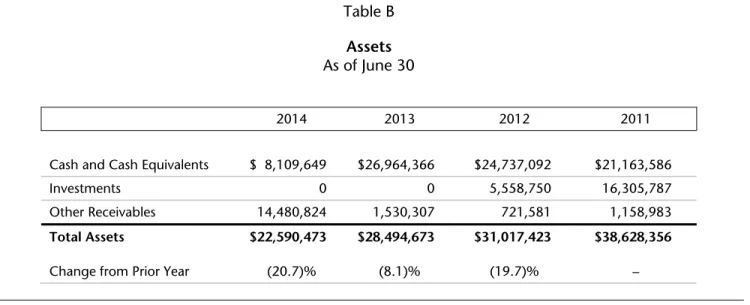
Table B shows total assets decreased by $16.0 million, or 41.5 percent, from June 30, 2011, to June 30, 2014. Assets decreased due to increased claim payments as a result of significant loss experiences mainly from storm and fire activity. The increase in loss activity was funded from the Property Fund’s holdings in the SIF.
MA NA GE M EN T’S DISCUSSION AND ANALYSIS
21
Table B
Assets
As of June 30
2014 2013 2012 2011
Cash and Cash Equivalents $ 8,109,649 $26,964,366 $24,737,092 $21,163,586
Investments 0 0 5,558,750 16,305,787
Other Receivables 14,480,824 1,530,307 721,581 1,158,983
Total Assets $22,590,473 $28,494,673 $31,017,423 $38,628,356
Change from Prior Year (20.7)% (8.1)% (19.7)% –
Liabilities
Table C shows total liabilities have increased by 28.4 percent from June 30, 2011, to June 30, 2014. As an insurance entity, the Property Fund’s primary liabilities are unpaid loss liabilities and unearned premiums, which are recorded net of corresponding excess-of-loss coverage.
Table C
Liabilities
As of June 30
2014 2013 2012 2011
Net Unpaid Loss Liabilities $13,444,474 $ 8,965,078 $13,005,007 $13,374,614 Unearned Premiums 2,987,885 3,689,334 3,355,426 3,652,539
Dividend Payable 0 0 0 0
Other Current and
Long-Term Liabilities 6,861,294 1,556,356 482,343 1,112,500
Total Liabilities $23,293,653 $14,210,768 $16,842,776 $18,139,653
Change Total Liabilities
22
MA NA GE M EN T’S DISCUSSION AND ANALYSISThe loss liabilities include amounts for individual case estimates for reported losses, as well as estimates for losses that were incurred but not yet reported. Loss liabilities also include a provision for the estimated future payment of losses and loss expenses associated with the outstanding claims from insured localities. The unpaid loss liabilities are the amounts expected to be paid in the future for incidents that have already occurred. The unpaid loss liabilities can fluctuate based on whether there are significant loss claims, such as those for major fires or windstorms, open at the end of the fiscal year. Overall, the Property Fund experienced both an increase in severity and frequency of weather-related storms and fire losses in FY 2013-14 compared to FY 2012-13. As a result, net unpaid loss liabilities increased considerably as of June 30, 2014, compared to the amount as of June 30, 2013. The Property Fund incurred four fire losses and one weather-related storm event during FY 2013-14, each of which incurred losses that exceeded the excess-of-loss retention of $1.8 million. This resulted in the Property Fund recording additional recoveries from the excess-of-loss insurers. The Property Fund had an overall increase in the number of open claims at year end with 459 open claims as of June 30, 2014, compared to 343 for the prior year end. The increase in open claims is due to the increase in overall frequency of claims reported during the year as well as the timing of settlement of reported claims.
The following large events occurred in FY 2013-14 and FY 2011-12. A portion of the loss for each event was established as a liability as of June 30th for each
corresponding fiscal year-end.
On May 29, 2012, significant fire damage in the Siren School District resulted in $2.8 million of incurred losses.
On July 6, 2013, significant fire damage to the Milwaukee County Courthouse resulted in $20.0 million of damage, for which the Property Fund received $5.0 million from the excess-of-loss insurer as of June 30, 2014.
On August 1, 2013, significant fire damage in the Waukesha School District resulted in $6.2 million of incurred losses.
On February 27, 2014, significant fire damage in the Racine Unified School District resulted in approximately $11.0 million of incurred losses, for which $0 had been received as of
June 30, 2014.
On April 16, 2014, significant fire damage in the Oconto Unified School District resulted in $5.0 million of incurred losses.
From June 14, 2014 through June 18, 2014, severe storms that occurred within a 72-hour period in Dane County resulted in $4.2 million of incurred losses.
The change in unearned premiums fluctuates with changes in premiums written and unearned excess-of-loss premium ceded to the excess-of-loss insurer.
MA NA GE M EN T’S DISCUSSION AND ANALYSIS
23
Net Position
The Property Fund’s net position represents the difference between assets and liabilities. If assets are larger than liabilities, the net position is positive. If assets are less than the liabilities, the net position is a deficit. Changes in its net position, known as surplus on the statutory financial statements, are mainly attributable to the difference between its revenues and expenses for the year. The Property Fund’s net position decreased by $21.2 million from a surplus of $20.5 million as of
June 30, 2011, to a deficit of $703,000 as of June 30, 2014. The decrease is primarily attributed to significant losses that were incurred during FY 2011-12 and
FY 2013-14. Table D summarizes changes in the Property Fund’s net position over the three-year period from June 30, 2011, through June 30, 2014.
Table D
Net Position
Fiscal Year Ended June 30
2014 2013 2012 2011
Fund Net Position $(703,180) $14,283,905 $14,174,647 $20,488,703 Change from Prior Year (104.9)% 0.8% (30.8)% –
The Property Fund management considers several factors in establishing an appropriate surplus level to maintain. First, in accordance with s. Ins 6.72 (1),
Wis. Adm. Code, minimum surplus is established, using a measurement date prior to the annual reinsurance renewal, using the criteria that “no single risk assumed by any insurance company (net of excess-of-loss insurance) shall exceed 10 percent of surplus as regards policyholders.” Although the Administrative Code does not specifically apply to the Property Fund, it has been the Property Fund’s objective to adhere to the Code. In the Property Fund’s case, its net retention is $1.8 million per occurrence effective with the March 31, 2012, reinsurance program renewal (previously $2 million per occurrence), which yields a minimum surplus level of $18.0 million. The Property Fund’s surplus has remained under this level since June 30, 2012. As a result, rate increases were approved for each fiscal year since the surplus dropped below $18.0 million. This includes policies in effect as of July 1, 2014, July 1, 2013, and July 1, 2012, and policies that will be issued in future years.
Second, the Property Fund seeks to maintain its surplus at a level consistent with the insurance exposures in force and annual premiums written. As insurance in force has increased by $1.9 billion between June 30, 2011, and June 30, 2014, management has sought to maintain a higher surplus level. Finally, management also takes into consideration the fact that the Property Fund is a mono-line property insurer and operates solely in Wisconsin. These are elements that can cause increased volatility
24
MA NA GE M EN T’S DISCUSSION AND ANALYSISin annual loss experience, as was the case for FY 2013-14 with significant loss activity, because the Property Fund does not have other lines of business or geographical regions to smooth out losses in a given year. The Property Fund also strives to smooth any rate changes over time and, thereby, avoid large fluctuations in premiums charged to units of local government. For further discussion of surplus, see the section labeled “Change in Fund Net Position.”
Change in Financial Position
Revenues
The Property Fund’s operating revenues consist of premiums from insured units of local government, net of excess-of-loss insurance premiums ceded. All Property Fund policyholders are billed annually, but not all are billed in the same renewal month because insurance policies are issued or renewed throughout the year. The Building and Contents line of insurance for the Property Fund’s primary policy types uses rates obtained annually for each insured from an independent insurance rating organization. Other lines of insurance use rates established by an
independent actuary, and approved by the Oversight and Advisory Committees. The Property Fund has implemented the following changes:
On July 1, 2011, the Property Fund adopted updated loss costs and lowered its Loss Cost Multiplier to 1.058, which increased the Building and Content rate by 6.8 percent.
On July 1, 2012, the Property Fund adopted a Loss Cost Multiplier of 1.217, which increased the Building and Content rate by 15.0 percent. In addition, the Property Fund altered its deductible credits to encourage local governments to change the frequency and severity of claims submitted, and reduced Auto and Inland Marine rates.
On July 1, 2013, the Property Fund adopted a Loss Cost
Multiplier of 1.4131, which increased the Building and Content rate by 17.6 percent. The Property Fund again altered its deductible credits, and again reduced Auto and Inland Marine rates.
Table E presents operating revenues for the three-year period ended June 30, 2014. The decline in operating revenues in FY 2011-12 is attributable to an increase in costs to maintain excess-of-loss coverage, Insurance Services Office, Inc. base rate fluctuations, an increase in higher deductible plans, and a reduction in the number of policyholders with high property values. The increase in FY 2012-13 and
FY 2013-14 can be attributed to rate increases taken on all policies, except Auto and Inland Marine, effective during the years to rebuild the surplus position.
MA NA GE M EN T’S DISCUSSION AND ANALYSIS
25
Table E
Operating Revenues
Fiscal Year Ended June 30
2014 2013 2012 2011
Operating Revenues $18,038,546 $16,771,300 $14,910,305 $15,701,278 Change from Prior Year 7.6% 12.5% (5.0)% –
The Property Fund’s nonoperating revenues consist of investment income earned from interest on shares in the State Investment Fund and interest or market gains on investments in high-grade fixed income securities. As shown in Table F, there has been significant variability in investment income each year.
Table F
Investment Income
Fiscal Year Ended June 30
2014 2013 2012 2011
Investment Income $8,471 $36,045 $65,196 $178,242 Change from Prior Year (76.5)% (44.7)% (63.4)% –
Investment income fluctuates based on market conditions and the amount of funds available for investment. During FY 2008-09, the Property Fund began investing a portion of its available funds in longer-term high-grade securities managed by the State of Wisconsin Investment Board. As of June 30, 2014, and June 30, 2013, the Property Fund did not have any investments in long-term-investment securities compared to $5.6 million invested as of June 30, 2012. The decline in long-term investments was due to securities that matured in FY 2012-13, from which the proceeds were used to pay claims. The Property Fund’s investment in the SIF continued to decrease in FY 2013-14 in order to pay claims as a result of the increase in frequency and severity of losses. The Property Fund will continue to monitor its ability to pay claims and work with the State of Wisconsin Investment Board to determine future investment decisions based on established investment guidelines.
26
MA NA GE M EN T’S DISCUSSION AND ANALYSISExpenses
The Property Fund has two main categories of operating expenses: loss and loss adjustment expenses; and “other” operating expenses consisting of contracted services, personnel, and other expenses not related to losses or loss adjustment expenses. The Property Fund’s largest operating expenses consist of loss and loss adjustment expenses paid, plus changes to the loss liabilities. Table G shows operating expenses and the ratios of those expenses to operating revenues for FY 2013-14, FY 2012-13, FY 2011-12, and FY 2010-11.
Table G
Operating Expenses
Fiscal Year Ended June 30
2014 2013 2012 2011
Operating Expenses Net Losses and
Loss Adjustment Expenses $30,840,553 $14,740,742 $19,673,812 $25,732,743 Other Operating Expenses 2,190,267 1,954,635 1,613,459 1,908,621
Total Operating Expenses $33,030,820 $16,695,377 $21,287,271 $27,641,364
Ratios of Operating Expenses to Total Operating Revenues Net Losses and
Loss Adjustment Expenses 171.0% 87.9% 131.9% 163.9% Dividends to Policyholders 0.0 0.0 0.0 (0.1) Other Operating Expenses 12.1 11.7 10.8 12.2
Total Operating Expenses 183.1% 99.6% 142.7% 175.9%
Loss and loss adjustment expenses can vary widely depending both on claims paid and on claims reported during any given year. Further, loss adjustment expenses are affected by the changes to loss liabilities, which can be either positive or negative depending on changes in the reserves and estimated losses incurred but not reported. Any excess-of-loss insurance recoveries are netted in loss and loss adjustment expense (see the “Excess-of-Loss Program” section for more
information). Generally, weather-related claims account for a significant portion of total losses. However, in more recent years, significant fire-related losses increased in both frequency and severity, which was the result especially for FY 2013-14. Other operating expenses have remained relatively stable.
The ratios in Table G measure operating expenses, including loss, loss adjustment expenses and other expenses, compared to premiums. A ratio above 100 percent
MA NA GE M EN T’S DISCUSSION AND ANALYSIS
27
means the Property Fund is paying out more in losses than it is receiving in premiums. The ratio for FY 2013-14 indicates that the Property Fund paid out $1.83 in losses and expenses for every $1.00 in premium it received.
Excess-of-Loss Program
To transfer insurance risk, the Property Fund purchases excess-of-loss coverage in the commercial market. Note 6 to the Property Fund’s financial statements contains a table showing terms of the excess-of-loss policies in effect during FY 2011-12 through FY 2013-14. On the Statement of Revenues, Expenses, and Changes in Fund Net Position, premiums paid to excess-of-loss insurers are reported as a reduction of premium revenue, and claims paid by excess-of-loss insurers are reported as a reduction to losses and loss adjustment expenses paid by the Property Fund. The Property Fund uses excess-of-loss insurance to help reduce its exposure to significant loss events. Table H compares the excess-of-loss insurance loss recoveries to excess-of-loss insurance premiums paid over the four years from FY 2010-11 though FY 2013-14.
Table H
Excess-of-Loss Insurance Loss and Loss Adjustment Expense Recoveries Compared to Premiums
Fiscal Year Ended June 30 Recoveries from Excess-of-Loss Insurers Excess-of-Loss Insurance Premiums Ceded Inflow from (Outflow to) Reinsurers 2011 $18,858,960 $5,300,298 $13,558,662 2012 (107,270) 6,394,319 (6,501,589) 2013 2,054,999 7,091,015 (5,036,016) 2014 40,058,467 8,190,501 31,867,966
The Property Fund annually reviews with its excess-of-loss broker the per risk and aggregate excess-of-loss insurance retentions in relation to excess-of-loss insurance market pricing and selects a balance between risk retention and excess-of-loss insurance cost. For FY 2013-14, the Property Fund financed its reinsurance costs through a premium financing agency compared to prior years in which the Property Fund had paid the entire cost up front. The decision was made given the loss activity during the year and the need to monitor cash flow requirements for loss payments. As a result of using the financing agency, the Property Fund incurred interest expense of $102,000 in FY 2013-14.
28
MA NA GE M EN T’S DISCUSSION AND ANALYSISFor FY 2013-14, the Property Fund experienced an increase in both the frequency and severity of fire-related losses, including four that exceeded the excess-of-loss per occurrence retention of $1.8 million on a paid basis and one storm event that exceeded retention on an incurred basis. The Property Fund recorded an increase of recoveries from excess-of-loss reinsurers as a result of these claims as well as other claims for weather-related storm events that developed adversely during FY 2013-14.
Change in Fund Net Position
The change in fund net position reflects all revenues (operating and nonoperating), less expenses and transfers. Table I shows the increase or decrease in net position for FY 2013-14, FY 2012-13, FY 2011-12, and FY 2010-11.
Table I
Change in Net Position
Fiscal Year Ended June 30
2014 2013 2012 2011 Increase (Decrease)
in Net Position $(14,987,085) $109,258 $(6,314,056) $(11,749,212)
In FY 2011-12, the Property Fund continued to experience more significant-than-usual claim activity; however, it was less severe than for FY 2010-11. The Property Fund recorded an increase in net position for FY 2012-13 as rate increases during the year increased operating revenues, which exceeded the claim activity during the year. The rate changes were made to initially build net position and thereafter maintain a target point at which total revenues equal total expenses. Overall, the significant decrease in net position for FY 2013-14 resulted from several fire-related losses and the development of weather-related losses from prior years. These losses far exceeded premiums earned despite rate increases taken to offset these losses, and the recoveries incurred under the excess-of-loss coverage.
Summary
The Property Fund continues to operate for its stated purpose of making reasonably priced property insurance available for units of local government. It will continue to monitor its fund balance and adjust rates accordingly. Factors that will influence future rates will be changes to the net position and the structure, cost, and availability of excess-of-loss (reinsurance) coverage.
MA NA GE M EN T’S DISCUSSION AND ANALYSIS
29
Factors Affecting Future Periods
The decline in surplus in recent years will affect the Property Fund’s rates. The Property Fund actuarially determines the rate increases or decreases in order to maintain adequate levels of surplus. The following rate increases and other policy changes were approved by the Oversight Committee as a way to resolve the inadequate surplus position:
The Property Fund implemented a Loss Experience Modifier (LEM) in FY 2014-15 to create premium equity among insureds, encourage better loss control, and help retain risks that are profitable for the Property Fund.
The Property Fund approved the restructuring of the deductible credits, also in FY 2014-15.
For FY 2015-16, the LEM and deductible credits were further changed for an expected overall increase in premiums of 73.4 percent.
Consistent with best practices, the Property Fund revalued its insurance in force. The project to revalue, which began in FY 2011-12, included on-site appraisals of all local governmental properties valued at more than $750,000.
Contact Information
This financial report is designed to provide a general overview of the Local Government Property Insurance Fund’s financial performance for FY 2011-12 through FY 2013-14. Questions concerning any of the information provided in this report, or requests for additional information, should be addressed to:
Brynn Bruijn-Hansen, Insurance Program Manager Local Government Property Insurance Fund
125 South Webster Street Madison, Wisconsin 53703-3474
31
June 30, 2014 June 30, 2013 June 30, 2012
ASSETS
Current Assets:
Cash and Cash Equivalents (Notes 2 and 4) $ 8,109,649 $ 26,964,366 $ 24,737,092 Investments (Notes 2 and 4) 0 0 5,558,750 Receivables:
Due from Policyholders 1,391,617 1,109,804 682,229 Investment Income Receivable 0 0 33,783 Excess-of-Loss Insurance Recoverable on Paid Claims (Notes 2, 6, and 7) 13,089,207 420,503 5,569 Due from Other Funds 0 0 0 Total Receivables 14,480,824 1,530,307 721,581 Total Current Assets 22,590,473 28,494,673 31,017,423 Noncurrent Assets:
Investments (Notes 2 and 4) 0 0 0
TOTAL ASSETS $ 22,590,473 $ 28,494,673 $ 31,017,423
LIABILITIES AND NET POSITION
Current Liabilities:
Unpaid Loss Liabilities (Notes 2, 5, 6, and 7) $ 13,444,474 $ 8,965,078 $ 13,005,007 Unearned Premiums (Notes 2 and 6) 2,987,885 3,689,334 3,355,426 Dividends Payable (taxes and other deposits) 0 0 0 Premiums Received in Advance (Note 2) 946,315 1,157,587 48,813 Excess-of-Loss Insurance Payable 5,252,154 0 0 Contracted and Other Services Payable 644,277 374,045 418,204 Compensated Absences 157 4,515 (15) Due to Other Funds 10,459 12,011 9,834 Total Current Liabilities 23,285,721 14,202,570 16,837,269 Noncurrent Liabilities:
Compensated Absences 592 249 133 Other Postemployment Benefits 7,340 7,949 5,374 Total Noncurrent Liabilities 7,932 8,198 5,507 Total Liabilities 23,293,653 14,210,768 16,842,776 Net Position:
Unrestricted (703,180) 0 0 Restricted for Fund Purposes 0 14,283,905 14,174,647
TOTAL LIABILITIES AND NET POSITION $ 22,590,473 $ 28,494,673 $ 31,017,423
Statement of Net Position
June 30, 2014, June 30, 2013, and June 30, 2012
State of Wisconsin
Office of the Commissioner of Insurance Local Government Property Insurance Fund
The accompanying notes are an integral part of this statement.
Year Ended Year Ended Year Ended June 30, 2014 June 30, 2013 June 30, 2012
OPERATING REVENUES
Net Premiums Earned (Notes 2 and 6) $ 18,038,546 $ 16,771,300 $ 14,910,305
Total Operating Revenues 18,038,546 16,771,300 14,910,305
OPERATING EXPENSES
Losses and Loss Expenses (Notes 2, 5, and 6) 30,840,553 14,740,742 19,673,812 Contracted Services 1,840,498 1,613,468 1,267,299 Personnel Services 105,350 96,929 85,161 Other Expenses 244,419 244,238 260,999 Dividends to Policyholders 0 0 0
Total Operating Expenses 33,030,820 16,695,377 21,287,271
OPERATING INCOME (LOSS) (14,992,274) 75,923 (6,376,966)
NONOPERATING REVENUES (EXPENSES)
Investment Income 8,471 36,045 65,196
Total Nonoperating Revenues 8,471 36,045 65,196
Income (Loss) Before Transfers (14,983,803) 111,968 (6,311,770) Transfers (3,282) (2,710) (2,286)
CHANGE IN NET POSITION (14,987,085) 109,258 (6,314,056)
NET POSITION
Net Position—Beginning of the Year 14,283,905 14,174,647 20,488,703 Net Position—End of the Year $ (703,180) $ 14,283,905 $ 14,174,647
Local Government Property Insurance Fund
Statement of Revenues, Expenses, and Changes in Fund Net Position
for the Years Ended June 30, 2014, June 30, 2013, and June 30, 2012
State of Wisconsin
Office of the Commissioner of Insurance
The accompanying notes are an integral part of this statement.
Year Ended Year Ended Year Ended June 30, 2014 June 30, 2013 June 30, 2012
CASH FLOWS FROM OPERATING ACTIVITIES
Cash Received for Premiums $ 22,096,166 $ 17,786,407 $ 13,709,084 Losses and Loss Expenses Paid (38,536,288) (19,195,605) (19,450,447) Cash Payments for Contracted Services (2,056,181) (1,657,627) (1,162,157) Cash Payments to Employee for Services (109,974) (89,708) (92,363) Cash Payments for Dividends to Policyholders 0 0 0 Other Operating Revenues (Expenses) (253,629) (242,061) (277,035)
Net Cash Used by Operating Activities (18,859,906) (3,398,594) (7,272,918)
CASH FLOWS FROM NONCAPITAL FINANCING ACTIVITIES
Transfers Out (3,282) (2,710) (2,286)
Net Cash Used by Noncapital Financing Activities (3,282) (2,710) (2,286)
CASH FLOWS FROM INVESTING ACTIVITIES
Proceeds from Sale and Maturities of Investments 0 5,500,000 10,500,000 Investment Income Received 8,471 128,578 348,710 Purchase of Investments 0 0 0
Net Cash Provided (Used) by Investing Activities 8,471 5,628,578 10,848,710
NET DECREASE IN CASH AND CASH EQUIVALENTS (18,854,717) 2,227,274 3,573,506
Cash and Cash Equivalents at the Beginning of the Year 26,964,366 24,737,092 21,163,586 Cash and Cash Equivalents at the End of the Year $ 8,109,649 $ 26,964,366 $ 24,737,092
for the Years Ended June 30, 2014, June 30, 2013, and June 30, 2012
Statement of Cash Flows
State of Wisconsin
Office of the Commissioner of Insurance Local Government Property Insurance Fund
The accompanying notes are an integral part of this statement.
Year Ended Year Ended Year Ended June 30, 2014 June 30, 2013 June 30, 2012
RECONCILIATION OF NET OPERATING INCOME TO NET CASH AND CASH EQUIVALENTS PROVIDED BY OPERATING ACTIVITIES
Operating Income (Loss) $ (14,992,274) $ 75,923 $ (6,376,966) Adjustments to Reconcile Net Income to Net Cash and Cash Equivalents
Provided by Operating Activities: Changes in Assets and Liabilities:
Decrease (Increase) in Due from Policyholders (281,813) (427,575) (192,136) Decrease (Increase) in Excess-of-Loss Insurance Recoverable on Paid Claims (12,668,704) (414,934) 592,792 Decrease (Increase) in Due from Other Funds 0 0 89 Increase (Decrease) in Unpaid Loss Liabilities 4,479,396 (4,039,929) (369,607) Increase (Decrease) in Unearned Premiums (701,449) 333,908 (297,113) Increase (Decrease) in Dividends Payable 0 0 0 Increase (Decrease) in Premiums Received in Advance (211,272) 1,108,774 (711,972) Increase (Decrease) in Excess-of-Loss Insurance Payable 5,252,154 0 0 Increase (Decrease) in Contracted and Other Services Payable 270,232 (44,159) 91,888 Increase (Decrease) in Compensated Absences Liability (4,015) 4,646 (5,183) Increase (Decrease) in Due to Other Funds (1,552) 2,177 (2,691) Increase (Decrease) in Other Postemployment Benefits Liability (609) 2,575 (2,019) Total Adjustments (3,867,632) (3,474,517) (895,952)
Net Cash and Cash Equivalents Provided (Used) by
Operating Activities $ (18,859,906) $ (3,398,594) $ (7,272,918)
Noncash Investing, Capital, and Financing Activities:
Net Change in Unrealized Gains and Losses $ 0 $ (22,152) $ (128,017)
The accompanying notes are an integral part of this statement.
37
1.
D
ESCRIPTION OF THEF
UNDThe Local Government Property Insurance Fund is part of the State of Wisconsin’s financial reporting entity and is reported as an other enterprise fund in the State’s basic financial statements. The purpose of the Property Fund is to provide property insurance coverage to tax-supported units of local government such as counties, towns, cities, villages, school districts, and library boards. Coverage is available on an optional basis. It grew out of the State Property Insurance Fund, which was created in 1903. Chapter 221, Laws of 1979, transferred coverage for state-owned property from the State Property Insurance Fund to a self-funded program administered by the Wisconsin Department of Administration. In addition, the State Property Insurance Fund was re-created as the Local Government Property Insurance Fund to insure the remaining non-state government properties previously covered by the State Property Insurance Fund.
The Property Fund is managed by the Office of the Commissioner of Insurance of the State of Wisconsin (OCI), which contracts with private companies to administer the fund.
The Property Fund provides insurance coverage to units of local government against all property losses except, among other exclusions, flood, earthquake, wear and tear, extremes in temperature, mold, war, nuclear reaction, and embezzlement. Motor vehicle and inland marine property coverage, and builder’s risk policies for new building construction and renovations, are also available.
38
NOTES TO THE FI NA NC IA L STA TEMENTSThe Property Fund functions similarly to a commercial insurer. Policyholders receive insurance protection for an insurance premium. The Property Fund bears the risk of loss for property covered by the policies, subject to policy deductibles that vary from $500 to $100,000 per loss. Policyholders are obligated to pay the annual insurance premium and to report losses in a timely manner.
Policyholders are not subject to any premium assessments should a premium deficiency exist. Pursuant to s. 605.30, Wis. Stats., if the Property Fund does not have sufficient assets to pay losses that are due, the Department of Administration is to transfer from the State’s General Fund to the Property Fund amounts sufficient to pay the losses. The Property Fund would have to repay the General Fund. For this and other reasons, the Property Fund seeks to ensure that net assets are maintained at a sufficient level to minimize the potential for a premium deficiency to develop or to require transfers from the General Fund.
Policy counts for the Property Fund, along with total insurance in force as of June 30, 2014, June 30, 2013, and June 30, 2012, can be seen in the table that follows:
June 30, 2014 June 30, 2013 June 30, 2012
Cities 128 134 154 Counties 69 70 71 Other 131 129 129 School Districts 252 274 295 Towns 161 167 176 Villages 242 247 260 Total Insureds 983 1,021 1,085 Builders Risk 61 53 71
Insurance in Force $51.9 billion $53.3 billion $51.2 billion
2.
S
UMMARY OFS
IGNIFICANTA
CCOUNTINGP
OLICIESA. Basis of Presentation and Financial Reporting Entity
The accompanying financial statements of the Property Fund have been prepared in conformity with generally accepted accounting principles (GAAP) for governments as prescribed by the Governmental
Accounting Standards Board (GASB). These statements present the net position and revenues, expenses, and changes in net position of only the activity of the Property Fund and are not intended to present the financial activity for the State of Wisconsin as a whole.
NOTES TO TH E FINANCIAL STATEMENTS
39
B. Measurement Focus, Basis of Accounting, and Financial Statement
Presentation
The Fund is accounted for using the economic resources measurement focus. With this measurement focus, all assets and liabilities are included on the Statement of Net Position. The Fund is reported on the full accrual basis of accounting. This basis of accounting recognizes revenues and overpayment recoveries when they are measurable and due, regardless of when cash is received. Expenses are recognized in the period incurred, regardless of when cash is paid.
The Statement of Revenues, Expenses, and Changes in Fund Net Position classifies revenues and expenses as either operating or nonoperating. Transactions categorized as operating revenues and expenses are those related to the Property Fund’s primary purpose of collecting premiums and making claims payments. Certain revenues that are not related to the Property Fund’s principal operation, such as investment earnings, are reported as nonoperating revenues.
C. Accounting Estimates
The preparation of financial statements requires management to make estimates and assumptions that affect the amounts reported in the financial statements and accompanying notes. Actual results could differ from those estimates. Estimates that are particularly susceptible to significant change in future years are the liabilities for unpaid losses and loss expenses. In estimating these liabilities, management uses the methodology discussed in Note 2G, Note 5, and Note 6.
D. Cash and Cash Equivalents
Cash and cash equivalents includes shares in the State Investment Fund, a short-term investment pool of state and local funds, and cash deposited in the State of Wisconsin’s bank awaiting transfer to the State Investment Fund.
E. Investment Valuation
Investments of the Property Fund consist of high-grade, fixed income securities managed by the State of Wisconsin Investment Board. Fixed income securities are reported at fair value consistent with the provisions of GASB Statement Number 31, Accounting and Financial Reporting for Certain Investments and for External Investment Pools.
Fair value information is determined using quoted market prices.
F. Premiums
Policies are written for annual terms. Premiums are recognized as revenue over the terms of the insurance policies by calculating the earned premium on each policy. The daily pro rata portion of premiums written that are applicable to the unexpired terms of insurance policies in force as of the date of the Statement of