This Paper was Presented on : 2nd International Conference on Internet and Cloud Computing Technology ( ICICCT 2013 ) – Singapore on January 19 - 20, 2013 ……… Page …. 65
An online Peer-Tutoring Platform for Programming Languages based on Learning
Achievement and Teaching Skill
Yu-Chen Kuo
Department of Computer Science and Information Management Soochow University
Taipei, Taiwan [email protected]
Zhe-Yu Wu
Department of Computer Science and Information Management Soochow University
Taipei, Taiwan [email protected] Abstract :
The research is to establish an online Peer-Tutoring Platform for Programming Languages and delve into the one-to-one peer-tutoring activities, while we conduct the learning strategy about the peer education. Students with better learning ability serve as tutors, instructing those with worse learning ability, called tutees. Tutors proceed with the peer-tutoring activities of the online programming language with respectively different teaching skills. The aim of that is to enable the students to learn the programming language and ameliorate their program designing ability. Furthermore, we delve into how their peers are affected in learning, when the students as tutors utilize on different teaching skills to carry the learning activities out.
Keywords- peer-tutoring; programming language; learning achievement; teaching skill I. INTRODUCTION
With the rapid development of technology and the universal internet, both computer-assisted instruction and web-based collaborative learning have been commonly applied to the school education[1]. Recently, several scholars replaced the traditional classroom learning activities with the web-based learning strategy. The internet is used to process the learning activities, which enables teachers to efficiently manage students’ learning behaviors and learning portfolios[2, 3]. Besides, although the web-based collaborative learning can increase students’ motivation for learning, some scholars point out that the learning activity process is usually more complex in the process[4]. The reason for that is students with inferior learning ability usually lengthen their collaborative time[5, 6]. Hence, the issue that we need to understand is how to draw on the effective learning strategy for assisting the on-line learning activities like that.
The peer-tutoring is a structural learning strategy. It mainly encourages children’s interactive learning. Some scholars propose that the peer-tutoring on the internet can prompt students to learn the mother tongue, modern languages, and the attitude toward modern languages[7]. In addition, it can enhance students’ ability for designing the programming language[8].
This Paper was Presented on : 2nd International Conference on Internet and Cloud Computing Technology ( ICICCT 2013 ) – Singapore on January 19 - 20, 2013 ……… Page …. 66
In college, programming language is an important core capability for students whose major is information-related. However, it is a difficult subject for many students. Kelleher and Pausch pointed out that students usually face complicated languages and instruction codes in thinking about how to solve the programming language problems and understand the executive process of the program[9]. These abstract structures cause students to have the idea that learning the programming language is a hard and complex task. Many studies show that at school, students who select the subject of programming language are diminishing and more and more students have less passion and interest in programming language, which cause them to give up on it[10]. In traditional teaching about programming language, teachers always lecture on the platform. Therefore, there is only one-way communication between teachers and students. Students do not know how to ask and teachers can not clearly find out students’ problems. This one-way teaching reduces students’ learning desire. With a view to this, more and more scholars offer research related to computer-assisted instruction. It aims to help students learn programming language. Since 1980, the systems for computer-assisted instruction have been gradually developed, such as WebToTeach[11]. In 1995, Intelligent Tutoring Systems (ITS) which possess the strength of web, such as ELM-ART, started to appear[12, 13]. The aforementioned systems are mainly to aid teachers. They help teachers with course arrangement, exams and assist students individually with virtual teaching assistants. There are limited effects about communication, flexibility, and learning results in the face of virtual TAs[14, 15]. In 2008, scholars proposed a programming language teaching platform which supports peer-tutoring[16]. Students do not learn by virtual TAs anymore; instead, it is the peers that give instruction as TA. Nonetheless, because a TA faces more than one student, the learning results are rather limited.
The research is to establish an online Peer-Tutoring Platform for Programming Languages. The learning strategy for peer-tutoring is used to process one-to-one peer-tutoring activities. Students with superior learning ability act as tutors. They instruct students, tutees, with inferior learning ability. They are provided with pre-activity training. By this, tutors can enhance their programming ability. Then we delve into how their peers are affected in learning, when tutors utilize on different teaching skills to carry the learning activities out.
II. LITERATURE REVIEW
A. Programming Language Learning Systems
The computer-assisted programming language learning systems have been discussed by many scholars. Much research is conducted on automatic virtual TAs. These systems only provide students with a good learning environment and strengthen the learning effects of students with formalized feedback. Arnow and Barshay proposed a programming language learning system, WebToTeach[11]. WebToTeach, a web-based teaching environment, supports many programming languages and diverse training question patterns in order to allow students to acquire more information. Brusilovsky proposed LISP of ELM-ART, which provides virtual TAs, so that students can obtain more help by virtual TAs[12]. Besides, the system can arrange the difficulties of chapters for letting students fit in quickly, based on students’ capability. However, the feedback these systems can provide is limited can the feedback that students can get is still the formalized answer which teachers devised beforehand. Students are only able to get relatively limited help. Chien proposed the programming language teaching platform which supports peer learning[16]. This reverses the traditional views about learning programming languages. Students serve as TAs through the online learning performance. In literature, TAs need
This Paper was Presented on : 2nd International Conference on Internet and Cloud Computing Technology ( ICICCT 2013 ) – Singapore on January 19 - 20, 2013 ……… Page …. 67
to encounter several students. Nonetheless, they have not had any pre-learning training, which resulted in insufficient teaching capability.
B. Peer-Tutoring
Peers have been playing a significant role in students’ career. Students can have a mutual learning and encouragement by learning with peers at their age and with the similar background. This behavior can not only increase tutees’ motivation and confidence for learning, but decrease their learning pressure and fortify the learning effect. Moreover, the tutor’s social skill and mind development will be improved. Peer-Tutoring is a teaching system where peers help and discuss with each other and share their own experience[17]. It mainly highlights the tutee learn by accepting the education of the tutor at his age and with the similar thinking pattern. On the other hand, the tutor can learn in two ways. One is the preparation and training before teaching; the other, the feedback of teaching tutees. Frick indicated that the peer-tutoring is a teaching strategy that students teach others of similar age and with inferior learning ability one on one[18]. This strategy applies to every age group, capability level and learning field. Fantuzzo, Riggio, Connelly and Dimeff thought that peers’ instructing and cooperating with each other can help them solve confusion on studies and have a shared experience[19].
From the above review, we see that most scholars tend to explore on the impacts on students who use learning systems, or to introduce the effectiveness of peer-tutoring. Not many scholars discuss about whether the tutor is capable on teaching or not during peer-tutoring. Moreover, whether there is any discrepant between the teaching technique of the tutor and the effects of peer-tutoring activity is still to be discussed.
III. RESEARCH METHODS
A. System Structure
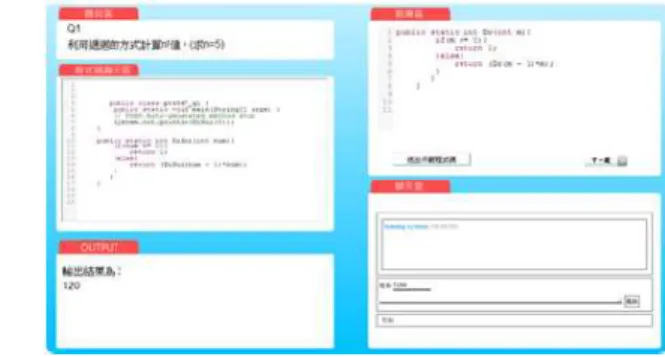
This research is to set up an online Peer-Tutoring Platform for Programming Languages. By applying the strategy of peer-tutoring, we divide the students into tutor and tutee according to their capabilities, and adopt one-to-one peer-tutoring activity. During the allowed time for answering, the tutee writes program codes and they are sent synchronously to the tutor through the internet. When the tutee faces certain problems, he may ask help from the tutor through the online chat-room. On the other hand, the tutor notices about the mistakes of the tutee immediately through the screen. The tutor then gives guidance to the tutee, and he also may provide some help through the learning platform.
B. Design of experiments
Before the experiment begins, we first conduct a pre-test and then divide the students into groups according to their capabilities. Following the strategy of peer-tutoring, we put student with higher capability and student with lower capability into one group. Therefore, this study will group the students into Experimental Group A and Experimental Group B. For Experimental Group A, the student who acts as the tutor is going to perform Peer-tutoring activity, through conducting an online program language by using the teaching skill of demonstration method(Fig. 2). And for Experimental Group B, the tutor is going to perform peer-tutoring activity, through conducting an online program language by using the teaching technique of the flow chart method(Fig. 4). The
This Paper was Presented on : 2nd International Conference on Internet and Cloud Computing Technology ( ICICCT 2013 ) – Singapore on January 19 - 20, 2013 ……… Page …. 68
procedure of the experiment is: students will first spend 30 minutes on pre-test. The aim of such pre-test is to know whether the familiarity level on programming language of each student varies greatly or not. The pre-test is also used to distinguish tutors and tutees. Before conducting the online peer-tutoring, the tutors in each group will receive pre-training classes for twice, 30 minutes each time. This is to reinforce the programming and tracing code capability of the tutors. Next, after classes every week, Experimental Group A and Experimental Group B use the online Peer-Tutoring Platform for Programming Languages, and two problems on programming languages will be asked for tutoring activity, lasting for 5 weeks. After the designed peer-tutoring activity, there will be a 30-minute post-test. The aim of the post-test is to know that after conducting the online peer-tutoring activity, whether the students’ capability of programming language has improved or not. Lastly, in order to find out the satisfaction of the online system, 15 minutes will be spent on conducting a related survey. Then we can analyze the learning activity situations and effects of the students.
Figure 1: experimental group A_tutee Figure 2: experimental group A_tutor
Figure 3: experimental group B_tutee Figure 4: experimental group B_tutor C. Experimental Subjects
The experimental subjects of this study are the sophomores of Class A and Class B studying in the Department of Information Management. For convenience, classes will be seen as units, and are divided into Experimental Group A and Experimental Group B. The problems used for testing the students are designed by experts; aim to test on the common programming language topics, especially on the main concept of recursive programming language. To most students, recursive programming language is a lot more difficult than others like if-else, do-while and the For Loop. Therefore through this study, we aim to strengthen students’ concept and familiarity towards recursive program.
This Paper was Presented on : 2nd International Conference on Internet and Cloud Computing Technology ( ICICCT 2013 ) – Singapore on January 19 - 20, 2013 ……… Page …. 69
IV. CONCLUSION AND FUTURE WORK
The subject of programming language includes complicated program syntax and logic concepts, and these characteristics will definitely reduce the students’ willingness to learn. Therefore, this study changes traditional learning methods. In after-school practices, students now can practice and learn through peer-tutoring, rather than practicing alone. When students face problems, their peers can help them to solve problems. The learning result and willingness will be increased by using this method.
During the development process of the platform, we will invite experts to carry out tests on the accuracy, availability and feasibility of the system. We estimate that the learning results and learning willingness of the students will be improved, through the peer-tutoring activity conducted on the online Peer-Tutoring Platform for Programming Languages. This aims to make students learn and teach at the same time.
The platform developed in this study is now used in the Data Structure courses in the university. Experimental subjects includes totally 106 students from two classes, and they are divided into Experimental Group A and Experimental Group B according to their classes. The experimental questions in this study mainly come from the concept of recursive language in the programming language. Pre-test are conducted before the experiment to ensure the two groups both have a considerable degree of knowledge. Before the learning activity, the tutor will undergo some pre-training in order to reinforce their ability of programming and tracing code. In Experimental Group A, the teaching skill used in peer-tutoring by the tutor is demonstration; and for Experimental Group B, flow charts are used during teaching. After the learning activities, post-test and survey will be carried out.
REFERENCES
[1] T. D. Koschmann, R. Hall, and N. Miyake, CSCL 2, carrying forward the conversation: Lawrence Erlbaum, 2002.
[2] G. J. Hwang, H. C. Chu, J. L. Shih, S. H. Huang, and C. C. Tsai, "A decision-tree-oriented guidance mechanism for conducting nature science observation activities in a context-aware ubiquitous learning environment," Educational Technology & Society, vol. 13, pp. 53-64, 2010.
[3] Z. Zhan, F. Xu, and H. Ye, "Effects of an online learning community on active and reflective learners’ learning performance and attitudes in a face-to-face undergraduate course," Computers & Education, vol. 56, pp. 961-968, 2011.
[4] L. F. Thompson and M. D. Coovert, "Teamwork online: The effects of computer conferencing on perceived confusion, satisfaction and postdiscussion accuracy," Group Dynamics: Theory, Research, and Practice, vol. 7, pp. 135-151, 2003.
[5] J. Fjermestad, "An analysis of communication mode in group support systems research," Decision Support Systems, vol. 37, pp. 239-263, 2004.
[6] L. Lipponen, M. Rahikainen, J. Lallimo, and K. Hakkarainen, "Patterns of participation and discourse in elementary students' computer-supported collaborative learning," Learning and instruction, vol. 13, pp. 487-509, 2003.
This Paper was Presented on : 2nd International Conference on Internet and Cloud Computing Technology ( ICICCT 2013 ) – Singapore on January 19 - 20, 2013 ……… Page …. 70
[7] A. Thurston, D. Duran, E. Cunningham, S. Blanch, and K. Topping, "International on-line reciprocal peer tutoring to promote modern language development in primary schools," Computers & Education, vol. 53, pp. 462-472, 2009.
[8] K. W. Han, E. K. Lee, and Y. J. Lee, "The impact of a peer-learning agent based on pair programming in a programming course," Education, IEEE Transactions on, vol. 53, pp. 318-327, 2010.
[9] C. Kelleher and R. Pausch, "Lowering the barriers to programming: A taxonomy of programming environments and languages for novice programmers," ACM Comput. Surv., vol. 37, pp. 83-137, 2005.
[10] P. Kinnunen and L. Malmi, "Why students drop out CS1 course?," presented at the Proceedings of the second international workshop on Computing education research, Canterbury, United Kingdom, 2006.
[11] D. Arnow and O. Barshay, "WebToTeach: an interactive focused programming exercise system," in Frontiers in Education Conference, 1999. FIE '99. 29th Annual, 1999, pp. 12A9/39-12A9/44 vol.1.
[12] P. Brusilovsky, E. Schwarz, and G. Weber, "ELM-ART: An intelligent tutoring system on World Wide Web," 1996, pp. 261-269.
[13] G. Weber and A. Möllenberg, "A Tutoring System for LISP Beginners," Cognition and computer programming, p. 373, 1995.
[14] C. Daly and J. M. Horgan, "An automated learning system for Java programming," Education, IEEE Transactions on, vol. 47, pp. 10-17, 2004.
[15] W. Wong, T. Chan, C. Chou, J. Heh, and S. Tung, "Reciprocal tutoring using cognitive tools," Journal of Computer Assisted Learning, vol. 19, pp. 416-428, 2003.
[16] C. M. Chien, "Applying peer tutoring to programming languages instruction platform," Taiwan: Unpublished dissertation of Yunlin University, 2008.
[17] S. Goodlad and B. Hirst, Peer Tutoring. A Guide to Learning by Teaching: Nichols Publishing, PO Box 96, New York, NY 10024., 1989.
[18] L. Frick, "Peer tutors: The peerless resource," VocEd, vol. 5, pp. 28-29, 1980.
[19] J. W. Fantuzzo, R. E. Riggio, S. Connelly, and L. A. Dimeff, "Effects of reciprocal peer tutoring on academic achievement and psychological adjustment: A component analysis," Journal of Educational Psychology, vol. 81, p. 173, 1989.