R.-S. Chang, T.-h. Kim, and S.-L. Peng (Eds.): SUComS 2011, CCIS 223, pp. 222–233, 2011. © Springer-Verlag Berlin Heidelberg 2011
Web Services for Cloud Computing
Sheng-Yuan Yang1, Dong-Liang Lee2, Kune-Yao Chen2, and Chun-Liang Hsu3
1
Dept. of Computer and Communication Engineering, St. John’s University, Taiwan
2 Dept. of Information Management, St. John’s University, Taiwan
{lianglee,kychen}@mail.sju.edu.tw
3
Dept. of Electrical Engineering, St. John’s University, Taiwan
Abstract. This paper focuses on designing an information multi-agent system with Web service techniques for cloud computing and its interaction paradigms. It employs the concept of SQL IC to construct the operational interface of cloud database as a data warehouse. This approach not only can look after both sides of ubiquitous access advantages of cloud techniques, but also retain the consis-tent user interface of a data warehouse. It enables information users to conve-niently use the Internet to quickly access the system information in clouds. This paper preliminarily proposes an energy-saving information multi-agent system architecture with Web services for cloud computing. Related presentations and comparisons of the system prototype also verify its feasibility.
Keywords: Web Services, Energy-saving Information Systems, Agent Systems, Cloud Computing.
1 Introduction
Computer popularization and network technology improvement are two great achievements of Internet applications. People can only rely on browsers to easily use various Web services, for example, on-line shopping, Web games, Web banks, etc. In view of the advantages brought by Internet technology, many conventional applica-tions continuously shift their running models into the Internet. In regard to Web ser-vices development, however, most information WebPages are prepared by people, read by people, and judged by people. Lacking interactive communication mechan-isms, it is fundamentally impossible to make application programs actively deal with related service information. Therefore, it is imperative to specially establish Web services for modern application programs. In addition, it is necessary to strengthen the communication requirements of application procedures. It is even more important to establish universal standards and agreements on communication information. Exam-ples include: HP’s information communication standard: e-Speak; Microsoft’s .Net strategy; WSTK (Web Service Toolkit) and WSDE (Web Service Development Envi-ronment) published by IBM; Dynamic Services developed by Oracle; SUN also an-nounced its network service framework and joined the standard into the operational
environment of J2EE; finally, W3C established and unified all of its Web service standards, resulting in a widely operational infrastructure and platform for Web ser-vices.
Web Services principally provide services for application programs on Web and enable the usage of programs in other machines, which are provided with powerful inter-communication and extendibility. It can easily integrate application programs and related programs on the Web and achieve some complicated information service processes through interactive programs. Related standards contain XML (Extensible Makeup Language), SOAP (Simple Object Access Protocol), WSDL (Web Services Description Language), and UDDI (Universal Description, Discovery and Integra-tion) [2]. Cloud computing is a technique of Internet- ("cloud-") based development and use of computer technology. In other words, it will set up the necessary operat-ing resources and related data in the Internet so that users can directly use them when they access the Internet. Furthermore, determining how to construct an interaction diagram of cloud computing for extensively and seamlessly entering related Web information agent systems through Web service techniques is also an investigation point of this study.
To sum up, this paper focuses on designing an information multi-agent system with Web service techniques for cloud computing and its interaction paradigms. It employs the concept of SQL IC to construct the operational interface of cloud data-base as a data warehouse. This approach can regard both sides of ubiquitous access advantages of cloud techniques, and also retain consistent user interface of the data warehouse. It enables information users to conveniently use the Internet to quickly access the system information in clouds. The paper preliminarily proposes an ener-gy-saving information multi-agent system architecture with Web services for cloud computing. Related presentations and comparisons of the system prototype also veri-fy its feasibilities.
2 Background and Technique
2.1 Introduction to Energy-Saving Information System
Due to the distribution of space and monitoring hosts, energy-saving information systems need a more flexible manner of program development. Replacing existent application interface with functions of network transmission and Web services can not
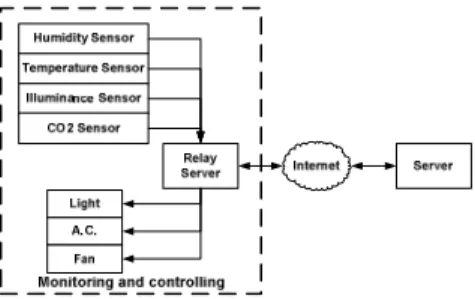
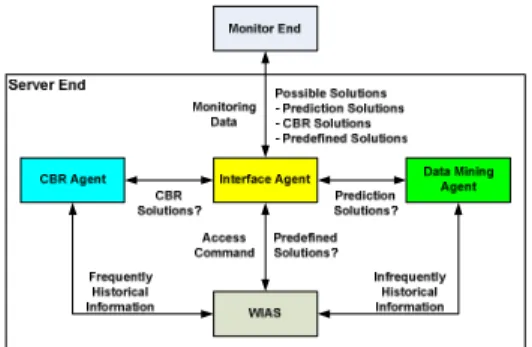
only easily achieve on-line and real-time addition/modification services, but also im-mediately extend its powerful functions. Fig. 1 illustrates the conceptual architecture of an energy-saving information system. Monitoring and controlling were constructed with a wireless sensor network to detect and collect the running parameters of all electrical devices; then the related data would be sent to a server through embedded mid-way by wireless communication of ZigBee modules or Bluetooth. The embedded mid-way not only plays the role of data collector between the server and end-devices, but also receives the control commands delivered by the server to feedback control the facilities in the power consumption space [4]. The server system is a multi-agent system, including: Interface Agent, Data Mining Agent, Case-Based Reasoning Agent- CBR Agent, and Web-Service-Based Information Agent System- WIAS, as shown in Fig. 2. The Interface Agent is responsible for providing energy-saving monitoring of information access and intelligent decision making. The latter is aimed at providing corresponding control decisions to monitor information, including whether prediction solutions exist, as judged by the Data Mining Agent; whether CBR solutions exist, as judged by the CBR Agent; and whether predefined solutions exist, as judged by the Interface Agent in accordance with predefined rules within WIAS; this is called three-stage intelligent decision processing. WIAS employs the concept of SQL IC to be responsible for providing various Web services of energy-saving information from the abovementioned agent systems, which can achieve the investi-gation on fast accessing system information in clouds via the Internet.
Fig. 2. System structure of backend multi-agent system
2.2 Cloud Computing
Cloud computing is an information technology that enables users to take advantage of information services whenever they can access the Internet, even with an incomplete understanding of the complex information service structure and without any profes-sional knowledge. Back in the early 1990s, initial cloud computing was developed from the techniques of Grid Computing and Utility Computing. In the 21st century, the related network services have been developed vigorously, in tandem with im-provements in network techniques. In 2007, Google proposed the concept of cloud computing that offered huge business opportunities, including Infrastructure as a Service (IaaS), Platform as a Service (PaaS), and Software as a Service (SaaS)., com-prising the new 3C, i.e., Cloud Computing, Connecting and Client Devices [1]. This
paper focuses on an information multi-agent system with Web service techniques for cloud computing and its interaction paradigms. That is to say, in cloud computing environments, the system prototype plays the SaaS role of cloud computing provider. Furthermore, it can explore how to construct an interaction diagram of cloud compu-ting for extensively and seamlessly entering relevant Web information agent systems through Web service techniques.
2.3 Web Services
Traditional programs deal with all operations in individual processes, one by one, which greatly inhibits processing performance. This approach not only wastes time on meaningless processes, but also cannot effectively control processing efficiency. However, program development has gradually improved designing procedures, with more and stronger support of programs, along with science and technology advance-ments, such as object concept production that can not only increase convenience in programming but also decrease complexity in maintenance. In the middle stage, the development of API (Application Programming Interface) enabled programmers to develop various and universal functions as well as modularized interfaces to apply to each type of program. The convenience of this approach is greater than it was before. In the networking era, many Web services resulted from developing the interface of traditional program providers with cloud computing techniques. It is ready to go through networks, transmit necessary service interfaces to needed programs, and even proposes formats of communication standards. When program scales need addition or modification, they can immediately be achieved through Web services. In regard to cloud computing environments, this paper developed a backend information agent system on the basis of Web service techniques, which can easily achieve the applica-tion goal of ubiquitously accessing energy-saving informaapplica-tion.
2.4 Developing Techniques
The system prototype adopted MS SQL Server and My-SQL Server as the sharing platform of backend databases; the information safety can be guaranteed by different servers with mutual backup information. The former has powerful analysis and opti-mization mechanisms, which mainly draws on websites of large-scale companies and international enterprises. Its cost is comparatively high, but it has excellent and stable operational efficiency for a large amount of continual information processing. The latter not only possesses the advantages of the MS SQL Server, but also is a freeware of relational database. SQL is a query language for obtaining data from the relational database. This paper employed the concept of SQL access templates to construct the usual SQL IC with C#. Their functions are like those of the IC’s, which can bind dif-ferent parameters to easily access corresponding query results. Not only can this ap-proach expand the Web service functions of WIAS, but it can also provide various query services of energy-saving information to other agents within the system. The rest of the agents were developed by Java and collocated in the multi-threading build-ing manner, easily leadbuild-ing to a double-win strategy for multi-taskbuild-ing processes and enhancing system performance. In addition, Interface Agent also introduced JFree Chart to develop related statistical tables of energy-saving information. This approach
can not only complete dynamic analyses of energy-saving information, but also finish display functions of the example energy-saving information system.
3 System Architecture of Clouding and Multi-agent Information
System with Web Services
The system architecture realizes on-line interfaces of Web services with cloud compu-ting and information transmission techniques on the Internet. It enables individual agents to access the common function library to immediately respond to the corres-ponding agent that uses this Web service. Not only can it easily achieve communica-tion with the backend database, but it can also easily add and renew related funccommunica-tions for the research purpose of designing a Web-service-based information agent with clouding techniques.
3.1 Structure of Web-Service-Based Information Agent System
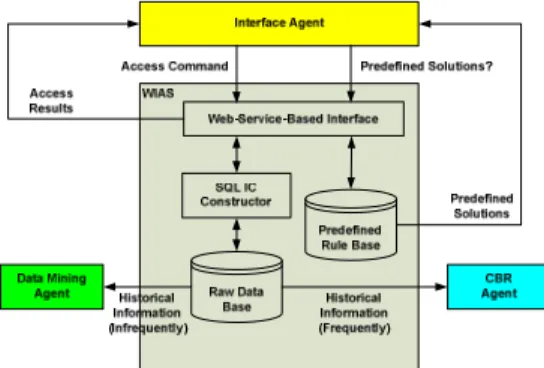
Fig. 3 is the structure of the Web-service-based Information Agent System, WIAS. If the query information is an access command, WIAS directly goes through Web-Service-Based Interface to employ the SQL IC Constructor to trigger the correspond-ing SQL access templates, part of them as shown in Table 1. After bindcorrespond-ing related access parameters, WIAS retrieves the corresponding access results from the Raw Data Base. Finally, it goes through the Web-Service-Based Interface to return those results to the Interface Agent. If the query information is whether predefined solutions exist, WIAS also goes through the Web-Service-Based Interface to ask the Predefined Rule Base to return the corresponding predefined solutions to the Interface Agent. Furthermore, Raw Data Base also provides all of the frequent historical information to the CBR Agent as information material for the production of cases, and supplies all infrequent historical information into the Data Mining Agent as information material to trigger the production of prediction solutions. Detailed function description and relationship with agents are shown in Table 2.
Table 1. Part of SQL Ics and their function description
SERVICE NAME
SERVICE
DESCRIPTION TO WHOM
CCMonitor_InsertTmpData Case Cycle's Temporal Data CBR Agent CCMonitor_Main Case Cycle's API CBR Agent CMonitor_Main Transfer Case Information into Predication Rules Data Mining Agent CMonitor_ViewPredRule Reviewing Predication Rules Data Mining Agent DMonitor_Main Transfer Raw Data and Rules into Cases with semantics CBR Agent ESAS_InsertRawData Insert Raw Data to DB Interface Agent ESAS_ViewMacType Checking Sensor Types of MACs Interface Agent PMonitor_Main Data Mining's API Data Mining Agent System_ViewDBSDT Providing System Time Stamp Sharing
Table 2. Detailed function description and relationship of WIAS
4 WIAS
Function Description
4.1 Information Query: Thread Processing, through Web-Service-Based Interface (Interrupted Processing) 4.2 Frequent Information Providing: Thread Processing, through Data Monitor (Interrupted Processing) 4.3 Infrequent Information Providing: Thread Processing, through Data Monitor (Interrupted Processing) 4.4 Predefined Solutions Providing: Thread Processing, through Web-Service-Based Interface (Interrupted Processing) 4.5 Predefined Rules Constructing: Thread Processing, through Rule Maker (Interrupted Processing)
I/O Description
Input Function Output
1 Interface Agent: User Interface 4.1 Information Query 4 WIAS: Web-Service-Based Interface 4 WIAS: Data Monitor 4.2 Frequent Information Providing 3 CBR Agent: Case Generator 4 WIAS: Data Monitor 4.3 Infrequent Information Providing 2 Data Mining Agent: Prediction Monitor 1 Interface Agent: Decision Maker 4.4 Predefined Solutions Providing 4 WIAS: Web-Service-Based Interface
Expert Interrupted 4.5 Predefined Rules Constructing 4 WIAS: Rule Maker
3.2 Structure of Interface Agent
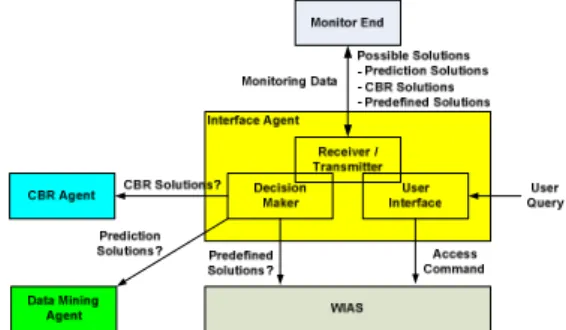
The functions of Interface Agent are accessing energy-saving monitor information and intelligent decision making. Fig. 4 is the system block diagram, including Receiv-er/Transmitter, Decision Maker, and User Interface. All three are independent opera-tional procedures and operate in the manner of multi-threading to achieve the function of parallel processing. First, the Receiver gets all of the sensor data from the Monitor end, carries out filtering and arrangement [4], and then goes through WIAS (ESAS_InsertRawData) to store the information into the system clouding databases. The User Interface periodically goes through WIAS (ESAS_ViewMacType) to real-time renew all of the monitoring information from the clouding database and also accepts user queries about various commands related to energy-saving information. The Decision Maker, responsible for intelligent decision making, proceeds with the three-stage intelligent decision processing for producing Possible Solutions through the help of the Data Mining Agent, CBR Agent and WIAS. Finally, the Transmitter returns Possible Solutions to the Monitor end to achieve the system goal of energy-saving feedback control. Detailed function description and relationship with agents are shown in Table 3.
Table 3. Detailed function description and relationship of Interface Agent
1 Interface Agent
Function Description
1.1 Information Processing: Thread Processing, through Receiver/Transmitter (Real Time Processing) 1.1.1 Information Receiving
1.1.2 Information Transmitting
1.2 Information Browsing: Thread Processing, through User Interface (Interrupted Processing) 1.2.1 User Query
1.2.2 Information Figures and Tables Displaying
1.3 Three-stage Intelligent Decision Making: Thread Processing, through Decision Maker (Real Time Processing) 1.3.1 If Prediction Solutions Exist?
1.3.2 If CBR Solutions Exist? 1.3.3 If Predefined Solutions Exist?
I/O Description
Input Function Output
0 Monitor End 1.1.1 Information Receiving 1 Interface Agent: Receiver 1 Interface Agent: Decision Maker 1.1.2 Information Transmitting 0 Monitor End
User Access Commands 1.2.1 User Query 4 WIAS 1 Interface Agent: User Interface 1.2.2 Information Figures and Tables Displaying 4 WIAS 1 Interface Agent: Decision Maker 1.3.1 If Prediction Solutions Exist? 2 Data Mining Agent 1 Interface Agent: Decision Maker 1.3.2 If CBR Solutions Exist? 3 CBR Agent 1 Interface Agent: Decision Maker 1.3.3 If Predefined Solutions Exist? 4 WIAS
3.3 Structure of Data Mining Agent
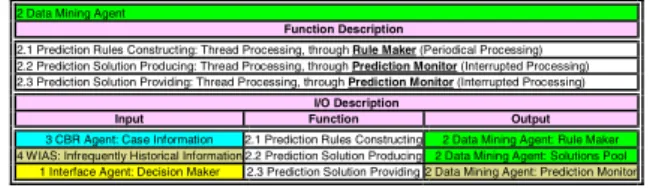
Fig. 5 illustrates the structure of the Data Mining Agent [3]. First, it goes through the Case Base constructed by the CBR Agent to get Case Information. Then the Rule Maker employs algorithms of Information Entropy (such as ID3, C4.5, and C5.0) in accordance with the information to calculate and obtain related Object-Action Pairs (for instance, what are their corresponding energy-saving actions to the range from maximum to minimum of some monitoring data) for constructing suitable Prediction Rules. If the query information is whether prediction solutions exist, it is usually ab-normal energy-saving information, i.e., Infrequent Historical Information from WIAS (CMonitor_Main). The Data Mining Agent produces corresponding prediction solu-tions into the Solusolu-tions Pool in accordance with the Prediction Rules (CMoni-tor_ViewPredRule). The system then sends suitable prediction solutions back to the Interface Agent in accordance with the system threshold. When the prediction solu-tion is successful, it will become learning material of the CBR Agent. Its learning efficiency is gradually incorporated into the Case Base within CBR Agent, and then the CBR Agent provides corresponding Case Information into Data Mining Agent, the Rule Maker revises Prediction Rules and correspondingly enhances its prediction robustness. Detailed function description and relationship with agents are shown in Table 4.
Table 4. Detailed function description and relationship of Data Mining Agent
2 Data Mining Agent
Function Description
2.1 Prediction Rules Constructing: Thread Processing, through Rule Maker (Periodical Processing) 2.2 Prediction Solution Producing: Thread Processing, through Prediction Monitor (Interrupted Processing) 2.3 Prediction Solution Providing: Thread Processing, through Prediction Monitor (Interrupted Processing)
I/O Description
Input Function Output
3 CBR Agent: Case Information 2.1 Prediction Rules Constructing 2 Data Mining Agent: Rule Maker 4 WIAS: Infrequently Historical Information 2.2 Prediction Solution Producing 2 Data Mining Agent: Solutions Pool
1 Interface Agent: Decision Maker 2.3 Prediction Solution Providing 2 Data Mining Agent: Prediction Monitor
3.4 Structure of CBR Agent
Case-based reasoning (CBR) is a problem-solving technique employing previous experiences and past success cases for solving current problems. For this reason, the system gives a Case a definition: the most usual occurrence situation (that is most frequent happening) and its corresponding energy-saving operational mode at a spe-cific time slot. Its ‘meaning’ is the most stable energy-saving operational plan in the specific monitor space. Fig. 6 is the production concept of cases. However, the origi-nal cases storage in Fig. 6 cannot directly apply to various energy-saving operatioorigi-nal modes. They have to be transformed into suitable semantic cases in accordance with the corresponding MAC Tables; then they can be applied to the mechanism for the reasoning of the majority of energy-saving cases. Fig. 7 is the transformation concept of semantic cases.
Fig. 6. Production concept of Case (T: Temperature, C: CO2, and H: Humidity)
Fig. 7. Transformation concept of semantic case
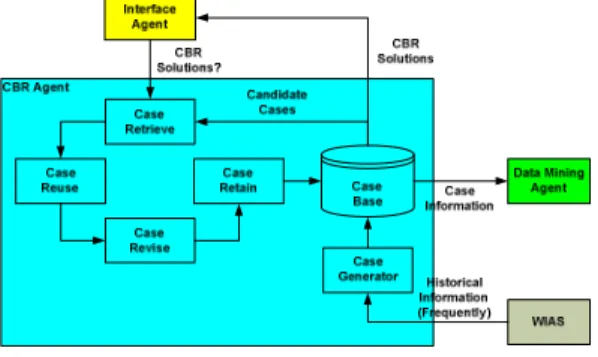
Fig. 8 is the structure of the CBR Agent. The Case Generator is responsible for constructing case resources and storage in Case Base, which is based on Historical Information provided by WIAS (DMonitor_Main). If the query information is wheth-er CBR solutions exist, the CBR Agent starts the cycle of case-based reasoning
through help of WIAS (CCMonitor_Main), as detailed in [3]. The Case Base also provides Case Information to become information material for constructing Prediction Rules within the Data Mining Agent. Detailed function description and relationship with agents are shown in Table 5.
Fig. 8. Structure of CBR Agent
Table 5. Detailed function description and relationship of CBR Agent
3 CBR Agent
Function Description
3.1 Case Base Constructing: Thread Processing, through Case Generator (Periodical Processing) 3.2 Case Information Providing: Thread Processing, through Case Monitor (Periodical Processing) 3.3 CBR Solutions Providing: Thread Processing, through CBR (Interrupted Processing)
I/O Description
Input Function Output
4 WIAS: Frequently Historical Information 3.1 Case Base Constructing 3 CBR Agent: Case Generator 3 CBR Agent: Case Monitor 3.2 Case Information Providing 2 Data Mining Agent: Rule Maker 1 Interface Agent: Decision Maker 3.3 CBR Solutions Providing 3 CBR Agent: CBR
4 System Display and Comparisons
Fig. 9 is the interface of the system prototype. For the moment, the browsing func-tions of energy-saving information to users contain real-time browsing and historical query. The interface display is divided into three parts. One is the page tags of all sensor data on the top of the interface. Those tags are constructed in the tree structure,
which orderly subdivide from big to small data type and end in a single sensor data. The system establishes the page tags structure of the interface with the data structure of the page tags from clouding database through WIAS, and then the structure can bind corresponding browsing data. The other is the dynamic curve diagram corres-ponding to the browsing data on the middle part of the interface. The diagram can real-time and dynamically extend its time axle from left to right and provide four types of information: real time data curve (yellow color), average data curve (green color), mark of the maximum value (red color), and mark of the minimum value (blue color). The last one is data script on the bottom of the interface. It immediately pro-vides all of the newest data of the system operation, including current value, average value, maximum value, minimum value, and the corresponding times of the last up-dating. On the page of historical query, its interface is similar to the page of real-time browsing. Its interface only additionally provides a series of list menus which enables users to select corresponding query conditions. The list menu contains all of the con-ditions that are orderly permutations from coarse to fine items, including year, season, month, day, hour, and sensor type. The system provides the necessary query solutions and shows the corresponding data curve diagrams in accordance with the selected query conditions through the help of WIAS.
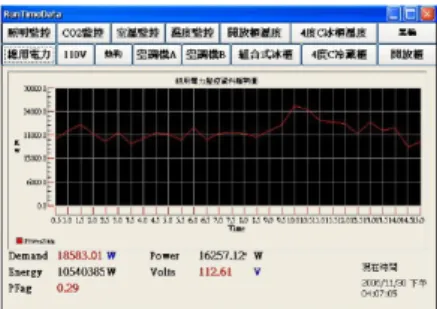
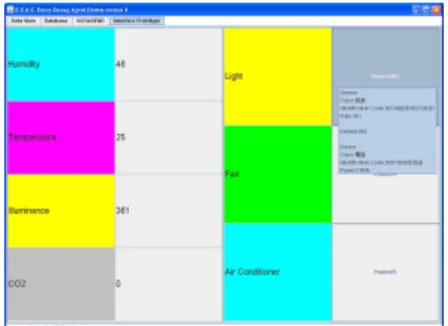
Fig. 10 is the monitor system interface of energy-saving information of the Indus-trial Technology Research Institute, ITRI, in Taiwan. It can provide tables, figures, and corresponding data displays of all monitoring data; the red color means the over-taking prompt value is greater than the corresponding threshold. Up to now, the sys-tem prototype can present all of the functions rather than ITRI’s and display current value, average value, maximum value, minimum value, their corresponding times of the last updating, and their corresponding colors of value representation. Fig. 11 is the energy-saving website display of Providence University in Taiwan. Its display func-tion of the maximum contract electrical capacity will become the focus of one of our future investigations. The most important point is that the two systems mentioned above do not have the true control function of energy-saving feedback, as shown in Fig. 12. The left part of the interface is real-time monitoring data, while the right part of the interface is corresponding electrical equipments of feedback control and their operational modes. That is a unique advantage of the system prototype.
Fig. 11. Energy-saving website display of Providence University
Fig. 12. Clouding user interface of the system prototype
5 Conclusion and Discussion
The paper has developed an information multi-agent system with Web service tech-niques for cloud computing and its interaction paradigms. It employed the concept of SQL IC to construct the operational interface of cloud database as a data warehouse. This approach can not only look after both sides of ubiquitous access advantages of cloud techniques, but also retains the consistent user interface of a data warehouse. It enables information users to conveniently use the Internet to quickly access the system information in clouds. The paper preliminarily proposes an energy-saving information multi-agent system architecture with Web services for cloud computing. Related presentations and comparisons of the system prototype also verify its feasibil-ity and provide some interesting points:
(1) It is the first energy-saving information monitor and management information system with Web service technique in clouding environment.
(2) The proposed architecture is the first multi-agent structure of energy-saving sys-tem in practical environment.
(3) The presented three-stage intelligent decision processing strategy is the first ap-pearance in intelligently energy-saving systems.
Truly completing the display functions of the maximum contract electrical capacity and three-stage intelligent decision processing will be the focus of our future investigation.
Acknowledgement. The authors would like to thank Hung-Chun Chiang, Ming-Yu Tsai, and Guo-Jui Wu for their assistance in system implementation and experiments. This partial work was supported by the National Science Council, ROC, under Grant NSC-99-2221-E-129-012 and the Ministry of Education, Taiwan, R.O.C., under Grant Skill of Taiwan (1) Word No. 1000041444t.
References
1. Gu, S.R.: Cloud Computing Robs Their Turfs, A New Warring Age of IT Industry. Com-mon Wealth Magazine 423, 178–181 (2009)
2. Wu, H.H.: Introduction to Web Service Techniques,
http://www.ascc.sinica.edu.tw/nl/93/2023/02.txt (visited on March 9, 2011)
3. Yang, S.Y., Hsu, C.L.: An Ontological Proxy Agent with Prediction, CBR, and RBR Tech-niques for Fast Query Processing. Expert Systems with Applications 36(5), 9358–9370 (2009)
4. Yang, S.Y., Chiang, H.C., Wu, K.J.: Developing an Intelligent Energy-saving Information Processing and Decision Supporting System. In: Proc. of 2010 Symposium on Constructing Industrial and Academic Park of Green Energy Science and Technology and Intelligent Energy-saving Techniques and Project Achievement Lunching Ceremony, Taipei, Taiwan, pp. 41–47 (2010)
![Fig. 5 illustrates the structure of the Data Mining Agent [3]. First, it goes through the Case Base constructed by the CBR Agent to get Case Information](https://thumb-us.123doks.com/thumbv2/123dok_us/8654370.2337761/7.892.299.596.834.989/illustrates-structure-data-mining-agent-constructed-agent-information.webp)