Coordination in Open Source versus Commercial Software
Development
Chintan Amrit
IEBIS Department
University of Twente
The Netherlands
[email protected]
ABSTRACTProcess patterns based on particular coordination mechanisms have been used to describe and understand the work practices of commercial software development. However, there has not been much work done on whether the specific coordination mechanisms noticed in commercial software development are indeed applicable to Open Source software development projects. Such an analysis can help managers of Open Source projects in coordinating their project. In this paper we explore whether three Commercial software development patterns are applicable to Open Source software development projects. We do this through an analysis of published case studies.
Keywords
Open Source, Coordination Mechanisms, Pattern theory. INTRODUCTION
Many Open Source development projects still face significant challenges. Out of 199903 projects registered in the Sourceforge portal, largest host of Open Source projects (Sourceforge, Retrieved 1st March 2009), only 36642 (18,3 %) of the
projects were considered stable (had a stable version of their software) and only 3490 (1,74 %) had reached mature status. It has been observed that the success or failure of Open Source software depends largely on the health of the health of such Open Source communities (Crowston and Howison, 2003, 2006). For an IT professional or Open Source project leader it is crucial to know the status of the Open Source project in order to contribute or recommend the project (Crowston and Howison, 2006). Understanding how the coordination of software developers can be carried out in an Open Source environment can help in ensuring fewer Open Source projects are abandoned. To achieve this goal, one needs to know if and how the process of development of Open Source projects is different from that of Commercial Software Development projects. Literature on the differences in coordination practices between Open Source and Commercial development has been quite ad hoc without a focus on categorising the differences. A categorization of the differences can act as a platform for the identification of coordination practices specific to the development process. In this paper we aim to use this categorization technique to understand the coordination processes that are specific to Open Source software development. To achieve this goal of categorising the differences, we resort to the concept of patterns in software development. Realising the differences in applicability of patterns can also lead to an understanding of which patterns are specifically applicable to the Open Source development environment. This would also help us understand which coordination problems (related to these patterns) one can identify in order to improve the Open Source development process. In this paper we explore whether three patterns typically found in the commercial software development companies are applicable in the Open Source environment. In order to achieve this we perform a secondary analysis of published case studies similar to that done by Gallivan (2001).
The rest of the paper is structured as follows; section 1 deals with Socio-Technical Pattern theory, section 2 discusses the patterns addressed in this paper, section 3 describes the secondary analysis of case studies and the results of the analysis, section 4 discusses the results and finally section 5 concludes the paper.
SOCIO-TECHNICAL PATTERNS
Some of the problems concerning development activities have been collected and described by Coplien et al.(2004) including a set of what they call Process Patterns to deal with these coordination problems. However, these process patterns were created based on experiences in commercial projects and have not been tested in Open Source projects. As the term process patterns is also used in business process management and workflow, we prefer to use the term Socio/Technical Patterns to
process. As they capture a wide variety of knowledge and experience, Socio/Technical Patterns are potentially very useful to aid the project manager in planning and monitoring a complex development project.
Pattern Name
(gives an indication of what the pattern is about and the name needs to be descriptive in order to communicate the essence of the pattern) (Coplien and Harrison, 2004) Conway’s Law (Conway, 1968, Herbsleb and Grinter, 1999a) Code Ownership Pattern(Coplien, 1994, Nordberg, 2003) Betweenness centrality match (Hossain et al., 2006, Freeman et al., 1979, Mullen et al., 1991)
Problem: A problem growing from the Forces. (the problem is not context free)
Aligning Organization and Architecture A Developer cannot keep up with a constantly changing base of implementation code. Centrality of important people
Context: The current structure of the system giving the context of the problem
(gives an indication of the current structure of the system and could hint on other possible patterns that can be applied)
An architect and development team are in place.
A system with mechanisms to document and enforce the software
architecture, and developers to write the code
Social Network of the team at different stages of software
development
Forces: Forces that require resolution
(describe the different considerations that need to be balanced in the solution and hence can be considered a part of the problem) Architecture shapes communication paths in the organization. Formal organization shapes architecture.
Most design knowledge lives in the code; navigating unfamiliar code to explore design issues takes time. Not everyone can know everything all the time.
People who are not central to the software development or management take a central role in coordination Solution: The solution proposed
for the problem
(solution represents the preferred way to deal with the problem based on knowledge from best practice solutions gathered from practitioners and researchers)
Make sure organization is compatible with the architecture
Each code module in the system is owned by a single Developer. Except in exceptional and explicit
circumstances, code may be modified only by its owner.
Make sure the important people take a more central role in coordination.
Resulting Context: Discusses the context resulting from applying the pattern. In particular, trade-offs should be mentioned
The organization and product architecture will be aligned.
The architecture and organization will better reflect each other.
Project critical information will be conveyed to all team members.
Design Rationale/Related patterns: The design rationale behind the proposed solution. Patterns are often coupled or composed with other patterns, leading to the concept of pattern language.
Historical Lack of code ownership is a major contributor to discovery effort in large-scale software development today. Betweenness centrality is a key predictor for coordination
Table 1:The Socio/Technical Patterns found in commercial closed source settings (Coplien and Harrison, 2004, Coplien, 1994)
. The basic format of a pattern that we use in this thesis is taken from the Process Pattern format (Coplien and Harrison, 2004) and can be seen on the first column in Table 1. The reason behind choosing these particular patterns is that these patterns are also frequently observed in commercial software development environments (Herbsleb and Grinter, 1999a, Nordberg, 2003, Hossain et al., 2006, Coplien, 1994) and often cited by literature(Mockus et al., 2002).
COMPARING OPEN SOURCE AND COMMERCIAL DEVELOPMENT PROCESSES
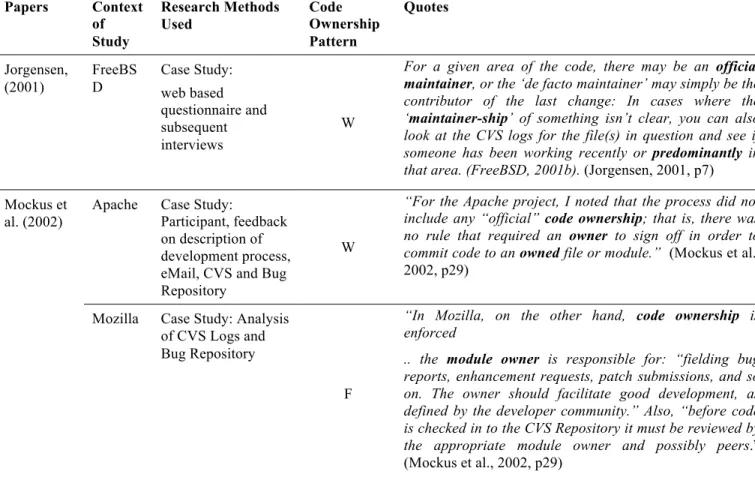
In this section we intend to see if the Socio/Technical Patterns that apply to Commercial Software Development Processes also apply to Open Source software development processes. In order to achieve this goal, we employ a secondary analysis of published case studies in a way, similar to, the one done by Gallivan (2001). With such analysis, we can see if they mention these patterns explicitly or implicitly and in what way they find them relevant. In order to identify relevant case studies we searched electronic archives (of ACM, IEEE, ISI web of Science and Scopus) for relevant literature with the broad search terms ‘ “Case Study” AND “Open Source” among others. From the papers obtained, we shortlisted those that explicitly or implicitly discuss coordination issues in Open Source software. In all we accumulated 154 papers on Open Source software, of which the list of papers that discuss the particular Socio/Technical Patterns are shown in Tables 2, 3 and 4. To avoid selection bias we did not exclude the papers that only mentioned “Code Ownership”, “Conway’s law” or “Betweenness Centrality”. To fit the selection criteria the case studies had to describe the development process of particular open source software and also had to contain original data as well as analysis. The case studies in each of the papers were reviewed a minimum of three times in order to locate passages which mention the patterns explicitly or implicitly. We use content analysis to identify relevant passages (as used by Gallivan (2001)) and highlight the terms that refer to Conway’s Law, Code Ownership as well as Betweenness Centrality patterns. Tables 2, 3 and 4 show the different paper authors, the context of the Open Source case study, the methods used as well as the occurrence of the particular patterns. ‘W’ indicates a ‘Work-around’ for the particular pattern; ‘F’ indicates that the particular pattern is ‘Followed’ and ‘U’ (‘Unclear’) indicates that its ‘Unclear’ of the particular pattern is followed, given the analysis and data. We first deal with literature on case studies that reference Code Ownership Pattern.
Papers Context of Study Research Methods Used Code Ownership Pattern Quotes Jorgensen, (2001) FreeBS D Case Study: web based questionnaire and subsequent interviews W
For a given area of the code, there may be an official maintainer, or the ‘de facto maintainer’ may simply be the contributor of the last change: In cases where the ‘maintainer-ship’ of something isn’t clear, you can also look at the CVS logs for the file(s) in question and see if someone has been working recently or predominantly in that area. (FreeBSD, 2001b). (Jorgensen, 2001, p7) Mockus et
al. (2002)
Apache Case Study:
Participant, feedback on description of development process, eMail, CVS and Bug Repository
W
“For the Apache project, I noted that the process did not include any “official” code ownership; that is, there was no rule that required an owner to sign off in order to commit code to an owned file or module.” (Mockus et al., 2002, p29)
Mozilla Case Study: Analysis of CVS Logs and Bug Repository
F
“In Mozilla, on the other hand, code ownership is enforced
.. the module owner is responsible for: “fielding bug reports, enhancement requests, patch submissions, and so on. The owner should facilitate good development, as defined by the developer community.” Also, “before code is checked in to the CVS Repository it must be reviewed by the appropriate module owner and possibly peers.” (Mockus et al., 2002, p29)
von Krogh et al. (2003)
Freenet Case Study: Telephonic
interviews, analysis of e-Mails, Analysis of CVS repository,
F
“Roughly 80% of all files created and/or modified by a maximum of two developers during the period of analysis, with a mean value of 1.88 contributors per file.” (von Krogh et al., 2003, p1230) Dinh-Trong et al. (2005) FreeBS D
Case Study: eMail archive, Bug Database and CVS Repository
W
Our study shows that, among 26,048 .c and .h files, only 30 percent of the files were modified by one committer, 25 percent by two committers, 15 percent by three
committers, and 8 percent by 10 or more committers. One file was changed by 74 developers. In fact, every
committer has the privilege to make any change to any file in the system. Code ownership in FreeBSD does not exist.
(Dinh-Trong and Bieman, 2005, p8) Jensen, Scacchi (2007) NetBean s -same- F
Additionally, they may gain module owner status by creating a module or taking over ownership of an abandoned module of which they have been a primary committer. (Jensen and Scacchi, 2007, p6)
Mozilla Case Study: participant
interviews, collection and cross-coding of OSSD artefacts, semi automated web site data mining, and multi-mode modelling
F
“In rare cases, such a developer may even be offered the position of module owner if s/he is the primary developer
of that module and it has not been blocked for inclusion into the trunk of the source tree” (Jensen and Scacchi, 2007, p3)
Rigby et al. (2008)
Apache Case Study: Analysis of Commit logs and Mailing Lists
W
“Since the contribution sizes are very small (see Section4.3), one would expect that the discussion would remain very localized. However, our findings indicate that a large proportion of the reviews that found defects discussed the abstract or global implications of the contribution. One explanation for this finding is the lack of
“code ownership” exhibited by Apache
developers”(Rigby, 2008, p7)
Table 2: Open Source Case studies in relation to Code Ownership Pattern
In Table 2 we see that the Code Ownership Pattern is followed by Mozilla (Mockus et al., 2002), Netbeans (Jensen and Scacchi, 2007) and Freenet (von Krogh et al., 2003), while in the case of Apache and FreeBSD projects the developers workaround the Code Ownership coordination mechanism.
Jorgensen (2001) describe the software development process in FreeBSD in a case study and observe that implies that Code Ownership is not enforced in FreeBSD and generally exists only when code maintenance is concerned.
Mockus et al. (2002) describe and compare the development process of two Open Source software development projects namely Apache and Mozilla to commercial software development. They particularly test seven hypotheses related to the development process that also includes a hypothesis on Code Ownership. They suggest the lack of code ownership in the Apache project and on the other hand they observe Code Ownership being followed in the Mozilla project.
von Krogh et al. (2003) study joining and early contribution and its relation to the collective action of open source software innovation. They note that Freenet has a high level of Code Ownership by having less than two developers per file on an average.
Jensen and Scacchi (2007) do a comparative analysis of role migration and project career advancement process in three Open Source Software Development projects, namely Apache, Mozilla and NetBeans. They find that there has been “Code Ownership” practiced in Mozilla until recently when such practice has declined, while in the case of Netbeans, they find Code Ownership practiced quite frequently.
Rigby et al. (2008) describe the process of code reviews in a case study of Apache and reiterate the lack of code ownership in Apache by Mockus et al. (2002).
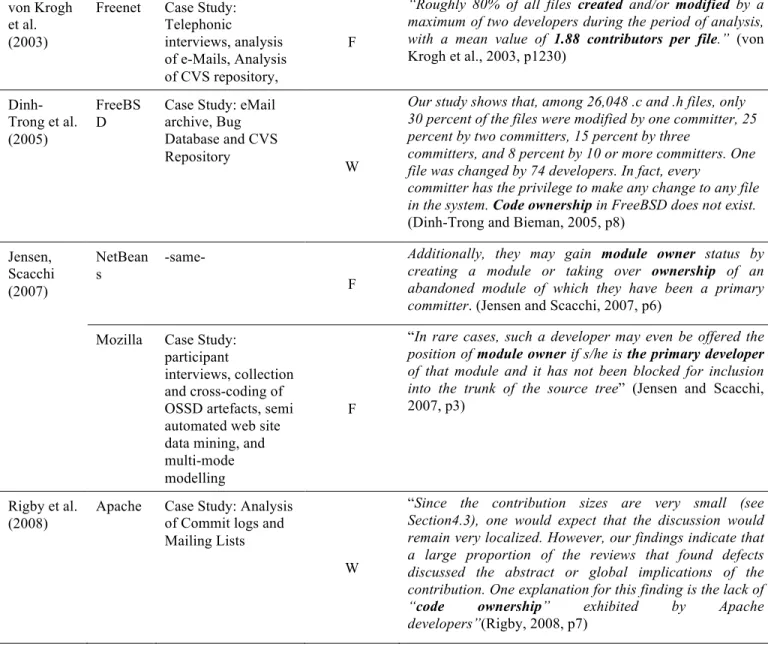
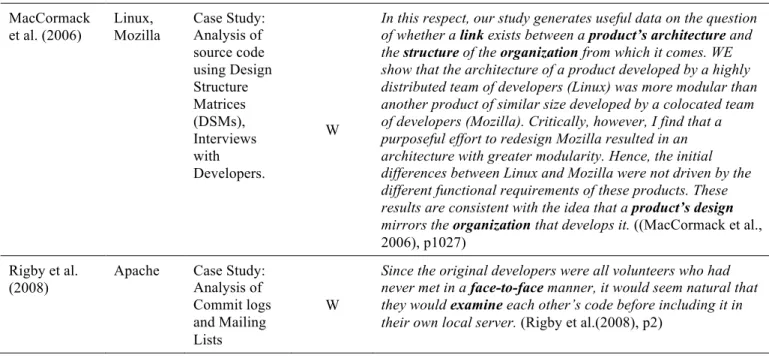
In Table 3 we describe the occurrence of Conway’s Law Pattern in different case studies. Papers Context of Study Research Methods Used Conway’s Law Pattern Quotes Mockus et al. (2002)
Apache Case Study: Participant, feedback on description of development process, eMail, CVS and Bug Repository W
Apache adopts an approach to coordination that seems to work extremely well for a small project. The server itself is kept small. Any functionality beyond the basic server is added by means of various ancillary projects that interact with Apache only through Apache’s Ill-defined interface. That interface
serves to coordinate the efforts of the Apache developers with anyone building external functionality, and does so with minimal ongoing effort by the Apache core group.
…The tasks of finding and reporting bugs are completely free of interdependencies, in the sense that they do not involve changing the code. (Mockus et al. (2002), p34-35) Mozilla Case Study:
Analysis of CVS Logs and Bug
Repository U
However, the Mozilla modules are not as independent from one another as the Apache server is from its ancillary projects. Because of the interdependence among modules, considerable effort (i.e., inspections) needs to be spent in order to ensure that the interdependencies do not cause problems. In addition, the modules are too large for a team of 10 to 15 to do 80% of the work in the desired time. Therefore, the relatively free-wheeling Apache style of communication and implicit
coordination is likely not feasible. (Mockus et al. (2002), p35) von Krogh et
al. (2003)
Freenet Case Study: Telephonic interviews, analysis of e-Mails, Analysis of CVS repository, W
“Developer #101 contrasts this with the core node
functionality, including cryptography, where the “learning curve” for newcomers is very high because it requires thorough understanding of modules and features and their
interconnectedness. As I reasoned, those modules are highly
intertwined and specific to the project and require significant past investment in learning about the architecture, thus erecting contribution barriers for newcomers” (von Krogh et al., 2003, p1232)
Jensen, Scacchi (2005)
NetBeans Case Study: eMail archive, Bug Database and CVS Repository
W
Thus, this separation of concerns in the Netbeans.org design architecture engenders separation of concerns in the process architecture. Of course, this is limited by the extent that each module in the Netbeans.org community is dependent on other modules.(Jensen and Scacchi, 2005, p3)
MacCormack et al. (2006) Linux, Mozilla Case Study: Analysis of source code using Design Structure Matrices (DSMs), Interviews with Developers. W
In this respect, our study generates useful data on the question of whether a link exists between a product’sarchitecture and the structure of the organization from which it comes. WE show that the architecture of a product developed by a highly distributed team of developers (Linux) was more modular than another product of similar size developed by a colocated team of developers (Mozilla). Critically, however, I find that a purposeful effort to redesign Mozilla resulted in an architecture with greater modularity. Hence, the initial differences between Linux and Mozilla were not driven by the different functional requirements of these products. These results are consistent with the idea that a product’sdesign
mirrors the organization that develops it. ((MacCormack et al., 2006), p1027)
Rigby et al. (2008)
Apache Case Study: Analysis of Commit logs and Mailing Lists
W
Since the original developers were all volunteers who had never met in a face-to-face manner, it would seem natural that they would examine each other’s code before including it in their own local server. (Rigby et al.(2008), p2)
Table 3: Open Source Case studies in relation to Conway’s Law Pattern
In Table 3 we notice that almost all the projects other than Mozilla implement a work around mechanism to coordinate the development of the project rather than follow the Conway’s Law Pattern.
Mockus et al. (2002) describe how the Apache community avoids the need for communication and instead adopts other coordination mechanisms. While in the case of the Mozilla project they are unclear as to the actual coordination mechanism used to resolve dependencies.
von Krogh et al. (2003) describe the way the software developers of Freenet tackle the coordination mechanism described by the Conway’s Law Pattern. They explain that the developers of the Freenet project proactively assign tasks to themselves, especially ones who are involved in modifying highly dependent modules. Thus, the developers work around the need for additional coordination due to software dependencies.
Jensen and Scacchi (2005) describe the collaboration processes in the NetBeans project. They suggest that at the level of modules the separation of concerns makes sure that the processes are also not very dependent implying less need for communication and preventing a Conway’s Law STSC.
MacCormack et al. (2006) indicate how Open Source projects try and avoid the coordination problem related to the Conway’s Law Pattern, by increasing modularity of the software and thus using it as a coordination mechanism.
Rigby et al. (2008) describe the coordination mechanism Apache developers use in order to mange highly interdependent code in the Apache HTTP server project, without resorting to communication (thus working around the Conway’s Law Pattern). This coordination mechanism involves frequent reviews of code by Core team members thus reducing the problems that occur when dependent modules are modified
In Table 4 we look at case studies that refer to the Betweenness Centrality Match Pattern.
Bird et al. (2006a) analyse the social network of Apache HTTP server project by mining the Apache mailing list. They show that the Core developers have a higher betweenness centrality than peripheral developers (Bird et al., 2006a). Bird et al. (2006b) replicate this case study on another Open Source project called PostGres to achieve similar results.
Papers Context of Study Research Methods Used Betweenness Centrality Match Pattern Quotes Bird et al. (2006a)
Apache Case Study: Analysis of Apache HTTP project eMail archive
F
In fact the correlation for betweenness is quite high, at 0.757. It should be noted that these are non-parametric correlation measures, and are thus more robustly indicative of a relationship. This indicates that even within the higher-status group of developers, the most active developers play the strongest role of communicators, brokers, and gatekeepers. It’s also noteworthy that the correlation with document changes is much weaker, indicating that higher activity in source code is a stronger determinant of social status than activity in documents. (Bird et al. (2006a), p6)
Bird et al. (2006b)
PostGres Case Study: Analysis of Apache HTTP project eMail archive
F -
Table 4: Open Source Case studies in relation to Betweenness Centrality Match Pattern
All the case studies considered in the above literature are from highly successful Open Source projects namely, Apache, Mozilla, Netbeans, FreeBSD, GNOME, Linux (and Fetchmail) and Freenet. While two of these projects namely, Mozilla and Netbeans have the backing and support of commercial companies, the rest are purely Open Source projects started by individuals. As seen in Table 2, 3 and 4, six papers mention Code Ownership pattern, five mention Conway’s Law pattern, while we could only locate two papers that explicitly mention the Betweenness Centrality match pattern. In Table 2, we see that the company supported Open Source projects (Netbeans, Mozilla) use Code Ownership pattern to coordinate the development process, with the exception of Freenet. Mockus et al. (2002) reason, that this could be because the commercial projects are started within the companies where the development teams develop a more interdependent piece of code. Thus, the company needs more formal mechanisms to coordinate, like Code Ownership mechanism. On the other hand, they say that teams of core developers in Apache do not practice Code Ownership. Instead, they use the coordination mechanism of keeping the core functionality of the server small, in order to make it easier to understand and modify some other developer’s implicitly owned code. We see that all the case studies that mention the dependencies between individual code modules or between parts of the architecture, do not suggest communication as means to coordinate the dependencies, as suggested by the Conway’s Law pattern. Instead, the case studies mention other coordination mechanisms, such as few core developers taking up the task of modifying highly interdependent pieces of code (von Krogh et al., 2003), by maintaining a small core and designing stable interfaces (Mockus et al., 2002) and by performing frequent code reviews (Rigby et al., 2008). Performing frequent code reviews is a coordination mechanism that minimizes communication, as one can concentrate on the dependencies being affected by previous modifications, without having to resort to communication. Again, Mockus et al. (2002) reason that this could be because the “communication-only” approach does not scale and as the complexity and size of the project increases the channels of communication can get overwhelmed.
DISCUSSION AND CONCLUSION
In this paper we used the content analysis of published case studies approach to explore whether coordination mechanisms related to Socio/Technical Patterns that are applicable to commercial software development are applicable to Open Source software development.
It is clear from the onset that Open Source developers do not have the same motivations as Commercial developers (Lerner and Tirole, 2002, Lakhani and Wolf, 2005, Ye and Kishida, 2003). So, the management of Open Source developers has to be different from the management of Commercial developers. As, even if the Project Leader of an Open Source project wants to relocate tasks or enable communication among developers he or she has to wait for the developer to get self motivated and
coordinate the development process and as a result have a higher betweenness centrality, as observed in the case study by Bird et al. (2007). Furthermore, pure Open Source projects being the meritocracy (a social system based on merit) they are, discourage developers who are inexperienced from coordinating the development process (Ducheneaut, (2005)).
From the analysis of the case studies we find that the three Socio/Technical Patterns: Code Ownership, Conway’s Law and Betweenness centrality match, are not very applicable in Open Source projects as:
• Code Ownership is usually implicit in many pure Open Source projects (non-commercial) and not enforced. The
reason behind this could be to encourage core developers and give them the freedom to analyse and modify other’s implicitly owned code, thereby facilitating good code reviews. As a result the core developers employ other coordination mechanisms such as keeping the core functionality of the software small in order to enable easier understanding, as is done in the case of Apache and Linux (Mockus et al., 2002).
• Conway’s Law is usually not practiced in an Open Source development environment as communication as a means
of solving different coordination problems is not suitable in a large globally distributed environment (Mockus et al., 2002). Instead, the many Open Source projects employ other coordination mechanisms such as enabling only core developers with sufficient experience to take up the task of modifying highly interdependent pieces of code (von Krogh et al., 2003), by designing highly stable interfaces (Mockus et al., 2002) and by performing frequent code reviews (Rigby et al., 2008).
• Though all the literature reviewed indicated that Betweenness Centrality pattern is applicable to Open Source
projects, there were not many case studies available to confirm this fact. As most developers of Open Source projects work on the project in their free time, they try to have a bias towards “action” (Yamauchi et al., 2000), hence they would avoid trying to coordinate the project out of turn. A review of literature reveals that Open Source projects are generally a meritocracy (Ducheneaut, 2005, Fielding, 1999), and very often only a core developer is nominated to coordinate and manage releases as a Release Manager (Mockus et al., 2002, Jensen and Scacchi, 2007). In such a scenario, it is very unlikely that an inexperienced peripheral developer would take up the initiative to coordinate the development, review or the release of the Open Source software module. So we might be able to conclude that there might not be a need to apply the Betweenness Centrality pattern in Open Source projects. Hence, what an Open Source project leader needs to help him coordinate the development process are Socio/Technical Patterns that deal specifically with the idiosyncrasies of the Open Source development process. As seen from Tables 2 and 3 the Code Ownership and Conway’s Law Socio/Technical patterns that are applicable to the commercial software environment are not really applicable to the Open Source environment. While on the other hand, the Betweenness Centrality Match pattern perhaps is not applicable to Open Source projects, as the coordination mechanism suggested by the pattern occurs as the default coordination mechanism in most Open Source projects.
This lack of applicability of commercial Socio/Technical Patterns to Open Source environments brings up the need for patterns that are applicable to Open Source environments. Future work can focus on discovering Socio/Technical Patterns that are applicable to Open Source software development environments. A validation of such patterns can also be very beneficial to the Open Source community.
REFERENCES
1. Bird, C., Gourley, A., Devanbu, P., Gertz, M. and Swaminathan, A. (2006a) Proceedings of the 2006 international workshop on Mining software repositories, 137-143.
2. Bird, C., Gourley, A., Devanbu, P., Gertz, M. and Swaminathan, A. (2006b) In Proceedings of the 2006 international workshop on Mining software repositoriesACM, Shanghai, China.
3. Conway, M. (1968) In Datamation, Vol. 14, pp. 28-31.
4. Coplien, J., O (1994) In Proceedings of PLoP/94Monticello, Il., pp. 1--33. 5. Coplien, J., O. and Harrison, N., B. (2004) Upper Saddle River, NJ, USA. 6. Crowston, K. and Howison, J. (2003) OASIS 2003 Workshop (IFIP 8.2 WG). 7. Crowston, K. and Howison, J. (2006) Computer,39, 89-91.
8. Dinh-Trong, T. T. and Bieman, J. M. (2005) IEEE TRANSACTIONS ON SOFTWARE ENGINEERING, 481-494. 9. Ducheneaut, N. (2005) Computer Supported Cooperative Work (CSCW),14, 323-368.
10. Fielding, R. T. (1999) Communications of the Acm,42, 42-43.
11. Freeman, L. C., Roeder, D. and Mulholland, R. R. (1979) Centrality in Social Networks II: Experimental Results, School of Social Sciences, University of California.
13. Herbsleb, J., D. and Grinter, R., E. (1999a) In IEEE Software, Vol. 16 Los Alamitos, CA, USA, pp. 63--70.
14. Hossain, L., Wu, A. and Chung, K. K. S. (2006) In Proceedings of the 2006 20th anniversary conference on Computer supported cooperative workACM Press, Banff, Alberta, Canada.
15. Jensen, C. and Scacchi, W. (2005) Proceedings of the 38th Annual Hawaii International Conference on System Sciences (HICSS 05), page 196b.
16. Jensen, C. and Scacchi, W. (2007) Proceedings of the 29th International Conference on Software Engineering, 364-374. 17. Jorgensen, N. (2001) Information Systems Journal,11, 321-336.
18. Lakhani, K. R. and Wolf, R. G. (2005) Perspectives on Free and Open Source Software. 19. Lerner, J. and Tirole, J. (2002) Journal of Industrial Economics,50, 197-234.
20. MacCormack, A., Rusnak, J. and Baldwin, C. Y. (2006) Management Science,52, 1015-1030.
21. Mockus, A., Fielding, R. O. Y. T. and Herbsleb, J. D. (2002) ACM Transactions on Software Engineering and Methodology,11, 309-346.
22. Mullen, B., Johnson, C. and Salas, E. (1991) Social Networks,13, 169-185. 23. Nordberg, M. E., III (2003) Software, IEEE,20, 26-33.
24. Rigby, P. C., German, D. M. and Storey, M. A. (2008) Proceedings of the 13th international conference on Software engineering, 541-550.
25. Sourceforge (Retrieved 1st March 2009).
26. von Krogh, G., Spaeth, S. and Lakhani, K. R. (2003) Research Policy,32, 1217-1241.
27. Yamauchi, Y., Yokozawa, M., Shinohara, T. and Ishida, T. (2000) Proceedings of the 2000 ACM conference on Computer supported cooperative work, 329-338.
28. Ye, Y. and Kishida, K. (2003) Proceedings of the 25th international conference on Software engineering, Portland, Oregon, IEEE Computer Society, 419-429.