RESEARCH DIALOGUE
Issue no. 118
NOVEMBER 2015
SIMPLIFYING CHOICES IN DEFINED CONTRIBUTION
RETIREMENT PLAN DESIGN
Any opinions expressed herein are those of the authors, and do not necessarily represent the views of TIAA-CREF, the TIAA-CREF Institute or any other organization with which the authors are affiliated. ABSTRACT
In view of the growth and popularity of defined contribution pensions, along with the government’s growing attention to retirement plan costs and investment choices provided, it is important to evaluate how people select their plan investments. This paper tracks how employees in a large firm altered their fund allocations when the employer streamlined its pension fund menu, tiering options in an easier-to-understand format. Using administrative data, we examine what investment choices the plan participants elected prior to and after the streamlining, and how they altered their equity share, risk exposure, fees paid, and turnover patterns as a result of the change. We also discuss what
difference the changes might make for participants’ eventual retirement well-being. Specifically, we show that streamlined participants’ new allocations exhibited significantly lower turnover rates and expense ratios; based on reasonable
assumptions, this could lead to additional aggregate savings for these participants over a 20-year period of $20.2 million, or in excess of $9,400 per participant. Moreover, after the reform, streamlined participants’ portfolios held significantly less equity and exhibited significantly lower risks by way of reduced exposures to most systematic risk factors, compared to their non-streamlined counterparts.
Donald B. Keim The Wharton School University of Pennsylvania
Olivia S. Mitchell Pension Research Council The Wharton School University of Pennsylvania
Acknowledgements: Research support for the analysis herein was provided by the TIAA-CREF Institute and by the Pension Research Council/Boettner Center at The Wharton School of the University of Pennsylvania. We are grateful for expert programming assistance from Louis Yang and Yong Yu, and for suggestions from Jonathan Reuter. Opinions and conclusions expressed herein are solely those of the authors and do not represent the opinions or policy of the TIAA-CREF Institute or any institution with which the authors are affiliated. This research is part of the NBER programs on Aging and Public Economics. ©2015 Keim and Mitchell. All rights reserved.
Working Americans have increasingly relied on employment-based defined contribution (DC) retirement plans as the more traditional defined benefit (DB) pensions have declined over the past 50 years.1 A distinguishing feature of DC plans in the U.S. is that participants must decide how much to contribute and where to invest their retirement assets, instead of holding the employer responsible for plan investments. Employees make these decisions within the menu of investment options offered by plan sponsors, and employers often automatically enroll participants into ‘default’ investments if people do not elect an option. Recent research in social psychology has argued that too many choices may create confusion, resulting in poorly-informed consumer decisions. Additionally, prior analyses show that participants who are automatically enrolled end up allocating their DC savings (Madrian and Shea, 2001).
Relatively little is known about how changing the fund lineup can shape employee investment choices in DC plans. We seek to fill this gap using administrative data provided by a plan sponsor. The information enables us to examine how participants contributed to a menu of funds and what happened to their fund allocations, along with the costs and risks of the resulting portfolios, as a result of a firm-wide DC plan streamlining effort. In all, the plan menu in the firm was reduced considerably, with almost half of the funds deleted from the lineup. This streamlining process was intended to simplify the fund menu, and also to make possible a more coherent categorization or ‘tiering’ of the retained funds. We examine plan participants’ investment choices prior to and after the streamlining event and evaluate what happened to participant fund allocations, risk exposure, and costs as a result of the reform. We seek answers to several questions regarding the impact of the investment menu changes. First, we explore what types of individuals held the deleted funds and how (if at all) they differed from other participants. We refer to the holders of these deleted funds as the streamlined participants, and their counterparts as the non-streamlined plan members. Second, we wish to ascertain how streamlined participants responded to the changes, and how they reallocated their retirement assets after the reform. Third, we evaluate whether the streamlining process affected investors’ portfolio turnover, risk, and expenses. Fourth, we ask whether streamlined participants responded to the change by reallocating to comparable funds, or moved to the new brokerage accounts.
We show that participants subject to the streamlining proved to be older, more likely to be male, and higher-income; they also held higher balances in riskier funds and lower balances in safer balanced/target date funds. Participants holding the deleted funds initially reallocated to safer assets, and only 9% elected the new brokerage window (taking only 0.2% of assets). Post-streamlining, participants adjusted their portfolio holdings even more, ending up with fewer funds, significantly lower turnover rates, and lower expense ratios. Based on reasonable assumptions, these portfolio adjustments could lead to potential accumulated savings for these participants over a 20-year period of $20.2 million, or more than $9,400 per participant. Also, after the reform and relative to the non-streamlined participants, streamlined participants’ portfolios held significantly less equity and exhibited significantly lower risks by way of lower diversifiable/ idiosyncratic risk and reduced exposures to systematic/non-diversifiable risk factors.
In what follows, we first offer a brief literature review, followed by a discussion of our data and descriptive statistics. We then use multivariate regression models to estimate differences in the changes in portfolio characteristics and risks for participants affected by the streamlining compared to those who were not, controlling for several factors differentiating the participants. We conclude with thoughts on how a streamlining intervention such as this might shape employees’ eventual retirement well-being.
1 The U.S. Department of Labor (2014) reports that in 1975, 74% of all participants in private sector plans were covered by DB plans; by 2012, only 6% of participants were in DB pensions.
1. RELATED PRIOR LITERATURE
Financial economics suggests that participants in a pension plan should rationally focus on their own portfolios’ risk-return profiles independent of the number of funds in their pension plan menu. Yet Benartzi and Thaler (2001) suggested that plan participants actually followed a naïve diversification approach, investing 1/n of their assets in each of the n funds made available in the menu. Similarly suboptimal investment decisions are reported by Tang, Mitchell, Mottola, and Utkus (2010) who showed that even when plan sponsors offered a sufficiently diversified (efficient) menu of funds, participants regularly selected inadequately-diversified portfolios given their selected level of risk.
In addition, recent research in social psychology has argued that too many choices can create confusion and distraction, resulting in poorly-informed consumer decisions (e.g., Iyengar and Lepper, 2000). In the context of DC fund menus, Iyengar, Huberman, and Jiang (2004) asked whether such “choice overload” affected participant decisions in the 401(k) environment. They used a 2001 cross-section of data on 649 DC plans managed by the Vanguard Group to ascertain whether participation rates were lower in plans when more funds were on the menu. They found that for every 10 additional funds on a menu participation dropped 2%. While most of the plans examined had 10-30 options, participation rates were actually highest for those with 10 or fewer options.
In a follow-up analysis using the same dataset, Huberman and Jiang (2006) explored fund investment patterns rather than participation rates. There, conditional on participation, the authors concluded that (page 763) “the number of funds used, typically between three and four, is not sensitive to the number of funds offered by the plans, which ranges from 4 to 59. A participant’s propensity to allocate contributions to equity funds is not very sensitive to the fraction of equity funds among offered funds.” They also reported that (page 765) “Once plans offer an abundance of choices (more than 10 funds), there is no correlation between equity allocation and exposure.” Ultimately the authors concluded that plan sponsors need not be overly concerned about the length of the plan menu, as long as a reasonable diversity of options is included.
In a related study, Brown, Liang, and Weisbenner (2007) employed SEC 11-k filings on 891 plans from 1991-2000. The panel nature of their dataset permitted the authors to use fixed-effect regressions which confirmed that (page 1995) “the number of equity and bond options in the 401(k) plan is an important predictor of contributions to equity and bond funds, respectively, even after accounting for firm-level fixed effects.” They also found that, over the time period they examined, most funds added to 401(k) plans were expensive, actively-managed equity funds, resulting in higher average portfolio expenses and lower average portfolio performance. They concluded that (page 2006) “the choice of investment options to make available in an individual accounts program is likely to have a first-order effect on the portfolio allocations that individuals make.”
In a more recent study, Morrin, Inman, Broniarczyk, Nenkov, and Reuter (2012) examined how employees covered by the Oregon University System DC plan altered their behavior when their plan menu was expanded from 10 to 19 fund choices. Both before and after the expansion, the default was a money market fund. When the smaller menu was offered, 21% defaulted to the money fund, while with the larger menu 34% defaulted. Accordingly, the authors concluded that offering more funds (page 548) “may be overwhelming for many investors.” Of those who did make an election, participants selected on average 37% (3.7 funds) of the funds from the 10-fund menu, and 27% (5.3) from the 19-fund menu. While those results did not support the 1/n heuristic, they are consistent with perhaps a weaker form of the heuristic whereby increasing the number of offered funds led participants to hold more funds. Moreover, the authors concluded that it is sensible for plan sponsors to offer a sufficient variety of choices, but there is a need to “clearly categorize the options to help the [participants] perceive the set of offerings at a higher, more abstract level. Partitioning the funds may enhance asset class diversification while not reducing (and actually increasing) the total number of funds in which participants invest. Subjectively grouping funds by asset class is more likely to assist novice investors than expert investors in their financial decision making.”
In sum, research to date has provided mixed conclusions about how the number and mix of DC fund options influences investment patterns in retirement accounts.2 Moreover, no study has yet examined how participants react to a rather substantial reduction of retirement plan investment choices. In what follows, we explore this question with a unique new dataset that permits us to follow investor behavior before and after a substantial streamlining in the fund menu.
2. THE SETTING
The employer we study is a large US nonprofit institution. Like its peers, it has long offered a DC structure to cater to participants’ retirement saving needs on a pre-tax basis. Prior to 2013, the plan included almost 90 mutual funds in the investment menu, ranging from equity to target date to bond index funds, as well as REIT, commodity, and other sector funds. Cognizant of the growing literature on choice overload (see references in section 1), the firm’s investment committee in 2011 determined that a simpler, easier-to-understand tiering of the funds on offer would be easier to administer, explain, and rationalize compared to the prior menu.
To this end, the committee streamlined the plan menu and constructed a simpler tiering structure for the remaining funds. Participants who had invested in the funds to be eliminated from the menu would be allowed to reallocate their assets and contributions to any other fund in the menu. Anyone who did not move his assets out of a fund slated to be eliminated would have those assets automatically transferred to the age-appropriate Target Date Fund (TDF).3 Alternatively, participants who elected to do so could also move their assets to a new self-directed brokerage account within the plan which would give them access to not only the closed funds, but also thousands of other mutual funds. In what follows, we describe the changes in the investment lineup.
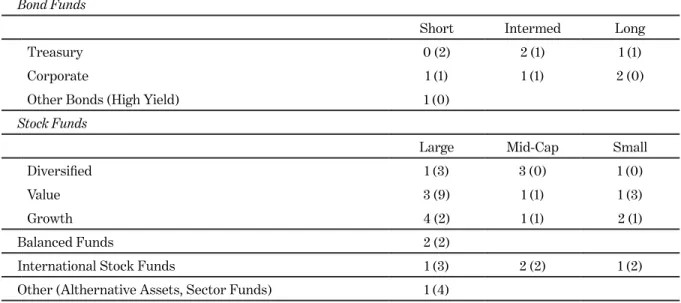
The result was the elimination of 39 funds from the initial lineup, based on fund expense ratios, the number of participants, and the aggregate amount invested in each fund. Remaining funds were allocated across a new 4-tier structure, where each successive tier would afford participants additional choice. Tier 1, selected as the default tier for participants not actively electing an investment mix, included 13 low-cost Target Date Funds. Additional tiers offered increasing flexibility of choice for participants seeking to make more customized and sophisticated allocations. Tier 2 included four indexed funds: Money Market, U.S. Diversified Stocks, U.S. Bonds, and Diversified International Stocks. Tier 3 included 32 funds arranged into separate “risk” categories illustrated in more detail in Table 1. The range of categories included: small/mid/ large-cap and value/growth stock funds; small/mid/large-cap international stock funds; short/intermediate/long-maturity and Treasury/corporate bond funds; balanced funds; and a passive equity REIT fund to provide access to the real estate asset class. Tier 4 constituted the brokerage account.
2 See also Beshears et al. (2013) who evaluated how a simple saving rate and asset allocation protocol in a DC plan affects the probability of participating and contribution rates conditional on participation; they did not, however, look at asset allocation patterns.
3 This was defined as the TDF with the target date closest to the year the participant would attain age 65. Under the Pension Protection Act of 2006, the US Department of Labor permits TDFs as QDIAs (qualified default investment alternatives) that can be used for participants who do not elect their own investment mix.
TABLE 1. DESCRIPTION OF FUND MENU POST- (AND PRE-) STREAMLINING
1 Three Money Market funds were eliminated. 2 Thirty-nine funds were eliminated.
Note: Post (pre) allocation computed as of end of December (June) 2012. Source: Authors’ calculations.
The plan sponsor announced its streamlined fund lineup in July 2012, with an implementation date of mid-October 2012. In addition to a newsletter sent to all participants, the employer created a custom website, broadcasted online webinars, sent targeted emails, held participant meetings, and sent hard copy mail to explain the changes.
3. DATA AND DESCRIPTIVE STATISTICS
To analyze the change in behavior post- versus pre-streamlining, we obtained access to information on the retirement plan account balances and periodic contributions of all (identity-censored) participants. Our dataset included information on contributions, balances, and asset allocation prior to the streamlining, defined in our analysis below as end of June 2012 and, after the change, defined as end of December 2012. To this file we appended information from public sources (via ticker and CUSIP numbers) for each fund’s equity fraction and style (bond, balanced, stock, etc.), as well as monthly return histories. The fund administrator also provided individual demographic information on participants’ age, sex, education (more than college versus not), and, from external sources, imputed household income (assigned according to participant zip codes where low was <$50,000; middle was $50,000-$100,000; and high was >$100,000).4
Using the participant balance and contribution data, we also construct variables to identify participants whose holdings were directly affected by the streamlining, as well as participants who, pre-streamlining, had actively adjusted their portfolio allocations. Specifically, we define Streamlined as a variable equal to 1 if the plan participant held funds at end of April 2012 that were subsequently deleted due to streamlining, and equal to 0 otherwise. We define Active as a variable equal to 1 if the plan participant made at least two exchanges in at least one month during the period July 2011–June 2012 prior to the streamlining, and equal to 0 otherwise.
4 These were derived from data supplied to the plan administrator from IXI Corporation (http://www.ixicorp.com/products-and-services/customer-targeting- and-scoring/wealthcomplete/) derived from zip+4 Census tract information.
Tier 1: 13 Target Date Funds
Tier 2: 4 Funds (Money Market, U.S. Diversified Stocks, U.S. Bonds, Int’l Stocks)1
Tier 3:32 Funds [Number of funds kept (Number of funds eliminated)]2 Bond Funds
Short Intermed Long
Treasury 0 (2) 2 (1) 1 (1)
Corporate 1 (1) 1 (1) 2 (0)
Other Bonds (High Yield) 1 (0)
Stock Funds
Large Mid-Cap Small
Diversified 1 (3) 3 (0) 1 (0)
Value 3 (9) 1 (1) 1 (3)
Growth 4 (2) 1 (1) 2 (1)
Balanced Funds 2 (2)
International Stock Funds 1 (3) 2 (2) 1 (2)
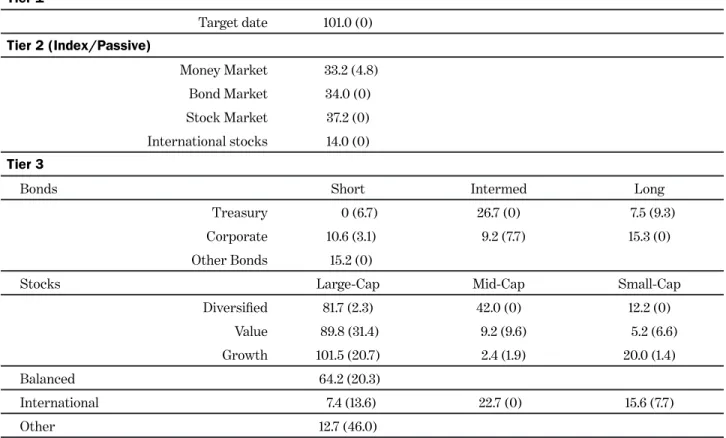
To better illustrate how the reform worked, we begin by reviewing descriptive statistics on the balances in the retained and deleted funds by risk category. We also compare key attributes of participants and their retirement plan investments as of end of June 2012 (our baseline). Table 2 reports aggregate balances held in retained and deleted funds by risk category, where of the almost $1 billion invested at end of June 2012, most of the assets (80%) were held in retained funds. Overall, 20% of the total assets were in funds that were subsequently deleted. Of those, about 60% had been in equity (stock, balanced, or international) funds, 24% in alternatives/sector funds, and 14% in bond funds (with the remainder in money market funds).
TABLE 2. TOTAL BALANCES IN RETAINED (AND DELETED) FUNDS BY RISK CATEGORY (AS OF END OF JUNE 2012; $ MILLIONS)
Source: Authors’ calculations.
In Table 3 we report aggregate dollar balances, the number of total participants, and the number of funds held by all plan participants at end of June 2012 (rightmost column), along with the same information for the streamlined participants (who owned at least one deleted fund) and the non-streamlined participants (who owned no deleted funds). The number of participants in each group was roughly similar (2,238 versus 2,271), but the streamlined group had accumulated almost 60% more in assets ($603.8 versus $380.0 million), contributed 30% more on a monthly basis ($1802 versus $1356 per participant), and held more funds (87 in total versus 47). On average, about one-third of the contributions from the streamlined participants were in funds that were subsequently deleted, and two-thirds in retained funds.
Tier 1 Target date 101.0 (0) Tier 2 (Index/Passive) Money Market 33.2 (4.8) Bond Market 34.0 (0) Stock Market 37.2 (0) International stocks 14.0 (0) Tier 3
Bonds Short Intermed Long
Treasury 0 (6.7) 26.7 (0) 7.5 (9.3)
Corporate 10.6 (3.1) 9.2 (7.7) 15.3 (0)
Other Bonds 15.2 (0)
Stocks Large-Cap Mid-Cap Small-Cap
Diversified 81.7 (2.3) 42.0 (0) 12.2 (0) Value 89.8 (31.4) 9.2 (9.6) 5.2 (6.6) Growth 101.5 (20.7) 2.4 (1.9) 20.0 (1.4) Balanced 64.2 (20.3) International 7.4 (13.6) 22.7 (0) 15.6 (7.7) Other 12.7 (46.0)
TABLE 3. BALANCES, NUMBER OF PARTICIPANTS, AND NUMBER OF FUNDS OWNED: STREAMLINED VS. NON-STREAMLINED PARTICIPANTS (AS OF END OF JUNE 2012)
Source: Authors’ calculations.
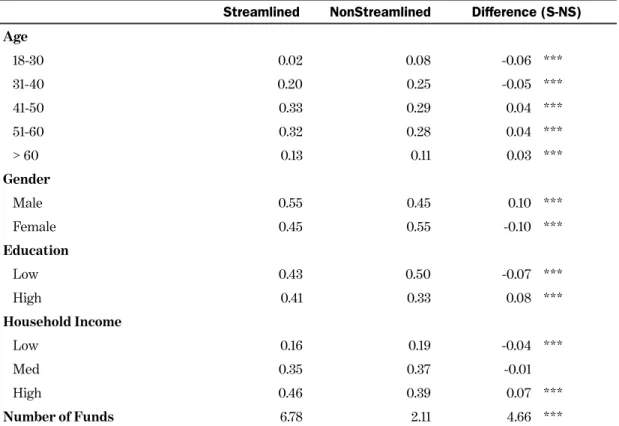
A comparison of characteristics for streamlined versus non-streamlined active participants appears in Table 4. The streamlined participants were significantly older, more likely to be male, and lived in higher-income households. They also held three times as many funds (6.8 versus 2.1) compared to the non-streamlined participants. Regarding asset allocations, Table 5 indicates that the streamlined participants were significantly more likely to contribute to stock funds (both
domestic and international), and less likely to elect target date funds compared to the non-streamlined participants. In other words, the streamlined participants held portfolios containing higher-volatility securities, on average.
TABLE 4. DIFFERENCES IN MEAN CHARACTERISTICS: STREAMLINED VS. NON-STREAMLINED PARTICIPANTS (AS OF END OF JUNE 2012)
Notes: * p<0.10, ** p<0.05, *** p<0.01. The low income group is defined to have household income of <$50,000; the middle group $50,000- to $100 ,000; and the high income group >$100,000.
Source: Authors’ calculations.
Streamlined Group Non-Streamlined Group Overall (N=2,238) (N=2,371) (N=4,609)
Total Balance ($Millions) 603.8 380.0 983.7
# participants 2,238 2,371 4,609
# funds 87 47 87
Contribution ($, per participant) Mean Median Mean Median Mean Median
To all funds 1,802 1,395 1,356 849 1,573 1,084
To Deleted funds 588 330
To Nondeleted funds 1,214 833
Streamlined NonStreamlined Difference (S-NS)
Age 18-30 0.02 0.08 -0.06 *** 31-40 0.20 0.25 -0.05 *** 41-50 0.33 0.29 0.04 *** 51-60 0.32 0.28 0.04 *** > 60 0.13 0.11 0.03 *** Gender Male 0.55 0.45 0.10 *** Female 0.45 0.55 -0.10 *** Education Low 0.43 0.50 -0.07 *** High 0.41 0.33 0.08 *** Household Income Low 0.16 0.19 -0.04 *** Med 0.35 0.37 -0.01 High 0.46 0.39 0.07 *** Number of Funds 6.78 2.11 4.66 ***
TABLE 5. DIFFERENCE IN DISTRIBUTION OF MEAN PARTICIPANT ASSET ALLOCATIONS: STREAMLINED VS. NON-STREAMLINED PARTICIPANTS (AS OF END OF JUNE 2012)
Note: * p<0.10; ** p<0.05; *** p<0.01 Source: Authors’ calculations.
4. CHANGES IN PORTFOLIO ALLOCATIONS: A FIRST LOOK
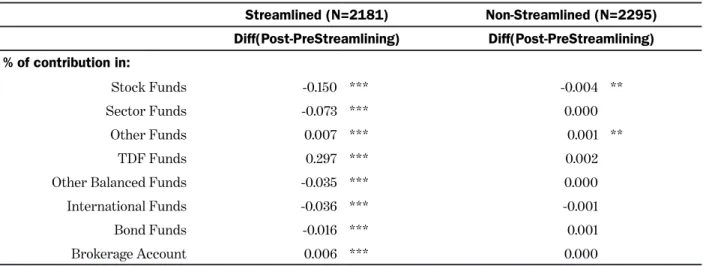
Table 6 reports how participants changed their retirement plan portfolios after the streamlining went into effect. In particular, we compare the allocation of retirement plan assets prior to (measured at end of June 2012), and after streamlining (end of December 2012). Overall, non-streamlined participants made virtually no changes to their portfolios. In contrast, the streamlined participants significantly reduced allocations to international, bond, and especially stock and sector funds, (in total a 27.1% reduction in contributions), shifting contributions mainly to TDFs.5
TABLE 6. DIFFERENCE IN MEAN PARTICIPANT ASSET ALLOCATIONS: POST- MINUS PRE-STREAMLINING (END OF DECEMBER VS END OF JUNE 2012)
Note: * p<0.10; ** p<0.05; *** p<0.01 Source: Authors’ calculations.
5 A small portion of the aggregate assets, $2.3 million, was also allocated to the brokerage account; relatively few participants did so (only 9% of those holding deleted funds prior to the change subsequently opened a brokerage account following the change). This may be because, at the time the brokerage accounts were announced, restrictions were imposed on the number of exchanges permitted in and out of certain funds each year. Also participants were informed that holdings in the brokerage account would incur special redemption fees of 1% (minimum $50, maximum $250) for no-transaction-fee funds; for transaction-fee funds, the participant would be charged $20 per transaction. These fees were eliminated prior to the actual change. In both cases the minimum investment was $1,000. Additional loads would depend on the share classes elected by each participant.
Streamlined Nonstreamlined Difference % of contribution in: (N=2,238) (N=2,371)
Stock Funds 0.45 0.28 0.18 ***
Sector Funds 0.07 0.00 0.07 ***
Other Funds 0.01 0.00 0.01 ***
TDF Funds 0.10 0.55 -0.46 ***
Other Balanced Funds 0.08 0.04 0.04 ***
International Funds 0.11 0.04 0.07 *** Bond Funds 0.17 0.08 0.09 *** Streamlined (N=2181) Non-Streamlined (N=2295) Diff(Post-PreStreamlining) Diff(Post-PreStreamlining) % of contribution in: Stock Funds -0.150 *** -0.004 ** Sector Funds -0.073 *** 0.000 Other Funds 0.007 *** 0.001 ** TDF Funds 0.297 *** 0.002
Other Balanced Funds -0.035 *** 0.000
International Funds -0.036 *** -0.001
Bond Funds -0.016 *** 0.001
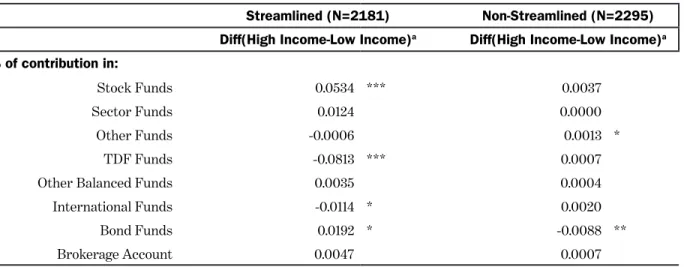
Within the streamlined group, Table 7 shows that higher-income group members were less likely to tilt toward the safer TDF funds, and they retained a relatively higher exposure to equity funds in the post-streamlining period relative to before.
TABLE 7. CHANGE IN MEAN PARTICIPANT ASSET ALLOCATIONS BY INCOME: POST- MINUS PRE-STREAMLINING (END OF DECEMBER VS END OF JUNE 2012)
Note: * p<0.10; ** p<0.05; *** p<0.01 Source: Authors’ calculations.
5. CHANGES IN PARTICIPANT PORTFOLIO CHARACTERISTICS AND RISKS: MULTIVARIATE ANALYSIS
Next we use multivariate regression analyses to analyze in more detail the post- versus pre-streamlining changes in the characteristics and risks of the portfolios of streamlined and non-streamlined participants. To measure these differences we use the variable Streamlined, along with the variable Active (the participant made at least two exchanges in at least one month July 2011–June 2012) to test whether the streamlining process affected the portfolios of the active participants differently than the non-active participants, plus an interaction between Streamlined and Active. Our analysis also controls for various observed attributes of individual participants: age and age-squared (to test for possible nonlinear effects); male or female; educational level (graduate degree or not); and high versus low household income.6 We estimate the change in portfolio characteristics over two intervals: end of June 2012 to end of December 2012 (the points in time analyzed in Tables 6 and 7), and also end of June 2012 to end of December 2013 (a longer interval that allows more time
for participants to adjust their portfolio allocations post-streamlining). 5.1 Changes in portfolio characteristics
In Table 8 we compare the effects of the reform on participant portfolio turnover rates, expense ratios, number of funds held, and percentage allocation to stocks for the portfolios of streamlined versus non-streamlined participants. Panel A (B) reports model estimates for the shorter (longer) post-streamlining period.
6 Recall, from section 3, that the low income group had household income of under $50,000; the middle group of $50,000-$100,000, and the high income group of over $100,000.
Streamlined (N=2181) Non-Streamlined (N=2295) Diff(High Income-Low Income)a Diff(High Income-Low Income)a
% of contribution in:
Stock Funds 0.0534 *** 0.0037
Sector Funds 0.0124 0.0000
Other Funds -0.0006 0.0013 *
TDF Funds -0.0813 *** 0.0007
Other Balanced Funds 0.0035 0.0004
International Funds -0.0114 * 0.0020
Bond Funds 0.0192 * -0.0088 **
TABLE 8A. CHANGES IN FRACTION OF PORTFOLIO INVESTED IN STOCKS, ANNUAL TURNOVER, EXPENSE RATIOS, AND NUMBER FUNDS HELD (END OF DECEMBER 2012 MINUS END OF JUNE 2012 BALANCES)
Δ%Stock ΔTurnover ΔExpRatio ΔNfunds
Explanatory Variables Mean
Streamlined 0.49 0.0029 -0.1079 *** -0.0362 *** -1.2166 *** Active 0.11 0.0379 ** 0.0090 -0.0002 0.1711 Streamlined*Active 0.08 -0.0550 *** -0.0314 ** -0.0090 * -0.9785 *** Age 47.64 0.0008 0.0043 * 0.0001 0.0195 Age**2 2383.79 0.0000 * -0.0001 ** 0.0000 -0.0001 Male 0.50 -0.0093 ** 0.0016 -0.0026 * -0.1175 ** Education gradschool 0.37 -0.0053 0.0100 * -0.0020 -0.0372 HH income low 0.18 -0.0013 -0.0107 -0.0041 * 0.1093 HH income high 0.42 -0.0030 0.0054 0.0004 0.0630 Balance/100k 2.10 0.0007 -0.0005 -0.0005 -0.0136 N 4,476 4,447 4,476 4,476 R-squared 0.02 0.09 0.15 0.16
Mean of dep var -0.007 -0.056 -0.021 -0.600
Note: * p<0.10, ** p<0.05, *** p<0.01. Dependent variables as follows: Δ%Stock is the % of the participant’s portfolio of funds invested in common stocks; ΔTurnover measures participant changes in overall annual portfolio turnover (post-pre); ΔExpRatio measures the change in annual participant expense ratios (post-pre) and Δ#funds measures the change in the number of funds held (post-pre). Values computed for each participant using end of December 2012 minus end of June 2012 balances. Source: Authors’ calculations.
TABLE 8B. CHANGES IN FRACTION OF PORTFOLIO INVESTED IN STOCKS, ANNUAL TURNOVER, EXPENSE RATIOS, AND NUMBER OF FUNDS HELD (END OF DECEMBER 2013 MINUS END OF JUNE 2012 BALANCES)
Δ%Stock ΔTurnover ΔExpRatio ΔNfunds
Explanatory Variables Mean
Streamlined 0.49 0.0201 *** -0.0983 *** -0.0249 *** -1.2043 *** Active 0.11 0.0735 *** -0.1117 *** 0.0067 0.3561 * Streamlined*Active 0.08 -0.0632 *** 0.0489 -0.0010 -1.0488 *** Age 47.66 -0.0014 -0.0007 -0.0076 *** 0.0111 Age**2 2384.89 0.0000 0.0000 0.0001 *** 0.0000 Male 0.50 -0.0171 *** 0.0025 -0.0067 ** -0.1115 * Education gradschool 0.37 -0.0086 * 0.0190 *** 0.0025 0.0025 HH income low 0.18 -0.0051 -0.0008 -0.0075 * 0.0730 HH income high 0.42 -0.0058 0.0129 -0.0042 0.0984 Balance/100k 2.11 0.0022 *** -0.0060 *** -0.0061 *** -0.0224 * N 4,434 4,406 4,434 4,434 R-squared 0.02 0.10 0.12 0.11
Mean of dep var 0.007 -0.113 -0.076 -0.487
Note: * p<0.10, ** p<0.05, *** p<0.01. Dependent variables as follows: Δ%Stock is the % of the participant’s portfolio of funds invested in common stocks; ΔTurnover measures participant changes in overall annual portfolio turnover (post-pre); ΔExpRatio measures the change in annual participant expense ratios (post-pre) and Δ#funds measures the change in the number of funds held (post-pre). Values computed for each participant using end of December 2013 minus end of June 2012 balances. Source: Authors’ calculations.
Over the shorter interval (Table 8A), we find that, relative to their unaffected counterparts, streamlined participants displayed significantly greater reductions in portfolio turnover, larger reductions in expense ratios, and a larger decline in the number of funds held. Moreover, these reductions were larger for the subset of streamlined participants also classified as active traders. For example, the reduction in the expense ratio was 36.2 bps larger for the streamlined participants relative to non-streamlined, and this decline was nearly one basis point greater for the active members of the streamlined sample. While the change in the percentage of the portfolio allocated to stocks over the shorter interval was not different for the streamlined versus the non-streamlined participants, there are interesting changes in stock allocations for the active participants. Specifically, the active subsample overall significantly increased its stock allocations by 3.8% by the end of December 2012; the active members of the streamlined group experienced a statistically and economically significant 5.5% reduction in stock allocations as a result of the streamlining.
One possible reason for this difference could be that active traders who were in the streamlined group re-established a portion of their equity allocations via transactions in the brokerage window. We lack data on these non-plan investments, but it will be recalled that few assets were moved to the brokerage option. We also find that the reductions in stock allocations, expense ratios, and number of funds held were greater for men than for women, consistent with Barber and Odean’s (2001) report that male individual investors in the stock market traded more aggressively than did female investors.
The main message of Table 8B is simple: changes in portfolio characteristics caused by the reform that were evident over the shorter interval in Panel A largely remained intact for the entire 2013 calendar year. Accordingly, the initial effects of the reform were not undone by participant transactions over the subsequent twelve months.
These effects are not only statistically significant, but also economically important. That is, the (unconditional) average reduction in the annual expense ratio for the streamlined group was 4.0bp (=27.9bp – 23.9bp), or a $0.242 million annual cost savings (based on the pre-streamlining balance for the streamlined group of $603.8 million at end of June 2012). Given that the average age of the streamlined participants was 49 in April 2012, if these savings could be achieved on an ongoing basis over 20 years and reinvested at 5% annually, the accumulated benefit would amount to $8.40 million, or around $4,000 per participant. Additionally, the (unconditional) average decline in annual turnover for the streamlined group was 11.3% (=35.2% – 23.9%). Based on the streamlined group balance of $603.8 million at end of June 2012 and assuming round-trip transaction costs of 0.50%, this could translate into an annual aggregate cost savings of $0.341 million.7 If such savings could be achieved on an ongoing basis over 20 years and reinvested at 5% annually, the accumulated additional benefit would be $11.8 million, or $5,400 per participant. In total, the per-participant savings could be over $9,400 per participant. 5.2 Changes in portfolio risks
We also examine how participant portfolio risks changed by comparing pre- versus post-streamlining positions. To this end, we first estimate the factor-related systematic risks and diversifiable (idiosyncratic) risks for both retained and deleted funds, using a model similar to Fama-French (1993) in which the estimated coefficients measure each fund’s exposures to systematic factor risks:
Here refers to the excess return of fund i over the risk-free rate (the one-month Treasury bill rate from Ibbotson Associates); refers to the value-weighted return on all NYSE, AMEX, and NASDAQ stocks (from CRSP) minus the risk-free rate; SmB refers to the difference in the performance of small relative to big stocks; HmL to the difference in performance of value stocks to growth stocks; WmL is a momentum factor premium measuring the difference in performance of past winner and past loser stocks; Term measures the difference between the monthly long-term government bond return (from Ibbotson Associates) and the one-month Treasury bill rate measured at the end of the previous month (from the Center for Research in Security Prices, CRSP); and Def measures the difference between the 7 We compute this as $603.8 x (0.113 x 2 x 0.025).
return on a market portfolio of long-term corporate bonds (the Composite portfolio in the corporate bond module of Ibbotson Associates) and the monthly long-term Treasury bond return. The fund’s diversifiable (idiosyncratic) risk is measured as σ(e), the standard deviation of the regression residuals.
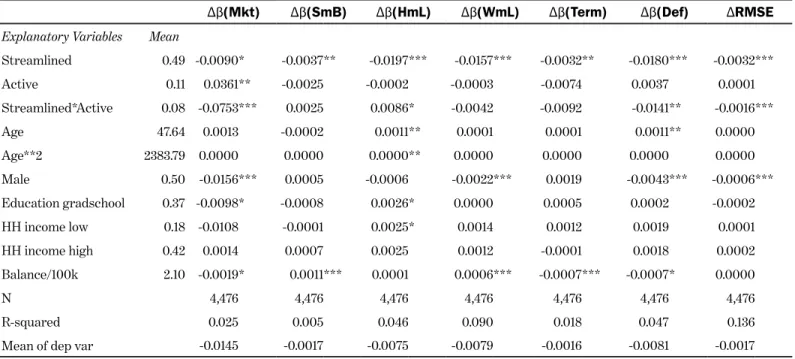
Having estimated the model parameters representing systematic and idiosyncratic risks, we next compute for each participant the systematic and idiosyncratic risks specific to his or her own portfolio, using his portfolio weights of end of June 2012 and end of December 2012. Finally, we regress the post−pre changes in systematic and idiosyncratic risks on Streamlined, Active, the interaction between Streamlined and Active, and our control variables. Results appear in Table 9, where Panel A (B) reports model estimates for the shorter (longer) post-streamlining period.
TABLE 9A. CHANGE IN PARTICIPANT PORTFOLIO SYSTEMATIC AND IDIOSYNCRATIC RISK EXPOSURES (END OF DECEMBER 2012 MINUS END OF JUNE 2012 BALANCES)
Note: *p<0.10, **p<0.05, ***p<0.01. Post-Pre dependent variables measured as follows: Δβ(Mkt) measures changes in participants’ exposure to market risk; Δβ(SmB) measures changes in participants’exposure tothe difference in performance of small relative to big stocks; Δβ(HmL) measures changes in participants’ exposure to the difference in performance of value stocks to growth stocks; ; Δβ(Term) refers to changes in participants’ exposure to the difference in returns on a market portfolio of long-term corporate bonds and the one-month Treasury bill rate measured at the end of the previous month; and Δβ(Def) measures changes in participants’ exposure to the difference between the monthly long-term government bond return and the one-month Treasury bill rate; and ΔRMSE is the standard deviation of the residuals from the six-factor model in section 5.2. Values are computed for each participant using end of December 2012 minus end of June 2012 balances. Source: Authors’ calculations; see variable descriptions in text.
Δβ(Mkt) Δβ(SmB) Δβ(HmL) Δβ(WmL) Δβ(Term) Δβ(Def) ΔRMSE
Explanatory Variables Mean
Streamlined 0.49 -0.0090* -0.0037** -0.0197*** -0.0157*** -0.0032** -0.0180*** -0.0032*** Active 0.11 0.0361** -0.0025 -0.0002 -0.0003 -0.0074 0.0037 0.0001 Streamlined*Active 0.08 -0.0753*** 0.0025 0.0086* -0.0042 -0.0092 -0.0141** -0.0016*** Age 47.64 0.0013 -0.0002 0.0011** 0.0001 0.0001 0.0011** 0.0000 Age**2 2383.79 0.0000 0.0000 0.0000** 0.0000 0.0000 0.0000 0.0000 Male 0.50 -0.0156*** 0.0005 -0.0006 -0.0022*** 0.0019 -0.0043*** -0.0006*** Education gradschool 0.37 -0.0098* -0.0008 0.0026* 0.0000 0.0005 0.0002 -0.0002 HH income low 0.18 -0.0108 -0.0001 0.0025* 0.0014 0.0012 0.0019 0.0001 HH income high 0.42 0.0014 0.0007 0.0025 0.0012 -0.0001 0.0018 0.0002 Balance/100k 2.10 -0.0019* 0.0011*** 0.0001 0.0006*** -0.0007*** -0.0007* 0.0000 N 4,476 4,476 4,476 4,476 4,476 4,476 4,476 R-squared 0.025 0.005 0.046 0.090 0.018 0.047 0.136
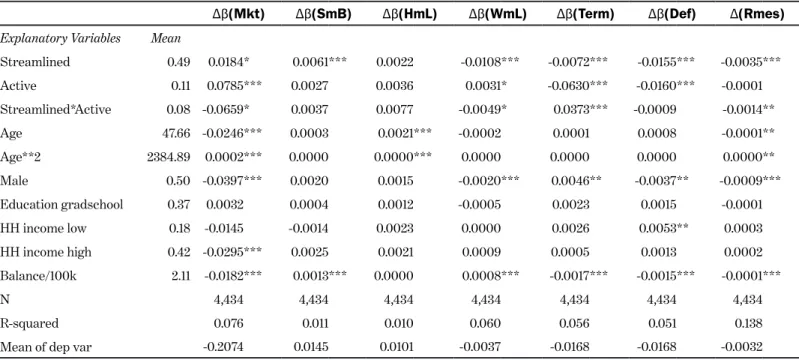
TABLE 9B. CHANGE IN PARTICIPANT PORTFOLIO SYSTEMATIC AND IDIOSYNCRATIC RISK EXPOSURES (END OF DECEMBER 2013 MINUS END OF JUNE 2012 BALANCES)
Note: *p<0.10, **p<0.05, ***p<0.01. Post-Pre dependent variables measured as follows: Δβ(Mkt) measures changes in participants’ exposure to market risk; Δβ(SmB) measures changes in participants’exposure tothe difference in performance of small relative to big stocks; Δβ(HmL) measures changes in participants’ exposure to the difference in performance of value stocks to growth stocks; ; Δβ(Term) refers to changes in participants’ exposure to the difference in returns on a market portfolio of long-term corporate bonds and the one-month Treasury bill rate measured at the end of the previous month; Δβ(Def) measures changes in participants’ exposure to the difference between the monthly long-term government bond return and the one-month Treasury bill rate; and ΔRMSE is the standard deviation of the residuals from the six-factor model in section 5.2. Values are computed for each participant using end of December 2013 minus end of June 2012 balances. Source: Authors’ calculations; see variable descriptions in text.
Table 9A shows that the streamlined participants’ portfolios after the reform exhibited significantly lower systematic risk relative to the non-streamlined participants. In aggregate, streamlined participants’ portfolios exhibited significantly less ‘tilt’ toward systematic sources of variation. By contrast, there is little evidence of post- versus pre-streamlining change in systematic risk exposures between the active and non-active participants. An exception, however, is seen in exposure to the market risk factor, mimicking the changes in broad stock market exposure described in Table 8. Overall, the active participants increased their market beta by 0.036 by the end of December 2012, but the active members of the streamlined group significantly reduced market beta by 0.075 as a result of the streamlining. We also find that the reform resulted in a significant reduction in idiosyncratic risk for the streamlined group relative to their non-streamlined peers, and that this reduction was even greater for active members of the streamlined group. Finally, we also find that the reduction in idiosyncratic risk was greater for male versus female participants, as were reductions in exposures to the market, momentum stock risk factors, and both bond risk factors. These last findings are again consistent with the results in Barber and Odean (2001), albeit in the retirement plan setting rather than for online brokerage accounts. It is also worth pointing out that many of these changes in risk exposure are most pronounced for participants with larger, versus smaller, portfolio balances.
As with our discussion above about portfolio characteristics, the main message from Table 9B is clear: the changes in portfolio risks produced by the reform seen for the shorter interval in Panel A largely remained intact through the entire 2013 calendar year. Accordingly, the initial effects of the reform were not undone by participant transactions over the subsequent 12 months.
Δβ(Mkt) Δβ(SmB) Δβ(HmL) Δβ(WmL) Δβ(Term) Δβ(Def) Δ(Rmes)
Explanatory Variables Mean
Streamlined 0.49 0.0184* 0.0061*** 0.0022 -0.0108*** -0.0072*** -0.0155*** -0.0035*** Active 0.11 0.0785*** 0.0027 0.0036 0.0031* -0.0630*** -0.0160*** -0.0001 Streamlined*Active 0.08 -0.0659* 0.0037 0.0077 -0.0049* 0.0373*** -0.0009 -0.0014** Age 47.66 -0.0246*** 0.0003 0.0021*** -0.0002 0.0001 0.0008 -0.0001** Age**2 2384.89 0.0002*** 0.0000 0.0000*** 0.0000 0.0000 0.0000 0.0000** Male 0.50 -0.0397*** 0.0020 0.0015 -0.0020*** 0.0046** -0.0037** -0.0009*** Education gradschool 0.37 0.0032 0.0004 0.0012 -0.0005 0.0023 0.0015 -0.0001 HH income low 0.18 -0.0145 -0.0014 0.0023 0.0000 0.0026 0.0053** 0.0003 HH income high 0.42 -0.0295*** 0.0025 0.0021 0.0009 0.0005 0.0013 0.0002 Balance/100k 2.11 -0.0182*** 0.0013*** 0.0000 0.0008*** -0.0017*** -0.0015*** -0.0001*** N 4,434 4,434 4,434 4,434 4,434 4,434 4,434 R-squared 0.076 0.011 0.010 0.060 0.056 0.051 0.138
To summarize the results in this section, the streamlining of the DC plan described here had a statistically significant and economically potent impact on the characteristics and risks of participant portfolios. Specifically, turnover in participants’ retirement portfolios (a significant cause of largely unseen transaction costs), and the expense ratios of those portfolios, were significantly reduced; and systematic/non-diversifiable as well as idiosyncratic/diversifiable risks were also
significantly curtailed. As such, our results complement and extend previous studies which suggested that simplification enhances retirement saving (e.g., Beshears et al. 2013), though previous work has focused only on participation and contributions, not on asset allocation outcomes as here.
6. CONCLUSIONS
This study examines the salutary effects of streamlining the DC fund menu by deleting some funds and tiering options in an easier-to-understand format. While recent studies have evaluated how simplification can influence participation and contributions, they have not examined how streamlining changes investment patterns. Our analysis examines how halving the fund menu while including a new brokerage account changed investment behavior at a large nonprofit institution. We find that participants who initially held at least one deleted fund were relatively older, more likely to be male, and earned higher incomes; they also held higher balances in riskier funds and lower balances in safer/balanced/ target date funds. Interestingly, in response to the changed lineup, only 9% of these participants moved any money at all into the new brokerage window, taking only 0.2% of assets. Moreover, streamlined participants’ new allocations contained significantly fewer funds and had significantly lower exposure to non-market systematic risks; they also contained a much lower allocation to stocks. Streamlined participants’ new allocations also exhibited significantly lower turnover rates and expense ratios, which, based on reasonable assumptions, could lead to potential accumulated savings for these participants over a 20-year period of $20.2 million, or more than $9,400 per participant.
The changes we have discerned are important, particularly given regulators’ growing interest in retirement plan fees and costs. As one example, recent U.S. Department of Labor guidance to plan participants alerted members to the possibility that costs may rise as investment options become more numerous.8 Such costs, in turn, can reduce the size of the nest egg available for retirement. Additionally, employers in their plan fiduciary capacity are charged under pension law with managing retirement plans in the best interests of participants.9 Our work implies that plan sponsors would do well to recognize that the length and complexity of the plan menu matters. Accordingly, our results should be of substantial interest to those seeking to improve defined contribution retirement plan design, including employers, fund providers, consultants, and regulators.
8 For instance, the U.S. Department of Labor (USDOL) states on its website (http://www.dol.gov/ebsa/publications/401k_employee.html). In recent years, there has been a dramatic increase in the number of investment options typically offered under 401(k) plans as well as the level and types of services provided to participants. These changes give today’s employees who direct their 401(k) investments greater opportunity than ever before to affect their retirement savings. As a participant you may welcome the variety of investment options and the additional services, but you may not be aware of their cost. As shown above, the cumulative effect of the fees and expenses on your retirement savings can be substantial.”
9 That is, plan sponsors must “ensure that fees paid to service providers and other expenses of the plan are reasonable in light of the level and quality of services provided; and select investment options that are prudent and adequately diversified; disclose plan, investment, and fee information to participants to make informed decisions regarding their investment options under the plan; and monitor investment options and service providers once selected to see that they continue to be appropriate choices.” (http://www.dol.gov/ebsa/publications/401k_employee.html)
REFERENCES
Barber, B. and T. Odean. 2001. “Boys will be Boys: Gender, Overconfidence, and Common Stock Investment” Quarterly Journal of Economics 116(1): 261-292
Benartzi, S., and R. Thaler. 2001. “Naıve Diversification Strategies in Defined Contribution Saving Plans. American Economic Review. 91: 79–98.
Beshears, J., J. Choi, D. Laibson, and B. Madrian. 2013. “Simplification and Saving.” Journal of Economic Behavior & Organization 95: 130– 145
Brown, J., N. Liang, and S. Weisbenner. 2007. “Individual Account Investment Options and Portfolio Choice: Behavioral Lessons from 401(k) Plans.” Journal of Public Economics. 91(10): 1992-2013.
Choi, J., D. Laibson, and B. Madrian. 2004. “Plan Design and 401(k) Savings Outcomes.” National Tax Journal 57: 275-298. Fama, Eugene and Kenneth R. French. (1993). “Common Risk Factors in the Returns on Stocks and Bonds.”
Journal of Financial Economics 33: 3-56.
Huberman, G., S. Iyengar, and W. Jiang, W. 2007. Defined Contribution Pension Plans: Determinants of Participation and Contribution Rates. Journal of Financial Services Research, 31(1): 1-32.
Huberman, G. and W. Jiang. 2006. “Offering vs. Choice in 401(k) Plans: Equity Exposure and Number of Funds.” Journal of Finance. 61 (2): 763–801.
Iyengar, Sheena S. and Mark Lepper. 2000. “When Choice is Demotivating: Can One Desire Too Much of a Good Thing?” Journal of Personality and Social Psychology 76: 995-1006.
Iyengar, S., W. Jiang, and G. Huberman. 2004. “How Much Choice is Too Much? Contributions to 401(k) Retirement Plans.” In Pension Design and Structure: New Lessons from Behavioral Finance. Eds. O. S. Mitchell and S. P. Utkus. Oxford University Press: 83-95.
Madrian, B., and D. Shea. 2001. “The Power of Suggestion: Inertia in 401(k) Participation and Saving Behavior.” Quarterly Journal of Economics 116(4): 1149-1187.
Mitchell, O. S., and S. P. Utkus. 2006. “How Behavioral Finance Can Inform Retirement Plan Design.” Journal of Applied Corporate Finance. 18(1): 82-94
Mitchell, O. S. and S. P. Utkus. 2012. “Target-Date Funds and Portfolio Selection in 401(k) Plans.” NBER WP 17911. Morrin, M., J. Inman, S. Broniarczyk, G. Nenkov, and J. Reuter. 2012. “Investing for Retirement: The Moderating Effect
of Fund Assortment Size on the 1/N Heuristic.” Journal of Marketing Research 49(4): 537-550.
Tang, N., O.S. Mitchell, G. Mottola, and S. Utkus. (2010). “The Efficiency of Sponsor and Participant Portfolio Choices in 401(k) Plans.” Journal of Public Economics. 94: 1073-1085
U.S. Department of Labor (US DOL). nd. “A Look At 401(k) Plan Fees.” http://www.dol.gov/ebsa/publications/401k_ employee.html
U.S. Department of Labor (US DOL). 2014. “Private Pension Plan Bulletin Historical Tables and Graphs.” Employee Benefits Security Administration, September. http://www.dol.gov/ebsa/pdf/historicaltables.pdf