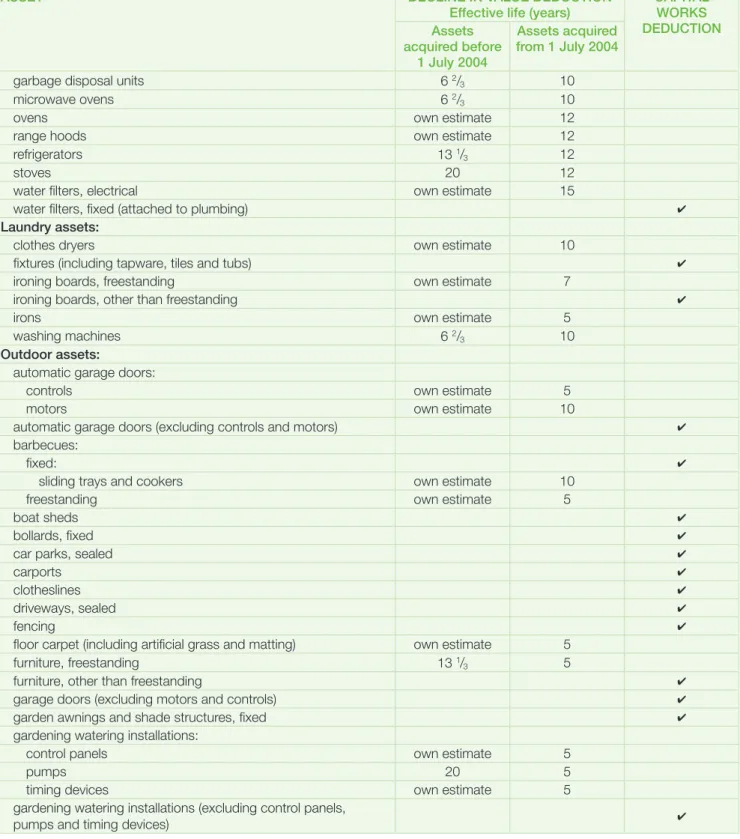
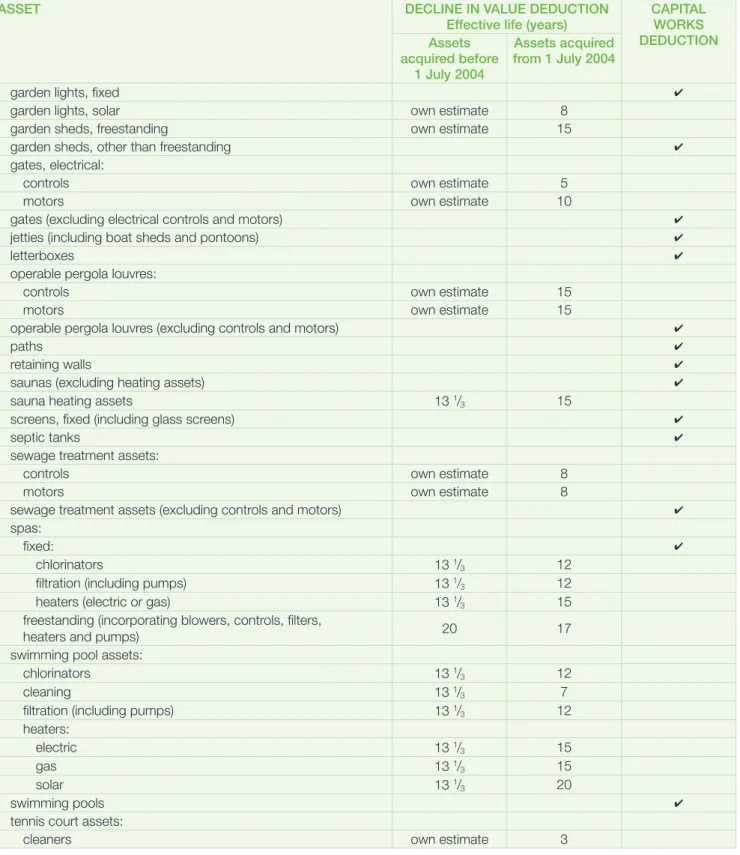
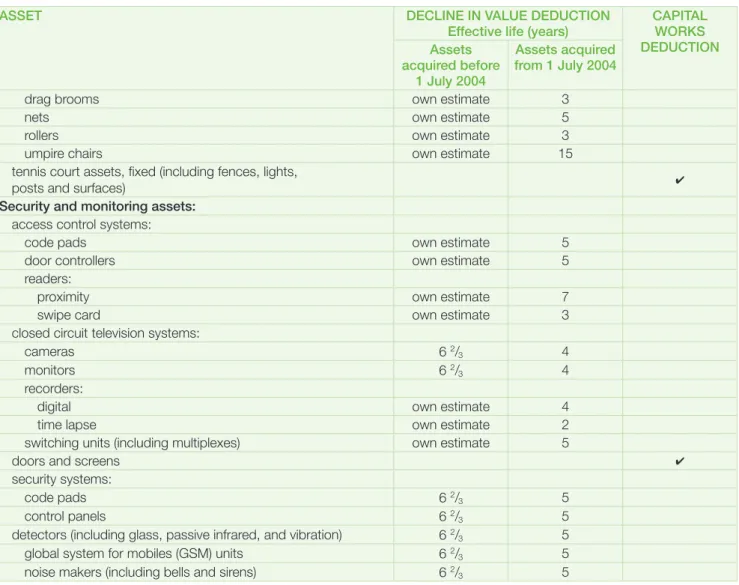
For more information go to ato.gov.au
Rental properties
2014
This guide explains how to treat rental income and expenses,
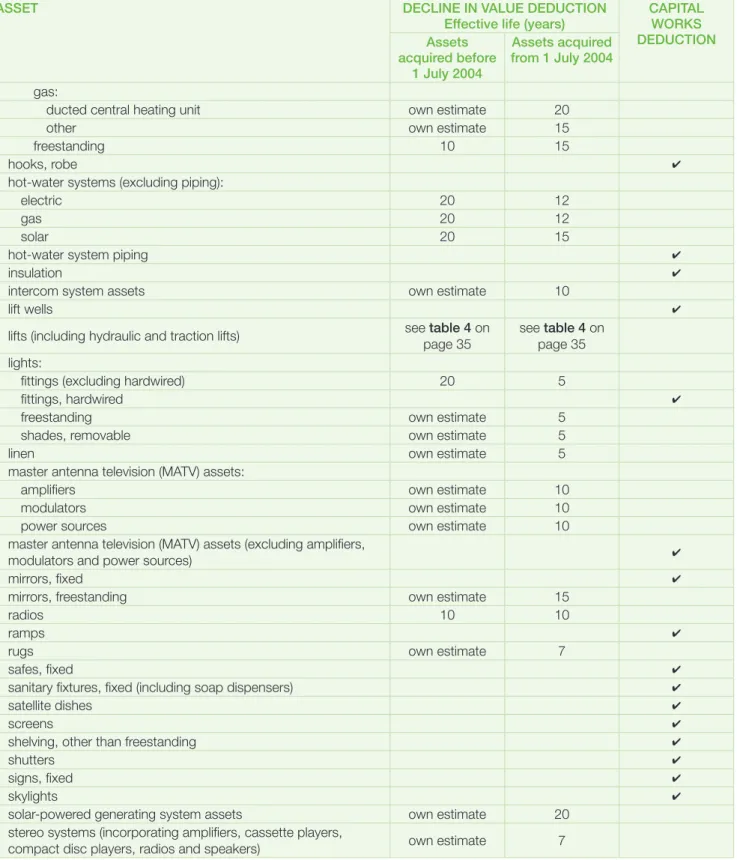
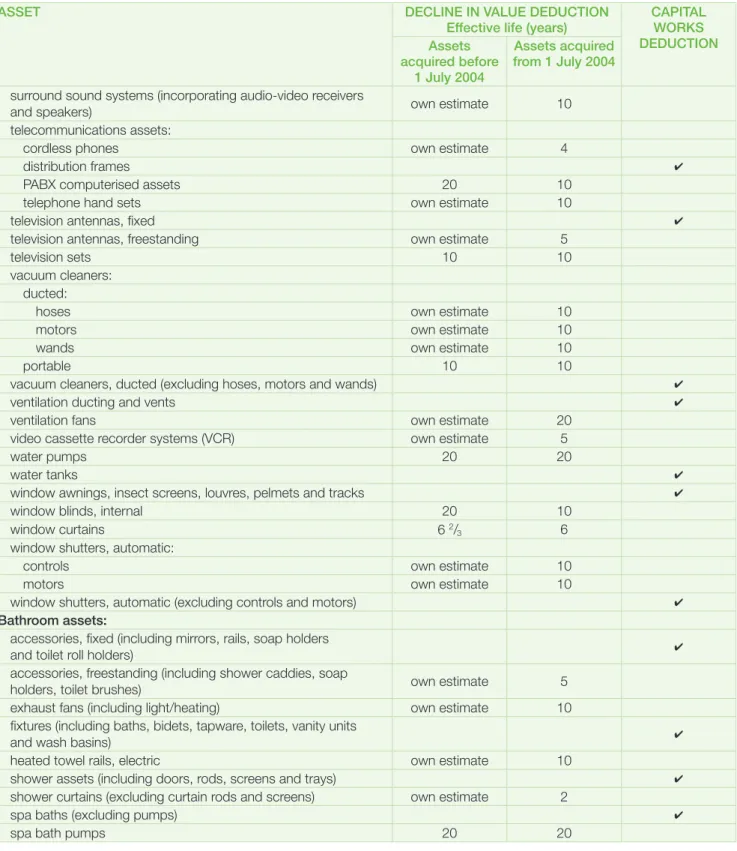
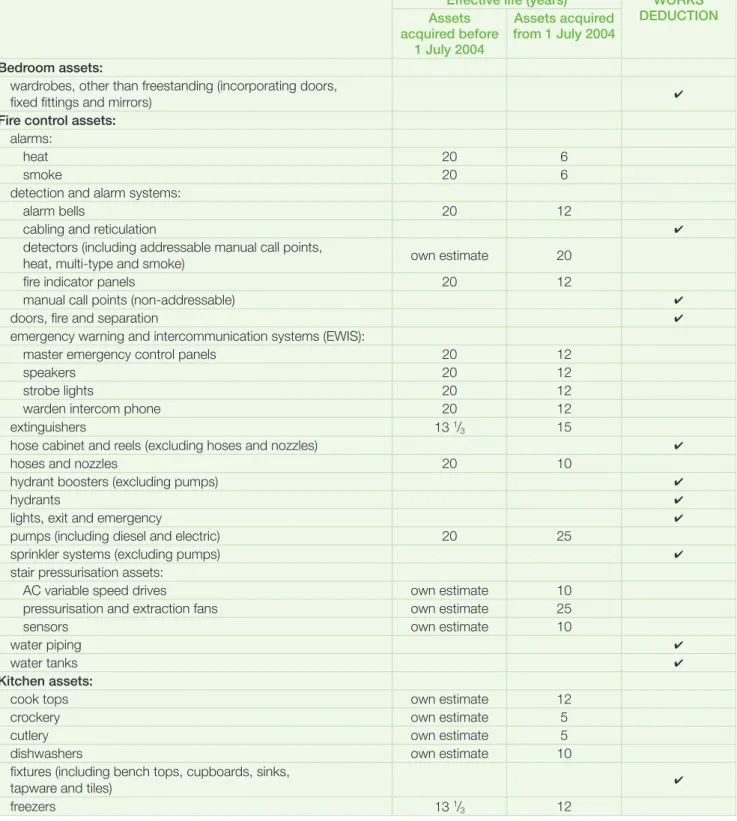
including how to treat more than 230 residential rental property items
OUR COMMITMENT TO YOU
We are committed to providing you with accurate, consistent and clear information to help you understand your rights and entitlements and meet your obligations. If you follow our information in this publication and it turns out to be incorrect, or it is misleading and you make a mistake as a result, we must still apply the law correctly. If that means you owe us money, we must ask you to pay it but we will not charge you a penalty. Also, if you acted reasonably and in good faith we will not charge you interest.
If you make an honest mistake in trying to follow our information in this publication and you owe us money as a result, we will not charge you a penalty. However, we will ask you to pay the money, and we may also charge you interest. If correcting the mistake means we owe you money, we will pay it to you. We will also pay you any interest you are entitled to.
If you feel that this publication does not fully cover your circumstances, or you are unsure how it applies to you, you can seek further assistance from us.
We regularly revise our publications to take account of any changes to the law, so make sure that you have the latest information. If you are unsure, you can check for more recent information on our website at ato.gov.au or contact us.
This publication was current at May 2014.
HOW SELF-ASSESSMENT AFFECTS YOU Self-assessment means the ATO uses the information you give on your tax return and any related schedules and forms to work out your refund or tax liability. We do not take any responsibility for checking the accuracy of the details you provide, although our system automatically checks the arithmetic.
Although we do not check the accuracy of your tax return at the time of processing, at a later date we may examine the details more thoroughly by reviewing specific parts, or by conducting an audit of your tax affairs. We also have a number of audit programs that are designed to continually check for missing, inaccurate or incomplete information.
© AUSTRALIAN TAXATION OFFICE FOR THE COMMONWEALTH OF AUSTRALIA, 2014
You are free to copy, adapt, modify, transmit and distribute this material as you wish (but not in any way that suggests the ATO or the Commonwealth endorses you or any of your services or products).
PUBLISHED BY Australian Taxation Office Canberra
May 2014 JS 29308
What are your responsibilities?
It is your responsibility to lodge a tax return that is signed, complete and correct. Even if someone else – including a tax agent – helps you to prepare your tax return and any related schedules, you are still legally responsible for the accuracy of your information.
What if you lodge an incorrect tax return? If you become aware that your tax return is incorrect, you must contact us straight away.
Initiatives to complement self-assessment There are a number of systems and entitlements that complement self-assessment, including:
n the private ruling system (see below)
n the amendment system (if you find you have left something out of your tax return)
n your entitlement to interest on early payment or over-payment of a tax debt.
Do you need to ask for a private ruling? If you are uncertain about how a tax law applies to your personal tax affairs, you can ask for a private ruling. To do this, complete a Private ruling application form (not for tax professionals) (NAT 13742), or contact us.
Lodge your tax return by the due date, even if you are waiting for the response to your application. You may need to request an amendment to your tax return once you have received the private ruling.
We publish all private rulings on our website. We edit the text to remove all information that could identify you.
Rental properties
CONTENTS
INTRODUCTION 3
Tax and natural disasters 3
Publications and services 3
Is your rental property outside Australia? 3
RENTAL INCOME 4
Rental-related income 4
Co-ownership of rental property 4
RENTAL EXPENSES 7
Types of rental expenses 7
Expenses for which you cannot claim deductions 9 Expenses for which you can claim an
immediate deduction 9
Expenses deductible over a number
of income years 14
WORKSHEET 22
OTHER TAX CONSIDERATIONS 23
Capital gains tax (CGT) 23
General value shifting regime 23
Goods and services tax (GST) 23
Keeping records 23
Negative gearing 24
Pay as you go (PAYG) instalments 24
RESIDENTIAL RENTAL PROPERTY ASSETS 25
Which deductions can you claim? 25
Definitions 25
Residential rental property items 27
Rental properties 2014 will help you, as an owner of rental property in Australia, determine:
n which rental income is assessable for tax purposes n which expenses are allowable deductions
n which records you need to keep
n what you need to know when you sell your rental property.
Many, but not all, of the expenses associated with rental properties will be deductible. This guide explains:
n how to apportion your expenses if only part of them
are tax deductible
n what expenses are not deductible
n when you can claim those expenses that are deductible
– some you can claim in the year they occur – others must be claimed over a number of years
(including decline in value of depreciating assets
and capital works expenses).
When you own a rental property, you may also need to know about capital gains and goods and services taxes, negative gearing, pay as you go (PAYG) instalments and the effects of the general value shifting regime. This guide explains these at pages 23–24.
TAX AND NATURAL DISASTERS
We have special arrangements for people affected by natural disasters such as a cyclone, flood or fire occuring
during the financial year. For more information go to
ato.gov.au and search for ‘Dealing with disasters’. If your tax records were lost or destroyed, we can help you to reconstruct them, and make reasonable estimates where necessary.
Phone our emergency support team on 1800 806 218
and we can discuss the best way we can help you.
We can also:
n fast track refunds
n give you extra time to pay debts, without interest charges n give you more time to meet activity statement, income
tax and other lodgment obligations, without penalties
n help you if you are experiencing serious hardship.
PUBLICATIONS AND SERVICES
To find out how to get a publication referred to in this guide and for information about our other services,
see More information.
IS YOUR RENTAL PROPERTY
OUTSIDE AUSTRALIA?
If your property is located outside Australia, special rules apply to the deductibility of your rental property expenses. Question 20 in Individual tax return instructions supplement 2014 contains further information on foreign source income. If you are unsure of your obligations, contact your recognised tax adviser or us.
The examples given in this publication featuring Mr and
Mrs Hitchman are based on the assumption that the Hitchmans own their rental properties as joint tenants who are not carrying on a rental property business.
Rental and other rental-related income is the full amount of rent and associated payments that you receive, or become entitled to, when you rent out your property, whether it is paid to you or your agent. You must include your share
of the full amount of rent you earn in your tax return.
Associated payments may be in the form of goods and services. You will need to work out the monetary value of these.
RENTAL-RELATED INCOME
You must include rental bond money as income if you become entitled to retain it, for instance, because a tenant defaulted on the rent, or because damage to your rental property required repairs or maintenance.
If you received an insurance payout, there may be situations where the payout needs to be included as income, for example, if you received an insurance payment to compensate you for lost rent.
If you received a letting or booking fee, you must include this as part of your rental income.
Associated payments include all amounts you receive,
or become entitled to, as part of the normal, repetitive and recurrent activities through which you intend to
generate profit from the use of your rental property. If you received a reimbursement or recoupment for deductible expenditure, you may have to include an amount as income. For example, if you received:
n an amount from a tenant to cover the cost of repairing
damage to some part of your rental property and you can claim a deduction for the cost of the repairs, you need to include the whole amount in your income
n a government rebate for the purchase of a depreciating
asset, such as a solar hot-water system, you may need to include an amount in your income. For more information, see Taxation Determination TD 2006/31 – Income tax: is a government rebate received by a rental property owner an assessable recoupment under subsection 20-20(3) of the Income Tax Assessment Act 1997, where the owner is not carrying on a property rental business and receives the rebate for the purchase of a depreciating asset (for example, an energy saving appliance) for use in the rental property.
You must include as rental income any assessable amounts relating to limited recourse debt arrangements involving your rental property. For more information, see Limited recourse debt arrangements on page 21 and see the Guide to depreciating assets 2014 (NAT 1996).
CO-OWNERSHIP OF RENTAL PROPERTY The way that rental income and expenses are divided between co-owners varies depending on whether the
co‑owners are joint tenants or tenants in common or there
is a partnership carrying on a rental property business. Co-owners of an investment
property (not in business)
A person who simply co-owns an investment property
or several investment properties is usually regarded as an
investor who is not carrying on a rental property business, either alone or with the other co-owners. This is because of the limited scope of the rental property activities and the limited degree to which a co-owner actively participates in rental property activities.
Dividing income and expenses according to legal interest
Co-owners who are not carrying on a rental property business must divide the income and expenses for the rental property in line with their legal interest in the property. If they own the property as:
n joint tenants, they each hold an equal interest in the
property
n tenants in common, they may hold unequal interests in
the property, for example, one may hold a 20% interest and the other an 80% interest.
Rental income and expenses must be attributed to each co-owner according to their legal interest in the property, despite any agreement between co-owners, either oral or in writing, stating otherwise.
EXAMPLE 1: Joint tenants
Mr and Mrs Hitchman own an investment rental property as joint tenants. Their activity is insufficient for them to be
characterised as carrying on a rental property business.
In the relevant income year, Mrs Hitchman phones us
and asks if she can claim 80% of the rental loss. Mrs
Hitchman says she is earning $67,000 a year, and Mr Hitchman is earning $31,000. Therefore, it would be
better if she claimed most of the rental loss, as she would
save more tax. Mrs Hitchman thought it was fair that she
claimed a bigger loss because most of the expenses were paid out of her wages. Under a partnership
agreement drawn up by the Hitchmans, Mrs Hitchman is supposed to claim 80% of any rental loss.
Mrs Hitchman was told that where two people own a rental property as joint tenants, the net rental loss must
be shared in line with their legal interest in the property.
Therefore, the Hitchmans must each include half of the
total income and expenses in their tax returns.
Any agreement that the Hitchmans might draw up
to divide the income and expenses in proportions other than equal shares has no effect for income tax
purposes. Therefore, even if Mrs Hitchman paid most
of the bills associated with the rental property, she would not be able to claim more of the rental property
deductions than Mr Hitchman.
EXAMPLE 2: Tenants in common
In example 1, if the Hitchmans owned their property as tenants in common in equal shares, Mrs Hitchman
would still be able to claim only 50% of the total property deductions.
However, if Mrs Hitchman’s legal interest was 75% and Mr Hitchman’s legal interest was 25%, Mrs Hitchman would have to include 75% of the income and expenses on her tax return and Mr Hitchman
would have to include 25% of the income and expenses on his tax return.
Interest on money borrowed by only one of the co-owners which is exclusively used to acquire that person’s interest
in the rental property does not need to be divided between
all of the co-owners.
If you don’t know whether you hold your legal interest
as a joint tenant or a tenant in common, read the title
deed for the rental property. If you are unsure whether your activities constitute a rental property business, see Partners carrying on a rental property business in the next column.
EXAMPLE 3: Co-owners who are not carrying on a rental property business
The Tobins own, as joint tenants, two units and a
house from which they derive rental income. The Tobins occasionally inspect the properties and also interview prospective tenants. Mr Tobin performs most repairs and maintenance on the properties himself, although he generally relies on the tenants to let him know what is required. The Tobins do any cleaning or maintenance that is required when tenants move out. Arrangements have been made with the tenants for the weekly rent to be paid into an account at their local bank. Although the Tobins devote some of their time to rental income activities, their main sources of income are their
respective full‑time jobs.
The Tobins are not partners carrying on a rental property business, they are only co-owners of several rental
properties. Therefore, as joint tenants, they must each
include half of the total income and expenses on their tax returns, that is, in line with their legal interest in the properties.
Partners carrying on a rental property business Most rental activities are a form of investment and do not
amount to carrying on a business. However, where you
are carrying on a rental property business in partnership with others, you must divide the net rental income or loss according to the partnership agreement. You must do this whether or not the legal interests in the rental properties are different to the partners’ entitlements to profits and losses under the partnership agreement. If you do not have
a partnership agreement, you should divide your net rental
income or loss between the partners equally. See the example below.
EXAMPLE 4: Is it a rental property business?
The Hitchmans’ neighbours, the D’Souzas, own a number of rental properties, either as joint tenants or
tenants in common. They own eight houses and three apartment blocks (each apartment block comprising
six residential units) making a total of 26 properties. The D’Souzas actively manage all of the properties.
They devote a significant amount of time, an average of 25 hours per week each, to these activities. They undertake all financial planning and decision
making in relation to the properties. They interview
all prospective tenants and conduct all of the rent collections. They carry out regular property inspections and attend to all of the everyday maintenance and repairs themselves or organise for them to be done
on their behalf. Apart from income Mr D’Souza earns
from shares, they have no other sources of income.
The D’Souzas are carrying on a rental property
business. This is demonstrated by:
n the significant size and scale of the rental property
activities
n the number of hours the D’Souzas spend on the
activities
n the D’Souzas’ extensive personal involvement in the
activities, and
n the business-like manner in which the activities are
Mr and Mrs D’Souza have a written partnership
agreement in which they agreed to carry on a rental
property business. They have agreed that Mrs D’Souza
is entitled to a 75% share of the partnership profits or
losses and Mr D’Souza is entitled to a 25% share of the
partnership profits or losses.
Because the D’Souzas are carrying on a rental property
business, the net profit or loss it generates is divided between them according to their partnership agreement (in proportions of 75% and 25%), even if their legal interests in the rental properties are equal, that is, they each own 50%.
For more information about dividing net rental income or losses between co-owners, see Taxation Ruling TR 93/32 – Income tax: rental property – division of net income or loss between co-owners.
For more information about determining whether a rental property business is being carried on, determining whether it is being carried on in partnership, and the distribution of partnership profits and losses, see:
n Taxation Ruling TR 97/11 – Income tax: am I carrying on
a business of primary production?
n Taxation Ruling TR 94/8 – Income tax: whether a
business is carried on in partnership (including ‘husband and wife’ partnerships)
n Taxation Ruling IT 2423 – Withholding tax: whether rental
income constitutes proceeds of business – permanent establishment – deduction for interest
n Taxation Ruling IT 2316 – Income tax: distribution of
partnership profits and losses.
Paragraph 13 of Taxation Ruling TR 97/11 lists eight indicators to determine whether a business is being carried on. Although this ruling refers to the business of primary production, these indicators apply equally to activities of
a non‑primary production nature.
If you are carrying on a business, you may be eligible for the small business concessions. For further information, see Concessions for small business entities (NAT 71874).
Contact your recognised tax adviser or us if you are
unsure whether:
n your rental property activities amount to a partnership
carrying on a rental property business
n you are carrying on a rental property activity as a joint
tenant or a tenant in common, or
You can claim a deduction for certain expenses you incur for the period your property is rented or is available for rent.
However, you cannot claim expenses of a capital nature or
private nature (although you may be able to claim decline in value deductions or capital works deductions for certain capital expenditure or include certain capital costs in the cost base of the property for CGT purposes).
TYPES OF RENTAL EXPENSES
There are three categories of rental expenses, those for which you:
n cannot claim deductions
n can claim an immediate deduction in the income year
you incur the expense
n can claim deductions over a number of income years.
Each of these categories is discussed in detail in the following pages.
Apportionment of rental expenses
There may be situations where not all your expenses are deductible and you need to work out the deductible portion. To do this you subtract any non-deductible
expenses from the total amount you have for each category of expense; what remains is your deductible expense. You will need to apportion your expenses if any of the following apply to you:
n your property is available for rent for only part of the year n only part of your property is used to earn rent
n you rent your property at non-commercial rates.
Expenses prior to property being available for rent
You can claim expenditure such as interest on loans, local council, water and sewage rates, land taxes and emergency services levy on land on which you have purchased to build a rental property or incurred during
renovations to a property you intend to rent out. However,
you cannot claim deductions from the time your intention changes, for example if you decide to use the property
for private purposes.
Property available for part-year rental
If you use your property for both private and assessable income-producing purposes, you cannot claim a deduction for the portion of any expenditure that relates to your private use. Examples of properties you may use for both private and income-producing purposes are holiday homes and time-share units. In cases such as these you cannot claim a deduction for any expenditure incurred for those periods when the home or unit was used by you, your relatives or your friends for private purposes.
In some circumstances, it may be easy to decide which expenditure is private in nature. For example, council rates paid for a full year would need to be apportioned on a time basis according to private use and assessable income-producing use where a property is used for both purposes during the year.
In other circumstances, where you are not able to
specifically identify the direct cost, your expenses will need to be apportioned on a reasonable basis.
EXAMPLE 5: Apportionment of expenses where property is rented for part of the year
Mr Hitchman’s brother, Dave, owns a property in Tasmania. He rents out his property during the period 1 November 2013 to 30 March 2014, a total of 150 days. He lives alone in the house for the rest of the year. The council rates are $1,000 per year. He
apportions the council rates on the basis of time rented. Rental expense 5 portion of year = deductible
amount
He can claim a deduction against his rental income of $1,000 5 150 = $411
365
If he had any other expenses, such as telephone expenses, these too may need to be apportioned on a reasonable basis. This may be different from the basis used in the above example.
Only part of your property is used to earn rent If only part of your property is used to earn rent, you can claim only that part of the expenses that relates to the rental income. As a general guide, apportionment should be made on a floor-area basis, that is, by reference to the floor area of that part of the residence solely occupied by the tenant, together with a reasonable figure for tenant access to the general living areas, including garage and outdoor areas if applicable.
EXAMPLE 6: Renting out part of a residential property Michael’s private residence includes a self-contained flat. The floor area of the flat is one-third of the area of the residence.
Michael rented out the flat for six months in the year at
$100 per week. During the rest of the year, his niece,
Fiona, lived in the flat rent free.
The annual mortgage interest, building insurance, rates and taxes for the whole property amounted to
$9,000. Using the floor‑area basis for apportioning these expenses, one‑third (that is $3,000) applies to the flat. However, as Michael used the flat to produce
assessable income for only half of the year, he can claim
a deduction for only $1,500 (half of $3,000).
Assuming there were no other expenses, Michael would calculate the net rent from his property as:
Gross rent $2,600 (26 weeks 5 $100)
Less expenses $1,500 ($3,000 5 50%)
Net rent $1,100
For more information about the apportionment of expenses, see Taxation Ruling IT 2167 – Income tax: rental properties – non-economic rental, holiday home, share of residence, etc. cases, family trust cases and Taxation Ruling TR 97/23 – Income tax: deductions for repairs.
Non-commercial rental
If you let a property, or part of a property, at less than normal commercial rates, this may limit the amount
of deductions you can claim.
EXAMPLE 7: Renting to a family member
Mr and Mrs Hitchman were charging their previous
Queensland tenants the normal commercial rate of rent
($180 per week). They allowed their son, Tim, to live in the property at a nominal rent of $40 per week. Tim lived
in the property for four weeks. When he moved out, the
Hitchmans advertised for tenants.
Although Tim was paying rent to the Hitchmans, the
arrangement was not based on normal commercial
rates. As a result, the Hitchmans cannot claim a
deduction for the total rental property expenses for the period Tim was living in the property. Generally, a deduction can be claimed for rental property expenses up to the amount of rental income received from this type of non-commercial arrangement.
Assuming that during the four weeks of Tim’s residence
the Hitchmans incurred rental expenses of more than $160, these deductions would be limited to $160 in total ($40 multiplied by 4 weeks).
If Tim had been living in the house rent free, the
Hitchmans would not have been able to claim any
deductions for the time he was living in the property. For more information about non-commercial rental arrangements, see Taxation Ruling IT 2167.
Prepaid expenses
If you prepay a rental property expense, such as insurance or interest on money borrowed, that covers a period of 12 months or less and the period ends on or before 30 June 2015, you can claim an immediate deduction. A prepayment that does not meet these criteria and is
$1,000 or more may have to be spread over two or more
years. This is also the case if you carry on your rental activity as a small business entity and have not chosen
to deduct certain prepaid business expenses immediately.
For more information, see Deductions for prepaid expenses 2014 (NAT 4170).
EXPENSES FOR WHICH YOU CANNOT CLAIM DEDUCTIONS
Expenses for which you are not able to claim deductions include:
n acquisition and disposal costs of the property n expenses not actually incurred by you, such as water
or electricity charges borne by your tenants
n expenses that are not related to the rental of a property,
such as expenses connected to your own use of a holiday home that you rent out for part of the year.
For more information about common mistakes made when claiming rental property expenses, see Rental Properties – avoiding common mistakes.
Acquisition and disposal costs
You cannot claim a deduction for the costs of acquiring
or disposing of your rental property. Examples of expenses
of this kind include the purchase cost of the property, conveyancing costs, advertising expenses and stamp duty on the transfer of the property (but not stamp duty on a lease of property; see Lease document expenses on
page 11). However, these costs may form part of the cost
base of the property for CGT purposes. See also Capital gains tax on page 23.
EXAMPLE 8: Acquisition costs
The Hitchmans purchased a rental property for $170,000 in July 2013. They also paid surveyor’s fees of $350 and stamp duty of $750 on the transfer of the
property. None of these expenses is deductible against
the Hitchmans’ rental income. However, in addition to the $170,000 purchase price, the incidental costs of $350 and $750 (totalling $1,100) are included in the cost base and reduced cost base of the property. This means that when the Hitchmans dispose of the property, $171,100 ($170,000 + $1,100) will be included in the cost base or reduced cost base for the
purposes of determining the amount of any capital gain or capital loss.
For more information, go to ato.gov.au and enter ‘Guide to capital gains tax 2014’ in the ‘Search for’ box
at the top of the page.
EXPENSES FOR WHICH YOU CAN CLAIM AN IMMEDIATE DEDUCTION Expenses for which you may be entitled to an immediate deduction in the income year you incur the expense include:
n advertising for tenants n bank charges
n body corporate fees and charges* n cleaning
n council rates n electricity and gas
n gardening and lawn mowing
n in-house audio and video service charges n insurance
– building – contents – public liability
n interest on loans* n land tax
n lease document expenses*
– preparation – registration – stamp duty
n legal expenses* (excluding acquisition costs and
borrowing costs)
n mortgage discharge expenses* n pest control
n property agents fees and commissions n quantity surveyor’s fees
n repairs and maintenance* n secretarial and bookkeeping fees n security patrol fees
n servicing costs, for example, servicing a water heater n stationery and postage
n telephone calls and rental n tax-related expenses n travel and car expenses*
– rent collection – inspection of property – maintenance of property
n water charges.
You can claim a deduction for these expenses only if you actually incur them and they are not paid by the tenant. Deductions marked with an asterisk (*) are discussed in detail on the following pages.
Interest on loans
If you take out a loan to purchase a rental property, you can claim the interest charged on that loan, or a portion of the
interest, as a deduction. However, the property must be
rented, or available for rental, in the income year for which you claim a deduction. If you start to use the property for private purposes, you cannot claim any interest expenses you incur after you start using the property for private purposes.
While the property is rented, or available for rent, you may also claim interest charged on loans taken out:
n to purchase depreciating assets n for repairs
n for renovations.
Similarly, if you take out a loan to purchase land on which to build a rental property or to finance renovations to a property you intend to rent out, the interest on the loan will be deductible from the time you took the loan out.
However, if your intention changes, for example, you
decide to use the property for private purposes and you
no longer use it to produce rent or other income, you
cannot claim the interest after your intention changes. Banks and other lending institutions offer a range of financial products which can be used to acquire a rental property. Many of these products permit flexible repayment and redraw facilities. As a consequence, a loan might be obtained to purchase both a rental property and, for example, a private car. In cases of this type, the interest on the loan must be apportioned into deductible and non-deductible parts according to the amounts borrowed for the rental property and for private purposes. A simple example of the necessary calculation for apportionment
of interest is on the next page.
If you have a loan account that has a fluctuating balance due to a variety of deposits and withdrawals and it is used for both private purposes and rental property purposes, you must keep accurate records to enable you to calculate the interest that applies to the rental property portion of the loan; that is, you must separate the interest that relates to the rental property from any interest that relates to the private use of the funds.
If you have difficulty calculating your deduction for interest, contact your recognised tax adviser or us.
Some rental property owners borrow money to buy a new home and then rent out their previous home. If there is an outstanding loan on the old home and the property is used to produce income, the interest outstanding on the loan, or
part of the interest, will be deductible. However, an interest
deduction cannot be claimed on the loan used to buy the new home because it is not used to produce income. This is the case whether or not the loan for the new home is secured against the former home.
Body corporate fees and charges
You may be able to claim a deduction for body corporate fees and charges you incur for your rental property.
Body corporate fees and charges may be incurred to cover the cost of day-to-day administration and maintenance or they may be applied to a special purpose fund.
Payments you make to body corporate administration funds and general purpose sinking funds are considered to be payments for the provision of services by the body corporate and you can claim a deduction for these levies
at the time you incur them. However, if the body corporate
requires you to make payments to a special purpose fund to pay for particular capital expenditure, these levies are not deductible.
Similarly, if the body corporate levies a special
contribution for major capital expenses to be paid out of the general purpose sinking fund, you will not
be entitled to a deduction for this special contribution amount. This is because payments to cover the cost of capital improvements or repairs of a capital nature are not deductible; see Repairs and Maintenance on page 12 and Taxation Ruling TR 97/23. You may be able to claim a capital works deduction for the cost of capital improvements or repairs of a capital nature once the cost has been charged to either the special purpose fund
or, if a special contribution has been levied, the general
purpose sinking fund; see Capital works deductions
on page 19.
A general purpose sinking fund is one established to cover a variety of unspecified expenses (some of which may be capital expenses) that are likely to be incurred by the body corporate in maintaining the common property (for example, painting of the common property, repairing
or replacing fixtures and fittings of the common property).
A special purpose fund is one that is established to cover a specified, generally significant, expense which is not covered by ongoing contributions to a general purpose sinking fund. Most special purpose funds are established to cover costs of capital improvement to the common property.
If the body corporate fees and charges you incur are for things like the maintenance of gardens, deductible repairs and building insurance, you cannot also claim deductions for these as part of other expenses. For example, you cannot claim a separate deduction for garden maintenance if that expense is already included in body corporate fees and charges.
EXAMPLE 9: Apportionment of interest
The Hitchmans decide to use their bank’s ‘Mortgage breaker’ account to take out a loan of $209,000 from which $170,000 is to be used to buy a rental property and $39,000 is to be used to purchase a private car.
They will need to work out each year how much of their interest payments is tax deductible. The following whole-year example illustrates an appropriate method that could be used to calculate the proportion of interest that is deductible. The example assumes an interest rate of 6.75% per annum on the loan and that the property is rented from 1 July:
Interest for year 1 = $209,000 5 6.75% = $14,108
Apportionment of interest payment related to rental property:
Total interest
expense 5
rental property loan = deductible interest total borrowings
$14,108 $170,000 = $11,475 $209,000
If you prepay interest it may not be deductible all at once; see Prepaid expenses on page 8.
Thin capitalisation
If you are an Australian resident and you or any associate entities have certain international dealings, overseas interests or if you are a foreign resident, then thin
capitalisation rules may apply if your debt deductions, such as interest, combined with those of your associate entities
for 2013–14 are more than $250,000.
Companies, partnerships and trusts that have international dealings will need to complete the International Dealings Schedule (IDS). See the International dealings schedule 2014 (NAT 73345).
For more information about the deductibility of
interest, see:
n Taxation Ruling TR 2004/4 – Income tax: deductions
for interest incurred prior to the commencement of, or following the cessation of, relevant income earning activities
n Taxation Ruling TR 2000/2 – Income tax: deductibility
of interest on moneys drawn down under line of credit facilities and redraw facilities
n Taxation Ruling TR 98/22 – Income tax: the taxation
consequences for taxpayers entering into certain linked
n Taxation Ruling TR 93/7 – Income tax: whether penalty
interest payments are deductible
n Taxation Determination TD 1999/42 – Income tax: do
the principles set out in Taxation Ruling TR 98/22 apply to line of credit facilities?
n Rental properties – claiming interest expenses
(NAT 71956)
If you need help to calculate your interest deduction, contact your recognised tax adviser or us.
Lease document expenses
Your share of the costs of preparing and registering a lease and the cost of stamp duty on a lease are deductible to the extent that you have used, or will use, the property to produce income. This includes any such costs associated with an assignment or surrender of a lease.
For example, freehold title cannot be obtained for properties in the Australian Capital Territory (ACT). They are commonly acquired under a 99-year crown lease. Therefore, stamp duty, preparation and registration costs you incur on the lease of an ACT property are deductible
to the extent that you use the property as a rental property.
Legal expenses
Some legal expenses incurred in producing your rental income are deductible, for example, the cost of evicting a non-paying tenant.
Most legal expenses, however, are of a capital nature
and are therefore not deductible. These include costs of:
n purchasing or selling your property n resisting land resumption
n defending your title to the property.
For more information, see Rental properties – claiming legal expenses.
Non-deductible legal expenses which are capital in nature may, however, form part of the cost base of your property for capital gains tax purposes.
For more information, see Capital gains tax on
page 23 and you can also go to ato.gov.au and enter ‘Guide to capital gains tax 2014’ in the ‘Search for’ box
EXAMPLE 10: Deductible legal expenses
In September 2013, the Hitchmans’ tenants moved out, owing four weeks rent. The Hitchmans retained the
bond money and took the tenants to court to terminate the lease and recover the balance of the rent. The legal expenses they incurred doing this are fully deductible.
The Hitchmans were seeking to recover assessable
rental income, and they wished to continue earning
income from the property. The Hitchmans must include
the retained bond money and the recovered rent in their assessable income in the year of receipt.
Mortgage discharge expenses
Mortgage discharge expenses are the costs involved in discharging a mortgage other than payments of principal and interest. These costs are deductible in the year they are incurred to the extent that you took out the mortgage as security for the repayment of money you borrowed to use to produce assessable income.
For example, if you used a property to produce rental income for half the time you held it and as a holiday home for the other half of the time, 50% of the costs of discharging the mortgage are deductible.
Mortgage discharge expenses may also include penalty interest payments. Penalty interest payments are amounts paid to a lender, such as a bank, to agree to accept early repayment of a loan, including a loan on a rental property. The amounts are commonly calculated by reference to the number of months that interest payments would have been made had the premature repayment not been made. Penalty interest payments on a loan relating to a rental property are deductible if:
n the loan moneys borrowed are secured by a mortgage
over the property and the payment effects the discharge of the mortgage, or
n payment is made in order to rid the taxpayer of a
recurring obligation to pay interest on the loan. Property agents fees or commissions You can claim the cost of fees such as regular
management fees or commissions you pay to a property agent or real estate agent for managing, inspecting or collecting rent for a rental property on your behalf. You are unable to claim the cost of:
n commissions or other costs paid to a real estate agent or
other person for the sale or disposal of a rental property
n buyer’s agent fees paid to any entity or person you
engage to find you a suitable rental property to purchase. These costs may form part of the cost base of your property for capital gains purposes.
Repairs and maintenance
Expenditure for repairs you make to the property may
be deductible. However, the repairs must relate directly to wear and tear or other damage that occurred as a result of your renting out the property.
Repairs generally involve a replacement or renewal of a worn out or broken part, for example, replacing some guttering damaged in a storm or part of a fence that was damaged by a falling tree branch.
However, the following expenses are capital, or of a capital
nature, and are not deductible:
n replacement of an entire structure or unit of property
(such as a complete fence or building, a stove, kitchen cupboards or refrigerator)
n improvements, renovations, extensions and alterations,
and
n initial repairs, for example, in remedying defects, damage
or deterioration that existed at the date you acquired the property.
You may be able to claim capital works deductions for these expenses; for more information, see Capital works deductions on page 19. Expenses of a capital nature may form part of the cost base of the property for capital gains tax purposes (but not generally to the extent that capital works deductions have been or can be claimed for them). For more information, see the Guide to capital gains tax 2014. See also Cost base adjustments for capital works deductions on page 21.
EXAMPLE 11: Repairs prior to renting out the property
The Hitchmans needed to do some repairs to their
newly acquired rental property before the first tenants moved in. They paid an interior decorator to repaint dirty walls, replace broken light fittings and repair doors on two bedrooms. They also discovered white ants in some of the floorboards. This required white ant treatment and replacement of some of the boards.
These expenses were incurred to make the property
suitable for rental and did not arise from the Hitchmans’
use of the property to generate assessable rental income. The expenses are capital in nature and the
Hitchmans are not able to claim a deduction for these
expenses.
Repairs to a rental property will generally be deductible if:
n the property continues to be rented on an ongoing
basis, or
n the property remains available for rental but there
is a short period when the property is unoccupied, for example, where unseasonable weather causes cancellations of bookings or advertising is unsuccessful in attracting tenants.
If you no longer rent the property, the cost of repairs may still be deductible provided:
n the need for the repairs is related to the period in which
the property was used by you to produce income, and
n the property was income-producing during the income
year in which you incurred the cost of repairs. EXAMPLE 12: Repairs when the
property is no longer rented out
After the last tenants moved out in September 2013,
the Hitchmans discovered that the stove did not work,
kitchen tiles were cracked and the toilet window was broken. They also discovered a hole in a bedroom wall that had been covered with a poster. In October 2013
the Hitchmans paid for this damage to be repaired so
they could sell the property.
As the tenants were no longer in the property, the
Hitchmans were not using the property to produce assessable income. However, they could still claim a
deduction for repairs to the property because the repairs related to the period when their tenants were living in the property and the repairs were completed before the end of the income year in which the property ceased to be used to produce income.
Examples of repairs for which you can claim deductions are:
n replacing broken windows n maintaining plumbing
n repairing electrical appliances.
Examples of improvements for which you cannot claim deductions are:
n landscaping n insulating the house n adding on another room.
For more information, see Capital gains tax on
page 23. You can also see Rental properties – claiming repairs and maintenance expense, the Guide to capital gains tax 2014 and Taxation Ruling TR 97/23.
Travel and car expenses
If you travel to inspect or maintain your property or collect the rent, you may be able to claim the costs of travelling as a deduction. You are allowed a full deduction where the sole purpose of the trip relates to the rental property.
However, in other circumstances you may not be able to
claim a deduction or you may be entitled to only a partial deduction.
EXAMPLE 13: Travel and vehicle expenses Although their local rental property was managed by
a property agent, Mr Hitchman decided to inspect
the property three months after the tenants moved
in. During the income year Mr Hitchman also made a
number of visits to the property in order to carry out
minor repairs. Mr Hitchman travelled 162 kilometres
during the course of these visits. On the basis of a cents-per-kilometre rate of 74 cents for his 2.6 litre car*
Mr Hitchman can claim the following deduction:
Distance travelled rate per km = deductible amount 162 km 76 cents per km = $123.12
On his way to golf each Saturday, Mr Hitchman drove
past the property to ‘keep an eye on things’. These motor vehicle expenses are not deductible as they are
incidental to the private purpose of the journey.
* See the tax return instructions or read work‑related car expenses for the
appropriate rates.
Apportionment of travel expenses
Where travel related to your rental property is combined with a holiday or other private activities, you may need
to apportion the expenses.
If you travel to inspect your rental property and combine this with a holiday, you need to take into account the reasons for your trip. If the main purpose of your trip is to have a holiday and the inspection of the property is incidental to that main purpose, you cannot claim a
deduction for the cost of the travel. However, you may be
able to claim local expenses directly related to the property inspection and a proportion of accommodation expenses. EXAMPLE 14: Apportionment of travel expenses
The Hitchmans also owned another rental property
in a resort town on the north coast of Queensland.
They spent $1,000 on airfares and $1,500 on
accommodation when they travelled from their home in Perth to the resort town, mainly for the purpose of holidaying, but also to inspect the property. They also
spent $50 on taxi fares for the return trip from the hotel to the rental property. The Hitchmans spent one day
on matters relating to the rental property and nine days swimming and sightseeing.
No deduction can be claimed for any part of the
$1,000 airfares.
The Hitchmans can claim a deduction for the $50 taxi fare.
EXPENSES DEDUCTIBLE OVER A NUMBER OF INCOME YEARS
There are three types of expenses you may incur for
your rental property that may be claimed over a number of income years:
n borrowing expenses
n amounts for decline in value of depreciating assets n capital works deductions.
Each of these categories is discussed in detail in the following pages.
Borrowing expenses
These are expenses directly incurred in taking out a loan for the property. They include loan establishment fees, title search fees and costs for preparing and filing mortgage documents, including mortgage broker fees and stamp duty charged on the mortgage.
Borrowing expenses also include other costs that the lender requires you to incur as a condition of them lending you the money for the property, such as the costs of
obtaining a valuation or lender’s mortgage insurance if you borrow more than a certain percentage of the purchase price of the property.
The following are not borrowing expenses:
n insurance policy premiums on a policy that provides for
your loan on the property to be paid out in the event that you die or become disabled or unemployed
n interest expenses.
If your total borrowing expenses are more than $100,
the deduction is spread over five years or the term of the loan, whichever is less. If the total deductible borrowing
expenses are $100 or less, they are fully deductible in the
income year they are incurred.
If you repay the loan early and in less than five years, you can claim a deduction for the balance of the borrowing expenses in the year of repayment.
If you obtained the loan part way through the income year, the deduction for the first year will be apportioned according to the number of days in the year that you had the loan. EXAMPLE 15: Apportionment of borrowing expenses
In order to secure a 20‑year loan of $209,000 to purchase a rental property for $170,000 and a private motor vehicle for $39,000, the Hitchmans paid a total of $1,670 in establishment fees, valuation fees and stamp duty on the loan. As the Hitchmans’ borrowing expenses are more than $100, they must be apportioned over five years, or the period of the loan, whichever is the lesser. Also, because the loan was to be used for both income‑producing and non‑income
producing purposes, only the income-producing portion of the borrowing expenses is deductible. As they obtained the loan on 17 July 2013, they would work out the borrowing expense deduction for the first year as follows:
Year 1
Borrowing expenses
number of
relevant days in year = amount for the maximum income year
rental property loan = deduction for year number of days
in the 5-year period
total borrowings
$1,670 349 days = $319 $170,000 = $259
1,826 days $209,000 Their borrowing expense deductions for subsequent years would be worked out as follows:
Borrowing expenses remaining
number of
relevant days in year = amount for the maximum income year
rental property loan = deduction for year remaining number of days
in the 5-year period
total borrowings
Year 2 $1,351 365 days = $334 $170,000 = $272
1,477 days $209,000 Year 3
(leap year) $1,017
366 days
= $335 $170,000 = $272
1,112 days $209,000
Year 4 $682 365 days = $334 $170,000 = $272
746 days $209,000
Year 5 $348 365 days = $333 $170,000 = $271
381 days $209,000
Year 6 $15 16 days = $15 $170,000 = $12
Deduction for decline in value of depreciating assets
You can deduct an amount equal to the decline in value for an income year of a depreciating asset that you held
for any time during the year. However, your deduction is
reduced to the extent your use of the asset is for other than a taxable purpose. If you own a rental property, the taxable purpose will generally be for the purpose of producing assessable income.
Some items found in a rental property are regarded as part of the setting for the rent-producing activity and are not
treated as separate assets in their own right. However, a
capital works deduction may be allowed for some of these items, see Capital works deductions on page 19. How do you work out your deduction?
You work out your deduction for the decline in value of a depreciating asset using either the prime cost or diminishing value method. Both methods are based on the effective life of the asset. The decline in value calculator on our website will help you with the choice and the calculations.
The diminishing value method assumes that the decline in value each year is a constant proportion of the remaining value and produces a progressively smaller decline over time. For depreciating assets you started to hold on or after 10 May 2006, you generally use the following formula
for working out decline in value using the diminishing value method:
base value* days held 200%
365** asset’s effective life * For the income year in which an asset is first used or installed ready
for use for any purpose, the base value is the asset’s cost. For a later
income year, the base value is the asset’s opening adjustable value plus
any amounts included in the asset’s second element of cost for that year. ** Can be 366 in a leap year.
This formula does not apply in some cases, such as if you
dispose of and reacquire an asset just so the decline in
value of the asset can be worked out using this formula. For depreciating assets you started to hold prior to 10 May 2006, the formula for working out decline in value using the diminishing value method is:
base value* days held 150%
365** asset’s effective life * For the income year in which an asset is first used or installed ready
for use for any purpose, the base value is the asset’s cost. For a later
income year, the base value is the asset’s opening adjustable value plus
any amounts included in the asset’s second element of cost for that year.
An asset’s cost has two elements. The first element of cost is, generally, amounts you are taken to have paid to hold the asset, such as the purchase price. The second element of cost is, generally, the amount you are taken to have paid to bring the asset to its present condition, such as the cost of capital improvements to the asset. If more than one person holds a depreciating asset, each holder works out their deduction for the decline in value of the asset based on their interest in the asset and not on the cost of the asset itself.
The adjustable value of a depreciating asset is its cost
(first and second elements) less its decline in value up
to that time. Adjustable value is similar to the concept
of undeducted cost used in the former depreciation
provisions. The opening adjustable value of an asset for an income year is generally the same as its adjustable
value at the end of the previous income year.
The prime cost method assumes that the value of a depreciating asset decreases uniformly over its effective life. The formula for working out decline in value using
the prime cost method is:
asset’s cost days held 100%
365* asset’s effective life * Can be 366 in a leap year.
The formula under the prime cost method may have to be
adjusted if the cost, effective life or adjustable value of the
asset is modified. For more information, see the Guide to depreciating assets 2014.
Under either the diminishing value method or the prime cost method, the decline in value of an asset cannot amount to more than its base value.
If you use a depreciating asset for other than a taxable purpose (for example, you use the same lawn mower at both your rental property and your private residence) you are allowed only a partial deduction for the asset’s decline in value, based on the percentage of the asset’s total use that was for a taxable purpose.
Effective life
Generally, the effective life of a depreciating asset is how long it can be used by any entity for a taxable purpose, or for the purpose of producing exempt income or non-assessable non-exempt income:
n having regard to the wear and tear you reasonably
expect from your expected circumstances of use
n assuming that it will be maintained in reasonably good
For most depreciating assets you can choose to work out the effective life yourself or to use an effective life determined by the Commissioner of Taxation. The sort of information you could use to make an estimate of effective life of an asset is listed in the Guide to depreciating assets 2014.
In making his determination, the Commissioner assumes the depreciating asset is new and has regard to general industry circumstances of use.
There are various Taxation Rulings made by the Commissioner regarding how to determine the effective life of depreciating assets:
n Taxation Ruling TR 2013/4 is applicable from 1 July 2013 n TR 2012/2 is applicable from 1 July 2012
n TR 2011/2 is applicable from 1 July 2011 n TR 2010/2 is applicable from 1 July 2010 n TR 2009/4 is applicable from 1 July 2009 n TR 2008/4 is applicable from 1 July 2008 n TR 2007/3 is applicable from 1 July 2007 n TR 2006/15 is applicable from 1 January 2007 n TR 2006/5 is applicable from 1 July 2006 n TR 2000/18 is applicable from 1 July 2001.
Because the Commissioner often reviews the
determinations of effective life, the determined effective life may change from the beginning of, or during, an income year. You need to work out which Taxation Ruling, or which schedule accompanying the relevant Taxation Ruling, to use for a particular asset’s determined effective life. As a general rule, use the ruling or schedule that is in force at the time you:
n entered into a contract to acquire the depreciating asset n otherwise acquired it, or
n started to construct it.
Immediate deduction for certain non-business depreciating assets costing $300 or less The decline in value of certain depreciating assets
costing $300 or less is their cost. This means you get an
immediate deduction for the cost of the asset to the extent that you use it for a taxable purpose during the income year in which the deduction is available.
The immediate deduction is available if all of the following tests are met in relation to the asset:
n it cost $300 or less
n you used it mainly for the purpose of producing
assessable income that was not income from carrying on a business (for example, rental income where your rental activities did not amount to the carrying on of a business)
n it was not part of a set of assets costing more than $300
that you started to hold in the income year, and
n it was not one of a number of identical, or substantially
identical, assets that you started to hold in the income
year that together cost more than $300.
If you hold an asset jointly with others and the cost of your interest in the asset is $300 or less, you can claim
the immediate deduction even though the depreciating
asset in which you have an interest cost more than $300;
see Partners carrying on a rental property business
on page 5.
EXAMPLE 16: Immediate deduction
In November 2013, Terry purchased a toaster for his rental
property at a cost of $70. He can claim an immediate
deduction as he uses the toaster to produce assessable income, provided he is not carrying on a business from
the rental activity.
EXAMPLE 17: No immediate deduction
Paula is buying a set of four identical dining room chairs
costing $90 each for her rental property. She cannot
claim an immediate deduction for any of these because they are identical, or substantially identical, and the total
cost is more than $300.
For more information about immediate deductions for
depreciating assets costing $300 or less, see the Guide to depreciating assets 2014.
Low-value pooling
You can allocate low-cost assets and low-value assets relating to your rental activity to a low-value pool. A low-cost
asset is a depreciating asset whose cost is less than $1,000 (after GST credits or adjustments) as at the end of the
income year in which you start to use it, or have it installed ready for use, for a taxable purpose. A low-value asset is a depreciating asset that is not a low-cost asset and:
n that has an opening adjustable value for the current year
of less than $1,000, and
n for which you have worked out any available deductions
for decline in value under the diminishing value method. You work out the decline in value of an asset you hold
jointly with others based on the cost of your interest in the asset. This means if you hold an asset jointly and the cost of your interest in the asset or the opening adjustable value of your interest is less than $1,000, you can allocate
your interest in the asset to your low-value pool. Once you choose to create a low-value pool and allocate a low-cost asset to it, you must pool all other low-cost assets you start to hold in that income year and in later income years.
However, this rule does not apply to low‑value assets. You
can decide whether to allocate low-value assets to the pool on an asset-by-asset basis.
Once you have allocated an asset to the pool, it remains in the pool.
Once an asset is allocated to a low-value pool it is not
necessary to work out its adjustable value or decline in value
separately. Only one annual calculation for the decline in value for all of the depreciating assets in the pool is required. You work out the deduction for the decline in value of depreciating assets in a low-value pool using a diminishing value rate of 37.5%.
For the income year you allocate a low-cost asset to the pool, you work out its decline in value at a rate of 18.75%,
or half the pool rate. Halving the rate recognises that assets
may be allocated to the pool throughout the income year and eliminates the need to make separate calculations for each asset based on the date it was allocated to the pool. When you allocate an asset to the pool, you must make a reasonable estimate of the percentage of your use of the asset that will be for a taxable purpose over its effective life (for a low-cost asset) or the effective life remaining at the start of the income year for which it was allocated to the pool (for a low-value asset). This percentage is known as the asset’s taxable use percentage.
It is this taxable use percentage of the cost or opening
adjustable value that is written off through the low‑value pool.
For further information about low-value pooling, including how to treat assets used only partly to produce assessable income and how to treat the disposal of assets from a low-value pool, see the Guide to depreciating assets 2014.
If you are an individual who owns or has co-ownership of
a rental property, you claim your low‑value pool deduction
for rental assets at item D6 on your tax return, not at
item 21 on your tax return (supplementary section). What happens if you no longer hold
or use a depreciating asset?
If you cease to hold or to use a depreciating asset,
a balancing adjustment event will occur. If there is a balancing adjustment event, you need to work out a balancing adjustment amount to include in your assessable
income or to claim as a deduction.
A balancing adjustment event occurs for a depreciating
asset if:
n you stop holding it, for example, if the asset is sold, lost
or destroyed
n you stop using it and expect never to use it again n you stop having it installed ready for use and you expect
You work out the balancing adjustment amount by
comparing the asset’s termination value (such as the
proceeds from the sale of the asset) and its adjustable value at the time of the balancing adjustment event. If the termination value is greater than the adjustable value, you
include the excess in your assessable income. If you are an individual who owns or has co-ownership of a rental property, you show such assessable amounts at item 24 Other income on your tax return (supplementary section) and not at item 21.
If the termination value is less than the adjustable value,
you can deduct the difference.
For more information about balancing adjustments,
see the Guide to depreciating assets 2014.
If a balancing adjustment event happens to a depreciating
asset that you used at some time other than for income-producing purposes (for example, privately) then a capital gain or capital loss might arise to the extent that you so used the asset.
For more information about capital gains tax
and depreciating assets see the Guide to capital gains tax 2014.
Purchase and valuation of second-hand assets If you purchase a second-hand asset you can generally claim a deduction based on the cost of the asset to you. Where you purchase a rental property from an unrelated
party, one objective means of establishing your cost of
depreciating assets acquired with the property is to have their value, as agreed between the contracting parties, specified in the sale agreement. If separate values for depreciating assets are not included in the sale agreement for your rental property when you purchase it, you may be required to demonstrate the basis of your valuation. Generally, independent valuations that establish reasonable values for depreciating assets satisfy ATO requirements. In the absence of an independent valuation, you may need to demonstrate that your estimate provided a reasonable value. Considerations would include the market value of the asset compared to the total purchase price of the property. Working out your deductions for decline in value of depreciating assets
Following are two examples of working out decline in value deductions. The Guide to depreciating assets 2014 contains two worksheets (Worksheet 1: Depreciating assets and Worksheet 2: Low-value pool) that you can use to work out your deductions for decline in value of depreciating assets.
EXAMPLE 18: Working out decline in value deductions
In this example, the Hitchmans bought a property part way through the year, on 19 July 2013. In the purchase
contract, depreciating assets sold with the property were assigned separate values that represented their market
values at the time. The Hitchmans could use the amounts shown in the contract to work out the cost of their individual
interests in the assets. They can each claim deductions for decline in value for 347 days of the 2013–14 income year.
If the Hitchmans use the assets wholly to produce rental income, the deduction for each asset using the diminishing
value method is worked out as shown below:
Description Cost of the
interest in the asset
Base value No. of days
held, divided by 365
200% divided by effective life
(yrs)
Deduction for decline in
value
Adjustable value at end
of 2013–14 income year
Furniture $2,000 $2,000 347365 200%131/
3 $285 $1,715
Carpets $1,200 $1,200 347
365
200%
10 $228 $972
Curtains $1,000 $1,000 347
365
200%
6 $317 $683*
Totals $4,200 $4,200 $830 $3,370
* As the adjustable values of the curtains and the carpets at the end of the 2013–14 income year are less than $1,000, either or both of the Hitchmans can choose to transfer their interest in the curtains and the carpets to their low‑value pool
for the following income year (2014–15).
EXAMPLE 19: Decline in value deductions, low-value pool
In the 2013–14 income year the Hitchmans’ daughter, Leonie, who owns a rental property in Adelaide, allocated
to a low-value pool some depreciating assets she acquired in that year. The low-value pool already comprised various low-value assets. Leonie expects to use the assets solely to produce rental income.
Taxable use percentage of cost or opening
adjustable value
Low-value pool rate Deduction for decline
in value in 2013–14
Low-value assets:
Various $1,679 37.5% $630
Low-cost assets:
Television set (purchased 11/11/2013) $747
Gas heater (purchased 28/2/2014) $303
Total low-cost assets $1,050 18.75% $197
Total deduction for decline in value
for year ended 30 June 2014 $827
Closing pool value at 30 June 2014
Low-value assets: $1,679 – $630 = $1,049
Low-cost assets: $1,050 – $197 = $853 = $1,902
Capital works deductions
You can deduct certain kinds of construction expenditure. In the case of residential rental properties, the deductions
would generally be spread over a period of 25 or 40 years.
These are referred to as capital works deductions. Your total capital works deductions cannot exceed the construction expenditure. No deduction is available until the construction is complete.
Deductions based on construction expenditure apply to capital works such as:
n a building or an extension, for example, adding a room,
garage, patio or pergola
n alterations, such as removing or adding an internal wall, or n structural improvements to the property, for example,
adding a gazebo, carport, sealed driveway, retaining wall
or fence.
You can only claim deductions for the period during the year that the property is rented or is available for rent. If you can claim capital works deductions, the construction expenditure on which those deductions are based cannot be taken into account in working out any other types of deductions you claim, such as deductions for decline in value of depreciating assets.
Amount of deduction
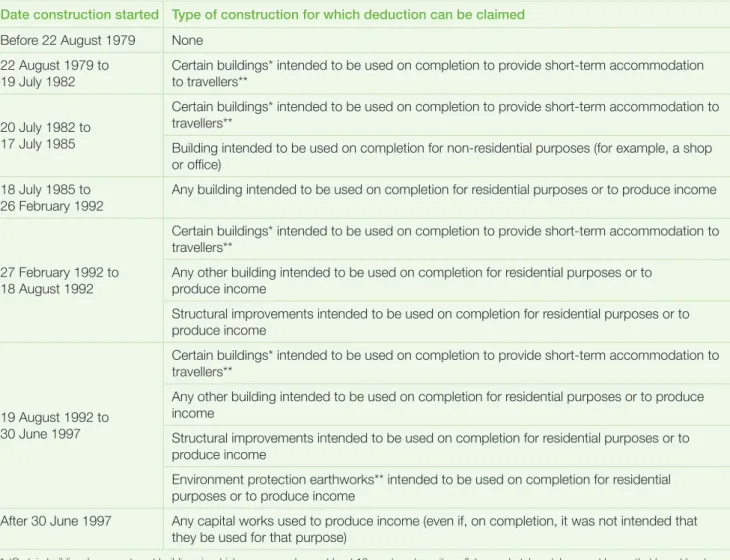
The amount of the deduction you can claim depends on the type of construction and the date construction started. Table 1 below shows you the types of rental property construction that qualify. If the type of construction you
own (or own jointly) does not appear next to the relevant
‘date construction started’ in the table, you cannot claim
a deduction. If the type of construction qualifies, table 2
on the next page shows the rate of deduction available.
TABLE 1
Date construction started Type of construction for which deduction can be claimed Before 22 August 1979 None
22 August 1979 to
19 July 1982 Certain buildings* intended to be used on completion to provide short-term accommodation to travellers**
20 July 1982 to 17 July 1985
Certain buildings* intended to be used on completion to provide short-term accommodation to travellers**
Building intended to be used on completion for non-residential purposes (for example, a shop or office)
18 July 1985 to 26 February 1992
Any building intended to be used on completion for residential purposes or to produce income
27 February 1992 to 18 August 1992
Certain buildings* intended to be used on completion to provide short-term accommodation to travellers**
Any other building intended to be used on completion for residential purposes or to produce income
Structural improvements intended to be used on completion for residential purposes or to produce income
19 August 1992 to 30 June 1997
Certain buildings* intended to be used on completion to provide short-term accommodation to travellers**
Any other building intended to be used on completion for residential purposes or to produce income
Structural improvements intended to be used on completion for residential purposes or to produce income
Environment protection earthworks** intended to be used on completion for residential purposes or to produce income