31
INFLUENCE OF EARLY BASAL LEAF REMOVAL ON YEALD
COMPONENTS AND MUST QUALITY ON CV. SAUVIGNON BLANC
ZORAN BEŠLIĆ, SLAVICA TODIĆ, NEBOJŠA MARKOVIĆ, ZORAN PRŽIĆ University of Belgrade, Faculty of Agriculture, Nemanjina 6, 11080 Zemun, Serbia
Key words: defoliation, yield, grape structure, skin to pulp ratio, grape quality
ABSTRACT
The aim of this two-year trial was to investigate the effects of timing of basal leaf removal on yield components, grape structure and berry composition in cv. Sauvignon Blanc. The experimental vineyard belongs to Experimental Station “Radmilovac”, Faculty of Agriculture in Belgrade. The vineyard location is in a Belgrade wine region, characterized as a Cfb climate. Leaf removal treatments were manually applied at full bloom, at fruit set (3-5 mm berry diameter) and ten days before veraison. The treatments consisted of defoliation of the first six nodes of all the shoots. Berry development of all treatments followed a typical double sigmoid curve. This means that berries develop in two phases, separated by a phase of slow growth – lag phase. Defoliation performed during flowering and fruit set period reduced the number of berries per cluster and berry size, resulting in a reduction of yield per vine from 2.80 kg in control, to 1.64 and 1.78 kg in flowering and fruit set treatment, respectively. The influence of defoliation time on change in the skin to pulp ratio was determined in flowering and fruit set treatments. Defoliation treatments increased the content of soluble solids in must (24.5, 24.2 and 23.8%) in comparison with control (22.8%), while the content of total acids was not significantly changed. The early defoliation can significantly affect the structure of the cluster, yields and chemical composition of grapes, and from a practical perspective, can replace the costly and time-consuming cluster thinning as a tool of yield control.
INTRODUCTION
Numerous studies have found that removing leaves from the fruit zone influences the improvement of microclimate conditions in terms of increasing the intensity of solar radiation, which leads to increased accumulation of dry matter, anthocyanins and other phenolic compounds in the berry (Kliewer et al. 1970; Poni et al. 2005; Bavaresco et al. 2008; Beslic et al. 2013). Also, defoliation affects the accumulation of different aromatic compounds in the berry and wine.
Early defoliation affects the higher concentration of monoterpenes, higher alcohols and volatile esters (Bubola et al. 2009), while reducing the content of 2-methoxy-3-isobutylpyrazine (IBMP), (Ford, 2007). Defoliation influence on better ventilation of fruit zone, and hence the lower incidences of gray roton the grapes (Smart et al. 1990; Sabbatini and Howell, 2010).
32
MATERIAL AND METHOD
The experiment were carried out during 2012 and 2013 on the cv. Sauvignon Blanc (Vitisvinifera L.), grafted on Kober 5BB rootstock. The vineyard is part of the Experimental Station ‘Radmilovac’ which belong to Faculty of Agriculture in Belgrade. According to the location, the vineyard belongs to Belgrade wine region. The site is characterized by favorable agro-climatic conditions for obtaining grapes and wines of the highest quality. This vineyard was established in 1993 with the 3 1 m vine spacing and were trained as a double Guyot with a trunk height of 90 cm, foliage height about 130 cm and width about 30 cm. The vines were pruned to a mix of canes and spurs. All lateral growth was trimmed consequently during vegetation period. The experiment was set as a random block design with 20 vines per experimental treatment, and each vine representing an observation unit. The vines were tagged and randomly assigned to the following treatments:
(a) non-defoliated (control) labelled as K;
(b) hand removal of the first six basal leaves at the phenological stage 65 (full flowering: 50% of flowerhoods fallen according to BBCH scale, Lorenz et al. 1994) labelled as T1;
(c) hand removal of the first six basal leaves at the phenological stage 73 (berries groat sized, ovary diameter varying from 3-5 mm according to BBCH scale, Lorenz et al.1994) labelled as T2;
(d) hand removal of the first six basal leaves at the stage 79 (majority of berries touching, according to BBCH scale, Lorenz et al. 1994) labelled as T3.
Berry size was monitored by measuring equatorial diameter of 30 randomly chosen berries per treatment using an electronic caliper. After the grape harvest, a representative sample of 3-5 kg of grape was taken from each experimental version and used for must, clusters and berry analysis. Must quality was determined from representative samples during the grape harvest. Concentration of Total Soluble Solids (°Brix) was determined by a hand-held refractometer, Milwaukee MR200ATC, USA. Titratable acidity (TA) was measured by titration with 0.1 N NaOH to a pH 8.2 end point.
RESULTS AND DISCUSSION
It was confirmed on base measuring of berry diameter from berry set to maturation, that the curve of growth in all variants of defoliation follows the typical sigmoid curve (Figure 1.), (Coombe 1992). It maybenotedthatthereduction in the leaf areaduring the first3-4weeksof berry development, caused by earlydefoliation, reduced berry sizein all treatmentscomparedtocontrol (Table 1.). It is consistent with other studies of defoliationinfluence on the grape structure on cvs.Cabernet Sauvignon and Prokupac (Beslic et al. 2013).Removing the part of active leaf area represents photosynthetic shock to the plant,especially if carried out in the early stages of growth berries, ie. during cell division of berry pericarp. Irreversible reduction in the size of berries is consequence of reduced inflow of the photosynthetic products, (Ollat and Gaudillère, 1998).
33
Figure 1. Effect of defoliation time on dynamic of berries growth. T1 – defoliation on BBCH stage 65 (full flowering: 50% of flowerhoods fallen; T2 – BBCH stage 73 (berries groat sized, ovary diameter varying from 3-5 mm; T3 – BBCH stage 79 (majority of berries touching) and k – non-defoliated vines.
There is a noticeable reduction in the number of berries per cluster in all variants, as a result of reduced inflow of photosynthetic products. The consequences of this disorders of photosynthesis intensity is an increasesof the level of aborted flowers and berries, in the initial stages of development of berries (Poni et al. 2005; Intrieri et al. 2008).
Changes in the skin/pulp ratio were recorded only when the defoliation performed in the flowering stage. This is in contrast to similar investigationoncvs.Cabernet Sauvignon and Prokupac (Beslic et al. 2013), where no changeshave been recorded in the skin/pulp ratio after early defoliation. It can be assumed that the cv. Sauvignon Blancreacts sensitive to photosynthetic shock at the flowering stage compared tomentioned cultivars.
Tab. 1. Effect of defoliation time on yield and grape structure
on cv. Sauvignon Blanc. Yield
(kg per vine)
Grape weight
(g)
Berry number per grape
Berry weight (g)
Berry diameter (mm)
Skin to pulp ratio
Т1 1.64a 79.0 a 64.5a 1.26a 11.6a 0.30a
Т2 1.78a 83.0a 68.6a 1.51b 12.48b 0.22b
Т3 1.89a 107.5b 73.2a 1.64bc 12.81b 0.21b
К 2.80b 151.5c 105.9b 1.71c 12.91b 0.21b
Lsd(0,05) 0.86484 22.3526 15.0464 0.137656 0.137656 0.0561211
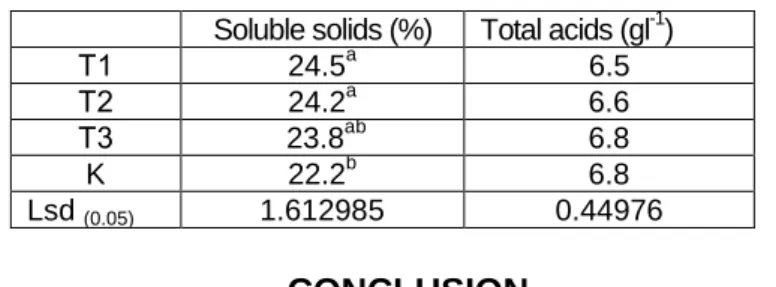
Defoliation were influenced on the changes of dry matter content and total acids in must in all experiment treatments compared to the control (Table 2). Highly significant increases in dry matter wereobserved in the defoliation at flowering stage (9.4%) and in the phase of fruit set (8.3%), while the increase in the third treatment was 6.7%. The lowest total acid content was detected in the control and in the third treatment of defoliation. The increase in dry matter content and a slight decrease in total acidity arethe result ofimprovements of light conditions in the fruit zone (Kliewer 1970; Smart et al., 1985; Morrison and Noble 1990; Dokoozlian and Kliewer 1996). In addition, early defoliation influence on the development of a large number of lateral shoots, whose young leaves have a higher intensity of photosynthesis (Poni et al. 2005; Tardaguila et al. 2008).
т1 т2 т3 k
34
Tab. 2. Effect of defoliation time on grape quality on cv. Sauvignon Blanc.
Soluble solids (%) Total acids (gl-1)
Т1 24.5a 6.5
Т2 24.2a 6.6
Т3 23.8ab 6.8
K 22.2b 6.8
Lsd (0.05) 1.612985 0.44976
CONCLUSION
These investigation is a continuation of previous researchesof the defoliation effect on yield and grape quality on wine cultivars in different region of Serbia. The results confirmed the significant impact of time of the defoliation, primarily on the structure of the cluster, and consequently onthe grape yield. The greatest impact had early defoliation (T1), with obtained statistically significant differences in the number and size of berries per cluster and the cluster weight. Applying of the early defoliation in stages of flowering and fruit set, loose clusters with smaller berries was obtained. Favorable light conditions in the fruit zone, cause an increase of the dry matter content in the must, while the total acid content is not significantly reduced. Additional research will be conducted on the chemical composition of the wine, particularlyon the aromatic complex, on the accumulation and changes in these compounds.
BIBLIOGRAPY
1. Bavaresco, L., Gatti, M.,Pezzutto, S.,Fregoni, M., Mattivi, F.,2008 -Effect of leaf removal on grape yield, berry composition, and stilbene concentration. American Journal forEnology and Viticulture, 59 (3), 292-298.
2. Beslic, Z., Todic, S.,Matijasevic, S., 2013 -Effect of timing of basal leaf removal on yield components and grape quality ofgrapevine cultivars Cabernet Sauvignon and Prokupac (Vitis vinifera L.). Bulgarian Journal of Agricultural Science. 19 (1). 96- 102. 3. Beslic, Z., Todic, S., Matijasevic, S., Novakovic, M.,Kuljancic, I., 2011 -Effect of early basal leaf removal on grape structure and quality of Prokupac (Vitis vinifera L.). Proceedings. 46th Croatian and 6th International Symposium on Agriculture. Opatija. Croatia, 919-923.
4. Bubola, M., Persuric, D. J., Ganic, K. K., Cossetto, M., 2009 -Influence of timing and intensity of basal leaf removal on aromatic composition of cv. Istrian Malvasia wines. (Retreived from) http:// www.fceye.ull.es/malvasia/doc/Trabajo25.pdf
5. Coombe, B. G., 1992 -Research on development and ripening of the grape berry.American Journal for Enology and Viticulture,43: 101–110.
6. Dookozlian, N. K.,Kliewer, W.M.,1996 -Influence of light on grape berry growth and composition varieties during development. Journal of the American Society for Horticultural Science, 121, 233-236.
7. Ford, R.J., 2007 -The effect of shading and crop load on flavour and aroma compounds in Sauvignon blanc grapes and wine. Master thesis. Lincoln University.
8 Intrieri, C., Filippetti, I., Allegro, G., Centinari M., Poni, S.,2008 -Early defoliation (hand vs. mechanical) for improved crop control and grape composition in Sangiovese (Vitis vinifera L.). Australian Journal of Grape and Wine Research, 14, 25-32.
35
10. Lorenz, D., Eichhorn, K., Bleiholder, H., Klose, R., Meier U., Weber, E., 1995 - Growth Stages of the Grapevine: Phenological growth stages of the grapevine (Vitis vinifera L. ssp. vinifera)—Codes and descriptions according to the extended BBCH scale. Australian Journal of Grape and Wine Research, 1, 100–103.
11. Morrison, J. C., Noble, A. C., 1990 - The effects of the leaf and cluster shading on the composition of Cabernet Sauvignon grapes and on fruit and wine sensory properties. American Journal for Enology and Viticulture, 41, 193-199.
12. Ollat, N., Gaudillere, J. P., 1998 -The effect of limiting leaf area during stage I of berry growth on development and composition of berries of Vitis vinifera L. cv. Cabernet Sauvignon.American Journal for Enology and Viticulture, 49, 251-258.
13. Poni, S., Bernizzoni, F., Briola, G., 2005 -Effects of early leaf removal on cluster morphology, shoot efficiency and grape quality in two Vitis vinifera cultivars.Acta Horticulturae, 689, 217-226.
14. Poni, S., Casalini, L., Bernizzioni, F., Civardi S., Intrieri, C., 2006) - Effects of early defoliation on shoot photosynthesis, yield components and grape composition.Functional Plant Biology, 57, 397-407.
15. Sabbatini, P.,Howell, G. S., 2010 -Effects of early defoliation on yield, fruit composition, and harvest season cluster rot complex of grapevines.Hortscience, 45(12), 1804–1808.
16. Smart, R. E., Dick, J. K., Gravett, I. M., Fisher, B. M., 1990 - Canopy management to improve grape yield and wine quality – principles and practices. South African Journal of Enology and Viticulture, 11, 3-17.
17. Smart, R. E., Robinson, J. B., Due, G. R., Brien, C. J., 1985 - Canopy microclimate modification for the cultivar Shiraz II. Effect on must and wine composition. Vitis, 24, 119-128.