Research Article
Clinical study of diabetic patients with special reference to their
glycemic status
Amith Kumar Pendurthi*, Srjana Karumanchi
INTRODUCTION
The term diabetes mellitus refers to a group of metabolic disorders characterized by chronic hyperglycemia and these disorders usually result from defects in insulin secretion, insulin action or both. Sustained hyperglycemia is associated with complications in the macro-vasculature, microvasculature and nerves, causing protracted morbidity and premature mortality. Macro-vascular complications, particularly coronary artery disease and stroke are increased two to four fold and diabetic patients have a higher prevalence of peripheral
retinopathy and nephropathy and peripheral autonomic neuropathy are equally common.1
Two main categories of diabetes are distinguished;
Type 1: Formerly known as insulin dependent diabetes mellitus or juvenile onset diabetes. Usually manifests before adulthood and accounts for about 5% of all cases. Type 1 diabetes arises mainly through autoimmune destruction of pancreatic beta cells, which leaves the patients with severe insulinopaenia and extreme hyperglycemia. If untreated; insulin deficiency ABSTRACT
Background: India is the world’s diabetes capital. The prevalence of type 2 diabetes mellitus is expected to raise more rapidly in the future in India and 40 other countries because of increasing obesity and reducing activity levels and other lifestyle changes. To study the profile of diabetic patients with special reference to their glycemic status was the objective of the study.
Methods: One hundred patients of diabetes were studied at NRI Medical College and General Hospital, Chinakakani, Guntur. Among diabetics, the criteria were considered to include the patients for the study. The selected patients were studied in detail with history and physical examination.
Results: The mean age of male patients in the study was 54.82±12.38 years and that of the female patients was 54.82 ±11.08 years. The mean age of detection of diabetes mellitus among the male patients was 48.84±10.11years and in the female patients was 48.75 ±8.68 years. The mean duration of DM is not statistically significant between male and female patients with P=0.930. 22 patients had good glycemic control of which 14 patients had duration of diabetes less than 5 years.
Conclusions: Incidence of poor glycemic status has a statistically significant association with the longer duration of diabetes.
Keywords: Glycemic status, Diabetes, Incidence
Department of General Medicine, NRI Medical College and General Hospital, Chinakakani, Mangalgiri, Guntur District, Andhra Pradesh, India
Received: 26 March 2016 Revised: 01 April 2016 Accepted: 04 April 2016
*Correspondence:
Dr. Amith Kumar Pendurthi,
E-mail: [email protected]
Copyright: © the author(s), publisher and licensee Medip Academy. This is an open-access article distributed under the terms of the Creative Commons Attribution Non-Commercial License, which permits unrestricted non-commercial use, distribution, and reproduction in any medium, provided the original work is properly cited.
Type 2: Formerly known as non-insulin dependent diabetes mellitus (NIDDM) or maturity onset diabetes. Usually manifests in later adult life and accounts for about 95% of all cases. This type of diabetes develops mostly through a combination of insulin resistance and defective beta cell function. This causes less severe hyperglycemia that is not usually life threatening. However the catalogue of chronic complications of type 2 diabetes represents a serious clinical burden, eroding quality of life and reducing life expectancy. The progressive and heterogeneous nature of type 2 diabetes adds to the complexity of treatment, which usually requires one or more oral anti diabetic agents and may also necessitate the use of insulin.1
Diabetes mellitus, the most common endocrine disorder is characterized by metabolic abnormalities and long-term micro-vascular and macro-vascular complications. The prevalence of diabetes is on the rise, more alarmingly in the developing countries. Besides multiplying the risk for coronary heart disease, diabetes enhances the incidence of cerebrovascular accidents. Moreover it is the leading cause of acquired blindness and accounts for about a quarter of the cases with end stage renal disease as well as half of the cases of non-traumatic lower limb amputations.1
METHODS
Sample size
One hundred patients of diabetes.
Study place
NRI Medical College and General Hospital, Chinakakani, Guntur.
Criteria of patients
Symptoms of diabetes mellitus plus a random glucose concentration >200 (11.1mmol/l). The classic symptoms of diabetes mellitus include polyuria, polydipsia and unexplained weight loss.
OR
Fasting blood glucose >126 mg/dl (7.0mmol/l). Fasting is defined as no caloric intake for at least 8 hours.
OR
2 hour postprandial glucose > 200mg/dl (11.1 mmol /l).
Among diabetics, the above criteria were considered to include the patients for the study.
The selected patients were studied in detail with history and physical examination.
History
Patient’s characteristics age, sex, age of onset and duration of diabetes.
All details regarding the presenting complaints were noted.
Total duration of diabetes, the drugs the patient was taking and the dosages were noted. The regularity of the treatment taken by the patients was also noted. The family history regarding diabetes was taken.
Personal history regarding smoking, alcohol consumption, bowel and bladder habits and drug intake were noted.
RESULTS
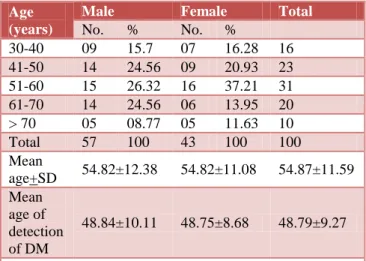
Patients were in the age group between 30 and 40 years, among whom 9 were male and 7 were female patients. 23 patients were in the age group between 41 and 50 years, among whom 14 were male and 9 were female patients. 31 patients were in the age group between 51 and 60 years, among whom 15 were male and 16 were female patients. 20 patients were in the age group between 61 and 70 years, among whom 14 were male and 6 were female patients. 10 patients were in the age group greater than 70 years, among whom 5 were male and 5 were female patients. The mean age of male patients in the study was 54.82±12.38 years and that of the female patients was 54.82±11.08 years. The mean age of detection of diabetes mellitus among the male patients was 48.84±10.11years and in the female patients was 48.75±8.68 years. The mean age between male and female is not statistically significant with p=0.964 and the mean age of detection of DM is not statistically significant with P=0.965 (Table 1).
Table 1: Age and sex distribution.
Age (years)
Male Female Total
No. % No. %
30-40 09 15.7 07 16.28 16 41-50 14 24.56 09 20.93 23 51-60 15 26.32 16 37.21 31 61-70 14 24.56 06 13.95 20 > 70 05 08.77 05 11.63 10 Total 57 100 43 100 100 Mean
age+SD 54.82±12.38 54.82±11.08 54.87±11.59 Mean
age of detection of DM
48.84±10.11 48.75±8.68 48.79±9.27
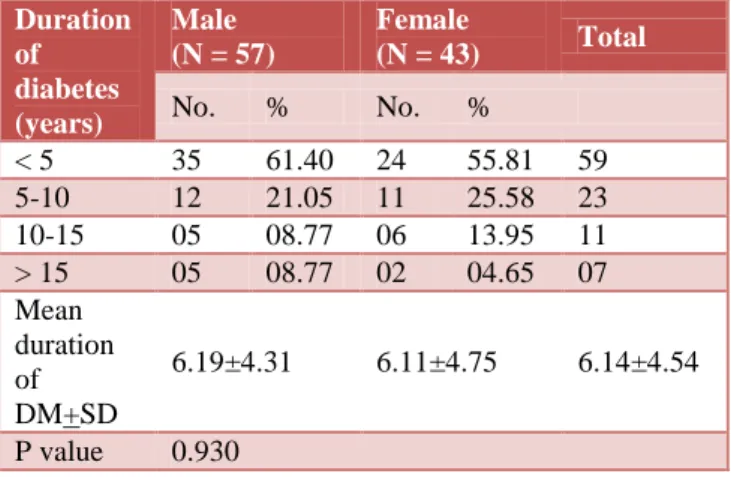
A total of 59 patients had duration of diabetes since diagnosis less than 5 years among which 35 were male and 24 female patients. 23 patients had duration of diabetes since diagnosis between 5 years and 10 years among which 12 were male and 11 were female patients. 11 patients had duration of diabetes since diagnosis between 10 years and 15 years among which 5 were male and 6 were female patients. 7 patients had duration of diabetes since diagnosis greater than 15 years among which 5 were male and 2 were female patients. The mean duration of diabetes since diagnosis was 6.19 ±4.31 years among the male patients and 6.11±4.75 years among the female patients. The mean duration of DM is not statistically significant between male and female patients with P=0.930 (Table 2).
Table 2: Duration of diabetes mellitus since diagnosis.
Duration of diabetes (years)
Male (N = 57)
Female
(N = 43) Total
No. % No. %
< 5 35 61.40 24 55.81 59 5-10 12 21.05 11 25.58 23 10-15 05 08.77 06 13.95 11 > 15 05 08.77 02 04.65 07 Mean
duration of DM+SD
6.19±4.31 6.11±4.75 6.14±4.54
P value 0.930
Table 3: Treatment.
Treatment Number (N = 100)
Insulin 04
OHA 84
OHA + Insulin 12
4 patients were on treatment with insulin and 84 patients were on treatment with oral hypoglycemic agents whereas 12 patients were on both insulin and oral hypoglycemic drugs (Table 3).
Table 4: Association of the duration of diabetes with HbA1C.
HbA1C <5yrs
5.1-10 yrs
10.1-15 yrs
>15
yrs Total
<6.5 14 7 1 0 22 6.5-7.0 13 7 3 0 23 7.0-7.5 11 2 2 0 15 >7.5 12 11 10 7 40 P value 0.03
22 patients had good glycemic control of which 14 patients had a duration of diabetes less than 5 yrs.
patients had the duration of diabetes more than 5 years (Table 4).
Incidence of poor glycemic status has a statistically significant association with the longer duration of diabetes with a p value of 0.03.
There is a statistically significant association between HbA1C and the duration of diabetes in patients without micro albuminuria.
DISCUSSION
Type 2 diabetes mellitus is being increasingly recognized as a disease, which is characterized by dysfunction of the capillary endothelium. Capillary endothelial dysfunction occurs in a generalized and widespread manner in diabetic subjects. The severity of the dysfunction is directly proportional to the age of the patient and the duration of diabetes. The clinical markers of the generalized endothelial dysfunction become manifest in several forms.
NIDDM is associated with two to three fold increased mortality mainly from cardiovascular disease. This propensity for vascular disease among NIDDM patients cannot be explained by co-existent conventional cardiovascular risk factors such as hypertension or dyslipidemia since the effect of diabetes per se persists even after controlling for confounding effects other risk factors. Nor can it be entirely attributed to the hyperglycemic state, since the available data on the relationship between glycemic and cardiovascular complications in NIDDM if not conflicting is certainly inconclusive. Mongensen in Denmark and Jarret et al in Britain were the first to explore the role of microalbuminuria as a marker in patients with NIDDM. Both reported independently in 1984 that microalbuminuria predicted all-cause mortality chiefly from cardiovascular diseases in NIDDM subjects. Three retrospective studies have been examined to predict the prognostic significance of microalbuminuria in cohorts of patients with NIDDM. Over an interval of 10-14 years, clinical proteinuria has shown a significantly increased risk of death. They have also shown an increased risk of cardiovascular death in these patients. Another prospective study of 3 years duration has confirmed the greater incidence of cardiovascular events in patients with NIDDM patients along with microalbuminuria.2
syndrome X. Interestingly, there is now evidence to promote microalbuminuria as a distinct and independent facet of this disorder. Investigating the influence of microalbuminuria and hypertension on insulin resistance in NIDDM patients, group et al reported that glucose metabolism, as measured during insulin clamp technique, was impaired in normotensive NIDDM patients with microalbuminuria compared with normotensive normoalbuminuric patients. The defect in insulin action was shown to correlate with urinary albumin excretion.
Furthermore, diabetic subjects with a combination of hypertension and microalbuminuria had a greater reduction in insulin mediated glucose disposal and widespread disturbances in lipid metabolism. Perhaps the most surprising finding of these studies was the observation that insulin- stimulated glucose disposal was remarkably normal in normotensive NIDDM patients who did not have microalbuminuria. A similar conclusion has also been reached by Nosadini and Zambon et al4 who showed that insulin sensitivity was not compromised in healthy NIDDM patients unless either microalbuminuria or hypertension or both existed. The relationship between insulin resistance and albuminuria in NIDDM subjects was also confirmed by Niskanen and Laaksa5 who showed that insulin mediated glucose uptake determined during euglycemic clamp study was significantly lower in microalbuminuric patients when compared with normoalbuminuric patients, independent of the confounding effect of hypertension. Thus, the association between insulin resistance and microalbuminuria in NIDDM as revealed by the findings of these studies raises the interesting question of whether the two phenomena might in some way be causally related. However, the presence of microalbuminuria in NIDDM has not been marked by a reduction in insulin sensitivity in all of the studies thus far reported. For the present, therefore the mechanism relating insulin resistance/hyperinsulinemia to albuminuria remains largely speculative. Finally, two recent reports have shed further insight into the significance of microalbuminuria in NIDDM. Haffner et al6 in a cross-sectional study and Mykannen et al7 in a prospective study have reported that microalbuminuria in non-diabetic individuals may precede and even predict the onset of NIDDM. Moreover, micro-albuminuric subjects who remained glucose tolerant after 3.5 years of follow-up still demonstrated multiple cardiovascular abnormalities, including elevated blood pressure, high triglycerides concentration, high insulin concentration, and low HDL cholesterol concentration, i.e. a cardiovascular risk profile akin to that observed in pre diabetic individuals. Micro-albuminuria may be regarded as a prominent feature of the pre diabetic state. The above findings therefore provide probably the most damaging evidence against microalbuminuria as a serious phenomenon in the evolution of NIDDM and atherosclerotic disease.
Present study has shown that incidence of poor glycemic status has a statistically significant association with the
longer duration of diabetes with a p value of 0.03. Verma M et al8 also showed that the HbA1c levels showed a significant increase with the duration of diabetes as well as the insulin level showed a significant correlation after adjustment for age, sex and duration of diabetes. Al-Lawati JA et al9 found that Longer duration of diabetes (≥5 years) and treatment with oral agents or insulin were inversely related to good glycemic control.
Rao GM et al10 found that the highest numbers of obese patients were in the age group 51-60 indicating the strong association between diabetes and obesity. A statistically significant correlation was found between fasting blood glucose levels and HbA1 concentrations (r=0.37; P less than 0.001). Correlations between urinary glucose and HbA1 or fasting blood glucose were highly significant. These diabetic patients have poorly controlled diabetes as indicated by the correlation between HbA1 and duration of diabetes. There was no significant difference in HbA1 levels of patients undergoing insulin administration and those taking oral hypoglycaemic drugs. Glycosylated haemoglobin levels will be a valuable adjunct to blood glucose determinations in epidemiological studies.
CONCLUSION
Incidence of poor glycemic status has a statistically significant association with the longer duration of diabetes.
Funding: No funding sources Conflict of interest: None declared
Ethical approval: The study was approved by the institutional ethics committee
REFERENCES
1. Schadewaldt H. History of Diabetes Mellitus. In: Van Englehardt D, editor. Diabetes, its Medical and cultural history. Berlin: Springer Verlag; 1987:43-100.
2. Hans-Henrisk P, Hommel EVA, Elisabeth M. Revalence of microalbuminuria, arterial hypertension, retinopathy and neuropathy in patients with insulin dependent diabetes mellitus. Br Med J. 1988;4:99-103.
3. Reavon GM, Hoffman BP. A role of insulin in the etiology of and the course of hypertension. Lancet. 1987;2:435-37.
4. Nosadini R, Zambon S, Manzato E, Solini A, Sambataro M, Brocco E et al. Lipoprotein abnormalities in non-insulin dependent diabetes mellitus with impaired insulin sensitivity, hypertension and microalbuminuria. Arteriosclero Thromb. 1994;14(6):911-6.
6. Haffner SM, Lehto S, Ronnemaa T, Pyorala K, Laakso M. Mortality from coronary heart disease in subjects with type 2 diabetes and in nondiabetic subjects with and without prior myocardial infarction. N Engl J Med. 1998;339(4):229-34. 7. Mykkanen L. Prevention of coronary heart disease
in type 2 diabetes. Int J Clin Pract Suppl. 2000;113:40-5.
8. Verma M, Paneri S, Badi P, Raman PG. Effect of increasing duration of diabetes mellitus type 2 on glycated haemoglobin and insulin sensitivity. Indian J Clin Biochem. 2006;21(1):142-6.
9. Al-Lawati JA, Barakat MN, Al-Maskari M, Elsayed MK, Al-Lawati AM, Mohammed AJ. HbA1c Levels among primary healthcare patients with type 2 diabetes mellitus in Oman. Oman Med J. 2012;27(6):465-70.
10. Rao GM, Morghom LO, Abukhris AA, Mansori SS, Alphgih FA, Ragale LY. Glycosylated haemoglobin and blood glucose levels in Libyan diabetic patients. Trop Geogr Med. 1986;38(4):391-7.