Volume 4, Issue 1 www.stmjournals.com
Development and Acceptability Evaluation of Soy Milk
Obtained from Soy
Bharti Jain
*Department of Food Science and Nutrition, Maharshi Dayanand Saraswati University, Ajmer, India
Abstract
Whole soybean is processed to make a rich, creamy milk-like liquid called soy milk. It has a unique delicious flavor. Soy milk makes a great substitute for milk, especially for individuals who cannot tolerate lactose (milk sugar). Soy milk is a good source of high-quality proteins, B-vitamins and iron. Soy milk is also a base for the preparation of many dairy analogs such as soy curd, soy tofu, etc. In the present study, soy milk was prepared from soy genotype JS 93-05 because of its high protein content. The main objective of the study was to find out the acceptability of soy milk and to compare the nutrient and cost of soy milk with cow’s milk. The processing of soybean is required to inactivate the anti-nutritional factors, to minimize the unacceptable beany flavor and improve the digestibility of the protein. About 8 L of soy milk can be obtained from 1 kg of dry soybean. To find out the acceptability of soy milk thirty young adult females of 35 to 40 years of age were selected. Acceptability of cow’s milk was 84.17%. Cow’s milk was compared with the acceptability of plain soy milk and flavored soy milk and the results reveled that acceptability of plain soy milk was 69.17% whereas acceptability of flavored soy milk was 83.33%. From these results it can be concluded that acceptability of flavored milk was equivalent to the cow’s milk. Plain soy milk was less acceptable due to its poor taste (33.33%). Results of nutrient content of soy milk revealed that there was not much difference in the protein and carbohydrate content of soy milk and milk. Major difference was observed in fat content of soy milk and this is due to the fact that higher yield of milk is obtained from 1 kg of soybean. Cost of soy milk (Rs. 8/kg) was less as compared to milk obtained from animal source (Rs. 20/kg).
Keywords: Cow’s milk, soy milk, flavored soy milk, anti-nutritional factors, acceptability evaluation, soy genotype
*Author for Correspondence E-mail: [email protected]
INTRODUCTION
Soybean (Glycin max) is one of the nature’s wonderful nutritional gifts. It is considered as gold obtained from soil and is thus rightly called today the “Gold Nugget of Nutrition” owing to its nutritional composition [1]. It is one of the very few plants that provide high-quality protein with minimum saturated fat. Soybean helps people feel better and live longer with an enhanced quality of life. Soybeans contain all the three macronutrients required for good nutrition, as well as fiber, vitamins, minerals. Soybean protein provides all the essential amino acids in the amounts needed for human health. Different varieties of soybean differ physically, agronomically and biochemically. Companies making soy foods and beverages want soybeans that optimize market access and buyer preference. For this, close attention is required for variety selection,
of the study was to find out the acceptability of soy milk and to compare the nutrient and cost of soy milk with cow’s milk.
METHODOLOGY
The study has been undertaken to find out the acceptability, nutritional content and cost of soy milk prepared from soy genotype JS 93-05. The study is designed in three phases.
Phase I: Development and Standardization of Soy Milk
On the basis of protein content, JS 93-05 soy genotype was used to develop soy milk to find out the acceptability. One of the simplest methods for converting soybean to a high-quality food is to produce a beverage known as soy milk. Vegetarians and other people who are lactose-intolerant appreciate soy milk. Soy
milk is consumed by persons of all ages, including children. This product contains virtually the same amount of protein as cow’s milk and is free of cholesterol and lactose [2].
Soy milk is also a base for the preparation of many dairy analogs such as soy curd, soy tofu, etc. About eight liter of soy milk can be obtained from one kilogram of dry soybean. The processing of soybean is required to inactivate the anti-nutritional factors, to minimize the unacceptable beany flavor and improve the digestibility of the protein.
Preparation of Soy milk
Soy milk was prepared from soy genotype JS 93-05. Various steps were followed to prepare soy milk.
Cleaning The beans were cleaned thoroughly. The debris /stubbles/broken/stones were removed and dehulled.
Soaking Soybeans were soaked in water with 0.1% (w/v) sodium bicarbonate at room temperature at a ratio of one to three (w/v). The length of soaking in winter is 20–22 h. The soaking removes most of the bitter substances.
Mashing Sufficient hot water was poured on to the soaked soybeans to cover them and then ground to a mash in a ratio of one to six (w/v).
Heating The mash was cooked under pressure for 20 to 30 min.
Filtration
The mash was filtered after the heat treatment into a large cotton/muslin bag, which was pressed by hand. The pulp (okara) is mainly fiber and crude protein. The liquid is the soy milk. The milk so prepared is free from objectionable flavor and color. It has the desired viscosity and color.
Standardization of Soy Milk
Standardization of developed soy milk was done by repeated trial method, using the same procedure to prepare the products each time. Adjustment of quantity of soybean was done to obtain the maximum acceptable quality. A panel of ten judges was selected for product standardization on the basis of threshold test. Products were prepared with a varying quantity till the product was noted acceptable by the panelists.
Phase II: Acceptability Evaluation of Soy Milk
Sensory quality or evaluation is a combination of different senses of perception which come into play for choosing and eating a food. Therefore, the sensory qualities were evaluated for ensuring the acceptability of the products.
Development of Score Card
Composite rating scale was used for rating of the sensory attributes for each of the products. For evaluating different products for their
sensory qualities, viz., taste, texture, flavor, consistency, appearance, color, mouth feel and overall acceptability score card was developed. The products were judged organoleptically by the subjects, using a composite scoring test in which sensory attributes were weighted separately for color (7), taste (5), flavor (5) and appearance (3) with a total possible composite score of 20. The acceptability of each sensory attribute was rated using seven-point hedonic scale as perfect (6), excellent(5), very good (4), good (3), bad (2), very bad (1) and inedible (0). Total maximum attainable score for color was 42, taste 30, flavor 30, appearance 18 and for overall acceptability score was 120.
Sensory Evaluation of Soy Milk
ISSN: 2249-4731(online),ISSN: 2347-7261(print)
characteristics and general acceptability were calculated. The data were statistically analyzed as per the objectives of the study.
Phase III: Nutritive Value and Cost of Soy Milk
The products developed were analyzed for the proximate compositions using Nutritive Value of Indian Foods [3] and the cost of products was also calculated.
RESULTS
One of the simplest methods for converting soybean to a high-quality food is to produce a beverage known as soy milk. Whole soybeans are processed to make a rich, creamy, milk-like liquid called soy milk. It has unique, delicious flavor. Served hot or cold, with a dash of sugar, soy milk makes a great tasting beverage. The positive features of soy milk are its low cost, nutritive value and suitability to lactose-intolerant children. Traditionally, soy milk is made by soaking the beans, grinding
them with water, cooking the slurry, and then filtering to remove the sludge. Soy milk is also a base for the preparation of many dairy products such as soy curd, soy srikhand, soy lassi, soy matha and soy ice-cream, etc. About 6 to 8 L of soy milk can be obtained from 1 kg of dry soybean [4].
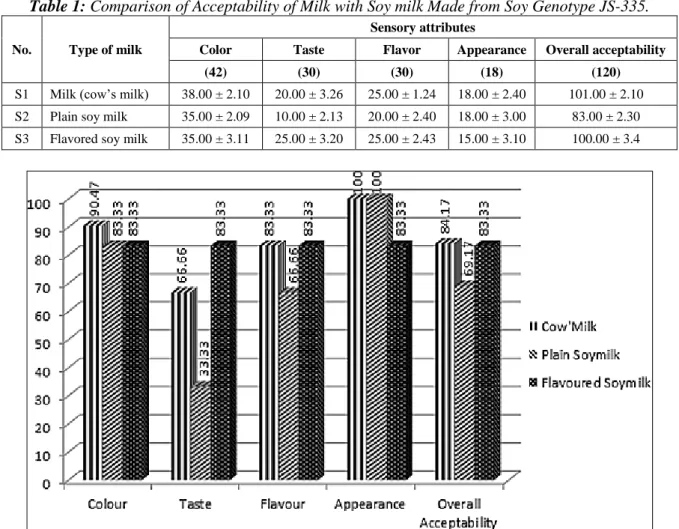
Comparison of mean acceptability score of milk with soy milk (Table 1) revealed that color of cow’s milk was more acceptable (38) as compared to soy milk. Color of plain soy milk and flavored soy milk was equally acceptable. Taste of flavored soy milk was highly acceptable (25) than followed by cow’s milk (20) and plain soy milk (10). Flavor of cow’s and flavored soy milk was equally acceptable (25). Appearance of cow’s milk and plain soy milk was highly acceptable (18) as compared to flavored soy milk (15). Overall acceptability of cow’s milk (101) and flavored soy milk (100) was equally acceptable as compared to plain soy milk (83).
Table 1: Comparison of Acceptability of Milk with Soy milk Made from Soy Genotype JS-335.
No. Type of milk
Sensory attributes
Color Taste Flavor Appearance Overall acceptability
(42) (30) (30) (18) (120)
S1 Milk (cow’s milk) 38.00 ± 2.10 20.00 ± 3.26 25.00 ± 1.24 18.00 ± 2.40 101.00 ± 2.10
S2 Plain soy milk 35.00 ± 2.09 10.00 ± 2.13 20.00 ± 2.40 18.00 ± 3.00 83.00 ± 2.30
S3 Flavored soy milk 35.00 ± 3.11 25.00 ± 3.20 25.00 ± 2.43 15.00 ± 3.10 100.00 ± 3.4
Results of Figure 1 revealed that acceptability of cow’s milk was 84.17%. When cow’s milk was compared with the acceptability of plain soy milk and flavored soy milk, the results revealed that acceptability of plain soy milk was 69.17% whereas acceptability of flavored soy milk was 83.33%. From these results, it can be concluded that acceptability of flavored milk was equivalent to the cow’s milk. Plain soy milk was less acceptable due to its poor taste (33.33%). Soy milk is consumed by persons of all ages, including children. Soy drinks are much more palatable than in the past. It also contains fiber. Soy milk is available in plentiful and it is an inexpensive
source of protein and calorie. Nutrient content of soy milk (Table 2) revealed that there was not much difference in the protein and carbohydrate content of soy milk and milk. Major difference was observed in fat content of milk (4.1 g/100 mL) and soy milk (1.78 g/100 mL) and this may be due to the fact that higher yield of milk is obtained from 1 kg of soybean. Due to lower content of fat in soy milk, regular intake of soy milk can lower blood concentrations of triglyceride and low density lipoproteins (LDL) and raise the level of high-density lipoproteins (HDL). This combined effect makes soy milk an ideal drink.
Table 2: Nutrient Comparison of Cow’s Milk with Soy Milk. Type of
milk
Moisture g/100 mL
Protein g/100 mL
Fat g/100 mL
Carbohydrate g/100 mL
Energy kcal/100 mL Cow’s
milk 87.5 3.2 4.1 4.4 67.3
Soy milk 90.21 3.74 1.78 4.27 48.06
Soy milk is a good source of protein which is low in saturated fats and rich in isoflavones. Soy milk contains virtually the same amount of protein as cow’s milk and is free of cholesterol and lactose [2, 5]. The processing of soybeans is required to inactivate the anti-nutritional factor, to minimize the unacceptable flavor and improve the digestibility of protein [6]. Gandhi et al., 2008 [7] reported that average chemical soy milk contain 3 to 4 g of protein, 1.5 to 2 g of fat and 1 to 2 g of carbohydrates. The calcium in soy milk is about 200 mg, which is six times less than the cow milk. Therefore, most commercial milks are fortified with calcium up to a level of 1200 mg/L. To give the soy milk the mouth feel of dairy milk, salt and sugar are added. Normally, soy milk is sold as plain and flavored. Cost of soy milk is given in Table 3 and the results reveal that cost of soy milk (Rs.8/kg) is less as compared to milk obtained from animal source (Rs. 20/kg).
Table 3: Cost of Cow’s Milk and Soy Milk.
S. No. Type of milk Rs/kg
1 Milk 20.00
2 Soy milk 8.00
CONCLUSIONS
Different varieties of soybean differ physically, agronomically and biochemically. Companies making soy foods and beverage want soybeans that optimize market access and buyer preference. Soy milk was prepared from soy genotype JS 93-05 because of its high protein content. Acceptability of cow’s milk was compared with the acceptability of plain soy milk and flavored soy milk prepared from genotype JS 93-05. Acceptability of flavored milk was equivalent to the acceptability of cow’s milk. Plain soy milk was less acceptable due to its poor taste. Lower content of fat in soy milk can lower blood concentrations of triglyceride and low-density lipoproteins (LDL) and raise the level of high-density lipoproteins (HDL). This combined effect makes soy milk an ideal drink. Soy milk is consumed by persons of all ages, including children. Cost of soy milk is less as compared to milk obtained from animal source and can easily be consumed by poor people.
REFERENCES
ISSN: 2249-4731(online),ISSN: 2347-7261(print)
Department of Food Science and Technology Centre. 2001.
2. Bhange S, Diwividi P, Gandhi AP, et al. Spray dried soy milk and its quality assessment. The Ind. J. Nutr. Dietetics. 2003; 40: 369–73p.
3. Gopalan C, Ramashastri BV, Balasubramanian SC. Nutritive Value of Indian Foods. NIN, ICMR, Hyderabad. 2000.
4. Gandhi AP, Mishra VK, Ali N. Organoleptic assessment of full fat soy flour in various indigenous products. International J. of Food Science and Technology, UK. 1983; 18: 771p.
5. Gandhi AP, Kotwaliwale N, Kawalkar J, et al. Effect of incorporation of defatted soy flour on the texture of chapattis. J. Food Science and Tech. 2000; 38: 502-03p.
6. Jha K. Soybean ek upyog anek. Udymita. Dec. 1997.
7. Gandhi, A.P., Kulkarni, S.D. and Jha, K. Highlights of achievements of soybean processing and utilization center. Central Institute of Agricultural Engg. Bhopal. 2008: 1–8p.