THE INFLUENCE OF CULTIVAR ON THE QUALITY OF FRUIT THE
SPECIES
Cucumis melo
L
Dinu Maria1, Soare Rodica2 1Faculty of Horticulture,University of Craiova, Department of Horticulture & Food Science, Romania 2Faculty of Agriculture, University of Craiova, Department of Agricultural and Forestry Technology,
Romania
Key word: Cucumis melo L, S.D.M, carotene, ascorbic acid, total sugar
ABSTRACT
The present study evaluates the morphological and biochemical characteristics most relevant from an assortment of seven melon cultivars with various origins, grown in solar located in southwest of Romania. Fruit morphology of melon cultivars for various parameters have differentiated such cultivation obviously. Also, their biochemical composition varied from one to another cultivar. Soluble dry matter content was ranged between 8.9 to 13.400 Brix; carotene content was 0.12 to 3.00 mg /g fresh substance;
ascorbic acid values ranged from 23.89 to 36.18 mg /g of fresh substance. Total sugar ranged between 466.34 and 845.23 mg /g dry matter, so pulling out huge influence on fruit quality of the cultivar of melon.
For cultivars Gustal and Corin were recorded high levels of acidity and total sugars content which makes them to be requested by the consumer. Piel de Sapo cultivar recorded lower values for ascorbic acid content and total sugars content but juiciness and consistency of pulp made it to be most appreciated by the consumer. This cultivar receiving the highest mark, 9.6 of all cultivars. These cultivars, due to morphological and organoleptic characteristics of the fruits can be used to improve varieties.
INTRODUCTION
Cucumis melo L. is one of the most important and various species of the Cucumis genus. It is grown primarily for its fruit which generally have a sweet flavour and a wide variety of sizes (50 g to 15 kg). The fruit pulp can be orange, green, white and pink, the peel is green, yellow, white, orange, red and gray and it has a round, flat and elongated shape.
Cucumis melo can be classified into seven distinct types depending on the variations listed above (Maria Dinu, 2009). Stepansky A. et al. (1999) show in a conducted study which used DNA fingerprints that the differences between the groups or types of melons are not clearly defined. The existing classifications have a descriptive purpose resulting in nine different types of melon.
From a commercial perspective there are three main groups of yellow melons: the cantaloupe melons group (var. cantalupensis); the reticulatus melons group (var. reticulatus) and winter melons group (var. inodorus).
The importance of cultivars used in culture is represented by their potential to meet the technological, food, medical and finally the financial requirements (Niculescu A., 2011). In Romania, in the urban areas, the aromatic yellow, juicy and sweet melons are preferred as refreshing fruits during summer. In the country side there are preferred the mealy fruit pulp that are consumed all the time especially from the inhabitants own culture.
The emergence of new vegetables on the Romanian market can have multiple benefits such as a good profit for the producers, the opportunities of diversifying people's food, by introducing in the diet vegetables with high biological value. (Rodica Soare et al., 2016).
The melon fruits are normally consumed at full physiological maturity, but they can be consumed at technological maturity too because in comparison with other species of the Cucurbitaceae family, at this stage they have the lowest content of cucumerine that is toxic to the human body.
The importance in terms of food is given to palatability (taste, juiciness, texture) which differs depending on cultivar and maturity. They are consumed with pleasure because of the content in sugars (glucose, fructose, etc.) (Lester and Hodges, 2008), carotenes, vitamin C, minerals, etc.
The present study aimed at highlighting the biochemical properties of the melon fruit cultivar and their selection to constitute the assortment in culture.
MATERIAL AND METHOD
The melon fruits are from a culture founded in solar greenhouse in the south-western part of Romania (44°19'N and 23°48 'E). The applied technology was the classical one for the melon culture in solar greenhouse. They were planted at 2 m between plant rows and 80 cm between plants in the row.
The fruits were harvested at physiological maturity, transported to the laboratory of biochemistry, washed with distilled water to remove the dust and to lower the temperature and they were stored at 8-100C and 80-85% relative humidity of air.
Physicochemical and nutritional evaluation
All the studied parameters in the fruit mesocarp of the melon were made after removing the placenta with seeds and fruits peel of five fruits from each cultivar. The mesocarp was placed in a blender for 1 minute resulting in a homogeneous mash. The experiments were carried out in four repetitions, and the results were expressed as the average of repetitions.
Total soluble solids
The Abbe hand refractometer was used for measuring total soluble solids (TSS) in extracted juice. The refractometer measures the refractive index, which indicates how much a light beam will be slowed down when it passes through the fruit juice,the values being expressed in °Brix.
Determination of antioxidant compounds
Ascorbic acid
Ascorbic acid was extracted and analyzed by reversedphase HPLC. Fresh melon homogenate, 5g, was mixed and diluted to 100 ml with 0.1 N HCl. After 30 minutes the extraction solution was centrifuge dat 4200 rpm for 10 minutes. The supernatant was filtered through 0,2 μm pore size filter.
The separation was performed using a Hypersil Gold a Q column (25cm x 4,6 mm) with a particle size of 5 μm while a 50 mM water solution of KH2PO4 buffer adjusted to pH 2,8 with orto-phosphoric acid was used as the mobile phase. The column temperature was kept at 10 0C and the flow rate at 0,7 ml min-1. All the results werw expressed in mg kg-1 fw. Acetonitrile was HPLC grade while potassium dihydrogen ortophosphate and phosphoric acid were of analytical purity. Ultrapure water was obtained from a Milli-Q water purification system.
Carotenoids
oxidation. Sixteen mililiters of acetone/hexane (4:6) solvent werw added to 1.0 g to melon homogenate and mixed in a test/tube. Automatically, two phases separated, and an aliquot was taken from the upper solution for measurement of optical density at 663, 645, 505, and 453 nm in a spectrophotometer (Varian Cary 50 UV/Vis ). Values are reported as mg / 100 g FW.
The total sugar content was measured by a colorimetric test as described by Frechilla and Manso (1994) using glucose as standard and the absorbance was measured at 620 nm with a Helios spectrophotometer. The results are expressed as mg/g dry matter.
Quality parameters
The quality characteristics of the melon fruits were determined by a number of 10 people (tasters) that are frequent consumers (Mackey et al., 1973). Cubes from the mesocarp were tasted that were taken from the equatorial region of the fruit. The commission members reviewed the internal appearance of the fruit, texture and flavour and gave them scores up to 10. The table shows the obtained average scores.
RESULTS AND DISCUSSIONS
The measurements in this study aimed to outline the morphological and biochemical characteristics of melon fruits from the studied cultivars.
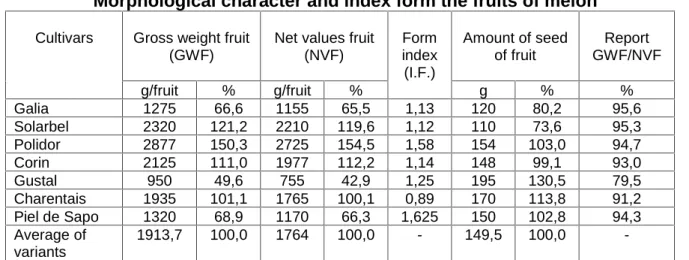
Referring to the average gross weight of fruits (GWF)(Table 1), it is observed that it ranged from 2,877 g for Polidor cultivar to 950 g for Gustal cultivar. The variation is quite obvious between cultivars even in comparison to the average of variants which were considered control plants in this study. The fruit weight must be average in size (1000 g/ fruit).
Table 1 Morphological character and index form the fruits of melon
Cultivars Gross weight fruit (GWF)
Net values fruit (NVF)
Form index (I.F.)
Amount of seed of fruit
Report GWF/NVF
g/fruit % g/fruit % g % %
Galia 1275 66,6 1155 65,5 1,13 120 80,2 95,6 Solarbel 2320 121,2 2210 119,6 1,12 110 73,6 95,3 Polidor 2877 150,3 2725 154,5 1,58 154 103,0 94,7 Corin 2125 111,0 1977 112,2 1,14 148 99,1 93,0 Gustal 950 49,6 755 42,9 1,25 195 130,5 79,5 Charentais 1935 101,1 1765 100,1 0,89 170 113,8 91,2 Piel de Sapo 1320 68,9 1170 66,3 1,625 150 102,8 94,3 Average of
variants
1913,7 100,0 1764 100,0 - 149,5 100,0
-The net weight of the fruit calculated after the extraction of seeds from the seminal cavity recorded variations between cultivars. This was determined by the amount of extracted seeds. The smallest amount of seeds has been recorded by Solarbel cultivar, 110 g, and the highest amount by Gustal cultivar, 195 g. There were 5 cultivars of muskmelon that had over 150 g of seeds, being known that in our country they are not consumed as in the large melon cultivators’ countries such as Spain, Italy, Portugal.
The seminal cavity, through its size, influences the physical quality of fruits and influences to some extent the storage and transport capacity, i.e. the higher it is, the higher the content of water is.
round for Charentais. This is a variety uninfluenced by culture and environmental conditions.
Regarding the ratio of the gross weight of the fruits and net values there is observed that values over 90% are recorded for all cultivars excepting the Gustal cultivar that has a ratio of 79.5%.
The content of total soluble substance (TSS) ranged from 8.9 to 13.400 Brix. The lowest values were recorded by the Corin, Gustal and Charentais cultivars, and the highest by Galia, Solarbel and Polidor cultivars (Table 2). It should be noted that Piel de Sapo is a cultivar with post-maturation but under the climate conditions of Oltenia it was matured earlier and recorded the highest content of T.S.S of 13.400 Brix. In general, the T.S.S content was significantly higher at the modern cultivars than at the traditional cultivars, as reported by Escribano and Lázaro (2015), excepting Piel de Sapo with the highest content of all the cultivars. The values recorded in these cultivars are consistent with those recorded by other researchers such as T. Bianchi et al., 2016.
The carotene content showed great interest recently because of its importance in human nutrition. The presence of this constituent in melon was studied by Burger et al., 2006; Hodges and Lester, 2006; Lester and Hodges, 2008. In the present study, this content ranged from 0.12 to 3.00 mg/g of fresh matter (F.M.). The highest content of carotene was recorded by the Charantais cultivar followed by Gustal and Corin. The other 4 cultivars had values between 0.12 and 0.20 mg/g F.M., values supported by Escribano et al., 2010; 2012). The bright orange pulp fruit are valued more by consumers than those with yellowish-white pulp (Escribano et al., 2010) so we can say that the presence of carotenoides can be considered as an added value for the melon cultivars.
Table 2 Biochemical composition of fruits melon (average)
Cultivars T.S.S.
0Bx
Carotene content (mg/ g F.M)
Ascorbic acid content (mg/100 g
F.M)
Total sugar (mg/g D.M)
Note the composition
of organoleptic
Galia 10.3 0.12 27.38 466.34 9.4
Solarbel 10.4 0.15 27.10 575.62 9.4
Polidor 11.1 0.20 36.18 546.70 9.2
Corin 9.6 1.87 29.79 623.17 9.4
Gustal 8.9 2.05 28.99 737.12 8.0
Charentais 9.5 3.00 23.89 845.23 9.0
Piel de Sapo 13.40 0.17 26.90 574.68 9.6
The antioxidant activity of vegetable species is a very important quality parameter from a nutritional standpoint (Maria Dinu et al., 2016).
The ascorbic acid content had values ranging from 23.89 mg/100 g fresh matter at Charentais to 36.18 mg/100 g FM at Polidor. These values are supported by other studies too. Katzir et. al., (2008) showed a content of 34.2 mg/100 g FM and Dhillon et al., (2007) in their study had cultivars with a maximum content of 34.1 mg/100 g F.M.
The presence of sugar in fruits is essential for a healthy and balanced diet. Melon fruits have a high content of total sugar. It ranged from 466.34 mg/g D.M to 845.23 mg/D.M. These values are supported by Sandra Escribano and Almudena Lázaro (2015) who in a study of 28 cultivars, including the cultivars studied by us, showed similar values to those present in this study. The highest value of our study was recorded by Charentais, of 845.23 mg/100 dry matter, Lester (2008) reported a value of 847 mg/g D.M. at a variety of melon that has been genetically improved to increase the content of sugar.
Pairing the sugar content with the ascorbic acid content provides a unique flavour and desirable for consumers (Burger et al., 2006). The Corin, Gustal, Charentais and Piel de Sapo cultivars recorded high values of acidity but also recorded high levels of sugars thus fulfilling the sensory qualities that were observed during tastings. An exception was Gustar cultivar which had a high content of ascorbic acid, carotene and sugars but apparently it was not liked by tasters. High levels of ascorbic acid and carotene from melon is essential for human health (Burger et al., 2006).
After organized tastings for fruit qualitative assessment taking into account all the characteristics in general, but especially the pulp consistency, flavour and aroma, there were given grades on a scale of 1 to 10 with values ranging between 8.0 and 9.6 (table 2). Valuable in this regard were considered the Piel de Sapo, Galia, Solarbel, Corin, Polidor and Charantais cultivars.
Corelațiile între anumiți parametri de calitate ai fructelor de pepene galben sunt prezentate în tabelul 3. Corelațiisemnificativ pozitive s-au găsit între conținutul de caroten și zahărul total, iar între TSS și acidul ascorbic s-a înregistrat tot corelație pozitivă dar nesemnificativă. Correlations between certain quality parameters of melon fruit are presented in Table 3. Significant positive correlations were found between carotene and total sugar, and between TSS and ascorbic acid were also recorded positive corelations but insignificant.The literature confirms that when fruits and vegetables with a high content of carotene are consumed, a powerful antioxidant activity occurs in the body because between these two elements is a strong correlation.
Table 3 Correlations between chemical compounds analyzed of melon cultivars
Specification Total caroten Acid ascorbic Total sugars
TSS (0Bx) -0.811 0.551 -0.713
Total carotene - 0.474 0.928*
Acid ascorbic -0.472
Total sugars
*Statistically significant at P ˂̲ 0.05=0,81
CONCLUSIONS
This study highlights the importance of knowing the morphological characteristics and biochemical constituents of melon fruits in order to elect the variety to establish a culture of melon.
The fruit morphological characteristics are important in the process of storing and trading. The organoleptic properties observed by tasters offer superior information with low cost compared with physicochemical methods for determining the biochemical composition of fruits.
This link between sensory attributes and consumer preferences ensures the success of some cultivars. The production increases highlight some cultivars that behaved well in solar greenhouse.
REFERENCES
1. Albuquerque, B., 2004. Avaliação da qualidade e regulação dos mecanismos de senescência durante a conservação do melão Tendral de Campo Maior, Univ. Nova Lisboa, Master Thesis, Lisboa, Portugal.
3. Burger, Y., Sa’ar, U., Paris, H.S., 2006. Genetic variability for valuable fruit quality traits in Cucumis melo. Israel Journal of Plant Sciences 54: 233 – 242.
5.Maria Dinu, Rodica Soare, Gheorghiţa Hoza, Alexandra Dida Becherescu, 2016.
Biochemical Composition of Some Local Pumpkin Population. Agriculture and Agricultural Science Procedia Vol.10, pp. 185-191.
6. Dinu Maria, 2004.Cercetări privind îmbunătăţirea tehnologiei de cultură a pepenelui galben în sere”. Teză de doctorat, USAMV București.
7. Dhillon, N.P.S., Ranjana, R., Singh, K., Eduardo, I., Monforte, A.J., Pitrat, M., Dhillon, N.K., Singh, P.P., 2007. Diversity among landraces of Indian snapmelon (Cucumis melo var.momordica).Genetic Resources and Crop Evolution 54:1267 – 1283.
8. Sandra Escribano, Almudena Lázaro, 2015. Physicochemical and nutritional evaluation of Spanish melon landraces. Plant Genetic Resources, Caracterization and utilization: 1-10.
9.Sandra Escribano, Francisco J. Sánchez, Almudena Lázaro, 2010.Establishment of a sensory characterization protocol for melon (Cucumis meloL.) and its correlation with physical–chemical attributes: indications for future genetic improvements. European Food Research and Technology. Volume 231, (4), pp 611–621.
10. Frechilla-Manso, S.,1994. Influencia de la nutricion nitrogenada en la respuesta de Pisum sativum L. al deficit hıdrico.Universidad de Navarra.
11. Hodges, D.M., Lester, G.E., 2006. Comparisons between orange- and green-fleshed non-netted and orange-green-fleshed netted muskmelons: antioxidant changes following different harvest and storage periods.Journal of the American Society for Horticultural Science 131: 110 – 117.
12. Lester, G.E., Hodges, D.M., 2008. Antioxidants associated with fruit senescence and human health: novel orange-fleshed non-netted honey dew melon genotype comparisons following different seasonal productions and cold storage durations. Postharvest Biology and Technology 48: 347 – 354.
13. Lester, G.E., 2008. Antioxidant, sugar, mineral, and phytonutrient concentrations across edible fruit tissues of orange-fleshed honeydew melon (Cucumis melo L.).J Agric Food Chem. 28;56(10): 3694-3698.
14. Mackey, A.C., Hard, M.M., Zaehringer, M.V., 1973. Measuring textural characteristics of fresh fruit and vegetables – Apples, carrots, and cantaloupes. A manual of selected procedures, Agric. Exp. St., Techn. Bull. 123, Oregon State Univ., Corvallis, OR, USA.
15. Nagata, M., Yamashita, I., 1992.Simple method for simultaneous determination of chlorophyll and carotenoids in tomato fruit. J. Japan. Soc. Food Sci. Technol.(Nippon Shokuhin Kogyo Gakkaishi), 39(10), 925-928.
16. Niculescu, A., 2011. Cercetări privind influența factorilor tehnologici de valorificare în asigurarea calității comerciale a pepenilor galbeni. Teză de doctorat. USAMV București.
17. Rodica Soare, Maria Dinu, Cristina Babeanu, Elena Bonciu, 2016. Researches concerning yield and morphological and biochemical characteristics of some kale varieties (Brassica oleracea L. var. Acephala) and chinese cabbage (Brassica rapa var. Chinensis). Mechanical Engineering Scientific Journal, Vol. 34, (1), pp 199–204.
18. Stepansky, A., Kovalski, I., Schaffer, A.A., Perl-Treves ,R., 1999. Variation in sugar levels and invertase activity in mature fruit representing a broad spectrum of Cucumis melo genotypes.Genetic Resources and Crop Evolution 46: 53 – 62.
19. Katzir, N., Harel-Beja, R., Portnoy, V., Tzuri, G., Koren, E., Lev, S., Bar, E., Tadmor, Y., Burger, J., Lewinsohn, E., Fei, Z., Giovannoni, J., Schaffer, A., 2008.