An Advanced Control Strategy for an IPM Synchronous Generator Based
Wind Turbine
Sunkara Naga Satya Hari Prasad1J Ramesh2
M.Tech Student, Department of EEE, KIET-II, Kakinada,India.1 Asst. Professor, Department of EEE, KIET-II, Kakinada, India.2
Abstract— This work proposes an direct control procedure for an inside permanent magnet synchronous generator-based variable speed wind turbine. In this plan, the necessity of the constant rotor position is dispensed with as every one of the counts are done in the stator reference outline. This plan has favorable circumstances, for example, lesser parameter reliance and lessened number of controllers contrasted and the customary backhanded vector control conspire. The immediate control conspire is more straightforward and can dispose of a portion of the downsides of customary circuitous vector control plot. The proposed control plot is executed in MATLAB/SimPower Systems and the outcomes demonstrate that the controller can work under consistent and shifting breeze speeds. At long last, a sensor less speed estimator is actualized, which empowers the breeze turbine to work without the mechanical speed sensor. The recreation comes about for the sensor less speed estimator are exhibited.
Index Terms—Direct control, interior permanent. magnet (IPM) synchronous generator, sensor less speed estimator, variable speed wind turbine.
I. INTRODUCTION
The wind energy will play a major role to meet the renewable energy target worldwide, to reduce the dependency on fossil fuel, and to minimize the impact of climate change. As of now, factor speed wind turbine innovations command the world piece of the overall industry because of their favorable circumstances over settled speed era, for example, expanded vitality catch, operation at most extreme power point, enhanced proficiency, and power quality [1]. The vast majority of these breeze turbines utilize doubly bolstered enlistment generator (DFIG) based variable speed twist turbines with gearbox [1]– [3]. This innovation has leeway of having power electronic converter with diminished power rating (30% of full appraised control) as the converter is associated with the rotor circuit. In any case, the utilization of gearbox in these turbines to couple the generator with the turbine causes issues. In addition, the gearbox requires normal upkeep as it experiences blames and glitches [4].
Variable speed wind turbine utilizing perpetual magnet synchronous generator (PMSG) without gearbox can improve the execution of the breeze vitality transformation framework. The utilization of perpetual magnet in the rotor of the PMSG makes it superfluous to supply polarizing current through the stator for consistent air-crevice flux. Along these lines, it can work at higher power factor and productivity [5], [6]. The past works done on PMSG based breeze turbines are for the most part in light of surface changeless magnet-sort synchronous generator [7]– [9]. Not very many works have been done as such far on inside PMSG-based breeze turbines, which can create extra power by misusing their rotor saliency [10]. It can likewise be worked over a wide speed run (more than appraised speed) by flux debilitating, which will permit consistent power-like operation at speeds higher than the evaluated speed [10], [11]. This work depends on inside lasting magnet-sort synchronous generator-based variable speed wind turbine.
There are distinctive control techniques revealed in the writing for changeless synchronous generator-based variable speed wind turbine, for example, switch-mode help rectifier (uncontrolled diode rectifier fell by a lift dc–dc chopper) [6], [12], [13], three-switch beat width tweak (PWM) rectifier [14], and six-switch vector-controlled PWM rectifier [6], [10], [11], [15]. The control of PMSG-based variable speed twist turbine with switch-mode rectifier has the value of straightforward structure and minimal effort due to just a single controllable switch. In any case, it does not have the capacity to control generator control factor and presents high consonant bending, which influences the generator productivity [8], [14]. Also, this plan presents high voltage surge on the generator winding which can lessen the life expectancy of the generator [16]. Customary vector control plot, as appeared in Fig. 1, is generally utilized as a part of current PMSG-based variable speed wind vitality transformation framework [6], [10], [11], [15]. In this plan, the generator torque is controlled by implication through current control. The
An Advanced Control Strategy for an IPM Synchronous Generator Based
Wind Turbine
Sunkara Naga Satya Hari Prasad1J Ramesh2
M.Tech Student, Department of EEE, KIET-II, Kakinada,India.1 Asst. Professor, Department of EEE, KIET-II, Kakinada, India.2
Abstract— This work proposes an direct control procedure for an inside permanent magnet synchronous generator-based variable speed wind turbine. In this plan, the necessity of the constant rotor position is dispensed with as every one of the counts are done in the stator reference outline. This plan has favorable circumstances, for example, lesser parameter reliance and lessened number of controllers contrasted and the customary backhanded vector control conspire. The immediate control conspire is more straightforward and can dispose of a portion of the downsides of customary circuitous vector control plot. The proposed control plot is executed in MATLAB/SimPower Systems and the outcomes demonstrate that the controller can work under consistent and shifting breeze speeds. At long last, a sensor less speed estimator is actualized, which empowers the breeze turbine to work without the mechanical speed sensor. The recreation comes about for the sensor less speed estimator are exhibited.
Index Terms—Direct control, interior permanent. magnet (IPM) synchronous generator, sensor less speed estimator, variable speed wind turbine.
I. INTRODUCTION
The wind energy will play a major role to meet the renewable energy target worldwide, to reduce the dependency on fossil fuel, and to minimize the impact of climate change. As of now, factor speed wind turbine innovations command the world piece of the overall industry because of their favorable circumstances over settled speed era, for example, expanded vitality catch, operation at most extreme power point, enhanced proficiency, and power quality [1]. The vast majority of these breeze turbines utilize doubly bolstered enlistment generator (DFIG) based variable speed twist turbines with gearbox [1]– [3]. This innovation has leeway of having power electronic converter with diminished power rating (30% of full appraised control) as the converter is associated with the rotor circuit. In any case, the utilization of gearbox in these turbines to couple the generator with the turbine causes issues. In addition, the gearbox requires normal upkeep as it experiences blames and glitches [4].
Variable speed wind turbine utilizing perpetual magnet synchronous generator (PMSG) without gearbox can improve the execution of the breeze vitality transformation framework. The utilization of perpetual magnet in the rotor of the PMSG makes it superfluous to supply polarizing current through the stator for consistent air-crevice flux. Along these lines, it can work at higher power factor and productivity [5], [6]. The past works done on PMSG based breeze turbines are for the most part in light of surface changeless magnet-sort synchronous generator [7]– [9]. Not very many works have been done as such far on inside PMSG-based breeze turbines, which can create extra power by misusing their rotor saliency [10]. It can likewise be worked over a wide speed run (more than appraised speed) by flux debilitating, which will permit consistent power-like operation at speeds higher than the evaluated speed [10], [11]. This work depends on inside lasting magnet-sort synchronous generator-based variable speed wind turbine.
There are distinctive control techniques revealed in the writing for changeless synchronous generator-based variable speed wind turbine, for example, switch-mode help rectifier (uncontrolled diode rectifier fell by a lift dc–dc chopper) [6], [12], [13], three-switch beat width tweak (PWM) rectifier [14], and six-switch vector-controlled PWM rectifier [6], [10], [11], [15]. The control of PMSG-based variable speed twist turbine with switch-mode rectifier has the value of straightforward structure and minimal effort due to just a single controllable switch. In any case, it does not have the capacity to control generator control factor and presents high consonant bending, which influences the generator productivity [8], [14]. Also, this plan presents high voltage surge on the generator winding which can lessen the life expectancy of the generator [16]. Customary vector control plot, as appeared in Fig. 1, is generally utilized as a part of current PMSG-based variable speed wind vitality transformation framework [6], [10], [11], [15]. In this plan, the generator torque is controlled by implication through current control. The
An Advanced Control Strategy for an IPM Synchronous Generator Based
Wind Turbine
Sunkara Naga Satya Hari Prasad1J Ramesh2
M.Tech Student, Department of EEE, KIET-II, Kakinada,India.1 Asst. Professor, Department of EEE, KIET-II, Kakinada, India.2
Abstract— This work proposes an direct control procedure for an inside permanent magnet synchronous generator-based variable speed wind turbine. In this plan, the necessity of the constant rotor position is dispensed with as every one of the counts are done in the stator reference outline. This plan has favorable circumstances, for example, lesser parameter reliance and lessened number of controllers contrasted and the customary backhanded vector control conspire. The immediate control conspire is more straightforward and can dispose of a portion of the downsides of customary circuitous vector control plot. The proposed control plot is executed in MATLAB/SimPower Systems and the outcomes demonstrate that the controller can work under consistent and shifting breeze speeds. At long last, a sensor less speed estimator is actualized, which empowers the breeze turbine to work without the mechanical speed sensor. The recreation comes about for the sensor less speed estimator are exhibited.
Index Terms—Direct control, interior permanent. magnet (IPM) synchronous generator, sensor less speed estimator, variable speed wind turbine.
I. INTRODUCTION
The wind energy will play a major role to meet the renewable energy target worldwide, to reduce the dependency on fossil fuel, and to minimize the impact of climate change. As of now, factor speed wind turbine innovations command the world piece of the overall industry because of their favorable circumstances over settled speed era, for example, expanded vitality catch, operation at most extreme power point, enhanced proficiency, and power quality [1]. The vast majority of these breeze turbines utilize doubly bolstered enlistment generator (DFIG) based variable speed twist turbines with gearbox [1]– [3]. This innovation has leeway of having power electronic converter with diminished power rating (30% of full appraised control) as the converter is associated with the rotor circuit. In any case, the utilization of gearbox in these turbines to couple the generator with the turbine causes issues. In addition, the gearbox requires normal upkeep as it experiences blames and glitches [4].
Variable speed wind turbine utilizing perpetual magnet synchronous generator (PMSG) without gearbox can improve the execution of the breeze vitality transformation framework. The utilization of perpetual magnet in the rotor of the PMSG makes it superfluous to supply polarizing current through the stator for consistent air-crevice flux. Along these lines, it can work at higher power factor and productivity [5], [6]. The past works done on PMSG based breeze turbines are for the most part in light of surface changeless magnet-sort synchronous generator [7]– [9]. Not very many works have been done as such far on inside PMSG-based breeze turbines, which can create extra power by misusing their rotor saliency [10]. It can likewise be worked over a wide speed run (more than appraised speed) by flux debilitating, which will permit consistent power-like operation at speeds higher than the evaluated speed [10], [11]. This work depends on inside lasting magnet-sort synchronous generator-based variable speed wind turbine.
reference outline. The generator created torque is controlled by managing the streams and as indicated by the generator torque condition.
For elite, the present control is ordinarily executed at the rotor reference outline, which pivots with the rotor. In this way, arrange change is included and a position sensor is, along these lines, compulsory for the torque circle. Every one of these assignments present postponements in the framework [17], [18]. Likewise, the torque reaction under this sort of control is constrained when steady of stator windings [17]. In this venture, an immediate control technique is executed where arrange changes are not required as every one of the estimations are done in stator reference outline. In this manner, the necessity of ceaseless rotor position is dispensed with. This strategy is characteristically sensor less and have a few favorable circumstances contrasted and the conventional backhanded vector control conspire [19]–[22]. Be that as it may, a speed sensor is required just for speed control circle. In this manner, a sensor less speed estimator is proposed and actualized in this paper to appraise the speed without a mechanical sensor.
The equations related to wind turbine system are obtained from the paper(1)
The mechanical rotor power versus rotor speed for varying wind speeds is shown in Fig. 2. The optimum power curve is also shown in Fig. 2, which shows how maximum energy can be captured at different wind speeds. The purpose of the controller is to keep the turbine operating on this curve, as the wind speed changes [6]. There is always a matching rotor speed that produces optimum power for a particular wind speed. If the controller can properly follow the optimum curve, the wind turbine will produce maximum power at
any speed within the allowable range. The optimum torque can be calculated from the optimum power given by (6).
III.PROPOSED DIRECT CONTROL SCHEME FOR IPM SYNCHRONOUS GENERATOR
The direct control scheme for IPM synchronous generator is shown in Fig. 4. In this scheme, current controllers are not used. Instead, the flux linkage and torque are controlled directly. The torque and flux are controlled using two hysteresis controllers
what's more, by choosing ideal converter exchanging
made to confine the torque and flux linkage mistakes inside the particular torque and flux hysteresis groups to accomplish the coveted torque reaction and flux linkage [20]. The required exchanging voltage vectors can be chosen by utilizing an exchanging voltage vector query table, as appeared in Table I.
The choice of the voltage space vectors can be controlled by the position of the stator flux linkage vector and the yields of the two hysteresis comparators. The hysteresis control squares contrast the torque and flux references and evaluated torque and flux, individually. At the point when the evaluated torque/flux dips under its differential hysteresis restrain, the torque/flux status yield goes high. At the point when the assessed torque/flux transcends differential hysteresis constrain, the torque/flux yield goes low. As far as possible, exchanging focuses for both torque and flux, are controlled by the hysteresis transfer speed [21], [24]. The suitable stator voltage vector can be chosen by utilizing the changing rationale to fulfill both the torque and flux status yields. There are six voltage vectors and two zero voltage vectors that a voltage source converter can deliver. The blend of the hysteresis control square (torque and flux comparators) and the exchanging rationale piece disposes of the requirement for a conventional PW modulator [20].
The ideal exchanging rationale depends on the numerical spatial connections of stator flux, rotor flux, stator current, and stator voltage. These connections are appeared in Fig. 5 as rotor flux reference, stator flux reference, and stationary reference outlines.
The edge between the stator and rotor flux linkages is the heap edge if the stator resistance is disregarded. In the unfaltering state, is consistent comparing to a heap torque and both stator and rotor fluxes pivot at the synchronous speed. In the transient operation, fluctuates and the stator and rotor fluxes pivot at various paces.
IV.MATLAB SIMULINK AND RESULTS
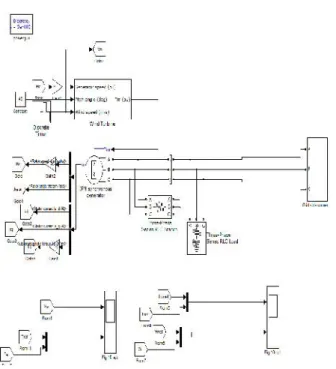
FIG5:Simulink block diagram
The direct control scheme for IPM synchronous generator based variable speed wind turbine shown in Fig.4 is implemented in MATLAB/SimPower Systems dynamic system simulation software. The IPM synchronous generator data are given in Table III. Table I is used for switching the converter. The bandwidths of torque and flux hysteresis controllers are 10%
Fig. 6. Performance of the traditional indirect vector control scheme: (a) wind speed, (b) -axis current and its
reference,
of their rated values. A smaller hysteresis bandwidth can reduce ripples in torque. The sampling times for the
torque and speed control loops are 10 and , respectively. For comparison, the traditional vector-controlled scheme shown in Fig. 1 has also been implemented in MATLAB/SimPower Systems using the same IPM synchronous generator. MATLAB/SimPowerSystems wind turbine model is used in this work. The input to the wind turbine model is wind speed and the output is torque.
Fig. 7. Performance of the traditional indirect vector control scheme: -axis current and its reference, and (d) speed reference and measured speed.
Fig. 8. Performance of the direct control scheme:(a) wind speed, (b) torque and its reference,
Fig. 9. Performance of the direct control scheme:,(c) flux linkage and its reference ,and (d) speed reference
CONCLUSION
This project proposed a sensor less immediate control methodology for an IPM synchronous generator-based variable speed wind turbine. In this control plot, no rotor position is required as every one of the estimations are done in stator reference outline. The proposed coordinate control plot has a few preferences contrasted and circuitous vector control conspire, for example, 1) lesser parameter reliance; 2) torque and flux control without rotor position and PI controller which diminish the related postponement in the controllers; and 3) sensorless operation without mechanical sensor. The outcomes demonstrate that the immediate controller can work under shifting breeze speeds. Notwithstanding, coordinate control conspire has the issue of higher torque swell that can present speed swells and dynamic vibration in the power prepare. The techniques to limit the torque/speed swells should be tended to. The recreation and test comes about for the sensor less speed estimator are introduced, and the outcomes demonstrate that the estimator can gauge the generator speed great with a little mistake.
REFERENCES
[1] M. Enamul Haque, Senior Member, IEEE, Y. C. Saw, and Mujaddid Morshed Chowdhury, Student
Member, IEEE” Advanced Control Scheme for an IPM Synchronous Generator-Based Gearless
Variable Speed Wind Turbine” IEEE TRANSACTIONS ON SUSTAINABLE ENERGY, VOL. 5, NO. 2, APRIL 2014
[2] S. Müller, M. Deicke, and R. W. D. De
Doncker,“Doubly fed induction generator system for wind turbines,”IEEE Ind. Appl. Mag., vol. 8, no. 3, pp. 26–33, May 2002.
[3] J. Hu, H. Nian, H. Xu, and Y. He,“Dynamic
modeling and improved control of DFIG under distorted
grid voltage conditions,”IEEE Trans. Energy Convers.,
vol. 26, no. 1, pp. 163–175, Mar. 2011.
[4] M. Mohseni, M. S. M. Islam, and M. A.
Masoum,“Enhanced hysteresisbased current regulators in vector control of DFIG wind turbine,”IEEE Trans.
Power Electron., vol. 26, no. 1, pp. 223–234, Jan. 2011.
[5] H. Polinder, F. F. A. Van der Pijl, G. J. de Vilder, and P. J. Tavner, “Comparison of direct-drive and
geared generator concepts for wind turbines,” IEEE
Trans. Energy Convers., vol. 3, no. 21, pp. 725–733, Sep. 2006.
[6] M. E. Haque, M. Negnevitsky, and K. M.
Muttaqi,“A novel control strategy for a variable-speed
generator,” IEEE Trans. Ind. Appl., vol. 46, no. 1, pp.
331–339, Jan./Feb. 2010.
[7] R. Esmali and L. Xu,“Sensorless control of
permanent magnet generator in wind turbine
application,”IEEE Industry Applications Society Annual Meeting, Tampa, FL, USA, Oct. 8–12, 2006, pp. 2070–2075.
[8] M. Chinchilla, S. Arnaltes, and J. C.
Burgos,“Control of permanent-magnet generators applied to variable-speed wind-energy systems
connected to the grid,”IEEE Trans. Energy Convers., vol. 21, no. 1, pp. 130–135, Mar. 2006.
[9] S. M. Deghan, M. Mohamadian, and A. Y.
Varjani,“A new variable-speed wind energy conversion system using permanent-magnet synchronous generator and Z-source inverter,”IEEE Trans. Energy Convers.,
vol. 24, no. 3, pp. 714–724, Sep. 2009.
[10] S. Morimoto, H. Nakayama, M. Sanada, and Y.
Takeda,“Sensorless output maximization control for
variable-speed wind generation system using
IPMSG,”IEEE Trans. Ind. Appl., vol. 41, no. 1, pp. 60–