ISSN: 1305-578X
Journal of Language and Linguistic Studies, 15(3), 1171-1187; 2019
A qualitative inquiry into the application of 9
thgrade EFL program in terms of
the CEFR
Erkan Yüce a * , İsmail Hakkı Mirici b
a Dr., Nevşehir Hacı Bektaş Veli University, Nevşehir, 50300, Turkey b Prof. Dr., Near East University, Nicosia, 99138, Northern Cyprus APA Citation:
Yüce, E., & Mirici, İ. H. (2019). A qualitative inquiry into the application of 9th grade EFL program in terms of the CEFR. Journal of Language
and Linguistic Studies, 15(3), 1171-1187. Doi: 10.17263/jlls.631560 Submission Date:28/08/2019
Acceptance Date:22/09/2019
Abstract
Current study investigated applicability of the 9th Grade EFL Program with regard to proficiency descriptors and
educational principles of the Common European Framework of Reference for Languages (CEFR). Qualitative inquiry was followed by adopting a phenomenological approach to conduct the study. The data were collected through document analyses, face-to-face interviews, and teacher and students observations regarding classroom instructions. Descriptive analysis was administered to analyze the data obtained from the document analyses, interviews, and observations. The results showed that the EFL program corresponds to students’ language levels and needs, while teachers come across problems due to course materials and insufficient class hours during implementations. Besides the participant teachers reported problems in terms of seminars and in-service training activities.
© 2019 JLLS and the Authors - Published by JLLS.
Keywords: CEFR; EFL program; 9th grade; program evaluation
1.
Introduction
1.1.
The Common European Framework of Reference for Languages (CEFR)
The release of the Common European Framework of Reference for Languages (CEFR) has affected language education contexts profoundly since 2001. Though the CEFR was published originally in English and French languages, nowadays language users can reach it in forty different languages. Although it was intended for language professionals and users in member states of the European Union (EU), the CEFR has become a reference tool in language education contexts across the world in curriculum development, assessment, and standard setting (Alderson, 2007; Byram & Parmenter, 2012; Hulstijn, 2007; Khalifa & Ffrench, 2008; Mirici, 2015; North, 2014). The CEFR can be used as a reference document in education contexts to define language users’ language proficiency levels through its illustrative descriptors; also, it provides several pedagogical principles which can be followed to enhance the efficiency of language education contexts. Following these pedagogical principles can
* Corresponding author. Tel.: 0 (384) 228 10 00
promote plurilingualism, pluriculturalism, intercultural awareness, and contribute to mutual understanding internationally (CoE, 2001; Çelik, 2013; Girard & Trim, 1998; Mirici, 2014).
1.2.
The 9
thGrade EFL Program in Turkey
The Board of Education (BoE) of the Ministry of National Education (MoNE), Turkey proposed the latest curriculum for secondary schools on 19.01.2018 with the Article Number of 40. It was declared that the new program would be implemented for all grades of secondary schools step by step starting from the fall term of the 2018-2019 school year. It was announced that an action-oriented approach was adopted; four language skills were aimed to develop considering such educational principles as learner autonomy and self-assessment in order to address communication problems that the students may confront in their real lives (MoNE, 2018).
1.3.
Importance of the Study and Research Questions
Program evaluation provides us real insights into efficiency of processes conduced in language education contexts, especially, when we consider time and effort devoted to a program development and implementation. In this respect, the current study investigates applicability of the new EFL program with regard to the CEFR. The research questions of this study are:
- To what extent do the outcomes of 9th Grade EFL Program correspond to the proficiency
descriptors of the CEFR?
- What are the perspectives of EFL teachers in terms of the implementation of 9th Grade EFL
Program with regard to the educational principles of the CEFR?
- What are the classroom observations regarding the applicability of 9th Grade EFL Program with
respect to the CEFR?
1.4.
Literature Review
Foreign language program development and implementation issues hold crucial place both in our country and in other countries, and many research studies were carried out in order to investigate different aspects of foreign language programs. In this regard, the following paragraphs discuss a number of research studies to provide a general understanding to this study.
competence, integrated language skills, project and problem-based learning. Similarly, Egyptian context was investigated by Shaarawy and Lotfy (2013) through a quasi-experimental design in terms of blended learning approach and the CEFR proficiency descriptors. The results indicated a significant difference between the groups with regard to their writing proficiency as learners in the experiment group over scored learners in the control group. The study discussed importance of the research for Egyptian context. Accordingly, Nakatani (2012) investigated the influence of communicative strategy provided by the CEFR on Japanese EFL students’ proficiency levels. The study followed a mixed methods approach to collect data from Japanese students. The results indicated that the CEFR implementations helped students to improve themselves in terms of strategy use and awareness.
Moreover, self-assessment aspect of the CEFR has become a research interest; many studies have investigated contributions of the CEFR in foreign language learning in terms of self-assessment. Denies and Janssen (2016) presented the results of their study regarding self-assessments through application of 12 can-do statements from the CEFR by 22,500 language learners. The results indicated positive correlations between the results; also, background profiles of the participants affected their patterns of results. Similarly, Runnels (2016) studied the relations between language proficiency and self-assessment due to extensive application of the CEFR as an assessment tool in language education contexts in Japan. The study discussed self-assessment preferences of the learners, effectiveness of the self-assessment for learners, and interpretability of the results. Also, Şentürk and Mirici (2019) expressed that self-assessment through CEFR-based documents such as English Language Portfolio (ELP) had positive effects on language learners.
There have also been studies which have addressed specifically alignment processes of the CEFR into national language education contexts. Ilc and Stopar (2015), for example, addressed the alignment process of national examinations conducted in English to the CEFR proficiency descriptors in Slovenian context. The study reported significance of this kind of processes since understanding descriptors in international benchmarks such as the CEFR may contribute substantially to language teaching policies followed by countries. Likewise, Huy and Hamid (2015) reported adaptation and alignment processes of the CEFR into language education context in Vietnam. The study addressed to perceptions of stakeholders on adaptation process of the CEFR in a state university. The results suggested implementation of the CEFR to confront possible problems in foreign language education both in Vietnam and in developing countries. Additionally, adaptation and implementation of the European Portfolio for Student Teachers of Languages (EPOSTL), another CEFR-based document, in language education contexts was strongly suggested (Çakır & Balcikanli 2012; Seitova, 2017; Yüce, 2019).
2.
Methodology
2.1.
Research Design
This study followed a qualitative model by adopting a phenomenological approach. In phenomenology, data regarding experiences are analyzed and compared to depict the nature of a phenomenon, for example, essence of being a participant in particular program. Phenomena can be feelings, social relationships such as professions, marriages, or can be a culture, an organization, and a program; experiencing phenomenon directly enables to understand what others feel about it, and, this addresses importance of interviewing (Creswell, 2007; Patton, 2002). The study investigated applicability of the 9th Grade EFL Program of the MoNE with regard to the CEFR in language education
2.2.
Participants
The participants were 11 EFL teachers chosen purposefully and conveniently; and, only volunteer participants were incorporated into the study. Demographic profiles of the participants were categorized in terms of sex, age, educational background (EB), department of graduation (DG), and teaching experience (TE). The participants were labelled with an alphabetical code from ‘A’ to ‘K’ to provide their confidentiality. All of the participants had a bachelor degree (BD). Most of them (n=10) graduated from an English Language Teaching (ELT) department, and, only one of them (n=1) graduated from an English Language and Literature (ELL) department. The participants had more than 5 years of teaching experience. The following table (Table 1) presents demographic profiles of the participants:
Table 1. Demographic Profiles of the Participants
Part. Sex Age EB DG TE
A F 38 BD ELT 16
B F 33 BD ELT 11
C F 42 BD ELT 17
D F 41 BD ELL 20
E F 30 BD ELT 6
F F 34 BD ELT 12
G F 52 BD ELT 30
H F 38 BD ELT 17
I F 37 BD ELT 15
J F 40 BD ELT 17
K F 42 BD ELT 20
2.3.
Data Collection
The first research question was answered through document analyses, the 2nd research question was answered through face-to-face interviews with the participants, and the last research question was answered through observations regarding classroom instruction in this study. The CEFR (2001), EAQUALS Bank of Descriptors-As Checklists (2008) documents and 9th Grade EFL Program proposed by the BoE (2018) were used during the document analysis processes. An interview form consisting of ten semi-structured interview questions was developed to carry out face-to-face interviews, and an observation checklist consisting of twenty items was developed to observe EFL classes.
2.4.
Data Analysis
were defined by giving direct quotations. Lastly, the results were explained by associations and comparisons.
2.5.
Trustworthiness
Trustworthiness of the study was provided by following several strategies such as triangulation, member checking, intercoder agreement, peer review, external audits, and thick description. Firstly, triangulation points to comparing data by employing different sources, and researchers can investigate a problem from different perspectives (Given, 2015; Palmer & Bolderston, 2006).The researchers benefited from document analyses, face-to-face interviews and observations to ensure believability of the study. Secondly, transcriptions of the face-to-face interviews and conclusions on the transcriptions were shared with the participants in order to avoid any semantic loss. Member checking promotes credibility of conclusions (Creswell, 2007). Thirdly, an agreement on the themes and categories among several experts who were unaware of each other were sought by the researchers. Intercoder agreement highlights an agreement among several experts on the same data (Creswell, 2007). Fourthly, the results were shared and discussed with several peers who had conducted qualitative research studies beforehand to gain insights on the processes. Peer review enables to review processes and data by other experts who have knowledge and experience in the field (Creswell & Miller, 2000). Fifthly, external audits address to outsiders who comment on processes and results of a study (Erlandson, Harris, Skipper & Allen, 1993). Different experts were consulted about appropriateness of steps followed in the study. Lastly, the researchers applied thick description. This strategy enables readers to get most of a research study by giving clear details about it (Patton, 2002). All the processes followed in this study were described in a detailed way for readers to enhance transferability of the study in other contexts.
3.
Results
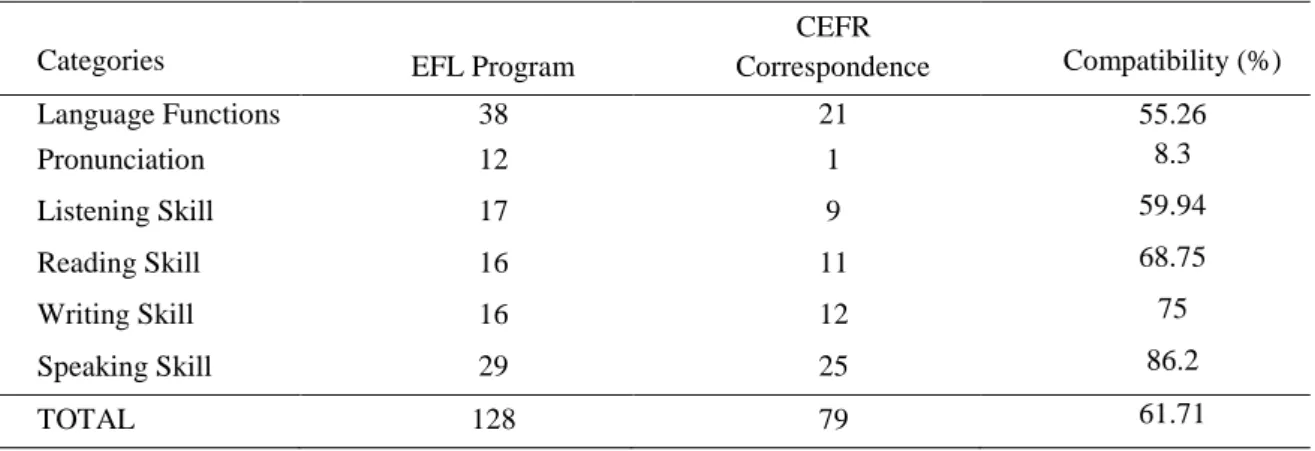
The first research question explored the compatibility of outcomes proposed by 9th Grade EFL Program with proficiency descriptors of the CEFR. In this respect, a comparative analysis process was conducted with documents of the CEFR (2001), EAQUALS Bank of Descriptors-As Checklists (2008), and 9th Grade EFL Program. The results obtained after document analysis process were summarized in following table (Table 2) as:
Table 2. Compatibility of the EFL program outcomes with proficiency descriptors of the CEFR
Categories EFL Program
CEFR
Correspondence Compatibility (%)
Language Functions 38 21 55.26
Pronunciation 12 1 8.3
Listening Skill 17 9 59.94
Reading Skill 16 11 68.75
Writing Skill 16 12 75
Speaking Skill 29 25 86.2
TOTAL 128 79 61.71
the EFL program proposes 38 outcomes for language functions and 21 (55.26%) of them correspond to A1 and A2 levels. Secondly, the EFL proposes 12 outcomes for pronunciation and 1 (8.3%) of them correspond to A1 and A2 levels. Thirdly, the EFL program proposes 17 outcomes for listening skill and 9 (59.94%) of them correspond to A1 and A2 levels. Fourthly, the EFL program proposes 16 outcomes for reading skill and 11 (68.75%) of them correspond to A1 and A2 levels. Fifthly, the EFL program proposes 16 outcomes for writing skill and 12 (75%) of them correspond to A1 and A2 levels. Lastly, the EFL program proposes 29 outcomes speaking skill and 25 (86.2%) of them correspond to A1 and A2 levels. In sum, the EFL program proposes 128 outcomes to be attained and 79 (61.71%) of them correspond to A1 and A2 levels.
The second research question investigated applicability of the EFL program in terms of the CEFR educational principles. To form a frame, the researchers consulted different experts in the area and defined 8 main themes (plurilingualism, pluriculturalism, intercultural awareness, action-oriented approach, task-based learning, communicative language competence, autonomous learning, and self-assessment (ELP)) proposed by the CEFR (CoE, 2001) by following Miles and Huberman (1994) model. The formula of Δ= ∁ ÷ (∁ + 𝜕) × 100 suggested by Miles and Huberman was applied to define internal validity of the descriptive themes, and 88.88% of agreement was defined among the experts (Baltacı, 2017; Miles & Huberman, 1994; Patton, 2002). Based on these themes, semi-structured interview questions were prepared and implemented to the participants. The researchers labelled each participant in an alphabetical order as A, B, C, etc. to ensure the confidentiality of their identities. Respectively, results obtained from the face-to-face interviews as follows:
The first interview question investigated the EFL teachers’ perceptions on whether the EFL program involve educational principles of ‘plurilingualism and pluriculturalism’ of the CEFR. Most of the participants (f=9) stated that the EFL program does not enable 9th grade learners to become plurilingual and pluricultural. They think that though nationalities and countries were mentioned in the first units of course materials, the other units do not involve activities which may foster plurilingualism and pluriculturalism. Sample extracts gathered from the face-to-face interviews are as follows:
A: “...No, it does not. It does not enable our students to become plurilingual or pluricultural. Though there are elements like ‘hello’ in different languages at the beginning of the term, it does not provide further samples for our students to become plurilingual or pluricultural. For example, it does not provide detailed items or samples of ‘breakfast’ to our students in different cultures. They do not know how to say a proper name in French or in Spanish. The activities do not teach samples of usages in different languages.”
E: “...Only ‘greetings’ expressions. We have covered 5 units so far and we did not come across such activities or exercises.”
According to the responses, the EFL program does not provide plurilingual and pluricultural elements.
The second interview question investigated the participants’ perceptions about whether the EFL program for 9th grade students comprises ‘action-oriented approach’. Action-oriented approach is one of the educational principles emphasized in the CEFR, and the EFL program asserts including an action oriented aspect in designing units of the program (MoNE, 2018). Most of the participants (f=10) think that the EFL program presents activities and examples for learners to solve their communication problems which they may encounter in their social contexts. One participant (f=1) did not want to state her views on this interview question. Sample extracts from the interviews are presented as follows:
G: “...The activities of communicative problems for the interested students are available.”
Based on the responses, it can be stated that the EFL program presents activities for language learners to overcome their communicative problems which may arise in their daily lives. According to the responses, the course materials which were designed in line with the program provide communication activities for students to prepare them for the real life situations. Thus, it can be concluded that the EFL program involves action-oriented approach principle of the CEFR.
The third interview question investigated the participants’ perceptions on whether the EFL program comprises communicative language competence principle of the CEFR. While most of the participants (f=8) agreed that the EFL program enable students to develop their communicative language competences, one participant (f=1) did not want to express her views, and the other participants (f=2) expressed negative views on this issue. Several extracts from the interviews for this question are:
A: “...The new program and course materials are better than the previous ones when we compare them in terms of developing students’ communicative competences. Especially speaking activities are up to the point. Describing a picture, their homes or close friends in a detailed way are some of the examples of speaking activities presented in the course materials based on the program and they help students to develop their communicative competences.”
E: “...In fact, communicative competences can be developed easily with this program...”
The results showed that the EFL program provides activities to develop communicative language competences of students by focusing on language skills, especially speaking skill. The participants think that the activities in course materials based on language functions enhance students’ speaking skills. It can be concluded that the EFL program comprises communicative language competence education principle suggested in the CEFR.
The fourth interview question investigated the EFL teachers’ views on whether the EFL program for involve ‘task-based learning’ educational principle of the CEFR. Most of the participants (f=9) think that the EFL program presents real life tasks for students to accomplish in an ordinary day by using foreign language, while one participant (f=1) thinks vice versa. Sample extracts for this interview question are:
C: “...At the beginning of each unit, there are activities for speaking or expressing opinion on an event. There were subjects related to letters in previous years but now we come across subjects such as e-mails, blogs and attending to meetings etc. It presented skills for student such as maintaining a conversation in daily life. Discussion activities or expressions such as like/dislike are provided for students.”
E: “...Yes, it does. It develops students. For example, they know how to respond an e-mail or write a postcard.”
The results indicated that the EFL program involves task-based learning activities that students need to succeed in personal, public, educational, and occupational domains in their lives. It can be concluded from the results that the EFL program comprises task-based learning educational principle of the CEFR.
The fifth interview question investigated the participants’ views on whether the EFL program comprises ‘self-assessment’ educational principle of the CEFR. The interview results showed that the EFL program helps students to assess themselves in foreign language learning through ‘Check Yourself’ parts in course materials. All of the participants (f=11) stated that self-assessment educational principle of the CEFR is presented in the EFL program. Sample extracts from the interviews are:
A: “...Yes, it does. There are ‘Check Yourself’ parts at the end of each unit...” C: “...There are self- assessment activities at the end of units...”
According to the results, the EFL program enables 9th grade students to assess themselves through ‘Check Yourself’ parts in the course materials.
that the EFL program enables students to learn cultural similarities and differences. Their responses indicated that the EFL program involves interesting subjects on intercultural issues for students. Sample extracts for the sixth interview question are:
C: “...Yes. The program provides this awareness. For example, our students learned the celebrations such as ‘Thanksgiving Day’, ‘Halloween Day’ and ‘Christmas Day’.”
H: “... Festivals, especially, are described for the students and ‘Easter Day’ is one of them.”
The interview results revealed that the EFL program presents intercultural awareness principle of the CEFR. The participants mentioned various examples from traditional rooms, festivals to American and Indian film sectors that they covered in EFL classes. Therefore, it can be concluded that the EFL program helps students to enhance their communicative language competences through activities comprising intercultural aspects in language learning.
The seventh interview question investigated the participants’ perceptions on whether the EFL program involves autonomous learning educational principle of the CEFR. According to the results, seven participants (f=7) agreed that the EFL program equip students with basic skills which enable them to become autonomous in language learning while three participants (f=3) expressed negative views on this issue. Sample extracts from the interviews are:
G: “...These kinds of activities are available. There are project parts.” H: “...We give project assignments to the students...”
The interview results indicated that the EFL program comprises autonomous learning educational principle of the CEFR. The literature did not present any results regarding on autonomous learning in previous studies of program evaluation, thus, it can be stated that MoNE included activities regarding autonomous learning in the new EFL program.
The eighth interview question investigated the participants’ views on seminars or in-service training activities on the new EFL program. The results showed that all of the participants (f=11) took part in a seminar or in-service training activity. Also, most of the participants (f=8) think that the seminars was not beneficial for their professional development for various reasons, while three participants (f=3) expressed positive opinions about the seminars. Sample extracts from the interviews are:
D: “...The training was not favorable at all. I do not think that it provided new ideas or information for us.” I: “... No, it was not beneficial for me because it did not present new activities for me to be applicable in the classroom. They only provided information theoretically which I had already known.”
The results indicated that the seminars or in-service training activities did not contribute to their professional developments for various reasons. From the results, it can be stated that the seminars or in-service training activities regarding the new EFL program for the participants was not effective with regard to its scope and application.
The ninth interview question investigated the participants’ views on appropriateness of learning and teaching processes to learners’ language levels and needs. While most of the participants (f=9) think that the new EFL program is appropriate to students’ levels and needs, one participant (f=1) expressed negative views, and one participant (f=1) did not answered this question. Sample extracts from the interviews are:
H: “...The program is appropriate for the students’ levels... It is also appropriate for the students’ needs. It reflects the subjects which they are interested in daily life in the classroom environment.”
J: “... It is appropriate to their levels. It starts with the basic subjects. It is also appropriate to student needs at our school.”
According to the results, the participants (f=9) think the EFL program appeals to learners’ levels and needs. The participants commented that the topics of the previous grades are reviewed in the program, and communicative needs of the learners are addressed in the units through activities. However, they stated that they confront several problems in accomplishing activities, but, these problems are not related to the design of activities, and they stem from study habits of previous years.
The tenth interview question investigated the participants’ perceptions on the applicability, strengths and weaknesses of EFL program. After multiple readings of the transcriptions, the categories were defined as: being communicative (f=6), comprising interesting topics (f=4), intercultural awareness (f=3), course hours (f=9), and course materials (f=8).The interviews revealed factors affecting the implementations of the EFL program positively and negatively. While course hours, learning habits of students, and quality of materials can be sequenced among negative factors; interesting themes, presenting four language skills, addressing communicative needs of learners and intercultural issues can be sequenced among positive factors. Sample extracts for this interview are as follows:
A: “...There were not skill-based course materials in the previous years. Students were used to come across grammar structures such as ‘used to’ at the very beginning of the terms. But now, it is not the case. The program looks more like foreign resources. Listening activities are appropriate for students’ levels... and, writing activities do not require direct composition writing. The simple and beneficial expressions on daily bases which students use in their ordinary lives enhance the writing skills of the students.”
“...I cannot deal with all of the students in the classroom for speaking activities, because 4 hours of language courses are not sufficient to involve all of the students in the activities. There must be more course hours allotted weekly for us.”
D: “...It refers different cultures in the course materials... It focuses on developing students’ communicative skills... Student participation is emphasized in comparison to the previous ones.”
H: “...It is rich in terms of content... The topics are interesting for the students and a different idiom is presented for the students in each unit.”
The results showed that outside factors affect applicability of the EFL program negatively, and, design of the course materials, course hours allotted, study habits of students can be regarded among these factors. The participants think that the design of course materials is not professional, and they do not seem professional both for teachers and students. Also, the participants expressed that they do not use multimedia tools in EFL classes. For example, they stated that listening activities are not integrated to online materials, and they need to carry an extra flash memory to open listening audios for students. Similarly, they asserted that pictures and photos in the coursebook do not seem professional for learners’ age group which leads them not to take classes seriously.
Items of the instrument investigated appropriateness and applicability of the EFL program with regard to themes of the units, language skills, pronunciation, everyday problems, plurilingualism, pluriculturalism, communicative competences, tasks in different domains, self-assessment, intercultural awareness, autonomous learning, language materials, students’ age groups and levels, students’ linguistic and intercultural needs, and general applicability of the program. Sample fieldnotes obtained from the observations are as follows:
- The participation to the activities is high. (S1-O1)
- They can understand the listening audios.(S1-O4)
- The students replied to the questions asked by the teacher.(S1-O2)
- They are eager for the reading activities.(S1-O1)
- They wrote a short message to their families.(S1-O5)
- Peer corrections were provided for the pronunciation of ‘customer, spicy, sour, delicious’.(S1-O1)
- Students discussed which foods are healthy or unhealthy.(S1-O3)
- One of the students: “Could I leave a message?” (in customer role).(S1-O5)
- Asking and answering questions about their favorite foods.(S1-O2)
- Airport attitudes, getting a boarding pass, boarding the plane.(S1-O3)
- Reading passages concerning Lisbon, Shanghai, and Buenos Aires. (S1-O4)
- Searching some topics on the Net.(S2-O3)
- Most of the students can easily participate in the activities.(S1-O4)
- Visuals and audios are not professional.(S1-O1)
- Conversations about types of illnesses and incidents. (S2-O4)
- Many examples about eating habits of different nations (Chinese, Brazilians etc.) are provided for the students in the lesson.(S1-O2)
- The students can easily follow and participate in the activities.(S1-O4)
Fieldnotes obtained from the observations indicated that the EFL program comprises most of the criteria defined in the checklist. The results, firstly, showed that themes presented in the program are attractive for language learners. Secondly, the activities prepared for language learners are appropriate to their levels in terms of language skills and pronunciation. Thirdly, the program involves situations for language learners which may they come across in an ordinary day. Fifthly, the program includes possible problems and their solutions for language learners. Sixthly, the program provides activities for students to enhance communicative competences, intercultural awareness, autonomous learning, task-based learning, and self-assessment. However, several criteria were not addressed during the observations. For example, while materials implemented in the lessons are appropriate to students’ language levels, they are partly appropriate to students’ age groups. Also, there were not any activities regarding plurilingualism and pluriculturalism during the observations. All in all, the observations indicated that the new EFL program is applicable in English lessons.
4.
Discussion
The results of the document analyses support the previous studies regarding language outcomes in literature. For example, Özer (2012) stated that 3rd Grade EFL program did not equally administer
issues, seminars or in-service training activities, course hours, course materials, being communicative and skill-based, while they contradict with previous results in the literature regarding self-assessment. Initially, according to the responses, the EFL program does not provide plurilingual and pluricultural elements. This result was supported by the previous studies (Dağ, 2008; Sarıca, 2009; Zorba, 2012). Dağ (2008) suggested including multilingual and multicultural elements in EFL programs of secondary schools. Similarly, Sarıca (2009) called for an EFL program comprising pluriculturalism and plurilingualism for 8th grade students. Likewise, Zorba (2012) stressed that plurilingualism is a neglected
aspect in 9th grade EFL program. Based on the result, it can be asserted that plurilingualism and pluriculturalism are two disregarded issues in EFL program development processes of the MoNE, though they are strongly suggested by the CEFR. Next, the EFL program enables 9th grade students to
assess themselves through ‘Check Yourself’ parts in the course materials. This result contradicts the previous studies (Karcı, 2012; Örmeci, 2009; Zorba, 2012). Zorba (2012) stated that 9th grade EFL
coursebook did not present self-assessment parts for students. Similarly, Karcı (2012) expressed evaluation problems of EFL program for 9th grade students. Based on the results, it can be stated that
self-assessment needs of language learners were paid attention in the new EFL program by the MoNE. Thus, it can be concluded that the new EFL program comprises self-assessment educational principle of the CEFR. Then, the results indicated that seminars or in-service training activities did not contribute to their professional developments for various reasons. From the results, it can be stated that the seminars or in-service training activities regarding the new EFL program for the participants were not effective with regard to its scope and application. Previous research studies with different grades also indicated similar results (Bayraktar, 2014; Bergil & Sarıçoban, 2017; Dağ, 2008; Doğan, 2007; Karcı, 2012; Özel, 2011; Öztürk, 2006). In this respect, it can be concluded that seminars and in-service training activities seem ongoing problems for language teachers, though the issue had been revealed in many studies previously. Lastly, the results showed that outside factors affect the applicability of the EFL program negatively, and, design of the course materials, course hours allotted, study habits of students can be regarded among these factors. The participants think that the design of course materials is not professional, and they do not seem professional both for teachers and students. Also, the participants expressed that they do not use multimedia tools in EFL classes. For example, they stated that listening activities are not integrated into online materials, and they need to carry an extra flash memory to open listening audios for students. Similarly, they asserted that pictures and photos in the coursebook do not seem professional for learners’ age group which leads them not to take classes seriously. The results contributed to the previous results for different grades indicated in the literature (Dağ, 2008; Karcı, 2012; Sarıca, 2009). Likewise, course hours allotted (4 hours a week) seem insufficient to include all students in activities equally, and this affects implementations negatively. Previous research studies for different grades also discussed this issue as a problematic factor (Bayraktar, 2014; Dağ, 2008; Karcı, 2012; Örmeci, 2009; Yörü, 2012). However, the participants mentioned some positive aspects of the EFL program which enhance its applicability. For example, they think that the EFL program comprises more communicative and skill-based activities than the EFL programs proposed in previous years (f=6). Furthermore, they think that the EFL program enables students to become more aware of intercultural differences (f=3). Also, they expressed that the EFL program presents interesting themes and topics which are appealing for students in comparison to the previous EFL programs (f=4).
are strongly suggested in previous research studies (Dağ, 2008; Sarıca, 2009; Zorba, 2012). Secondly, it was observed that though the course materials present self-assessment parts in ‘can-do’ forms, the application of these parts seems problematic. One of the researchers observed that the teacher did not cover one of these parts at the end of a unit and skipped to the next unit. Dönmez (2010) and Karcı (2012) reported similar problems. Dönmez (2010) mentioned that 8th Grade EFL teachers did not benefit
from alternative tools and techniques for assessment. Likewise, Karcı (2010) addressed similar problems in relation to assessment parts of EFL program for 9th Grade. Thirdly, when the observation results are
considered in terms of students’ age groups and language levels, the literature presents contradicting results. The current study demonstrated that while course materials are appropriate for students’ language levels, they are not appropriate for students’ age groups. Güneş (2009) stated that course materials for 5th Grade EFL classes were appropriate to students’ age groups, while Örmeci (2009)
reported that course materials for 4th, 5th, and 6th grades were not suitable for students’ both age groups
and language levels. Fourthly, the observations indicated that the students dealt easily with pronunciation of new words both through teacher corrections and peer corrections. This result contradicts the findings reported by Yörü (2012). Yörü (2012) reported negative views on pronunciation activities in terms of 8th Grade learners. Lastly, the observations indicated that the EFL program is applicable in language education contexts in general in terms of the predetermined criteria of the checklist. This result also contradicts the previous results discussed in literature. Karcı (2012), Örmeci (2009), and Yörü (2012) reported negative views on applicability of EFL programs of several grades, while Güneş (2009) and Yaman (2010) reported positive views on applicability of EFL programs.
5.
Conclusions and Implications
The current study investigated the applicability of 9th Grade EFL Program within the light of
proficiency descriptors and educational principles of the CEFR through a phenomenological inquiry (Creswell, 2007; Moustakas, 1994). Firstly, the study found that outcomes of the EFL program are not totally compatible with the CEFR regarding proficiency descriptors proposed for language learners at A1, A1+, and A2 levels. Secondly, the study demonstrated that the new EFL program for 9th grade students involves the CEFR’s educational principles of communicative language competence, intercultural awareness, task-based learning, action-oriented approach, autonomous learning, and self-assessment, while it disregards plurilingualism and pluriculturalism. Thirdly, the study indicated that activities of course materials are appropriate to learners’ language levels and needs, while design of the course materials does not appeal to learners’ age groups. Additionally, insufficient course hours affect the applicability of the EFL program negatively as the language teachers do not include all students into activities during classes. Fourthly, the study showed that though the course materials include self-assessment parts for learners, their applications seem problematic during classes as these parts are above learners’ levels. Furthermore, it was found that ELP is not implemented in EFL classes though it is strongly suggested in the CEFR. Fifthly, seminars and in-service training activities for EFL teachers do not seem to contribute to EFL teachers’ professional developments. All in all, the study found that the EFL program is applicable with respect to the CEFR at a large extent.
and reflect their levels and achievements. Lastly, seminars and in-service training activities can be planned more professionally for EFL teachers by considering their professional needs in terms of new EFL programs and current issues in these programs.
Acknowledgements
This article was produced from a part of the Ph.D. dissertation entitled “Evaluation of the High School 9th Grade English Language Curriculum of Turkey in Relation to the CEFR Principles”.
References
Akşit, H. N. (1998). A case study on teacher perception of quality of work life within the context of human resource management in an educational institution. In Yıldırım, A., & Şimşek, H. (2013). Sosyal bilimlerde nitel araştırma yöntemleri (9th ed). Ankara: Seçkin Yayıncılık.
Alderson, J. C. (2007). The CEFR and the need for more research. The Modern Language Journal, 91, 659-663.
Arslan, A. (2011). The application of the Common European Framework of Reference for Languages in the Turkish higher education in terms of curriculum development process. (Unpublished doctoral dissertation). Abant İzzet Baysal University, Bolu.
Baltacı, A. (2017). Nitel veri analizinde Miles-Huberman Modeli. Ahi Evran Üniversitesi Sosyal Bilimler Enstitüsü Dergisi (AEÜSBED), 3(1), 1-15.
Bayraktar, B. (2014). Evaluation of the English curriculum for second classes in primary schools according to teachers' opinions. (Unpublished master’s thesis), Uludağ University, Bursa.
Bergil, A. S, & Sarıçoban, A. (2017). The use of EPOSTL to determine the self-efficacy of prospective EFL teachers: Raising awareness in English language teacher education . Journal of Language and Linguistic Studies, 13(1), 399-411.
Byram, M., & Parmenter, L. (2012). The Common European Framework of Reference: The globalisation of language education policy. UK: Multilingual Matters.
Council of Europe (CoE). (2001). Common European Framework of Reference for Languages: Learning, teaching, assessment. Cambridge: Cambridge University Press.
Creswell, J. W. (2007). Qualitative inquiry and research design: Choosing among five approaches (2nd ed).Thousand Oaks, CA:Sage.
Creswell, J. W. (2009). Research design: Qualitative, quantitative and mixed methods approaches. Thousand Oaks, CA:Sage.
Creswell, J. W., & Miller, D. L. (2000). Determining validity in qualitative inquiry. Theory into Practice, 39(3), 124-130.
Çakır, A., & Balcikanli, C. (2012). The use of the EPOSTL to foster teacher autonomy: ELT student teachers’ and teacher trainers’ views. Australian Journal of Teacher Education, 37(3), 1-16. Çelik, S. (2013). Plurilingualism, pluriculturalism, and the CEFR: Are Turkey’s foreign language
Dağ, A. (2008). Assessment of Turkish students’ performance in English as a foreign language at secondary level within Common European Framework. (Unpublished master’s thesis), Çanakkale Onsekiz Mart University, Çanakkale, Turkey.
Demirlier, H. (2010). Students’ and teachers’ attitudes towards the newly developed curriculum of primary schools. (Unpublished master’s thesis), Muğla University, Muğla.
Denies, K., & Janssen, R. (2016). Country and gender differences in the functioning of CEFR-based can-do statements as a tool for self-assessing English proficiency. Language Assessment Quarterly, 13(3), 251-276.
Doğan, Z. Y. (2007). Avrupa Birliği ortak dil çerçevesi programının Milli Eğitim Bakanlığı ilköğretim okullarında yabancı dil (İngilizce) dersi öğretiminde uygulanabilirliği. (Yayımlanmamış yüksek lisans tezi), Yıldız Teknik Üniversitesi, İstanbul.
Dönmez, Ö. (2010). Implementation of the new eighth grade English language curriculum from the perspectives of teachers and students. (Unpublished master’s thesis), Middle East Technical University, Ankara.
EAQUALS, (2008). Portfolio descriptor revision project. Retrieved September 9, 2017, from https://www.eaquals.org/
Erlandson, D. A., Harris, E. L., Skipper, B. L., & Allen, S. D. (1993). Doing naturalistic inquiry: A guide to methods. Newbury Park, CA: Sage.
Girard, D., & Trim, J. L. M. (Eds.). (1998). Learning and teaching modern languages for communication: Final report of the project group (activities 1982/87). Strasbourg: Council of Europe.
Given, L. M. (2015). 100 questions (and answers) about qualitative research. California: Sage. Güneş, T. (2009). Teachers’ opinions on the English language curriculum of the 5th grade of primary
education. (Unpublished master’s thesis), Hacettepe University, Institute of Social Sciences, Ankara. Hulstijn, J. H. (2007). The shaky ground beneath the CEFR: Quantitative and qualitative dimensions of
language proficiency. The Modern Language Journal 91, 663-667.
Huy, N. V., & Hamid, M. O. (2015). Educational policy borrowing in a globalized world: A case study of Common European Framework of Reference for languages in a Vietnamese University. English Teaching: Practice & Critique, 14(1), 60-74.
Ilc, G., & Stopar, A. (2015). Validating the Slovenian national alignment to CEFR: The case of the B2 reading comprehension examination in English. Language Testing, 32(4), 443 –462.
Karcı, C. (2012). Evaluation of English curriculum in 9th grade of secondary schools through teachers’ views. (Unpublished master’s thesis), Adnan Menderes University, Aydın.
Khalifa, H., & Ffrench, A. (2008). Aligning Cambridge ESOL examinations to the CEFR: Issues & Practice. Paper presented at the 34th Annual Conference of the International Association for Educational Assessment, Cambridge, England.
Kondakçı, N. (2014). A comparative analysis of national and international English language curricula for high schools in Turkey. (Unpublished master’s thesis), Bilkent University, Ankara.
Ministry of National Education (MoNE) (2018). English language teaching curriculum of secondary
education. Retrieved January 25, 2018, from
http://mufredat.meb.gov.tr/ProgramDetay.aspx?PID=342
Mirici, İ. H. (2014). The Common European Framework of Reference for Languages (CEFR) and the European Language Portfolio (ELP). In S. Çelik (Eds.). Approaches and Principles in English as a Foreign Language (EFL) Education (381-396). Ankara: Eğiten.
Mirici, İ. H. (2015). European policy and practices in training foreign language teachers. H. U. Journal of Education, 30(4), 42-51.
Moustakas, C. (1994). Phenomenological research methods. Thousand Oaks, CA: Sage.
Nakatani, Y. (2012). Exploring the implementation of the CEFR in Asian contexts: Focus on communication strategies. Procedia - Social and Behavioral Sciences 46, 771 – 775.
North, B. (2014). The CEFR in practice. Cambridge: Cambridge University Press.
Örmeci, D. N. (2009). An evaluation of English language curricula implemented at the 4th, 5th, and 6th grades in respect of teachers’ opinions. (Unpublished master’s thesis), Trakya University, Edirne. Özel, R. T. (2011). Determination of challenges encountered in the implementation of English curricula
for primary schools (the sample of Ankara). (Unpublished master’s thesis), Ankara University, Ankara.
Özer, Ö. (2012). Comparative analysis of secondary school 3rd grade English language curriculum in parallel with the Common European Framework of Reference for Languages. (Unpublished master’s thesis), University of Bülent Ecevit, Zonguldak.
Öztürk, A. R. (2006). An analysis of ELT teachers’ perceptions of some problems concerning the implementation of English language teaching curricula in elementary schools. (Unpublished master’s thesis), University of Gaziantep, Gaziantep.
Palmer, C., & Bolderston, A. (2006).A brief introduction to qualitative research. The Canadian Journal of Medical Radiation Technology, 37(1), 16-19.
Patton, M. Q. (2002)(3rd ed). Qualitative research and evaluation methods. London: Sage.
Runnels, J. (2016). Self-assessment accuracy: Correlations between Japanese English learners’ self-assessment on the CEFR-Japan’s can do statements and scores on the TOEIC. Taiwan Journal of TESOL, 13(1), 105-137.
Sak, Ö. (2013). A comparative analysis of English language curriculum for primary education in Turkey and Finland according to common European framework for languages. (Unpublished doctoral dissertation), Abant İzzet Baysal University, Bolu.
Sarıca, Ö. K. (2009). An analysis of the language levels of the eighth (8th) graders in state primary schools in Turkey according to Common European Framework criteria and content. (Unpublished master’s thesis), Pamukkale University, Denizli.
Seitova, M. (2017). The European Portfolio for Student Teachers of Languages (EPOSTL) promotes professional development: ELT in-service teachers’ views. International Online Journal of Education and Teaching (IOJET), 4(4), 541-550.
Şentürk, B., & Mirici, İ. H. (2019). Does the ELP Promote Learning English as a Foreign Language at Tertiary Level?. Journal of Language and Linguistic Studies, 15(2), 695-718.
Wolcott, H. F. (1994). Transforming qualitative data: Description, analysis, and interpretation. New Delhi: Sage.
Yaman, S. (2010). Assessment of English curriculum for primary schools’ 4th and 5th grades according to teachers’ opinions: (A Case study in Gaziantep). (Unpublished master’s thesis), Fırat University, Elazığ.
Yıldırım, A., & Şimşek, H. (2013). Sosyal bilimlerde nitel araştırma yöntemleri (9th ed). Ankara: Seçkin
Yayıncılık.
Yörü, B. (2012). İlköğretim sekizinci sınıf İngilizce öğretim programına ilişkin öğretmen görüşleri (Eskişehir örneği). (Yayımlanmamış yüksek lisans tezi), Eskişehir Osmangazi Üniversitesi Eğitim Bilimleri Enstitüsü, Eskişehir.
Yüce, E. (2019). EPOSTL: Revisiting the roles of language teachers at a recently established ELT department. International Online Journal of Education and Teaching (IOJET), 6(1). 1272-1281. Zorba, M. G. (2012). An evaluation of Anatolian high schools’ 9th grade EFL curriculum and course
materials through the principles of the common European framework of reference for languages. (Unpublished master’s thesis), Akdeniz University, Antalya.
9. sınıf YDİ programının ADOÇEP bakımından uygulanmasına nitel bir
araştırma
Öz
Bu çalışma 9. Sınıf yabancı dil olarak İngilizce (YDİ) programının Avrupa Dilleri Ortak Çerçeve Programı (ADOÇEP) yeterlilik betimleyicileri ve eğitimsel ilkeleri bakımından uygulanabilirliğini araştırmıştır. Araştırmayı gerçekleştirmek için olgu bilimsel yaklaşım seçilerek nitel araştırma takip edilmiştir. Veriler doküman analizi, yüz yüze görüşme ve sınıf içi öğretimlere ilişkin öğretmen ve öğrenci gözlemleri yoluyla toplanmıştır. Doküman analizleri, görüşmeler ve gözlemlerden toplanan verileri analiz etmek için betimsel analiz uygulanmıştır. Sonuçlar YDİ programının öğrencilerin seviyeleri ve ihtiyaçlarına uygun olduğunu gösterirken, öğretmenlerin uygulamalarda ders materyalleri ve yetersiz ders saatleri bakımından problemlerle karşılaştıklarını göstermiştir. Ayrıca, katılımcı öğretmenler seminerler ve hizmet içi eğitim aktiviteleri bakımından problemleri bildirmişlerdir. Anahtar sözcükler: ADOÇEP; YDİ programı; 9. Sınıf; program değerlendirme
AUTHOR BIODATA
Erkan Yüce is an instructor at School of Foreign Languages of Nevşehir Hacı Bektaş Veli University. He received his Ph.D. degree in English Language Teaching from Hacettepe University. The CEFR, program evaluation, ESP and CBI are among his fields of interest.