International Journal of Communication Networks and Information Security (IJCNIS) Vol. 11, No. 3, December 2019
Performance Evaluation of Soil Substance
Measurement System in Garlic Plant based on
Internet of Things with Mesh Topology Network
Scenario
Doan Perdana
1, Muhammad Imadudin
2and Gustommy Bisono
31,2,3 School of Electrical Engineering, Telkom University, Bandung 40257, Indonesia
Abstract: The high consumption followed by low production makes the government have to import garlic to meet domestic needs every year. To help increase garlic yields, a system designed to facilitate the process of measuring Nitrogen (N), Phosphorus (P), Potassium (K) content on plantation land in real-time using NPK sensor and nodemcu as microcontrollers and provide the connectivity of real-time information using mesh topology. This system is an Internet of Things (IoT) based network, where internet connectivity is used to exchange information with each other with the objects around it. The result of the design of this system is a device to measure each element of N, P, and K as well as fertility status based on NPK values that have been obtained. And, with the IoT feature and mesh topology built in this device, the measurement data and whether or not the device works can be monitored easily through an android application that has been made on a smartphone. The mesh topology that built in this device is using painlessmesh library where the network built on the system is a true ad-hoc network, meaning that no-planning or central controller is required. We conclude that the accuracy of the measurement data compared to the NPK meter analog (Doctor Plant) is above 90%. Based on the durability test of the device and the system using Xiaomi's power bank of 5000mAh, the device and the system work well for 30 hours without any problems. Moreover, the accuracy of the data measured and uploaded to the database is no error with a 100% compatibility rate.
Keywords: Nitrogen, Phosphorus, Potassium, NPK Sensor, NodeMCU, Internet of Things, Painlessmesh
1.
Introduction
GARLIC is an important food commodity for the community. However, national garlic always has a deficit [1]. The high consumption followed by low production makes the government have to import garlic to meet domestic needs every year. The main nutrients needed for garlic in fertilization are N, P, and K in the form of N, P2O5, and K2O. Other nutrient elements can be fulfilled by providing manure. The device to measure the NPK value in the market at an affordable price is the Doctor Plant Fertilizer, where this tool can be used to measure the acidity (pH) of the soil and the level of soil fertility which is categorized into 3 classes, namely too little, ideal, and too much. Therefore, to make it easier to see user-friendly measurement results, a device is designed to display the measurement results of NPK elements in the form of digital values and can be monitored remotely in real time.
To get a value with high accuracy, data collection for mapping requires calibration of sensors with existing devices. In the application of real-time remote monitoring, IoT network technology is used with firebase intermediaries
to store data from devices. As a future development, LoRa technology becomes a very good alternative for this system. Internet of thins is a disruptive paradigm that brings waves of internet evolution by extending communication between types of smart objects, and enabling the integration of heterogeneous technology [2]. The Internet of Things (IoT) is a concept where internet connectivity can exchange information with each other with objects around it [3]. With this IoT concept, it will be easier for users to monitor a situation or condition in real-time from anywhere and anytime. In the previous studies regarding the measurement of soil nutrients, research was carried out on rice fields in the lowlands.
2.
Background
International Journal of Communication Networks and Information Security (IJCNIS) Vol. 11, No. 3, December 2019 (K) contained in soil so that fertilization can be done more
efficiently. This system was designed based on a plantation survey in Solo, Central Java, Indonesia. Smart agriculture can effectively monitor plant growth, meanwhile, the use of sensors or assistance for water irrigation and its distribution can help reduce labor costs [8].
3.
Methodology
In this research, there are several methods that used by authors to support the research include system design, block diagram, inverting amplifier, analog to digital conversion, map() functions, tools and components, schematic and fritzing design.
A. System Design
In general, the soil nutrient measurement system for garlic will be divided into three parts design. First, hardware design, is hardware design that will be implemented on a soil nutrient measurement prototype. The hardware in this system will be embedded in each node that has been determined on the plantation land. Second, network design, is the design of communication networks between hardware and user device and also communication between NodeMCU. In this network design, the topology used is mesh topology. Third, software design, software designed is an android application that is used to display the measurement data that are stored in Firebase.
Figure 1. System Design and Topology
B. Garlic Fertilization Recommendation
The recommended dose of chemical fertilizer per hectare for garlic is 200 kg N, 180 kg P2O5, 60 kg K2O and 142 kg S. Nitrogen fertilizer is applied 3 times during the growth of garlic, namely when planting, when forming shoots (15-30 days after planting) and when forming tubers (30-45 HST). Phosphorus and potassium fertilizers are given as basic fertilizer together with manure at planting time [9]. Phosphorus promotes root and growth and Potassium promotes flowering [10].
C. Kg/Ha to parts per-million (ppm) Conversion
The recommended dose of chemical fertilizer per hectare for garlic is 200 kg N, 180 kg P2O5, 60 kg K2O and 142 kg S. To convert from kg/ha to "part per million" (ppm) requires values for the soil bulk density (in kg/m3) and the depth of the soil layer sampled (in meters) [11]. The following results in Table 1 are rules of thumb for mineral soils that assume soil bulk density is 1000 kg/m3.
If sample depth was 0.15m (15cm or 6inch), the formula is: Value in kg=ha = value in ppm × 1:5(1)
Rationale: Value in kg / ha =
(1)
Example: 50 ppm N = approx: 75 (kg N) / Ha Nitrogen fertilizer is applied 3 times during the growth of garlic.
Table. 1 Garlic Fertilization Parameter
Fertilizer 1 Ha
Sample Depth (m)
Ppm (kg/ha : Sample Depth (m)) [15], [17]
N 200 kg
1,5m
133ppm
P2O5 180 kg 120ppm
K2O 60 kg 40ppm
D. Non-inverting Amplifier
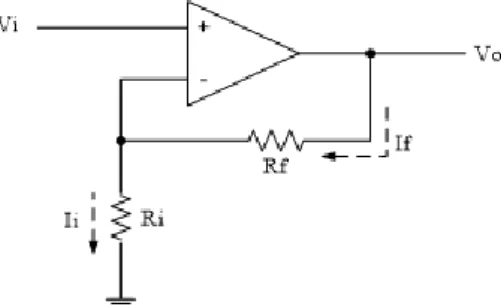
In general, the soil nutrient measurement system for garlic will be divided into three parts design. First, hardware design, is hardware design that will be implemented on this research uses IC UA741CP which is needed to implement non-inverting amplifier on the system [13]. Non-inverting amplifier is the operational amplifier in which the output is in phase with input signal [14].
Figure 2. System Design and Non-inverting Op-Amp Circuit
(3)
(4)
The reinforcement formula of the non inverting circuit is obtained from the following equation: where,
= Input current Ampere
= Feedback current (Ampere) = Resistor input (Ohm)
= Feedback Resistor (Ohm) = Input Voltage (Volt)
= Output Voltage (Volt)
E. Analog to Digital Conversion in NodeMCU
International Journal of Communication Networks and Information Security (IJCNIS) Vol. 11, No. 3, December 2019
F. Map() Function
After pin a0 converts adc, the value obtained will be processed in the map () function. In this function, the adc value will be grouped based on the number of classes entered [16]. After getting the class, then the value of nitrogen, phosphorus and potassium from each class will be determined using the map function process as well.
int vaql = analogRead(A0); Serial.println(vaql);
int val = map(vaql, 0, 1023, 1, 300); int N = map(val, 51, 201, 51, 200); int P = map(val, 51, 201, 5, 14); int K = map(val, 51, 201, 51, 200);
G. Painlessmesh
PainlessMesh is a library that takes care of the particulars of creating a simple mesh network using a star topology, avoiding any circular paths [17].
H. Delay
Delay or latency or round trip, is the time needed for a packet sent from a computer to the destination computer. Delay in a packet transmission process in a computer network is caused by a long queue, or taking another route to avoid traffic jams. to find the delay in the packet transmitted by dividing between packet lengths (bit units) divided by link bandwidth (unit bit / s) [18].
I. Throughput
Throughput measurement is the number of bits or packets of a data unit that is received correctly by the receiver [18].
(5)
= Package received (package)
= Duration of packet sending via channel Example: Throughput = 2157 / 2100 = 0.972
J. Jitter
Jitter is very closely related to delay. jitter caused by different packet travel paths. From the results of measurements that have been made can be seen, that the change in jitter at two points, name at 80 kbps and 64 kbps bitrate changes significantly, compared to other bitrate changes. This is caused by the path of different packets or because of collisions on the network [ 21].
K. Packet Lost
Lost packet measurement is the number of packets lost during the transmission process to the destination. Packets disappear when one or more data packets that pass through a network fail to reach their destination [18].
(6) Where :
= Package that experienced a drop (package) = Package sent (package)
= Simulation time (seconds) = Sampling time (seconds)
Example: Packet lost = 60 / 2175 100 = 2.8 %
4.
System Configuration
A. Painlessmesh Data Parsing in System
Exchange of measurement data information on painless mesh that is built using parsing methods, namely the breakdown of data to be processed or sent to another node. This is done to avoid data irregularities and facilitate checking of data received from other nodes. Data parsed on this system are the values of each element N, P, and K, fertility status, and node id number.
B. Tools and Components
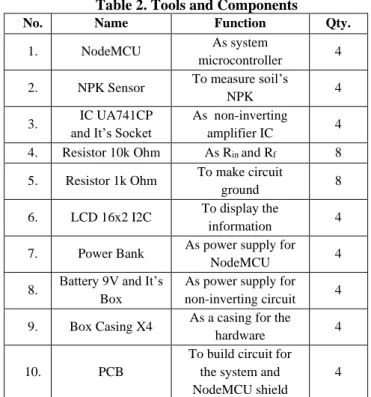
In this research, several tools and components are required to build this system as shown in the following table.
Table 2. Tools and Components
No. Name Function Qty.
1. NodeMCU As system
microcontroller 4 2. NPK Sensor To measure soil’s
NPK 4
3. IC UA741CP and It’s Socket
As non-inverting
amplifier IC 4
4. Resistor 10k Ohm As Rin and Rf 8
5. Resistor 1k Ohm To make circuit
ground 8
6. LCD 16x2 I2C To display the
information 4
7. Power Bank As power supply for
NodeMCU 4
8. Battery 9V and It’s Box
As power supply for non-inverting circuit 4 9. Box Casing X4 As a casing for the
hardware 4
10. PCB
To build circuit for the system and NodeMCU shield
4
C. Schematic and Fritzing Design
The system device consists of several components and circuits as a compiler to be able to work in accordance with the design, the components and circuits used in this device are as shown in the following figure.
Figure 3. Schematic Circuit System
Figure 4. Fritzing Design System
International Journal of Communication Networks and Information Security (IJCNIS) Vol. 11, No. 3, December 2019 supply from NodeMCU is used to perform the 16 × 2 I2C
LCD function, while a non-inverting amplifier circuit uses a 9v battery power supply.
Sequentially, the device works starting from the NPK sensor which measures the voltage produced by the combination of NPK [19] in the garlic soil, is amplified by a non-inverting amplifier, the reinforcement results are received by the A0 NodeMCU pin and then displayed on a 16 × 2 I2C LCD screen in the form of the elemental value of each Nitrogen, Phosphorus, and Potassium.
5.
Results and discussion
This chapter describes the results of testing the systems and devices that have been designed. From these testing parameters it can be seen the level of reliability of the performance of the system and devices. Before conducting the test, several soil garlic samples were prepared with different fertilizer levels. The wifi network must be in good condition and the power supply meets the system requirements.
Table 3. specifications of The Hardware
Dimensions 12.5 cm x 8.5 cm x 5 cm Microcontroller NodeMCU ESP8266
Display LCD 16x2 I2C
IC UA741CP
Power Supply Power Bank 5V 1A for NodeMCU, Battery 9V for non-inverting circuit Interface Android application,
Firebase.com
Software: Arduino IDE, Android Studio
Database Firebase Realtime Database
NPK Sensor Doctor Plant (Modified)
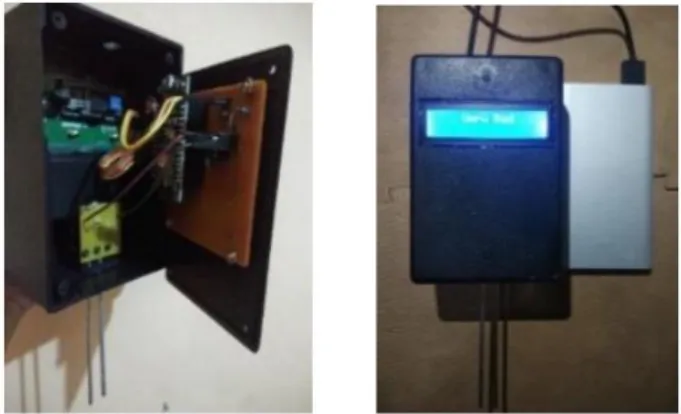
Figure 5. System Device
The casing of the device uses black acrylic plastic which is then modified in such a way as to adjust the circuit inside. At the front, the casing has a rectangular shaped hole
measuring 7 cm x 2.5 cm which is used as an LCD holder, a hole in the top for the USB cable from the power bank, a hole in the back for the placement of a Spicer from the PCB, and a hole in the section below for NPK sensor placement. Inside, there are PCB for the non-inverting amplifier circuit and NodeMCU shield, NPK sensor PCB, and 9v battery with it’s box. This device uses a PCB and jumper cable to connect the path between components as in Figure 5.
Figure 6. System Application Interface
In applications that is installed on the user's smartphone, the measurement results data displayed has the format as shown in Figure 6. In the upper left corner, there is a sender node label that has the value of the NodeMCU identity that acts as the sender of the measured data to Firebase. In the middle, there are 4 tables that are used to display data taken from Firebase. The data displayed is the last data from each node that goes to Firebase. Application calling the data from firebase using ‘get.references’ according to the variable of the data [20]. This application is designed using Android Studio with Java [21].
A. Testing in Garlic Soils
From several tests, it can be seen that the pure soil which is used as a sample is already in an ideal condition. and with the addition of fertilizer content of 1g, affecting ppm of about 20ppm.
Table 4. Results of Garlic Soil Measurement
Soil N P K Status
No fertilizer 144pp
m
10ppm
144ppm Ideal N and K
fertilizer (1gram)
166pp
m 11ppm
168ppm Ideal N and K
fertilizer (3gram)
200pp
m
14ppm
200ppm
Too Much N, P, K
fertilizer (3gram)
168pp
m
11ppm
168ppm Ideal N, P, K
fertilizer (2gram)
200pp
m
14ppm
200ppm
Too Much Road Soil
24ppm 1ppm
24ppm
Too Little
B. Firebase Test
International Journal of Communication Networks and Information Security (IJCNIS) Vol. 11, No. 3, December 2019 measurement. This is needed to make history from the data
obtained. This is what is called a real-time database [9].
Figure 7. Data Stored in Firebase
C. Delay and Accuracy Testing
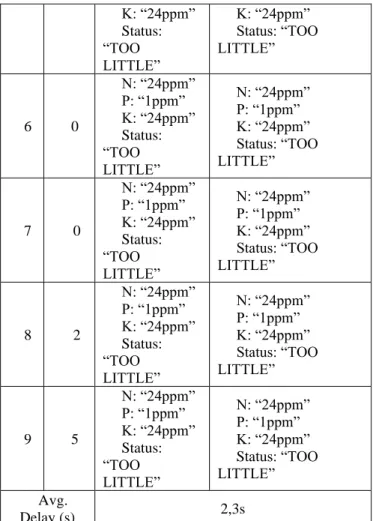
This test is conducted to determine the delay and accuracy of data sent from the device to the database via the internet using the Indihome WiFi network. If the delay obtained during normal network conditions (no interference) is not too large, then this system can meet the requirements to be implemented in the Garlic plantation.
Table 5. Device to Firebase Delay and Accuracy
No
Dela y (s)
Upload Firebase Received
1 0
N: “24ppm” P: “1ppm” K: “24ppm” Status: “TOO LITTLE”
N: “24ppm” P: “1ppm” K: “24ppm” Status: “TOO LITTLE”
2 6
N: “24ppm” P: “1ppm” K: “24ppm” Status: “TOO LITTLE”
N: “24ppm” P: “1ppm” K: “24ppm” Status: “TOO LITTLE”
3 7
N: “24ppm” P: “1ppm” K: “24ppm” Status: “TOO LITTLE”
N: “24ppm” P: “1ppm” K: “24ppm” Status: “TOO LITTLE”
4 0
N: “24ppm” P: “1ppm” K: “24ppm” Status: “TOO LITTLE”
N: “24ppm” P: “1ppm” K: “24ppm” Status: “TOO LITTLE” 5 1 N: “24ppm”
P: “1ppm”
N: “24ppm” P: “1ppm”
K: “24ppm” Status: “TOO LITTLE”
K: “24ppm” Status: “TOO LITTLE”
6 0
N: “24ppm” P: “1ppm” K: “24ppm” Status: “TOO LITTLE”
N: “24ppm” P: “1ppm” K: “24ppm” Status: “TOO LITTLE”
7 0
N: “24ppm” P: “1ppm” K: “24ppm” Status: “TOO LITTLE”
N: “24ppm” P: “1ppm” K: “24ppm” Status: “TOO LITTLE”
8 2
N: “24ppm” P: “1ppm” K: “24ppm” Status: “TOO LITTLE”
N: “24ppm” P: “1ppm” K: “24ppm” Status: “TOO LITTLE”
9 5
N: “24ppm” P: “1ppm” K: “24ppm” Status: “TOO LITTLE”
N: “24ppm” P: “1ppm” K: “24ppm” Status: “TOO LITTLE” Avg.
Delay (s) 2,3s
From the testing delay and accuracy of data in Table 4 it can be concluded that the average time required to upload data to the database is 2.3 seconds and the level of data accuracy is 100%. Thus the system has a fairly small delay and the exact data accuracy as desired in the design.
D. Durability Duration Testing
Table 6. Device Durability with 5000mAh Power Bank
Every Two Hours
Status
0 Works well
2 Works well
4 Works well
6 Works well
8 Works well
10 Works well
12 Works well
14 Works well
16 Works well
18 Works well
20 Works well
22 Works well
24 Works well
26 Works well
28 Works well
30 Works well
International Journal of Communication Networks and Information Security (IJCNIS) Vol. 11, No. 3, December 2019 internet network used on the device is a WiFi network from
the Indihome provider with speeds of up to 10 Mbps.
E. Painlessmesh Works in System
The mesh topology built on this system uses the painlessmesh library, where the mesh topology is a local network by utilizing the STA + AP (Station + Access Point) mode function of the ESP8266 NodeMCU [17]. With this function, each node of the system acts as a client and AP at the same time.The concept of painless mesh built on the system is that all nodes are connected to each other and exchange measurement data information using the local network created through a program sketch uploaded to NodeMCU. Each node has a different level. This level difference is to determine which node will act as the sender of the final data to Firebase. This is needed to minimize traffic and excessive use of IP.
In PainlessMesh, when a node wants to connect to an internet network via WiFi, then the node must detach from the mesh network first. This is because in this Painless Mesh library the AP mode function has been used to connect the node to the topology network, so it must break away from the mesh network and then switch connections to the WiFi internet network. Each node has its own delay based on the node level in the sketch uploaded to the NodeMCU microcontroller. Delays at each node have a difference of 20 seconds between node levels to allow time to re-initialize and reconnect to the mesh network after breaking free to send data to Firebase.
F. Data Sending in System with Painlessmesh
Exchange of measurement data information on the stainless mesh is done every 5 seconds, while for sending data to Firebase is done every 30 seconds for node 1 and the next 20 seconds for the next node. For the time of release from the mesh network and the process of connecting to the internet network takes about 10-20 seconds. Time fluctuates based on the strength of the WiFi network signal used by the node to send data to firebase. In the android application there is a date and time display of the last updated data to find out if there are nodes that are disconnected from the system and no longer send data to firebase.
G. NodeMCU versus Zigbee in System
In this research, 2 types of devices were made. first use NodeMCU ESP8266 as a microcontroller and a link to the internet. the second uses the Xbee S2C Zigbee as a connecting device to the internet and Arduino Uno as a microcontroller [22]. The following is the main comparison Table 7.
Table 7. NodeMCU and Zigbee Comparison at System
Stand-alone Using PC’s serial to connect
Using IDE Program Using XCTU to write and read [13]
Using Painlessmesh Library to build Mesh Topology at system
1 as Coordinator, the others as Router to build Mesh Topology at system
Can act as microcontroller and WiFi Module
Need Microcontroller and compatible shield [13] Using http protocol to
upload and update data to firebase [1]
Using Python to upload and update data to firebase [14]
H. ESP8266 NodeMCU Distance Testing
This test is conducted to determine the maximum distance NodeMCU can connect to Indihome WiFi networks. NodeMCU is said to not be connected to WiFi if the measurement data is not uploaded to Firebase.
Table 8. ESP8266 NodeMCU Distance Testing Result
Distance from AP
(m) Status
5m Data Successfully Sent to Firebase 10m Data Successfully Sent to Firebase 15m Data Successfully Sent to Firebase 20m Data Successfully Sent to Firebase
25m Disconnect from WiFi
For actual implementation, it’s better to use ESP-07 with an external antenna or LoRa NodeMCU for a wider range and MiFi as a connectivity provider. LoRa is best alternative choice. The LoRa network can connect and link tens of thousands of nodes [25]. So that, even in large plantations, IOT can still be implemented to the system.
I. Comparison with Analog NPK Meter
The device for measuring the element of soil NPK is the result of the development of a device that is already in analog form. Here is a table comparing the results of devices that have been made with existing tools to determine the level of accuracy of the measurement of the tools that have been made.
Table 9. The Comparison Result
Sample
Measurement Results of NPK Meter
IoT Digital Analog
ppm
Status Range Nilai
Index
N P K
1 82 5 82 Ideal Ideal 2
2 16
8 11 168 Ideal Ideal 3
3 20
0 14 200
Too Much
Too
Much >6 NPK Analog Meter (Doctor Plant) has 3 fertility ranges, namely too little, ideal, and too much. Too little is between the index value 0-1, ideal between> 1 - 4, and too much between >4 - 6. From Table 8, it can be seen that the measurement results of the device made already have a fairly high degree of accuracy compared to the tool npk analog meter that already exists.
6.
Conclusion
International Journal of Communication Networks and Information Security (IJCNIS) Vol. 11, No. 3, December 2019 Moreover, the accuracy of the data measured and uploaded
to the database is no error with a 100 % compatibility rate. The delay needed to upload data from the device to the database is 2.3 seconds using the Indihome internet provider network. The maximum distance of WiFi NodeMCU to stay connected to the Access Point (Indihome) is 20 meters away from the Access Point.
References
[1] "Budidaya Tanaman Bawang Putih," 2015. [online]. http://hortikultura.litbang.pertanian.go.id/teknologi-detail-43.html. Accessed at 23 April 2019.
[2] Evandro L. C. Macedo, Egberto A. R. de Oliveira, Fabio H. Silva, Rui R. Mello Jr, Felipe M. G. Franca, Flavia C. Delicato, Jose F. de Rezende, and Luis F. M. de Moraes, "On the Security Aspects of Internet of Things: A Systematic Literature Review," Journal of Communications And Networks, KICS, DOI:10.1109/JCN.2019.00004, 2019. [3] ITU-T, "Overview of the Internet of Things,"
Recommendation Y.2060, June 2012.
[4] Lee, H.-C., and Ke, K.-H., "Monitoring of Large-Area IoT Sensors Using a LoRa Wireless Mesh Network System: Design and Evaluation," IEEE Transactions on Instrumentation and Measurement, 67(9), 2018.
[5] Sethi, Pallavi and Sarangi, Smruti R, “Analisis volatilitas harga, volatilitas spillover, dan trend harga pada komoditas bawang putih (Allium sativum L.),” Agrise 14: 128-143, 2014.
[6] Lestari, "Pegaruh Jenis Pupuk Terhadap Pertumbuhan dan Produksi Siung serta Bulbil Bawang Putih CV Tawangmangu," Department of Agronomy and Horticulture, Bogor Agricultural University, May, 2018.
[7] Rukmana, Samadi, Budi dan Bambang Cahyono, “Intensifikasi Budidaya Bawang Putih,” Kanisius, Yogyakarta, 1996.
[8] Hsin-Te Wu and Chun-Wei Tsai, "An Intelligent Agriculture Network Security System Based on Private Blockchains," Journal of CommunicationsAnd Networks, KICS, DOI:10.1109/JCN.2019.000043, 2019.
[9] [online], “https://firebase.google.com/docs/functions/”
Accessed at 2 June
2019.“https://firebase.google.com/docs/functions/” Accessed at 15 March 2019.
[10]Masrie, M., Rosman, M. S. A., Sam, R., and Janin, Z., "Detection of nitrogen, phosphorus, and potassium (NPK) nutrients of soil using optical transducer," IEEE 4th International Conference on Smart Instrumentation, Measurement and Application (ICSIMA), 2017.
[11]Schmidt, Orlando and Poon, David, “Understanding Different Soil Test Methods, Nutrient Management Factsheet,” Ministry of Agriculture and Lands, Canada, 2010.
[12]Kowalenko, C.G., "Relationships between Extraction Methods for Soil Nutrient Testing in British Columbia," Report for Ministry of Agriculture and Lands, 2010. [13]Instruments, Texas. 2018. "Datasheet µA741
General-Purpose Operational Amplifiers Revised". January 2018. [14]RNA Muktiarto, D Perdana, RM Negara, “Performance
analysis of mobility impact on IEEE 802.11 ah standard with traffic pattern scheme”, International Journal of Communication Networks and Information Security, Vol. 10, No. 1, 2018.
[15][online], “Espressif Systems IOT Team,” 2015. [online] “ESP8266EX Datasheet Version 4.3” June 2015.
[16]“Arduino IDE and Math Map Functions Language,” 2019. [online], “https://www.arduino.cc.” Accessed at 14 April 2019.
[17]Painless Mesh ESP8266. 2019. [online]. https://gitlab.com/painlessMesh. Accessed at 25 April 2019. [18]Fahmi, Hasanul, "Analysis QoS (Quality of Service)
Measurement of Delay, Jitter, Packet Lost, and Throughput To Get Good Quality of Radio Streaming Work," The Journal of Information and Communication Technology, 2018.
[19]“Datasheet and Instructions of NPK Sensor,” 2012. “[online],
http://www.lusterleaf.com/img/instruction/1865instruction.p df Access at 30 May 2019
[20]Warno. "Pembelajaran Pemrograman Bahasa Java dan Arti Keyword," Jurnal Komputer, vol. 8, no.1, 2012.
[21]Satyaputra, Alfa, Eva Maulina A, “Let’s Build Your Android Apps with Android Studio,” Elex Media Komputindo, Jakarta, 2016
[22]Winardi, “Mengenal Teknologi ZigBee Sebagai Standar Pengiriman Data Secara Wireless,” Binus University, 2010. [23]Digi International Inc. "XBee/XBee-Pro S2C Zigbee RF
Module". http://www.digi.com. Access Date: July 23th, 2019.
[24]Sethi, Pallavi and Sarangi, Smruti R, “Internet of things: architectures, protocols, and applications,” Journal of Electrical and Computer Engineering, 2017.