Internet Traffic based Channel Selection in
Multi-Radio Multi-Channel Wireless Mesh Networks
Muni Lavanya
1, C Shoba Bindu
2, and G. Vijay Kumar
312JNTUA College of Engineering, Anantapuramu, India 3G. Pulla Reddy Engineering College, Kurnool, India
Abstract: Wireless Mesh Networks (WMNs) are the outstanding technology to facilitate wireless broadband Internet access to users. Routers in WMN have multiple radio interfaces to which multiple orthogonal/partially overlapping channels are assigned to improve the capacity of WMN. This paper is focused on channel selection problem in WMN since proper channel selection to radio interfaces of mesh router increases the performance of WMN. To access the Internet through WMN, the users have to associate with one of the mesh routers. Since most of the Internet Servers are still in wired networks, the major dominant traffic of Internet users is in downlink direction i.e. from the gateway of WMN to user. This paper proposes a new method of channel selection to improve the user performance in downlink direction of Internet traffic. The method is scalable and completely distributed solution to the problem of channel selection in WMN. The simulation results indicate the significant improvement in user performance.
Keywords: Mesh networks, Channel selection, Multi-Radio Multi-Channel, Internet Traffic.
1.
Introduction
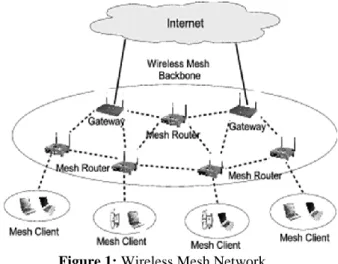
These days, the usage of mobile devices to access the Internet and using services [57] is increasing. The users want to experience the faster accessing of Internet resources as and when they need from everywhere. Wireless Mesh Networks (WMNs) are the promising technology to facilitate the broadband wireless Internet connectivity[1]–[8]. As shown in Fig. 1, the WMN has 3-level hierarchical architecture in which the gateway nodes are present at the top level-1, mesh routers in the next level-2 and the user devices are at the lowest level-3. Specifically, the WMN has two types of mesh nodes: mesh routers and mesh clients. A mesh router has three different types of functionality based on context of communication. A few of mesh routers will behaves like gateway routers which connects to the outside networks like internet with wired network. A few mesh routers perform routing functionality and connected together to form a complete wireless multi-hop mesh backhaul. A few mesh routers act as access points to provide network access to users. A mesh router can have one or more functionalities of gateway, router and access point. WMN is widely used in numerous commercial and civilian applications like home networking, enterprise networks etc[9]–[12].
Usually a mesh router has two or more radio interfaces to provide simultaneous transmissions and receptions with other routers and thereby to improve the capacity of WMN. But proper channel allocation to multiple interfaces is
important in improving the performance of WMN. If orthogonal channels available in the spectrum are assigned to interfaces such that no interference occurs with the communications of adjacent routers, the user throughput will be maximum. But the number of orthogonal channels are limited such as IEEE 802.11b standard supports only 3 orthogonal channels and IEEE 802.11a technology has 12 orthogonal channels. Thus, channel selection problem in multi-radio multi-channel WMN is important to consider in improving user performance [13]–[19].
Figure 1: Wireless Mesh Network
The various approaches are specified in literature [13] - [18] [20-30] for allocation of multiple channels and multiple radio interfaces in WMN with each one having its own objective and criteria. This paper proposes a new method, Internet Traffic based Channel Selection (ITCS) with the objective of improving the performance of Internet user in WMN. The basic idea is that most of the Internet traffic of mobile user is in downloading direction than uploading direction because almost all Internet servers are present in wired infrastructure. The proposed method ITCS allocates channels to multi-radio mesh routers in WMN such that the downloading speed of Internet user connected to WMN improves. Simulation results show the significant performance of ITCS than previous related work.
2.
Related Work
The performance of the user device connected to WMN depends on the capacity of WMN. The first generation of WMNs have mesh routers with single radio interface to which single channel was allocated. Since one common channel is assigned to all radio interfaces in the WMN, the user experiences poor performance in single radio single channel WMNs [31]. Later, mesh routers are equipped with multiple radio interfaces but common channel allocation gives same performance as in single radio single channel WMN. Proper channel allocation is important in improving the capacity of WMN. Channel interference frequency range is shown in Fig. 3.
Figure 2: IEEE 802.11 b/g channels [50]
Figure 3: Channel overlapping degree (reproduced from [51])
WMNs are deployed using the popular technologies of IEEE 802.11 standard. Specifically, IEEE 802.11b/g provides 3 orthogonal channels as shown in Fig.2, IEEE 802.11a provides 12 orthogonal channels to assign the radio interfaces of mesh routers in the WMN. Since the number of radio interfaces in WMN are less than number of orthogonal channels, there is a strong need of channel assignment schemes with proper utilization of limited number of orthogonal channels. It is also observed that the allocation of partially overlapping channels in addition to orthogonal channels improves further the capacity of WMNs [32]–[40]. In multi radio and multi-channel WMN, there exists a trade-off between the channel interference and network connectivity [49]. To reduce co-channel interference and maintain backhaul connectivity, it is needed to maintain common channel by the all the mesh routers. To maintain mesh backhaul connectivity, all the mesh routers must use a common channel and also to reduce the co-channel interference, a mesh router has to minimize the number of neighbour mesh routers with which it is sharing common channel. It is a big challenge for the researchers to design
channel assignment algorithm that compromise between connectivity and interference issues.
A wide different approach are proposed for channel allocation for multi radio and multi-channel allocation in the WMN literature. Our previous contribution [41] presents the detailed study of various algorithms of channel assignment under different classification schemes. Another study on channel assignment schemes for WMN is presented in [30]. Channel assignment approaches for multi-radio WMN can be widely categorized into distributed and centralized algorithms. In case of centralized schemes [14], [51], one network object controls the entire process of allocation of channels to all radio interfaces present in WMN. On the other hand, in case of distributed schemes [26], [27], there exists no centralized entity control, but each router takes care of itself by self-allocation of channels to its radio interfaces. Depends on time stamp the channel allocation approaches are categorized as static, dynamic and hybrid approaches. In static approach [52], [53], the fixed channels are assigned to fixed interfaces and no reallocation takes place. In dynamic assignment schemes [54], [55], allocation and reallocation of channels to interfaces occurs during the network operation time. Hybrid assignment schemes like [56] utilize the best features of both static and dynamic schemes such that some channels are fixed for some fixed interfaces and remaining channels in the spectrum are dynamically assigned to other interfaces.
Different schemes of channel assignment have different criteria with various parameters. Interference aware channel selection is presented in [18], [13], channel selection scheme to optimize throughput is given in [17], joint scheme of routing and channel assignment is provided in [25], [20], [29], channel assignment scheme to improve multimedia traffic QoS requirements is given in [28].
Unlike the previous work, this paper proposes a novel scheme of channel assignment with the objective of improving the performance of Internet user connected to the WMN.
3.
ITCS Design
This paper presents a novel protocol called Internet Traffic based Channel Selection (ITCS) with the objective of improving the performance of Internet user connected to the WMN.
3.1 Assumptions
internet with wired network. The users can connect to the any one of the mesh routers to get access of internet. A complete wireless mesh backhaul is formed by interconnecting the mesh routers in a multi-hop fashion. The formulation of channel selection metric is inspired from the work [42] and [58], which is defined for WLAN users and weextend the work for WMN environment. Since most of the Internet servers are still residing in the wired infrastructure, we assume that the major dominant mode of wireless usage is the downlink traffic. To simplify the derivation process of channel selection metric, we consider the saturated WMN withInternet traffic flowing from the gateway to the users through their associated mesh routers and each user is alwayswaiting for a packet to receive. This situation simplifiestheMAC layer modelling as the mesh routers are the only senders inthe network and the amount of interference caused bymesh routers does not depend on the number of their users. Underthese conditions, the long-term average throughputmeasured at MAC layer is same for all users associatedwith a mesh router[43].
We also assume that the mesh router implements multi-rate adaptationscheme of IEEE 802.11 standard. The user with poor quality link takes more time toreceive a packet from the associated mesh router compared to other usersassociated with the same router using good quality links ifthe packet size is assumed to be same for all users.
We consider the WMN system with ‘m’ routers and ‘n’ users. The set of ‘m’ mesh routers is represented as
r
r
r
r
m
R
=
1,
2,
3,....,
and the set of ‘n’ users is
u
u
u
u
n
U
=
1,
2,
3,....,
. The useru
iassociated with amesh router
r
jis represented asu
ij and if the router,r
j, is sending information to all its users in the packets of same size L, then the transmission delayT
D( )
u
ij experienced by the useru
ijis given by:
( )
))
(
(
1
j i j i Du
SINR
f
u
T
=
……. (1)where
f
(
SINR
(
u
ij))
gives instantaneous transmission rateof access link from router
r
j to useru
iexpressed usually in data units per second.As per our model, the mesh routers are the only senders transmitting data packets to the users and the users are waiting to receive the packets. According to IEEE 802.11 MAC CSMA/CA scheme, the mesh router has to compete with otherrouters for accessing the radio channel. Hence the medium utilization
MU
j of routerr
jwill not be 100% if other routers are present in its contention domain and the capacityC
jof routerr
j will only be a fraction of the medium capacity. Under these assumptions, the long-term average throughputTh
avg(
u
ij)
obtained by the useri
u
associated with routerr
jmeasured in a reference time period T is givenby
=
j U i j i D j j j i avgu
T
T
C
MU
u
Th
)
(
*
*
)
(
(2)where
U
jis the set of all active users associated with mesh routerr
j. The parameterC
j is the nominal capacity of the routerr
jwhich is based on the supporting physical layer and itis conveyed in the beacon/probe response frames. In ordertomeasure the medium utilization, each router measures thenumber of slots it spends in the transmission/reception, back off and idle states. The measurement period, T, can be defined with five transmissions/receptions as in [42]. The channel utilization fraction is estimated (busy slots/total slots) and maintained as a weighted moving average. Due to the performance anomaly of multi-rate users associated with the same router, the long-term average throughput is same for all users [44]. Since the low rate users degrade the performance of high rate users associated with the same router, the long-term average number of packets received by all users is same. In other words, the denominator of equation (2),
Uj
i
j i D
u
T
(
)
is observed to be almost same forall users,
u
i, associated with the same routerr
j.End-to-end throughput of a user is the aggregated throughput of access link throughput and backhaul link throughput. The access link throughput of user
u
i associated with a routerj
r
is calculated as shown in equation (2) and is given as)
(
ij avg linkaccess
Th
u
Th
−=
It is also assumed that each mesh router
r
jcalculates throughput on its routing interface as( )
T
L
DATA
r
Th
j=
*
where
DATA
is the number of data packets received with size L in a reference time-period T.Average backhaul link throughput of user
u
i connected to routerr
jis given as:j j b avg
U
r
Th
Th
=
(
)
where
U
j is the number of active users connected with routerr
j.Now the end-to-end throughput of user
u
ijis given as2
(
)
(
) (1
)
(3)
j b
E E i access link avg
where
w
is the weighing factor of access link and it has the value between 0 and 1. The value ofw
can be determined based on network conditions and application requirements. Each mesh routerr
jcalculates average throughput)
(
2
j i E E
u
Th
of active useru
iconnected with it and if the throughput falls below the predefined threshold valuethreshold
Th
then the routerr
jrecalculatesTh
E2E(
u
ij)
for all channels (except routing channel and current channel) and selects a channel in which 2(
)
j i E E
u
Th
is maximum and the new channel number is conveyed through beacon/probe response frames to all its users. Threshold valueTh
thresholdis determined based on network conditions and application requirements.3.2 Algorithm: ITCS algorithm
Input:
r
r
r
r
m
R
=
1,
2,
3,....,
given a set of ‘m’ routers
u
u
u
u
n
U
=
1,
2,
3,....,
given a set of ‘n’ usersbegin
(i) each mesh router
r
jcalculates access link throughput of its active usersu
ijas)
(
ij avg linkaccess
Th
u
Th
−=
(ii) each mesh router
r
j calculates backhaul link throughput for each of its active usersu
ijasj j b
avg
U
r
Th
Th
=
(
)
(iii) each mesh router
r
j calculates end-to-end average throughput for each of its active usersu
ijasb avg link
access j
i E
E
u
w
Th
w
Th
Th
2(
)
=
(
−)
+
(
1
−
)
(iv) if
(
2(
)
threshold)
ji E
E
u
Th
Th
then
repeat steps (i) to (iii) for all channels except current channel and routing channel.
(v) select channel with maximum 2
(
)
j i E E
u
Th
and inform the same to all users through beacon/probe response frames. end of algorithm
4.
ITCS Performance Analysis
The proposed method is evaluated using NCTUns 6.0 [45] simulator which is an open source simulator and emulator of networks. It is very easy to extend. The NCTUns is advanced network simulator consists of extensible unique features then the classical network emulator and simulators which uses the technology of kernel re-entering simulation. The NCTUns 6.0 is a Linux based network simulator/emulator upon which
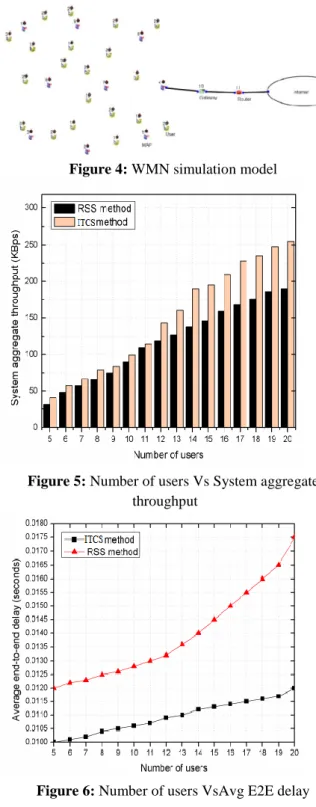
real world applications can be executed without modifications and a wide range of networking devices can be modelled using real TCP/IP network protocol stack to produce high-fidelity simulation results. In NCTUns, the configuration and operation for a simulated network are exactly the same as those for a real-life IP network. Using integrated GUI, it is easy for the user to create, edit and control the simulations/emulations and easily collect the results. The node conflicts of the wireless medium is accurately modelled in IEEE 802.11 standard MAC protocol DCF which is implemented in NS-2 simulation. The MAC layer of the NS-2 is imported to NCTUns to define complete functions of the standard MAC protocol. Moreover, it supports more realistic wireless signal propagation models. As per IEEE 802.11 standard, an user associates with a mesh router that has highest received signal strength (RSS) and when the user throughput falls below the threshold value, the router scans the remaining channels and selects a channel for an access interface which provides the highest throughput of user. This RSS based channel selection method is also simulated to analyse the performance of our method ITCS.We consider the simulation scenario with users and routers distributed randomly in the WMNasshown in Figure 4. We consider the IEEE 802.11b WMNwith 9 routers and 20 users and one gateway node connectedto the Internet with high speed (1 Gbps) wired link. Each mesh router utilizes “Open Shortest Path First (OSPF)” routing protocol to route the packets and the default metric in routing is hop-count. Access interface and routing interface are the two network interfaces utilized by each router in the network. As most of the Internet Servers are still present in wired infrastructure, the dominant wireless usage isthe downlink traffic. So, we considered the “User Datagram Protocol (UDP)” under the saturated internet traffic through gateway to all users with standard packet size 1000 bytes. The transmission rate of each traffic flow is set to 1Mbps and the simulation runs for 100 seconds.
RSS based method because selecting the highest signal strength channel does not guarantee the highest throughput and required Quality of Service. The received signal strength cannot reflect the actual throughput because it not only depends on the distance between user and router but also on the transmission power of router. It might happen that a distant user can associate with the router that has highest transmission power and use low bit rate transmission. Therefore, the users already associated with the router and using higher bit rate might have to wait until the low bit rate and distant user communication is finished. In the proposedITCS method, the router calculates the end-to-end throughput for all users on both access link and backhaul link by considering various parameters like channel conditions, access interface load, interference etc., and selects the channel which is providing highest throughput and thereby providing required end-to-end Quality of Service. The results are averaged over 10 simulation runs and shown in Figure 5and Figure 6.
Unlike the previous work [20], [25], [29], the proposed channel selection metric is independent of wireless mesh routing protocol and routing metric. To observe the impact of routing metric on the user performance, the simulation is repeated with two different routing metrics: hop count and expected transmission count(ETX) [46], for the same routing protocol OSPF. The simulation results for different routing metrics are presented in Figure 7. As the hop count metric does not consider link conditions like ETX metric, the system aggregate throughputis more when ETX routing metric is used with OSPF routingprotocol. As specified in [47], [48], when the routing metricoptimized for WMN environment is used along with ourchannel selection metric, a significant improvement in systemthroughput will be observed.
As the proposed method ITCS considers the access interface load and routing interface load into channel selection decision, we analysed the performance of ITCS method by varying network traffic load. By gradually increasing the load for all users in the network, we measured system throughput and average end-to-end delay. The simulation results are shown in Figure 8 and Figure 9. The method ITCS outperforms RSS method because the RSS method does not consider the access interface and routing interface load into channelselectiondecision and it solely depends on the received signal strength. Therefore the user associated with congested router cannotexperience better performance compared to other usersassociated with nearby lightly loaded routers.
In the previous simulation scenario, the mesh routers and users are randomly placed in the WMN. We perform simulations with two more scenarios where the routers are placed as a grid and the users are distributed uniformly and non-uniformly as shown in Figure 10 and Figure 11 respectively and we consider 9 routers and 20 users in the WMN. The routers are separated by a distance of 200 meters
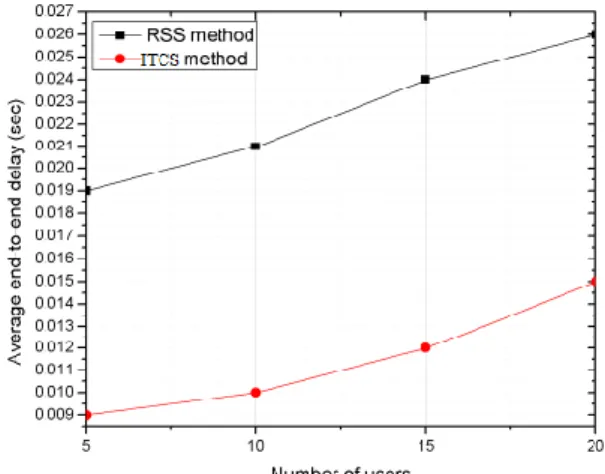
from each other and the users are uniformly distributed in the network. In fact, the channel loadis not the number of users associated with it, but in order to capture the impact of load distribution, we simulate that each router is transmitting the packets of 1000 bytes and with afixed rate of 1 Mbps to all users. The simulation runs for 100seconds. The results are shown in Figure 12 and Figure 13 and the performance of ITCS method is better than RSS-basedmethod. Similarly, the results of non-uniform distribution of users in WMN are shown in Figure 14 and Figure 15. Clearly, the RSS-based channel selection method fails in achieving better user throughput in this hot-spot congested scenario. ITCS method selects the channel based on achievable end-to-end throughput, and it outperforms the RSS-based method.
Figure 4: WMN simulation model
Figure 5: Number of users Vs System aggregate throughput
Figure 7: Impact of routing metric
Figure 8: Impact of network load
Figure 9: Network load vs E2E delay
Figure 10: Uniform distribution of routers in WMN
Figure 11:Non-uniform distribution of users
Figure 12: Impact of number of users
Figure 13: Number of users vsAvg E2E delay
Figure 15: Impact of number of users on avg. E2E delay
5.
Conclusions
Wireless Mesh Network is the promising technology to facilitate wireless broadband Internet connectivity to the mobile users. Proper channels must be assigned to numerous radio interfaces of mesh router to improve the performance of Internet user. This paper proposes a novel method ITCS of channel selection to the access interface of mesh router keeping fixed channel for routing interface of mesh router assuming that the mesh router has two interfaces. The model of ITCS can be generalized to mesh router with more than two interfaces. Moreover, the general framework of ITCS ensures that ITCS is independent of mesh routing protocol and routing metric. The performance analysis of ITCS shows significant results. Further enhancement of ITCS includes node mobility, better model of user throughput, etc.
References
[1] G. Vijaya Kumar and C. Shoba Bindu, “Liberal method of access point selection in wireless mesh networks,”
International Journal of Communication Networks and
Distributed Systems, vol. 19, no. 2, pp. 136–157, 2017.
[2] J. Wang, W. Shi, "Partially overlapped channels-and flow-based end-to-end channel assignment for radio multi-channel wireless mesh networks", China Communications, vol. 13, no. 4, pp. 1-13, April 2016.
[3] G. Vijaya Kumar and C. Shoba Bindu, “Improving Performance of Wireless Mesh Networks Through User Association Method,” in Proceedings of the Second International Conference on Computer and Communication
Technologies. Springer, 2016, pp. 249–258.
[4] D. Chakraborty, “I-QCA: An intelligent framework for quality of service multicast routing in multichannel multiradio wireless mesh networks,” Ad Hoc Networks, 2015.
[5] A. E. K. H. M. Almasaeid, “Receiver-based channel allocation in cognitive radio wireless mesh networks,” IEEE/ ACM
Transactions on Networking, vol. 23, no. 4, pp. 1286–1299,
2015.
[6] G. A. Zhang, J. Y. Gu, Z. H. Bao, C. Xu, and S. B. Zhang, “Joint routing and channel assignment algorithms in cognitive wireless mesh networks,” Transactions on Emerging
Telecommunications Technologies, 2014.
[7] J. F. Y. J. Xu, Y. Lee, C. C. Guo, “Resource allocation in city-wide real-time wireless mesh networks,” Journal of Networks, vol. 9, no. 8, pp. 2026–2036, 2014.
[8] S. Chieochan and E. Hossain, “Channel Assignment for
Throughput Optimization in Multichannel Multiradio Wireless Mesh Networks Using Network Coding,” Ieee Transactions on
Mobile Computing, 2013.
[9] E. Hossain and K. Leung, Wireless mesh networks:
Architectures and protocols. 2007.
[10] S. L. Mihail, “Wireless Mesh Networks: Opportunities And Challenges,” Proc of the Wireless World Congress, no. October, pp. 1–6, 2005.
[11] R. Bruno, M. Conti, and E. Gregori, “Mesh networks: Commodity multihop ad hoc networks,” IEEE
Communications Magazine, vol. 43, no. 3, pp. 123–131, 2005.
[12] K. C. Karthika, “Wireless mesh network: A survey,” in
Proceedings of the 2016 IEEE International Conference on Wireless Communications, Signal Processing and Networking,
WiSPNET 2016, 2016, pp. 1966–1970.
[13] A. P. Subramanian, H. Gupta, S. R. Das, and J. Cao, “Minimum interference channel assignment in multiradio wireless mesh networks,” IEEE Transactions on Mobile
Computing, vol. 7, no. 12, pp. 1459–1473, 2008.
[14] M. Alicherry, R. Bhatia, and L. E. Li, “Joint channel assignment and routing for throughput optimization in multiradio wireless mesh networks,” IEEE Journal on Selected
Areas in Communications, vol. 24, no. 11, pp. 1960–1971,
2006.
[15] H. Skalli, S. Ghosh, S. K. Das, L. Lenzini, and M. Conti, “Channel assignment strategies for multiradio wireless mesh networks: Issues and solutions,” IEEE Communications
Magazine, vol. 45, no. 11, pp. 86–93, 2007.
[16] Y. Ding, K. Pongaliur, and L. Xiao, “Channel allocation and routing in hybrid multichannel multiradio wireless mesh networks,” IEEE Transactions on Mobile Computing, 2013. [17] S. Chieochan and E. Hossain, “Channel assignment for
throughput optimization in multichannel multiradio wireless mesh networks using network coding,” IEEE Transactions on
Mobile Computing, vol. 12, no. 1, pp. 118–135, 2013.
[18] D. Yiltas-Kaplan, S. Durukan-Odabasi, and P. Kirci, “An interference-aware channel assignment scheme for wireless mesh networks,” Ad-Hoc and Sensor Wireless Networks, vol. 30, no. 3–4, pp. 183–199, 2016.
[19] P. Kyasanur, J. So, C. Chereddi, and N. H. Vaidya, “Multichannel mesh networks: Challenges and protocols,”
IEEE Wireless Communications, vol. 13, no. 2, pp. 30–36,
2006.
[20] H. Cheng and S. Yang, “Joint multicast routing and channel assignment in multiradio multichannel wireless mesh networks using tabu search,” in 5th International Conference on Natural
Computation, ICNC 2009, 2009, vol. 4, pp. 325–330.
[21] K. Xing, X. Cheng, L. Ma, and Q. Liang, “Superimposed code based channel assignment in multi-radio multi-channel wireless mesh networks,” 2007.
[22] F. Bokhari, “Channel assignment and routing in multiradio wireless mesh networks using smart ants,” in 2011 IEEE International Conference on Pervasive Computing and
Communications Workshops, PERCOM Workshops 2011,
2011, pp. 403–404.
[23] Y. Ding, Y. Huang, G. Zeng, and L. Xiao, “Using partially overlapping channels to improve throughput in wireless mesh networks,” IEEE Transactions on Mobile Computing, 2012. [24] E. Gregori, N. Scalabrino, Yuguang Fang, I. Chlamtac, and
Pan Li, “How to Effectively Use Multiple Channels in Wireless Mesh Networks,” IEEE Transactions on Parallel and
Distributed Systems, vol. 20, no. 11, pp. 1641–1652, 2008.
[25] N. Sadeghianpour, T. C. Chuah, and S. W. Tan, “Joint channel assignment and routing in multiradio multichannel wireless mesh networks with directional antennas,” International
Journal of Communication Systems, vol. 28, no. 9, pp. 1521–
1536, 2015.
[26] X. Lin and S. B. Rasool, “Distributed and provably efficient algorithms for joint channel-assignment, scheduling, and routing in multichannel ad hoc wireless networks,” IEEE/ACM
2009.
[27] H. Wu, F. Yang, K. Tan, J. Chen, Q. Zhang, and Z. Zhang, “Distributed channel assignment and routing in multiradio multichannel multihop wireless networks,” IEEE Journal on
Selected Areas in Communications, vol. 24, no. 11, pp. 1972–
1982, 2006.
[28] S. Y. Jang and C. Y. Lee, “Multipath selection and channel assignment in wireless mesh networks,” Wireless Networks, vol. 17, no. 4, pp. 1001–1014, 2011.
[29] H. Cheng and S. Yang, “Joint QoS multicast routing and channel assignment in multiradio multichannel wireless mesh networks using intelligent computational methods,” in Applied
Soft Computing Journal, 2011, vol. 11, no. 2, pp. 1953–1964.
[30] A. B. M. Alim Al Islam, M. J. Islam, N. Nurain, and V. Raghunathan, “Channel Assignment Techniques for Multi-Radio Wireless Mesh Networks: A Survey,” IEEE
Communications Surveys and Tutorials, vol. 18, no. 2, pp.
988–1017, 2016.
[31] I. F. Akyildiz, X. Wang, and W. Wang, “A-23. Wireless mesh networks: A survey,” Computer Networks, 2005.
[32] M. A. Hoque and X. Hong, “Interference minimizing channel assignment using partially overlapped channels in multi-radio multi-channel wireless mesh networks (non-refereed),” in
Conference Proceedings - IEEE SOUTHEASTCON, 2009, p.
445.
[33] L. Xiang and J. Luo, “Joint channel assignment and link scheduling for wireless mesh networks: Revisiting the partially overlapped channels,” in IEEE International Symposium on
Personal, Indoor and Mobile Radio Communications, PIMRC,
2010, pp. 2063–2068.
[34] K. Liu, N. Li, and Y. Liu, “Min-interference and connectivity-oriented partially overlapped channel assignment for multi-radio multi-channel wireless mesh networks,” in 2017 3rd IEEE International Conference on
Computer and Communications, ICCC 2017, 2018, vol.
2018–Janua, pp. 84–88.
[35] Y. Liu, R. Venkatesan, and C. Li, “Load-aware channel assignment exploiting partially overlapping channels for wireless mesh networks,” in GLOBECOM - IEEE Global
Telecommunications Conference, 2010.
[36] A. H. Mohsenian Rad and V. W. S. Wong, “Partially overlapped channel assignment for multi-channel wireless mesh networks,” in IEEE International Conference on
Communications, 2007.
[37] Y. Ding, Y. Huang, G. Zeng, and L. Xiao, “Channel assignment with partially overlapping channels in wireless mesh networks,” in Proceedings of the 4th International ICST
Conference on Wireless Internet, 2008.
[38] F. Bokhari and G. Zrub, “Partially Overlapping Channel Assignments in Wireless Mesh Networks,” in Wireless Mesh Networks - Efficient Link Scheduling, Channel Assignment and
Network Planning Strategies, 2012.
[39] P. Li, N. Scalabrino, Y. Fang, E. Gregori, and I. Chlamtac, “How to effectively use multiple channels in wireless mesh networks,” IEEE Transactions on Parallel and Distributed
Systems, 2009.
[40] Y. Ding, Y. Huang, G. Zeng, and L. Xiao, “Channel assignment with partially overlapping channels in wireless mesh networks,” 2009.
[41] B. M. Lavanya, C. S. Bindu, and G. V. Kumar, “A study on channel assignment algorithms for multi-channel multi-radio wireless mesh networks,” in 2017 International Conference on
Intelligent Sustainable Systems (ICISS), 2017, pp. 568–575.
[42] K. Sundaresan and K. Papagiannaki, “The need for cross-layer information in access point selection algorithms,” 2007. [43] S. Choi, K. Park, and C. Kim, “On the performance
characteristics of WLANs,” ACM SIGMETRICS Performance
Evaluation Review, vol. 33, no. 1, p. 97, 2007.
[44] M. Heusse, F. Rousseau, G. Berger-Sabbatel, and A. Duda, “Performance anomaly of 802.11b,” in IEEE INFOCOM 2003. Twenty-second Annual Joint Conference of the IEEE
Computer and Communications Societies (IEEE Cat.
No.03CH37428), 2003, pp. 836–843 vol.2.
[45] S.-Y. Wang and C.-C. Lin, “NCTUns 6.0: A Simulator for Advanced Wireless Vehicular Network Research,” in 2010
IEEE 71st Vehicular Technology Conference, 2010.
[46] D. S. J. De Couto, D. Aguayo, J. Bicket, and R. Morris, “a high-throughput path metric for multi-hop wireless routing,”
Wireless Networks, vol. 11, no. 4, pp. 419–434, Jul. 2005.
[47] Sarasvathi, V., Snehanshu Saha, "Coefficient of Restitution based Cross Layer Interference Aware Routing Protocol in Wireless Mesh Networks."International Journal of Communication Networks and Information Security, Vol.7, No.3, 177-186, 2015.
[48] Carvalho, C. B., & De Rezende, J. F., “Routing for capacity improvement in Multi-Channel-Width Multi-Radio Wireless Mesh Networks,” .International Journal of Communication Networks and Information Security,Vol.7, No.3, 197-206, 2015.
[49] C. L. Liu, Yuting and Ramachandran Venkatesan, Channel assignment exploiting partially overlapping channels for wireless mesh networks, IEEE Global Telecommunications Conference, (2009), 1–5.
[50] A. Prodan and V. Mirchandani, Channel Assignment Techniques for 802.11-Based Multiradio Wireless Mesh Networks, Guide to Wireless Mesh Networks, Springer London. (2009), 119–146.
[51] M. Burton, Channel Overlap Calculations for 802.11b Networks, White Paper, Cirond Technologies Inc, (2002). [51] A. Raniwala, K. Gopalan, and T. Chiueh, Centralized channel
assignment and routing algorithms for multi-channel wireless mesh networks, ACM SIGMOBILE Mobile Computing and Communications Review. (2004).
[52] S. R. A. K. Das and R. Vijayakumar, Static channel assignment in multi-radio multi-channel 802.11 wireless mesh networks, Proc. of IEEE Globecom (2006).
[53] L. L. and M. C. H. Skalli, S. K. Das, Traffic and Interference aware channel assignment for multi-radio Wireless Mesh Networks, Proc. of ACM MobiCom (2007), 15–26.
[54] M. B. R. Ramachandran, E. Belding and K. Almeroth, Interference-aware channel assignment in multi-radio wireless mesh networks, Proc. of IEEE Infocom (2006), 1– 12.
[55] H. A. C. and N. N. T. R. Kareem, K. Matthee, Adaptive Priority Based Distributed Dynamic Channel Assignment for Multiradio Wireless Mesh Networks, Proc. of the 7th international conference on Ad-hoc, Mobile and Wireless Networks. (2008) no. 5198, 321–332.
[56] P. K. and N. H. Vaidya, Routing and interface assignment in multi-channel multi-interface wireless networks, Proc. of IEEE Wireless Communication and Networking Conference (2005), no. 4, 2051–2056.
[57] Veeresh P, R. Praveen Sam, and C. Shoba Bindu. "Fuzzy Based Optimal QoS Constraint Services Composition in Mobile Ad Hoc Networks." International Journal of Communication Networks and Information Security Vol 9, No 3 (2017): 491-499.
![Figure 2: IEEE 802.11 b/g channels [50]](https://thumb-us.123doks.com/thumbv2/123dok_us/8121997.2154208/2.892.99.428.362.585/figure-ieee-b-g-channels.webp)