Introduction
Over the last five years there has been increasing interest in the use of email as a method of obtaining information for epidemiological and other research purposes and for surveying opinion. Studies to date in the UK and the USA have found better response rates to postal questionnaires, but have identified the reduction in costs for electronic communication, both in terms of postal charges and time taken for replies.1–4
Last year, Evans et al. reported the use of email by doctors in the West Midlands, following a postal survey in 2000.5 In addition to 224 questionnaires distributed to doctors at three large hospitals, 300 general practitioners (GPs) selected at random from a list of 771 GP principals around Birmingham were also sent questionnaires. They reported a 60% response rate, but did not comment whether there was any difference in the response rate between hospital and GP groups. They found that 55% of the responding GPs said that they used email, in comparison with
Refereed papers
Using email as a research tool in general
practice: starting to implement the
National Service Framework for Mental Health
Guy Houghton MA MB FRCGP
Clinical DirectorSukhdev Singh MB ChB MRCGP
Clinical Governance FellowJason Fraser
Clinical Governance Officer
Birmingham Clinical Governance Unit, Birmingham, UK
ABSTRACT
Introduction The first primary care trust milestone for implementation of Standard 2 of the National Service Framework for Mental Healthis the use of a formal diagnostic approach to the assessment of the severity of common psychiatric illnesses. Whilst developing a diagnostic tool to assess depressive symptoms, based on the ICD-10 classification of disease, we surveyed the current usage of such diagnostic aids by general practitioners (GPs) in Birmingham. According to the Birmingham Health Authority IT Directorate, 477 GP principals in the city had personal access to email at their practices through the NHSnet.
Method All GPs were sent a short questionnaire by email. They were asked to indicate their responses to four yes/no answers and return the email by pressing the ‘Reply’ icon. Non-respondents were then sent the questionnaire by post.
Results We had a total response rate of 67%. We received an email response from 105 GPs, or
22%. A further 216 out of a possible 372 GPs (58%) then responded by post. Forty-seven (22%) of the postal respondents had received the email, but 38 of them had problems replying; 150 (69%) said that they had never seen the email.
Conclusions The overall response rate to the ques-tionnaire suggests that the topic was considered sufficiently relevant for GPs to reply and was not the reason for the poor email response. There were no obvious differences in the answers to the question-naire to suggest that the mental health topic had identified a separate email-using GP population. Although four out of every five Birmingham GPs have access to email, only one in five feels confident or com-petent to use it as a regular means of professional communication. It is not yet appropriate to use email as the only conduit for obtaining GP opinion.
84% of hospital consultants. However, the main use was for communication with friends and family (92%) or work colleagues (61%), and for transmitting clinical data (7%) and making referrals (3%).
In 2001, all GP principals responsible to Birmingham Health Authority were to be linked to the NHSnet at their surgeries at no cost and given their own individual email addresses. By October 2001, the Birmingham Health Authority IT Directorate could identify 477 GPs in the city with NHSnet access.
At this time, we were undertaking a project sup-ported by the West Midlands Deanery from 2000/2001 ‘Blending Education and Service’ funds to facilitate the implementation of the first primary care trust (PCT) milestone of Standard 2 of the National Service Framework for Mental Health.6 This requires the use of a formal diagnostic approach to the assessment of the severity of common psychiatric illnesses. We were investigating the possibility of developing a diagnostic tool to allow consistent measurement of the severity of depressive episodes in the general practice consulta-tion, based on the ICD-10 classification of disease. The World Health Organization (WHO) published the condensed primary care version of the universally accepted ICD-10 model in 2000 (ICD-10 PHC).7 The WHO Guide to Mental Health in Primary Care– incorporating ICD-10 PHC – has already been
successfully adapted for the UK by the WHO Collaborating Centre (at the Institute of Psychiatry in London) under the direction of Professor Rachel Jenkins, and endorsed by the Royal College of General Prac-titioners, the Royal College of Psychiatrists, the Royal College of Nursing and the Patients’ Association.
As a part of the baseline for our audit cycle, we wanted to survey the current routine use and under-standing of formal diagnostic tools and the ICD-10 PHC in managing depression among general practitioners in the city. In view of the increasing ac-ceptance and availability of email as a communication medium, we decided to send our first simple ques-tionnaire by email to all GP principals in Birmingham with known NHSnet addresses. Then, if necessary, we could revert to a traditional postal follow-up and at the same time incorporate two further simple questions to investigate whether GPs had actually seen the email communication.
Method
The short questionnaire shown in Figure 1 was sent to 477 GPs in Birmingham, with the instruction to alter
Figure 1 The email questionnaire
There are only four questions. All you need to do is change the text in italicsinto bold type to indicate your answer on screen. Your immediate response is required: there is no need to look anything up. There are no right or wrong answers – all I want to know is your current practice.
1 Do you use any formal diagnostic criteria when diagnosing depression?
ALWAYS / USUALLY / OCCASIONALLY / NEVER
If you do, please specify source of criteria }
2 Do you use any clinical guidelines to help you manage depression?
ALWAYS / USUALLY / OCCASIONALLY / NEVER
If you do, please specify source }
3 Do you use any depression rating scales for assessment during the consultation?
ALWAYS / USUALLY / OCCASIONALLY / NEVER
If you do, please specify which ones }
4 There are two main classifications in use at present for defining depression: please indicate your familiarity with each of them by changing the most appropriate response for you into BOLD.
ICD-10 NEVER HEARD OF IT / HEARD OF IT / READ ABOUT IT / ATTENDED TEACHING SESSION ON IT / USE IT
the text to provide the appropriate answer and return by pressing the ‘Reply’ icon.
The first problem we encountered was that most GPs received their emails in plain text rather than rich text which negated the italics and so they were unable to change these to bold. This necessitated a second mailing to include the change of instruction to under-line the appropriate answer.
Having sent two emails, and not received a response, we sent the form out by post on a single side of A4 with a personalised covering letter, individually signed, and a stamped addressed envelope. We added two further questions (see Figure 2).
Results
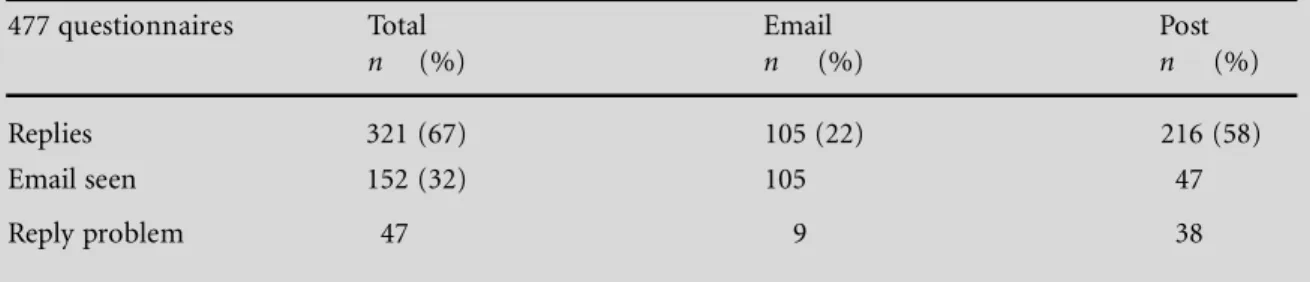
We had an email response of 105 out of a possible 477, or 22%. The questionnaire was sent by post to 372 GPs. A further 216 or 58% replied to the paper questionnaire. This provided us with an overall response of 321 out of 477 (67%). This response rate is in line with replies to previous postal questionnaires from us to Birmingham practices, for example the 186/249 or 75% response of practices surveyed to a diabetes management questionnaire in 1996, the 65% response from individual practitioners to the pre-scribing of innovative drugs in the city in 1997, and is better than the rather disappointing 54% response to an elder abuse survey in 1999.8–10
The results of the questionnaire are shown in Tables 1 and 2. We cannot see any obvious differences between the replies of the postal and email respond-ents to suggest that the mental health subject matter had any bearing on the use of the communication medium or GPs’ willingness or ability to undertake email responses. The postal respondents appeared slightly less aware of the ICD-10 and DSM-IV classifications of disease. Although some respondents gave more than one answer about their acquaintance with these classifications, we have recorded the highest levels of awareness in Table 2.
Forty-seven (22%) of the postal respondents agreed to having seen the email questionnaire: 38 (81%) of these admitted to problems in replying electronically. Of the postal respondents 150 (69%) said that they had never seen the email and 15 were unsure if they had seen it or not; four did not specify a comment.
Discussion
Although 477 GPs in Birmingham were connected to the NHSnet by October 2001 at their surgeries, only a quarter replied to a simple questionnaire by email. Although this figure might have been predicted from the previous findings of Evans et al.from 1999, we would have expected an increase in email usage over the 18-month period since that survey.5 At that time, just 24% of their respondents used email to
Table 1 Email results
477 questionnaires Total Email Post
n (%) n (%) n (%)
Replies 321 (67) 105 (22) 216 (58)
Email seen 152 (32) 105 47
Reply problem 47 9 38
Figure 2 Two further questions
In view of our problem with the NHSnet email questionnaire, please answer the following:
A Did you see the email questionnaire similar to the one above?
YES / NO / DON’T KNOW
B Did you have problems replying?
communicate with work colleagues – of the 39% of doctors (GPs and hospital doctors) in their survey who used email, 61% of them used it for this purpose. As the NHSnet has now become freely available to all GPs, we thought that this should have had an effect on usage along with increasing computer skills and availability both at home and work.
We had not anticipated the technical difficulties with the plain/rich text reply problem. Sixty email respondents managed to reply to the first mailing and a further 45 to the revised instruction. Of the email non-respondents, 80% admitted on their postal replies to problems in trying to answer electronically. If they had been able to send their reply by email this would have increased the email response by 40%. Even so, we are still left with 165 GPs (half of all respondents, a third of the total with email addresses) who did not know whether they had ever seen the questionnaire in electronic format.
The response to the same questionnaire sent to email non-respondents suggests that there was no problem with the subject matter of the questionnaire. Ten GPs offered free text comments. One of the postal respondents was deterred from replying by email on account of the lack of anonymity. Six admitted that they never checked their email or did not know how. Two denied that they could receive email and two said that they did not reply to questionnaires anyway.
Conclusions
Email is a cheap and efficient way of researching GP views, although there are still some technical glitches. Despite the Government’s investment into the NHSnet, half the GP workforce in Birmingham has yet to Table 2 Questionnaire results
In managing depression: Total Email Post
% % %
Use formal diagnostic criteria
Always 9 9.5 8.5
Usually 18 13 20
Occasionally 23 19 23
Never 50 50 47
Use clinical guidelines
Always 6.5 6.5 6.5
Usually 23 20 23
Occasionally 19 15 20.5
Never 50 50 49
Use a depression rating scale
Always 2 2 2
Usually 6 6.5 6
Occasionally 22 24 20
Never 69 59 71
ICD-10 classification
Never heard of it 25 20 27
Heard of it 37 39 36
Read about it 18.5 20 18
Attended teaching on it 6 4 6
Use it 6 7 5
Not answered 6 9.5 5.5
DSM-IV classification of disease
Never heard of it 40 34 44.5
Heard of it 27 28.5 25
Read about it 18.5 23 19
Attended teaching on it 4 2 5
Use it 3.5 4 3
incorporate the use of email as a routine means of communication in practice. In consequence, a survey of GP opinion by email alone will at best reflect the views of only half of the country’s GPs, with a further corres-ponding reduction with an average 60% response rate.
At present, we cannot recommend the use of email communication alone to assess and reflect GP opinion.
Summary
In 2001, 80% of GP principals in Birmingham had access to email.
Only one in five feels confident or competent enough to use it as a regular means of professional communication at the moment.
It is not yet appropriate to use email as the only conduit for obtaining GP opinion.
REFERENCES
1 Mavis B and Brocato J (1998) Postal surveys versus elec-tronic mail surveys. The tortoise and the hare revisited.
Evaluation and the Health Profession21 (3): 395–408.
2 Jones R and Pitt N (1999) Health surveys in the work-place: comparison of postal, email and World Wide Web methods.Occupational Medicine (London)49 (8): 556–8. 3 Selwyn N and Robson K (1998) Using email as a research
tool.Social Research Update2 (1): 1–6.
4 Raziano D, Jayadevappa R, Valenzula D, Weiner M and Lavizzo-Mourey R (2001) Email versus conventional postal mail survey of geriatric chiefs.Gerontologist 41 (6): 799–804.
5 Evans L, Nicholas P, Hughes-Webb P, Fraser C, Jamalapuram K and Hughes B (2001) The use of email by
doctors in the West Midlands.Journal of Telemedicine and Telecare7 (2): 99–102.
6 Department of Health (1999) National Service Frame-work for Mental Health. Department of Health: London. 7 Ustun TB, Goldberg D, Cooper J, Simon GE and
Sartorius N (1995) New classification for mental disorders with management guidelines for use in primary care: ICD-10 PHC chapter five.British Journal of General Practice45: 211–15.
8 Sproston B and Houghton G (1996) Birmingham MAAG Annual Report 1995/96. Birmingham Health Authority: Birmingham.
9 Houghton G, Sproston B and Seal R (1999) Shared care or cost shifting? An audit of general practitioners’ pre-scriptions for innovative drugs in Birmingham.Journal of Clinical Excellence1: 79–84.
10 McCreadie C, Bennett G, Gilthorpe M, Houghton G and Tinker A (2000) Elder abuse: do GPs know or care?
Journal of the Royal Society of Medicine93: 67–71.
ADDRESS FOR CORRESPONDENCE
Guy Houghton
Birmingham Clinical Governance Unit Birmingham Health Authority
St Chad’s Court 213 Hagley Road Birmingham B16 9RG UK
Tel: +44 (0)121 695 2228 Fax: +44 (0)121 685 2231
Email: [email protected]