Emerging Science Journal
Vol. 4, No. 2, April, 2020
Parametric Study of an Organic Rankine Cycle Using Different Fluids
Rabah Touaibi
a*, Hasan Koten
b, Ozlem Boydak
ba Djilali Bounaama University of Khemis Miliana, Laboratory of FIMA, Algeria b Istanbul Medeniyet University, Mechanical Engineering Department, Istanbul, Turkey
Abstract
This work is an energy study of an organic Rankine cycle (ORC) for the recovery of thermal energy by comparing three organic fluids. This cycle is considered to be a promising cycle for the conversion of heat into mechanical energy suitable for low temperature heat sources; it uses more volatile organic fluids than water, which generally has high molecular weights, thus allowing operating pressures at temperatures lower than those of the traditional Rankine cycle. A thermodynamic model was developed using the Engineering Equation Solver (EES) software to determine its performance using different working fluids (toluene, R245fa and R123) under the same operating conditions, taking into account the effect of certain operating parameters and the selection of organic fluids on cycle performance. The results obtained show that the toluene organic fluid has the best thermal efficiency of the cycle compared to the other fluids; 14.38% for toluene, 13.68% for R123 and 13.19 for R245fa.
Keywords:
ORC Cycle; Energy Analysis; Organic Fluids; Performance.
Article History:
Received: 19 November 2019
Accepted: 23 March 2020
Published: 01 April 2020
1- Introduction
A continuous increase in energy consumption has recently been observed due to the production process where certain environmental problems have been reported such as global warming and the depletion of fossil fuels. World energy consumption increased from 575 quadrillion British thermal units (Btu) in 2015 to 736 Btu quadrant in 2040, an increase of 28% (International Energy Outlook, United States, 2017); therefore, efficient systems are required by the integration of multiple power generation units, and as a result, a common primary energy supply can be used. It should be remembered that gas turbines in traditional thermal power plants use fossil fuels as a primary energy source in the production of electricity, where they use exhaust combustion gases to perform other thermal cycles such as than the Rankine vapor cycle, the organic Rankine cycle, absorption refrigeration cycles, desalination cycle and heating units [1, 2]. Studies and applications of Rankine Organic Cycle Systems (ORCs) have been steadily increasing in recent years due to their advantages in recovering heat from low temperature sources. Many researchers have studied the choice of working fluids; systems design methods, equipment and applications of ORC systems [3]. The Rankine organic cycle is one of the most commonly used technologies to generate electricity from low-content heat [4], which can be derived from geothermal energy [5-7], from biomass [8 , 9], industrial waste [10] and solar energy [11, 12].
The organic fluids used by ORC systems are usually, Hydrofluorocarbon (HFC) refrigerants, ammonia (NH3), butane (C4H10), isopentane (C5H12), and toluene. Depending on the nature of the fluid, isentropic expansion from the dew curve may conserve, decrease, or increase the vapor titer. In fact, the slope of the dew curves in the Mollier diagram that explains this phenomenon specific to the nature of the fluid. A study was carried out by Feng et al. [4] on the experimental investigation of lubricating oil on a Rankine organic cycle (ORC) of 3 kW using R123. The effect of lubricant oil ratio using R123 on the system behavior under three different degree of superheating has been investigated [13]. Regarding the same topic area, by Yu et al. [14] conducted their study on the working fluids for
*CONTACT:
DOI: http://dx.doi.org/10.28991/esj-2020-01216
Organic Rankine Cycles, their study show that the most energy-efficient working fluids are R125, R143a, R290 and R1270 for ORCs. Scaccabarozzi et al. [15] studied a Comparison of working fluids and cycle optimization for heat recovery ORCs from large internal combustion engines. In this work authors addresses the optimal working fluid selection for organic Rankine cycle recovering heat from heavy-duty internal combustion engines. Four cases are considered featuring two different engine exhaust temperatures (245 °C vs 354 °C) and two scenarios (maximum recovery of mechanical power vs. cogeneration of low-temperature heat).A new isothermal desalination system controlled by ORC has been studied experimentally, using the working fluid R245fa has been studied by Igobo et al. [16].
The purpose of this study is to estimate the mechanical power that can be provided by an organic ORC cycle, by studying the effect of the evaporation temperature and the choice of organic fluid that can adapt to this type of energy conversion system, and also to find the performance of the ORC cycle by comparing three different organic fluids (toluene, R245fa and R123).
2- Description of ORC Cycle
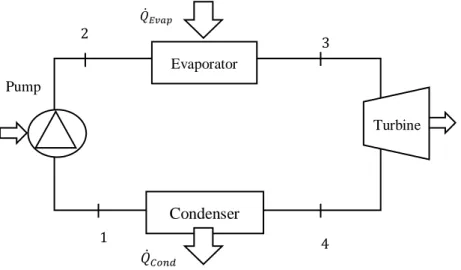
The heat transfer fluid at high temperature transfers the heat stored to the evaporator of the ORC cycle. This fluid can reach relatively high temperatures. The organic fluid pressurized by the pump is heated, then evaporated and superheated in the evaporator, by the heat energy from the heat source, transferred to the latter. The superheated steam obtained at the outlet of the evaporator drives the turbine, which is a rotational movement drives an alternator for the production of electricity. The steam at the outlet of the turbine is directed to the condenser where it is cooled by a flow of cooling water.
Figure 1. Scheme of Organic Rankine Cycle (ORC).
3- Thermodynamic Model
The ORC cycle is analyzed by applying the principle of conservation of mass and energy according to the first law of thermodynamics, for each of the four components of the organic Rankine cycle, taking the following hypotheses:
Changes in kinetic energy and potential energy are negligible. The system is adiabatic (without thermal losses).
The system operates at steady state.
3-1- Mass and Energy Balance of the ORC Cycle
The input and output mass flows are equal in steady state, we have:
𝑚̇1= 𝑚̇2 = 𝑚̇3= 𝑚̇4= 𝑚̇ (1)
3-1-1- Pump
The circulation pump allows the movement of the organic fluid from the low-pressure condenser to the evaporator at high pressure; it is possible to determine the consumption of the pump. The energy balance of the pump is written as follows:
1 2
3
4
Evaporator
𝑄̇𝐸𝑣𝑎𝑝
Pump
Turbine
Condenser
𝑊̇𝑃= 𝑚̇ (ℎ2− ℎ1) (2)
The specific work consumed by the pump to compress the fluid is written:
𝒲𝑃= (ℎ2− ℎ1) = 𝜈(𝑃2− 𝑃1) (3)
For an irreversible adiabatic compression, the mechanical efficiency of the pump is introduced as follows:
ɳ𝑃 𝑖𝑠=
𝑊̇𝑃 𝑟é𝑣
𝑊̇𝑃 𝑖𝑟𝑟é𝑣
=𝑊̇𝑃 𝑖𝑠 𝑊̇𝑃
=(ℎ2𝑖𝑠− ℎ1) (ℎ2− ℎ1)
(4)
3-1-2- Evaporator
The working fluid enters the evaporator in the liquid state and heated therein at constant pressure 𝑃2 to the evaporation temperature, then it evaporates at constant temperature and pressure. The energy balance of the evaporator is written as follows:
𝑄̇𝐸𝑎𝑣𝑝 = 𝑚̇ (ℎ3− ℎ2) (5)
3-1-3- Turbine
The expansion in the turbine is considered adiabatic and irreversible with a constant isentropic efficiency, which is defined as follows:
ɳ𝑇 𝑖𝑠 =
𝑊̇𝑇 𝑖𝑟𝑟é𝑣
𝑊̇𝑇 𝑟é𝑣
= 𝑊̇𝑇
𝑊̇𝑇 𝑖𝑠
= (ℎ3− ℎ4)
(ℎ3− ℎ4 𝑖𝑠 )
(6)
The energy balance of the turbine is written as follows:
𝑊̇𝑇= 𝑚̇ (ℎ3− ℎ4) = 𝑚̇ (ℎ3− ℎ4 𝑖𝑠 ) ɳ 𝑇.𝑚é𝑐 (7)
The electric power of the turbine is given by:
𝑊̇𝑇.𝑂𝑅𝐶𝑒𝑙𝑒𝑐 = 𝜂𝑔é𝑛∗ 𝑊̇𝑇.𝑂𝑅𝐶 (8)
3-1-4- Condenser
The working fluid enters the condenser in the vapor state, condenses at constant temperature and pressure, and exits in the liquid state where it yields a quantity of heat. The energy balance of the condenser is written as follows:
𝑄̇𝐶𝑜𝑛𝑑 = 𝑚̇(ℎ4− ℎ1) (9)
Performances of the ORC system
The thermal efficiency of organic Rankine cycle is defined as:
ɳ 𝑇ℎ=
𝑊̇𝑛𝑒𝑡.𝑂𝑅𝐶
𝑄̇𝐸𝑣𝑝.𝑂𝑅𝐶
(10)
𝑊̇𝑛𝑒𝑡.𝑂𝑅𝐶 = 𝑊̇𝑇− 𝑊̇𝑃 (11)
4- Results
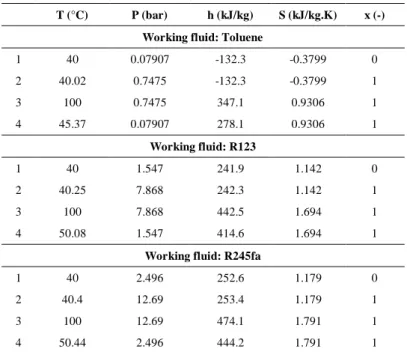
Table 1.Characteristic thermodynamic points of ORC cycle.
T (°C) P (bar) h (kJ/kg) S (kJ/kg.K) x (-)
Working fluid: Toluene
1 40 0.07907 -132.3 -0.3799 0
2 40.02 0.7475 -132.3 -0.3799 1
3 100 0.7475 347.1 0.9306 1
4 45.37 0.07907 278.1 0.9306 1
Working fluid: R123
1 40 1.547 241.9 1.142 0
2 40.25 7.868 242.3 1.142 1
3 100 7.868 442.5 1.694 1
4 50.08 1.547 414.6 1.694 1
Working fluid: R245fa
1 40 2.496 252.6 1.179 0
2 40.4 12.69 253.4 1.179 1
3 100 12.69 474.1 1.791 1
4 50.44 2.496 444.2 1.791 1
In order to jointly consider the fluid having the highest net mechanical power, and the best energy efficiency. This study allowed us to compare the behavior of different types of working fluid under similar conditions. The thermodynamic performances of the ORC cycle of the three fluids are shown in Table 2.
Table 2. Thermodynamic performance of the ORC cycle.
Performances Working fluids
Toluene R123 R245fa
ẆPump (kW) 0.1089 0.4445 0.7853
Q̇Evp(kW) 479.4 200.1 220.8
ẆTurbine(kW) 69 27.82 29.91
Q̇Cond(kW) 410.5 172,7 191.7
Ẇnet.ORC (kW) 68.92 27.38 29.12
ηth.ORC (%) 14.38 13.68 13.19
The results show that the Toluene organic fluid appears to be a good compromise for these two criteria, it is the fluid that has the highest value of the net mechanical power Ẇnet.ORC= 68.92k𝑊 compared with the other fluid, it is also a fluid which presents the best energetic efficiency of the cycle which equals ηth.ORC−Toluene= 14.38 % compared to that of the organic fluid R123 ηth.ORC−R123= 13.68 % and that of the organic fluid ηth.ORC−R123= 13.19 %.
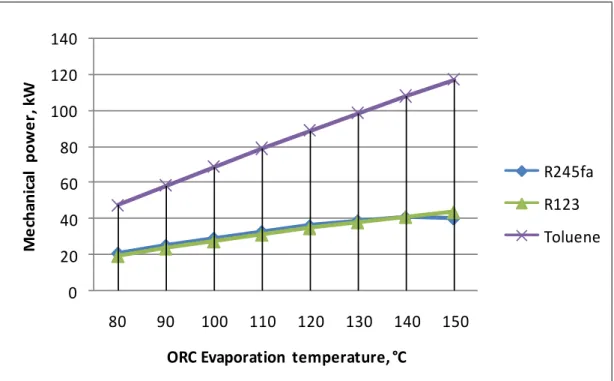
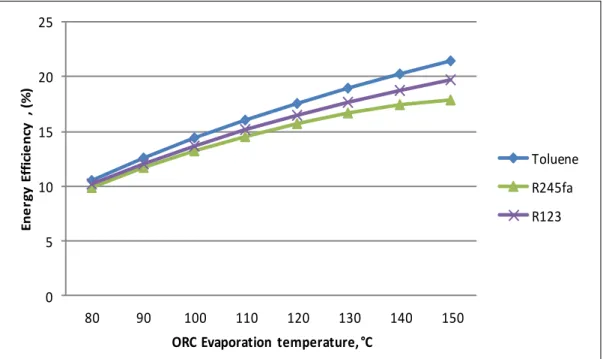
In this part, we studied the influence of the evaporation temperature of the ORC cycle on the performances of the organic Rankine cycle, namely the net power delivered by the ORC cycle and the cycle efficiency using the three organic fluids. To do this by keeping the condensing temperature constant, that is to say by fixing the condensation temperature (TCond= 40 °C), and by varying the evaporation temperature in the range of (80 - 150 °C).
0
20
40
60
80
100
120
140
80
90
100
110
120
130
140
150
M
e
cha
ni
ca
l
po
w
e
r,
k
W
ORC Evaporation temperature, °C
R245fa
R123
Toluene
Figure 2. Variation of mechanical power of Turbine with ORC evaporation temperature according to the studied working fluids
Figure 3 shows the effect of the evaporation temperature on the thermal power received by the evaporator to feed the organic Rankine cycle. The results show that the thermal power required for the supply of the ORC cycle is increased with the increase of the evaporation temperature, the working fluid Toluene uses a lot of energy during its vaporization at the evaporator. The thermal power received by the evaporator of the ORC cycle ranges from 450 kW to 550 kW for toluene; but the evaporation temperature does not affect the thermal power of the evaporator for R123 and R245fa.
0 100 200 300 400 500 600
80 90 100 110 120 130 140 150
the
rm
al
po
w
e
r
, k
W
ORC Evaporation temperature, °C
Toluene
R123
R245fa
Figure 3. Variation of thermal power of evaporator with ORC evaporation temperature according to the studied working fluids
0 5 10 15 20 25
80 90 100 110 120 130 140 150
E
ne
rg
y
E
ff
ic
ie
nc
y
,
(%
)
ORC Evaporation temperature, °C
Toluene
R245fa
R123
Figure 4. Variation of Energy Efficiency with ORC evaporation temperature according to the studied working fluids
5- Conclusion
This work focused on the energy study of an Organic Rankine Cycle (ORC) for the production of electrical energy, based on the use of an organic fluid. From the results found, it was concluded that:
The mechanical power supplied increases with the increase of the evaporation temperature for the three fluids.
The thermal power required for the supply of the ORC cycle is increased with the increase of the evaporation temperature, the working fluid Toluene uses a lot of energy during its vaporization at the evaporator.
The thermal efficiency of the ORC cycle is increased with the increase of the evaporation temperature for the three fluids.
The Toluene fluid gives a better performance in terms of thermal efficiency relative to the other fluids.
6- Acknowledgments
The authors thank the University Djilali Bounaama Khemis Miliana (Algeria) for funding this study.
7- Conflict of Interest
The author declares that there is no conflict of interests regarding the publication of this manuscript. In addition, the ethical issues, including plagiarism, informed consent, misconduct, data fabrication and/or falsification, double publication and/or submission, and redundancies have been completely observed by the authors.
8- References
[1] Energy Information Administration (2017). International energyoutlook, USA, Available online: https://www.eia.gov/outlooks/ieo/#1 (accessed on 15 November 2019).
[2] Touaibi, R., Köten, H., Feidt, M., & Boydak, O. (2018). Investigation of three Organic Fluids Effects on Exergy Analysis of a Combined Cycle: Organic Rankine Cycle/Vapor Compression Refrigeration. Journal of Advanced Research in Fluid Mechanics and Thermal Sciences 52(2), 232-245.
[3] Zhao, Yuanyang, Guangbin Liu, Liansheng Li, Qichao Yang, Bin Tang, and Yunxia Liu. “Expansion Devices for Organic Rankine Cycle (ORC) Using in Low Temperature Heat Recovery: A Review.” Energy Conversion and Management 199 (November 2019): 111944. doi:10.1016/j.enconman.2019.111944.
[4] Braimakis, Konstantinos, and Sotirios Karellas. “Energetic Optimization of Regenerative Organic Rankine Cycle (ORC) Configurations.” Energy Conversion and Management 159 (March 2018): 353–370. doi:10.1016/j.enconman.2017.12.093. [5] Heberle, Florian, and Dieter Brüggemann. “Exergy Based Fluid Selection for a Geothermal Organic Rankine Cycle for
[6] Liu, Qiang, Yuanyuan Duan, and Zhen Yang. “Performance Analyses of Geothermal Organic Rankine Cycles with Selected Hydrocarbon Working Fluids.” Energy 63 (December 2013): 123–132. doi:10.1016/j.energy.2013.10.035.
[7] Bu, Xianbiao, Lingbao Wang, and Huashan Li. “Performance Analysis and Working Fluid Selection for Geothermal Energy-Powered Organic Rankine-Vapor Compression Air Conditioning.” Geothermal Energy 1, no. 1 (August 23, 2013). doi:10.1186/2195-9706-1-2.
[8] Drescher, Ulli, and Dieter Brüggemann. “Fluid Selection for the Organic Rankine Cycle (ORC) in Biomass Power and Heat Plants.” Applied Thermal Engineering 27, no. 1 (January 2007): 223–228. doi:10.1016/j.applthermaleng.2006.04.024.
[9] Taljan, Gregor, Gregor Verbič, Miloš Pantoš, Manfred Sakulin, and Lothar Fickert. “Optimal Sizing of Biomass-Fired Organic Rankine Cycle CHP System with Heat Storage.” Renewable Energy 41 (May 2012): 29–38. doi:10.1016/j.renene.2011.09.034. [10] Sun, Wenqiang, Xiaoyu Yue, and Yanhui Wang. “Exergy Efficiency Analysis of ORC (Organic Rankine Cycle) and
ORC-Based Combined Cycles Driven by Low-Temperature Waste Heat.” Energy Conversion and Management 135 (March 2017): 63–73. doi:10.1016/j.enconman.2016.12.042.
[11] Rayegan, R., and Y.X. Tao. “A Procedure to Select Working Fluids for Solar Organic Rankine Cycles (ORCs).” Renewable Energy 36, no. 2 (February 2011): 659–670. doi:10.1016/j.renene.2010.07.010.
[12] Shaaban, S. “Analysis of an Integrated Solar Combined Cycle with Steam and Organic Rankine Cycles as Bottoming Cycles.” Energy Conversion and Management 126 (October 2016): 1003–1012. doi:10.1016/j.enconman.2016.08.075.
[13] Feng, Yong-qiang, Tzu-Chen Hung, Ya-Ling He, Qian Wang, Shih-Chi Chen, Shang-Lun Wu, and Chih-Hung Lin. “Experimental Investigation of Lubricant Oil on a 3 kW Organic Rankine Cycle (ORC) Using R123.” Energy Conversion and Management 182 (February 2019): 340–350. doi:10.1016/j.enconman.2018.12.021.
[14] Yu, Haoshui, Donghoi Kim, and Truls Gundersen. “A Study of Working Fluids for Organic Rankine Cycles (ORCs) Operating Across and Below Ambient Temperature to Utilize Liquefied Natural Gas (LNG) Cold Energy.” Energy 167 (January 2019): 730–739. doi:10.1016/j.energy.2018.11.021.
[15] Scaccabarozzi, Roberto, Michele Tavano, Costante Mario Invernizzi, and Emanuele Martelli. “Comparison of Working Fluids and Cycle Optimization for Heat Recovery ORCs from Large Internal Combustion Engines.” Energy 158 (September 2018): 396–416. doi:10.1016/j.energy.2018.06.017.
[16] Igobo, O.N., and P.A. Davies. “Isothermal Organic Rankine Cycle (ORC) Driving Reverse Osmosis (RO) Desalination: Experimental Investigation and Case Study Using R245fa Working Fluid.” Applied Thermal Engineering 136 (May 2018): 740–746. doi:10.1016/j.applthermaleng.2018.02.056.