Repeated Cycles of Binge-Like Ethanol Drinking in C57BL/6J Mice Augments Subsequent Voluntary Ethanol Intake But Not Other Dependence-Like Phenotypes
Benjamin Reid Cox
A thesis submitted to the faculty of the University of North Carolina at Chapel Hill in partial fulfillment of the requirements for the degree of Master of Arts in the Department of
Psychology (Behavioral Neuroscience)
Chapel Hill 2013
iii ABSTRACT
Benjamin R. Cox: Repeated Cycles of Binge-Like Ethanol Drinking in C57BL/6J Mice Augments Subsequent Voluntary
Ethanol Intake But Not Other Dependence-Like Phenotypes (Under the direction of Dr. Todd E. Thiele)
Background: Recently, procedures have been developed to model specific facets of human alcohol abuse disorders, including those that model excessive binge-like drinking (i.e., “drinking in the dark”, or DID) and excessive dependence-like drinking (i.e., resulting from intermittent ethanol vapor exposure). Similar neuropeptide systems modulate excessive ethanol drinking stemming from both procedures, raising the possibility that both paradigms are actually modeling the same phenotypes and triggering the same central neuroplasticity. Therefore, the goal of the present project was to study the effects of a history of binge-like ethanol drinking, using DID procedures, on phenotypes that have previously been described with procedures to model dependence-like drinking.
Methods: Male C57BL/6J mice first experienced 0 to 10 4-day binge-like drinking episodes (3 days of rest between episodes). Beginning 24-h after the final binge-like drinking session, mice were tested for anxiety-like behaviors (with elevated plus maze (EPM) and open-field locomotor activity tests), ataxia with the rotarod test, and sensitivity to handling-induced convulsions (HICs). One week later, mice began a 40-day 2-bottle (water versus ethanol) voluntary consumption test with concentration ranging from 10 to 20% (v/v) ethanol.
Results: A prior history of binge-like ethanol drinking significantly increased
iv
initially experienced 6 or 10 binge-like drinking episodes and completely absent in mice that experienced 1 binge-like episode. Conversely, a history of binge-like ethanol drinking did not influence anxiety-like behaviors, ataxia, or HICs.
Conclusions: Excessive ethanol drinking stemming from DID procedures does not initially induce phenotypes consistent with a dependence-like state. However, the subsequent increases of voluntary ethanol consumption and preference that become more robust
v
ACKNOWLEDGEMENTS
I would like to thank Dr. Todd E. Thiele for his guidance and mentorship throughout this project. I would also like to thank Dr. Jennifer A. Rinker, Dr. Emily G. Lowery-Gionta, Dr. Montserrat Navarro, Dr. Gretchen M. Sprow and Dr. Thomas L. Kash for their technical expertise and guidance, as well as Jeff J. Olney and Rhiannon D. Thomas for their technical
TABLE OF CONTENTS
LIST OF TABLES ... viii
LIST OF FIGURES ... ix
LIST OF ABBREVIATIONS ...x
Chapter I. INTRODUCTION ...1
II. METHODS ...4
Animals ...4
Drinking-in-the-dark (DID) Procedure ...4
Elevated Plus Maze (EPM) ...5
Open-Field Locomotor Activity Test ...5
Accelerating Rotarod Test ...6
Handling-Induced Convulsions (HIC) ...6
Continuous 2-Bottle Voluntary Ethanol Consumption ...7
Data Analysis ...7
III. RESULTS ...8
Drinking-in-the-dark ...8
Elevated Plus Maze: Assessment of Anxiety-Like Behavior ...8
ii Accelerating Rotarod Test:
Assessment of Ataxia ...10
Handling-Induced Convulsions (HIC): Assessment of Seizure Sensitivity ...10
Continuous 2-Bottle Voluntary Ethanol Consumption ...11
IV. DISCUSSION ...13
LIST OF TABLES Table 1: Average (Mean ± SEM) behavior in the
elevated plus maze (EPM) tests from Experiments 1 and 2 ...18 Table 2: Average (Mean ± SEM) behavior in the
open-field activity tests from Experiments 1 and 2 ...18 Table 3: Average scores (Mean ± SEM) from the
LIST OF FIGURES
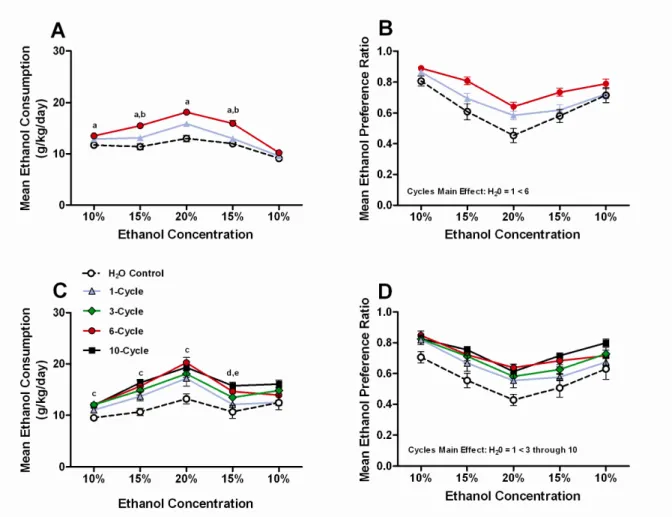
Figure 1: Continuous 2-bottle voluntary ethanol consumption ...19 A) Experiment 1: Mean g of ethanol consumed per kg of body weight per day
B) Experiment 1: Mean ethanol preference
LIST OF ABBREVIATIONS
ANOVA Analysis of variance
BEC Blood ethanol concentration CeA Central amygdala
CRF Corticotropin releasing factor
CRF1R Corticotropin releasing factor 1 receptor DID Drinking-in-the-dark
EPM Elevated plus maze
EtOH Ethanol
g/kg Grams per kilogram
HIC Handling-induced convulsions
NPY Neuropeptide Y
RPM Revolutions per minute
CHAPTER 1 INTRODUCTION
Early pre-clinical alcoholism research primarily relied on animal models that
involved voluntary consumption of ethanol, in which rats or mice were given 24-h/day access to ethanol and water simultaneously in separate bottles. However, voluntary ethanol
consumption may not be the most appropriate model for human alcohol abuse disorders, as rodents typically consume low amounts of ethanol which do not generate blood ethanol levels thought to be pharmacologically meaningful. Recently, procedures have been developed to model specific facets of human alcohol abuse disorders. Such procedures include those that model excessive binge-like drinking prior to the development of
dependence (Boehm et al., 2008; Lowery-Gionta et al., 2012; Lowery et al., 2010; Sparrow et al., 2012; Sprow and Thiele, 2012), excessive ethanol intake stemming from ethanol
dependence (Funk et al., 2007; Gilpin et al., 2011; Roberts et al., 1996), excessive relapse-like ethanol drinking (Spanagel and Holter, 2000; Spanagel et al., 1996; Sparta et al., 2009) and ethanol seeking behaviors (Le et al., 1999; Le et al., 1998; Weiss and Liu, 2002). These models have been useful for discovering the neurochemical pathways and the neurocircuitry involved in alcohol-related behaviors.
2
Rhodes et al., 2007)), central administration of CRF-1 receptor (CRF1R) antagonists and NPY were found to prevent binge-like ethanol drinking in mice. Interestingly, CRF1R
antagonists and NPY failed to alter low level non-binge-like ethanol drinking, suggesting that central CRF and NPY systems are recruited only after sufficient blood/brain ethanol
concentrations are achieved, which may motivate continued binge-like drinking (Lowery-Gionta et al., 2012; Lowery et al., 2010; Sparrow et al., 2012). Interestingly, central administration of CRF1R antagonists or NPY have also been shown to protect against excessive dependence-like ethanol drinking in rodents that have had a prior history of repeated intermittent ethanol vapor exposure, but these compounds failed to alter low level ethanol intake in non-dependent animals (Gilpin et al., 2011; Roberto et al., 2010). The striking similarity between results obtained with models of binge-like ethanol drinking in “non-dependent” animals and in “dependent” animals has led our group to propose that overlapping systems may be involved (Lowery-Gionta et al., 2012; Sparrow et al., 2012; Thiele, 2012). Theoretically, CRF signaling is increased and NPY signaling is blunted when sufficient brain ethanol levels are achieved during binge-like drinking, stimulating continued excessive ethanol intake. Alterations in neuropeptide signaling are thought to initially be transient, but with repeated episodes of binge-like drinking these neuroplastic changes may become rigid, contributing to excessive dependence-like drinking.
3
accomplish the same end-point. If this is true, one would predict that DID procedures should promote phenotypes consistent with ethanol dependence.
Therefore, the goal of the present project was to study the effects of a history of binge-like ethanol drinking on phenotypes that have previously been described following intermittent ethanol vapor exposure (Becker and Lopez, 2004; Crabbe et al., 1991;
Kliethermes et al., 2004; Lopez et al., 2011; Philibin et al., 2012). A dependence-like state is typically associated with subsequent increases of voluntary ethanol consumption and self-administration (Becker and Lopez, 2004), and mice have been shown to exhibit elevated anxiety-like behaviors (Kliethermes et al., 2004), increased ataxia (Philibin et al., 2012), and increased sensitivity to handling-induced convulsion (HICs) following 24-h or more of withdrawal after ethanol vapor exposure (Beadles-Bohling and Wiren, 2006; Homanics et al., 1998). In fact, it could be argued that these withdrawal-induced phenotypes promote
4
CHAPTER 2 METHODS Animals
Male C57BL/6J mice (Jackson Laboratories, Bar Harbor, ME) were 6-8 weeks of age and weighed 20-30 g upon arrival. Mice were housed individually in standard plastic cages and allowed to habituate to the environment for at least 1 week before experimental
procedures were initiated. The animal colony room was maintained at ~22°C with a 12h/12h light/dark cycle (lights on at 0700 h). Mice had ad libitum access to food throughout all experiments and ad libitum access to water except during ethanol access, as noted below. All procedures used were in accordance with the National Institute of Health guidelines and were approved by the University of North Carolina Institutional Animal Care and Use Committee. Drinking-in-the-dark Procedure
5
single binge-like ethanol drinking “cycle” or “episode” below. Between each binge-like drinking cycle, mice were given 3 days of rest with no access to ethanol. In Experiment 1 described below, mice were separated into groups based on body weights. Groups of mice experienced 1 (n = 13) or 6 (n = 13) binge-like drinking cycles and a third control group drank water throughout the binge-like drinking portion of the experiment (n = 13). In Experiment 2 described below, animals were divided into 5 groups based on body weights: The groups experienced 1, 3, 6, or 10 binge-like drinking cycles, and a fifth control group drank water only throughout the binge-like drinking portion of the experiment (n =10/group). For both experiments, initiation of binge-like drinking was staggered between groups such that all mice experienced their last binge-like drinking cycle at the same age.
Elevated Plus Maze (EPM): Assessment of Anxiety-like Behavior
The EPM test is a pharmacologically validated model for the assessment of anxiety in rodents (Pellow et al., 1985). For both Experiments 1 and 2, the EPM test was initiated 24-h after the completion of the final binge-like drinking test. We have described the apparatus and the 5-min procedure previously (Fee et al., 2004). The behavior in the EPM was recorded using a digital video camera with night vision capability, and measures were scored by condition-blinded individuals trained to identify the various dependent measures. With the EPM test, anxiety-like behavior is reflected as reduced number of entries into the open arms and in the time spent in the open arms, along with an increase in the number of entries and amount of time spent in the closed arms of the EPM.
Open Field Locomotor Activity Test: Assessment of Anxiety-like Behavior
6
anxiety (Choleris et al., 2001; Fee et al., 2004). After the completion of the EPM test in Experiments 1 and 2, mice were transported in their home cages to an adjacent room and allowed to rest for 10 min. We have described the apparatus and procedure elsewhere (Fee et al., 2004). Testing sessions were 10 minutes in duration, and marginal time and distance traveled (cm), and central time and distance traveled (cm) in the open-field arena were measured over the course of the session.
Accelerating Rotarod Test: Assessment of Ataxia
Recent observations show that mice experiencing ethanol withdrawal exhibit elevated ataxia, and have difficulty maintaining balance on a rotarod apparatus (Philibin et al., 2012). After open-field testing in Experiment 2, mice were allowed to rest for 15 min in their home cage and were then placed on a rotarod apparatus (Ugo Basile, Italy) with an initial rotation speed of 4 rpm. The speed was gradually increased to 40 rpm over a period of 5 min and latency-to-fall and rpm at the time of fall were recorded. The test was repeated three more times, with 5 min between each test. Average latency-to-fall and rpm at time of fall were averaged over the 4 test trials.
Handling-Induced Convulsions (HIC): Assessment of Seizure Susceptibility
7
score of 7 given to mice exhibiting severe tonic-clonic convulsions. A detailed description of HIC procedures and the scoring scale is described elsewhere (Crabbe et al., 1991).
Continuous 2-Bottle Voluntary Ethanol Consumption
Approximately one week after the completion of binge-like ethanol drinking in Experiments 1 and 2, the mice were tested for voluntary ethanol consumption using a home cage 2-bottle choice procedure. Over 8 days, mice were given 24 h access to 2-bottles in their homecage, one containing tap water and the other containing a 10% (v/v) ethanol solution. The concentration of ethanol was changed every 8 days as follows: 10, 15, 20, 15, and 10% ethanol. The positions of the bottle were alternated every day to control for position preferences. Each drinking bottle was weighed every day to calculate fluid intake and body weights were recorded every 4 days.
Data Analysis
8 CHAPTER 3
RESULTS Drinking-in-the-dark
In Experiment 1, there were no significant differences between the groups that experienced 1 (5.42 + 0.28 g/kg/4h) or 6 (6.05 + 0.29 g/kg/4h) binge-like drinking cycles in terms of the amount of ethanol consumed during the final binge-like drinking session [F(1,25) = 2.486, p = 0.127]. Similarly, in Experiment 2 there were no significant differences between the groups that experienced 1 (4.43 + 0.29 g/kg/4h), 3 (5.09 + 0.41 g/kg/4h), 6 (6.16 + 0.36 g/kg/4h), or 10 (5.36 + 0.31 g/kg/4h) binge-like drinking cycles in the amount of ethanol consumed during the final binge-like drinking session [F(3,36) = 1.374, p = 0.226]. These data suggest that up to 10 binge-like drinking cycles did not significantly increase the level of binge-like ethanol drinking. Although we did not assess blood ethanol concentrations (BECs) in an attempt to avoid the potential confounding effects of stress on subsequent measures, the amount of ethanol consumed by mice on the final day of binge-like ethanol drinking was consistent with amounts that we have previously reported and which produced BECs of 80 mg/dL or greater (Lowery-Gionta et al., 2012; Lowery et al., 2010; Sparrow et al., 2012; Sparta et al., 2008).
Elevated Plus Maze (EPM): Assessment of Anxiety-Like Behavior
9
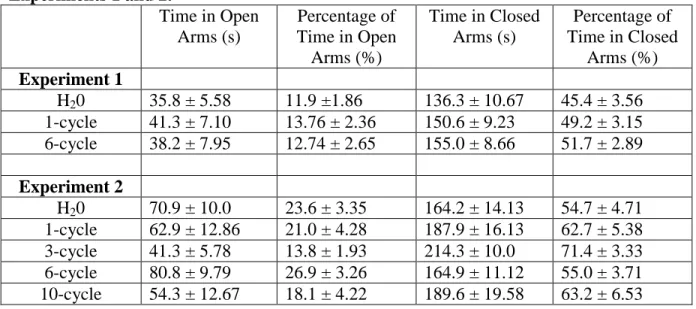
mice that experienced 1 or 6 cycles of binge-like ethanol drinking exhibited no significant differences in open arm time [F(2,36) = 0.146, p = 0.865] or percentage total time spent in open arms [F(2,36) = 0.145, p = 0.856]. Furthermore, there were no group differences in closed arm time [F(2,37) = 1.056, p = 0.358] or percentage of total time spent in closed arms [F(2,37) = 1.058, p = 0.357]. A lack of group differences in total arm entries [F(2,37) = 1.05, p= 0.360] suggests that the history of binge-like ethanol drinking did not impact overall activity (H2O = 18.38 ± 1.20 entries; 1-cycle = 20.46 ± 1.07 entries; 6-cycle = 18.92 ± 0.84 entries).
In Experiment 2, relative to the water control group there was no evidence of alterations of anxiety-like behavior in mice that experienced 1 to 10 cycles of binge-like ethanol drinking. Thus, there were no group differences in open arm time [F(4,44 )= 2.012, p = 0.109] or percentage total time spent in open arms [F(4,44)= 2.007, p = 0.110]. Furthermore, there were no group differences in closed arm time [F(4,45) = 2.016, p = 0.108] or percentage of total time spent in closed arms [F(4,45) = 2.013, p = 0.109]. Finally, there were no significant differences between groups on the number of total arm entries [F(4,45) = 0.448, p= 0.774], suggesting that the history of binge-like ethanol drinking did not impact overall activity (H2O = 22.2 ± 1.10 entries; 1-cycle = 21.3 ± 1.59 entries; 3-cycle = 21.5 ± 1.68 entries; 6-cycle = 22.7 ± 1.32 entries; 10-cycle = 20.3 ± 1.03 entries).
Open-Field Locomotor Activity Test: Assessment of Anxiety-Like Behavior
10
2.505, p = 0.095], average distance traveled in the center [F(2,36) = 0.867, p = 0.429], or average time spent in the center [F(2,37) = 0.507, p = 0.095]. Additionally, analysis of total distance traveled data failed to achieve statistical significance [F(2,37) = 0.688, p = 0.509], further support that a history of binge-like ethanol drinking did not alter overall locomotor behavior (H2O = 2982.38 ± 226.83 cm2/10min; 1-cycle = 3278 ± 195.19 cm2/10min; 6-cycle = 2956.57 ± 218.52 cm2/10min; 10-cycle = 3146 ± 134.36 cm2/10min).
The same pattern of results were observed from the open-field test of Experiment 2. There were no group differences in average distance traveled in the margins [F(4,45 )= 0.244, p = 0.912], average time spent in margins [F(4,45) = 0.112, p = 0.978], average distance traveled in the center [F(4,45) = 0.283, p = 0.887], and average time spent in the center [F(4,45) = 0.112, p = 0.978], and analysis of total distance traveled failed to achieve statistical significance
[F(4,45) = 0.133, p = 0.969] (H2O = 2942 ± 206.4 cm2/10min; 1-cycle = 3094.5 ± 212.46 cm2/10min; 3-cycle = 3037.7 ± 256.41 cm2/10min; 6-cycle = 2989.7 ± 275.36 cm2/10min; 10-cycle = 3146 ± 134.36 cm2/10min).
Accelerating Rotarod Test: Assessment of Ataxia
Data averaged over the 4 rotarod tests performed in Experiment 2 are presented in Table 3. Separate one-way ANOVAs performed on latency to fall data [F(4,45) = 0.691, p = 0.602] and average RPM at fall data [F(4,45) = 0.724, p = 0.58] both failed to achieve statistical significance, indicating that a history of binge-like ethanol drinking did not promote increased ataxia.
Handling-Induced Convulsions (HIC): Assessment of Seizure Sensitivity
11
0.629], suggesting that a history of binge-like ethanol drinking did not alter seizure sensitivity.
Continuous 2-Bottle Voluntary Ethanol Consumption
Data representing the average 8-day consumption of ethanol (g/kg) and average 8-day ethanol preference at each ethanol concentration tested in Experiment 1 (Fig. 1A and B, respectively) and Experiment 2 (Fig. 1C and D, respectively) are presented in Fig. 1. Separate two-way (ethanol concentration x number of binge-like drinking cycles) ANOVAs were performed to analyze each data set. Analysis of ethanol consumption data from Experiment 1 revealed significant main effects of ethanol concentration [F(4,148) = 49.724, p < 0.001] and binge-like drinking cycles [F(1,37) = 10.279, p < 0.001], and a significant interaction effect [F(8,148) = 2.97, p = 0.004]. Post hoc Bonferroni tests revealed that the group with a prior history of 6 binge-like ethanol drinking cycles voluntarily drank significantly more ethanol relative to the control group during access to 4 of the 5 ethanol solutions, and more than the 1-cycle group at 2 of the 5 concentrations (Fig. 1A). Analysis of ethanol preference ratio data from Experiment 1 showed significant main effects of ethanol concentration [F(4,148) = 58.905, p < 0.001] and binge-like drinking cycles [F(1,37) = 8.357, p = 0.001], but the interaction effect was not significant [F(8,148) = 1.923, p = 0.061]. A post hoc Bonferroni test of the binge-like drinking cycles main effect revealed that only the 6-cycle binge-like ethanol drinking group preferred ethanol significantly more than the control group (Fig. 1B).
12
13 CHAPTER 4 DISCUSSION
14
consumption and preference that become more robust following repeated episodes of binge-like ethanol drinking may reflect the emergence of ethanol dependence, suggesting that DID procedures may be ideal for studying the early stages of the transition to ethanol dependence. We speculate that increased anxiety-like behavior, ataxia, and sensitivity to HIC may emerge with greater experience with binge-like ethanol drinking (i.e., more than 10 cycles of DID exposure).
The most striking results from the present data set were the robust and long-lasting increases of voluntary ethanol consumption and preference stemming from a history of binge-like ethanol drinking. These observations parallel those obtained with vapor inhalation models that have been shown to induce subsequent increases of voluntary ethanol consumption in rats (Funk et al., 2007; Gilpin et al., 2011) and mice (Becker and Lopez, 2004; Finn et al., 2007; Lopez et al., 2011). Importantly, increases of subsequent voluntary ethanol consumption in the present report resulted from animals voluntarily drinking excessive amounts of ethanol in a pattern and level that closely matches human binge drinking, rather than from forced exposure to ethanol vapor. Thus, as a model to study the neurobiology underlying the transition to an ethanol dependence-like state (Thiele, 2012), repeated binge-like drinking episodes using procedures such as DID arguably have greater face validity than models employing repeated intermittent ethanol vapor exposure.
15
16
drinking episodes would lead to the development of neuroplastic alterations in line with models of ethanol dependence.
17
changes contribute to the transition to ethanol dependence. Evidence of increased voluntary ethanol drinking resulting from a history of binge-like ethanol drinking in the present report may reflect, in part, such changes in CRF and NPY signaling.
18
TABLE 1: Average (Mean + SEM) behavior in the elevated plus maze (EMP) tests from Experiments 1 and 2.
Time in Open Arms (s)
Percentage of Time in Open
Arms (%)
Time in Closed Arms (s)
Percentage of Time in Closed
Arms (%) Experiment 1
H20 35.8 ± 5.58 11.9 ±1.86 136.3 ± 10.67 45.4 ± 3.56 1-cycle 41.3 ± 7.10 13.76 ± 2.36 150.6 ± 9.23 49.2 ± 3.15 6-cycle 38.2 ± 7.95 12.74 ± 2.65 155.0 ± 8.66 51.7 ± 2.89
Experiment 2
H20 70.9 ± 10.0 23.6 ± 3.35 164.2 ± 14.13 54.7 ± 4.71 1-cycle 62.9 ± 12.86 21.0 ± 4.28 187.9 ± 16.13 62.7 ± 5.38 3-cycle 41.3 ± 5.78 13.8 ± 1.93 214.3 ± 10.0 71.4 ± 3.33 6-cycle 80.8 ± 9.79 26.9 ± 3.26 164.9 ± 11.12 55.0 ± 3.71 10-cycle 54.3 ± 12.67 18.1 ± 4.22 189.6 ± 19.58 63.2 ± 6.53
Table 2: Average (Mean + SEM) behavior in the open-field activity tests from Experiments 1 and 2.
Marginal Distance (cm2/10min)
Time in Margin (s)
Center Distance (cm2/10min)
Time in Center (s) Experiment 1
H20 2271.4 ± 198.88 505.3 ± 5.58 711.0 ± 36.61 94.7 ± 5.58 1-cycle 2501.5 ± 119.17 510.5 ± 7.59 673.8 ± 68.14 89.5 ± 7.59 6-cycle 2325.9 ± 155.85 521.3 ± 5.53 609.2 ± 60.66 78.7 ± 5.53
Experiment 2
H20 2194.7 ± 163.56 507.6 ± 9.60 747.2 ± 66.37 92.4 ± 9.60 1-cycle 2351.8 ± 162.53 509.1 ± 8.49 742.6 ± 71.58 90.9 ± 8.49 3-cycle 2418.1 ± 163.64 500.1 ± 14.81 655.3 ± 101.75 99.9 ± 14.81 6-cycle 2311.0 ± 277.12 505.0 ± 7.90 678.4 ± 56.81 95.0 ± 7.90 10-cycle 2414.6 ± 125.60 500.9 ± 16.04 732.1 ± 86.19 99.1 ± 16.04
Table 3: Average scores (mean + SEM) from the rotarod and HIC test in Experiment 2. Rotarod: Latency to
Fall (s)
19
20
REFERENCES
1. Beadles-Bohling AS, Wiren KM (2006) Anticonvulsive effects of kappa-opioid receptor modulation in an animal model of ethanol withdrawal. Genes Brain Behav 5(6):483-96.
2. Becker HC, Lopez MF (2004) Increased ethanol drinking after repeated chronic ethanol exposure and withdrawal experience in C57BL/6 mice. Alcohol Clin Exp Res 28(12):1829-38.
3. Becker HC, Veatch LM (2002) Effects of lorazepam treatment for multiple ethanol withdrawals in mice. Alcohol Clin Exp Res 26(3):371-80.
4. Boehm SL, 2nd, Moore EM, Walsh CD, Gross CD, Cavelli AM, Gigante E, Linsenbardt DN (2008) Using drinking in the dark to model prenatal binge-like exposure to ethanol in C57BL/6J mice. Dev Psychobiol 50(6):566-78.
5. Choleris E, Thomas AW, Kavaliers M, Prato FS (2001) A detailed ethological analysis of the mouse open field test: effects of diazepam, chlordiazepoxide and an extremely low frequency pulsed magnetic field. Neurosci Biobehav Rev 25(3):235-60.
6. Crabbe JC, Merrill C, Belknap JK (1991) Acute dependence on depressant drugs is determined by common genes in mice. J Pharmacol Exp Ther 257(2):663-7.
7. Fee JR, Sparta DR, Knapp DJ, Breese GR, Picker MJ, Thiele TE (2004) Predictors of high ethanol consumption by RIIbeta knockout mice: Assessment of anxiety and ethanol-induced sedation. Alcohol Clin Exp Res 28(10):1459-1468.
8. Finn DA, Snelling C, Fretwell AM, Tanchuck MA, Underwood L, Cole M, Crabbe JC, Roberts AJ (2007) Increased Drinking During Withdrawal From Intermittent Ethanol Exposure Is Blocked by the CRF Receptor Antagonist d-Phe-CRF(12-41). Alcohol Clin Exp Res 31(6):939-49.
9. Funk CK, Zorrilla EP, Lee MJ, Rice KC, Koob GF (2007) Corticotropin-releasing factor 1 antagonists selectively reduce ethanol self-administration in ethanol-dependent rats. Biol Psychiatry 61(1):78-86.
10. Gilpin NW, Misra K, Herman MA, Cruz MT, Koob GF, Roberto M (2011) Neuropeptide y opposes alcohol effects on gamma-aminobutyric Acid release in amygdala and blocks the transition to alcohol dependence. Biol Psychiatry 69(11):1091-9.
21
12. Homanics GE, Le NQ, Kist F, Mihalek R, Hart AR, Quinlan JJ (1998) Ethanol tolerance and withdrawal responses in GABA(A) receptor alpha 6 subunit null allele mice and in inbred C57BL/6J and strain 129/SvJ mice. Alcohol Clin Exp Res 22(1):259-65. 13. Hwa LS, Chu A, Levinson SA, Kayyali TM, DeBold JF, Miczek KA (2011) Persistent
escalation of alcohol drinking in C57BL/6J mice with intermittent access to 20% ethanol. Alcohol Clin Exp Res 35(11):1938-47.
14. Kliethermes CL, Cronise K, Crabbe JC (2004) Anxiety-like behavior in mice in two apparatuses during withdrawal from chronic ethanol vapor inhalation. Alcohol Clin Exp Res 28(7):1012-9.
15. Koob GF (2003) Alcoholism: allostasis and beyond. Alcohol Clin Exp Res 27(2):232-243.
16. Koob GF, Le Moal M (2001) Drug addiction, dysregulation of reward, and allostasis. Neuropsychopharmacology 24(2):97-129.
17. Le AD, Poulos CX, Harding S, Watchus J, Juzytsch W, Shaham Y (1999) Effects of naltrexone and fluoxetine on alcohol self-administration and reinstatement of alcohol seeking induced by priming injections of alcohol and exposure to stress. Neuropsychopharmacology 21(3):435-444.
18. Le AD, Quan B, Juzytch W, Fletcher PJ, Joharchi N, Shaham Y (1998) Reinstatement of alcohol-seeking by priming injections of alcohol and exposure to stress in rats. Psychopharmacology 135(2):169-174.
19. Lopez MF, Grahame NJ, Becker HC (2011) Development of ethanol withdrawal-related sensitization and relapse drinking in mice selected for high- or low-ethanol preference. Alcohol Clin Exp Res 35(5):953-62.
20. Lowery-Gionta EG, Navarro M, Li C, Pleil KE, Rinker JA, Cox BR, Sprow GM, Kash TL, Thiele TE (2012) Corticotropin releasing factor signaling in the central amygdala is recruited during binge-like ethanol consumption in C57BL/6J mice. J Neurosci 32(10):3405-13.
21. Lowery EG, Spanos M, Navarro M, Lyons AM, Hodge CW, Thiele TE (2010) CRF-1 antagonist and CRF-2 agonist decrease binge-like ethanol drinking in C57BL/6J mice independent of the HPA axis. Neuropsychopharmacology 35(6):1241-52.
22
23. Philibin SD, Cameron AJ, Schlumbohm JP, Metten P, Crabbe JC (2012) Ethanol withdrawal-induced motor impairment in mice. Psychopharmacology (Berl) 220(2):367-78.
24. Rhodes JS, Best K, Belknap JK, Finn DA, Crabbe JC (2005) Evaluation of a simple model of ethanol drinking to intoxication in C57BL/6J mice. Physiol Behav 84(1):53-63.
25. Rhodes JS, Ford MM, Yu CH, Brown LL, Finn DA, Garland T, Jr., Crabbe JC (2007) Mouse inbred strain differences in ethanol drinking to intoxication. Genes Brain Behav 6(1):1-18.
26. Roberto M, Cruz MT, Gilpin NW, Sabino V, Schweitzer P, Bajo M, Cottone P, Madamba SG, Stouffer DG, Zorrilla EP, Koob GF, Siggins GR, Parsons LH (2010) Corticotropin releasing factor-induced amygdala gamma-aminobutyric Acid release plays a key role in alcohol dependence. Biol Psychiatry 67(9):831-9.
27. Roberts AJ, Cole M, Koob GF (1996) Intra-amygdala muscimol decreases operant ethanol self- administration in dependent rats. Alcoholism Clinical & Experimental Research 20(7):1289-1298.
28. Spanagel R, Holter SM (2000) Pharmacological validation of a new animal model of alcoholism. Journal of Neural Transmission - General Section 107(6):669-80.
29. Spanagel R, Holter SM, Allingham K, Landgraf R, Zieglgansberger W (1996) Acamprosate and alcohol: I. Effects on alcohol intake following alcohol deprivation in the rat. Eur J Pharmacol 305(1-3):39-44.
30. Sparrow AM, Lowery-Gionta EG, Pleil KE, Li C, Sprow GM, Cox BR, Rinker JA, Jijon AM, Pena J, Navarro M, Kash TL, Thiele TE (2012) Central neuropeptide Y modulates binge-like ethanol drinking in C57BL/6J mice via Y1 and Y2 receptors. Neuropsychopharmacology 37(6):1409-21.
31. Sparta DR, Ferraro FM, 3rd, Fee JR, Knapp DJ, Breese GR, Thiele TE (2009) The alcohol deprivation effect in C57BL/6J mice is observed using operant self-administration procedures and is modulated by CRF-1 receptor signaling. Alcohol Clin Exp Res 33(1):31-42.
32. Sparta DR, Sparrow AM, Lowery EG, Fee JR, Knapp DJ, Thiele TE (2008) Blockade of the corticotropin releasing factor type 1 receptor attenuates elevated ethanol drinking associated with drinking in the dark procedures. Alcohol Clin Exp Res 32(2):259-65. 33. Sprow GM, Thiele TE (2012) The neurobiology of binge-like ethanol drinking: evidence
23
34. Thiele TE (2012) Commentary: studies on binge-like ethanol drinking may help to identify the neurobiological mechanisms underlying the transition to dependence. Alcohol Clin Exp Res 36(2):193-6.