POWER FOR ALL?
ELECTRICITY AND UNEVEN DEVELOPMENT IN NORTH CAROLINA
Conor M. Harrison
A dissertation submitted to the faculty at the University of North Carolina at Chapel Hill in partial fulfillment of the requirements for the degree of Doctor of Philosophy in the
Department of Geography.
Chapel Hill 2014
Approved by:
Scott Kirsch
John Pickles
E. Jeff Popke
Alvaro Reyes
ABSTRACT
Conor M. Harrison: Power for all? Electricity and Uneven Development in North Carolina
(Under the direction of Scott Kirsch)
Many towns in eastern North Carolina face a number of challenges common
to the rural South, including high rates of poverty and diminishing employment
opportunities. However, some residents of this region also confront a unique
hardship—electricity prices that are vastly higher than those of surrounding areas.
This dissertation examines the origins of pricing inequalities in the electricity
market of eastern North Carolina—namely how such inequalities developed and
their role in the production of racial and economic disparities in the South.
This dissertation examines the evolving relations between federal and state
agencies, corporations, and electric utilities, and asks why these interactions
produced varying social outcomes across different places and spatial settings. The
research focuses on the origins and subsequent development of electric utilities in
eastern North Carolina, and examines how electricity as a material technology
interacted with geographies of race and class, as well as the dictates of capital
accumulation. This approach enables a rethinking of several concepts that are rarely
examined by scholars of electric utilities, most notably the monopoly service
territory, which I argue served as a spatial fix to accumulation problems in the
Carolina during the 20th century brings to the forefront the at times contradictory
relationships among systems of electricity provision, Jim Crow segregation, the
Progressive Era, and the New Deal. Such a focus highlights the important role that
the control of electricity provision played in shaping racial inequalities that continue
to persist in the region. With most urban areas were electrified in the 1930s, the
research also traces the electricity distribution lines as they moved out of cities
through rural electrification programs, a shift that highlights the state as a
multi-scalar and variegated actor that both aided and impeded electrification efforts by
various institutional and corporate entities. Ultimately, I argue that the historical
geography of electricity is a critical factor that must be considered in order to
adequately understand and address the issues of inequality and poverty that
ACKNOWLEDGEMENTS
When I decided to return to graduate school in 2008 I was basically clueless
as to what success in academia entailed. Luckily, I had the support and guidance of a
wonderful group of faculty and colleagues at both East Carolina University and the
University of North Carolina at Chapel Hill. At East Carolina University I thank
Daniel Marcucci for patiently introducing me to graduate-level research, Ron
Mitchelson for his unique ability to find geography in numbers, and Burrell Montz
for her support of my academic ambitions. I especially thank Jeff Popke for his
careful critique of my writing (which I continue to need!), pushing me into the world
of critical theory, and walking me through the process of academic publishing. At
University of North Carolina, I thank John Pickles for forcing me to understand what
a methodology really is, Alvaro Reyes for introducing me to the world of critical race
theory, and Gaby Valdivia for our frequent conversations about materiality and
energy. Finally, I owe a big thanks to Scott Kirsch for his guidance and seemingly
unwavering confidence in my ability to write this dissertation.
What I learned more than anything else during my time in Chapel Hill is the
power of working collectively, and that any individual achievement is, in fact, a
relational one. From day one, my fellow graduate students have given generously of
their time, encouragement, knowledge, critiques, and laughs. Without them, I would
texts that would fundamentally reshape my thinking. There are too many to name,
but I am especially indebted to Stevie Larson, Mabel Gergan, Agnes Chew, Brian
Miles, Pavithra Vasudevan, Chris Courtheyn, Autumn Thoyre, Kim Engie, Maggie
Kovach, Aron Sandell, Haruna Suzuki, Yousuf al-Bulushi, Elizabeth Hennessy, Mike
Dimpfl, and Adam Bledsoe.
I owe a further debt of gratitude the archivists and librarians that helped me
find the primary sources that form the basis for this project. At the Southern
Historical Collection, I am thankful for Matthew Turi’s patience as I chased down
numerous dead ends, and his suggestions and guidance on other collections that
may have what I was looking for. Jason Tomberlin and the staff of the North Carolina
Collection were gracious and welcoming as I returned week after week to examine
and re-examine annual reports, maps, and newspaper clippings. At the State
Archives of North Carolina, I am especially thankful to Dennis Daniels who happily
travelled to the off-site archival storage center to collect the incredibly dusty boxes
that provided the basis for Chapter Four, as well as numerous other boxes the
proved to be less useful. At the National Archives in Kansas City, I thank Pam
Anderson and Jake Ersland. They were especially helpful in planning my visit, and
provided exceptional service from afar in helping me to decode the extensive finding
aids. Finally, I owe an enormous thanks to Pamela Casey at the City Clerk’s office in
Rocky Mount. The entire City Clerk’s staff was welcoming of the graduate student
who would spend eight hours a day for days on end inside the windowless vault in
the City Hall. They encouraged me to look at whatever was in the vault, and I took
numerous times standing on chairs reaching for and opening dusty and long
forgotten boxes. Some of these boxes held significant portions of Chapter Three.
My family has been critical to both the origins and completion of this project.
Thanks to my mother in law, Sally St. John, who first inadvertently introduced me to
the problem of energy poverty. Thank you to my own parents for their support and
the huge and delicious Sunday night dinners that fueled numerous busy weeks. Also
thanks to my Mom for asking me how my ‘paper’ was going. It is finally done, Mom.
My six years in graduate school were bookended by the birth of two children:
Beatrice in 2009, and Meg in 2013. I never realized how much more productive I
would be after having children, nor how much fun it would be to stop working and
just play. A big thanks to them for putting graduate school in perspective! More than
anyone else, though, the good parts of this dissertation are the result of my wife,
Sayward. She inspired me to go back to school six years ago, and has read countless
bad paper drafts and heard countless terrible practice presentations – all of which
were immeasurably better after her help. I cannot thank her enough for putting her
own life and aspirations on hold while I completed school, nor can I express how
TABLE OF CONTENTS
LIST OF FIGURES ... xi
LIST OF TABLES ... xiii
LIST OF ABBREVIATIONS ... xv
Chapter 1: Introduction: Energy and Uneven Development ... 1
1.1 The Electricity Landscape of North Carolina ... 3
1.2 Energy and Historical-Geographical Materialism ... 15
1.3 Energy, Materiality, and Politics ... 17
1.4 Energy, the state, and territory ... 20
1.5 Energy and the production of uneven geographies ... 22
1.6 The materiality of electricity ... 26
1.7 The Plan for this Work ... 31
Chapter 2: Electric utilities, finance, and the natural barriers to accumulation ... 41
2.1. Introduction ... 41
2.2 Fixed capital, materialities, and the state ... 45
2.3 Rematerializing the history of electricity ... 50
2.5 Frank M. Wooten and Joint Municipal Electricity Production ... 76
2.6 The work that territory does ... 91
Chapter 3: Extending the ‘White Way’: Municipal Electric Utilities and Race, 1900-1930 ... 95
3.1 Introduction ... 95
3.2 North Carolina racial politics, 1865-1900... 101
3.3 Street Lighting in Rocky Mount ... 106
3.4 Electricity Service Requests in Rocky Mount ... 130
3.5 Municipal Ownership and the White Way ... 135
3.6 Conclusion: Producing the White Way in Rocky Mount ... 154
Chapter 4: Accounting for Race in the North Carolina Rural Electrification Survey of 1934 ... 157
4.1 African American Rural Life in the 1930s ... 166
4.2 The Origins of 1934 North Carolina Rural Electrification Survey Project ... 173
4.3 Making Territory Legible I: The survey work ... 177
4.4 Making Territory Legible II: Accounting for “People of a low grade of intelligence” ... 193
4.5 The Rural Electrification Survey in Edgecombe County ... 197
4.6 Conclusion ... 222
Chapter 5: The Utility Consensus? Territory, generation, and creeping socialism, 1934-65 ... 225
5.1 The Development of Rural Electrification in North Carolina, 1935-41 ... 233
5.3 The Question of Territorial Integrity ... 263
5.4 Closing the Territorial Fight – But the Generation Issue Remains ... 280
Chapter 6: Conclusion: Shearon Harris and beyond ... 286
6.1 The shift to nuclear energy ... 288
6.2 The Shearon Harris Nuclear Power Plant ... 293
6.3 Plant Investments by Municipal Utilities ... 296
6.4 Nuclear Power: No Longer a Political Issue? ... 301
6.5 Putting current events in light of the past ... 303
6.6 Electricity and uneven development past, present, and future ... 311
LIST OF FIGURES
Figure 1.1. Eastern North Carolina ... 4
Figure 1.2 North Carolina Electric Utility Territory by Utility Type... 7
Figure 1.3 Residential Electricity Rates by Median Household Income ... 11
Figure 1.4 Residential Electricity Rates by Percentage of African American Population ... 12
Figure 2.1 EBASCO operating companies and power plants in North Carolina, 1925 ... 64
Figure 2.2 Carolina Power and Light Territorial Growth, 1910-1926 ... 66
Figure 2.3 CP&L’s Convoluted Consolidation ... 69
Figure 2.4 Electricity charges based on monthly consumption, 1932... 79
Figure 2.5 Location of hydroelectric facilities with greater than 1,000 hp capacity in relation to eastern North Carolina municipal systems, 1925 ... 80
Figure 2.6 Postcard scene of rural Pitt County, circa 1910s ... 88
Figure 2.7 Frank M. Wooten Sr.’s Imagined Decentralized City ... 89
Figure 3.1. Rocky Mount locator map, 2013 municipal boundaries... 98
Figure 3.2. Rocky Mount Street Lighting Requests, 1902-1927 ... 123
Figure 3.3 Street Lighting Requests Approved by Rocky Mount Board of Commissioners, 1902 – 1927 ... 124
Figure 3.4. Ordered Street Lighting Requests Forming a Path to and from Work .. 125
Figure 3.5. Street Lighting Requests Sent to Light Committee ... 126
Figure 3.6. Electricity Service Requests Sent to Lighting Committee ... 132
Figure 3.7. Electricity Service Requests Ordered to be Done by Board of Commissioners ... 133
Figure 3.8. Location of West Haven neighborhood ... 136
Figure 4.1 Edgecombe County Proposed Lines From North Carolina Rural
Electrification ... 161
Figure 4.2. Location of Federal Writers Project Interviewees ... 168
Figure 4.3. Cities and Towns of Edgecombe County ... 200
Figure 4.4 Existing and Proposed Distribution Lines, Edgecombe County ... 212
Figure 4.5 Proposed Line 24 Detail ... 215
Figure 4.6 Proposed Line 13 Detail ... 216
Figure 4.7 Proposed Line 27 Detail ... 217
Figure 4.8 Proposed Line 21 Detail ... 218
Figure 4.9 Proposed Line 28 Detail ... 219
Figure 5.1. Johnston County locator map ... 240
Figure 5.2. The Numerous Service Territories Surrounding the Bugg’s Island Dam Project ... 261
Figure 5.3. Brochure of the Citizens for Preservation of Constitutional Government ... 277
Figure 6.1. CP&L Revenues and Net Income, 1961-1970 ... 291
Figure 6.2. Average Fuel Cost for CP&L Steam Plants, 1963-1981 ... 292
Figure 6.3. CP&L Electricity Sales by Sector, 1961-1982 ... 299
Figure 6.4. Percent change in African American population by town, NCEMPA members, 1990-2011 ... 309
LIST OF TABLES
Table 1.1 Aggregated Electric Utility Data by Type ... 8
Table 1.2 Rates and Demographics of Top 10 Highest Income Utility Territories ... 8
Table 1.3 Rates and Demographics of Top 11 Lowest Income Utility Territories ... 8
Table 2.1 Eastern North Carolina Town Populations, 1900-1930 ... 78
Table 2.2 Electricity charges based on monthly consumption, 1932 ... 78
Table 3.1. 1917 Hierarchical Table of Street Lighting Recommendations ... 118
Table 3.2. Table of Rocky Mount Municipal Utility Revenues and Profits, 1902 - 1929... 147
Table 3.3 Charge Offs Data by Neighborhood ... 153
Table 4.1. Overall Statistics, 1934 Rural Electrification Survey ... 159
Table 4.2 Annual Appliance Electricity Use ... 185
Table 4.3 Matrix Used to Determine Correction Factor ... 195
Table 4.4 1930 North Carolina and Edgecombe County Demographics ... 198
Table 4.5 1930 North Carolina and Edgecombe County Farm Size ... 199
Table 4.6 1930 North Carolina and Edgecombe Agricultural Statistics by Race of Farm Operator ... 203
Table 4.7. Edgecombe County Surveyed Farm Characteristics ... 206
Table 4.8. Edgecombe County Surveyed Farm Characteristics by Housing Tenure and Race ... 207
Table 4.9. Edgecombe County Ratings, Correction Factors, and Electricity Consumption ... 208
Table 4.10. Edgecombe County Ratings, Corrections Factors, and Electricity Consumption by Tenure and Race ... 209
Table 4.12. Corrected and Uncorrected Proposed Line County Rankings,
Edgecombe County ... 221
Table 5.1. Rural electricity distribution lines construction statistics, 1937
and 1944 ... 246
LIST OF ABBREVIATIONS
CP&L Carolina Power and Light
CPCG Citizens for Preservation of Constitutional Government
CWIP Construction Work in Progress
EBASCO Electric Bond and Share Company
EMC Electric Membership Corporation
EPIC Electric Power in the Carolinas
FPC Federal Power Commission
FTC Federal Trade Commission
GE General Electric Company
NCEMPA North Carolina Eastern Municipal Power Agency
NCMPA1 North Carolina Municipal Power Agency 1
NCREA North Carolina Rural Electrification Authority
NRECA National Rural Electric Cooperative Association
REA Rural Electrification Administration
TVA Tennessee Valley Authority
Chapter 1: Introduction: Energy and Uneven Development
On an early January evening in 1902 the formerly dimly lit Main Street of
Rocky Mount, North Carolina, burst into light. Main Street merchants, many of
whom had lobbied the town’s Board of Commissioners for the lighting upgrade, kept
stores open longer to take advantage of the crowds that had gathered to witness the
lighting. Several of the Board of Commissioners were on hand, watching with some
satisfaction as the municipally owned street lights extended daylight while the
municipally owned power plant whirred and released its sooty smoke several
blocks away. Within several years, the revenues from electricity sales would far
outstrip costs, and these ‘profits’ would begin funding a substantial portion of
municipal operations. To the Board, electric lighting was symbol of progress and the
growing stature of a small agricultural crossroads as it rapidly industrialized and
grew in the early 20th century, and proof that a municipality could provide these
services. However, this progress and the provision of services was selective, as by
the mid-1910s African Americans desiring electric lighting in their homes would be
directly denied this service.
At the same time as the municipal system began in Rocky Mount, private
electric companies were starting to provide service to towns all over North Carolina.
In 1906, three such companies would merge in the city of Raleigh, the capital of
off-shoot of General Electric, Carolina Power and Light, as the new electric utility was
called, began growing rapidly. By the mid-1920s, it was one of the largest power
companies in North Carolina, and its stock, traded on the New York Stock Exchange,
was among a group of rapidly growing public utility stocks taking Wall Street by
storm. The company had residential and industrial customers throughout eastern
and western North Carolina, and was obtaining franchises to serve cities and towns
throughout the state. By the early 1930s, however, CP&L would be embroiled in
scandal, with Congressional hearings investigating how its growth was enabled by
years of financial chicanery.
Even while cities and towns across the state were beginning to be
illuminated by a mix of private and municipal electric utilities, most rural areas did
not have electricity. In fact, in 1930 only 3.2% of North Carolina farms had
electricity service. The federally funded Rural Electrification Administration helped
rural electric cooperatives form across the country in order to change this.
Numerous electric cooperatives formed in North Carolina, and by the mid 1950s,
most rural areas of North Carolina had electricity service and the program was
considered an enormous success. Yet these accomplishments ignore how the
process of electrification actually proceeded. Rather than the democratic and
cooperative process rural electrification is often portrayed as being, the plans for
rural electrification were driven by racially tinged statistical aggregations of
territorial value.
Today all three types of electric utility – municipally owned, privately owned,
Carolina’s electrification is often told as one of benevolent institutions striving to
bring the ‘gift’ of electricity to an eager public (see for example Durden 2001; Beck
2002; Constantinos et al. 1985; Riley 1958). The typical narrative describes the
price of electricity service decreasing from 1900-1965 as a result of technological
improvements in electricity generation and distribution, meaning more and more
customers were able to afford it. With greater electricity use, the argument
continues, comes an increase in leisure, freedom, and prosperity. Electric utilities
were portrayed the pillars of the community – reliable, trustworthy, and providing a
necessity for modern life.
This dissertation presents an alternative view of the history of electricity in
North Carolina, one in which electricity is not considered a neutral technology, but
rather a material substance that interacts with the political economic forces of
capital accumulation in a particularly racialized geographic setting. All of these
forces interact to produce particular spatial and territorial configurations that have
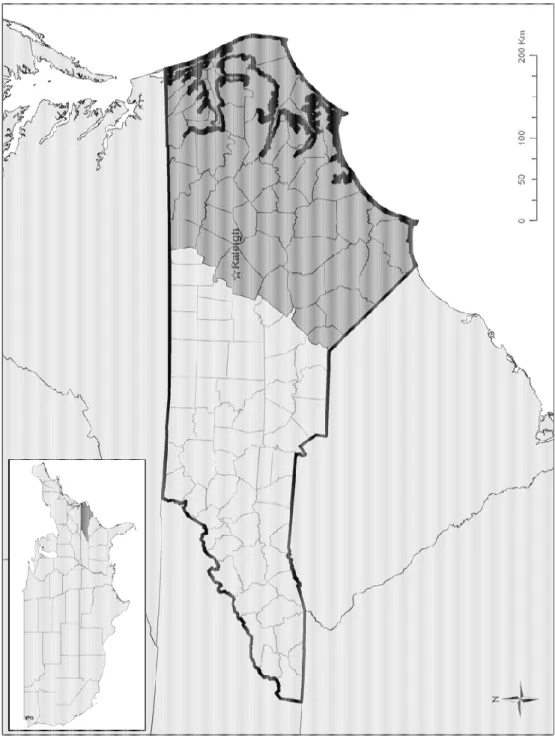
decidedly uneven impacts. In eastern North Carolina (Figure 1.1), the results of the
over one hundred year history of electricity are significant differences in electricity
price based on where you live, differentials that are causing significant harm to the
health and overall well-being of thousands of people in the region.
1.1 The Electricity Landscape of North Carolina
The differences in electricity bills previously described arise in part due to
the different types of electric utilities that operate in North Carolina. These can be
divided into three categories: investor owned utilities, rural electric cooperatives,
Fi
gu
re
1
.1
.
E
ast
er
n N
or
th
C
ar
ol
in
utilities, are the largest electricity suppliers in North Carolina. As of March 2014,
two private utilities operate in North Carolina: Duke Energy, which recently
acquired Progress Energy, and Virginia Electric Power Company, which serves small
portions of northeastern North Carolina under the name Dominion North Carolina
Power. After its acquisition of Progress Energy in 2012, Duke Energy became the
largest electric utility in the United States, operating across six states. It dominates
the energy landscape in North Carolina, serving 75% of the customers and
generating nearly 96% of the electricity produced. About 18% of this electricity is
sold at wholesale to the rural electric cooperatives and the municipal electric
systems (North Carolina Utilities Commission 2013).
Rural electric cooperatives, also called electric membership cooperatives
(EMCs), were formed in the 1930s and 1940s with help from New Deal-era
legislation designed to spread the availability of electricity into rural areas across
the United States. There are 31 operating in North Carolina, 26 of which are
headquartered within the state. The territory served by EMCs is generally rural and
sparsely populated. While EMCs cover the largest geographic area in the state, they
provide electricity to only around 13% of North Carolina residents (North Carolina
Utilities Commission 2013). EMCs are non-profit and member owned. They have
very little of their own generation capacity, but do have partial ownership stakes in
several Duke Energy plants.
Finally, municipally owned systems provide electricity to their citizens, much
as they would water and sewage service. In North Carolina, more than 70
2009), most of who reside within their municipal boundaries. These utilities are
non-profit, but as mentioned many historically were operated at a ‘profit’ in order to
fund overall municipal budgets. It is during the early periods of municipal utility
operation that a number of operational practices were put into place that served the
racial ideologies of white supremacy. While many of these towns initially had their
own electricity generation capacity, most began buying power at wholesale from
private utilities by the 1960s. In the late 1970s, several municipalities bought into
several electricity generation facilities and it is in these towns, particularly those
located in the eastern part of North Carolina, that people are facing such high
electricity rates.
The electricity market in North Carolina is not deregulated; customers do not
have a choice between providers. This makes retail electricity provision highly
spatially ordered: the location of a particular home or business determines the
electricity provider, and in most cases, the rates the customer must pay. Each type of
electric utility in North Carolina has a specific non-competitive service territory1,
but also faces varying levels of regulation from a state utility commission. Private
utilities are wholly regulated by the utility commission, which means that requests
ranging from issuing stock to raising electricity rates must be approved. EMC and
municipal system retail rates are not regulated by the state commission, but they do
face regulation of their borrowing and wholesale electricity purchases by a variety
of institutions and regulators.
Table&1.1!Aggregated!Electric!Utility!Data!by!Type! Source.!Platt’s!Electric!Power!Data,!2011! ! Table&1.2!Rates!and!Demographics!of!Top!10!Highest!Income!Utility!Territories! Source.!Platt’s!Electric!Power!Data!(2011)!and!United!States!Census!ACS!5IYear! Summary!File,!2007I2012! Table&1.3!Rates!and!Demographics!of!Top!11!Lowest!Income!Utility!Territories! Source.!Platt’s!Electric!Power!Data!(2011)!and!United!States!Census!ACS!5IYear! Summary!File,!2007I2012! ! ! Avg$Residential$ Rate$(per$1,000$
kWh) Total$Area$(sq$mi)
Total$ Residential$
Accounts Accounts/sq$mi
IOUs $++++++++++++++++++97.68 ++++++++22,704 +++++++3,274,000 144.2
EMCs $++++++++++++++++115.55 ++++++++26,659 +++++++++++900,666 33.8
Munis $++++++++++++++++122.91 +++++++++++++517 +++++++++++494,418 956.3
Company(Name Utility(Type (Residential(Rate(
(per(1000(kWh)( Percent( African( American Median(HH( Income
Wake%EMC EMC $%%%%%%%%%%%%%%117.97 16% $%%%%%%%84,693 Apex%Municipal%System MUNI $%%%%%%%%%%%%%%120.57 3% $%%%%%%%76,885 Union%EMC EMC $%%%%%%%%%%%%%%108.61 11% $%%%%%%%67,449 Piedmont%EMC EMC $%%%%%%%%%%%%%%128.48 15% $%%%%%%%64,547 Town%of%Walstonburg MUNI $%%%%%%%%%%%%%%129.48 7% $%%%%%%%61,250 EnergyUnited%EMC EMC $%%%%%%%%%%%%%%%%96.07 6% $%%%%%%%56,318 Cornelius%Muniicpal%System MUNI $%%%%%%%%%%%%%%%%91.70 9% $%%%%%%%56,184 CarteretPCraven%EMC EMC $%%%%%%%%%%%%%%107.88 9% $%%%%%%%52,161 Huntersville%Municipal%System MUNI $%%%%%%%%%%%%%%%%88.16 16% $%%%%%%%51,953 Duke%Energy IOU $%%%%%%%%%%%%%%%%88.63 24% $%%%%%%%50,112
Company(Name Utility(Type (Residential(Rate((per(1000(kWh)(
Percent( African( American
As a result of the varying levels of regulation, different size service
territories, and different operational goals, a patchwork of electric utility
distribution has emerged in North Carolina, with the rates charged by the different
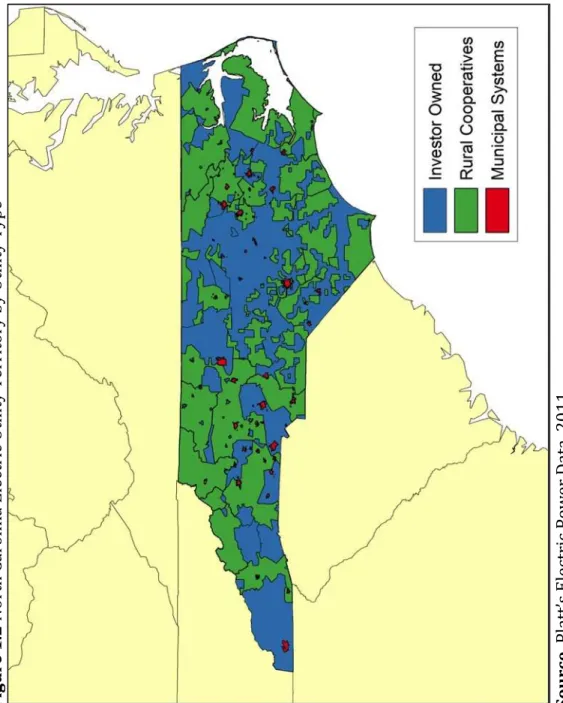
utilities varying widely. As Figure 1.2 and Table 1.1 show, the majority of North
Carolina territory is served by EMCs, but the vast majority of residential customers
are served by investor owned utilities. In terms of customer density, however,
municipal systems lead the way despite serving only 517 square miles of territory.
But in general, the retail electricity rates charged by the municipal systems are also
significantly higher than those charged in the rest of the state. The uneven
development of the distribution system is not just differentiated in terms of rates or
area coverage, but can also seen in terms of the demographics of the customers in
each territory. While the exact demographics of customers served by private
utilities and EMCs are not available, it is possible to estimate by combining United
States Census Data with utility territories using ArcGIS2. Tables 1.2 and 1.3 show the
territories with the highest and lowest median household incomes. While the
highest group shows a mix of utility types, two things stand out. First, the municipal
systems that are included, particularly Apex, Cornelius, and Huntersville, are the
beneficiaries of their proximity to major metropolitan regions. All three serve as
bedroom communities to larger nearby cities and have experienced significant
population growth in the last 25 years. The second is that the African American
populations in these towns are fairly low, especially when they are compared with
the towns in Table 1.3. Table 1.3 is comprised entirely of municipal systems, and all
of them are located in the eastern part of the state.
A quick look at the tables points to a third trend – it appears that electricity
rates are lower in the wealthier territories than in their lower income counterparts.
Figure 1.3 charts this relationship, showing a general trend among municipal
utilities and investor owned utilities for the price of electricity to decrease as
median household incomes in a utility’s territory increases. This means that on the
whole, regions with greater wealth are being charged less for their electricity.
However, this trend does not exist among rural electric cooperatives – as wealth
increases among different EMCs, the rates charged largely remain stable. Figure 1.4
relates electricity rates to the percentage of the territories’ population that is
African American. Again, a fairly consistent trend is evident among municipal
systems: the more a city’s population is comprised of African Americans, the higher
the electricity rates charged tend to be. As in the case of incomes, differences in race
appear to have little impact on the rates charged by EMCs.
The preceding maps and figures raise significant questions about electricity
provision in North Carolina. Why do some utilities charge rates that are significantly
higher than others? And why do those utilities tend to have a higher proportion of
African Americans living in them? In a very general way, we can answer the
question of why electricity rates in the municipal systems are so high. The variance
in cost can largely be attributed to an investment made by a group of 32 municipal
electric utilities, like the one Rocky Mount, in the Shearon Harris nuclear power
from 1970 to 1987) was jointly funded by these towns and Carolina Power and
Light (CP&L), an investor-owned utility. Carolina Power and Light, as previously
mentioned, started in Raleigh, North Carolina in 1906. During the course of Shearon
Harris’ construction, massive cost overruns left investing towns heavily indebted
and forced to charge exorbitant electricity rates to pay down their debt. But while
the current high electricity prices in the investing towns can be traced to this
moment, there are a number of unanswered questions that remain about the
development of North Carolina’s geographical patchwork of energy provision and
its implications today. This dissertation seeks to answer two sets of questions
related to the production and consumption of electricity in eastern North Carolina.
The first set of questions concern the electric utility service territory and
different utility ownership forms. As Figure 1.3 shows, three territorially bounded
types of electric utilities control electricity provision in North Carolina. Why are
electric utilities territorially bounded? Why are there three different types of
electric utility, all serving their own unique territory? Why are some areas served by
private utilities, while others by municipal systems? Why, or even how, were
municipal systems able to persist even as private utilities began producing
electricity for far cheaper and on a scale far greater than a single town could?
Answering these questions involves understanding how electric utilities came to
terms with a series of challenges to their profitability and viability, most notably the
issue of high fixed costs and challenges related to the materiality of electricity. As
development of the electric utility service territory, and the relationship between
industrial and financial capital play a crucial role in overcoming these challenges.
The second of questions considers the temporal and geographic context in
which North Carolina electric utilities developed. As utilities were starting up during
the first decades of the 20th century, the racialized geographies of Jim Crow and the
Progressive Era undoubtedly affected their development. How did the networked
infrastructure of central station electric utility service, as directed and shaped by
local and distant industrial, academic, and political elites, account for race, benefit
from race, and even work to produce racial differentiation in eastern North
Carolina? Following the mundane and everyday world of electric utility operations,
and their connections to racial and electric power politics in Chapters Three and
Four makes this possible.
Answering these questions requires a theoretical framework that is able to
draw together thinking on energy as a material substance, issues of race, and the
political economy of uneven development. Drawing together such a comprehensive
and coherent framework poses a challenge. Marxist political economy, for example,
has been critiqued for both its undertheorization on matters of race (e.g. Du Bois
1940; Wilson 2002) and for an anthropocentrism that denies the agency of
non-human objects (e.g. Castree 2002; Bennett 2005). Actor network theory, on the
other hand, has also been met with claims that it ignores issues of race (e.g. Harding
2008) and dismisses the role of political economy (e.g. Castree 2002). Postmodern
accounts of race, on the other hand, have been dismissed as politically divisive and
foment social change (e.g. Harvey 1996; Castree 1999). The sections that follow
represent an attempt to grapple with this challenge, ultimately pointing to several
key themes that help to understand the place of energy and race in the capitalist
mode of production, broadly conceived.
1.2 Energy and Historical-Geographical Materialism
Historical-geographical materialism starts with the viewpoint that historical
transformations and processes are knowable and explainable based on material
conditions, and that historical change should be understood as arising from
contradictions embedded in the mode of production. While the mode of production
can be defined in quite narrow terms that focuses solely on commodity production
and exchange, Kirsch (2009) argues that our conception of production should be
expanded to include the social, political, and cultural forms and institutions that are
essential to the production and reproduction of capitalism as a process. By
broadening our definition of production, historical geographical materialism can
develop into something more akin to an approach for examining “the active
construction and transformation of material environments (both physical and
social)” (Harvey 1984: 6), a method that interrogates how space “acquires meaning,
significance, resonance, even a particular form in and through the multiple relations
with which it is infused and through which it becomes produced” (Swyngedouw
1999: 94). This broad conception recognizes that the reproduction of capitalism,
which requires the production of a range of social, political, and cultural
geographies, is the driver of the production of various uneven landscapes of
geographical space is conceptualized as “both a force and a materialized relation of
production” (Swyngedouw 1992: 418) that produces and is produced by certain
territorial forms of organization. The tensions and contradictions that arise from the
mode of production give rise to uneven spaces and rounds of investment and
disinvestment that are, in turn, essential to the reproduction of capitalism over time
(Smith 2008).
These analyses thus build from one of Marx’s (1990) key points: capital is not
a static entity, rather it is a process made up of the flows, circulation, and movement
of a variety of social actors, entities, and materials. But at the same time that there is
great movement and flow, there is also the need for circulating capital to be
transformed into material objects. This is among capital’s central contradictions: it
has a simultaneous need for both circulation and spatial fixity (Harvey 2006; 2010).
This is most clear in the built environment, and particularly the infrastructures that
allow for more rapid capitalist circulation. Roads, pipes, electricity distribution lines,
and other forms of infrastructure provide productive benefits to all who have
access. But the large-scale investment that is required for their production and
maintenance is frequently beyond the means of an individual capitalist, thus the
necessity for state action and intervention. This is a central feature of Lefebvre’s
‘state mode of production’, which suggests that “states have come to play a key role
in the management and maintenance of capitalist growth at all spatial scales”
(Brenner and Elden 2009: 17). As such, to Lefebvre the crucial role of the state in
requires that the role of the state in the reproduction of capitalism be fully
examined.
Energy, and in particular fossil fuel based energy, has been essential to the
shift from pre-capitalist to capitalist modes of production (Altvater 2007) and “is
constitutive of what Henri Lefebvre referred to as the social production of space”
(Huber 2013a: 8). This is particularly evident in the role of oil in forming the
particular American spaces of suburban high consumption and neoliberalism. But it
does more than that – oil also contributes to the production of ideologies and
expectations, and is a force that shapes social reproduction and contributes to “the
real subsumption of life under capital” (Huber 2013a: xix). In what follows, three
key points that emerge from critical geographies of energy are discussed. The first is
that the actual material properties of energy have a shaping effect on those spaces
that are produced in conjunction with energy’s extraction, distribution, and
consumption. Second, energy production and distribution under capitalism pose
particular challenges that require particular state, institutional, spatial, and scalar
fixes to alleviate or postpone crises of production. Finally, and related to the first
two points, energy extraction and provision are central to the production of very
uneven social and cultural geographies.
1.3 Energy, Materiality, and Politics
Fossil fuels, and the connections that are formed in the course of their
extraction, distribution, and consumption, have the potential to open up or close
down different forms of democratic politics (Mitchell 2009). Following the carbon,
span from fossil fuels, principally how fossil fuels are converted into forms of
socio-technical organization, financial circulation, and political power.
The view that forms of carbon extraction and consumption can give rise to
certain political subjectivities has been taken up in depth by Valdivia, who argues
that it is through the material and discursive properties of petroleum that a variety
of political mobilizations have occurred in Ecuador (Valdivia 2008; Perreault and
Valdivia 2010). Similar ideas have been brought to the United States context by
Huber (2013b), who provides a historical analysis of the relationship between oil
and the Fordist regime of accumulation. In doing so, Huber argues that the creation
of the “high energy economy”, one predicated on cheap and plentiful fossil fuels, was
essential to the post WWII period of labor productivity gains and the growth of the
consumer economy. Oil, in the form of gasoline, was central to this shift, fueling “a
certain kind of mobility characterized by an individuated command over space”
(Huber 2013a: x). This, he argues, provided the foundations for post-Fordism and
neoliberalism, a shift that Huber describes as the entrepreneurial way of life.
The unique biophysical properties of oil are important to the production of
particular political subjectivities and political economic formations. Oil is dense in
energy content, meaning that the ratio of oil’s ‘ability to do work’, as energy is often
defined, versus its weight and volume is substantially higher than any other fuel.
Further, oil has a propensity to flow, meaning that it can readily be transported long
distances by pipelines more cheaply than an equivalent amount of coal, for example.
Finally, oil has a remarkable chemical composition that allows for its refinement and
plastics to fertilizers to petroleum jelly. But Huber also takes care to point out that
oil is much more than this. While oil plays an important role in the production of
absolute spaces3, it is also important to enabling ways of living, feeling, and thinking
(Huber 2013a).
Three key points from this work inform this dissertation. First is the
importance of the material properties of energy, and the way in which each stage of
its extraction, distribution, and consumption produces particular spaces. Following
the oil (or the coal), as Mitchell (2009) advocates, allows for tracing of the web of
connections that emerges from the ‘thing’. This is not to say that the ‘material’
necessarily be determinative, or that a concern for the material take analytical
precedence. Rather the point is that things matter, and that understanding the way
in which things interact with cultural, political, and economic geographies is crucial
to investigating material conditions (Kirsch 2013). Second, not only are material
landscapes created through the ‘social life’ of energies like oil, but also discursive
ones. Energy is an important part of the creation of an uneven political landscape, as
evidenced by the co-existence of a high-energy democracy in the United States with
the autocratic regimes of oil producing states in the Middle East. The same energy is
central to the production of both. Finally, the material world of natural resources is
full of contradictions and paradoxes that can both help and hinder the ability of
commercial actors to generate and capture value from resources (Henderson 1998;
Bridge 2009). The solution to these problems often involves some interaction of the
state, which can operate to produce spatial formations beneficial to capital
accumulation. The role of the state will be taken up in the section that follows.
1.4 Energy, the state, and territory
Writing about natural resources in 1933, American resource geographer
Erich Zimmerman argued that “resources are not: they become” (cited in Bridge
2009:1220). Zimmerman captures in this statement a contradiction central to
‘natural’ resources: they obtain neither a use nor an exchange value until they
undergo a transformation in order to solve a certain problem (i.e. production of
steam, internal combustion, etc.). Energy very much fits this description, as oil or
coal in the ground does very little underground until it is mobilized and employed
within particular socio-technical arrangements4.
As noted, because energy infrastructures are embedded in material and
discursive landscapes, the development of and changes in energy extraction and
provision has involved reconfiguring related patterns of economic and social
activity (Bridge et al. 2013). Because these changes take place on very large scales,
and because of the centrality of energy to modern capitalism (Altvater 2007; Huber
2013a), the state’s scalar capacity – its “ability to mobilize landscapes and resources
on a very large scale” (Bridge 2014: 120) – pushes it to the forefront in natural
resource development. This necessity brings Lefebrve’s concept of the state mode of
production to the forefront, a pattern that is evident in the state involvement in the
oil industry (Labban 2008), but also in hydropower developments across the world
(Kaika 2006; Desbiens 2014).
A central state tactic to facilitating energy development is the creation of
territorial solutions to solve, or at least delay, accumulation problems before crisis
occurs. While much recent work on the concept of territory is focused on geopolitics
(Elden 2010; Crampton 2011)5, Brenner and Elden’s (2009) reading of territory
through the work of Lefebvre presents a more open consideration of other
territorial formations, principally those that aid in the production of governable
political economic formations. They argue for a conception of territory as a
historically specific form of politico-spatial organization that enables the
management of cyclical or acute economic crises. Territorial configurations, then,
represent an attempt by the state, working with a range of actors, to create discrete,
delineated, and bounded spaces that foster sustained economic growth. This is
evident in the oil industry, which, for example, has complex rules about the
governance of subterranean mineral rights (Huber 2013a).
Territories are produced using the particular spatial, political, and economic
calculative rationalities (Crampton 2011), which can be directed by goals as diverse
as profit-making or ethnic ‘purity’. But it is important to note that territories face
certain limits if deployed as a spatial fix to profitability problems (Harvey 2006;
Brenner and Elden 2009). This dissertation closely considers the development of
the electric utility service territory as a spatial fix for the utility industry, and one
that is shaped by the biophysical properties of electricity that influence its modes of
production and consumption. But it will also consider the ways in which the
monopoly service territory is not a settled concept, rather it is contested and faces
its own particular limits. This leads to new contradictions stemming from the state
mode of production, which are especially evident when the state takes on conflicted
projects itself (such as was the case with Progressivism and Jim Crow in the early
20th century discussed below). Papering over the cracks of capitalism by repeatedly
producing territorial solutions and fixes leads to persistent and entrenched uneven
geographical development (Swyngedouw 1992; Smith 2008).
1.5 Energy and the production of uneven geographies
Energy’s importance to the capitalist mode of production means that it has
the potential to contribute to uneven geographical development on a very large
scale. This is evidenced by the uneven rise in standards of living made possible by
the provision of cheap and abundant fossil fuel energy during Fordism. Increasing
wages and more favorable working conditions were a phenomenon enjoyed almost
exclusively by white, semiskilled workers, as rural Americans, and especially African
Americans, were largely excluded from these improvements (Huber 2013a). This
points to the ability of networked resources, such as energy or water, to produce
uneven geographies of development (Graham and Marvin 2001). But networked
infrastructure convey more than material necessities like water or energy. Once
transformed into commodity form by human labor, natural resources become a
carrier of not only past labor processes and exploitation, but also have the ability to
‘act’ in ways driven and shaped by human drives, desires, and imaginations
the promise of emancipation and progress become embodied in a thing – for
example water behind a massive dam, and related to this, its ample provision in dry
and arid landscapes (Walker and Williams 1982; Swyngedouw 1999b; Kaika 2006).
During the initial provision of networked infrastructures in cities, a period Kaika
and Swyngedouw (2000) refer to as ‘early modernity’, connection to these networks
was a symbol of prestige and authority. However, those that were excluded were
also excluded from power, both literally and figuratively.6
The process of resource provision, then, interacts not only with the goals of
capital accumulation, but also can work to produce and reinforce discursive and
material inequality. In the American South, developing systems of networked
infrastructure in the early 1900s meant interaction with legal, political and
economic frameworks that were developed to institutionalize segregation and white
supremacy (Woodward 1955; Steedman 2012; Cole et al. 2012). In cities and rural
areas, local elites worked to shape and alter many political and economic goals and
policies (Badger 2007), particularly those emerging from the nationwide
Progressive movement. Progressivism encompassed a wide range of goals, ranging
from anti-trust legislation and Taylorism designed to reshape the workplace, to
movements for women’s suffrage and Prohibition aimed at changing dominate
social relations.
In aggregate, Wiebe (1967) has defined the Progressive Era as a quest for
efficiency and order. In the South, the complex social and political economic ideas of
Progressivism were confronted directly by the equally complex social, racial, and
political economic workings of Jim Crow segregation. In tandem, Progressivism and
Jim Crow segregation operated as the central planning ideologies in many Southern
cities during the early 20th century. With a segregation-led division of races on the
one hand, and a simultaneous quest for efficiency and order on the other, these
ideologies combined in often unpredictable ways to shape the emerging
geographies of networked infrastructure in the South (Campbell 1986; Wilson
2002). Ideas of progress and efficiency were also shaped into more subtle methods
for the control of races, what Connolly (2009) has referred to as ‘technologies of
racism’. These ‘technologies’ include many of the mundane and everyday practices
involved in the governance of cities, including zoning, public transit, and building
codes. What is important to recognize is that while these tactics were infused and
shaped by racist ideologies, they also were employed to ensure conditions
appropriate for capital accumulation (Marable 1983; Wilson 2005; Connolly 2009).
Detailed historical analyses have shown how the ideologies and social
relations of Progressivism and Jim Crow were actually put into action in particular
places. Clyde Woods (1998), for example, focuses on the workings of what he calls
the plantation bloc in the Mississippi Valley, a group of former plantation owners
that in addition to controlling agriculture, manufacturing, banking, and land also
were active in local and state politics and financial policy. Over time, Woods argues,
this group came into alliance with Northern capital, a term that describes groups
interested in locating branch manufacturing plants, commercial and financial
institutions, as well as electric utility interests (Campbell 1986), via a mutual desire
to maintain control over production, Wilson’s (2005) examinations of consumption
by African Americans during Jim Crow shows that while segregation did not
completely prevent African Americans from consumption, it did serve as a spatial
limit that could preclude them from the consumption of public goods. Evidence
exists that public services were frequently denied to African Americans, even when
the denial of services to one segment would harm the population as a whole (Colten
2002). However, the denial of service in the South must be seen as part of sustained
efforts by the planter class to remain in power, and not solely a contradictory
economic decision. In fact, evidence is clear that attempts to exclude African
American access to public goods were part of deliberate attempts to devalue the
assets of non-whites (Wacquant 2002; Wilson 2005; Marable 1983).
Historians of electricity, however, have been slow to incorporate ideas of
social power and uneven development into their accounts of electrification7. While
most historians describe the process of electrification in technological and economic
terms that ascribe the spread of electricity to simple economic questions of rates
and affordability, there are several notable exceptions to this trend. Tobey (1996),
for example, charts the uneven spread of electricity in Riverside, California, pointing
to the important role of race and class in directing its spread. In doing so, he
questions the common modernist narratives of ‘technology as freedom’. Nye (1990)
also provides a more social history of American electricity, pointing to the various
cultural and social interpretations of electricity in the realms of art, literature, and
daily life. Kline (2000) argues that people did not always accept electricity with
open arms, and provides substantial evidence of rural households only accepting
electricity on their own terms.
Given the centrality of energy to the reproduction of capitalism, and the
centrality of electricity as a form of energy, a deeper theorization of the relationship
between electricity, capitalism, and racialized uneven development is essential. This
dissertation is an effort to do this. But before proceeding, it is crucial to consider the
materiality of electricity in particular.
1.6 The materiality of electricity
Electricity is different than coal or oil. An obvious point, but as a type of
energy electricity can become bound up in discussions and analyses of energy more
broadly. This section will consider the materiality of electricity in particular.
While electricity occurs naturally in the world (i.e. lightning or static
electricity), the ability to control, manipulate, and direct electricity first emerged in
the first part of the 19th century, and it was only in the latter quarter of the 19th
century that electricity was applied to industrial processes (Mumford 1934). To
produce electricity on large scales, an external fuel source is needed to turn the
blades of a turbine in order to use magnets inside of a generator to create an electric
charge8. A variety of ‘fuels’ can be used to do this, ranging from wind and falling
water, both of which directly turn a turbine, to combustible substances such as oil,
coal, and uranium that produce heat to boil water to produce steam or gas pressure
that turns the turbine. Initially, falling water was the dominant form of producing
electricity in the United States, but by the middle of the 20th century steam power,
mostly produced from burning coal, became most prevalent. Coal and oil are part of
the dead ecologies that power the dead labor of machinery that drove industrial
capitalism starting in the mid 19th century (Huber 2013a). By the 1920s, no longer
was the combustion of oil and coal directly driving machinery, rather it was being
used to produce the electricity that powered industry.
In the factory, electric currents provide the link between the dead ecologies
of coal and oil and the dead labor of machinery. But as a processed energy,
electricity takes on different geographies than the fuels used to produce it. Oil and
coal are unevenly distributed subterranean resources that require varying degrees
of labor to extract; falling water is located at a particular point along a river; the sun
shines more frequently in some places than others; and winds may be stronger and
more consistent in a particular location. For electric utilities, as once was true of
most industrial location, sites with significant waterpower potential are most
desirable, pitting them in competition with one another for rights to a particular
site. As steam powered electricity replaced hydropower, electricity production also
became less tied to particular monopoly locations along rivers. In the course of
these shifts, new geographies were created, with new locational capacities and
modes of regulation emerging in order to ‘fit’ with the new spatial and technological
ensembles (Swyngedouw 1992). For steam powered electricity, the shift away from
hydropower locations were made possibly by the mobility and high energy density
of fuels like coal and oil, which could be shipped by train or pipeline to the
As networked electricity service became widely available, industrial location
became less tied to a particular region. But electricity is produced for more than
simply powering industry, although that was the primary focus of utilities until well
into the 1920s. The distribution of electricity, particularly into the home, produces a
set of geographies different from its supply. Rather than be transported via
pipelines or trains, once electricity is produced it is transmitted out over a web of
distribution lines to the end user. While electricity can productively be thought of as
a networked resource emanating from several production points, unlike coal or oil it
is not a commodity that can readily be purchased and stockpiled except in very
small quantities (i.e. batteries). Once it is produced, electricity instantaneously
moves out through transmission grids to its point of consumption. This is a critical
point, and has important implications for the way that electric utilities have
developed in the United States.
Once electricity comes into the home, the end user rarely interacts corporally
with electricity. There is no fire to start, for example, nor coal to shovel into a
furnace. As such, households do not use electricity for its own sake, but rather to
accomplish social practices as mediated through a variety of electric appliances
(DEMAND 2014). This means that electricity itself is not necessarily what a
household desires, but rather lighting, heating, cleaning, or entertainment mediated
by a lamp, a furnace, a vacuum cleaner, and a television, respectively. As a result of
this, and in combination with the decreasing importance of location to electricity
generation, territorial competition in the electricity industry is less about finding
prime sites of consumption are subject to competition, the reverse is also true –
sites with low consumption, or sites where dominant groups is society seek to keep
electricity consumption low, are easily passed over.
The material properties of electricity have influenced the distinct territorial,
industrial, and institutional forms that have emerged in the industry. Electricity
cannot be produced on large scales without significant capital investment in costly
turbines, generators, and fuels. While it will be discussed in detail throughout the
dissertation, it is worth noting that its capital-intensive nature means that similar to
the oil industry, a mix of private, state, and quasi-state organizations dominate the
industry. Much of the United States electricity industry remains regulated, meaning
that the guiding hand of the state looms large in utility operations9. In most states,
electric utilities operate as ‘natural’ monopolies: they are granted non-competitive
service territories, thereby producing distinctive geographies, as other have shown
for other ‘natural’ monopolies such as water (Bakker 2003). This has implications
for the way in which the capture of surplus occurs in the industry. Because
producing and distributing electricity is a capital-intensive industry, dead labor, that
is, previous labor processes embodied in machines (i.e. generators and wires), and
the dead ecologies (Huber 2013a) of fossil fuels, make up a significant portion of
capital investment. Because of its relatively small size compared to dead labor and
dead ecologies, little surplus value is extracted from living labor, thus the
importance of state regulation for utilities. In most cases, rather than allowing the
9 Even in those states that currently have deregulated electricity sales to consumers, varying levels of local, state, and federal regulation still guide how and where
price of electricity to be determined by the invisible hand of the market, electricity
rates are determined by regulators charged with granting a ‘reasonable’ rate of
return on overall investments in fixed capital investments, while also presumably
guaranteeing fair rates for consumers.
Scarcity is central to effectively capturing surplus value. As has been shown
in the case of oil (Huber 2011; Labban 2008; Bridge and Wood 2008), if a certain
commodity does not have sufficient scarcity, it cannot be profitably produced.
Electric utilities have a relationship with scarcity that varies considerably with that
of the oil industry. Because most electric utilities have their own unique territory,
they have the ability to produce only as much electricity as they wish, thus creating
their own scarcity. For example, if a power plant with a one kilowatt generation
capacity operated at full capacity for 24 hours a day for 365 days it would produce
8760 kilowatt-hours of electricity in a year10. However, demand for electricity is
variable, meaning that while the full 1 kW capacity may be needed at particular
times, there will be times when it runs below peak capacity. And because electricity
cannot be stored in large quantities, any electricity produced during non-peak
demand hours is effectively wasted. But electric utilities are regulated, and the rates
charged customers are based on total utility capitalization rather than on the cost of
producing electricity. As such, electric utilities have an incentive to over-build and
produce a surplus capacity (Howell 2011). During periods when electricity use
consistently increases (as it did during the first 70 years of the 20th century), this is
an effective method of reaping continual profits. However, once growth ceases or
slows, the inability to achieve efficiencies by squeezing labor poses a significant
challenge for utilities.
This brief overview of the materiality of electricity points to three themes
that will carry through this dissertation. First, electric utilities, in conjunction with
state regulators and financial capital, have produced spatial and territorial
configurations that enabled rapid growth, and these are in part shaped by the
material properties of electricity itself. This will be most evident in Chapter Two.
Second, these territories are subject to competition, not only for sites of production,
but also for prime sites of consumption. This will be clear in Chapter Five. Finally,
territories, or parts of territories, with low rates of consumption are avoided with
equal fervor, as will be shown in Chapter Three and Four.
1.7 The Plan for this Work
This introductory chapter began with a description of the complex pricing,
profit, and regulatory patchwork of the electric utilities that serve the eastern part
of North Carolina. Not only do the electricity prices that the utilities charge vary by
location, but the demographic and economic make-up of the service territories are
different as well. Understanding the uneven geographies of electricity in eastern
North Carolina requires the close consideration of the interaction of electricity as a
material substance with the various economic, cultural, racial, and political
geographies of the region. In addition, the development of the electric utility
industry in the state was part of national debates about segregation and state’s
rights, as well as issues of the environment and industrial development. With this in
dissertation, the chapters that follow seek to answer the following two sets of
previously mentioned research questions.
First are concerns over the spatial forms and regulatory systems that shaped
utilities. What function does the electric utility service territory serve, and how did
it come to be? Related to this, how did the multiple forms of utility ownership come
to be, and how is the state implicated in each of these various forms? The second of
questions considers the context in which North Carolina electric utilities developed.
Central to this is the interaction between electricity as a networked infrastructure
and the racialized geographies of Jim Crow and the Progressive Era. How did electric
utilities affect the racialized life of cities, and how was race central to the planning of
electricity systems?
To address these questions, this dissertation examines the development of
electricity in eastern North Carolina starting in the early twentieth century. The
research that informs this work was conducted in ten archival collections across
North Carolina and the United States11. Over the course of these visits, I have
collected and analyzed internal utility financial and operations documents detailing
day-to-day operations; survey data and external correspondence related to utility
growth and development; the correspondence of private individuals and public
office holders; and numerous maps, pamphlets, and textual materials produced by
industry and state organizations. The data collected was analyzed using three
primary methods: content analysis of documents; biography to follow key figures in
the utility industry; and GIS mapping to trace territorial development, power plant
and distribution line locations, and flows of investment. This data was used to assess
the spatial, economic, and social calculus that guided utility development, and is
placed in the context of the broader historical geographies of North Carolina and the
American South.
The story that I tell in this dissertation is one of power – the power to control
how networked infrastructure will be spread, the power to create new forms of
spatial governance, and the power to assign, calculate, and rationalize the value
placed on individual people. A similar process occurs in the archive, where
archivists are charged with dispassionately assigning value to documents,
fragments, and objects. Their work continues while making sure that these objects
are shared while also protecting the value of those objects against charges of
valuelessness (Creswell 2012). Often times the archive becomes viewed as a place
where authenticity and history is judged, ignoring that the artifacts as collected and
organized are fragmentary, messy, and accidental (Creswell 2012; Mills 2013). As a
result, the archive is a site that “combines notions of power, durability, origins, place
and authority” (Creswell 2012: 166), and that if not examined critically, provides
evidence that enables the analyst the ability to discipline, erase, and otherwise
minimize the agency of those whose artifacts are not preserved.
Despite the limits of the archive, it is possible to read the archives ‘against
example, argues that “traditional documents, if used imaginatively, can be especially
useful for reconstructing the ways in which workers exploited racial stereotypes to
control the pace of work” (1993: 93). Citing the accounts of white managers that
African Americans were unreliable or ignorant, Kelley posits that these actions of
defiance were “not only misunderstood but were never supposed to be understood”
(1993: 94) and as such represent key forms of resistance used against white
supremacy. At the same time, archives can also be read ‘with the grain’ to
understand how the powerful were able to make their claims to truth appear
normal (Creswell 2012). By not only saving certain materials but also making them
available to the public via archival collections, individuals, organizations, and state
institutions are attempting to ascribe validity, value, and accuracy to artifacts.
Archival objects can thus be read for the certain truth claims and rationalities their
creators considered self evident – the application of a particular racial hierarchy by
a government official, for example.
In this dissertation, I have attempted to read the archives both with and
against the grain, to find absences and resistance but also to understand the way
that the powerful enacted their particular visions of electrification. In places I have
tried to provide accounts of African American agency and depictions of African
American daily life, but these are limited in scope and provide only a small window
into the undoubtedly active struggles being made to obtain services from networked
infrastructure. In general, this work focuses more on the activities, rationalities, and
calculations of the powerful. In large part this results from an overall focus on the